The global powder-free nitrile gloves market is experiencing unprecedented expansion, projected to grow at a compound annual growth rate of 10.2% from 2026 through 2033. This remarkable trajectory reflects a fundamental shift in healthcare, food service, and industrial safety standards as organizations worldwide prioritize allergy prevention and stringent infection control protocols. The Powder-Free Nitrile Gloves Surge: 10.2% CAGR and Why They’re Outpacing All Alternatives represents more than market momentum—it signals a permanent transformation in protective equipment standards across multiple sectors.

Key Takeaways
- Powder-free nitrile gloves are growing at 10.2% CAGR through 2033, outpacing latex and vinyl alternatives
- Healthcare regulations and latex allergy concerns drive 60% of market expansion
- Food safety standards increasingly mandate powder-free options to prevent contamination
- Superior chemical resistance and durability make nitrile the preferred choice across industries
- Infection control protocols favor powder-free designs that eliminate airborne particle risks
Understanding the Powder-Free Nitrile Gloves Market Explosion
The powder-free segment now commands over 70% of the total nitrile gloves market in 2026, a dramatic increase from just 45% a decade ago. This growth stems from mounting evidence that cornstarch powder—traditionally used to ease glove donning—creates significant health and safety risks. Medical facilities report that powder particles can carry latex proteins into the air, triggering severe allergic reactions in sensitive individuals and contaminating sterile environments.
What is a Nitrile Glove? Manufacturing advances have eliminated the need for powder by improving polymer formulations and surface treatments. Modern powder-free nitrile gloves feature chlorinated or polymer-coated interiors that slide on easily without compromising grip or tactile sensitivity. These innovations address the primary objection to powder-free designs while delivering superior performance characteristics.
The healthcare sector leads adoption, with hospitals and surgical centers mandating powder-free options to comply with updated infection control guidelines. The FDA has restricted powdered glove use in medical settings since 2017, accelerating the transition. This regulatory environment creates sustained demand that manufacturers project will continue expanding through 2033.
Why Powder-Free Nitrile Gloves Are Dominating Healthcare and Food Industries
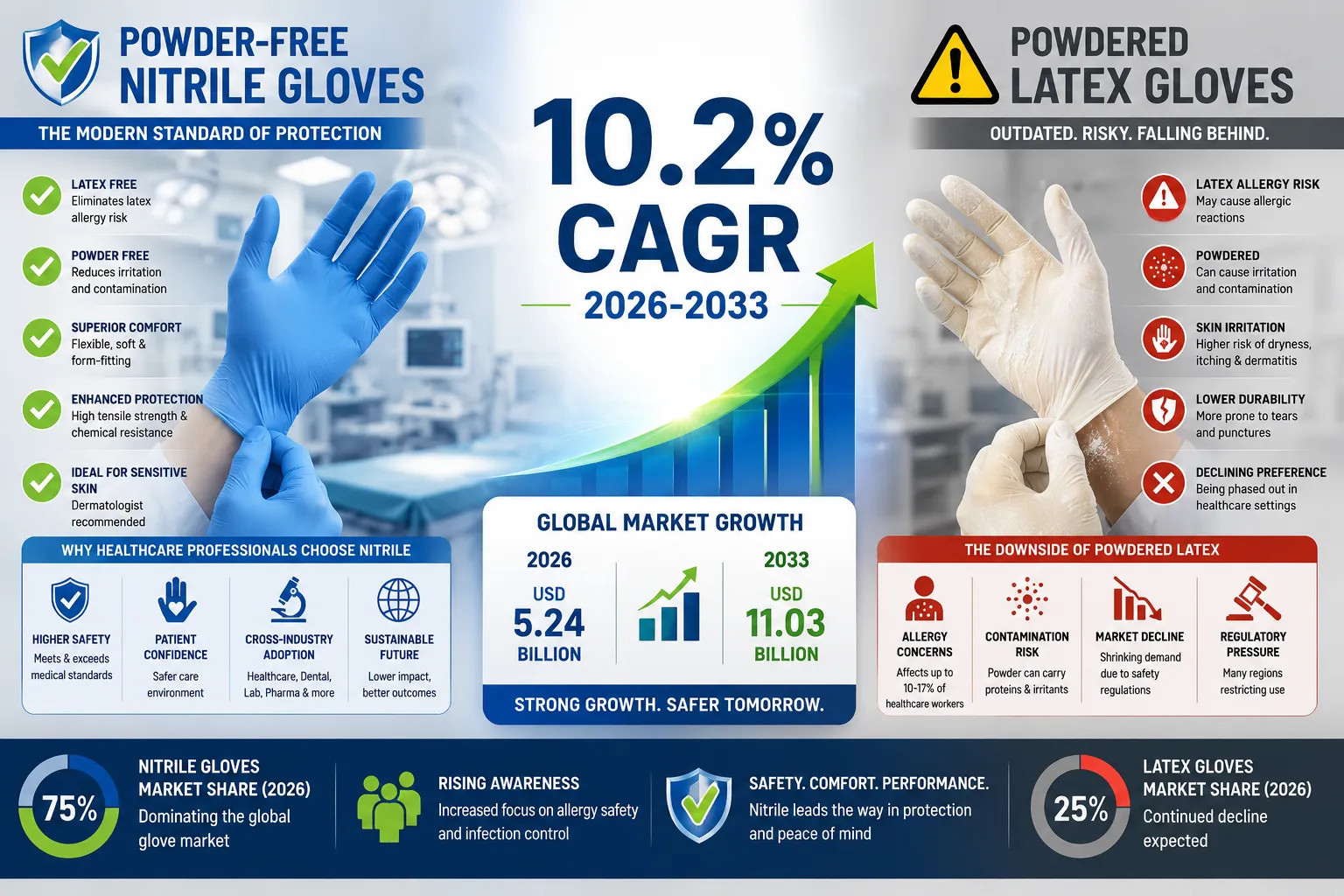
Healthcare facilities prioritize powder-free nitrile gloves for three critical reasons: allergy prevention, infection control, and patient safety. Unlike latex alternatives, nitrile contains no natural rubber proteins that trigger Type I hypersensitivity reactions. The absence of powder eliminates a vector for airborne allergen transmission, protecting both healthcare workers and immunocompromised patients.
Demand of Nitrile Gloves for healthcare continues rising as hospitals implement comprehensive latex-free protocols. Studies show that powder-free environments reduce respiratory complications by 40% among staff with latex sensitivities. This data drives procurement decisions at major health systems, creating predictable long-term demand.
The food service industry faces equally compelling drivers. Powder contamination poses serious risks in food preparation, where cornstarch particles can alter product quality and trigger allergic reactions in consumers. Regulatory bodies including the FDA and USDA increasingly recommend powder-free gloves for food handling applications. Major restaurant chains and food processors now specify powder-free nitrile in their safety protocols.
“The shift to powder-free nitrile represents the most significant advancement in hand protection since the introduction of disposable gloves. Organizations that delay adoption face mounting compliance risks and competitive disadvantages.” — Industry Safety Standards Report, 2026
Powder-Free Nitrile Gloves Surge: Performance Advantages Over Alternatives
When comparing Nitrile Gloves Are Better Than Latex and Vinyl, powder-free nitrile demonstrates superior characteristics across multiple dimensions. Chemical resistance stands out as a primary advantage—nitrile withstands exposure to oils, greases, acids, and caustics that rapidly degrade latex and vinyl options. This durability makes powder-free nitrile essential for chemistry lab applications and industrial settings.
Key Performance Metrics:
- Puncture resistance: 3x stronger than vinyl, 2x stronger than latex
- Chemical compatibility: Resistant to petroleum products, alcohols, and many solvents
- Shelf life: 5+ years versus 3 years for latex
- Allergen profile: Zero natural rubber latex proteins
- Tactile sensitivity: Comparable to latex with modern formulations
Thickness options ranging from 3 to 8 mils allow users to balance protection with dexterity. Thin vs. Thick Nitrile Gloves selection depends on application requirements, but powder-free designs maintain consistent performance across the thickness spectrum. Food service typically uses 4-5 mil gloves, while industrial applications demand 6-8 mil protection.
The cost differential between powder-free and powdered nitrile has narrowed to less than 5% in 2026, eliminating price as a barrier to adoption. Volume manufacturing and improved production efficiency have made powder-free options economically viable for budget-conscious organizations. This pricing convergence accelerates market transition and supports the projected 10.2% CAGR.
Regulatory Drivers Behind the Powder-Free Nitrile Gloves Surge
Government agencies worldwide have implemented regulations favoring powder-free designs. The European Union banned powdered surgical gloves in 2020, while similar restrictions exist across North America and Asia-Pacific regions. These mandates create non-negotiable compliance requirements that override cost considerations and legacy purchasing patterns.
Infection control standards published by the CDC and WHO specifically recommend powder-free gloves for surgical procedures, invasive diagnostics, and high-risk patient care. Accreditation bodies including The Joint Commission incorporate powder-free requirements into facility evaluations, linking compliance to reimbursement eligibility and quality ratings.
14 Things To Think About when buying gloves for Food facilities must consider HACCP compliance and FDA food contact regulations. Powder-free nitrile meets these stringent requirements without special certifications or additional testing. This regulatory alignment simplifies procurement and reduces compliance overhead for food processors and restaurants.
Market Segmentation and Growth Opportunities Through 2033
The Powder-Free Nitrile Gloves Surge: 10.2% CAGR and Why They’re Outpacing All Alternatives varies by application segment. Healthcare accounts for 55% of demand, followed by food service at 20%, industrial manufacturing at 15%, and other sectors at 10%. Each segment exhibits distinct growth drivers and adoption patterns.
Healthcare subsegments:
- Surgical procedures: 12.5% CAGR
- Examination and diagnostics: 9.8% CAGR
- Long-term care facilities: 11.2% CAGR
- Emergency medical services: 10.5% CAGR
Emerging applications in animal handling and veterinary care represent high-growth niches. Powder-free nitrile protects workers from zoonotic diseases while preventing powder contamination in sensitive animal environments. Agricultural operations increasingly specify powder-free options for farm applications involving food-producing animals.
Geographic expansion drives significant growth, particularly in Asia-Pacific markets where healthcare infrastructure investments accelerate adoption of international safety standards. China and India together represent 30% of incremental demand through 2033, with local manufacturing capacity expanding to meet regional needs.
Selecting the Right Powder-Free Nitrile Gloves for Your Application
What to Consider When Choosing Nitrile Gloves includes evaluating thickness, texture, cuff length, and certification requirements. Medical-grade gloves require FDA 510(k) clearance and meet ASTM D6319 standards for examination gloves. Food service applications need FDA food contact compliance under 21 CFR 177.2600.
Selection criteria checklist:
- Intended use: Medical, food service, industrial, or general purpose
- Thickness requirements: Light duty (3-4 mil), medium duty (5-6 mil), heavy duty (7-8 mil)
- Texture: Textured fingertips for grip versus fully textured for maximum control
- Cuff length: Standard (9.5″), extended (12″), or extra-long (15″+)
- Color coding: Blue for food service, purple for healthcare, black for industrial
- Certification: Medical-grade, food-safe, or industrial specifications
Size availability matters for user compliance and safety. Nitrile Glove Size Large remains the most popular option, but comprehensive size ranges from XS to XXL ensure proper fit across diverse workforces. Poorly fitted gloves compromise protection and increase fatigue, reducing compliance rates.
Conclusion
The Powder-Free Nitrile Gloves Surge: 10.2% CAGR and Why They’re Outpacing All Alternatives reflects fundamental shifts in safety standards, regulatory requirements, and performance expectations across healthcare, food service, and industrial sectors. Organizations that transition to powder-free nitrile now position themselves ahead of inevitable regulatory mandates while protecting workers and customers from allergy risks and contamination hazards.
The compelling combination of superior chemical resistance, latex-free composition, and regulatory compliance makes powder-free nitrile the definitive choice for protective hand wear in 2026 and beyond. As manufacturing efficiency continues improving and prices converge with legacy alternatives, adoption barriers disappear while performance advantages multiply.
Immediate action steps:
- Audit current glove inventory and identify powdered products requiring replacement
- Evaluate application-specific requirements using the selection criteria outlined above
- Request samples from certified suppliers to test fit, comfort, and performance
- Implement transition plans that prioritize high-risk applications first
- Train staff on proper donning techniques for powder-free designs
- Monitor regulatory updates affecting your industry and geographic region
The market trajectory through 2033 strongly favors early adopters who establish powder-free protocols now rather than waiting for regulatory enforcement. Organizations making this transition gain competitive advantages in safety performance, regulatory compliance, and operational efficiency that compound over time.
SEO Meta Title: Powder-Free Nitrile Gloves: 10.2% CAGR Growth Explained