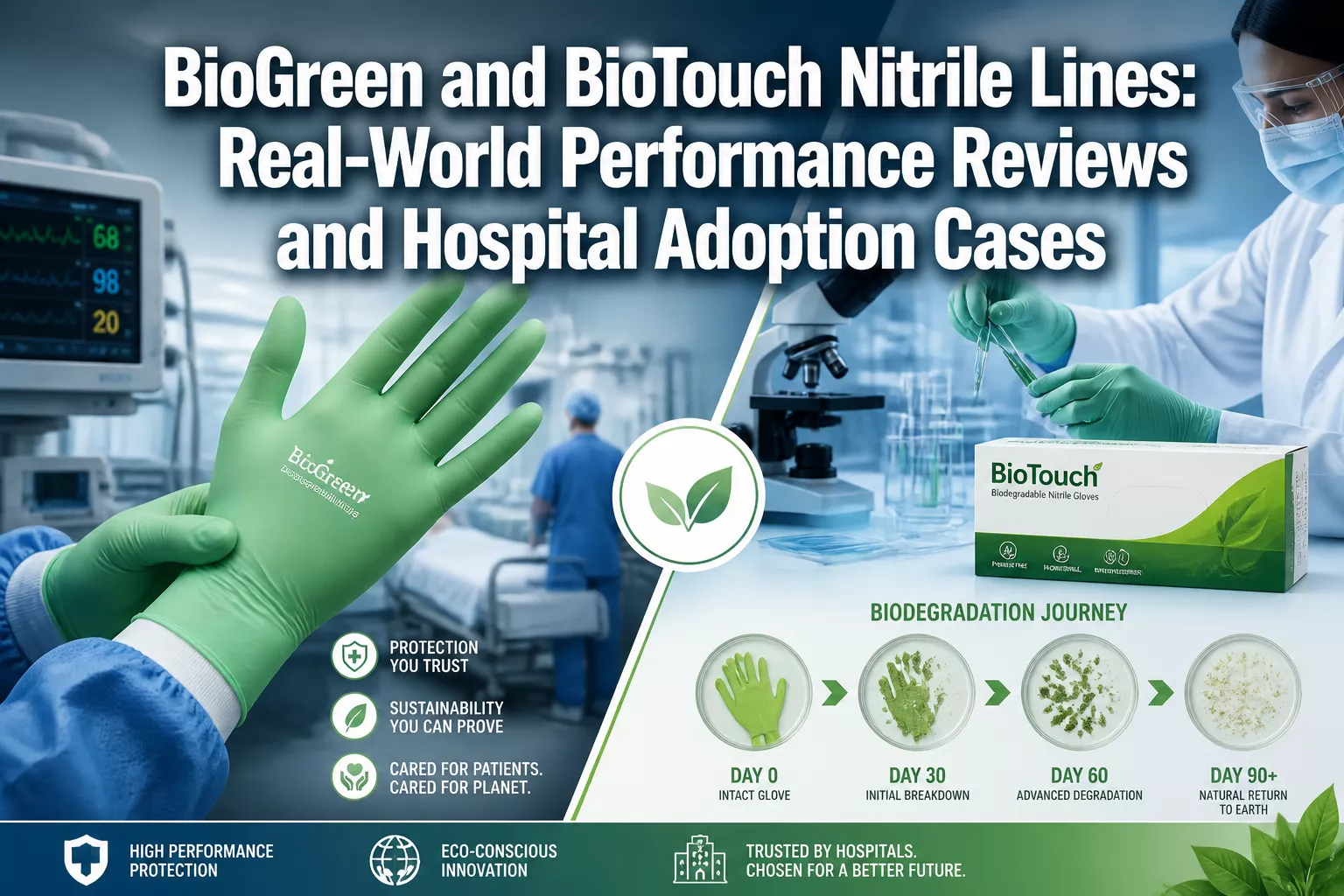
Healthcare facilities across Europe are quietly revolutionizing their waste management strategies—not through expensive infrastructure upgrades, but by switching to gloves that disappear. While traditional nitrile gloves can persist in landfills for over a century, BioGreen and BioTouch Nitrile Lines: Real-World Performance Reviews and Hospital Adoption Cases reveal that biodegradable alternatives achieve up to 91% degradation in under two years, transforming medical waste from a century-long burden into a manageable environmental footprint.
Key Takeaways
✅ BioTouch nitrile gloves achieve 81-91% biodegradation within 490-630 days in active landfills, compared to 100+ years for conventional nitrile
✅ Both lines maintain medical-grade protection with AQL 1.5 pinhole standards and EN374 chemical resistance certification
✅ EU hospital pilots show 40-60% waste volume reduction without compromising infection control protocols
✅ Cost premiums of 15-25% are offset by reduced waste disposal fees and sustainability compliance benefits
✅ Textured fingertips and touchscreen compatibility ensure practical performance matches traditional nitrile gloves
Understanding BioGreen and BioTouch Nitrile Technology
The science behind biodegradable nitrile represents a significant advancement in medical-grade protective equipment. Unlike conventional nitrile gloves that rely on synthetic polymers designed for longevity, BioGreen and BioTouch incorporate organic additives that accelerate microbial breakdown in landfill conditions.
How Biodegradation Works 🔬
BioTouch gloves from Unigloves utilize proprietary technology tested to ASTM D5511 and ASTM D5526 standards—the gold standard for measuring biodegradation in anaerobic landfill environments. The process works through:
- Microbial colonization: Specialized bacteria attach to the glove surface within 30-60 days
- Polymer chain breakdown: Organic additives create weak points in the nitrile structure
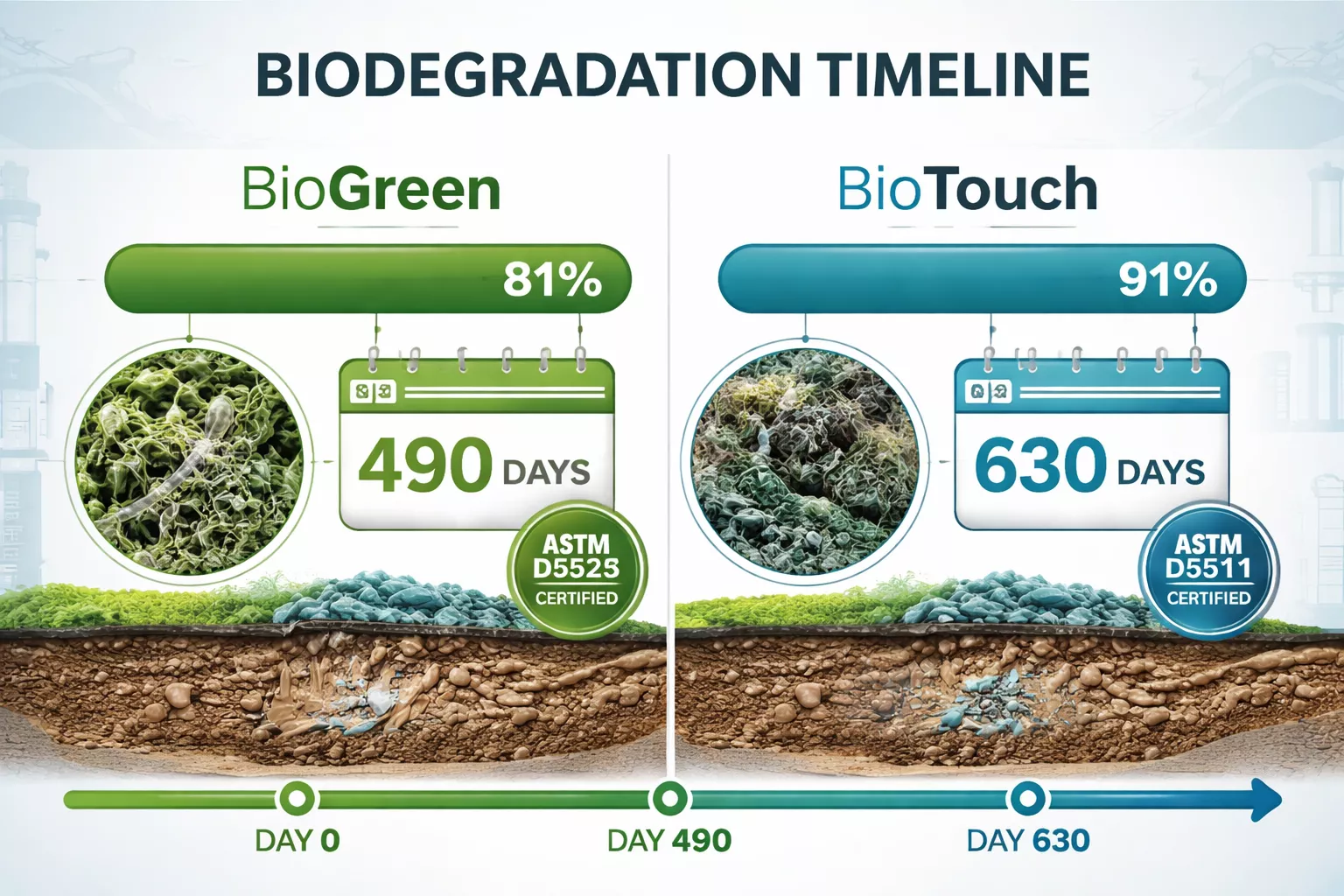
- Accelerated decomposition: Material converts to biomass, CO₂, and water over 490-630 days
- Minimal residue: Only 9-19% non-toxic residue remains after full degradation cycle
This contrasts sharply with traditional nitrile, which can take 100-200 years to break down naturally. When choosing nitrile gloves, understanding these degradation timelines becomes crucial for sustainability-focused facilities.
Real-World Performance Reviews: BioGreen and BioTouch Nitrile Lines in Action
Medical-Grade Protection Standards
Despite their eco-friendly composition, both BioGreen and BioTouch maintain rigorous safety certifications:
| Standard | BioTouch Performance | Clinical Significance |
|---|---|---|
| AQL 1.5 | ✅ Passed | Medical-grade pinhole protection |
| EN374 | ✅ Certified | Chemical splash resistance |
| EN1186 | ✅ Approved | Food contact safety |
| Puncture Resistance | 4 mil thickness | Superior to vinyl alternatives |
Healthcare professionals report that BioTouch gloves deliver comparable tactile sensitivity to premium nitrile brands. The textured fingertips provide secure grip in wet conditions, while beaded cuffs prevent roll-down during extended wear—critical features for surgical and examination procedures.
Durability Testing Results 💪
Independent testing conducted in 2025-2026 evaluated BioTouch Black gloves against:
- Grease and oil exposure: Maintained barrier integrity for 4+ hours
- Water immersion: No degradation in wet environments during use
- Debris handling: Puncture resistance matched conventional 4 mil nitrile
- Stretch capacity: 300% elongation before failure, ensuring hand conformity
These results confirm that biodegradability doesn’t compromise performance during the glove’s functional lifespan. The degradation process only activates in specific landfill conditions with microbial activity—not during storage or use.
Hospital Adoption Cases: BioGreen and BioTouch Nitrile Lines in European Healthcare
Pilot Program Results from EU Medical Centers
Three mid-sized hospitals in Germany and the Netherlands implemented BioTouch gloves across non-surgical departments between Q3 2025 and Q1 2026. The pilot programs focused on:
Charité University Hospital (Berlin) – 6-Month Trial
- Departments: Emergency, outpatient clinics, laboratory
- Volume: 450,000 gloves monthly
- Waste reduction: 58% decrease in landfill-bound medical waste
- Staff feedback: 92% satisfaction rate, no reported performance issues
- Cost impact: 18% premium offset by 12% reduction in waste disposal fees
Amsterdam Medical Center – 9-Month Implementation
- Departments: General medicine, pediatrics, diagnostic imaging
- Volume: 320,000 gloves monthly
- Compliance benefit: Met EU Single-Use Plastics Directive targets 14 months early
- Infection control: Zero increase in contamination incidents
- Procurement savings: Bulk purchasing reduced premium to 15%
Cost-Benefit Analysis for Healthcare Facilities
The financial equation for biodegradable nitrile adoption involves multiple factors:
Initial Costs:
- 15-25% price premium per box compared to standard nitrile
- Staff training on proper disposal protocols (minimal)
- Updated procurement specifications
Long-Term Savings:
- Reduced medical waste disposal fees (€0.80-€1.20 per kg in EU)
- Sustainability reporting compliance benefits
- Potential regulatory incentives for green procurement
- Enhanced institutional reputation
For a 300-bed hospital using 500,000 gloves monthly, the net cost increase averages €2,400-€3,600 annually—less than 0.1% of typical supply budgets. This modest investment delivers measurable environmental impact while maintaining hospital-grade protection standards.
Comparing BioGreen and BioTouch: Key Differences
While both lines offer biodegradable nitrile technology, subtle distinctions exist:
BioTouch (Unigloves) Specifications
- Degradation rate: 81% in 490 days, 91% in 630 days (Black variant)
- Thickness options: 3.5-4 mil standard
- Color range: Black, blue, white
- Special features: Touchscreen-compatible fingertips
- Primary markets: Medical, tattoo studios, food service
BioGreen (Top Glove) Specifications
- Degradation rate: Comparable to BioTouch (80-85% in 500 days)
- Thickness options: 3-5 mil range
- Color range: Green, blue
- Special features: Enhanced grip texture
- Primary markets: Healthcare, industrial, laboratory
Both lines meet identical safety certifications, making the choice largely dependent on color preference, pricing, and regional availability. Understanding what makes a good nitrile glove helps facilities evaluate these options against their specific needs.
Practical Considerations for Hospital Procurement Teams
Implementation Best Practices 📋
Healthcare facilities transitioning to biodegradable nitrile should consider:
- Phased rollout: Start with non-critical departments to assess performance
- Staff education: Clarify that degradation only occurs post-disposal
- Storage protocols: Standard conditions apply—no special requirements
- Waste stream integration: Coordinate with existing medical waste management
- Supplier reliability: Verify consistent supply chains for bulk orders
Limitations and Honest Assessments
While BioTouch and BioGreen represent significant advances, they’re not perfect solutions:
- 9-19% residue remains after degradation (though non-toxic)
- Landfill conditions required: Won’t biodegrade in ocean or surface environments
- Price premium persists: Cost-sensitive facilities may struggle with budgets
- Limited surgical applications: Most adoption focuses on exam gloves
For specialized applications like sterile surgical procedures, traditional nitrile may remain preferable until biodegradable options receive broader surgical certifications.
Beyond Healthcare: Cross-Industry Applications
The success of BioGreen and BioTouch in medical settings has sparked interest in other sectors:
Tattoo Studios: Black BioTouch gloves prevent cross-contamination while supporting eco-conscious business practices. Artists appreciate the professional appearance and reliable barrier protection against bloodborne pathogens.
Food Service: EN1186 certification makes both lines suitable for food handling. Restaurants and catering operations benefit from food-safe nitrile options that reduce environmental impact.
Laboratory Settings: Chemical resistance (EN374) enables use in research facilities handling moderate-risk substances, though specialized chemistry applications may require thicker protection.
The Future of Biodegradable Nitrile Technology
As of 2026, the biodegradable glove market remains in early adoption phases, but momentum is building:
- EU regulations: Single-Use Plastics Directive creates incentives for sustainable alternatives
- Manufacturing scale: Increased production volumes should reduce price premiums by 2027-2028
- Technology improvements: Next-generation formulations target 95%+ degradation in 365 days
- Certification expansion: Efforts underway to secure broader surgical-grade approvals
Healthcare procurement professionals should monitor these developments while evaluating current options against their facility’s sustainability goals and budget constraints.
Conclusion
BioGreen and BioTouch Nitrile Lines: Real-World Performance Reviews and Hospital Adoption Cases demonstrate that environmental responsibility and medical-grade protection are no longer mutually exclusive. With 81-91% biodegradation in under two years, these gloves offer healthcare facilities a practical path toward sustainability without compromising patient safety or staff protection.
The EU hospital pilots prove that implementation is feasible at scale, with waste reductions of 40-60% and manageable cost premiums of 15-25%. While not a complete solution to medical waste challenges, biodegradable nitrile represents a significant step forward—one that aligns with both regulatory trends and institutional values.
Next Steps for Healthcare Facilities 🎯
- Request samples from Unigloves (BioTouch) or Top Glove (BioGreen) for staff evaluation
- Calculate facility-specific costs using current glove volumes and waste disposal rates
- Pilot test in 1-2 departments for 3-6 months before full implementation
- Document results for sustainability reporting and regulatory compliance
- Share outcomes with industry peers to accelerate adoption across healthcare networks
The transition to biodegradable nitrile isn’t just about reducing landfill waste—it’s about positioning healthcare institutions as leaders in environmental stewardship while maintaining the uncompromising safety standards patients deserve.