Healthcare-associated infections affect approximately 1 in 31 hospital patients on any given day, costing the U.S. healthcare system billions annually. Now, breakthrough antimicrobial coatings on nitrile gloves are transforming infection control by killing 99.999% of microbes within five minutes—without leaching chemicals onto skin or surfaces. As we navigate 2026, Antimicrobial Nitrile Gloves: Latest Innovations and Applications in Post-Pandemic Hygiene represent a paradigm shift in protective equipment across healthcare, food service, and industrial sectors.
The post-pandemic landscape has fundamentally altered expectations for personal protective equipment. Traditional nitrile gloves provide an excellent barrier, but contaminated glove surfaces can still transfer pathogens between patients, food items, or work surfaces. Antimicrobial technology addresses this critical vulnerability by actively destroying microorganisms on contact, creating a self-sanitizing barrier that reduces cross-contamination risks throughout extended wear periods.
Key Takeaways
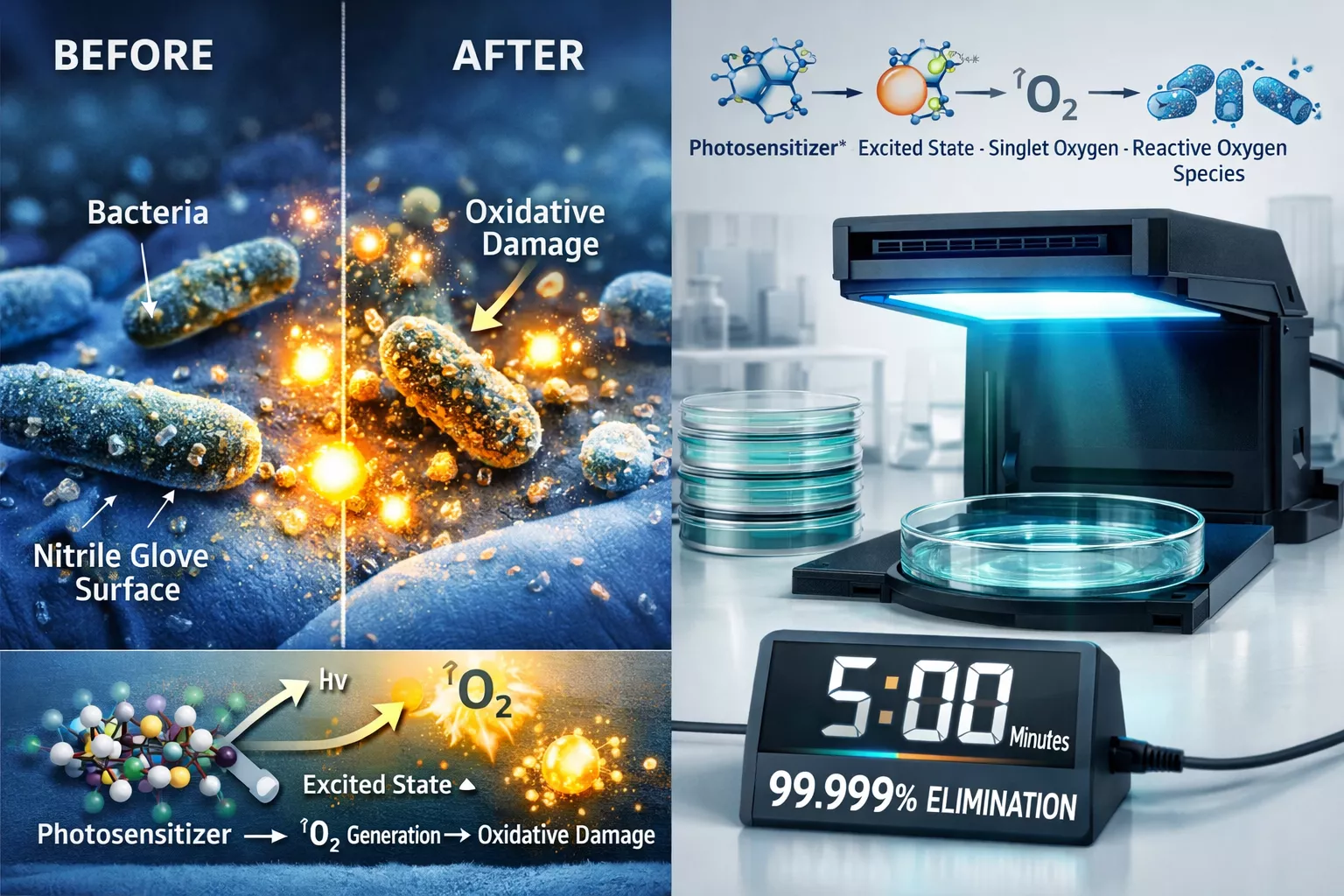
✅ Advanced antimicrobial coatings use photosensitizer technology to eliminate 99.999% of bacteria within 5 minutes through singlet oxygen oxidation
✅ Non-leaching formulations ensure antimicrobial agents remain on glove surfaces without transferring to skin or contaminating handled materials
✅ Multi-sector adoption spans healthcare facilities, food processing plants, pharmaceutical cleanrooms, and industrial environments requiring enhanced hygiene protocols
✅ Next-generation materials combine antimicrobial properties with improved durability, achieving 400-650% elongation and 10x higher abrasion resistance
✅ Regulatory compliance meets FDA, EN455, EN374, and EU CE standards while addressing latex allergy concerns with synthetic alternatives
Understanding Antimicrobial Technology in Modern Nitrile Gloves
The science behind Antimicrobial Nitrile Gloves: Latest Innovations and Applications in Post-Pandemic Hygiene centers on photosensitizer technology that fundamentally changes how protective gloves function. Unlike conventional gloves that merely block pathogens, antimicrobial variants actively destroy microorganisms through a sophisticated chemical process.
How Photosensitizer Technology Works 🔬
Modern antimicrobial nitrile gloves incorporate photosensitizers that activate when exposed to ambient light and oxygen. This activation generates singlet oxygen—a highly reactive form of oxygen that oxidizes bacterial proteins and lipids, effectively destroying cell membranes and killing microbes on contact.
The HANDISOL™ antimicrobial glove system exemplifies this technology, achieving microbial elimination rates of 99.999% within just five minutes of exposure. The non-leaching design ensures antimicrobial agents remain bonded to the glove material, preventing transfer to skin or handled surfaces—a critical consideration for food safety and patient care applications.
Key advantages of photosensitizer antimicrobial coatings:
- ⚡ Instantaneous activation upon light exposure
- 🛡️ Broad-spectrum efficacy against bacteria, fungi, and viruses
- 🌱 No chemical residue on skin or contacted surfaces
- ♻️ Continuous protection throughout glove lifespan
- 💪 Maintains material integrity without compromising glove thickness or durability
Material Science Breakthroughs in 2026
Beyond antimicrobial coatings, the latest nitrile glove innovations address fundamental material performance. INTCO Medical’s April 2026 launch of Syntex™ Synthetic Latex Gloves demonstrates the industry’s commitment to latex-free alternatives that eliminate natural rubber protein allergies while delivering superior mechanical properties.
These synthetic materials achieve 650% average elongation at break—significantly exceeding traditional nitrile formulations. The sulfur-free composition addresses allergic reactions to nitrile gloves caused by chemical accelerators, making them suitable for sensitive-skin users across medical, food processing, and industrial applications.
Simultaneously released Synmax Pro Gloves push durability boundaries with 10x higher abrasion resistance than conventional nitrile and over 400% elongation. This enhanced resilience reduces replacement frequency in high-use environments, delivering cost savings while maintaining consistent protection standards.
Applications of Antimicrobial Nitrile Gloves Across Industries
The practical implementation of Antimicrobial Nitrile Gloves: Latest Innovations and Applications in Post-Pandemic Hygiene extends far beyond traditional healthcare settings, addressing infection control challenges across diverse sectors.
Healthcare and Clinical Environments 🏥
Healthcare facilities represent the primary adoption sector for antimicrobial nitrile technology. Nitrile surgical gloves and exam gloves for hospitals now increasingly feature antimicrobial coatings to combat healthcare-associated infections (HAIs).
The Medi-Dash MD-Antimicrobial Nitrile Gloves utilize photosensitizer technology for instantaneous microbial kill, eliminating cross-contamination risks during patient examinations, surgical procedures, and routine care activities. The 99.999% bacterial elimination rate provides measurable infection control improvements compared to standard barrier gloves.
Clinical applications include:
- Surgical procedures requiring extended sterile field maintenance
- Emergency department triage and examination
- Long-term care facilities with vulnerable populations
- Dental procedures with aerosol exposure risks
- Laboratory specimen handling and processing
Surgicare’s 2026 nitrile glove line incorporates improved wet-condition grip textures alongside antimicrobial properties, enhancing surgical precision when handling instruments in blood or fluid-exposed environments. This dual functionality addresses both infection control and procedural safety requirements.
Food Service and Processing Industries 🍽️
Food safety regulations increasingly mandate enhanced hygiene protocols, making antimicrobial gloves attractive for commercial kitchens, processing facilities, and retail food handling. The non-leaching antimicrobial technology ensures no chemical transfer to food products while maintaining active surface protection against bacterial contamination.
What to consider when choosing nitrile gloves for food applications includes verifying FDA compliance, powder-free formulations to prevent food contamination, and appropriate thickness for task requirements. Antimicrobial variants add an extra safety layer during extended food preparation sessions where glove changes may be delayed.
Pharmaceutical and Cleanroom Environments 💊
The nitrile cleanroom gloves market continues expanding through 2034, driven by pharmaceutical, biotechnology, and semiconductor manufacturing demands. These controlled environments require low particulate generation combined with chemical resistance—properties that antimicrobial nitrile gloves deliver while adding contamination control benefits.
Accelerator-free formulations address skin sensitivity concerns among cleanroom personnel working extended shifts. The combination of antimicrobial protection, chemical resistance, and reduced allergic reaction potential makes these gloves ideal for pharmaceutical compounding, sterile manufacturing, and quality control testing applications.
Industrial and High-Risk Occupational Settings ⚙️
Heavy-duty antimicrobial nitrile gloves serve industrial applications requiring both chemical resistance and infection control. The Inspire Black Nitro Gloves feature 6 mil thickness for enhanced puncture and chemical resistance while maintaining antimicrobial surface properties.
Industries benefiting from antimicrobial nitrile technology include:
- Automotive and mechanical work with exposure to oils and solvents
- Waste management handling potentially infectious materials
- Veterinary medicine treating animals with zoonotic disease risks
- Tattoo and body art requiring sterile technique maintenance
- Emergency response with unknown contamination exposure
Understanding how long nitrile gloves last in various applications helps determine replacement schedules that maintain antimicrobial effectiveness throughout the glove’s functional lifespan.
Quality Verification and Selection Criteria
Selecting appropriate antimicrobial nitrile gloves requires understanding quality metrics and certification standards. Acceptable Quality Level (AQL) ratings indicate manufacturing defect rates, with lower numbers representing higher quality. Medical-grade gloves typically maintain AQL 1.5 or better for pinhole defects.
Essential verification steps include:
- Confirm regulatory compliance (FDA 510(k), EN455, EN374, EU CE marking)
- Review Certificate of Analysis (COA) for antimicrobial efficacy testing
- Verify third-party testing for microbial elimination rates
- Check material specifications for thickness, elongation, and tensile strength
- Assess powder-free certification to prevent respiratory irritation
- Evaluate packaging integrity to maintain sterility until use
The Klex Nitro Exam Gloves exemplify medical-grade antimicrobial protection with excellent chemical and puncture resistance, snug fit for tactile sensitivity, and documented antimicrobial performance—all critical factors for clinical hygiene applications.
Environmental Considerations and Sustainability
Post-pandemic glove consumption has created significant waste management challenges, prompting innovation in biodegradable formulations. Cranberry’s May 2023 launch of Bio Nitrile Biodegradable Powder-Free Gloves demonstrates industry response, breaking down 90% faster in landfills within 18 months through microbial additive technology.
These biodegradable options maintain ASTM tensile strength standards while offering environmental benefits—an important consideration as facilities evaluate alternatives to disposable nitrile gloves that balance protection, cost, and ecological impact.
Future Trends in Antimicrobial Glove Technology
The trajectory of Antimicrobial Nitrile Gloves: Latest Innovations and Applications in Post-Pandemic Hygiene points toward several emerging developments:
Smart glove integration 📱 with embedded sensors monitoring contamination levels and signaling replacement needs
Enhanced chemical resistance 🧪 for specialized applications involving aggressive solvents and industrial chemicals
Customized antimicrobial spectrums 🎯 targeting specific pathogen profiles for different industry requirements
Improved sustainability 🌍 through bio-based nitrile alternatives and accelerated biodegradation technologies
Cost optimization 💰 making antimicrobial protection accessible across broader market segments
The convergence of material science, microbiology, and manufacturing automation continues driving innovation that makes antimicrobial protection standard rather than premium in protective glove markets.
Conclusion
Antimicrobial nitrile gloves represent a fundamental advancement in infection control technology, addressing critical gaps in traditional barrier protection through active pathogen elimination. The 99.999% microbial kill rates achieved by photosensitizer coatings, combined with non-leaching formulations and enhanced material durability, position these gloves as essential tools across healthcare, food service, pharmaceutical, and industrial sectors in 2026.
Take action to implement antimicrobial protection:
🔍 Assess your current glove usage to identify high-risk contamination scenarios where antimicrobial technology delivers maximum benefit
📋 Review regulatory requirements for your industry to ensure selected antimicrobial gloves meet applicable standards
🧪 Request product testing documentation verifying antimicrobial efficacy claims before committing to large-volume purchases
💡 Train personnel on proper glove selection, donning, and disposal procedures to maximize antimicrobial effectiveness
📊 Monitor infection rates and contamination incidents to measure the impact of antimicrobial glove adoption
The evolution of Antimicrobial Nitrile Gloves: Latest Innovations and Applications in Post-Pandemic Hygiene continues reshaping protective equipment standards. As photosensitizer technology becomes more accessible and material science delivers increasingly durable, comfortable, and sustainable options, antimicrobial protection will transition from specialized application to universal expectation across industries prioritizing safety and hygiene.