Last updated: May 2, 2026
Quick Answer
Nitrile gloves are essential for computer builders and technicians because they provide antistatic protection that prevents electrostatic discharge (ESD) damage to sensitive components, offer superior tactile sensitivity for handling tiny screws and connectors, and resist oils and chemicals that could contaminate electronics. Unlike bare hands, nitrile gloves create a protective barrier while maintaining the dexterity needed for precision assembly work.
Key Takeaways
- Nitrile gloves naturally dissipate static electricity, protecting CPUs, RAM, and motherboards from ESD damage that can cost hundreds of dollars
- Thin nitrile material (3-5 mil) provides exceptional tactile sensitivity for handling small components like M.2 screws and jumper pins
- Oil and chemical resistance prevents skin oils and contaminants from transferring to circuit boards and optical components
- Puncture resistance and durability mean fewer glove changes during multi-hour build sessions compared to vinyl alternatives
- Latex-free composition eliminates allergy concerns for technicians with sensitivities
- Cost-effective protection at roughly $0.10-0.25 per glove for professional-grade options
- Better grip than bare hands on smooth metal cases and plastic cable connectors, especially textured varieties
- Disposable convenience allows quick changes between different repair jobs without cross-contamination
What Makes Nitrile Gloves Better Than Bare Hands for PC Building?
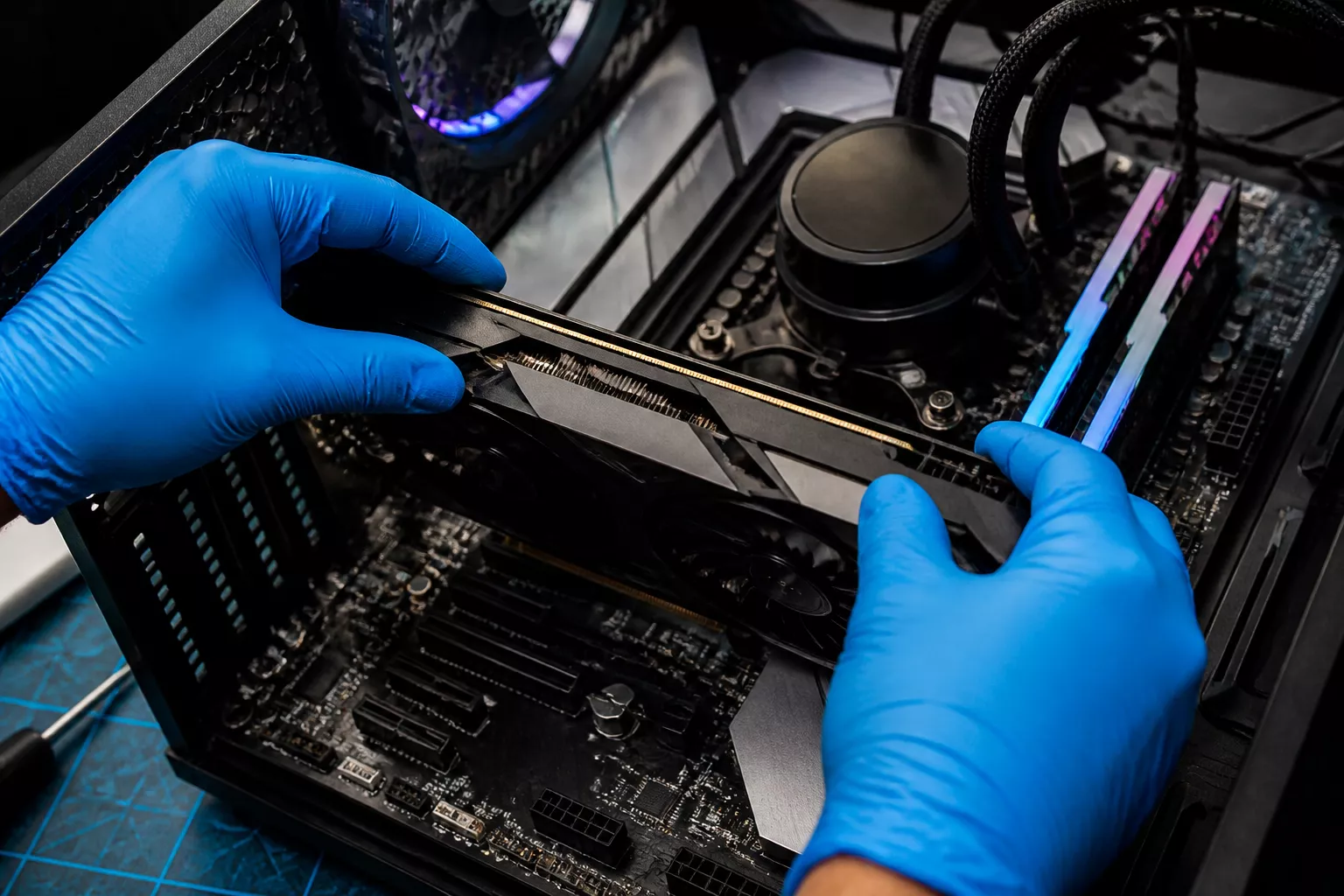
Nitrile gloves protect both your components and your hands during computer assembly. The primary advantage is antistatic properties that naturally dissipate static electricity, preventing the invisible ESD events that can instantly destroy a $500 processor or corrupt a motherboard’s firmware.[1]
Beyond static protection, nitrile gloves create a barrier between your skin’s natural oils and sensitive electronics. Fingerprints on thermal paste application surfaces reduce heat transfer efficiency, while oils on optical drive lenses cause read errors. The gloves also protect your hands from sharp metal case edges, thermal paste chemicals, and isopropyl alcohol used for cleaning.
Key advantages over bare hands:
- Prevents static discharge to components (especially critical for RAM, CPUs, and GPUs)
- Blocks skin oil transfer that degrades thermal interfaces
- Protects against cuts from sharp I/O shields and case edges
- Maintains cleaner work environment for optical components
- Allows handling of thermal paste and cleaning chemicals without skin contact
Common mistake: Using cotton gloves thinking they’re safer. Cotton actually generates more static than nitrile and lacks the chemical resistance needed for electronics work.
For more information on how nitrile gloves compare to other materials, see our guide on nitrile gloves versus vinyl gloves.
How Do Nitrile Gloves Prevent Static Damage to Computer Components?
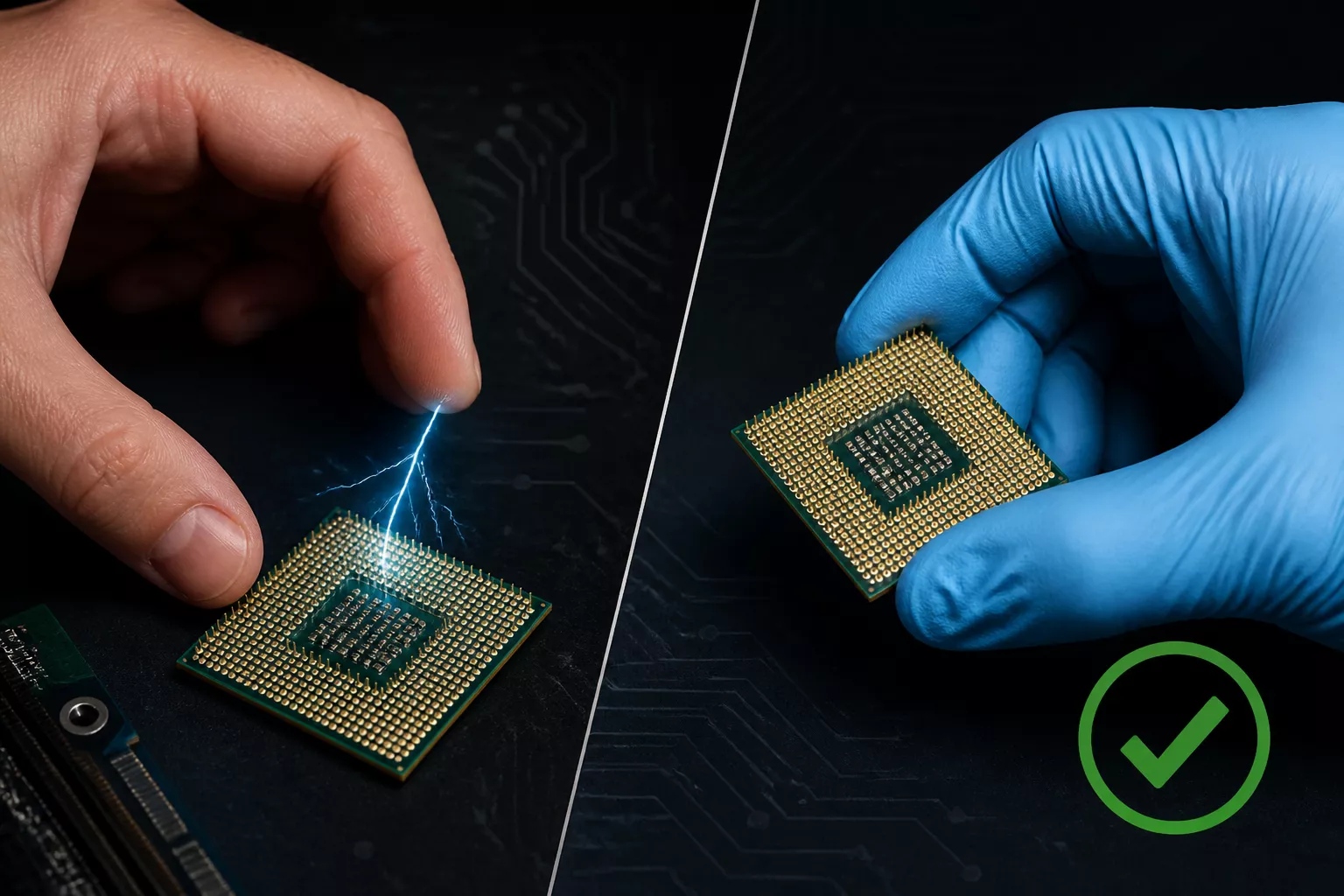
Nitrile gloves are inherently antistatic, meaning they dissipate static charges gradually rather than allowing sudden discharge. This property protects sensitive integrated circuits that can be damaged by voltages as low as 30-50 volts—far below what you’d feel as a shock.[2]
The synthetic rubber material in nitrile has a surface resistivity that falls within the static-dissipative range. When you wear nitrile gloves while handling a CPU or RAM module, any static charge on your body disperses slowly through the glove material rather than jumping to the component in a destructive spark.
How ESD protection works:
- Your body accumulates static charge from walking on carpet or moving in synthetic clothing
- Nitrile glove material provides a controlled path for charge dissipation
- Static electricity bleeds away gradually instead of discharging instantly
- Component pins and circuits remain protected from voltage spikes
Choose nitrile gloves if: You’re building PCs in carpeted rooms, working in low-humidity environments (winter months), or handling expensive components like high-end CPUs and graphics cards. The protection is especially critical for bare circuit boards and exposed pins.
Edge case: Nitrile-coated fabric gloves (with nitrile only on palms) may not provide full ESD protection since the fabric backing can still generate static. For maximum protection, use fully nitrile disposable gloves.[5]
Learn more about what nitrile gloves protect against in various applications.
What Thickness of Nitrile Gloves Works Best for Computer Repair?
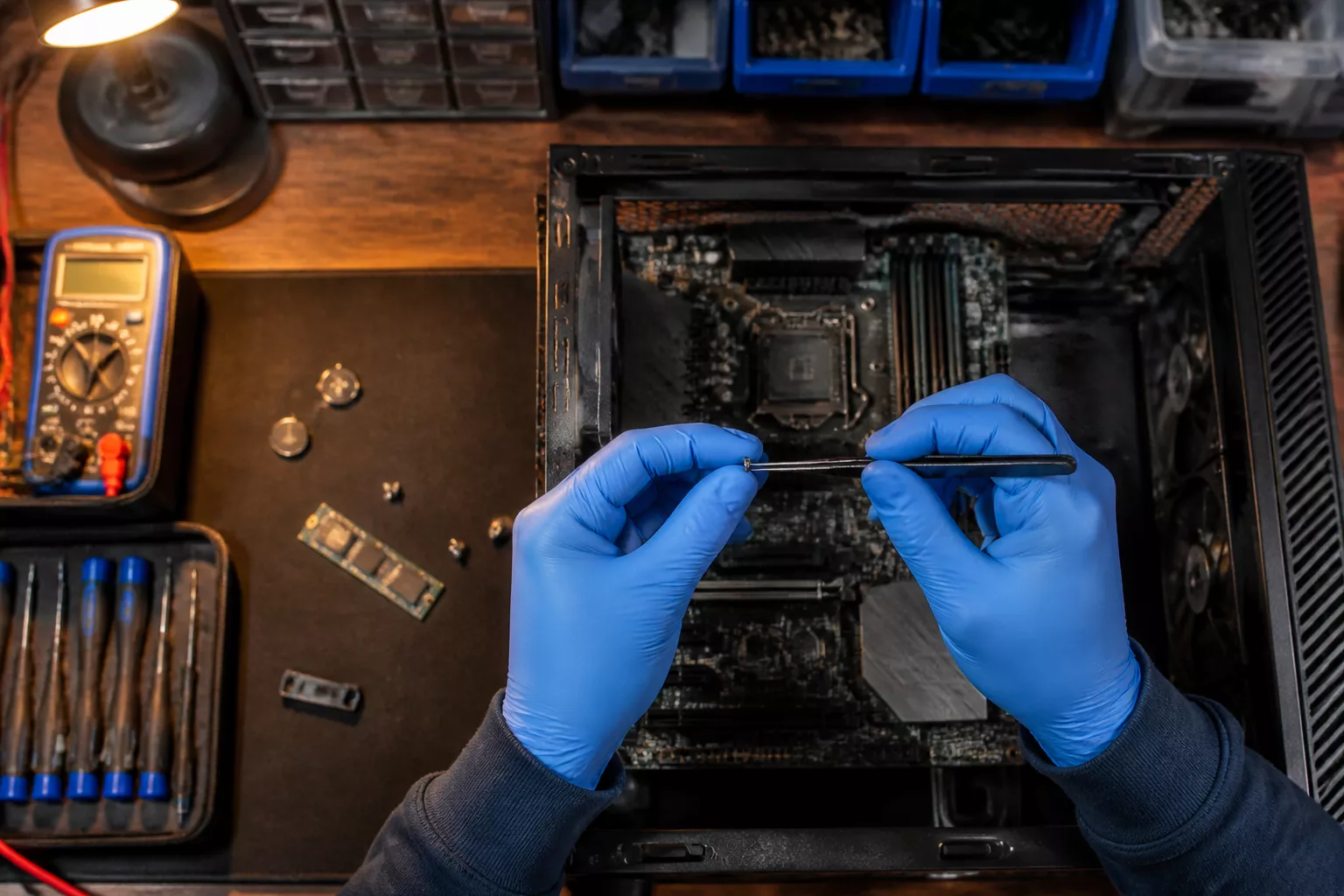
The ideal thickness for computer building and repair is 3-5 mil (0.003-0.005 inches), which provides the best balance of protection and tactile sensitivity. Thinner gloves let you feel tiny screws and delicate connector pins, while thicker options sacrifice dexterity for durability.[1]
Thin nitrile gloves allow you to distinguish between a seated RAM module and one that’s 1mm away from fully clicking in—a critical difference that prevents boot failures. You can also feel when a motherboard standoff is cross-threading or when a cable connector is misaligned.
Thickness comparison:
| Thickness | Best For | Trade-offs |
|---|---|---|
| 2-3 mil | Precision work, small component handling | Less puncture resistance, tears more easily |
| 4-5 mil | General PC building and repair | Optimal balance for most tasks |
| 6-8 mil | Heavy-duty repairs, sharp metal work | Reduced tactile feedback, harder to grip small parts |
Decision rule: Choose 4-5 mil gloves for standard builds and upgrades. Go thinner (3 mil) only if you’re doing micro-soldering or laptop repair with extremely small components. Use thicker gloves (6+ mil) when working with server racks or industrial equipment with sharp edges.
Common mistake: Buying the thickest gloves thinking more protection is always better. Thick gloves make it nearly impossible to feel if a CPU is properly seated in its socket, potentially causing bent pins.
For detailed guidance, check our article on the best thickness for nitrile gloves.
Why Do Nitrile Gloves Provide Better Grip Than Other Options?
Nitrile gloves offer superior grip on smooth metal surfaces, plastic cable connectors, and glass panels compared to bare hands or vinyl alternatives. The synthetic rubber material naturally has higher friction coefficients, and many manufacturers add textured patterns to fingertips and palms for enhanced grip.[3]
This grip advantage matters when you’re trying to remove a stubborn PCIe power connector, hold a heavy graphics card steady during installation, or manipulate small screws in tight spaces. The material also maintains grip even when slightly damp from hand perspiration, unlike vinyl which becomes slippery.
Grip benefits for PC work:
- Textured fingertips provide secure hold on tiny motherboard screws and standoffs
- Palm grip patterns prevent heavy components from slipping during installation
- Consistent friction across temperature ranges (room temperature to slightly warm from handling)
- Better than bare hands on powder-coated metal cases and smooth aluminum heatsinks
When grip matters most: Installing CPU coolers that require significant mounting pressure, removing tight RAM modules, handling glass side panels, and working with cable management in cramped cases.
For tips on maximizing grip performance, see our guide on tricks to enhance grip with nitrile gloves.
Are Nitrile Gloves Safe for Extended Computer Building Sessions?
Yes, nitrile gloves are safe for extended wear during multi-hour build sessions, typically comfortable for 4-6 hours of continuous use. The material is breathable enough to prevent excessive moisture buildup, and the latex-free composition eliminates allergic reactions that affect 8-17% of healthcare workers exposed to latex.[1]
For maximum comfort during long sessions, choose powder-free nitrile gloves to avoid residue buildup, and consider taking brief breaks every 1-2 hours to let your hands air out. Some technicians prefer to change gloves mid-session if their hands become sweaty, which maintains both comfort and grip.
Comfort factors:
- Powder-free options prevent skin irritation and component contamination
- Ambidextrous design eliminates pressure points from handed gloves
- Thin material (4-5 mil) allows better air circulation than thick gloves
- Beaded cuffs prevent gloves from rolling down during extended use
Choose nitrile over latex if: You have any history of latex sensitivity, work in shared spaces where others may have allergies, or want to avoid the powder residue that latex gloves often contain.
Edge case: Some individuals develop Type IV hypersensitivity to chemical accelerators used in nitrile manufacturing. If you experience delayed redness or itching (24-48 hours after use), switch to accelerator-free nitrile gloves. Learn more about potential allergic reactions to nitrile gloves.
Research shows that nitrile gloves can be safely worn for up to 8 hours with proper selection and fit.
How Do Nitrile Gloves Compare to Anti-Static Wrist Straps?
Nitrile gloves and anti-static wrist straps serve complementary but different purposes. Wrist straps provide a direct ground path for static discharge, while nitrile gloves offer static dissipation plus additional benefits like contamination prevention and hand protection.[2]
The best practice is using both: wear a grounded wrist strap for primary ESD protection and nitrile gloves for component cleanliness and tactile benefits. However, if you must choose one, nitrile gloves provide broader protection since they also prevent skin oil transfer and protect against sharp edges.
Comparison breakdown:
Anti-static wrist straps:
- Direct ground connection for immediate static dissipation
- Requires proper grounding point (case, grounded outlet)
- No protection against oils, chemicals, or cuts
- Can be restrictive during movement
- One-time purchase (reusable)
Nitrile gloves:
- Static-dissipative properties (slower dissipation than direct ground)
- No grounding point needed
- Protects components from contamination
- Protects hands from chemicals and sharp edges
- Disposable (ongoing cost)
Decision rule: Use both for professional builds or expensive components. If working in a properly grounded environment with an anti-static mat, nitrile gloves alone may suffice for routine builds. Never rely solely on a wrist strap when handling components that require clean surfaces (CPUs during thermal paste application, optical drives).
What Should Computer Technicians Look for When Buying Nitrile Gloves?
Computer technicians should prioritize powder-free, 4-5 mil thickness, textured fingertips, and ambidextrous fit when selecting nitrile gloves. These specifications balance protection, dexterity, and cost for typical PC building and repair work.[1][3]
Avoid gloves marketed as “industrial” or “heavy-duty” unless you’re specifically working with sharp metal or harsh chemicals—these are usually too thick for precision electronics work. Similarly, skip “medical examination” gloves thinner than 3 mil, as they tear too easily on case edges and cable ties.
Essential features checklist:
✅ Powder-free (prevents residue on components)
✅ 4-5 mil thickness (optimal tactile sensitivity)
✅ Textured fingertips (better grip on small parts)
✅ Ambidextrous (no left/right distinction needed)
✅ Beaded cuff (prevents roll-down)
✅ Blue or black color (easier to spot if piece tears off inside case)
Nice-to-have features:
- Extended cuff length (9.5+ inches) for better wrist coverage
- Chlorinated finish for easier donning
- Certified ESD-safe rating (though standard nitrile is typically sufficient)
Size selection: Measure your hand width across the palm below knuckles. Small: 3-3.5″, Medium: 3.5-4″, Large: 4-4.5″, XL: 4.5″+. Gloves should fit snugly without restricting movement. For sizing guidance, see why large size nitrile gloves are popular.
Budget consideration: Quality nitrile gloves cost $10-25 per 100-count box ($0.10-0.25 per glove). At this price point, you can afford to change gloves between builds without worrying about cost, maintaining cleanliness standards.
Can Nitrile Gloves Protect Against Thermal Paste and Cleaning Chemicals?
Yes, nitrile gloves provide excellent protection against thermal paste compounds and common electronics cleaning chemicals including isopropyl alcohol, contact cleaners, and flux removers. The synthetic rubber material resists petroleum-based substances and most solvents used in computer maintenance.[1]
This chemical resistance matters because thermal paste often contains zinc oxide, silver particles, or silicone compounds that can irritate skin or be difficult to wash off. Similarly, 90%+ isopropyl alcohol used for cleaning thermal surfaces dries out skin with repeated exposure.
Chemical protection benefits:
- Thermal paste handling: Prevents skin contact with metal oxide compounds and silicone
- Isopropyl alcohol: Protects against skin drying and irritation during cleaning
- Flux removers: Blocks exposure to aggressive solvents used in soldering
- Contact cleaners: Prevents absorption of petroleum distillates through skin
Limitation: Nitrile gloves are not suitable for prolonged exposure to acetone or MEK (methyl ethyl ketone). If you’re using these aggressive solvents for adhesive removal, change gloves frequently or use specialized chemical-resistant gloves. Learn more about acetone permeation through nitrile gloves.
Best practice: Apply thermal paste while wearing nitrile gloves, then use a fresh glove or finger cot to spread it if needed. This prevents oils from your skin mixing with the paste and maintains optimal thermal transfer properties.
For information on oil resistance, see our article on how nitrile gloves perform with oils.
How Long Do Nitrile Gloves Last During Computer Building Work?
A single pair of nitrile gloves typically lasts through one complete PC build (2-4 hours) or 2-3 quick repairs before showing signs of wear. The actual lifespan depends on glove thickness, the sharpness of components you’re handling, and how carefully you work around case edges and cable ties.[1]
Replace gloves immediately if you notice any tears, punctures, or significant stretching at fingertips. Even small holes compromise both ESD protection and contamination prevention. For professional technicians doing multiple builds daily, budget for 2-4 pairs per 8-hour shift.
Factors affecting glove lifespan:
- Component type: Laptop repair (longer life) vs. custom water cooling with sharp fittings (shorter life)
- Case design: Modern cases with rolled edges (longer life) vs. budget cases with sharp metal (shorter life)
- Glove thickness: 3 mil gloves may last one build, 5 mil gloves often last 2-3 repairs
- Work style: Careful, deliberate movements extend life vs. rushing increases tear risk
Signs it’s time to change gloves:
- Visible tears or punctures (even tiny ones)
- Fingertips feel loose or stretched out
- Gloves become slippery from perspiration buildup
- You’ve touched contaminated surfaces (thermal paste, oils)
Storage tip: Keep gloves in their original box away from direct sunlight and heat sources. Properly stored nitrile gloves have a shelf life of 3-5 years. For more details, see how long nitrile gloves last.
Conclusion
Nitrile gloves have become an essential tool for computer builders and technicians in 2026, offering a unique combination of ESD protection, tactile sensitivity, and contamination prevention that bare hands simply cannot match. The antistatic properties protect expensive components from invisible static discharge, while the thin material maintains the dexterity needed for precision assembly work.
For optimal results, choose powder-free nitrile gloves in the 4-5 mil thickness range with textured fingertips. This specification provides the best balance of protection, grip, and tactile feedback for typical PC building and repair tasks. At roughly $0.10-0.25 per glove, the cost is negligible compared to the value of the components you’re protecting.
Take action now:
- Order a box of quality nitrile gloves (100-count, 4-5 mil, powder-free) for your workspace
- Make glove use standard practice for all component handling, not just when you remember
- Replace gloves between builds to maintain cleanliness and protection standards
- Combine with proper grounding (anti-static mat or wrist strap) for maximum component safety
- Keep spare boxes on hand so you never run out during critical builds
The small investment in nitrile gloves pays for itself the first time they prevent a static discharge to a $500 CPU or keep skin oils off a thermal interface. Make them a standard part of your toolkit alongside screwdrivers and cable ties—your components (and your hands) will thank you.
Frequently Asked Questions
Do I really need gloves for building a PC, or is it overkill?
Nitrile gloves are not overkill—they provide essential ESD protection and prevent skin oil contamination that can degrade thermal performance and damage sensitive components. While many successful builds happen without gloves, they significantly reduce risk, especially for expensive components.
Can I reuse nitrile gloves for multiple PC builds?
You can reuse gloves for 2-3 builds if they show no tears or punctures, but replace them immediately if damaged. For professional work, use fresh gloves for each customer build to maintain cleanliness standards and prevent cross-contamination.
What’s the difference between nitrile-coated gloves and disposable nitrile gloves?
Nitrile-coated gloves have fabric backing with nitrile only on palms and may not provide full ESD protection. Disposable nitrile gloves are fully synthetic rubber throughout, offering better static dissipation and contamination prevention for electronics work.
Will nitrile gloves prevent me from getting shocked by capacitors?
No, thin nitrile gloves do not protect against electrical shock from charged capacitors or live circuits. They only protect against static discharge (ESD). Always discharge capacitors properly and never work on powered equipment.
Are black nitrile gloves better than blue ones for PC building?
Color makes no functional difference—both provide the same protection. Some technicians prefer black gloves because they look more professional or hide dirt better, while blue gloves make it easier to spot if a piece tears off inside a case.
Can I use latex gloves instead of nitrile for computer work?
Latex gloves work but have disadvantages: they cause allergic reactions in some people, often contain powder that contaminates components, and have less chemical resistance. Nitrile is the better choice for electronics work. See our comparison of nitrile versus latex gloves.
How do I know what size nitrile gloves to buy?
Measure your hand width across the palm below the knuckles. Small fits 3-3.5 inches, Medium 3.5-4 inches, Large 4-4.5 inches, and XL over 4.5 inches. Gloves should fit snugly without restricting finger movement or circulation.
Do nitrile gloves leave residue on computer components?
Powder-free nitrile gloves leave no residue on components. Avoid powdered gloves entirely for electronics work, as the powder can contaminate circuit boards and optical components.
Can I touch thermal paste with nitrile gloves on?
Yes, nitrile gloves protect your hands from thermal paste and prevent skin oils from contaminating the paste. This is actually one of the key benefits—you can apply and spread thermal paste without worrying about skin contact or contamination.
Are expensive nitrile gloves worth it for occasional PC building?
For occasional home builds, mid-range nitrile gloves ($10-15 per 100-count box) provide excellent protection. Save premium gloves ($20-25+ per box) for professional use or if you have specific needs like extended cuff length or certified ESD ratings.
Will nitrile gloves protect my hands from sharp case edges?
Yes, 4-5 mil nitrile gloves provide good protection against minor cuts from case edges and I/O shields. For cases with particularly sharp metal or heavy-duty server work, consider 6-8 mil thickness for added puncture resistance.
Can I wear nitrile gloves if I have a latex allergy?
Yes, nitrile gloves are latex-free and safe for people with latex allergies. This is one of the main reasons nitrile has become the standard for medical and technical work. However, some people may develop sensitivity to chemical accelerators in nitrile—if this occurs, look for accelerator-free options.
References
[1] Why Nitrile Gloves Are A Must Have For Computer Builders And Technicians – https://aldenagloves.eu/why-nitrile-gloves-are-a-must-have-for-computer-builders-and-technicians/
[2] Anti Static Gloves In Pc Building – https://www.nmsafety.com/anti-static-gloves-in-pc-building/
[3] Custom Nitrile Coated Work Gloves – https://www.imprint5.com/custom-nitrile-coated-work-gloves.html
[4] Watch – https://www.youtube.com/watch?v=YZ58R4iKLNQ
[5] Are Nitrile Coated Gloves Suitable For Pc Building – https://forums.tomshardware.com/threads/are-nitrile-coated-gloves-suitable-for-pc-building.613166/