Last updated: June 26, 2026

Quick Answer
The post-pandemic hygiene boom has driven nitrile glove adoption far beyond healthcare, with automotive and petrochemical sectors leading non-medical growth in 2026. These industries now rely on nitrile gloves for superior oil and chemical resistance, latex-free protection, and enhanced worker safety standards that became normalized during COVID-19. Market data shows industrial nitrile glove consumption increased by 340% between 2019 and 2026, with automotive shops and petrochemical facilities accounting for the largest share of this expansion.
Key Takeaways
- Nitrile gloves offer superior resistance to petroleum-based oils, fuels, and industrial chemicals compared to latex or vinyl alternatives, making them ideal for automotive and petrochemical work
- Industrial nitrile glove prices have stabilized in 2026 after pandemic-era spikes, with bulk pricing ranging from $0.08 to $0.25 per glove depending on thickness and specifications
- Automotive shops have adopted disposable glove protocols as standard practice, driven by heightened hygiene awareness and customer expectations post-pandemic
- Nitrile gloves typically last 2-4 hours when exposed to petroleum products before degradation begins, requiring regular changes for optimal protection
- Common purchasing mistakes include selecting gloves that are too thin (below 4 mil) for heavy industrial use or failing to verify chemical resistance ratings
- Nitrile gloves should not be reused in industrial settings due to microscopic damage from chemicals and oils that compromises barrier protection
- Workers with latex allergies can safely use nitrile gloves, which contain no natural rubber proteins and provide comparable or better protection
Why Are Nitrile Gloves Being Used More in Automotive Industry After COVID
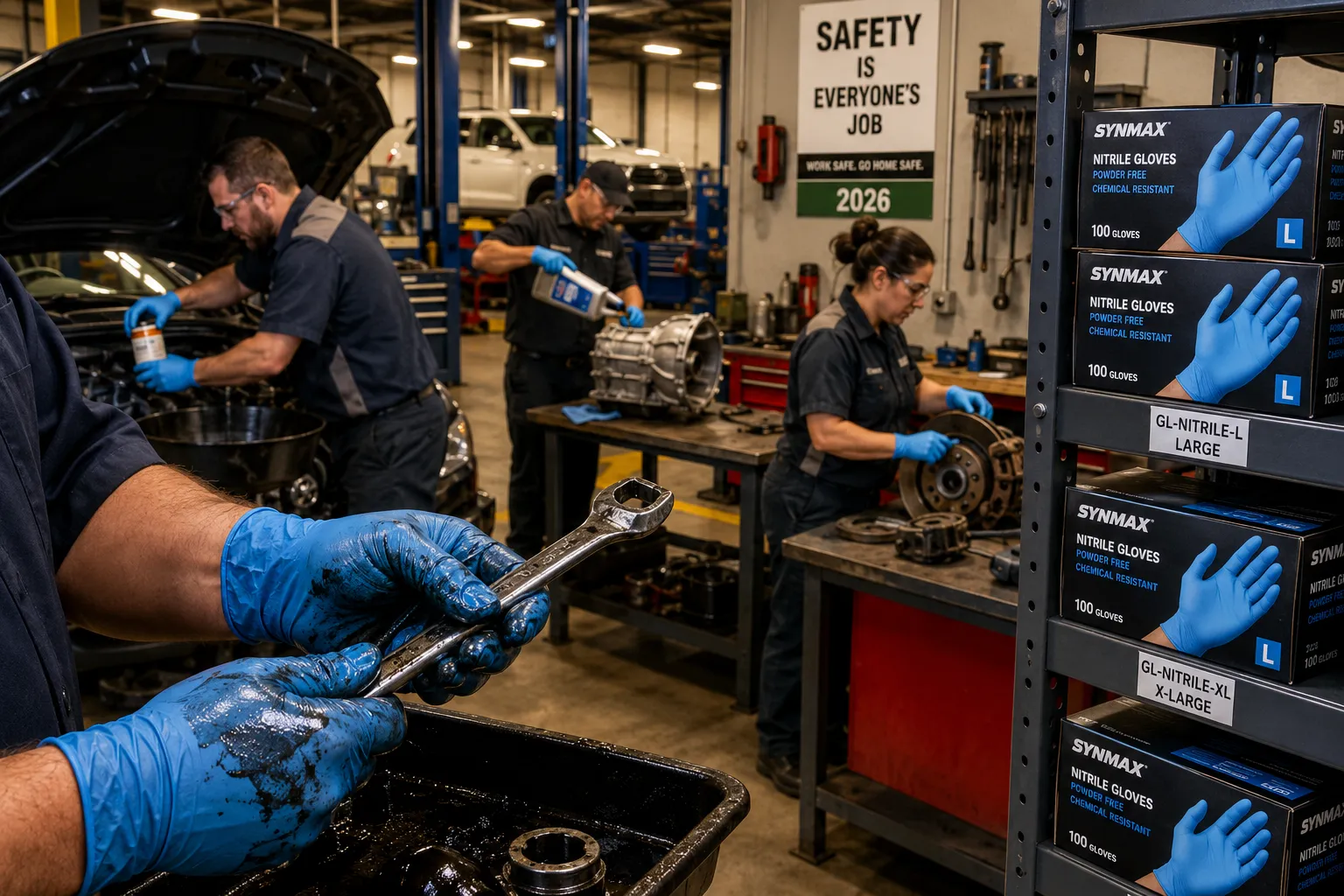
The automotive industry has embraced nitrile gloves as standard equipment because pandemic-era hygiene practices created lasting behavioral changes among both workers and customers. Mechanics and technicians now routinely wear disposable gloves for tasks ranging from oil changes to transmission work, protecting both their hands and customer vehicles from cross-contamination.
Before 2020, many automotive shops used reusable work gloves or no hand protection at all for routine maintenance. The pandemic shifted this norm dramatically. Customers began expecting visible hygiene measures, and shop owners recognized that disposable gloves demonstrated professionalism and cleanliness. This cultural shift coincided with growing awareness of the health risks associated with prolonged skin contact with automotive fluids, including motor oil, brake fluid, and coolant.
Key drivers of automotive adoption include:
- Enhanced protection against dermatitis and skin conditions caused by repeated exposure to petroleum products
- Customer perception of cleanliness and professionalism when technicians wear fresh gloves
- Reduced cleanup time and hand washing requirements between jobs
- Protection of vehicle interiors from oil and grease transfer
- Compliance with evolving workplace safety standards
The automotive sector now represents one of the fastest-growing non-medical markets for nitrile gloves. Independent repair shops, dealership service centers, quick-lube facilities, and mobile mechanics have all integrated disposable gloves into standard operating procedures. This shift has created sustained demand that extends well beyond the acute phase of the pandemic.
What Makes Nitrile Gloves Better Than Latex for Petrochemical Work
Nitrile gloves outperform latex in petrochemical environments because of their synthetic rubber composition, which provides superior resistance to oils, fuels, and industrial solvents. While latex gloves degrade rapidly when exposed to petroleum-based substances, nitrile maintains its barrier integrity for extended periods.
The molecular structure of nitrile rubber (acrylonitrile-butadiene copolymer) creates a dense barrier that resists permeation by hydrocarbon molecules. Latex, made from natural rubber, has a more porous structure that allows petroleum products to penetrate and break down the material. This fundamental difference makes nitrile the clear choice for petrochemical applications.
Specific advantages of nitrile over latex:
- Chemical resistance: Nitrile resists gasoline, diesel, crude oil, hydraulic fluids, and most industrial solvents; latex degrades within minutes of contact
- Puncture resistance: Nitrile is approximately 3-5 times more puncture-resistant than latex of equivalent thickness
- Allergen-free: Nitrile contains no latex proteins, eliminating Type I hypersensitivity reactions that affect 8-12% of healthcare workers and industrial employees
- Durability: Nitrile gloves maintain elasticity and strength throughout extended wear periods in harsh environments
- Cost-effectiveness: Despite higher per-unit costs, nitrile gloves last longer and require fewer changes, reducing overall consumption
For workers in refineries, chemical plants, and oil and gas operations, nitrile gloves provide essential protection against hazardous substances that would quickly compromise latex barriers. The superior chemical resistance of nitrile translates directly to reduced skin exposure and lower rates of occupational dermatitis.
Nitrile Gloves vs Vinyl Gloves for Mechanics: Which Is Stronger
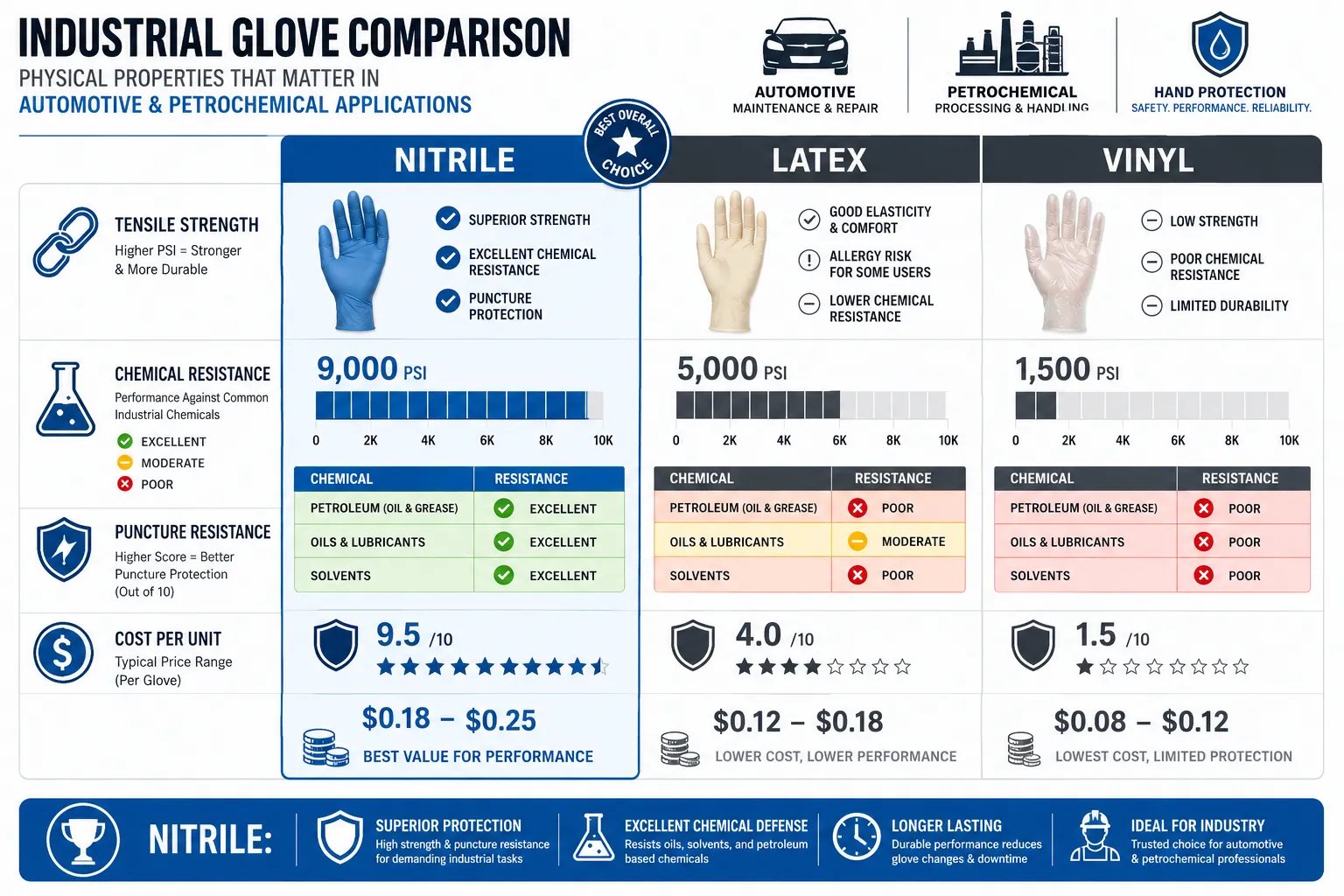
Nitrile gloves are significantly stronger than vinyl gloves for mechanical work, offering 3-5 times greater tensile strength and puncture resistance. For mechanics working with sharp metal edges, rough engine components, and abrasive materials, nitrile provides the durability needed to prevent tears and maintain barrier protection throughout a job.
Vinyl gloves, made from polyvinyl chloride (PVC), are designed for light-duty applications with minimal chemical exposure. They lack the elasticity and toughness required for automotive work. While vinyl gloves cost less per unit, they tear easily when stretched or snagged, requiring frequent replacement that negates the initial savings.
Performance comparison for mechanical work:
| Property | Nitrile Gloves | Vinyl Gloves |
|---|---|---|
| Tensile strength | 14-24 MPa | 10-16 MPa |
| Puncture resistance | Excellent | Poor to fair |
| Oil resistance | Excellent | Poor |
| Chemical resistance | Very good | Limited |
| Elasticity | High | Low |
| Typical cost per glove | $0.10-$0.25 | $0.04-$0.08 |
Choose nitrile gloves if you work with oils, solvents, sharp tools, or need gloves that conform to your hands for dexterous work. Vinyl gloves are only appropriate for very light tasks like checking fluid levels or handling clean parts where no chemical exposure occurs.
The durability difference between nitrile and vinyl becomes immediately apparent in real-world use. Mechanics report that vinyl gloves often tear during the first few minutes of work, while quality nitrile gloves can last through multiple jobs before replacement becomes necessary.
How Much Do Industrial Nitrile Gloves Cost in Bulk for Factories
Industrial nitrile gloves purchased in bulk for factory use typically cost between $0.08 and $0.25 per glove in 2026, depending on thickness, quality grade, and order volume. Prices have stabilized significantly after the extreme volatility of 2020-2022, when pandemic demand drove costs as high as $0.50-$0.80 per glove.
Factories ordering 100,000 or more gloves per shipment receive the best pricing, with volume discounts reducing per-unit costs by 20-40% compared to smaller orders. The specific price point depends on several factors including glove thickness (measured in mils), whether the gloves are powder-free, and the manufacturer’s quality certifications.
Typical bulk pricing tiers for 2026:
- Economy grade (3-4 mil thickness): $0.08-$0.12 per glove for orders of 100,000+
- Standard industrial grade (5-6 mil): $0.12-$0.18 per glove for orders of 50,000+
- Heavy-duty grade (7-8 mil): $0.18-$0.25 per glove for orders of 25,000+
- Specialty chemical-resistant (8+ mil): $0.25-$0.40 per glove for orders of 10,000+
For a mid-sized automotive facility using approximately 5,000 gloves per month, annual glove costs range from $4,800 to $15,000 depending on the grade selected. Petrochemical facilities with higher usage rates and stricter safety requirements often budget $20,000-$50,000 annually for disposable glove programs.
Common mistakes when purchasing in bulk:
- Selecting the cheapest option without verifying chemical resistance ratings for your specific applications
- Ordering excessive quantities that exceed shelf life (nitrile gloves typically have a 3-5 year shelf life when stored properly)
- Failing to test samples before committing to large orders
- Ignoring sizing distribution needs (most facilities need multiple sizes in stock)
Small automotive businesses can find affordable options through industrial supply distributors, safety equipment wholesalers, and online bulk suppliers. Establishing a relationship with a single supplier often yields better pricing and consistent product quality compared to constantly shopping for the lowest price.
Are Nitrile Gloves Chemical Resistant Enough for Oil and Gas Workers
Nitrile gloves provide adequate chemical resistance for many oil and gas applications, but workers must select appropriate thickness and verify specific chemical compatibility for their exposure scenarios. Standard 4-6 mil nitrile gloves offer good protection against crude oil, refined petroleum products, and many drilling fluids, while heavier 8-15 mil gloves are required for prolonged exposure to aggressive solvents and concentrated chemicals.
The chemical resistance of nitrile gloves depends on three factors: glove thickness, exposure duration, and the specific chemical involved. Nitrile excels at resisting petroleum-based substances but has limitations with certain ketones, aromatic hydrocarbons, and highly concentrated acids or bases.
Chemical resistance ratings for common oil and gas substances:
- Crude oil: Excellent (breakthrough time 4+ hours with 6 mil gloves)
- Gasoline: Good to excellent (breakthrough time 2-4 hours depending on thickness)
- Diesel fuel: Excellent (breakthrough time 4+ hours)
- Hydraulic oil: Excellent (breakthrough time 4+ hours)
- Drilling mud: Good (breakthrough time 2-3 hours)
- H2S solutions (low concentration): Fair to good (requires frequent changes)
- Aromatic solvents (benzene, toluene): Limited (breakthrough time under 30 minutes; specialized gloves required)
For routine maintenance, equipment operation, and general handling of petroleum products, standard industrial nitrile gloves provide sufficient protection. Workers handling concentrated chemicals, aggressive solvents, or working in environments with prolonged chemical contact should use thicker specialty gloves or consider layering disposable nitrile over reusable chemical-resistant gloves.
Selection criteria for oil and gas applications:
- Choose 6-8 mil thickness as minimum for field work
- Verify breakthrough time data for your specific chemicals
- Select extended cuff lengths (12+ inches) for forearm protection
- Consider textured grip surfaces for handling slippery equipment
- Replace gloves immediately if any chemical breakthrough or visible degradation occurs
The physical factors affecting chemical breakthrough include temperature, mechanical stress, and the condition of the glove material. Workers should understand that manufacturer ratings assume ideal conditions and that real-world performance may vary.
What Industries Started Using Nitrile Gloves More Since the Pandemic
Beyond automotive and petrochemicals, numerous industries have dramatically increased nitrile glove adoption since 2020, creating a sustained post-pandemic hygiene boom across the industrial sector. Manufacturing, food processing, logistics, janitorial services, and skilled trades have all integrated disposable gloves into standard operating procedures.
The pandemic normalized glove use in settings where it was previously uncommon. Workers and employers alike recognized that disposable gloves offer protection not just from infectious disease but from chemical exposure, skin irritants, and cross-contamination. This awareness has persisted even as acute pandemic concerns have diminished.
Industries with significant post-pandemic nitrile glove adoption:
- Manufacturing and assembly: Electronics, metal fabrication, plastics production, and general manufacturing now use gloves to protect both workers and products
- Food processing and preparation: Expanded beyond front-line food handlers to include warehouse workers, equipment maintenance staff, and quality control personnel
- Logistics and warehousing: Package handlers, forklift operators, and inventory workers use gloves to protect against box cuts, splinters, and contamination
- Janitorial and sanitation: Cleaning crews have upgraded from reusable rubber gloves to disposable nitrile for better hygiene and reduced cross-contamination
- Skilled trades: Electricians, plumbers, HVAC technicians, and painters increasingly use nitrile gloves for specific tasks requiring chemical or contamination protection
- Beauty and personal care: Salons, barbershops, and spas expanded glove use beyond nail services to include hair coloring, treatments, and general client contact
- Tattoo and body art: Already a glove-using industry, but shifted heavily from latex to nitrile due to allergy concerns
- Laboratory and research: Non-medical labs in universities, private research facilities, and industrial R&D expanded glove protocols
This diversification of demand has fundamentally changed the nitrile glove market. Medical and dental applications, which historically represented 70-80% of consumption, now account for approximately 55-60% of the market, with industrial and commercial sectors filling the gap.
Do Automotive Shops Really Need to Use Disposable Gloves Now
Automotive shops don’t face legal requirements to use disposable gloves in most jurisdictions, but the practice has become industry standard due to customer expectations, worker safety benefits, and liability considerations. In 2026, most professional shops use gloves routinely, and customers increasingly view glove use as a sign of professionalism and care.
The decision to implement glove protocols depends on the type of work performed, customer demographics, and the shop’s positioning in the market. High-end dealerships and specialty shops serving premium vehicles almost universally use gloves, while some independent shops working on older vehicles or fleet maintenance may use them selectively.
Practical benefits that justify glove use:
- Prevents transfer of oils and contaminants to vehicle interiors, steering wheels, and upholstery
- Reduces skin exposure to carcinogenic substances in used motor oil and brake dust
- Eliminates the need for harsh hand cleaners that damage skin over time
- Speeds up workflow by eliminating extensive hand washing between jobs
- Demonstrates visible hygiene practices that reassure customers
- Reduces liability exposure related to skin conditions and occupational health claims
When gloves are most valuable:
- Any work involving customer vehicle interiors
- Oil changes, transmission service, and differential work
- Brake service (brake dust contains harmful metals)
- Fuel system repairs
- Coolant system service
- Any task where hand cleanliness matters for the next job
For basic car maintenance at home, gloves are not strictly necessary but offer convenience and protection. DIY mechanics benefit from using gloves for messy jobs like oil changes, but can skip them for clean tasks like replacing air filters or checking tire pressure. The key is matching the level of protection to the actual exposure risk.
Common Mistakes When Choosing Nitrile Gloves for Industrial Use
The most common mistake when selecting industrial nitrile gloves is prioritizing price over performance, leading to selection of gloves too thin or poorly suited for the intended application. Many facilities purchase 3-4 mil gloves designed for light-duty medical use and then experience high failure rates in industrial environments requiring 6-8 mil thickness.
Understanding what thickness is appropriate for your specific application prevents costly mistakes. Thicker isn’t always better, as excessive thickness reduces dexterity and tactile sensitivity, but insufficient thickness leads to tears, punctures, and chemical breakthrough.
Critical selection mistakes to avoid:
- Ignoring chemical compatibility: Not all nitrile gloves resist all chemicals equally; verify breakthrough time data for your specific substances
- Wrong thickness for application: Using medical-grade 4 mil gloves for heavy automotive or petrochemical work
- Incorrect sizing: Gloves that are too small tear easily; gloves that are too large reduce dexterity and increase accident risk
- Overlooking grip texture: Smooth gloves slip on oily surfaces; textured palms and fingers provide essential grip
- Neglecting cuff length: Standard wrist-length gloves don’t protect forearms during reaching or overhead work
- Failing to test samples: Ordering large quantities without worker testing leads to poor adoption and wasted inventory
- Ignoring storage conditions: Nitrile gloves degrade when exposed to heat, ozone, and direct sunlight; improper storage shortens shelf life
- Mixing powder-free and powdered: Powder can contaminate sensitive equipment and cause respiratory issues; most industrial applications require powder-free
Decision framework for selection:
- Light duty (inspection, light assembly): 4-5 mil, smooth or lightly textured
- Medium duty (automotive maintenance, general manufacturing): 5-6 mil, textured grip
- Heavy duty (petrochemical, aggressive chemicals): 7-8 mil, heavy texture, extended cuff
- Specialty applications: 8-15 mil, verify specific chemical resistance data
Workers should have input in glove selection, as comfort and fit directly affect compliance. The best glove on paper is worthless if workers refuse to wear it due to poor fit or reduced dexterity.
Can Nitrile Gloves Be Reused in Non-Medical Settings Like Garages
Nitrile gloves should not be reused in garage or industrial settings because chemical exposure, mechanical stress, and microscopic damage compromise their barrier protection after a single use. While the gloves may appear intact, petroleum products and solvents create invisible permeation pathways that allow subsequent chemical exposure directly to skin.
The term “disposable” reflects both the intended single-use design and the material limitations of thin nitrile gloves. Unlike heavy-duty reusable gloves designed for cleaning and decontamination, disposable nitrile gloves lack the thickness and durability required for washing and reuse.
Why reuse is problematic:
- Chemical absorption: Petroleum products absorbed into the nitrile material cannot be fully removed by washing
- Microscopic damage: Stretching, flexing, and contact with rough surfaces create micro-tears invisible to the naked eye
- Contamination risk: Washing gloves doesn’t eliminate all contaminants, creating cross-contamination risk
- Material degradation: Chemical exposure weakens the polymer structure even if no visible damage occurs
- False security: Worn gloves provide a false sense of protection while actually allowing chemical contact
Proper disposal practices:
For home garages, used nitrile gloves can typically be disposed of in regular trash unless they’re contaminated with hazardous waste. Commercial facilities should follow local regulations for disposing of oil-contaminated gloves, which may require special handling depending on the substances involved.
If cost is a concern, the solution is to use gloves selectively for the messiest parts of a job rather than attempting to reuse them. A single pair of gloves costing $0.15 provides adequate protection for an oil change or brake job and should be discarded afterward.
Where to Buy Affordable Nitrile Gloves for Small Automotive Business
Small automotive businesses can purchase affordable nitrile gloves through industrial supply distributors, online bulk retailers, and membership warehouse clubs, with prices ranging from $0.10 to $0.20 per glove when buying cases of 1,000-2,000 gloves. Establishing accounts with 2-3 suppliers ensures consistent availability and competitive pricing.
The key to affordable purchasing is balancing unit cost with quality and avoiding the temptation to buy the absolute cheapest gloves available. Poor-quality gloves that tear frequently cost more in the long run due to higher consumption rates and worker frustration.
Recommended purchasing channels:
- Industrial safety suppliers: Grainger, Fastenal, MSC Industrial Supply offer business accounts with consistent pricing and delivery
- Online bulk retailers: Uline, Global Industrial, and specialty glove distributors provide competitive pricing for case quantities
- Membership warehouses: Costco Business Center and Sam’s Club carry industrial gloves at competitive prices
- Direct from manufacturers: Larger shops can negotiate direct purchasing for the best per-unit pricing
- Group purchasing: Joining with other local shops to place combined orders increases volume discounts
What to look for when comparing suppliers:
- Case pricing (typically 1,000 or 2,000 gloves per case)
- Minimum order requirements
- Shipping costs and delivery time
- Return policy for defective products
- Availability of sample packs for testing
- Consistency of supply (avoid suppliers with frequent stock-outs)
For a small shop using 200-500 gloves per month, purchasing 2-4 cases at a time balances inventory costs with per-unit pricing. This quantity typically represents 4-6 months of supply, well within the shelf life of properly stored gloves.
Budget planning:
A three-bay shop performing 15-20 jobs per day should budget approximately $100-$200 per month for gloves, or $1,200-$2,400 annually. This modest expense delivers significant benefits in worker protection, customer perception, and reduced cleanup time.
Are Nitrile Gloves Overkill for Basic Car Maintenance at Home
Nitrile gloves are not overkill for home car maintenance; they’re an inexpensive convenience that protects skin from harmful substances and eliminates the need for aggressive hand cleaning. For DIY mechanics, a box of 100 gloves costing $10-$15 provides protection for a year or more of routine maintenance.
The question of whether gloves are necessary depends on the specific task and individual preferences. Some jobs clearly benefit from gloves, while others are clean enough that gloves add little value.
Tasks where gloves provide clear benefits:
- Oil changes (prevents skin contact with used motor oil, which contains carcinogens)
- Brake work (brake dust contains harmful metals)
- Transmission or differential service (gear oil is difficult to clean from skin)
- Fuel system work (gasoline exposure dries and damages skin)
- Coolant system service (ethylene glycol is toxic)
- Battery maintenance (prevents acid contact)
Tasks where gloves are optional:
- Checking fluid levels
- Replacing air filters
- Changing wiper blades
- Tire rotation
- Replacing light bulbs
- Most electrical work
The cost-benefit analysis strongly favors using gloves. At $0.10-$0.15 per pair, gloves are cheaper than the harsh hand cleaners required to remove automotive fluids from skin. They also prevent the long-term skin damage caused by repeated exposure to petroleum products and aggressive soaps.
Practical approach for home mechanics:
Keep a box of nitrile gloves in your garage and use them for any task involving fluids or dirty components. The minor cost is offset by convenience, and you’ll avoid the skin irritation and dryness that comes from repeated exposure to automotive chemicals and cleaners.
Why Did Nitrile Glove Prices Go Up After Pandemic for Non-Healthcare
Nitrile glove prices increased dramatically for non-healthcare sectors after the pandemic because medical demand consumed global production capacity, forcing industrial buyers to compete for limited supply at premium prices. Prices peaked in 2021-2022 at 400-600% above pre-pandemic levels before gradually declining as manufacturers expanded capacity and demand normalized.
The price surge affected non-medical sectors more severely than healthcare because medical facilities had existing contracts and priority allocation, while industrial buyers entered a spot market with extreme scarcity. Automotive shops and petrochemical facilities that never previously competed for glove supply suddenly found themselves bidding against hospitals and governments.
Factors driving the price increase:
- Demand shock: Global nitrile glove demand increased 300-400% within months as pandemic protocols expanded
- Production constraints: Manufacturing capacity couldn’t scale quickly enough to meet demand
- Raw material shortages: Nitrile rubber and other key inputs faced supply chain disruptions
- Shipping costs: Container shipping rates increased 500-800%, adding significant cost to imported gloves
- Speculation and hoarding: Distributors and end-users stockpiled inventory, amplifying shortages
- Market power shift: Manufacturers could dictate terms in a seller’s market
Price trajectory 2019-2026:
- 2019: $0.05-$0.08 per glove (industrial grade, bulk pricing)
- 2020: $0.15-$0.30 per glove (prices doubled by mid-year)
- 2021: $0.40-$0.80 per glove (peak pricing, severe shortages)
- 2022: $0.25-$0.50 per glove (capacity expansion begins)
- 2023: $0.15-$0.30 per glove (market normalization)
- 2024-2026: $0.08-$0.25 per glove (return to near pre-pandemic pricing with higher baseline demand)
By 2026, prices have stabilized at levels slightly above pre-pandemic norms, reflecting permanently higher demand from non-medical sectors. The market has achieved better balance between supply and demand, though prices remain sensitive to any supply disruptions or demand spikes.
Industrial buyers learned important lessons about supply chain resilience, with many establishing relationships with multiple suppliers and maintaining larger safety stock to avoid future shortages.
How Long Do Nitrile Gloves Last When Working With Petroleum Products
Nitrile gloves typically maintain effective barrier protection for 2-4 hours when working with petroleum products, depending on glove thickness, the specific petroleum substance, and work intensity. Workers should replace gloves when they notice any degradation, loss of elasticity, or visible swelling of the material.
The concept of “breakthrough time” measures how long a glove maintains its barrier properties against a specific chemical. For petroleum products, nitrile performs well, but the protection is not indefinite. Understanding how petroleum affects nitrile helps workers make informed decisions about change frequency.
Typical breakthrough times for common petroleum products:
- Motor oil (new): 4-6 hours with 6 mil gloves
- Used motor oil: 3-4 hours (contaminants reduce breakthrough time)
- Gasoline: 2-4 hours depending on thickness
- Diesel fuel: 4-6 hours
- Hydraulic oil: 4-6 hours
- Gear oil: 3-5 hours
- Brake fluid: 1-2 hours (more aggressive than petroleum oils)
Signs that gloves need immediate replacement:
- Visible swelling or puffiness of the material
- Loss of elasticity or stiffness
- Discoloration or visible degradation
- Any tears, punctures, or holes
- Reduced tactile sensitivity
- Slippery or sticky feeling on the exterior
Best practices for extended petroleum exposure:
- Start each major job with fresh gloves
- Change gloves every 2-3 hours during continuous exposure
- Use thicker gloves (7-8 mil) for prolonged petroleum contact
- Consider double-gloving for maximum protection (thin inner glove plus heavier outer glove)
- Remove and replace gloves if they become saturated with petroleum products
For automotive technicians performing multiple oil changes in a day, using fresh gloves for each vehicle is the safest practice. The minimal cost of $0.15-$0.20 per job is a worthwhile investment in skin health and professional appearance.
Alternatives to Nitrile Gloves for Industrial Workers With Latex Allergies
Industrial workers with latex allergies can safely use nitrile gloves as their primary option, as nitrile contains no natural rubber latex proteins and does not trigger Type I latex allergies. However, some individuals may experience irritation from nitrile due to chemical accelerators used in manufacturing, in which case vinyl or polyethylene gloves serve as alternatives for light-duty applications.
The confusion about nitrile glove allergies often stems from mixing up latex allergies with contact dermatitis caused by other glove materials or chemicals. True latex allergy is an immune response to proteins in natural rubber, which nitrile gloves do not contain.
Glove options for workers with latex allergies:
- Nitrile gloves (primary recommendation): Latex-free, excellent chemical resistance, suitable for most industrial applications
- Vinyl gloves: Latex-free, inexpensive, appropriate for light-duty work without chemical exposure
- Polyethylene gloves: Latex-free, very inexpensive, suitable for minimal protection needs
- Neoprene gloves: Latex-free, excellent chemical resistance, more expensive but very durable
- Butyl rubber gloves: Latex-free, superior chemical resistance for specialized applications
For workers who react to nitrile:
Some individuals develop contact dermatitis from chemical accelerators (thiurams, carbamates) used in nitrile glove manufacturing. This is not a latex allergy but a different type of sensitivity. Options include:
- Accelerator-free nitrile gloves (specialty products with alternative curing chemistry)
- Vinyl gloves for tasks not requiring chemical resistance
- Cotton glove liners worn under nitrile gloves to reduce skin contact
- Neoprene gloves as an alternative synthetic rubber
Identifying the type of reaction:
- Latex allergy: Immediate reaction (minutes), hives, itching, potentially severe (anaphylaxis in extreme cases)
- Chemical sensitivity: Delayed reaction (hours to days), redness, dry skin, cracking, localized to contact areas
- Irritant dermatitis: Gradual development, dryness, cracking, often related to moisture and friction rather than allergy
Workers experiencing any allergic reaction to gloves should consult with occupational health professionals to identify the specific cause and select appropriate alternatives. Proper diagnosis ensures workers receive effective protection without compromising their health.
Frequently Asked Questions
Can I use the same nitrile gloves for food prep and automotive work?
No, you should never use the same gloves for both food preparation and automotive work. Automotive gloves may be contaminated with petroleum products, heavy metals, and other toxic substances that are unsafe for food contact. Keep separate glove supplies for each purpose and never cross-contaminate.
Do nitrile gloves protect against battery acid?
Nitrile gloves provide limited protection against battery acid (sulfuric acid). They can handle brief incidental contact but are not suitable for prolonged exposure. For extensive battery work, use thicker chemical-resistant gloves specifically rated for acid protection. Replace nitrile gloves immediately if they contact battery acid.
How should I store bulk nitrile gloves in my shop?
Store nitrile gloves in a cool, dry location away from direct sunlight, heat sources, and ozone-generating equipment. Keep them in their original packaging until use. Ideal storage temperature is 50-70 degrees Fahrenheit with low humidity. Properly stored gloves maintain quality for 3-5 years.
Are black nitrile gloves better than blue ones for automotive work?
Color doesn’t affect performance, but black nitrile gloves hide oil and grease stains better than blue ones, maintaining a cleaner appearance. Some workers prefer black for customer-facing work. Both colors offer identical protection if they have the same thickness and specifications.
Can nitrile gloves cause skin problems?
Nitrile gloves rarely cause skin problems, but prolonged wear can lead to moisture buildup causing irritation. Some people develop contact dermatitis from chemical accelerators in the gloves. If you experience persistent redness, itching, or rash, try accelerator-free gloves or use cotton liners underneath.
Do I need different glove sizes for different workers?
Yes, proper sizing is critical for safety and performance. Stock at least three sizes (medium, large, extra-large) to accommodate different hand sizes. Gloves that are too small tear easily, while oversized gloves reduce dexterity and increase accident risk.
Are powder-free nitrile gloves worth the extra cost?
Yes, powder-free gloves are worth the minimal extra cost for automotive and industrial use. Powder can contaminate painted surfaces, electronics, and precision components. It also causes respiratory irritation in some workers. Most industrial applications require powder-free gloves.
How many gloves should a small auto shop keep in stock?
A small shop with 2-3 technicians should maintain at least a one-month supply (approximately 1,000-2,000 gloves) to avoid running out. This typically means keeping 1-2 cases on hand. Larger shops should stock 2-3 months of supply to take advantage of bulk pricing.
Can nitrile gloves be composted or recycled?
Nitrile gloves cannot be composted or recycled through standard programs. Clean, unused gloves may be accepted by specialized recycling programs, but contaminated gloves must be disposed of as regular waste or hazardous waste depending on what they contacted. Check local regulations for proper disposal.
Do nitrile gloves expire?
Nitrile gloves don’t have a strict expiration date but degrade over time. Manufacturers typically recommend using them within 3-5 years of production. Old gloves become brittle and may tear easily. Check for flexibility and elasticity before using gloves that have been stored for extended periods.
Are thicker nitrile gloves always better?
No, thicker isn’t always better. While thicker gloves (8+ mil) offer more protection and durability, they reduce tactile sensitivity and dexterity. Match thickness to your application: 4-5 mil for light work, 6-7 mil for general automotive work, 8+ mil for heavy chemical exposure.
Can I use nitrile gloves for welding?
No, standard nitrile gloves are not suitable for welding. They melt instantly when exposed to welding heat, sparks, or slag. Use proper welding gloves made from leather or other heat-resistant materials. Nitrile gloves can be used for pre-welding preparation or post-welding cleanup of cool materials.
Conclusion
The post-pandemic hygiene boom has permanently transformed nitrile glove usage across non-medical sectors, with automotive and petrochemical industries leading this industrial safety revolution. What began as a pandemic response has evolved into standard practice, driven by superior chemical resistance, latex-free protection, and heightened awareness of occupational health risks.
For automotive shops, petrochemical facilities, and other industrial operations, nitrile gloves now represent an essential component of worker safety programs. The investment is minimal compared to the benefits: reduced skin exposure to harmful substances, improved hygiene standards, enhanced professional image, and decreased long-term health risks.
Key actions for industrial operations:
- Evaluate your current glove usage and identify gaps in protection
- Select appropriate glove thickness and specifications for your specific applications
- Establish relationships with 2-3 reliable suppliers to ensure consistent availability
- Train workers on proper glove selection, use, and disposal
- Budget appropriately for ongoing glove costs as a standard operating expense
- Monitor glove performance and worker feedback to optimize selection
The market has stabilized after pandemic-era volatility, making 2026 an ideal time to implement or upgrade glove programs. With prices returning to reasonable levels and supply chains normalized, organizations can establish sustainable practices that protect workers while controlling costs.
For small businesses and individual mechanics, the barrier to entry is minimal. A modest investment in quality nitrile gloves delivers immediate benefits in convenience, cleanliness, and protection. The post-pandemic hygiene boom has made disposable gloves accessible and affordable for operations of all sizes.
As awareness of occupational health risks continues to grow, nitrile glove adoption in non-medical sectors will likely expand further. Organizations that embrace these practices now position themselves as industry leaders in worker safety and professional standards.
SEO Meta Title: Nitrile Gloves Surge in Automotive & Petrochemical Sectors