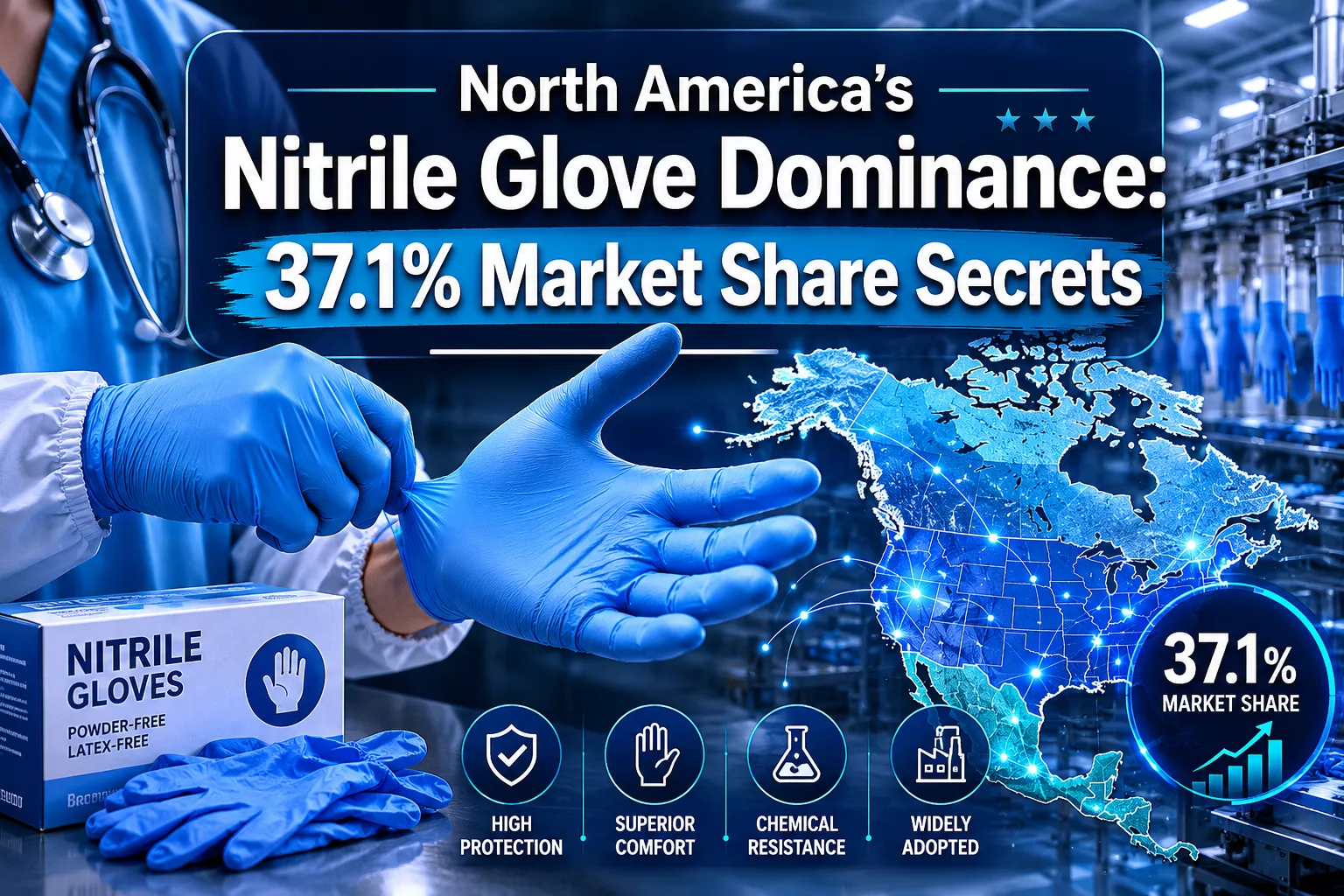
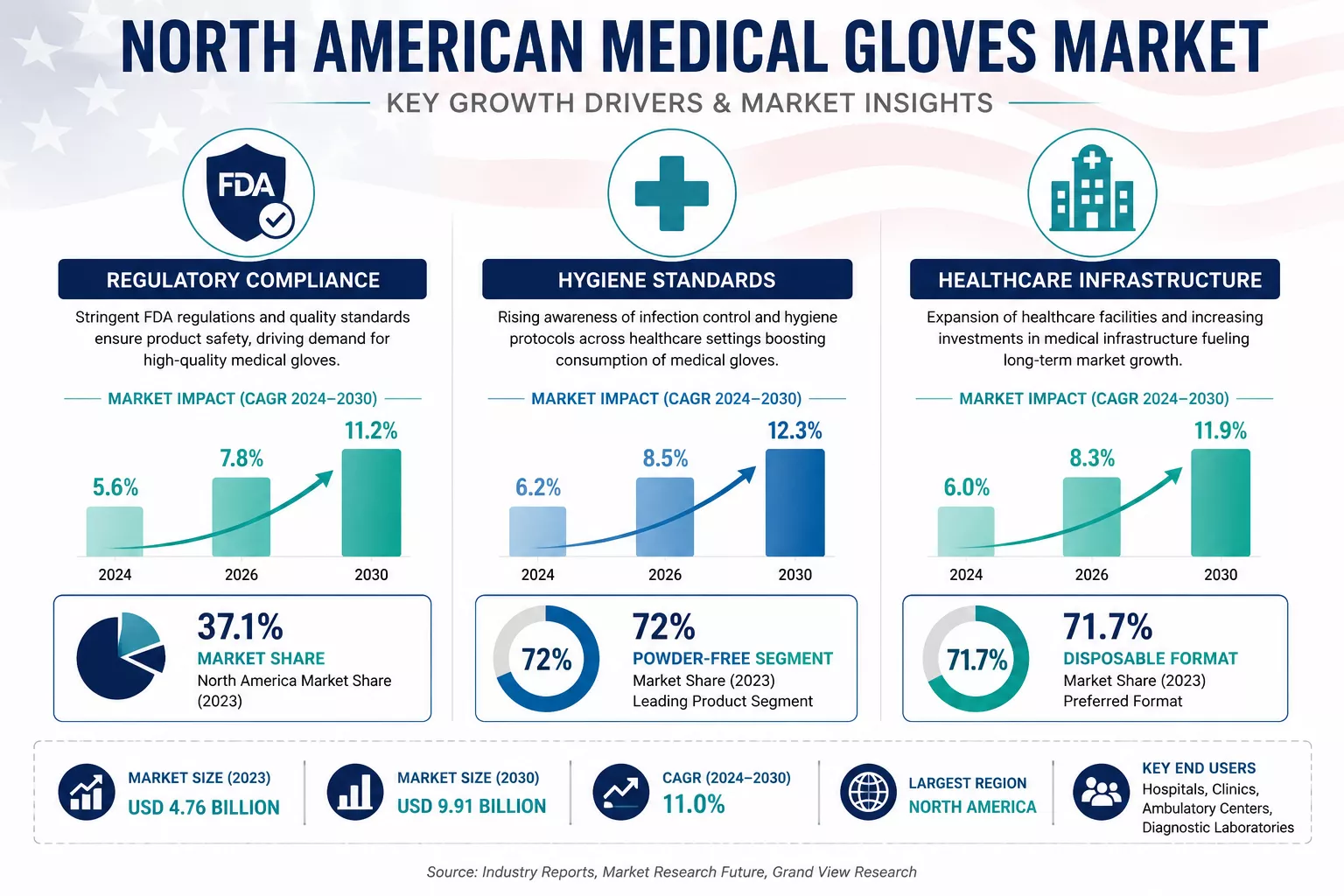
North America captured 37.1% of global nitrile glove revenue in 2025, establishing itself as the world’s largest regional market. This commanding position reflects decades of regulatory evolution, heightened hygiene awareness, and strategic infrastructure investments that transformed disposable gloves from a niche medical supply into an essential commodity across healthcare, food service, and industrial sectors. Understanding North America’s Nitrile Glove Dominance: 37.1% Market Share Secrets and Sourcing Opportunities reveals critical insights for buyers, distributors, and manufacturers navigating this high-growth market in 2026.
Key Takeaways
✅ North America holds 37.1% global revenue share in nitrile gloves, driven by strict regulatory standards and robust healthcare infrastructure
✅ Powder-free disposable formats dominate, representing approximately 72% of regional demand in 2026
✅ Healthcare and food processing sectors fuel consistent growth, with surgical procedures and infection control as primary drivers
✅ Strategic sourcing requires balancing local production advantages against global supply chain efficiencies
✅ Market projected to reach USD 5.43 billion by 2035 in North America alone, growing at 11.02% CAGR
Why North America’s Nitrile Glove Dominance Reached 37.1% Market Share
The region’s market leadership stems from three interconnected factors: regulatory rigor, healthcare spending, and latex-free adoption.
Regulatory Framework and Compliance Standards
North American regulatory bodies enforce stringent quality benchmarks that favor nitrile over alternatives. The FDA’s medical device classification system requires manufacturers to demonstrate biocompatibility, barrier integrity, and consistent performance. These standards naturally elevate nitrile gloves, which offer superior puncture resistance and chemical protection compared to vinyl or latex options.
Food safety regulations further amplify demand. The FDA Food Safety Modernization Act (FSMA) mandates protective barriers in food handling environments, driving adoption across restaurants, processing plants, and retail food operations. Powder-free nitrile gloves for chemistry labs and similar specialized applications benefit from these compliance requirements.
Healthcare Infrastructure Investment
The United States healthcare system alone performs millions of surgical procedures annually, each requiring multiple glove changes per operation. This volume creates baseline demand that smaller regions cannot match. The disposable gloves market in the U.S. is projected to increase by USD 1.6 billion from 2024 to 2029, growing at 7.5% CAGR primarily due to surgical volume and infection prevention protocols.
Hospital procurement departments increasingly specify nitrile for its latex-free composition, addressing allergy concerns while maintaining protection standards. The high demand for nitrile gloves in healthcare reflects this institutional preference shift.
Powder-Free and Disposable Format Preferences
Powder-free nitrile gloves represent approximately 72% of North American revenue in 2026, a dramatic shift from powdered latex dominance two decades ago. Healthcare facilities banned powder due to airborne contamination risks and surgical complications, creating permanent market restructuring.
The disposable segment commands roughly 71.7% market share, driven by single-use protocols in medical and food service settings. This format preference aligns with infection control best practices and eliminates cross-contamination risks inherent in reusable gloves.
Sourcing Opportunities: Leveraging North America’s Nitrile Glove Market Position
Smart buyers can capitalize on regional dynamics through strategic sourcing approaches that balance quality, cost, and supply security.
Local Production vs. Import Strategies
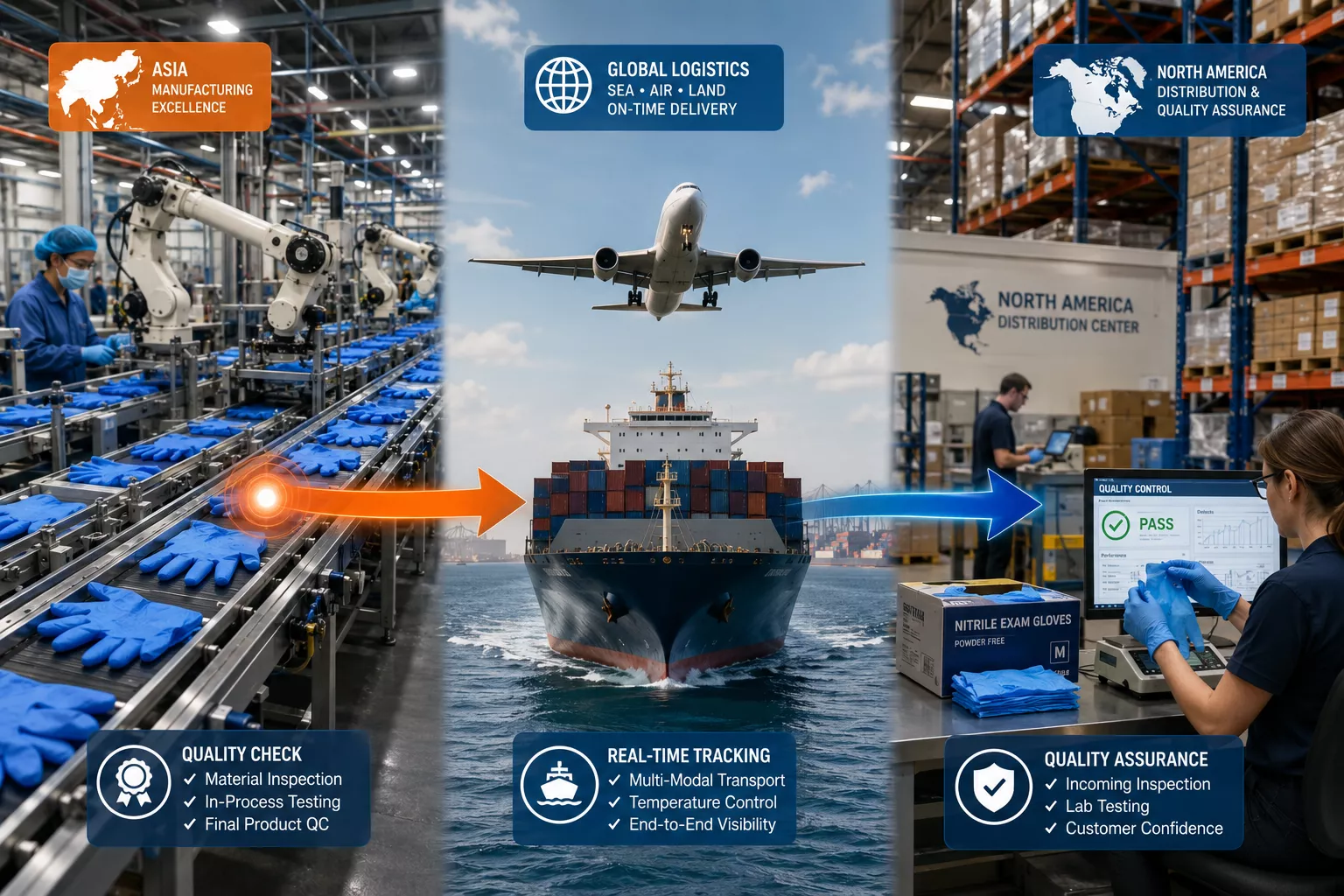
North America’s 37.1% consumption share does not translate to equivalent manufacturing capacity. Southeast Asia produces approximately 53.3% of global disposable gloves, creating a structural dependency on imports. This geographic mismatch presents both risks and opportunities.
Local production advantages:
- 🚚 Reduced shipping times and logistics costs
- 📋 Simplified regulatory compliance and quality audits
- 🛡️ Supply chain resilience during global disruptions
- 🤝 Direct manufacturer relationships and customization options
Import sourcing benefits:
- 💰 Lower per-unit costs due to scale economies
- 🏭 Access to specialized manufacturing capabilities
- 📊 Broader product variety and specification options
- 🌐 Established quality systems in major production hubs
Buyers should evaluate nitrile glove thickness and durability requirements against sourcing geography. High-specification industrial applications may justify premium local production, while standard food service gloves can leverage cost-effective imports.
Quality Verification and Certification
North American buyers must verify that imported gloves meet regional standards. Key certifications include:
| Certification | Application | Verification Focus |
|---|---|---|
| FDA 510(k) | Medical devices | Biocompatibility, sterility |
| ASTM D6319 | Examination gloves | Physical properties, dimensions |
| ASTM D6978 | Food handling | Chemical resistance, migration |
| EN 374 | Chemical protection | Permeation, degradation |
Distributors should request third-party test reports and maintain batch documentation. Understanding what makes nitrile gloves suitable for oil-contaminated environments requires specific chemical resistance data that varies by formulation.
Automated Manufacturing and Capacity Trends
The next wave of market growth is driven by investments in automated manufacturing capacity. Modern production lines reduce labor costs, improve consistency, and enable rapid scaling. Buyers partnering with manufacturers investing in automation gain access to:
- Consistent quality through reduced human error
- Faster order fulfillment and shorter lead times
- Competitive pricing as efficiency gains compound
- Innovation capacity for specialized formulations
Diverse applications for nitrile gloves continue expanding beyond traditional medical and food service sectors into beauty, automotive, and agricultural markets, each with distinct specification requirements.
Risk Mitigation Through Diversified Supply
The pandemic exposed vulnerabilities in concentrated supply chains. Forward-thinking buyers now implement multi-source strategies:
- Primary supplier (60-70% volume): Established relationship, competitive pricing
- Secondary supplier (20-30% volume): Geographic diversity, backup capacity
- Emergency supplier (10% volume): Rapid response capability, premium pricing accepted
This approach balances cost efficiency with supply security. Buyers should also consider nitrile gloves for food safety applications versus industrial uses when allocating supplier relationships, as regulatory requirements differ significantly.
Market Outlook: Sustaining North America’s Nitrile Glove Leadership Through 2035
The North American nitrile gloves market is projected to reach USD 5.43 billion by 2035, growing from USD 1.72 billion in 2024 at an 11.02% CAGR. This trajectory reflects sustained demand drivers rather than temporary pandemic effects.
Emerging Growth Sectors
Beyond traditional healthcare applications, several sectors show accelerating adoption:
- Food processing automation: Robotic food handling requires specialized glove specifications
- Pharmaceutical cleanrooms: Contamination control drives premium nitrile demand
- Beauty and personal care: Disposable nitrile gloves in beauty services address hygiene and allergy concerns
- Agricultural operations: Farm-specific nitrile gloves protect against pesticides and zoonotic diseases
Sustainability and Material Innovation
Environmental concerns are reshaping product development. Manufacturers are investing in:
- Biodegradable nitrile formulations that maintain performance standards
- Recycling programs for post-consumer glove waste
- Reduced packaging materials and optimized shipping densities
- Plant-based additives to reduce petroleum dependency
Buyers prioritizing sustainability should request lifecycle assessments and environmental certifications from suppliers. Understanding what nitrile gloves are and their composition helps evaluate environmental claims.
Competitive Dynamics and Consolidation
Market concentration is increasing as larger manufacturers acquire regional players to secure distribution networks. This consolidation creates opportunities for mid-tier buyers to negotiate volume commitments in exchange for pricing stability and supply guarantees.
Strategic buyers should monitor manufacturer capacity expansions, particularly in Mexico and the southern United States, where proximity to end markets combines with competitive labor costs.
Conclusion
North America’s Nitrile Glove Dominance: 37.1% Market Share Secrets and Sourcing Opportunities reveals a market shaped by regulatory excellence, healthcare infrastructure, and strategic format preferences. The region’s leadership position reflects decades of quality standards evolution and institutional adoption that created structural demand advantages.
For buyers and distributors, the path forward requires balancing local production benefits against global sourcing efficiencies. Successful strategies incorporate multi-source supply chains, rigorous quality verification, and partnerships with manufacturers investing in automation and innovation.
Actionable Next Steps
🔍 Audit current suppliers against FDA, ASTM, and industry-specific certifications
📊 Evaluate sourcing geography based on application requirements and risk tolerance
🤝 Establish secondary supplier relationships before supply disruptions occur
📈 Monitor emerging sectors like pharmaceutical cleanrooms and automated food processing
♻️ Request sustainability data to align procurement with environmental goals
The North American nitrile glove market’s projected growth to USD 5.43 billion by 2035 offers substantial opportunities for stakeholders who understand regional dynamics and implement strategic sourcing frameworks. By leveraging the insights behind the 37.1% market share achievement, buyers can secure competitive advantages in quality, cost, and supply reliability throughout the next decade.