Disposable gloves generate millions of tons of waste annually, but one company’s November 2024 launch is changing the conversation. Sybron introduced biodegradable nitrile gloves that achieve 81% breakdown in just 491 days under landfill conditions—without charging a premium over standard nitrile prices. This represents a significant shift in how the personal protective equipment (PPE) industry approaches sustainability, especially as the global nitrile gloves market races toward USD 8.78 billion by 2031.
The Biodegradable Nitrile Gloves: Sybron’s 81% Breakdown in 491 Days and Eco-Friendly Shift marks a turning point for healthcare facilities, automotive shops, food manufacturers, and cleaning services seeking greener alternatives without sacrificing performance or budget.
Key Takeaways
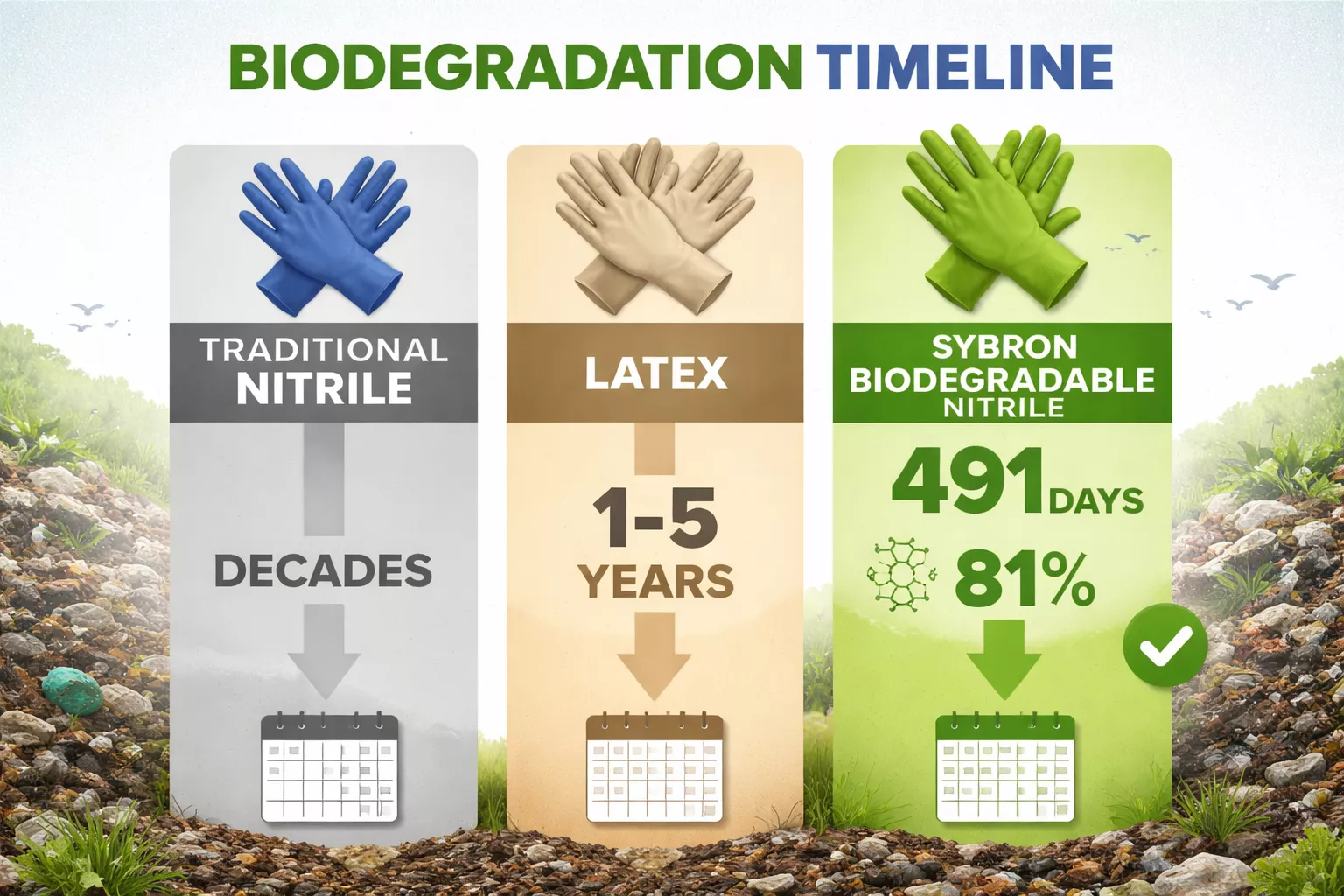
✅ Sybron’s biodegradable nitrile gloves break down 81% in 491 days in active landfill environments, compared to decades for traditional nitrile
✅ Priced identically to standard nitrile gloves, removing the cost barrier for sustainable PPE adoption
✅ Food-approved, powder-free, and textured for grip across healthcare, automotive, food service, and janitorial sectors
✅ Sybron de-listed conventional latex and nitrile products as part of its environmental commitment
✅ Part of broader industry trend toward sustainable disposable gloves as market grows 9.35% annually
Understanding the Biodegradable Nitrile Gloves Innovation
What Makes Sybron’s Gloves Different?
Traditional nitrile gloves are synthetic rubber products that can persist in landfills for decades. The Biodegradable Nitrile Gloves: Sybron’s 81% Breakdown in 491 Days and Eco-Friendly Shift addresses this problem through modified polymer technology that accelerates decomposition when exposed to landfill microorganisms.
Key specifications include:
- 🧤 81% biodegradation in 491 days (active landfill conditions)
- 💰 Same price as standard nitrile gloves
- 🍽️ Food-approved and powder-free
- 🤲 Textured surface for enhanced grip
- 🎨 Available in blue and black colors
- 📏 Four size options for universal fit
How Biodegradation Actually Works
The term “biodegradable” requires careful interpretation. Sybron’s gloves begin decomposing when disposed of in active landfill environments where microorganisms, moisture, and specific conditions trigger breakdown. This differs significantly from:
- ❌ Home composting (not suitable)
- ❌ Open-air decomposition (minimal effect)
- ❌ Standard recycling streams (not recyclable)
- ✅ Municipal landfills with active microbial activity
For context, latex gloves naturally biodegrade in 1-5 years because they’re made from natural rubber, but they carry higher allergy risks. Standard nitrile gloves can take decades or longer to decompose. The Biodegradable Nitrile Gloves: Sybron’s 81% Breakdown in 491 Days and Eco-Friendly Shift represents an incremental but meaningful improvement over conventional synthetic options.
Market Impact and Industry Applications
Target Sectors Embracing the Change
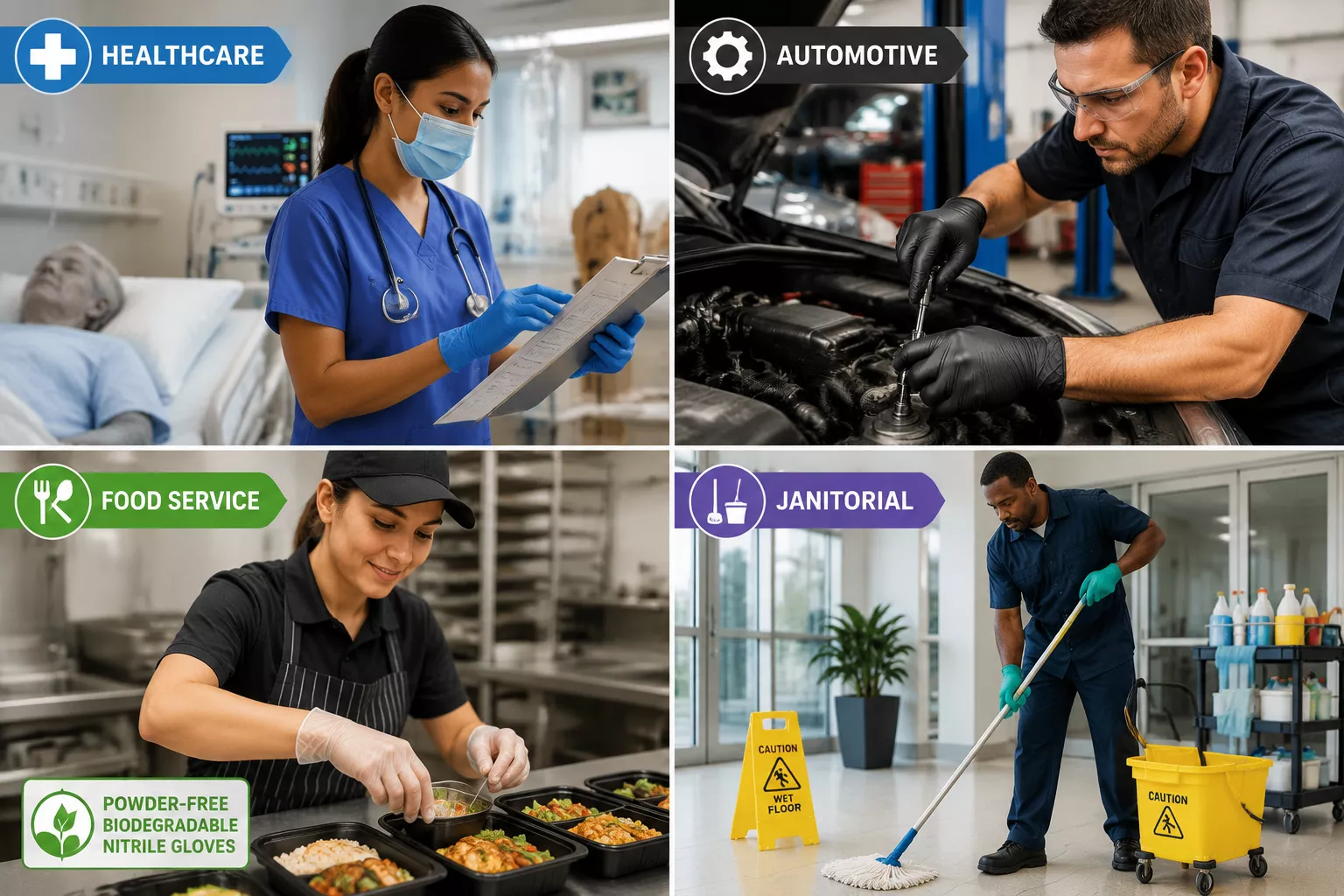
Sybron positioned these gloves for broad cross-industry adoption, targeting sectors where disposable glove usage is highest:
Healthcare & Medical Facilities 🏥
Hospitals and clinics use millions of gloves daily. The demand for nitrile gloves in healthcare remains strong due to latex allergy concerns, making biodegradable options attractive for sustainability-focused institutions.
Food Manufacturing & Preparation 🍴
Food-approved biodegradable gloves meet safety standards while reducing environmental impact. Organizations evaluating food-safe nitrile gloves can now choose eco-friendly options without compromising hygiene protocols.
Automotive & Mechanical Services 🔧
Mechanics who regularly wear nitrile gloves for oil changes and repairs generate significant disposable waste. Black biodegradable gloves offer the same chemical resistance with reduced environmental persistence.
Janitorial & Facilities Management 🧹
Cleaning services consume enormous quantities of disposable gloves. The identical pricing makes switching to biodegradable options a straightforward decision for procurement managers.
Construction & Utilities 🏗️
Workers requiring hand protection in various conditions benefit from textured grip surfaces while contributing to reduced landfill impact.
The Broader Market Context
The global nitrile gloves market demonstrates why sustainability innovations matter:
| Market Metric | 2024 Value | 2031 Projection | Growth Rate |
|---|---|---|---|
| Market Size | USD 4.70 billion | USD 8.78 billion | 9.35% CAGR |
| Powder-Free Share | 56.6% | Growing | Dominant segment |
| Disposable Share | 71.7% | Growing | Largest category |
The Biodegradable Nitrile Gloves: Sybron’s 81% Breakdown in 491 Days and Eco-Friendly Shift competes directly in the market’s largest segments—powder-free and disposable—where volume is highest and environmental impact most significant.
Sybron’s Environmental Commitment Strategy
De-Listing Conventional Products
Sybron didn’t just add biodegradable options—the company de-listed its standard latex and nitrile gloves entirely. This bold move signals genuine commitment rather than “greenwashing” through token eco-friendly product lines.
This strategy creates several advantages:
✅ Simplified procurement for buyers (no choice paralysis)
✅ Clear brand positioning around sustainability
✅ Market differentiation from competitors offering both types
✅ Reduced inventory complexity for distributors
No Price Premium: Breaking the Sustainability Barrier
Historically, eco-friendly alternatives cost 20-40% more than conventional products, creating adoption barriers. By pricing biodegradable gloves identically to standard nitrile, Sybron removes the primary objection for cost-conscious buyers.
This pricing strategy could accelerate industry-wide adoption, especially among:
- 🏢 Large institutional buyers with sustainability mandates
- 💼 Small businesses unable to absorb premium costs
- 📊 Procurement departments balancing environmental and budget goals
- 🌍 Organizations pursuing ESG (Environmental, Social, Governance) targets
Limitations and Realistic Expectations
What Biodegradable Doesn’t Mean
The Biodegradable Nitrile Gloves: Sybron’s 81% Breakdown in 491 Days and Eco-Friendly Shift represents progress, but it’s not a complete circular-economy solution. Important limitations include:
⚠️ Landfill-Dependent Decomposition
The 81% breakdown occurs specifically in active landfill environments with microbial activity, moisture, and appropriate conditions. Gloves discarded in other environments may not decompose at the same rate.
⚠️ Not Compostable
These gloves aren’t suitable for home or commercial composting systems. They require industrial landfill conditions to trigger biodegradation.
⚠️ Not Recyclable
Like all contaminated disposable gloves, these cannot enter standard recycling streams and must be disposed of as general waste.
⚠️ 19% Remains After 491 Days
While 81% breakdown is impressive, nearly one-fifth of the material persists beyond the tested timeframe. Long-term decomposition data beyond 491 days isn’t publicly available.
Comparing to Other Materials
Understanding how different glove materials decompose helps contextualize Sybron’s innovation:
| Material | Decomposition Time | Allergy Risk | Chemical Resistance |
|---|---|---|---|
| Latex | 1-5 years | High | Moderate |
| Standard Nitrile | Decades+ | Low | Excellent |
| Biodegradable Nitrile | 81% in 491 days | Low | Excellent |
| Vinyl | Very slow | Low | Limited |
For professionals comparing nitrile gloves to vinyl alternatives, biodegradable nitrile offers superior performance with improved environmental profile.
Industry Trend: The Sustainability Wave
Multiple Manufacturers Investing in Green Solutions
Sybron isn’t alone in pursuing biodegradable glove technology. The broader industry is experiencing a sustainability-focused innovation wave with several manufacturers launching eco-friendly products in 2024-2026.
This trend reflects:
🌱 Regulatory pressure for reduced plastic waste
🌱 Corporate sustainability commitments from major buyers
🌱 Consumer demand for environmentally responsible products
🌱 Competitive differentiation in crowded markets
What This Means for Buyers in 2026
Organizations purchasing disposable gloves should expect:
More Options: Additional biodegradable products entering the market
Price Competition: Potential price reductions as production scales
Performance Parity: Eco-friendly options matching conventional glove specifications
Transparency Requirements: Increased scrutiny of biodegradation claims and testing standards
For buyers evaluating the best thickness for nitrile gloves or uses across different applications, biodegradable options now exist across multiple specifications.
Practical Considerations for Switching
Who Should Consider Biodegradable Nitrile Gloves?
Ideal candidates for adoption:
✅ Healthcare facilities with sustainability goals
✅ Food service operations seeking eco-friendly PPE
✅ Automotive shops with high glove consumption
✅ Educational institutions teaching environmental responsibility
✅ Government agencies with green procurement mandates
✅ Any organization using 10,000+ gloves annually
Implementation Steps
1. Evaluate Current Usage
Calculate monthly glove consumption and disposal costs to understand potential environmental impact reduction.
2. Test Product Performance
Order sample boxes to verify grip, durability, and comfort meet operational requirements.
3. Update Procurement Specifications
Modify purchasing guidelines to specify biodegradable options where appropriate.
4. Train Staff
Educate employees on proper disposal (general waste to landfill, not recycling or composting).
5. Track Impact
Monitor glove usage and calculate estimated waste reduction for sustainability reporting.
Conclusion
The Biodegradable Nitrile Gloves: Sybron’s 81% Breakdown in 491 Days and Eco-Friendly Shift represents meaningful progress in reducing disposable PPE waste without compromising performance or affordability. By achieving 81% biodegradation in 491 days at the same price as conventional nitrile gloves, Sybron has removed the primary barriers to sustainable glove adoption.
While these gloves aren’t a perfect circular-economy solution—requiring landfill conditions for decomposition and leaving 19% residual material—they offer substantial improvement over traditional nitrile products that persist for decades. The company’s decision to de-list conventional products demonstrates genuine commitment to environmental responsibility.
Next Steps for Your Organization
Immediate Actions:
🔹 Request samples from Sybron or authorized distributors to test performance
🔹 Calculate your annual glove consumption to understand potential environmental impact
🔹 Review procurement policies to incorporate biodegradable specifications
🔹 Compare pricing against current suppliers to verify cost parity
🔹 Educate stakeholders about proper disposal requirements for biodegradable gloves
As the nitrile gloves market grows toward USD 8.78 billion by 2031, sustainability innovations like Sybron’s biodegradable gloves will likely become industry standard rather than exception. Organizations adopting these solutions now position themselves as environmental leaders while maintaining operational efficiency and budget discipline.
The shift toward biodegradable PPE has begun—and it’s happening at no additional cost.