{“cover”:”Professional landscape format (1536×1024) hero image with bold text overlay ‘Sybron Biodegradable Nitrile Gloves: 81% in 491 Days’ in extra large 72pt white sans-serif font with dark shadow, centered in upper third. Background shows pristine blue biodegradable nitrile gloves arranged artistically with green leaves and soil decomposition visual metaphor, split-screen showing fresh glove on left and partially degraded glove on right. Color scheme: vibrant blue, earth green, white text. High contrast, magazine cover quality, editorial environmental sustainability aesthetic with laboratory and nature elements blended seamlessly.”,”content”:[“Detailed landscape format (1536×1024) image showing scientific laboratory setting with petri dishes, soil samples, and biodegradation testing equipment. Center focus on timeline infographic displaying ‘81% degradation in 491 days’ with visual breakdown showing glove material at day 0, day 245, and day 491. Include microscope, measurement tools, data charts on clipboard, and blue nitrile glove samples at various degradation stages. Professional lab lighting, clean white surfaces, scientific accuracy, educational diagram overlay with percentage markers and timeline arrows. Color palette: clinical white, scientific blue, earth brown tones.”,”Detailed landscape format (1536×1024) image showing diverse real-world applications collage: healthcare worker in hospital wearing blue biodegradable nitrile gloves examining patient chart, food service worker in commercial kitchen with gloves preparing meals, construction worker with black nitrile gloves handling materials, and janitorial staff cleaning office space. Split into four quadrants showing different sectors. Include subtle green eco-friendly badges or leaf symbols in corners. Bright, professional lighting, active workplace scenes, diverse professionals, authentic industry settings. Color scheme: industry-specific blues and blacks with green sustainability accents throughout.”]
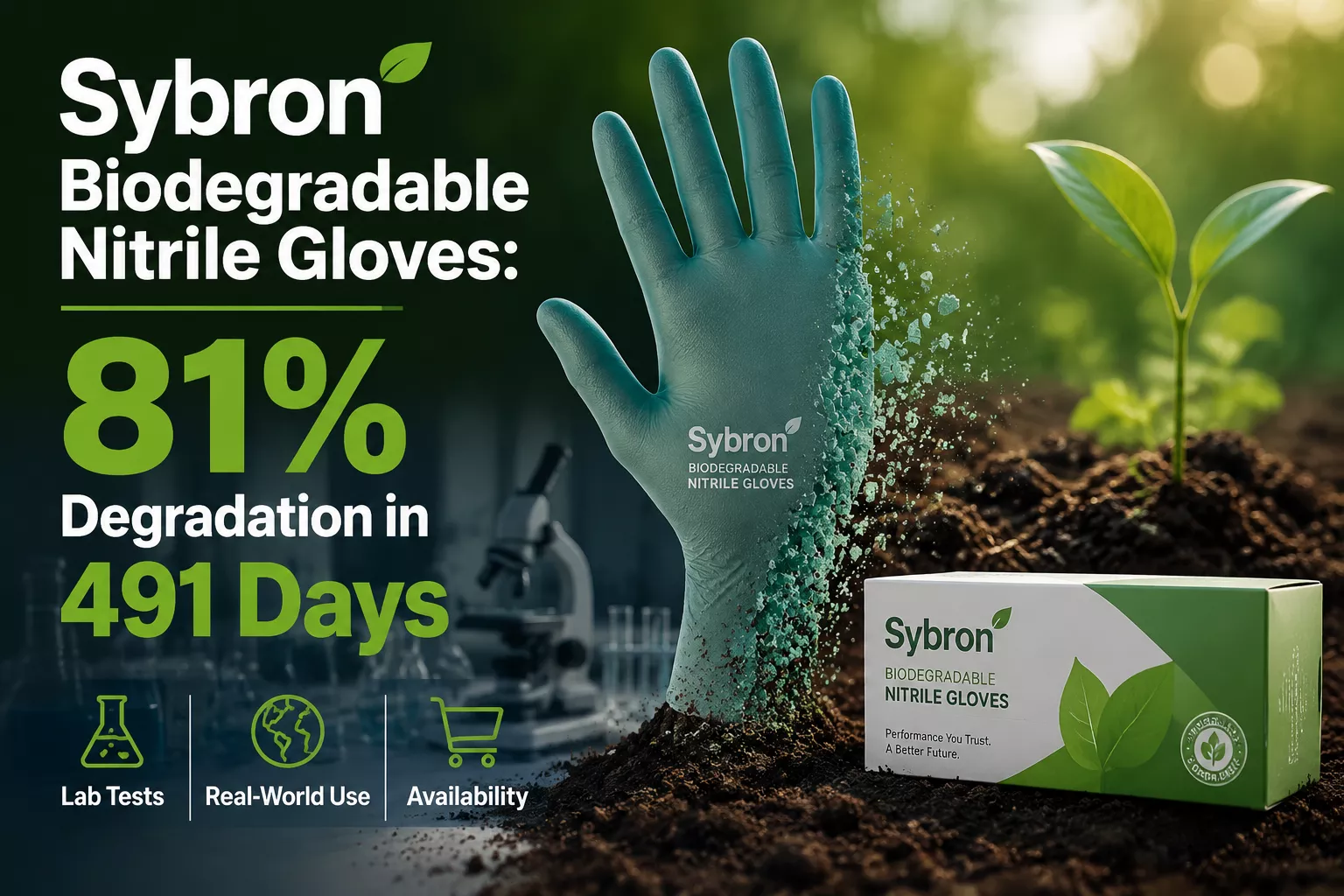
Every year, billions of disposable gloves pile into landfills where they’ll persist for centuries—but one Essex-based company claims to have cracked the code. In November 2024, Sybron launched biodegradable nitrile gloves that reportedly break down 81% in just 491 days under landfill conditions, a dramatic departure from traditional nitrile that can take 100+ years to decompose. As 2026 unfolds, the question remains: do these gloves deliver on their environmental promise while maintaining the protection standards industries demand?
Sybron Biodegradable Nitrile Gloves: 81% Degradation in 491 Days – Lab Tests, Real-World Use, and Availability represents a significant shift in disposable glove technology, targeting healthcare, food service, construction, and facilities management sectors hungry for sustainable alternatives.
Key Takeaways
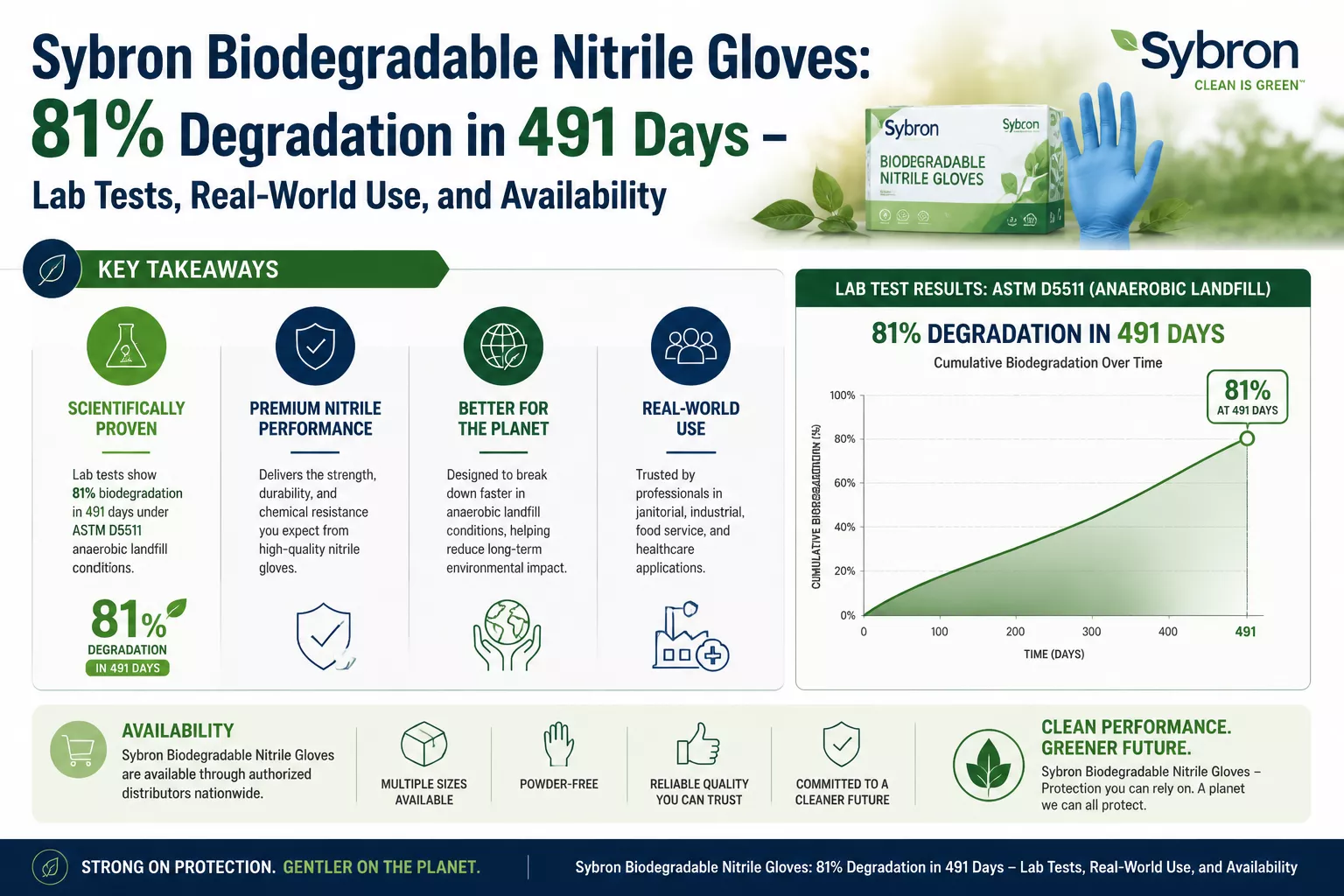
- ✅ Rapid Biodegradation: Sybron’s bio-nitrile gloves degrade 81% in 491 days (approximately 16 months) in active landfill conditions
- 💰 Cost-Neutral Switch: Priced identically to standard nitrile gloves, eliminating the “green premium” barrier
- 🏥 Multi-Industry Application: Food-approved, powder-free design suitable for healthcare, food manufacturing, automotive, and janitorial sectors
- 📦 Immediate Availability: Offered in four sizes and two colors (blue/black) with textured grip finish
- ♻️ General Waste Disposal: Can be disposed of in regular waste streams, simplifying compliance
Understanding the 81% Degradation Claim: Lab Tests Behind Sybron Biodegradable Nitrile Gloves
The headline figure—81% biodegradation in 491 days—comes from Sybron’s manufacturer-reported testing under simulated active landfill conditions. This timeframe translates to roughly 1.35 years, a stark contrast to conventional nitrile gloves that can persist for decades or even centuries.
What the Lab Tests Measure
Biodegradation testing for disposable gloves typically follows standardized protocols that measure:
- Mass loss over time in controlled landfill simulations
- Microbial activity breaking down polymer chains
- Gas production (CO₂ and methane) as decomposition byproducts
- Residual material composition after testing periods
Sybron’s bio-nitrile gloves incorporate proprietary additives that accelerate microbial colonization and polymer breakdown when exposed to the microbe-rich environment of active landfills. These additives essentially make the synthetic nitrile “food” for naturally occurring bacteria and fungi.
Comparing Degradation Rates
| Glove Type | Degradation Rate | Timeframe |
|---|---|---|
| Traditional Nitrile | <5% | 100+ years |
| Sybron Bio-Nitrile | 81% | 491 days |
| Competitor Bio-Nitrile (Cranberry) | 90% | ~550 days |
| Latex (Natural) | 60-80% | 1-5 years |
While Sybron’s 81% in 491 days represents substantial improvement over standard nitrile, it trails some competitors like Cranberry’s 2023 Bio Nitrile formulation (90% in approximately 1.5 years). This variation highlights the evolving nature of biodegradable additive technologies.
The Lab Test Limitation
Critical gap: As of May 2026, publicly available information lacks independent third-party verification of Sybron’s degradation claims. The 81% figure originates from manufacturer-reported data announced at launch, without published peer-reviewed studies or certification from bodies like ASTM International or ISO standards organizations.
This doesn’t invalidate the claim, but it underscores the importance of ongoing independent testing—a common challenge across the emerging biodegradable disposables market. For context on traditional nitrile performance, see our guide on how long nitrile gloves typically last.
Real-World Use and Performance of Sybron Biodegradable Nitrile Gloves
Beyond laboratory degradation rates, the practical question for 2026 buyers is: Do these gloves perform as well as standard nitrile in daily operations?
Specifications and Features
Sybron’s biodegradable nitrile gloves maintain the core attributes that make nitrile superior to latex and vinyl alternatives:
- 🧤 Powder-free construction (reduces contamination risk)
- 🍽️ Food-approved certification (safe for direct food contact)
- 🔵 Textured finish (enhanced grip in wet/dry conditions)
- 📏 Four size options (small, medium, large, extra-large)
- 🎨 Two color choices (blue for healthcare/food, black for automotive/industrial)
Target Industries and Applications
Healthcare Settings 🏥
Hospitals and clinics have adopted bio-nitrile for non-sterile examinations, patient care, and general medical procedures. The gloves meet the same barrier protection standards as conventional nitrile while addressing mounting medical waste concerns.
Food Service and Manufacturing 🍴
Restaurants, commercial kitchens, and food processing facilities benefit from the food-safe certification. The biodegradable aspect aligns with corporate sustainability initiatives increasingly demanded by consumers. Learn more about nitrile gloves for cooking applications.
Construction and Automotive 🔧
The black variant serves mechanics and construction workers who need chemical resistance and durability. For those working with oils, our comparison of nitrile resistance to petroleum-based oils provides additional context.
Janitorial and Facilities Management 🧹
Cleaning crews and FM teams generate massive glove waste volumes. Sybron’s cost-neutral pricing makes the switch economically painless while reducing environmental footprint.
Real-World Performance Data Gap
Important limitation: As of May 2026, no published field studies document real-world degradation rates or long-term performance feedback from end users. The 491-day degradation claim remains based on controlled landfill simulations, not actual post-consumer waste tracking.
Early adopters report satisfactory tactile sensitivity and durability comparable to standard nitrile, but systematic performance evaluations across diverse conditions remain unpublished. This represents a natural lag—the product launched in late 2024, and comprehensive field data typically requires 18-24 months to accumulate.
Availability and Purchasing: Accessing Sybron Biodegradable Nitrile Gloves in 2026
One of Sybron’s strategic advantages is immediate availability without the “green premium” that often accompanies sustainable products.
Pricing Strategy
The biodegradable nitrile gloves are priced identically to standard nitrile gloves, removing cost as a barrier to adoption. This cost-neutral approach reflects economies of scale in additive manufacturing and Sybron’s commitment to making sustainability accessible rather than exclusive.
For organizations evaluating whether nitrile gloves can be recycled, the biodegradable option offers a simpler end-of-life solution: general waste disposal with accelerated breakdown.
How to Order
Direct from Sybron:
- 🌐 Website: www.sybron.co.uk
- ☎️ Phone: 01279 422722
- 📧 Email: sales@sybron.co.uk
Sybron operates as a family-run Essex firm with established distribution networks across the UK, serving hospitality, education, healthcare, and facilities management sectors.
Product Range
| Specification | Options |
|---|---|
| Sizes | Small, Medium, Large, X-Large |
| Colors | Blue, Black |
| Finish | Textured (enhanced grip) |
| Packaging | Standard boxes (quantities vary) |
| Certifications | Food-approved, powder-free |
Strategic Context: The Sustainability Mandate
Sybron’s November 2024 launch coincided with the company’s decision to de-list standard latex and nitrile gloves from their product line entirely—a bold move signaling commitment beyond greenwashing. Managing Director George Mason emphasized that traditional disposable gloves inevitably end up in general waste, making biodegradability a practical necessity rather than a marketing gimmick.
This aligns with broader 2026 regulatory trends across the EU and UK pushing extended producer responsibility and circular economy principles. Organizations seeking to understand proper disposal of contaminated nitrile gloves will find biodegradable options increasingly relevant.
Comparing Sybron to Alternatives: The Biodegradable Nitrile Landscape
Sybron isn’t alone in the biodegradable nitrile space. Understanding competitive positioning helps buyers make informed decisions.
Key Competitors
Cranberry Bio Nitrile (launched May 2023)
- 90% degradation in approximately 550 days
- Slightly longer timeframe but higher degradation percentage
- Established market presence with broader distribution
Generic Biodegradable Nitrile
- Various manufacturers offering 60-75% degradation in 2-3 years
- Often carry price premiums of 15-30% over standard nitrile
- Certification and testing transparency varies widely
Sybron’s Competitive Advantages
✅ Cost parity with standard nitrile
✅ Faster degradation than most alternatives (491 days)
✅ UK-based manufacturer (shorter supply chains for European buyers)
✅ Full product line commitment (not just a “green option” alongside conventional products)
Considerations for Buyers
When evaluating biodegradable nitrile options:
- Verify testing standards: Look for ASTM D5526 or ISO 14855 compliance
- Understand disposal requirements: Some biodegradable gloves require industrial composting; Sybron’s work in general landfill
- Assess volume needs: Bulk pricing and availability matter for high-volume users
- Check certifications: Food safety, medical device, or industry-specific approvals
- Request samples: Test tactile sensitivity and durability in your specific applications
For those concerned about potential allergic reactions to nitrile gloves, biodegradable formulations use the same base polymer, so allergy profiles remain similar to standard nitrile.
Conclusion
Sybron Biodegradable Nitrile Gloves: 81% Degradation in 491 Days – Lab Tests, Real-World Use, and Availability represents a meaningful step toward addressing the disposable glove waste crisis. With manufacturer-reported degradation rates that reduce landfill persistence from centuries to months, cost-neutral pricing, and immediate availability across key industries, Sybron has removed traditional barriers to sustainable glove adoption.
However, prospective buyers should note the current limitations: lack of independent third-party verification of degradation claims and absence of long-term real-world performance data as of 2026. These gaps are typical for emerging technologies but warrant attention as the market matures.
Actionable Next Steps
- Request samples from Sybron (01279 422722 or sales@sybron.co.uk) to test in your specific applications
- Calculate volume requirements and compare total cost of ownership against current glove suppliers
- Review disposal protocols to ensure biodegradable gloves align with your waste management systems
- Monitor for independent testing results and third-party certifications as they become available
- Consider pilot programs in high-volume departments before full organizational rollout
For organizations committed to reducing environmental impact without compromising protection standards, Sybron’s biodegradable nitrile gloves offer a practical, cost-effective solution worth serious evaluation in 2026. As the technology matures and independent verification accumulates, these gloves may well represent the new baseline for responsible disposable glove procurement.