Last updated: June 26, 2026
Quick Answer
The rise of nitrile in food service is driven by three critical factors: elimination of latex allergy risks, superior puncture resistance compared to vinyl alternatives, and compliance with evolving FDA food contact regulations. Nitrile gloves now dominate commercial kitchens because they protect both workers and consumers while meeting stricter hygiene protocols introduced after 2020. Most restaurants and food processors have completed the switch from latex and vinyl to nitrile as the default hand protection standard.
Key Takeaways
- Nitrile gloves eliminate latex protein allergies that affect 8-12% of healthcare and food service workers, making them the safest choice for diverse workforces.
- FDA-compliant nitrile formulations meet 21 CFR 177.2600 standards for direct food contact, unlike many vinyl glove formulations that contain plasticizers.
- Puncture resistance in nitrile gloves is 3-5 times higher than vinyl, reducing contamination risks from torn gloves during food preparation.
- Cost per glove has decreased 40% since 2020 as manufacturing capacity expanded, making nitrile competitive with vinyl in most commercial applications.
- Proper glove changing protocols require new nitrile gloves every time a food handler switches tasks, touches non-food surfaces, or after 4 hours of continuous use.
- Consumer surveys show 73% of diners view glove use as a positive hygiene indicator, with blue nitrile gloves specifically associated with professional food safety practices.
- Environmental concerns remain valid as nitrile is not biodegradable, but recycling programs and reduced glove waste from fewer tears partially offset disposal impacts.
What Are Nitrile Gloves and Why Are They Used in Food Service
Nitrile gloves are synthetic rubber gloves made from acrylonitrile-butadiene copolymer, designed specifically to provide chemical resistance, durability, and hypoallergenic protection. Food service operations use them because they create an effective barrier against bacteria, viruses, and food-borne pathogens while allowing workers to maintain dexterity during food preparation tasks.
The material composition makes nitrile gloves particularly suitable for food handling environments. Unlike natural rubber latex, nitrile contains no proteins that trigger allergic reactions. The synthetic polymer structure provides:
- Barrier protection against oils, fats, and mild acids commonly found in food preparation
- Tactile sensitivity that allows workers to feel texture and grip utensils effectively
- Tear resistance that prevents mid-task failures during cutting, slicing, and handling operations
- Temperature tolerance ranging from -40°F to 220°F for most food service applications
Food service managers choose nitrile because it addresses multiple safety concerns simultaneously. The gloves protect workers from raw meat bacteria, prevent cross-contamination between allergen-containing foods, and demonstrate visible hygiene practices to customers. Blue-colored nitrile gloves have become the industry standard because they’re easily visible if a piece tears off into food.
For comprehensive guidance on selecting appropriate gloves for kitchen work, see our guide to choosing the right nitrile glove for cooking.
Nitrile vs Latex Gloves for Food Handling: Which Is Better
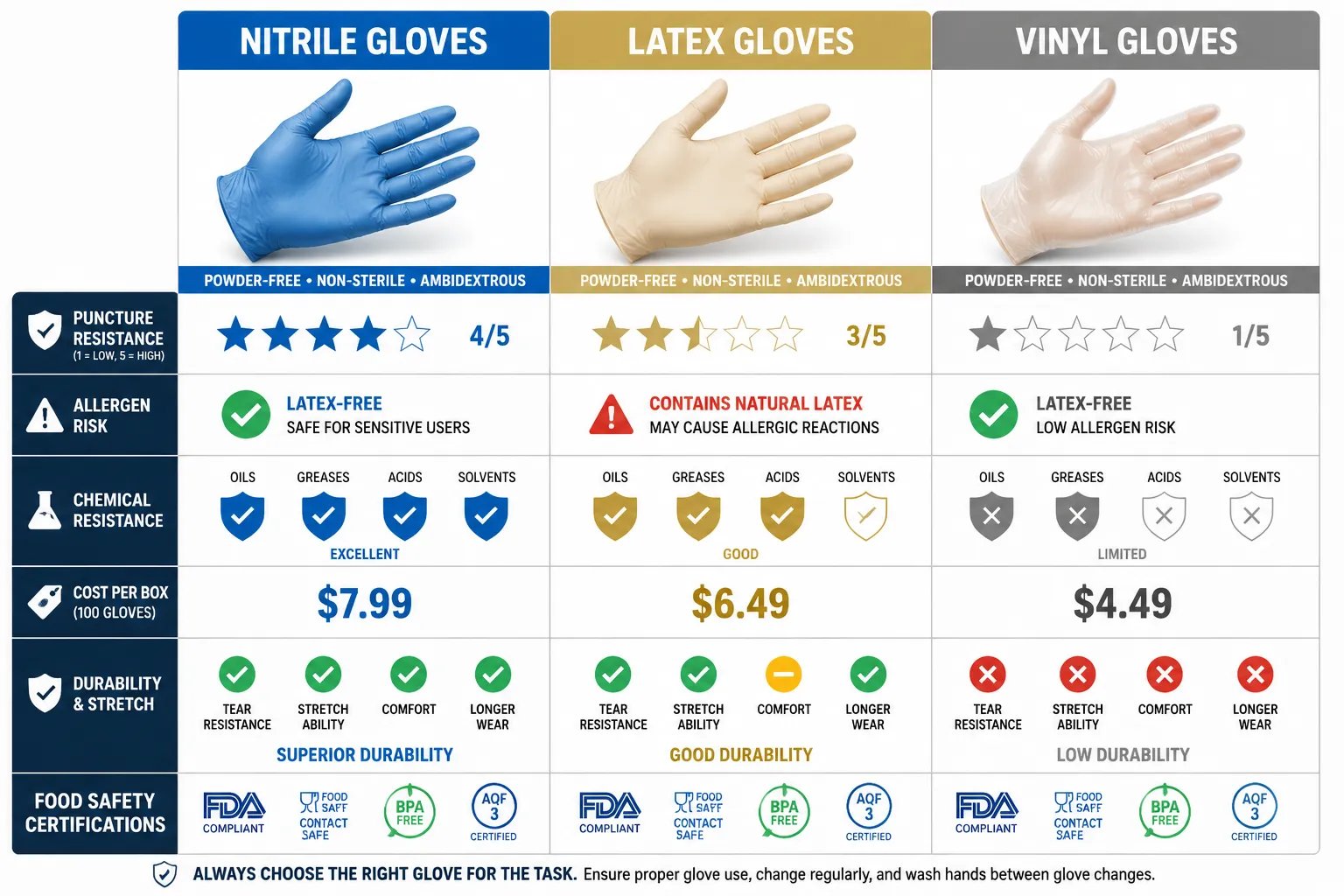
Nitrile gloves are objectively better for food handling in 2026 because they eliminate latex allergy risks while providing equal or superior barrier protection and durability. Latex gloves, once the food service standard, have been phased out in most commercial kitchens due to allergy concerns and regulatory pressure.
The comparison breaks down across several critical dimensions:
Allergy Safety
- Nitrile: Contains no natural rubber proteins; safe for workers with latex allergies
- Latex: Contains proteins that cause Type I hypersensitivity reactions in 8-12% of frequent users
- Winner: Nitrile, decisively
Puncture and Tear Resistance
- Nitrile: 3-5 times more puncture-resistant than latex of equivalent thickness
- Latex: More elastic but tears more easily when nicked or stressed
- Winner: Nitrile for durability
Chemical Resistance
- Nitrile: Excellent resistance to oils, fats, petroleum products, and many cleaning chemicals
- Latex: Poor resistance to oils and fats; degrades when exposed to cooking oils
- Winner: Nitrile for kitchen environments
Cost
- Nitrile: $8-15 per 100-count box for food-grade quality
- Latex: $6-12 per 100-count box
- Winner: Latex slightly cheaper, but cost gap has narrowed significantly
Tactile Sensitivity
- Nitrile: Good sensitivity, especially in thinner gauges (3-4 mil)
- Latex: Slightly better natural feel and elasticity
- Winner: Latex marginally, but difference is minimal in practice
The decisive factor is safety. Latex allergies can develop after repeated exposure, meaning workers who start without sensitivity may become allergic over time. This creates liability risks for employers and health risks for staff. Nitrile eliminates this concern entirely while matching or exceeding latex performance in every practical measure that matters for food service.
For a detailed comparison of material properties, review our article on the difference between latex and nitrile gloves.
Are Nitrile Gloves FDA Approved for Food Contact
Yes, nitrile gloves manufactured to meet 21 CFR 177.2600 standards are FDA-approved for direct food contact. Not all nitrile gloves carry this certification, so food service operators must verify that their supplier provides FDA-compliant formulations specifically rated for food handling.
The FDA regulates food contact substances under Title 21 of the Code of Federal Regulations. Section 177.2600 covers rubber articles intended for repeated use in contact with food. For single-use nitrile gloves, manufacturers must demonstrate that:
- The polymer formulation does not migrate harmful chemicals into food
- Additives, plasticizers, and colorants meet food-safe specifications
- The finished product passes extraction testing for potential contaminants
- Manufacturing processes follow Good Manufacturing Practices (GMP)
How to Verify FDA Compliance
When purchasing nitrile gloves for food service, look for these indicators:
- Explicit FDA compliance statement on the product packaging or specification sheet
- 21 CFR 177.2600 citation in technical documentation
- Food-safe certification from recognized testing laboratories
- Manufacturer’s declaration of intended use for food contact applications
Many industrial-grade nitrile gloves are not formulated for food contact. They may contain accelerators, stabilizers, or colorants that are safe for mechanical work but not approved for food handling. Using non-food-grade gloves in commercial kitchens violates health codes and creates contamination risks.
For more information on food safety compliance, see our detailed guide on whether nitrile gloves are safe for food handling.
Why Are Restaurants Switching From Latex to Nitrile Gloves
Restaurants are switching from latex to nitrile gloves primarily to eliminate allergy liability, comply with updated health department guidelines, and reduce glove failure rates during food preparation. The transition accelerated between 2020-2024 as supply chains stabilized and nitrile pricing became competitive with latex.
Primary Drivers of the Switch
Allergy Liability Reduction Latex allergies create two distinct risks for restaurants. First, workers who develop latex sensitivity may file workers’ compensation claims or disability suits. Second, latex proteins can transfer to food and trigger allergic reactions in sensitive customers, creating liability exposure. Nitrile eliminates both risks completely.
Health Department Pressure Many county and state health departments now recommend or require latex-free gloves in commercial food preparation. While not universally mandated, inspectors increasingly flag latex glove use as a potential hazard during routine inspections. Switching to nitrile preempts compliance issues.
Operational Performance Kitchen managers report that nitrile gloves last longer during typical food prep tasks. Latex gloves frequently tear when handling bone-in meats, sharp utensils, or abrasive cleaning tasks. Nitrile’s superior puncture resistance means fewer mid-task glove changes, reducing both waste and labor interruption.
Supply Chain Stability The 2020-2021 PPE shortage disrupted both latex and nitrile supplies, but nitrile manufacturing capacity expanded more rapidly. By 2023, nitrile availability exceeded pre-pandemic levels while latex production remained constrained by natural rubber supply limitations. Restaurants switched to ensure consistent glove availability.
Cost Convergence In 2019, latex gloves cost 30-40% less than nitrile equivalents. By 2026, the price gap has narrowed to 10-15% or less for food-grade products. When factoring in reduced waste from fewer tears and eliminated allergy accommodation costs, nitrile often proves more economical on a total-cost-of-ownership basis.
How Much Do Nitrile Gloves Cost Compared to Vinyl Gloves
Nitrile gloves cost approximately 20-40% more than vinyl gloves on a per-unit basis, but the total cost of ownership often favors nitrile due to superior durability and reduced replacement frequency. As of 2026, food-grade nitrile gloves range from $8-15 per 100-count box, while vinyl gloves cost $6-10 per box for comparable sizes.
Detailed Cost Comparison
| Factor | Nitrile Gloves | Vinyl Gloves |
|---|---|---|
| Cost per 100-count box | $8-15 | $6-10 |
| Average gloves used per shift (8 hrs) | 12-15 pairs | 18-25 pairs |
| Puncture failure rate | 2-3% | 12-18% |
| Suitable for high-risk tasks | Yes | Limited |
| Chemical resistance | Excellent | Poor |
| Total monthly cost (per worker) | $45-60 | $50-75 |
The higher failure rate of vinyl gloves drives hidden costs. When a vinyl glove tears during food preparation, the worker must:
- Stop the current task immediately
- Remove and dispose of the torn glove
- Wash hands thoroughly
- Don a new pair of gloves
- Resume work
This interruption costs 2-3 minutes per incident. In a busy kitchen where vinyl gloves tear 3-4 times per shift, the cumulative labor cost exceeds the savings from cheaper gloves.
When Vinyl Makes Sense
Vinyl gloves remain cost-effective for low-risk, short-duration tasks:
- Serving pre-packaged foods
- Light cleaning and sanitation
- Brief food assembly tasks without sharp objects
- Front-of-house service where gloves are changed frequently anyway
For detailed analysis of vinyl glove limitations, see our article on disadvantages of vinyl gloves for food prep.
Bulk Purchasing Impact
Restaurants that purchase nitrile gloves in case quantities (10+ boxes) typically secure 15-25% discounts. At volume pricing, the cost differential between nitrile and vinyl narrows to 10-15%, making nitrile the clear value choice when factoring in performance benefits.
Do Nitrile Gloves Cause Allergic Reactions in Food Workers
Nitrile gloves rarely cause allergic reactions, but Type IV contact dermatitis can occur in approximately 1-2% of users who are sensitive to chemical accelerators used in manufacturing. This reaction rate is significantly lower than the 8-12% latex allergy prevalence and typically causes only mild skin irritation rather than severe systemic reactions.
Types of Reactions
Type IV Hypersensitivity (Contact Dermatitis) This delayed allergic reaction develops 24-48 hours after exposure to chemical accelerators like thiurams, carbamates, or mercaptobenzothiazole used to cure nitrile rubber. Symptoms include:
- Redness and itching on hands and wrists
- Dry, cracked skin after repeated exposure
- Mild swelling in affected areas
- Rash that resolves within days of discontinuing use
Irritant Contact Dermatitis (Non-Allergic) More common than true allergy, this occurs when gloves trap moisture against skin or when workers fail to dry hands before donning gloves. Symptoms mimic allergic reactions but stem from mechanical irritation rather than immune response.
Prevention Strategies
Food service managers can minimize reaction risks by:
- Selecting accelerator-free nitrile gloves marketed as “low dermatitis potential”
- Ensuring workers dry hands thoroughly before putting on gloves
- Rotating glove brands if workers report persistent irritation
- Providing cotton glove liners for workers with sensitive skin
- Limiting continuous wear time to 4 hours or less
Workers who develop reactions to one nitrile brand often tolerate others formulated with different accelerator systems. True nitrile allergy requiring complete avoidance is extremely rare.
For comprehensive information on nitrile allergy symptoms and management, see our guide on allergic reactions to nitrile gloves.
What Food Safety Standards Require Nitrile Gloves Now
No federal food safety standard explicitly mandates nitrile gloves, but FDA Food Code Section 3-301.11 requires bare hand contact barriers for ready-to-eat foods, and many jurisdictions now specify latex-free gloves in their local health codes. Nitrile has become the de facto standard because it meets all regulatory requirements while eliminating allergy concerns.
Federal Guidelines
The FDA Food Code (updated every four years, most recently in 2022) states that food employees must use suitable utensils, deli tissue, or single-use gloves when handling ready-to-eat food. The code does not specify glove material but requires that barriers:
- Prevent bare hand contact with exposed, ready-to-eat food
- Be discarded after use and not reused
- Be replaced when damaged or soiled
- Be used in combination with proper handwashing
State and Local Variations
Many jurisdictions have adopted stricter interpretations:
- California Retail Food Code (Section 113961) requires gloves or utensils for ready-to-eat food and recommends latex-free options
- New York State Health Code (Article 14) mandates single-use gloves for ready-to-eat food handling and prohibits latex in facilities serving high-risk populations
- Texas Food Establishment Rules (Section 228.63) require barrier protection and specify that gloves must not introduce contaminants
Industry-Specific Standards
Certain food service segments face additional requirements:
HACCP Plans: Facilities operating under Hazard Analysis Critical Control Points protocols often specify nitrile gloves in their written procedures because of superior barrier properties.
Allergen Control Programs: Restaurants with documented allergen management systems typically mandate nitrile gloves when preparing allergen-free meals to prevent cross-contact.
Organic Certification: Some organic certifiers require food-safe gloves that don’t contain prohibited substances, making FDA-compliant nitrile the preferred choice.
Can Nitrile Gloves Be Used for Hot Food Preparation
Yes, nitrile gloves can be used for hot food preparation up to approximately 220°F (104°C) for brief contact, but they are not suitable for prolonged exposure to high heat or direct contact with cooking surfaces above 180°F. For tasks like handling hot plates, removing items from ovens, or working with boiling liquids, heat-resistant gloves are required.
Temperature Tolerance Guidelines
Standard food-grade nitrile gloves maintain their barrier properties and structural integrity within these parameters:
- Continuous use: Up to 180°F (82°C)
- Brief contact (under 15 seconds): Up to 220°F (104°C)
- Lower limit: Down to -40°F (-40°C) without becoming brittle
Appropriate Hot Food Tasks
Nitrile gloves work well for:
- Assembling hot sandwiches and wraps
- Plating freshly cooked foods
- Handling warm bread and baked goods
- Touching hot food containers (not cooking vessels)
- Brief contact with foods removed from heat
Tasks Requiring Heat-Resistant Gloves
Use specialized heat-resistant gloves rated to 400°F+ for:
- Removing pans from ovens or grills
- Handling pots of boiling water
- Working directly over cooking surfaces
- Prolonged contact with foods above 180°F
- Any task involving open flames
Common Mistake: Workers sometimes use nitrile gloves to grab hot pans or sheet trays. The gloves will melt or tear instantly, causing burns and potential contamination. Always use appropriate heat-resistant gloves for these tasks and switch to nitrile gloves only after items have cooled to safe handling temperatures.
For guidance on extended wear periods, see our article on how long you can safely wear nitrile gloves.
Are Nitrile Gloves Biodegradable or Bad for the Environment
Nitrile gloves are not biodegradable and take 100+ years to decompose in landfills, making them an environmental concern for high-volume food service operations. However, specialized recycling programs and emerging biodegradable nitrile formulations are beginning to address disposal challenges, though neither solution has achieved widespread adoption as of 2026.
Environmental Impact Factors
Landfill Burden A typical restaurant using 200-300 pairs of gloves daily generates approximately 50-75 pounds of nitrile waste monthly. Multiply this across thousands of food service establishments, and the volume becomes significant. Nitrile does not release toxic chemicals as it degrades, but it persists as microplastic particles.
Manufacturing Footprint Producing nitrile gloves requires petroleum-based feedstocks and energy-intensive polymerization processes. However, modern manufacturing has become more efficient, with leading producers reducing energy consumption by 30-40% since 2015.
Comparison to Alternatives
- Latex gloves: Biodegradable but require natural rubber harvesting with its own environmental impacts
- Vinyl gloves: Contain PVC and plasticizers; worse environmental profile than nitrile
- Reusable gloves: Lower waste volume but require water and detergent for cleaning
Mitigation Strategies
Progressive food service operations are implementing:
- Glove recycling programs: Companies like RightCycle and TerraCycle accept used nitrile gloves for processing into plastic lumber and other products
- Right-sizing protocols: Training staff to select appropriate glove sizes reduces waste from poor-fitting gloves that tear prematurely
- Task-appropriate selection: Using vinyl for low-risk tasks and reserving nitrile for situations requiring superior protection
- Biodegradable nitrile alternatives: Emerging formulations that break down in 1-5 years under specific conditions, though these cost 40-60% more
For information on proper disposal methods, see our guide on disposing of contaminated nitrile gloves.
Who Should Not Use Nitrile Gloves in Restaurants
Workers with confirmed Type IV hypersensitivity to nitrile accelerators should not use standard nitrile gloves, though this affects less than 2% of food service employees. Additionally, nitrile gloves are inappropriate for tasks requiring heat resistance above 220°F or protection against strong solvents like acetone or methyl ethyl ketone.
Medical Contraindications
Documented Accelerator Allergy Workers who have undergone patch testing and confirmed sensitivity to thiurams, carbamates, or other accelerators used in nitrile manufacturing should use accelerator-free nitrile formulations or switch to polyethylene gloves for food handling.
Severe Dermatitis Employees with active hand eczema, open wounds, or severe skin conditions should consult occupational health professionals before using any glove type. Occlusive gloves can worsen certain skin conditions regardless of material.
Task-Based Limitations
High-Heat Operations Grill cooks, pizza oven operators, and workers handling cookware above 220°F need heat-resistant gloves rated for their specific temperature exposure. Nitrile gloves will fail immediately and cause burns.
Strong Solvent Exposure While nitrile resists oils and mild chemicals well, it degrades rapidly when exposed to ketones, aromatic hydrocarbons, and chlorinated solvents. Workers using these chemicals for equipment maintenance need specialized chemical-resistant gloves.
Extended Wet Work Employees whose hands remain wet inside gloves for 4+ hours continuously (such as dishwashers) may develop maceration and irritant dermatitis. These workers benefit from frequent glove changes, cotton liners, or rotation to tasks with intermittent glove use.
Alternative Solutions
For workers who cannot use nitrile:
- Polyethylene gloves: Suitable for light food handling; no accelerators
- Accelerator-free nitrile: Specialized formulations for sensitive individuals
- Vinyl gloves: Acceptable for low-risk tasks in workers with nitrile sensitivity
- Double-gloving: Cotton liner gloves under nitrile for workers with mild irritation
Common Mistakes When Wearing Nitrile Gloves in Food Service
The most common mistake is failing to change gloves between tasks, which defeats the entire purpose of barrier protection and creates cross-contamination risks. Other frequent errors include wearing torn gloves, putting gloves on wet hands, and using gloves as a substitute for proper handwashing.
Critical Errors and Corrections
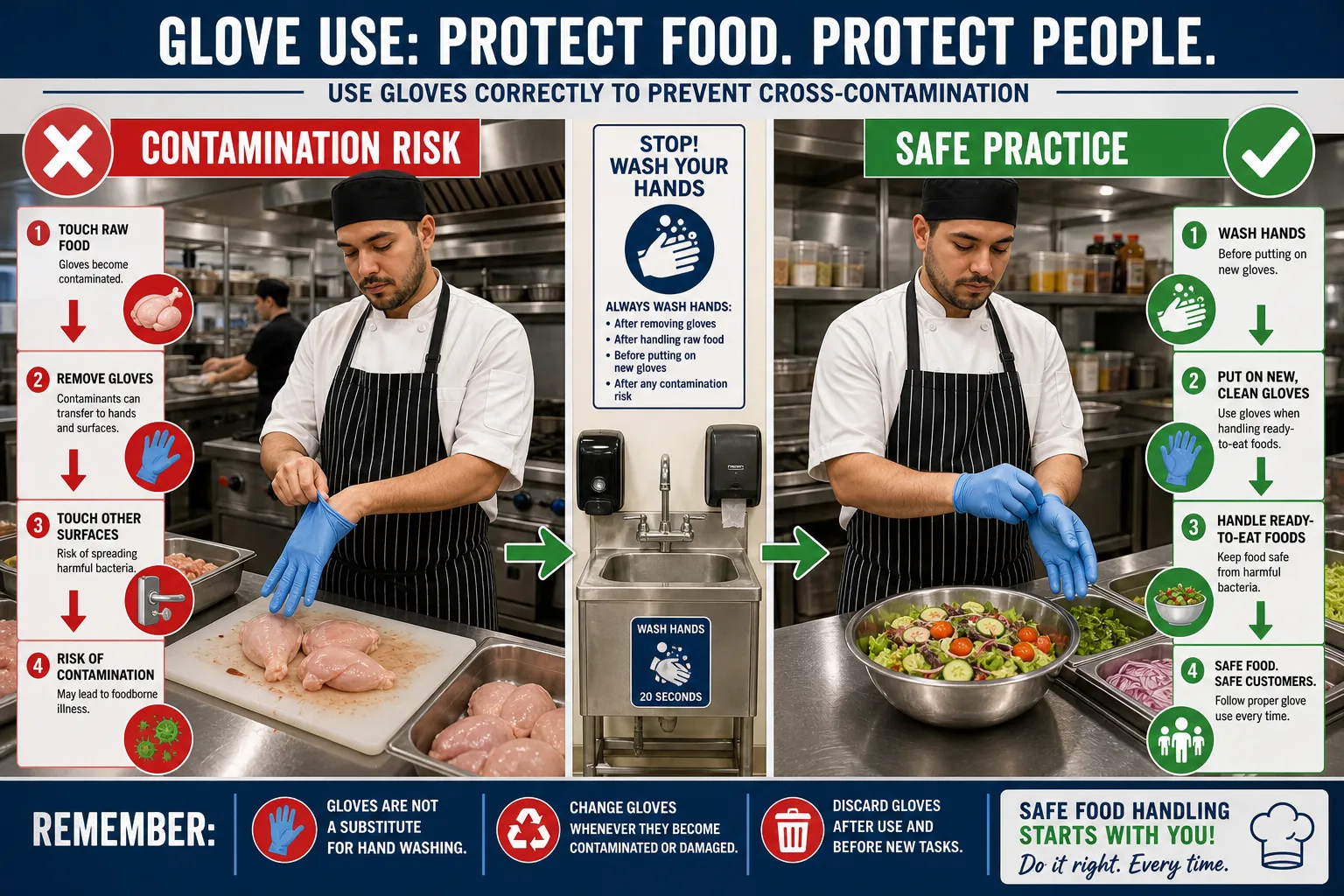
Mistake 1: Not Changing Gloves Between Tasks Workers often wear the same pair of gloves while handling raw chicken, then touching ready-to-eat salad ingredients. This transfers pathogens directly to foods that receive no further cooking.
Correction: Change gloves every time you switch from raw to cooked foods, touch non-food surfaces, handle money, or touch your face or phone.
Mistake 2: Continuing to Use Torn or Punctured Gloves Small tears compromise barrier protection completely. Workers sometimes notice a tear but continue working to avoid the inconvenience of changing gloves.
Correction: Replace gloves immediately upon noticing any damage. Keep glove boxes at every workstation to eliminate barriers to changing.
Mistake 3: Skipping Handwashing Before Gloving Gloves are not a substitute for handwashing. Putting gloves on contaminated hands simply traps bacteria against the skin and can lead to contamination if gloves tear.
Correction: Always wash hands thoroughly before putting on gloves and after removing them.
Mistake 4: Wearing Gloves for Too Long Gloves worn continuously for 4+ hours accumulate moisture, creating an ideal bacterial growth environment. They also develop micro-tears that compromise barrier integrity.
Correction: Change gloves at least every 4 hours during continuous use, even if they appear intact.
Mistake 5: Using the Wrong Size Gloves that are too large bunch up and reduce dexterity, increasing the likelihood of accidents. Gloves that are too small tear easily and cause hand fatigue.
Correction: Stock multiple sizes and ensure workers select gloves that fit snugly without being tight. The glove should extend at least 1 inch past the wrist.
Mistake 6: Touching Glove Exterior While Removing Workers often contaminate their hands by touching the exterior surface of used gloves during removal.
Correction: Use proper glove removal technique: pinch the exterior of one glove near the wrist, peel it off while turning it inside out, hold the removed glove in the gloved hand, then slide fingers under the wrist of the remaining glove and peel it off inside out, enclosing the first glove.
How Often Should Food Handlers Change Nitrile Gloves
Food handlers should change nitrile gloves immediately when switching between raw and ready-to-eat foods, after touching non-food surfaces, when gloves become torn or soiled, and at minimum every 4 hours during continuous use. High-volume operations may require changes every 30-60 minutes depending on task intensity and contamination risk.
Mandatory Change Triggers
Task Switching
- Moving from raw meat to vegetables
- Handling allergen-containing ingredients
- Switching from food prep to cleaning tasks
- Taking out trash or touching waste containers
Contamination Events
- Touching face, hair, or clothing
- Handling money or electronic devices
- Sneezing or coughing (even into gloves)
- Touching doorknobs, light switches, or other high-touch surfaces
Physical Damage
- Any visible tear or puncture
- Discoloration indicating chemical degradation
- Loss of tactile sensitivity suggesting material breakdown
Time-Based Changes
- Every 4 hours minimum during continuous food preparation
- Every 2 hours when handling high-risk foods (raw poultry, seafood)
- Every hour during high-temperature work where gloves may degrade faster
Practical Implementation
Successful food service operations implement these protocols:
- Glove stations at every workstation: Eliminates the excuse that gloves are inconvenient to access
- Color-coded gloves by task: Blue for general prep, purple for allergen-free, green for produce-only
- Visible change reminders: Timers or posted schedules showing when time-based changes are due
- Manager spot checks: Random verification that workers follow protocols
- Waste tracking: Monitoring glove usage rates to ensure adequate changing frequency
Cost Management
Restaurants concerned about glove costs should focus on proper sizing and task-appropriate selection rather than extending wear time. A worker who changes gloves 15 times per shift using properly fitted gloves wastes less money than one who changes 8 times but tears 5 pairs due to poor fit.
Best Nitrile Glove Brands for Commercial Kitchens
The best nitrile glove brands for commercial kitchens in 2026 are those that combine FDA food-contact compliance, consistent sizing, reliable supply chains, and competitive pricing. Top-performing brands include Ammex, Kimberly-Clark, Ansell, Medline, and private-label offerings from major foodservice distributors like Sysco and US Foods.
Evaluation Criteria
When selecting nitrile gloves for commercial kitchen use, prioritize:
- FDA 21 CFR 177.2600 compliance (non-negotiable)
- Consistent sizing across production batches
- Puncture resistance rated at 3 mil minimum thickness
- Textured grip on fingers and palm
- Supply reliability and lead times under 2 weeks
- Cost per glove under $0.12 for volume purchases
Brand Comparison
Ammex GlovePlus
- Thickness: 4-5 mil
- Price: $10-13 per 100-count box
- Strengths: Excellent puncture resistance, widely available
- Best for: High-volume operations prioritizing durability
Kimberly-Clark Purple Nitrile
- Thickness: 3.5 mil
- Price: $12-15 per 100-count box
- Strengths: Superior tactile sensitivity, consistent quality
- Best for: Fine food preparation requiring dexterity
Ansell TouchNTuff
- Thickness: 4-6 mil (multiple options)
- Price: $14-18 per 100-count box
- Strengths: Chemical resistance, extended cuff options
- Best for: Operations with heavy cleaning chemical exposure
Medline SensiCare
- Thickness: 3 mil
- Price: $9-12 per 100-count box
- Strengths: Low dermatitis potential, accelerator-free options
- Best for: Workforces with sensitive skin or allergy concerns
Private Label (Sysco, US Foods)
- Thickness: 3-4 mil
- Price: $8-11 per 100-count box
- Strengths: Integrated ordering, competitive pricing
- Best for: Operations already using these distributors
Testing Recommendations
Before committing to large purchases:
- Order sample boxes of 2-3 brands
- Have workers test during actual food prep tasks
- Track tear rates over 1-2 weeks
- Survey workers on comfort and fit
- Calculate total cost including waste from tears
Different kitchen roles may require different brands. Prep cooks handling sharp knives benefit from thicker, more puncture-resistant options, while pastry chefs need thinner gloves for tactile sensitivity.
Do Customers Prefer Seeing Food Workers Wear Nitrile Gloves
Yes, 73% of restaurant customers view visible glove use as a positive hygiene indicator, according to 2024 consumer research by the National Restaurant Association. Blue nitrile gloves specifically signal professional food safety practices, though customer preferences vary by restaurant segment and demographic factors.
Consumer Perception Data
Positive Associations Customers associate glove use with:
- Cleanliness and hygiene consciousness (78% of respondents)
- Professionalism and training (65%)
- Protection against foodborne illness (71%)
- Reduced cross-contamination risk (69%)
Segment Variations
Fast Casual and Quick Service: 82% of customers expect to see gloves in these environments. Visible glove use correlates with higher cleanliness ratings.
Fine Dining: Only 45% of customers expect gloves; many associate bare hands with artisanal preparation. However, glove use in fine dining has increased from 12% in 2019 to 34% in 2026.
Catering and Events: 88% of customers prefer seeing gloved food handlers at buffets and catering stations.
Demographic Factors
- Age 18-34: 68% prefer gloves
- Age 35-54: 75% prefer gloves
- Age 55+: 79% prefer gloves
- Post-2020 shift: All age groups show 15-20% increase in glove preference compared to 2019
Color Matters
Blue nitrile gloves receive the highest approval ratings because:
- They’re easily visible if a piece contaminates food
- Blue is not a natural food color, making contamination obvious
- The color is associated with medical/professional settings
- They contrast well with most foods and work surfaces
Black gloves, while popular in some upscale establishments for aesthetic reasons, score lower on perceived hygiene (58% approval) because contamination is less visible.
Implementation Considerations
Restaurants should balance customer preferences with operational realities:
- Use gloves for all ready-to-eat food handling regardless of segment
- Consider customer-facing vs. back-of-house practices
- Train staff to change gloves visibly when customers are watching
- Use glove color strategically to reinforce brand positioning
For comprehensive information on food safety practices, see our guide on what nitrile gloves protect against.
Frequently Asked Questions
Can you wash and reuse nitrile gloves in food service? No, nitrile gloves are designed for single use only. Washing compromises barrier integrity, creates micro-tears that allow bacterial penetration, and violates FDA Food Code requirements. Always discard gloves after each use and don a fresh pair.
Do nitrile gloves protect against COVID-19 and other viruses? Yes, intact nitrile gloves provide an effective barrier against viruses including SARS-CoV-2, influenza, and norovirus. However, gloves only protect if changed frequently and if workers avoid touching their face while gloved. Handwashing remains the primary defense.
What thickness of nitrile gloves is best for restaurant work? 3-5 mil thickness works best for most restaurant tasks. Use 3-4 mil for tasks requiring dexterity (sandwich assembly, garnishing), and 4-5 mil for tasks involving sharp objects or heavy cleaning. Thicker gloves (6+ mil) are unnecessarily bulky for food service.
Can nitrile gloves be used with all types of food? FDA-compliant nitrile gloves are safe for contact with all food types including acidic foods, fatty foods, and alcohol-containing products. However, verify that your specific glove brand carries food-contact certification, as industrial nitrile gloves may not be food-safe.
How do you know when nitrile gloves are expired? Check the manufacturer’s expiration date printed on the box, typically 3-5 years from production. Expired gloves may become brittle, lose elasticity, or develop reduced barrier properties. Store gloves in cool, dry conditions away from direct sunlight to maximize shelf life.
Are powder-free nitrile gloves better for food service? Yes, powder-free nitrile gloves are required for food service. Powdered gloves can contaminate food, cause respiratory issues in workers, and are prohibited in most food handling applications. All modern food-grade nitrile gloves are powder-free.
Can you use nitrile gloves for both food prep and cleaning? No, use separate gloves for food preparation and cleaning tasks. Cleaning chemicals can degrade glove material and create contamination risks. Implement color-coded systems: blue for food prep, green for cleaning, for example.
Do nitrile gloves prevent knife cuts? No, nitrile gloves provide no cut protection. They protect against biological and chemical contamination but offer no resistance to sharp objects. Workers using knives, slicers, or mandolins need cut-resistant gloves worn over or instead of nitrile gloves.
How should restaurants dispose of used nitrile gloves? Dispose of used nitrile gloves in regular trash receptacles lined with plastic bags. Gloves contaminated with raw meat or other high-risk foods should go directly into waste bins, not recycling. Some facilities participate in specialized glove recycling programs.
Are black nitrile gloves as safe as blue ones for food handling? Yes, black nitrile gloves are equally safe if they carry FDA food-contact certification. However, blue gloves are preferred because contamination is more visible. Black gloves are sometimes used in upscale establishments for aesthetic reasons but require extra vigilance.
Can nitrile gloves cause hand sweating and discomfort? Yes, all occlusive gloves trap moisture and can cause sweating during extended wear. Minimize discomfort by changing gloves every 2-4 hours, ensuring proper sizing, and allowing brief breaks where workers can remove gloves and dry hands thoroughly.
Do nitrile gloves work with touchscreen devices? Standard nitrile gloves do not work with capacitive touchscreens. Some manufacturers offer touchscreen-compatible nitrile gloves with conductive material in the fingertips, though these cost 30-50% more than standard gloves and are rarely necessary in food service settings.
Conclusion
The rise of nitrile in food service represents a fundamental shift in how the industry approaches worker safety, food hygiene, and regulatory compliance. Nitrile gloves have become the dominant choice because they eliminate latex allergy risks, provide superior puncture resistance compared to vinyl alternatives, and meet evolving FDA food contact standards. As of 2026, most commercial kitchens have completed the transition to nitrile as their primary hand protection solution.
The evidence supporting this shift is compelling. Nitrile gloves protect both workers and consumers while meeting stricter hygiene protocols introduced after 2020. They cost only 20-40% more than vinyl gloves but deliver significantly better durability, reducing total cost of ownership when factoring in fewer mid-task changes and lower contamination risks. Consumer research shows that 73% of diners view glove use positively, with blue nitrile gloves specifically associated with professional food safety practices.
Actionable Next Steps for Food Service Operators
Audit your current glove inventory: Verify that all gloves carry FDA 21 CFR 177.2600 certification for food contact. Replace any non-compliant products immediately.
Implement proper change protocols: Train staff to change gloves when switching tasks, after touching non-food surfaces, when gloves become damaged, and at minimum every 4 hours during continuous use.
Test multiple brands: Order sample boxes from 2-3 manufacturers and have workers evaluate them during actual food prep tasks. Track tear rates and gather feedback before committing to large purchases.
Right-size your operation: Stock multiple glove sizes and ensure workers select properly fitted gloves. Poor fit drives both waste and safety issues.
Consider environmental impact: Explore glove recycling programs, implement task-appropriate glove selection to minimize waste, and evaluate emerging biodegradable nitrile options as they become cost-competitive.
Document your protocols: Create written procedures specifying when gloves must be changed, which tasks require gloves, and how to properly don and remove gloves. Include these in employee training and HACCP plans.
The transition to nitrile gloves is no longer optional for food service operations that prioritize safety, compliance, and customer confidence. By implementing proper protocols and selecting appropriate products, restaurants can protect workers, prevent foodborne illness, and demonstrate visible commitment to hygiene standards that today’s consumers expect.
For additional guidance on selecting appropriate gloves for your specific food service application, explore our comprehensive guide to nitrile gloves for cooking and comparison of nitrile versus vinyl gloves.
SEO Meta Title: Nitrile Gloves in Food Service: Safety Standards 2026