The powder-free nitrile gloves segment is projected to grow at 10.2% CAGR through 2033, driven by pharmaceutical manufacturers and food processors who demand contamination-free barrier protection that meets evolving infection control standards. Market analysts estimate powder-free variants now command 72% of nitrile glove revenue, reflecting a decisive shift away from powdered formats that risk product contamination and respiratory sensitization in regulated environments.
This surge in powder-free adoption extends far beyond hospital operating rooms. Pharmaceutical cleanrooms, food packaging lines, and quality-control laboratories now specify unpowdered nitrile as the baseline for worker safety and product integrity. Understanding the regulatory drivers, performance benchmarks, and selection criteria for these gloves is essential for procurement teams tasked with balancing compliance, cost, and operational efficiency in 2026.
Key Takeaways
- Powder-free nitrile gloves represent approximately 72% of nitrile glove market revenue in 2026, with pharmaceutical and food sectors leading adoption.
- Regulatory compliance in pharma and food processing increasingly mandates powder-free formats to eliminate contamination risks and allergen exposure.
- Selection criteria must balance barrier integrity, chemical resistance, tactile sensitivity, and accelerator-free formulations for extended-wear applications.
- North America accounts for 34% of global demand, driven by stringent FDA and USDA enforcement in pharmaceutical manufacturing and food handling.
- Emerging accelerator-free nitrile technologies address skin sensitization concerns while maintaining the mechanical strength required for regulated environments.

Why Powder-Free Nitrile Gloves Dominate Infection Control Standards in Pharma
Pharmaceutical manufacturing environments demand gloves that eliminate every potential contamination vector. Powdered gloves, traditionally dusted with cornstarch to ease donning, introduce particulate matter that can compromise sterile compounding, contaminate active pharmaceutical ingredients, and trigger respiratory reactions in workers during extended shifts. Powder-free nitrile gloves solve these problems by using polymer coatings or chlorination treatments that facilitate donning without introducing foreign particles.
Regulatory alignment is a primary driver. The FDA’s current Good Manufacturing Practice (cGMP) guidelines for pharmaceutical production emphasize contamination control at every process stage. While the FDA banned powdered surgical and examination gloves for medical use in 2017, pharmaceutical manufacturers have extended this preference to all cleanroom and laboratory applications. Powder-free formats reduce the risk of cross-contamination between production batches and eliminate the need for additional air filtration to capture airborne powder particles.
Barrier performance in pharmaceutical settings requires gloves that resist permeation by solvents, acids, and active pharmaceutical ingredients. Nitrile’s synthetic rubber composition provides superior chemical resistance compared to latex or vinyl alternatives. Modern powder-free nitrile gloves achieve acceptable quality levels (AQL) of 1.5 or lower for pinhole defects, ensuring consistent barrier integrity during aseptic processing and hazardous drug handling. For more information on protective capabilities, see our guide on what nitrile gloves protect against.
Accelerator-free formulations represent the latest evolution in pharmaceutical-grade nitrile gloves. Traditional nitrile manufacturing uses chemical accelerators that can cause Type IV hypersensitivity reactions in workers with prolonged exposure. Recent product launches in 2025 introduced accelerator-free nitrile lines specifically designed for pharmaceutical and laboratory use, reducing dermatitis complaints while maintaining the tensile strength and elasticity required for precision work.
Sterile packaging options further enhance infection control compliance. Pharmaceutical buyers increasingly specify sterile, individually wrapped gloves for critical compounding areas. Market data indicates sterile nitrile glove production capacity increased by 120 million units year-over-year, reflecting demand from pharmaceutical manufacturers who require validated sterilization processes and lot traceability for regulatory audits.
Selection Criteria for Powder-Free Nitrile Gloves in Food Processing
Food processing facilities face a unique set of requirements when selecting powder-free nitrile gloves. Unlike pharmaceutical cleanrooms, food handling environments must balance barrier protection with tactile sensitivity for manual tasks, while meeting USDA and FDA food contact regulations. The powder-free nitrile gloves boom in this sector stems from their ability to satisfy multiple compliance frameworks simultaneously.
Food safety certification is non-negotiable. Powder-free nitrile gloves used in food processing must comply with FDA 21 CFR 177.2600 for food contact surfaces and EU Regulation 1935/2004 for materials intended to contact food. These standards ensure gloves do not transfer harmful substances to food products during handling, processing, or packaging. Buyers should verify that glove manufacturers provide migration testing documentation and certificates of compliance for each product line. Learn more about food safety requirements for nitrile gloves.
Thickness and durability directly impact both safety and operational efficiency. Food processing tasks range from delicate produce handling to cutting and deboning operations. Gloves between 4 and 6 mils thick provide adequate puncture resistance for most food handling tasks without sacrificing dexterity. Thicker gloves (8-10 mils) may be necessary for meat processing or tasks involving sharp utensils. For detailed guidance, review our article on what to consider when buying gloves for food plants.
Color coding serves as a visual quality control tool in food facilities. Black, blue, and purple nitrile gloves are popular in food processing because they create high contrast against most food products, making it easier to detect glove fragments if a tear occurs. This visual detection system complements metal-detectable glove options that some facilities require for additional foreign object control. Understanding whether all disposable gloves are food safe helps procurement teams avoid costly specification errors.
Extended wear comfort affects both worker compliance and cost per use. Food processing shifts often run 8-12 hours, requiring gloves that resist degradation from moisture, oils, and temperature fluctuations. Powder-free nitrile gloves with textured fingertips maintain grip in wet or greasy conditions, reducing the need for frequent glove changes. Accelerator-free formulations minimize skin irritation during extended wear, improving worker acceptance and reducing dermatitis-related absenteeism.
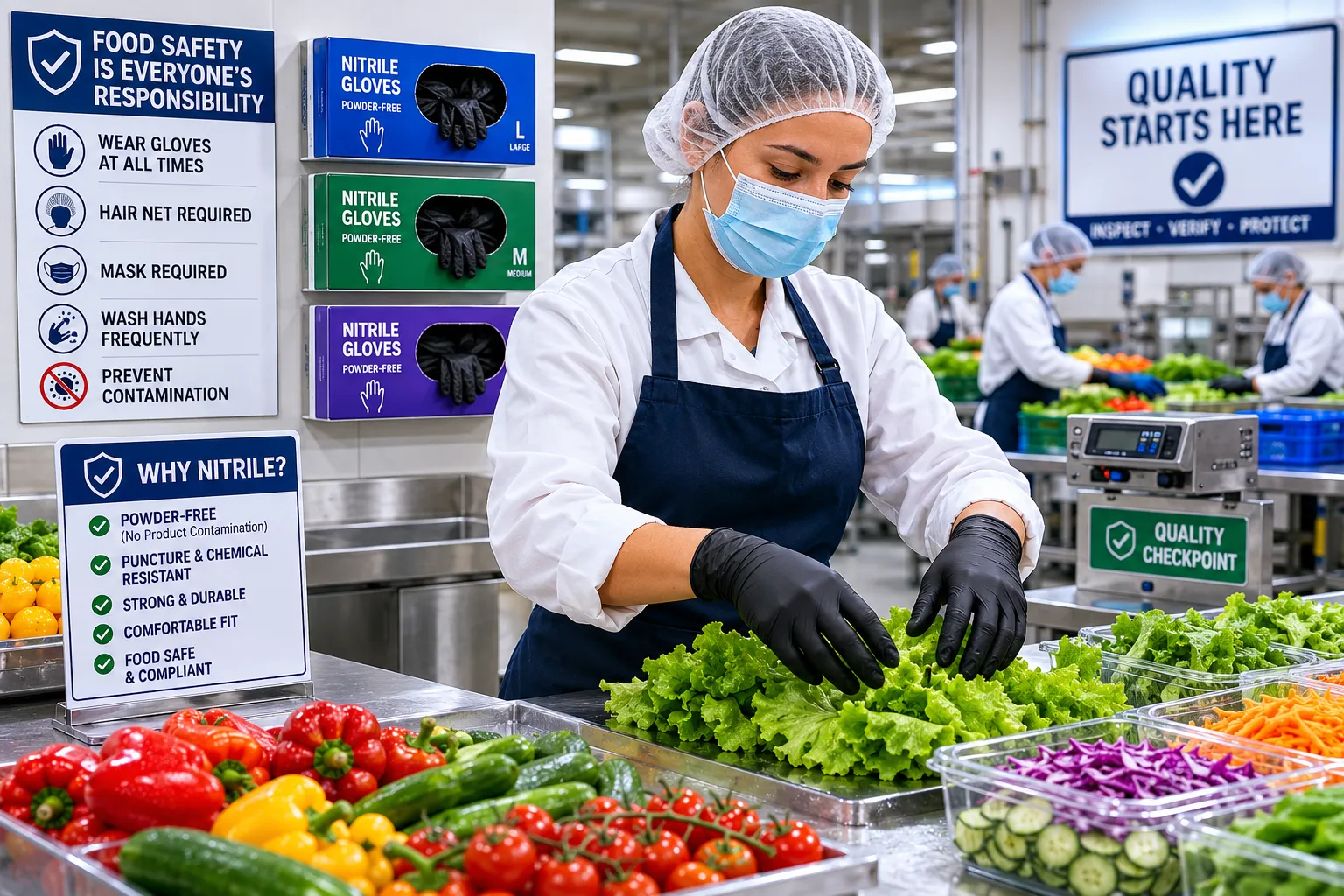
Latex-free composition eliminates allergen concerns in food facilities. Latex proteins can trigger severe allergic reactions in sensitized workers and pose a contamination risk for consumers with latex allergies. Powder-free nitrile gloves provide comparable elasticity and tactile sensitivity without introducing latex allergens into the food production environment. For workers with sensitivities, explore our recommendations for disposable gloves for sensitive skin.
Regional Compliance Drivers Behind the Powder-Free Nitrile Gloves Boom
North America leads global demand for powder-free nitrile gloves, accounting for approximately 34% of market share in 2026. This regional dominance reflects stringent enforcement of FDA regulations for pharmaceutical manufacturing and USDA standards for food processing. U.S. pharmaceutical companies face significant financial penalties for contamination incidents, creating strong incentives to specify powder-free gloves as standard operating procedure across all production areas.
European market growth is accelerating due to Medical Device Regulation (MDR) enforcement and sustainability procurement mandates. The MDR requires enhanced documentation of biocompatibility and performance characteristics for medical gloves, pushing manufacturers toward powder-free nitrile formulations that offer more consistent quality metrics. European food processors also face increasing pressure to demonstrate allergen control and contamination prevention, further driving powder-free adoption.
Supply chain resilience has become a critical selection factor following pandemic-era disruptions. Pharmaceutical and food companies now prioritize suppliers with diversified manufacturing footprints and validated quality systems. The powder-free nitrile gloves boom has attracted new production capacity in Southeast Asia, North America, and Europe, giving buyers more sourcing options while maintaining compliance with regional regulatory standards.
Cost-Benefit Analysis for Powder-Free Nitrile Gloves in Regulated Sectors
Powder-free nitrile gloves typically cost 15-30% more than powdered alternatives, but the total cost of ownership calculation favors powder-free formats in pharmaceutical and food applications. Elimination of powder-related contamination incidents reduces product waste, regulatory remediation costs, and potential recall expenses. Pharmaceutical manufacturers report that a single contamination event can cost millions in lost production and regulatory penalties, far exceeding annual glove procurement budgets.
Worker health costs also factor into the economic equation. Powder-free gloves reduce respiratory complaints and skin sensitization incidents, lowering workers’ compensation claims and absenteeism. Facilities that switched to accelerator-free powder-free nitrile gloves report 40-60% reductions in glove-related dermatitis cases, improving both worker satisfaction and operational continuity.
Operational efficiency gains from powder-free gloves include reduced cleaning requirements for equipment and work surfaces. Powder residue from traditional gloves accumulates on machinery and requires additional sanitation cycles. Powder-free formats eliminate this maintenance burden, allowing facilities to optimize cleaning schedules and reduce downtime between production runs.
Emerging Innovations in Powder-Free Nitrile Glove Technology
The powder-free nitrile gloves boom continues to drive product innovation beyond basic barrier protection. Manufacturers are developing specialized formulations that address specific pain points in pharmaceutical and food applications. Dual-layer nitrile gloves, for example, combine a soft inner layer for comfort with a reinforced outer layer for enhanced chemical resistance and puncture protection.
Biodegradable nitrile formulations are entering the market in response to sustainability concerns. While traditional nitrile gloves persist in landfills for decades, new polymer blends incorporate additives that accelerate degradation under specific conditions. Pharmaceutical and food companies with corporate sustainability commitments are piloting these products, though regulatory approval and performance validation remain ongoing.
Smart glove technology integrates sensors and RFID tags into powder-free nitrile gloves for enhanced traceability and compliance monitoring. These systems can track glove usage patterns, detect breaches in barrier integrity, and provide real-time alerts when glove change intervals are exceeded. While currently limited to high-value pharmaceutical applications, the technology may expand to food processing as costs decline.
Conclusion
The powder-free nitrile gloves boom reflects a fundamental shift in how pharmaceutical manufacturers and food processors approach infection control and contamination prevention. With powder-free variants capturing 72% of market revenue and growing at double-digit rates, these gloves have become the de facto standard for regulated environments that demand uncompromising barrier protection without particulate contamination risks.
Procurement teams should prioritize suppliers that provide comprehensive compliance documentation, including FDA food contact certification, AQL testing results, and accelerator-free formulation options. Evaluate total cost of ownership rather than unit price alone, factoring in contamination risk reduction, worker health benefits, and operational efficiency gains. For pharmaceutical applications, specify sterile packaging and validated lot traceability. For food processing, emphasize color coding, textured grip, and extended wear comfort.
As regulatory standards continue to tighten and sustainability pressures mount, the powder-free nitrile gloves market will likely see further innovation in accelerator-free chemistry, biodegradable formulations, and smart monitoring technologies. Organizations that establish robust selection criteria and supplier relationships now will be better positioned to adapt to these evolving requirements while maintaining the infection control standards that protect both workers and products.
SEO Meta Title: Powder-Free Nitrile Gloves: Pharma & Food Standards 2026