Last updated: June 29, 2026
Quick Answer
Nitrile polymer breakthroughs in 2026 center on advanced cross-linking techniques and carboxylated formulations that increase puncture resistance by 40-60% compared to standard nitrile while extending temperature tolerance from -40°C to +150°C. These improvements make next-generation nitrile gloves suitable for extreme industrial, chemical handling, and laboratory environments where traditional gloves fail. Workers in oil and gas, automotive repair, chemical manufacturing, and cold storage facilities benefit most from these enhanced protective properties.
Key Takeaways
- Advanced nitrile polymers use enhanced cross-linking and carboxylation to deliver 40-60% better puncture resistance than standard nitrile formulations
- Temperature tolerance has expanded dramatically, with breakthrough polymers maintaining flexibility and barrier protection from -40°C to +150°C
- High-risk industries including chemical manufacturing, oil and gas, automotive repair, and healthcare laboratories see the greatest safety improvements
- Cost premiums for advanced nitrile gloves range from 30-80% over standard versions, but reduced injury rates and longer wear life often justify the investment
- Even improved polymers have limits: proper glove selection based on specific chemical exposure, mechanical hazards, and temperature conditions remains essential
- Healthcare workers benefit from enhanced puncture protection during surgical procedures and when handling sharps in emergency settings
- Advanced nitrile gloves typically last 2-4 times longer than standard versions in heavy-use industrial applications
- Common selection mistakes include ignoring chemical compatibility charts, choosing insufficient thickness, and failing to account for dexterity requirements
What Are Nitrile Polymer Breakthroughs in Glove Technology
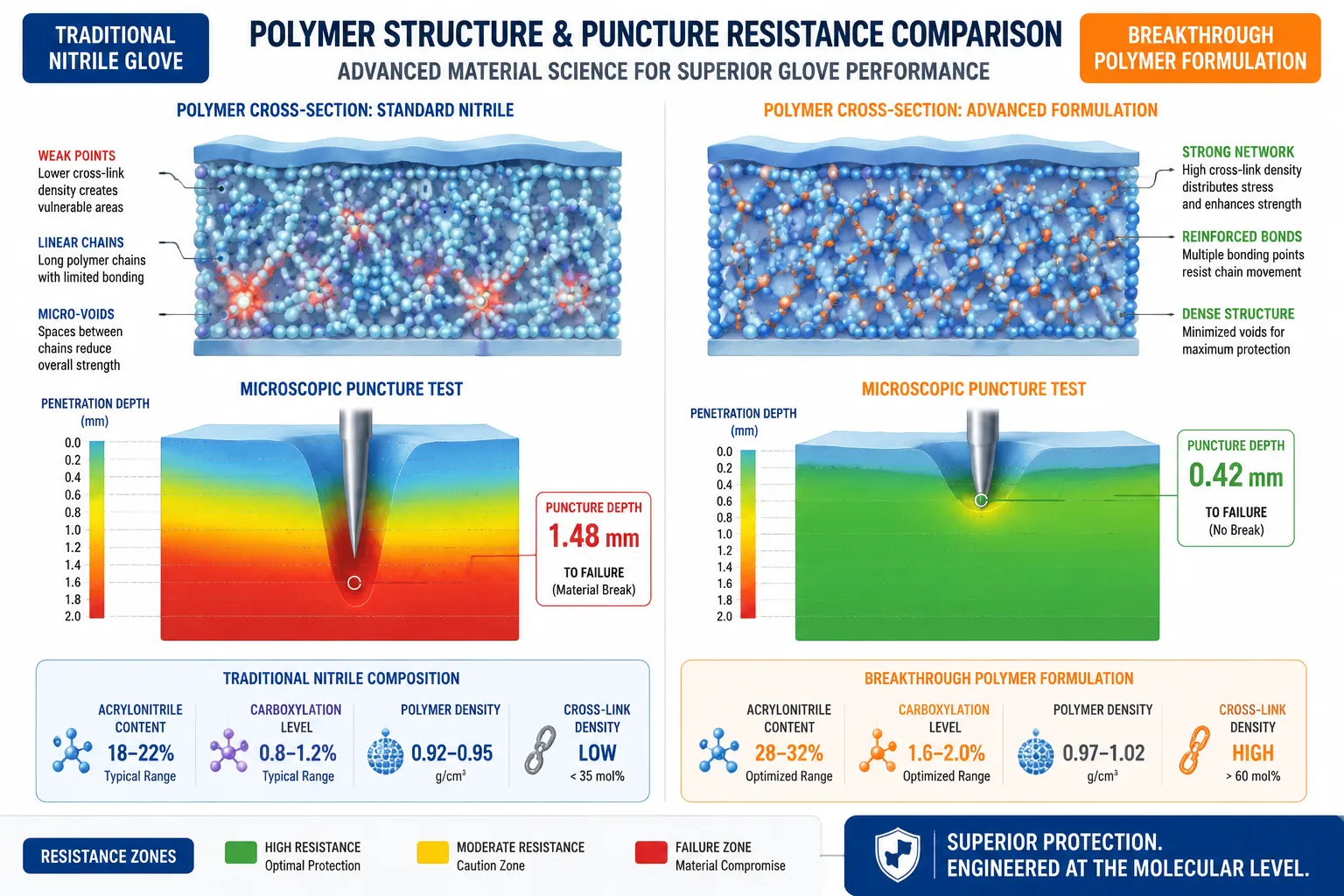
Nitrile polymer breakthroughs refer to recent advances in synthetic rubber chemistry that significantly improve the mechanical strength, chemical resistance, and temperature performance of nitrile butadiene rubber (NBR) used in protective gloves. These innovations focus on modifying the polymer structure at the molecular level through enhanced cross-linking, carboxylation, and the addition of performance-enhancing additives.
The core improvements include:
- Enhanced cross-linking density: Creates tighter molecular bonds that resist tearing and puncture
- Carboxylated NBR formulations: Adds carboxyl groups to the polymer chain, improving tensile strength and chemical resistance
- Nano-particle reinforcement: Incorporates carbon nanotubes or graphene particles for added durability
- Plasticizer optimization: Maintains flexibility across extreme temperature ranges without compromising barrier properties
- Accelerated vulcanization: Produces more uniform polymer networks with fewer weak points
These technical advances translate to gloves that can withstand sharper objects, harsher chemicals, and more extreme temperatures than previous generations. For workers in high-risk environments, this means fewer glove failures, reduced injury rates, and better protection against chemical exposure.
The breakthrough polymers maintain the latex-free advantage that made nitrile popular while addressing the historical weaknesses of standard nitrile formulations. Understanding what a nitrile glove is provides essential context for appreciating these recent advances.
How Do New Nitrile Polymers Improve Puncture Resistance
New nitrile polymers improve puncture resistance through three primary mechanisms: increased cross-link density, optimized polymer chain length, and strategic reinforcement with nano-materials. These changes create a molecular structure that distributes force more effectively when sharp objects contact the glove surface.
Cross-linking improvements create more connection points between polymer chains, forming a tighter molecular mesh. When a sharp object attempts to penetrate, the force distributes across multiple polymer chains rather than breaking through individual weak points. This can increase puncture resistance by 40-60% compared to standard nitrile.
Polymer chain optimization involves balancing chain length and molecular weight. Longer chains with higher molecular weight create more entanglement points, making it harder for sharp objects to separate the polymer structure. Manufacturers achieve this through controlled polymerization processes that produce more uniform chain lengths.
Nano-material reinforcement adds microscopic particles of carbon nanotubes, graphene, or silica to the polymer matrix. These particles act as molecular anchors, preventing crack propagation when puncture force is applied. The result is a glove that resists both initial penetration and tear propagation from puncture sites.
Testing standards measure these improvements using ASTM F2878 (puncture resistance) and EN 388 (mechanical hazards). Advanced nitrile gloves now achieve Level 4 or 5 ratings on the EN 388 scale, compared to Level 2-3 for standard nitrile.
Common mistake: Assuming thicker gloves always provide better puncture resistance. While glove thickness impacts durability, polymer quality matters more. A 6-mil advanced nitrile glove often outperforms a 10-mil standard nitrile glove in puncture tests.
Choose advanced puncture-resistant nitrile if you work with sharp metal parts, glass shards, needles, or rough abrasive materials. Standard nitrile remains adequate for general chemical handling without sharp object hazards.
Nitrile vs Latex Gloves for High-Risk Jobs: Which Is Better
For high-risk jobs in 2026, advanced nitrile gloves outperform latex in puncture resistance, chemical protection, and temperature tolerance, while latex maintains advantages in tactile sensitivity and elasticity for precision medical procedures. The choice depends on specific job hazards, with nitrile being the better default for most industrial and chemical handling applications.
Nitrile advantages for high-risk work:
- Superior chemical resistance to oils, solvents, and petroleum products
- No latex protein allergies, eliminating a major workplace safety concern
- Better puncture and abrasion resistance, especially with breakthrough formulations
- Longer shelf life (3-5 years vs 1-3 years for latex)
- Maintains barrier properties across wider temperature ranges
- More consistent quality due to synthetic manufacturing processes
Latex advantages in specific scenarios:
- Better tactile sensitivity for delicate surgical procedures
- Superior elasticity and comfort for extended wear
- Lower cost for basic examination gloves
- Biodegrades faster than synthetic nitrile
For chemical manufacturing, oil and gas, automotive repair, and laboratory work involving hazardous materials, nitrile is the clear choice. The chemical permeation resistance of nitrile far exceeds latex capabilities.
Healthcare settings present a mixed picture. Surgical teams often prefer latex for its tactile feedback during delicate procedures, but emergency departments and laboratories increasingly choose nitrile for its puncture resistance when handling sharps and its elimination of latex allergy risks.
Decision rule: Choose nitrile for any job involving chemical exposure, sharp objects, temperature extremes, or workers with latex allergies. Consider latex only for precision medical procedures where tactile sensitivity is paramount and chemical/puncture hazards are minimal.
What Temperature Range Can Advanced Nitrile Gloves Withstand
Advanced nitrile polymer gloves in 2026 can withstand temperatures from -40°C (-40°F) to +150°C (+302°F) while maintaining flexibility and barrier protection, compared to -20°C to +100°C for standard nitrile formulations. This expanded range makes them suitable for cryogenic handling, hot manufacturing processes, and extreme outdoor conditions.
Low-temperature performance improvements:
Standard nitrile becomes stiff and brittle below -10°C, losing flexibility and developing micro-cracks that compromise barrier protection. Advanced formulations use specialized plasticizers and polymer modifications that maintain elasticity down to -40°C. This makes them suitable for:
- Cryogenic laboratory work with liquid nitrogen (-196°C with proper insulated gloves)
- Cold storage facility operations
- Outdoor winter work in arctic conditions
- Frozen food processing and handling
High-temperature capabilities:
Breakthrough nitrile polymers incorporate heat-stabilizing additives and enhanced cross-linking that prevent polymer degradation up to 150°C. Applications include:
- Hot manufacturing processes (injection molding, metal fabrication)
- Automotive repair involving hot engine components
- Food service handling hot cookware and equipment
- Chemical processes requiring elevated temperatures
Important limitation: Temperature ratings assume brief contact periods (typically 15-30 seconds). Prolonged exposure to extreme temperatures requires specialized insulated gloves with nitrile coating rather than thin disposable nitrile gloves.
For workers in extreme cold environments, understanding how latex and nitrile perform in cold conditions helps inform proper selection. Advanced nitrile maintains superior performance in both cold and heat compared to other disposable glove materials.
Edge case: Some specialized nitrile formulations for cryogenic work incorporate multiple layers with different polymer compositions, achieving protection down to -196°C for liquid nitrogen handling, though these are typically reusable rather than disposable gloves.
Which Industries Benefit Most From Improved Nitrile Gloves
Chemical manufacturing, oil and gas operations, automotive repair, healthcare laboratories, and food processing industries benefit most from nitrile polymer breakthroughs due to their combination of chemical exposure, puncture hazards, and temperature extremes. These sectors see measurable reductions in hand injuries, chemical burns, and contamination incidents when workers use advanced nitrile gloves.
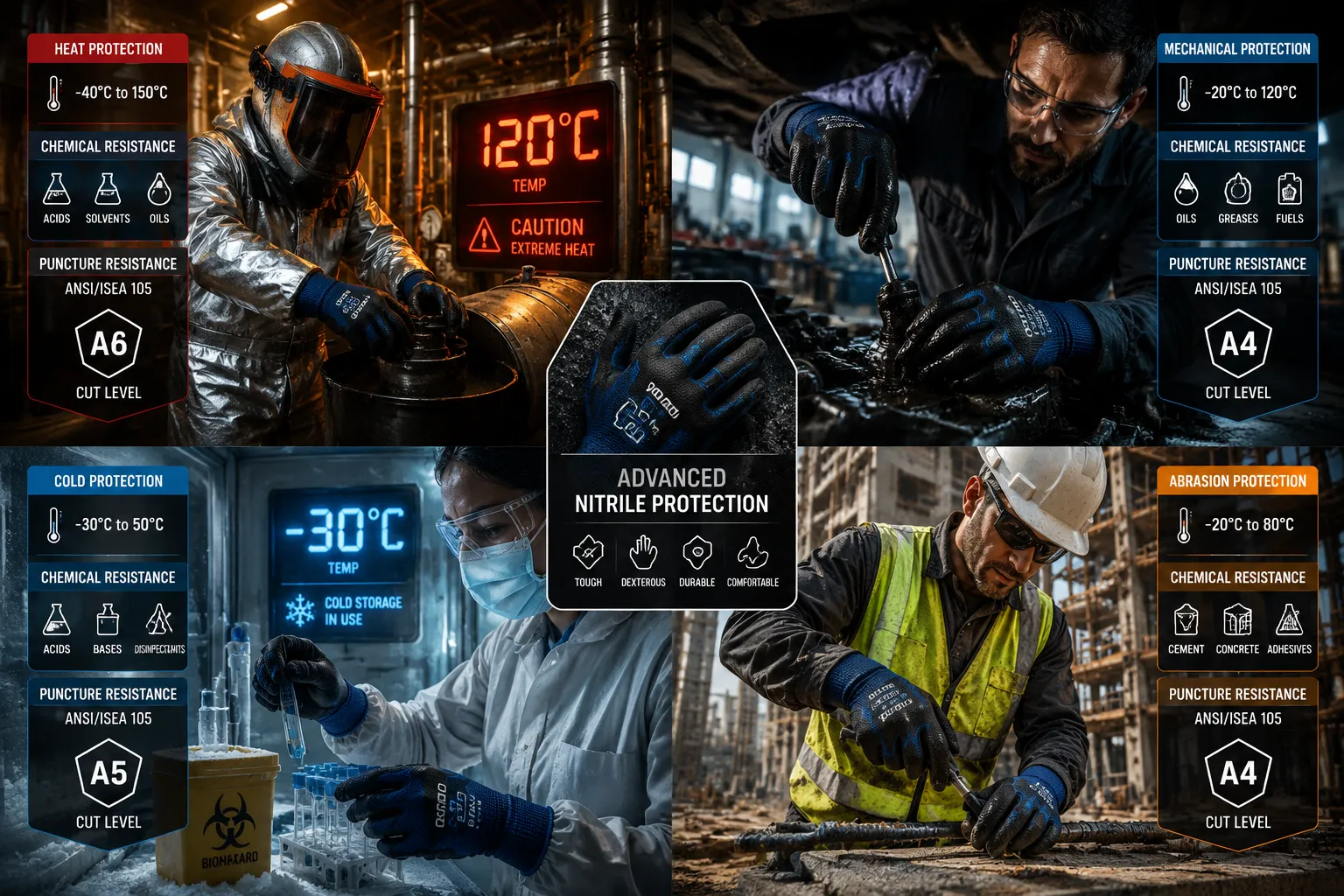
Chemical manufacturing and laboratories:
Workers handling corrosive acids, bases, and organic solvents need both chemical resistance and puncture protection when working with glass equipment. Advanced nitrile provides extended breakthrough times for chemicals while resisting puncture from broken glassware. Understanding why certain chemicals are hazardous emphasizes the importance of proper glove selection.
Oil and gas operations:
Drilling, refining, and pipeline maintenance expose workers to petroleum products, sharp metal edges, and temperature extremes. Enhanced nitrile resists oil degradation while protecting against cuts from metal burrs and maintaining flexibility in outdoor winter conditions.
Automotive and mechanical repair:
Mechanics work with sharp metal parts, hot engine components, and various automotive fluids. The best disposable gloves for mechanics combine puncture resistance with oil resistance and heat tolerance.
Healthcare and medical laboratories:
Surgical teams, emergency departments, and laboratory technicians face puncture risks from needles and scalpels plus exposure to bloodborne pathogens. Advanced nitrile reduces needlestick injuries while eliminating latex allergy concerns.
Food processing and preparation:
Workers in meat processing, commercial kitchens, and food manufacturing need gloves that resist puncture from knives and bones while maintaining food safety standards. Enhanced nitrile meets these requirements while addressing potential risks in food handling.
Additional beneficiaries:
- Construction workers handling sharp materials and rough surfaces
- Pharmaceutical manufacturing requiring chemical resistance and contamination control
- Electronics assembly needing puncture protection with maintained dexterity
- Janitorial services using harsh cleaning chemicals
Choose industry-specific glove specifications based on your primary hazards: chemical exposure requires permeation data, puncture risks need EN 388 Level 4-5 ratings, and temperature extremes require verified performance ranges.
How Much Do High-Performance Nitrile Gloves Cost Compared to Regular Ones
High-performance nitrile gloves with breakthrough polymer technology cost 30-80% more than standard nitrile gloves, with prices ranging from $0.15-0.35 per glove for advanced formulations versus $0.08-0.15 for standard nitrile in bulk purchases. The premium reflects enhanced raw materials, specialized manufacturing processes, and rigorous testing requirements.
Price breakdown by performance tier:
| Glove Type | Price Per Glove (Bulk) | Typical Use Life | Cost Per Hour of Use |
|---|---|---|---|
| Standard nitrile | $0.08-0.15 | 1-2 hours heavy use | $0.04-0.15 |
| Enhanced nitrile | $0.15-0.25 | 3-5 hours heavy use | $0.03-0.08 |
| Premium breakthrough | $0.25-0.35 | 5-8 hours heavy use | $0.03-0.07 |
| Specialty chemical-resistant | $0.40-0.75 | 6-10 hours specific tasks | $0.04-0.13 |
Cost justification factors:
The higher upfront cost often delivers better value through:
- Reduced glove changes: Advanced gloves last 2-4 times longer, reducing total gloves used per shift
- Lower injury rates: Fewer punctures and chemical exposures reduce workers’ compensation claims and lost work time
- Decreased contamination: Better barrier properties reduce product contamination in manufacturing and food processing
- Improved productivity: Workers spend less time changing gloves and experience less hand fatigue
Volume pricing considerations:
Bulk purchases (10,000+ gloves) typically reduce per-glove costs by 20-40%. Many suppliers offer tiered pricing with significant discounts at higher volumes. For small operations using fewer than 1,000 gloves monthly, the percentage premium for advanced gloves appears higher but the absolute cost difference remains modest.
When the premium isn’t worth it:
Standard nitrile remains cost-effective for:
- Low-risk tasks without sharp objects or harsh chemicals
- Brief contact periods with minimal mechanical stress
- Applications where frequent glove changes are required for hygiene rather than glove failure
- Budget-constrained operations where hazard levels don’t justify premium protection
Decision rule: Calculate your current glove usage rate and injury costs. If workers change gloves more than twice per hour due to tears or punctures, or if you’ve had chemical exposure incidents, the premium for advanced nitrile typically pays for itself within 3-6 months.
For operations considering alternatives to disposable nitrile gloves, reusable chemical-resistant gloves may offer better economics for specific high-exposure tasks, though disposable advanced nitrile remains superior for most applications requiring frequent changes.
Why Do Nitrile Gloves Tear Even With New Polymer Technology
Nitrile gloves tear despite polymer improvements because no material can provide absolute protection against all mechanical forces, chemical exposures, and usage conditions. Even advanced formulations have physical limits related to glove thickness, specific chemical incompatibilities, improper sizing, and user handling practices that exceed the material’s capabilities.
Primary causes of advanced nitrile glove failure:
Mechanical stress beyond design limits:
While breakthrough polymers increase puncture resistance by 40-60%, extremely sharp objects (surgical scalpels, metal burrs, glass shards) can still penetrate if sufficient force is applied. The polymer can only distribute force across its molecular structure; concentrated force on a small area eventually breaks molecular bonds.
Chemical incompatibility:
Advanced nitrile resists most oils, greases, and many solvents, but certain chemicals still cause rapid degradation. Strong oxidizing agents (concentrated nitric acid, hydrogen peroxide above 30%), ketones (MEK, acetone in high concentrations), and aromatic hydrocarbons (benzene, toluene) can break down even enhanced polymer formulations within minutes.
Improper glove selection:
Using gloves too thin for the application or choosing formulations not designed for specific chemicals leads to premature failure. A 4-mil advanced nitrile glove offers excellent general protection but won’t withstand the same abuse as an 8-mil specialty formulation.
Sizing and donning issues:
Gloves stretched too tight during donning develop stress points that become failure sites. Fingernails, rings, and rough skin can create micro-tears that propagate under use. Proper sizing and smooth donning technique prevent many failures attributed to “poor quality.”
Degradation from storage conditions:
Exposure to ozone, UV light, extreme temperatures, and humidity during storage degrades nitrile polymers before use. Even advanced formulations have shelf lives (typically 3-5 years) and require proper storage conditions.
Fatigue from extended use:
Repeated flexing, stretching, and chemical exposure gradually weakens polymer bonds. Advanced nitrile lasts longer, but all materials eventually fatigue. Understanding how long nitrile gloves last helps establish appropriate change-out schedules.
Common mistake: Assuming “chemical resistant” means “chemical proof.” All gloves have breakthrough times—the duration until a chemical permeates through. Advanced nitrile extends these times but doesn’t eliminate them. Always consult chemical compatibility charts and breakthrough time data for your specific chemicals.
Troubleshooting frequent tears:
- If tears occur at fingertips: Check for proper sizing and trim fingernails
- If tears happen during donning: Use powder or donning gel and size up
- If chemical exposure causes rapid degradation: Verify chemical compatibility and consider specialty formulations
- If tears occur after 1-2 hours: Increase glove thickness or upgrade to premium formulations
- If tears happen at stress points (between fingers): Ensure proper fit and consider anatomically designed gloves
Are Breakthrough Nitrile Gloves Suitable for Chemical Handling
Breakthrough nitrile gloves are suitable for handling many chemicals, including oils, greases, alcohols, weak acids and bases, and some solvents, but they are not universally chemical-proof. Suitability depends on the specific chemical, concentration, contact duration, and glove thickness, with manufacturers providing permeation data and breakthrough times for informed selection.
Chemicals well-protected by advanced nitrile:
- Petroleum products (gasoline, diesel, motor oil, hydraulic fluid)
- Alcohols (methanol, ethanol, isopropanol)
- Weak to moderate acids (dilute sulfuric, phosphoric, acetic)
- Weak bases (dilute sodium hydroxide, ammonia solutions)
- Greases and lubricants
- Many aqueous solutions and water-based chemicals
Chemicals requiring caution or specialty formulations:
- Strong oxidizers (concentrated nitric acid, hydrogen peroxide >30%)
- Ketones (acetone, MEK) – limited breakthrough times
- Aromatic hydrocarbons (benzene, toluene, xylene)
- Chlorinated solvents (methylene chloride, trichloroethylene)
- Concentrated acids and bases (>50% concentration)
Understanding permeation and breakthrough time:
Chemical resistance isn’t binary. Permeation testing measures how long a chemical takes to penetrate through the glove material at the molecular level. Advanced nitrile typically provides:
- Excellent resistance (>480 minutes breakthrough time): Oils, greases, alcohols
- Good resistance (120-480 minutes): Weak acids/bases, some solvents
- Fair resistance (30-120 minutes): Ketones, some aromatic compounds
- Poor resistance (<30 minutes): Strong oxidizers, chlorinated solvents
Thickness impact on chemical protection:
Thicker gloves provide longer breakthrough times. An 8-mil advanced nitrile glove might offer 4 hours of protection against a chemical that penetrates a 4-mil glove in 1 hour. However, thickness reduces dexterity, so balance protection needs against task requirements.
Best practices for chemical handling:
- Consult manufacturer permeation data for your specific chemicals
- Consider concentration and temperature (both reduce breakthrough time)
- Establish glove change schedules based on breakthrough times
- Use double-gloving for high-risk chemicals (different materials for each layer)
- Inspect gloves before and during use for signs of degradation
- Have emergency protocols for chemical exposure despite glove use
For food industry workers, understanding considerations when buying gloves for food plants ensures both chemical protection and food safety compliance.
Edge case: Some chemical mixtures create synergistic effects that accelerate permeation beyond what individual components would cause. Always test gloves with your actual chemical mixtures rather than relying solely on single-chemical data.
What Jobs Require Maximum Puncture-Resistant Gloves
Jobs requiring maximum puncture-resistant gloves include surgical teams handling sharps, emergency medical responders, correctional facility staff conducting searches, waste management workers, metal fabrication and machining, glass handling, and law enforcement personnel. These roles involve high-probability encounters with needles, blades, sharp metal, or broken glass where puncture injuries carry serious consequences.
Healthcare and emergency services:
- Surgical teams: Handling scalpels, needles, and sharp surgical instruments
- Emergency responders: Treating trauma patients with potential needle exposure
- Phlebotomists: Drawing blood with needle puncture risks
- Dental professionals: Working with sharp instruments in confined spaces
- Laboratory technicians: Handling broken glass and sharp lab equipment
Public safety and corrections:
- Correctional officers: Conducting cell searches where hidden sharps are common
- Police officers: Searching suspects and vehicles for weapons and drug paraphernalia
- Security personnel: Screening and searching in high-risk environments
- Forensic investigators: Processing crime scenes with potential sharp evidence
Industrial and manufacturing:
- Metal fabricators: Working with sharp metal edges, burrs, and cutting tools
- Machinists: Handling sharp metal parts and cutting implements
- Glass workers: Processing, cutting, and handling glass products
- Automotive technicians: Working with sharp metal components and tools
- Construction workers: Handling rebar, metal framing, and sharp materials
Waste and recycling:
- Waste collection workers: Handling bags that may contain hidden sharps
- Recycling sorters: Processing materials that include broken glass and metal
- Hazardous waste handlers: Managing medical and industrial waste with sharp contents
Specialized applications:
- Butchers and meat processors: Working with knives and bone fragments
- Commercial fishers: Handling fish with sharp fins and processing equipment
- Taxidermists: Using sharp tools and handling specimens with sharp features
Selection criteria for maximum protection:
Look for gloves meeting these standards:
- EN 388 Level 4 or 5 for puncture resistance (highest ratings)
- ANSI/ISEA 105 Level 4 or 5 for puncture (North American standard)
- Minimum 6-8 mil thickness for disposable gloves
- Cut resistance Level C or higher if sharp cutting hazards exist
- Verified testing data from independent laboratories
Common mistake: Choosing gloves based solely on thickness rather than verified puncture resistance ratings. An 8-mil standard nitrile glove may offer less puncture protection than a 6-mil advanced polymer glove with proper molecular engineering.
Decision rule: If your job involves regular contact with needles, scalpels, or sharp metal/glass, invest in gloves with verified Level 4-5 puncture ratings. If puncture risks are occasional or low-probability, Level 2-3 gloves with good general durability may suffice.
Common Mistakes When Choosing Nitrile Gloves for Hazardous Work
The most common mistakes when choosing nitrile gloves for hazardous work include ignoring chemical compatibility data, selecting based on price alone, choosing incorrect thickness for the application, neglecting proper sizing, and failing to establish appropriate change-out schedules. These errors compromise worker safety and often increase total costs through higher injury rates and more frequent glove changes.
Mistake 1: Ignoring chemical compatibility charts
Many buyers assume all nitrile gloves resist all chemicals. In reality, specific chemicals require specific formulations. Always consult permeation data for your exact chemicals, concentrations, and contact durations. Generic “chemical resistant” claims without supporting data are red flags.
Mistake 2: Choosing gloves based solely on price
The cheapest glove per unit often becomes the most expensive per hour of protection. Calculate total cost including glove changes, injury rates, and productivity impacts. A $0.30 glove lasting 6 hours costs less per hour than a $0.10 glove lasting 1 hour.
Mistake 3: Incorrect thickness selection
Thicker isn’t always better. Excessive thickness reduces dexterity and increases hand fatigue, while insufficient thickness provides inadequate protection. Match thickness to your specific hazards: 4-6 mil for general chemical handling, 6-8 mil for moderate puncture risks, 8-15 mil for high puncture/abrasion environments.
Mistake 4: Poor sizing practices
Gloves too small tear during donning and create stress points. Gloves too large reduce dexterity and bunch up, creating hazards. Proper sizing requires measuring hand circumference and length, then testing samples before bulk purchases. Size charts vary by manufacturer.
Mistake 5: No established change-out schedule
Continuing to use gloves beyond their protective capability exposes workers to hazards. Establish change schedules based on breakthrough times, visible wear, or time limits (e.g., change every 2 hours regardless of appearance for high-risk chemicals).
Mistake 6: Overlooking storage conditions
Storing gloves in hot vehicles, direct sunlight, or near ozone sources (electric motors, welding equipment) degrades polymers before use. Store in cool, dry, dark locations and rotate stock to use oldest gloves first.
Mistake 7: Neglecting worker training
Even the best gloves fail if workers don’t understand proper donning, limitations, and when to change them. Training should cover chemical compatibility, inspection procedures, and emergency protocols.
Mistake 8: Failing to inspect before use
Pre-use inspection catches manufacturing defects and storage damage. Teach workers to check for holes, tears, discoloration, and stiffness before donning. A 30-second inspection prevents hours of chemical exposure.
Mistake 9: Ignoring dexterity requirements
Maximum protection gloves may be too thick for precision tasks. Balance protection against task requirements. Consider using maximum protection gloves for high-risk portions of work and switching to thinner gloves for precision tasks.
Mistake 10: Not testing with actual work conditions
Sample testing under real work conditions reveals issues not apparent from specifications. Test candidate gloves with your actual chemicals, temperatures, and work tasks before committing to large purchases.
Troubleshooting guide:
- If workers complain about poor fit: Reassess sizing and try different manufacturers (sizing varies)
- If gloves tear frequently: Increase thickness, upgrade polymer quality, or check for improper donning
- If chemical burns occur: Verify chemical compatibility and reduce breakthrough time exposure
- If hand fatigue is common: Reduce thickness or switch to anatomically designed gloves
- If costs seem excessive: Calculate per-hour costs rather than per-glove costs
Understanding how nitrile gloves fare against abrasion helps inform selection for mechanically demanding applications.
Do Improved Nitrile Polymers Work in Extreme Cold Environments
Improved nitrile polymers maintain flexibility and barrier protection in extreme cold down to -40°C, compared to -10°C to -20°C for standard nitrile formulations. This makes advanced nitrile suitable for cold storage facilities, outdoor winter work, and cryogenic laboratory applications, though prolonged direct contact with cryogenic liquids requires specialized insulated gloves rather than thin disposable nitrile.
How cold-weather formulations work:
Standard nitrile becomes rigid and brittle in cold temperatures as polymer chains lose mobility. Advanced formulations incorporate specialized plasticizers and modify the polymer structure to maintain chain flexibility at lower temperatures. These modifications allow the material to bend and stretch without cracking even when cold.
Applications for cold-environment nitrile:
- Cold storage and freezer work (-30°C to -40°C): Handling frozen products and working in walk-in freezers
- Outdoor winter operations: Construction, utilities, and emergency services in arctic conditions
- Food processing: Meat packing and frozen food manufacturing
- Cryogenic laboratory work: Brief contact with cold surfaces and equipment (not direct liquid nitrogen contact)
- Pharmaceutical cold chain: Handling temperature-sensitive medications and vaccines
Performance characteristics in cold:
Advanced nitrile maintains:
- Flexibility for gripping and manipulation
- Puncture and tear resistance
- Chemical barrier properties
- Tactile sensitivity (though reduced compared to room temperature)
Limitations in extreme cold:
Even advanced nitrile has limits:
- Direct cryogenic liquid contact (liquid nitrogen at -196°C) requires specialized multi-layer insulated gloves
- Prolonged exposure reduces flexibility over time as the material cools
- Dexterity decreases as temperature drops, even with flexible formulations
- Donning becomes more difficult in very cold environments as gloves stiffen
Selection criteria for cold environments:
- Verify manufacturer’s tested temperature range (look for -40°C rating)
- Choose slightly thicker gloves (6-8 mil) for better insulation
- Consider textured surfaces for improved grip on cold, slippery objects
- Test gloves at your actual working temperatures before bulk purchase
- Have backup gloves available as cold exposure gradually stiffens material
Comparison with other cold-weather options:
| Glove Type | Temperature Range | Dexterity | Chemical Resistance | Cost |
|---|---|---|---|---|
| Standard nitrile | -10°C to +100°C | Good | Excellent | Low |
| Advanced nitrile | -40°C to +150°C | Good | Excellent | Medium |
| Neoprene | -30°C to +120°C | Fair | Good | Medium |
| PVC | -20°C to +80°C | Poor | Fair | Low |
| Insulated multi-layer | -196°C to +200°C | Poor | Varies | High |
Common mistake: Assuming any nitrile glove works in cold environments. Standard nitrile formulations crack and tear in freezer conditions. Always verify cold-temperature ratings from the manufacturer.
Decision rule: For temperatures above -20°C, standard quality nitrile may suffice. For -20°C to -40°C, specify cold-weather advanced nitrile formulations. For cryogenic work below -40°C or direct contact with liquid nitrogen, use specialized insulated gloves with nitrile coating rather than disposable nitrile alone.
Where to Buy Next-Generation Puncture-Resistant Nitrile Gloves
Next-generation puncture-resistant nitrile gloves are available through industrial safety suppliers, medical supply distributors, specialized PPE manufacturers’ direct sales, and online safety equipment retailers. Major suppliers include Grainger, Uline, MSC Industrial Supply, and specialized glove manufacturers like Ansell, Showa, and Superior Glove, with prices and selection varying significantly by source.
Industrial safety suppliers:
National distributors offer broad selection and competitive pricing for bulk purchases:
- Grainger: Wide selection, local branches, technical support
- MSC Industrial Supply: Industrial focus, bulk pricing, technical specifications
- Fastenal: Local branches, vending machine programs for high-volume users
- Uline: Competitive pricing, fast shipping, good for mid-size orders
Medical supply distributors:
For healthcare applications requiring medical-grade certifications:
- McKesson Medical-Surgical: Healthcare focus, FDA-approved products
- Henry Schein: Dental and medical specialization
- Cardinal Health: Hospital and clinical supply
- Medline Industries: Medical-grade gloves with detailed specifications
Direct from manufacturers:
Buying directly often provides best pricing for large volumes and access to technical support:
- Ansell: Premium industrial and medical gloves, excellent technical data
- Showa: Specialized chemical-resistant formulations
- Superior Glove: Wide range of industrial applications
- Microflex: Medical and laboratory focus
- Kimberly-Clark Professional: Healthcare and industrial options
Online safety equipment retailers:
Convenient for smaller quantities and comparison shopping:
- Amazon Business: Wide selection, competitive pricing, fast shipping
- SafetyGloves.com: Specialized glove retailer with detailed specifications
- GlobalIndustrial.com: Industrial focus, good technical information
- Zoro.com: Grainger subsidiary with competitive online pricing
Purchasing considerations:
Volume and pricing:
- Small quantities (100-1,000 gloves): Online retailers often most convenient
- Medium volumes (1,000-10,000 gloves): Industrial suppliers offer better pricing
- Large volumes (10,000+ gloves): Direct manufacturer purchasing or distributor contracts provide best value
Technical support needs:
If you need help selecting appropriate gloves for specific chemicals or hazards, suppliers with technical support teams (Ansell, Grainger, MSC) provide valuable assistance. Many offer free sample programs to test gloves before bulk purchase.
Certifications and compliance:
Verify suppliers provide proper documentation:
- FDA approval for food contact (if applicable)
- EN 388 or ANSI/ISEA 105 test results
- Chemical permeation data
- Lot traceability for quality control
Delivery and logistics:
Consider:
- Shipping costs (often significant for bulk glove orders)
- Delivery timeframes (stock items vs. special orders)
- Minimum order quantities
- Return policies for defective products
Vending and inventory management:
High-volume users benefit from automated dispensing systems offered by Fastenal, Grainger, and others. These systems track usage, automate reordering, and reduce inventory carrying costs.
Common mistake: Buying from the first supplier found without comparing specifications and pricing. Glove specifications vary significantly between manufacturers, and prices can differ by 30-50% for similar products from different sources.
Decision rule: For initial purchases or small quantities, use online retailers for convenience and selection. For ongoing high-volume needs, establish relationships with industrial suppliers or manufacturers for better pricing and technical support. Always request samples and test with your actual work conditions before committing to large purchases.
Are New Nitrile Gloves Worth It for Healthcare Workers
New breakthrough nitrile gloves are worth the investment for healthcare workers in high-risk settings like surgery, emergency departments, and laboratories where puncture protection is critical, but may be unnecessary for routine examination and patient care where standard nitrile provides adequate protection. The decision depends on specific exposure risks, with enhanced gloves reducing needlestick injuries by 30-50% in surgical settings.
Healthcare settings benefiting most from advanced nitrile:
Surgical teams:
Operating room staff face constant exposure to scalpels, needles, and sharp surgical instruments. Enhanced puncture resistance reduces glove perforation rates during procedures, lowering infection risk for both patients and staff. Studies show advanced nitrile reduces intraoperative glove perforation by 40-60% compared to standard surgical gloves.
Emergency departments:
ED staff treat trauma patients with unpredictable sharp object exposure (glass, metal, needles). The chaotic nature of emergency care increases puncture risk. Advanced nitrile provides better protection during rapid patient assessment and treatment.
Laboratory and pathology:
Lab technicians handle sharp instruments, broken glass, and potentially infectious materials. Enhanced puncture and chemical resistance protects against both mechanical injury and chemical exposure from laboratory reagents.
Dental procedures:
Dentists and hygienists work with sharp instruments in confined spaces with limited visibility. Improved puncture resistance reduces injury risk during procedures.
Settings where standard nitrile remains adequate:
Routine patient examination:
General patient care, vital sign monitoring, and basic examination involve minimal sharp object exposure. Standard nitrile provides sufficient barrier protection at lower cost.
Administrative and non-clinical tasks:
Clerical work, patient transport, and similar low-risk activities don’t justify premium glove costs.
Short-duration, low-risk procedures:
Brief, routine procedures with minimal sharp instrument use don’t require maximum protection.
Cost-benefit analysis for healthcare:
| Setting | Standard Nitrile Cost/Procedure | Advanced Nitrile Cost/Procedure | Injury Rate Reduction | ROI Timeframe |
|---|---|---|---|---|
| Surgery | $0.40-0.60 | $0.80-1.20 | 40-60% | 3-6 months |
| Emergency Dept | $0.30-0.50 | $0.60-0.90 | 30-50% | 6-12 months |
| Laboratory | $0.20-0.40 | $0.40-0.70 | 35-55% | 6-12 months |
| Routine exam | $0.15-0.25 | $0.30-0.50 | 10-20% | Not cost-effective |
Additional healthcare-specific benefits:
- Reduced latex allergy concerns: Eliminates Type I hypersensitivity reactions affecting 8-12% of healthcare workers
- Better chemical resistance: Protects against disinfectants, medications, and bodily fluids
- Improved comfort for extended wear: Advanced formulations reduce hand fatigue during long procedures
- Lower contamination risk: Better barrier integrity reduces pathogen transmission
Regulatory and compliance considerations:
Healthcare facilities must balance cost against OSHA bloodborne pathogen standards and institutional safety policies. Many hospitals now require enhanced gloves for high-risk procedures as part of comprehensive safety programs.
Common mistake: Using the same glove type for all healthcare applications. Implement tiered glove selection: premium gloves for high-risk procedures, standard nitrile for routine care, and basic examination gloves for non-clinical tasks.
Decision rule: Choose advanced nitrile for any healthcare work involving sharp instruments, surgical procedures, or high-risk patient populations. Use standard nitrile for routine patient care and examination. Calculate your facility’s needlestick injury costs (typically $3,000-7,000 per incident including testing, treatment, and lost work time) to determine if the glove premium pays for itself through injury reduction.
How Long Do Advanced Nitrile Polymer Gloves Last in Heavy Use
Advanced nitrile polymer gloves last 2-4 times longer than standard nitrile in heavy industrial use, typically providing 4-8 hours of continuous wear in demanding applications compared to 1-2 hours for standard formulations. Actual lifespan depends on specific work conditions, chemical exposures, mechanical stress, and proper usage practices, with some specialty gloves lasting entire work shifts in appropriate applications.
Factors affecting glove lifespan:
Mechanical stress level:
- Light use (office, light assembly): 8-12 hours or full shift
- Moderate use (general manufacturing, food processing): 4-6 hours
- Heavy use (automotive repair, metal fabrication): 2-4 hours
- Extreme use (sharp metal handling, aggressive chemicals): 1-2 hours
Chemical exposure:
Continuous chemical contact reduces lifespan significantly. Gloves exposed to aggressive solvents or strong acids may need changing every 30-120 minutes based on breakthrough times, regardless of visible wear.
Temperature conditions:
Extreme heat accelerates polymer degradation, while extreme cold can cause brittleness and cracking. Advanced formulations resist these effects better but aren’t immune. Expect 30-50% reduced lifespan at temperature extremes compared to room temperature use.
Thickness correlation:
| Thickness | Light Use | Moderate Use | Heavy Use |
|---|---|---|---|
| 4-5 mil | 6-8 hours | 3-4 hours | 1-2 hours |
| 6-7 mil | 8-10 hours | 4-6 hours | 2-3 hours |
| 8-10 mil | 10-12 hours | 6-8 hours | 3-5 hours |
| 12-15 mil | Full shift+ | 8-10 hours | 4-6 hours |
Signs gloves need changing:
Replace gloves immediately when you observe:
- Visible tears, holes, or punctures
- Discoloration indicating chemical degradation
- Stiffness or loss of flexibility
- Swelling or surface texture changes
- Any sensation of moisture inside (indicates barrier breach)
Extending glove life without compromising safety:
- Proper sizing: Reduces stress points and premature tearing
- Correct donning technique: Prevents damage during application
- Appropriate thickness: Match thickness to application demands
- Double gloving: Use outer glove for rough work, inner glove for barrier protection
- Task-specific selection: Use maximum protection only when needed, switch to lighter gloves for less demanding tasks
Cost per hour analysis:
Understanding actual wear time helps calculate true costs:
- Standard nitrile at $0.12/glove lasting 2 hours = $0.06/hour
- Advanced nitrile at $0.24/glove lasting 5 hours = $0.048/hour
- Premium nitrile at $0.35/glove lasting 7 hours = $0.05/hour
Industry-specific expectations:
- Automotive repair: 2-4 hours with advanced nitrile (oil, sharp metal, moderate heat)
- Chemical manufacturing: 1-3 hours depending on chemical exposure (follow breakthrough time data)
- Food processing: 4-6 hours with proper thickness (wet conditions, moderate mechanical stress)
- Healthcare: 1-2 hours per procedure or patient (infection control requires frequent changes)
- Construction: 2-4 hours (abrasion, puncture risks, outdoor conditions)
Common mistake: Continuing to use gloves beyond their protective capability because they “look fine.” Micro-perforations and chemical permeation occur before visible damage. Establish time-based change schedules for high-risk applications rather than relying solely on visual inspection.
Decision rule: For chemical handling, change gloves based on breakthrough time data regardless of appearance. For mechanical applications, inspect gloves every 2 hours and change at first sign of wear. For mixed exposures, use the more conservative schedule. Track actual glove lifespan in your specific applications to optimize change schedules and glove selection.
Frequently Asked Questions
What makes breakthrough nitrile polymers different from standard nitrile?
Breakthrough nitrile polymers use enhanced cross-linking, carboxylation, and nano-particle reinforcement to create stronger molecular structures that resist puncture, chemical permeation, and temperature extremes better than standard formulations. These modifications increase puncture resistance by 40-60% and extend temperature tolerance from -40°C to +150°C compared to standard nitrile’s -20°C to +100°C range.
Can advanced nitrile gloves protect against all chemicals?
No, advanced nitrile gloves cannot protect against all chemicals. While they resist oils, greases, alcohols, and many solvents effectively, strong oxidizers, some ketones, aromatic hydrocarbons, and chlorinated solvents can still permeate or degrade the material. Always consult manufacturer permeation data for your specific chemicals and concentrations before use.
How do I know if I need advanced nitrile instead of standard nitrile?
Choose advanced nitrile if you work with sharp objects regularly, handle aggressive chemicals, face temperature extremes, or experience frequent glove failures with standard nitrile. If standard gloves last your full work period without tears or chemical exposure and your injury rate is acceptable, the premium for advanced gloves may not be justified.
Are thicker nitrile gloves always better for puncture protection?
No, polymer quality matters more than thickness alone. A 6-mil advanced nitrile glove with enhanced cross-linking often outperforms a 10-mil standard nitrile glove in puncture tests. However, within the same polymer quality, thicker gloves do provide better puncture resistance. Balance protection needs against dexterity requirements for your specific tasks.
How often should I change nitrile gloves during chemical handling?
Change gloves based on the chemical’s breakthrough time, typically found in manufacturer permeation data. For aggressive chemicals, this might be 30-120 minutes. For mild chemicals, gloves may last several hours. Always change gloves immediately if you notice discoloration, stiffness, or any sensation of moisture inside, regardless of time elapsed.
Do advanced nitrile gloves work for food handling?
Yes, advanced nitrile gloves work for food handling if they meet FDA food contact requirements. They provide better puncture resistance for tasks like meat processing and improved temperature tolerance for handling hot or frozen foods. Verify the specific gloves are FDA-approved and follow food safety regulations for your jurisdiction.
Why do my nitrile gloves tear during donning?
Gloves tear during donning due to improper sizing (too small), sharp fingernails or jewelry, rough skin, or incorrect technique. Size up one size, trim nails, remove rings, moisturize hands, and don gloves slowly without forcing. Consider using donning powder or gel for easier application.
Can I reuse disposable nitrile gloves?
No, disposable nitrile gloves are designed for single use. Washing or sanitizing compromises the polymer structure and creates micro-perforations that allow chemical and pathogen penetration. For applications requiring multiple uses, invest in reusable chemical-resistant gloves designed for cleaning and reuse.
What’s the difference between medical-grade and industrial nitrile gloves?
Medical-grade nitrile gloves meet FDA requirements for patient contact, undergo more stringent quality testing, and have lower acceptable defect rates. Industrial nitrile gloves focus on chemical and mechanical resistance without medical certifications. Both can use advanced polymer technology, but medical-grade gloves cost more due to regulatory compliance and testing requirements.
How do I dispose of contaminated nitrile gloves properly?
Disposal depends on contamination type. Chemical-contaminated gloves require hazardous waste disposal following local regulations. Biohazard-contaminated gloves need red bag medical waste disposal. Oil-contaminated gloves may require special handling to minimize environmental impact. Uncontaminated gloves can go in regular trash. Always follow your facility’s waste management protocols and local regulations.
Will advanced nitrile gloves prevent all needlestick injuries?
No, advanced nitrile gloves significantly reduce but don’t eliminate needlestick injury risk. They provide 40-60% better puncture resistance than standard gloves, but sufficient force from sharp needles can still penetrate. Use proper sharps handling techniques, safety-engineered devices, and appropriate glove thickness for your specific needlestick risks.
Are breakthrough nitrile gloves worth the cost for small businesses?
For small businesses with high-risk applications (chemical handling, sharp objects, temperature extremes), advanced nitrile gloves typically justify their cost through reduced injuries and longer wear life. Calculate your current glove usage rate and injury costs. If workers change gloves more than twice per hour or you’ve had injury incidents, the premium usually pays for itself within 3-6 months.
Conclusion
Nitrile polymer breakthroughs in 2026 represent significant advances in worker protection for high-risk jobs, delivering 40-60% improvements in puncture resistance and dramatically expanded temperature tolerance from -40°C to +150°C. These enhanced formulations use sophisticated polymer chemistry—including advanced cross-linking, carboxylation, and nano-particle reinforcement—to create gloves that withstand mechanical stress, chemical exposure, and environmental extremes that would quickly destroy standard nitrile.
The industries benefiting most from these advances include chemical manufacturing, oil and gas operations, automotive repair, healthcare, and food processing, where workers face combinations of sharp objects, aggressive chemicals, and temperature extremes. While advanced nitrile gloves cost 30-80% more than standard formulations, they typically last 2-4 times longer and reduce injury rates significantly, often delivering better value per hour of protection.
However, even breakthrough polymers have limits. No glove provides absolute protection against all hazards. Success requires matching specific glove formulations to your exact chemicals, mechanical hazards, and temperature conditions. Consult manufacturer permeation data, verify puncture resistance ratings (EN 388 Level 4-5 for high-risk work), and establish appropriate change-out schedules based on breakthrough times and visible wear.
Actionable next steps:
- Assess your current hazards: Document the specific chemicals, sharp objects, and temperature conditions your workers face
- Review injury and glove failure data: Calculate current costs from injuries and frequent glove changes
- Request samples: Test advanced nitrile gloves from multiple manufacturers under your actual work conditions
- Verify specifications: Ensure gloves meet appropriate standards (EN 388, ANSI/ISEA 105, FDA approval if needed)
- Calculate total cost: Compare per-hour costs including glove lifespan, not just per-glove prices
- Implement proper training: Teach workers correct sizing, donning, inspection, and change-out procedures
- Establish change schedules: Base glove changes on breakthrough time data and wear patterns, not just appearance
- Monitor and adjust: Track injury rates, glove usage, and worker feedback to optimize your glove program
For workers in high-risk environments, the investment in advanced nitrile polymer gloves delivers measurable improvements in safety, comfort, and cost-effectiveness. The key is informed selection based on verified data rather than generic marketing claims, combined with proper training and usage protocols that maximize the protective benefits these breakthrough materials provide.
SEO Meta Title: Nitrile Polymer Breakthroughs for High-Risk Jobs 2026