Industrial sectors now drive 50-60% of global nitrile glove demand, with electronics assembly and semiconductor manufacturing leading the charge—far outpacing healthcare’s 30% share. This shift reflects a critical reality: a single particle of lint or contamination can destroy thousands of dollars worth of microchips in seconds. As semiconductor production expands globally in 2026, nitrile gloves in electronics assembly: lint-free protection for semiconductor manufacturing has become the cornerstone of quality control in cleanroom environments.
The stakes are extraordinary. Modern semiconductor fabrication operates at nanometer scales where human skin oils, fingerprints, or textile fibers represent catastrophic contamination risks. Standard work gloves simply cannot meet these demands, making specialized nitrile gloves an essential investment rather than a disposable commodity.
Key Takeaways
- Cleanroom nitrile gloves are laundered in deionized water and vacuum-packed in Class 10 environments to eliminate lint and particulate contamination
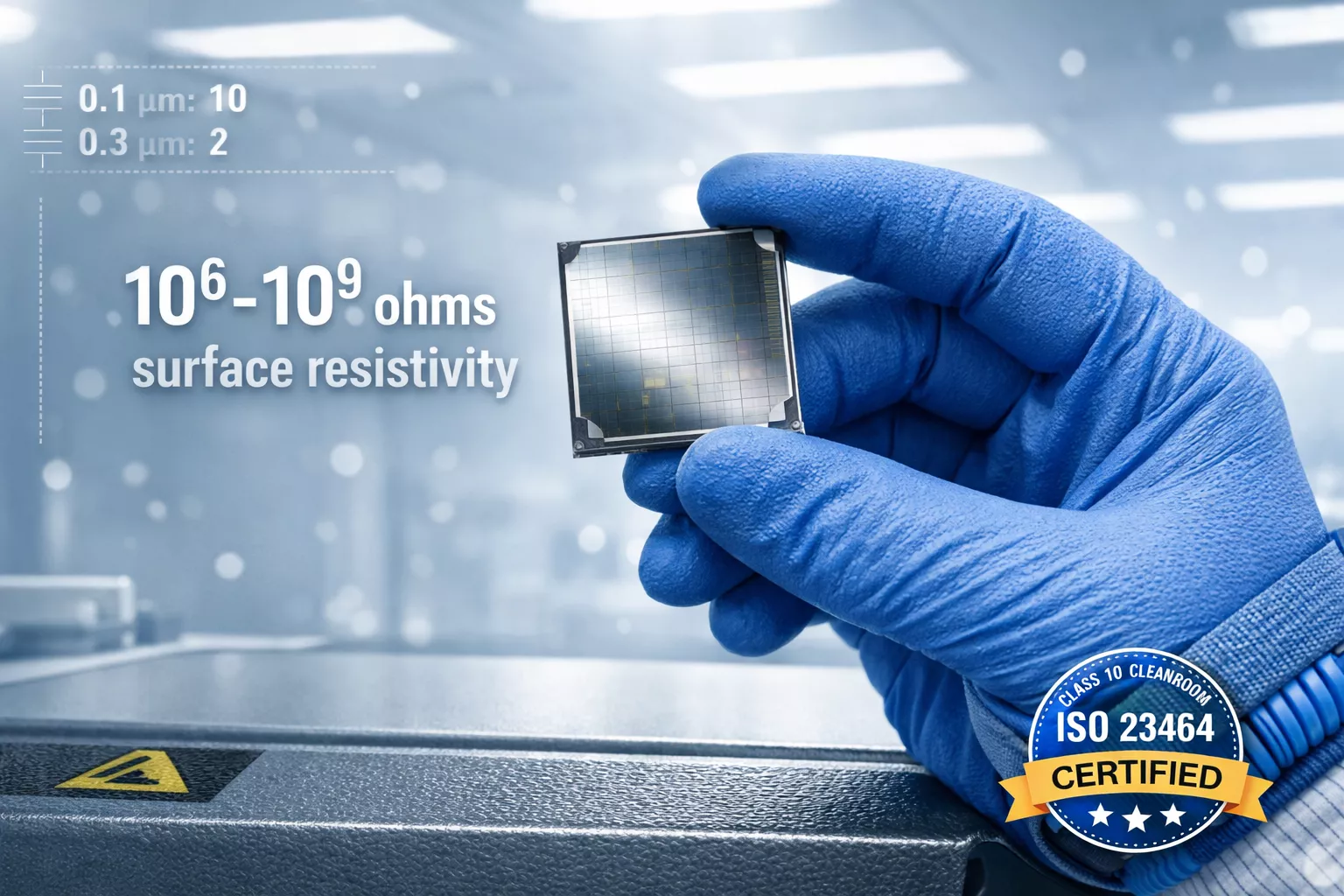
- ESD-treated nitrile gloves with carbon agents achieve surface resistivity of 10⁶ to 10⁹ ohms, meeting EN 16350 certification for static-sensitive electronics
- ISO 23464 standards specify strict requirements for particle counts, ion content, and chemical residues in electronics-grade nitrile gloves
- Finger-coated and palm-coated variants enhance grip and dexterity for handling delicate microchips and circuit boards
- Asia Pacific electronics manufacturing has made latex-free nitrile gloves the standard requirement due to allergy risks and superior low-particulate properties
Why Nitrile Gloves in Electronics Assembly: Lint-Free Protection Matters
The Contamination Challenge in Semiconductor Manufacturing
Semiconductor fabrication facilities operate under extreme cleanliness standards. A Class 10 cleanroom permits no more than 10 particles (0.5 microns or larger) per cubic foot of air. In this environment, traditional cotton or latex gloves become contamination sources themselves, shedding fibers and proteins that compromise delicate circuitry.
Nitrile gloves solve this problem through their synthetic polymer construction, which generates minimal particulates compared to natural rubber latex. When properly manufactured and packaged, cleanroom-grade nitrile gloves meet medical-grade cleanliness standards while providing the chemical resistance needed for electronics assembly.
Key Contamination Risks Nitrile Gloves Prevent
🔬 Electrostatic Discharge (ESD): Untreated nitrile is insulative and can hold static charges, but carbon-treated variants dissipate charges safely
🧪 Skin Oils and Amino Compounds: Human skin secretions contain salts and organic compounds that corrode circuit traces
💧 Moisture and Fingerprints: Water vapor and fingerprint residues create conductive paths on circuit boards
🧵 Lint and Fiber Contamination: Textile particles interfere with photolithography and bonding processes
Understanding what nitrile gloves protect against helps electronics manufacturers select appropriate specifications for their cleanroom requirements.
Cleanroom Standards for Nitrile Gloves in Electronics Assembly
ISO 23464 and Industry Specifications
The ISO 23464 standard establishes comprehensive requirements for nitrile cleanroom gloves used in electronics manufacturing. These specifications go far beyond basic barrier protection to address:
| Parameter | Requirement | Purpose |
|---|---|---|
| Particle Count | <100 particles/glove | Prevents contamination of wafers |
| Surface Ion Content | <10 μg/cm² | Reduces corrosion risk |
| Non-Volatile Residues | <5 mg/glove | Eliminates chemical interference |
| Silicon Content | <0.5 mg/glove | Prevents silicone contamination |
| Dioctyl Phthalate | <1 mg/glove | Avoids plasticizer migration |
These stringent requirements ensure that nitrile gloves in electronics assembly: lint-free protection for semiconductor manufacturing meets the demands of Class 10, 100, and 1000 cleanroom environments.
Manufacturing Process for Cleanroom Nitrile Gloves
Premium cleanroom nitrile gloves undergo specialized processing:
- Deionized Water Laundering: Removes ionic contaminants and residual manufacturing chemicals
- Class 10 Cleanroom Packaging: Vacuum-sealed in controlled environments to prevent post-production contamination
- Gamma Irradiation (Optional): Sterilizes gloves without chemical residues for ultra-clean applications
- Lot Testing: Each production batch undergoes particle count and chemical analysis verification
This manufacturing rigor explains why electronics-grade nitrile gloves command premium pricing compared to standard disposable gloves. The investment protects against product defects that cost exponentially more than the gloves themselves.
ESD Protection: Anti-Static Nitrile Gloves for Semiconductor Work
Understanding Static Electricity Risks
Standard nitrile gloves are excellent insulators, which creates a problem in electronics assembly. When workers handle static-sensitive components like microprocessors, memory chips, or circuit boards, insulative gloves can accumulate charges exceeding 10,000 volts—enough to invisibly damage semiconductor junctions.
While some wonder about nitrile gloves and electric shock protection, the real concern in electronics isn’t high-voltage shock but rather low-voltage ESD damage to sensitive components.
EN 16350 Certification for ESD Gloves
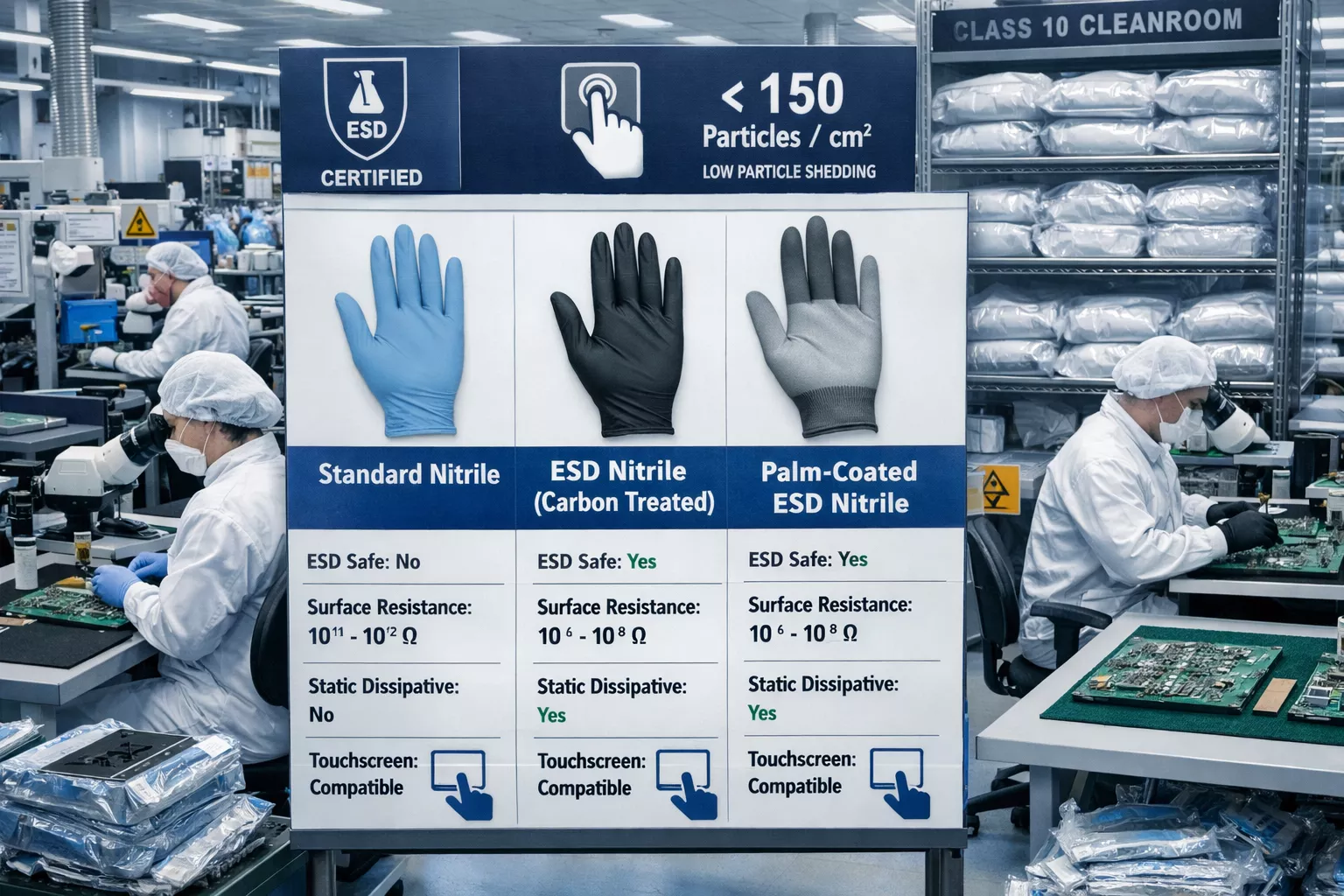
To address static risks, manufacturers treat nitrile gloves with carbon agents that create conductive pathways through the material. EN 16350 certification verifies that treated gloves achieve surface resistivity between 10⁶ and 10⁹ ohms—the “dissipative” range that safely bleeds static charges without creating shock hazards.
Key features of ESD nitrile gloves:
✅ Carbon fiber or carbon black integration throughout the nitrile polymer
✅ Consistent conductivity across all glove surfaces, including fingertips
✅ Compatibility with wrist straps and grounded ESD workstations
✅ Maintained performance through multiple donning/doffing cycles
✅ Visual identification through gray or black coloring (versus standard blue)
Electronics manufacturers in semiconductor hubs like Senai and Kulai in Malaysia have made EN 16350-certified gloves mandatory for assembly operations, recognizing that invisible ESD damage creates quality issues that only appear during customer use.
Specialized Coatings for Enhanced Performance
Finger-Coated and Palm-Coated Nitrile ESD Gloves
While base nitrile provides excellent chemical resistance and low particulate generation, specialized coatings dramatically improve handling performance for delicate semiconductor components:
Polyurethane (PU) Fingertip Coating:
- Enhances tactile sensitivity for precision placement of tiny components
- Provides superior grip on smooth silicon wafers and glass substrates
- Reduces component drops by 40-60% compared to uncoated gloves
- Maintains Class 10 cleanroom compatibility when properly formulated
Nitrile Palm Coating:
- Increases durability in high-use assembly environments
- Improves grip on tools and equipment
- Extends glove lifespan by 2-3x in abrasive handling tasks
- Balances protection with dexterity requirements
Polyester/Nylon Lint-Free Liners:
- Adds comfort during extended wear periods
- Wicks moisture away from hands to maintain grip
- Provides additional ESD protection when woven with conductive fibers
- Reduces hand fatigue during 8-12 hour shifts
The choice between coating types depends on specific assembly tasks. Wafer handling typically requires fingertip-coated gloves for maximum sensitivity, while circuit board assembly may benefit from full palm coating for tool grip. Understanding the best thickness for nitrile gloves helps balance protection with dexterity needs.
Touchscreen Compatibility and Modern Manufacturing
Digital Interface Integration
Modern electronics assembly increasingly relies on digital work instructions, quality control systems, and real-time data entry. Workers need to interact with touchscreens without removing protective gloves—a requirement that standard ESD gloves often fail to meet.
2026 cleanroom nitrile gloves now feature touchscreen-compatible formulations that maintain capacitive touch sensitivity while preserving ESD protection and lint-free properties. This innovation eliminates the contamination risk of repeatedly donning and doffing gloves to operate equipment.
Key benefits include:
📱 Seamless interaction with tablets and control panels
⚡ Maintained ESD protection during digital operations
🧼 Reduced contamination from glove changes
⏱️ Improved workflow efficiency and reduced assembly time
Comparing Nitrile to Alternative Glove Materials
Why Nitrile Outperforms Latex and Vinyl in Electronics
Electronics manufacturers have largely standardized on nitrile for compelling reasons:
Nitrile vs. Latex:
- Allergy-free: Eliminates latex protein sensitivity risks affecting 8-12% of workers
- Lower particulate generation: Synthetic polymer sheds fewer particles than natural rubber
- Superior chemical resistance: Better protection against solvents, oils, and cleaning agents
- Consistent quality: Less batch-to-batch variation than natural latex
For detailed comparisons, see why nitrile gloves are better than latex and vinyl.
Nitrile vs. Vinyl:
- Better durability: Nitrile resists tears and punctures more effectively
- Enhanced dexterity: Superior elasticity for precision handling
- Chemical resistance: Vinyl degrades rapidly with many electronics solvents
- ESD treatment compatibility: Carbon integration works better with nitrile polymer
The latex-free requirement has become standard across Asia Pacific electronics manufacturing, driven by both worker safety concerns and the superior low-particulate properties of nitrile. Learn more about latex-free disposable gloves performance in extended-use scenarios.
Brand Recommendations and Selection Criteria
Top-Tier Cleanroom Nitrile Glove Manufacturers
When selecting nitrile gloves in electronics assembly: lint-free protection for semiconductor manufacturing, prioritize suppliers with documented cleanroom certifications:
Ansell Microflex®:
- ISO 23464 certified cleanroom gloves
- Extensive ESD product line with EN 16350 compliance
- Touchscreen-compatible formulations
- Strong presence in semiconductor manufacturing
Kimberly-Clark Kimtech™:
- Class 10 cleanroom packaging
- Low particle generation verified through independent testing
- Specialized semiconductor assembly variants
- Comprehensive technical documentation
Showa Best Glove:
- ESD-safe nitrile with carbon treatment
- Finger-coated options for precision work
- Excellent durability in high-use environments
- Competitive pricing for volume purchases
Superior Glove:
- Touchscreen-compatible ESD nitrile
- Palm-coated variants for tool handling
- ISO 9001 quality management certification
- Responsive technical support for specification questions
Selection Checklist for Electronics Assembly
When evaluating glove options, verify:
✔️ Cleanroom Classification: Class 10, 100, or 1000 certification matching your facility requirements
✔️ ESD Performance: EN 16350 certification with documented surface resistivity
✔️ Chemical Compatibility: Resistance to specific solvents and cleaning agents used in your processes
✔️ Coating Type: Fingertip, palm, or uncoated based on handling requirements
✔️ Sizing Accuracy: Proper fit critical for dexterity and contamination control
✔️ Packaging Integrity: Vacuum-sealed, cleanroom-packaged to maintain cleanliness
✔️ Lot Traceability: Batch codes for quality control and issue investigation
✔️ Supplier Reliability: Consistent availability to prevent production disruptions
Cost-Benefit Analysis: Investment vs. Defect Prevention
The True Economics of Premium Cleanroom Gloves
Electronics manufacturers sometimes balk at the 3-5x price premium of cleanroom-grade nitrile gloves compared to standard disposables. However, the economics strongly favor quality:
Cost of Contamination:
- Single contaminated wafer: $5,000-$50,000 in lost product
- Production line shutdown: $100,000-$500,000 per hour
- Customer returns: Reputation damage plus replacement costs
- Regulatory issues: Potential facility certification problems
Cost of Premium Gloves:
- Cleanroom nitrile: $0.15-$0.40 per glove
- ESD-treated variants: $0.25-$0.60 per glove
- Coated specialty gloves: $0.40-$0.80 per glove
A single prevented defect pays for thousands of glove pairs. Forward-thinking manufacturers view ESD nitrile gloves as quality investments rather than consumable expenses, recognizing that invisible static damage and contamination create far greater costs than the protective equipment itself.
Implementation Best Practices
Maximizing Performance of Nitrile Gloves in Electronics Assembly
Proper implementation extends beyond simply purchasing certified gloves:
Storage and Handling:
- Maintain cleanroom storage conditions until point of use
- Rotate stock using first-in, first-out (FIFO) principles
- Avoid exposure to UV light, ozone, or extreme temperatures
- Keep vacuum packaging intact until donning
Donning Procedures:
- Wash hands thoroughly before gloving
- Don gloves in cleanroom environment, not in changing areas
- Inspect for tears or defects before use
- Ensure proper fit—too loose increases contamination risk
Usage Guidelines:
- Change gloves every 2-4 hours or when visibly soiled
- Replace immediately after contact with incompatible chemicals
- Avoid touching non-cleanroom surfaces while gloved
- Use proper ESD grounding in conjunction with dissipative gloves
Training Requirements:
- Educate workers on contamination risks and prevention
- Demonstrate proper donning and doffing techniques
- Explain ESD principles and static-safe handling
- Reinforce quality impact of proper glove use
Future Trends in Electronics Assembly Glove Technology
Innovations Shaping 2026 and Beyond
The semiconductor industry’s evolution drives continuous glove technology advancement:
Smart Glove Integration: Emerging products incorporate sensors that monitor ESD grounding continuity, alerting workers to compromised static protection in real-time.
Biodegradable Cleanroom Nitrile: Manufacturers are developing compostable nitrile formulations that maintain cleanroom performance while addressing environmental concerns.
Enhanced Tactile Feedback: New coating technologies provide haptic feedback for robotic-assisted assembly, improving precision in human-robot collaborative environments.
Antimicrobial Treatments: Silver-ion and copper-infused nitrile variants reduce microbial contamination risks in hybrid cleanroom/biological manufacturing facilities.
Custom Formulations: Suppliers increasingly offer application-specific nitrile blends optimized for particular semiconductor processes, chemical exposures, or assembly requirements.
The U.S. semiconductor reshoring initiative and expansion of battery manufacturing create growing demand for specialized cleanroom gloves, with suppliers investing heavily in production capacity and innovation to meet these needs.
Conclusion
Nitrile gloves in electronics assembly: lint-free protection for semiconductor manufacturing represents far more than basic hand protection—it’s a critical quality control measure that prevents costly contamination and ESD damage in nanometer-scale production environments. The evolution from standard disposable gloves to specialized cleanroom-grade, ESD-treated, coated variants reflects the semiconductor industry’s uncompromising demands for cleanliness and precision.
As electronics manufacturing continues expanding globally in 2026, particularly with reshoring initiatives in North America and growth in Asia Pacific, the importance of proper glove selection and implementation will only increase. The 50-60% industrial share of nitrile glove demand underscores how essential these products have become to modern manufacturing.
Next Steps for Electronics Manufacturers
- Audit current glove specifications against ISO 23464 and EN 16350 standards to identify gaps
- Conduct cost-benefit analysis comparing premium cleanroom gloves against historical defect rates
- Trial multiple suppliers to evaluate performance, fit, and reliability in your specific applications
- Implement comprehensive training on proper glove selection, donning, and usage procedures
- Establish supplier relationships that ensure consistent availability and technical support
- Monitor industry developments in smart glove technology and sustainable formulations
The investment in proper lint-free nitrile glove protection pays dividends through reduced defects, improved yields, and enhanced product quality—making it one of the highest-return decisions in semiconductor manufacturing operations.