Last updated: June 27, 2026
Quick Answer
Nitrile glove thickness ranges from 5mil (0.005 inches) to 33mil (0.033 inches), with each specification serving distinct applications. Thin gloves (5-8mil) maximize tactile sensitivity for medical and food handling tasks, medium gloves (10-15mil) balance protection and dexterity for automotive and janitorial work, while thick gloves (20-33mil) provide superior chemical resistance and durability for industrial applications. The optimal thickness depends on your specific task requirements, exposure risks, and budget constraints, with thicker gloves costing 2-5 times more than standard thin options but lasting significantly longer in harsh environments.
Key Takeaways
- Mil measurement refers to one-thousandth of an inch, so 5mil equals 0.005 inches of material thickness
- Medical and dental professionals typically use 4-6mil gloves for optimal tactile sensitivity during examinations
- Automotive mechanics benefit from 8-12mil gloves that resist petroleum products while maintaining grip
- Chemical handling requires 15mil or thicker gloves, with specific chemicals demanding up to 33mil protection
- Thin gloves (5-8mil) cost approximately $0.05-0.15 per glove, while thick gloves (20-33mil) range from $0.50-2.00 per glove
- Food handling regulations typically require 4-6mil gloves that balance safety with dexterity
- Gloves tearing frequently indicate either incorrect thickness selection or poor quality materials
- Thicker gloves reduce tactile sensitivity but increase protection duration and chemical breakthrough time
- Common mistakes include choosing thickness based solely on price or assuming thicker always means better
- Bleach and harsh cleaners require minimum 8-10mil thickness with extended chemical resistance ratings
What Does Mil Mean in Nitrile Glove Thickness
Mil is a unit of measurement equal to one-thousandth of an inch (0.001 inches), used to specify the thickness of nitrile glove material. A 5mil glove measures 0.005 inches thick, while a 15mil glove measures 0.015 inches thick. This standardized measurement allows consistent comparison across manufacturers and helps buyers select appropriate protection levels for specific tasks.
The mil measurement applies to the glove’s palm and finger thickness, though some manufacturers measure at different points. Most quality gloves maintain consistent thickness throughout, but budget options may have thinner fingertips or palms. When comparing gloves, verify whether the manufacturer measures at the palm, fingertip, or provides an average thickness.
Key measurement facts:
- 1 mil = 0.001 inches = 0.0254 millimeters
- Standard disposable gloves range from 3mil to 8mil
- Industrial gloves typically range from 10mil to 33mil
- Thickness tolerance can vary by plus or minus 0.5mil in manufacturing
Understanding mil measurements helps you match glove specifications to industry standards and safety requirements. For detailed guidance on selecting appropriate thickness for various applications, see our comprehensive guide to nitrile glove thickness.
How Thick Should Nitrile Gloves Be for Medical Use
Medical-grade nitrile gloves typically range from 4mil to 6mil, with 5mil being the most common standard for examination gloves. This thickness provides adequate barrier protection against bloodborne pathogens and bodily fluids while maintaining the tactile sensitivity required for patient examinations, injections, and diagnostic procedures. Surgical procedures may require slightly thicker gloves (6-8mil) for extended wear and enhanced protection.
The FDA regulates medical gloves under 21 CFR Part 880, requiring specific performance standards regardless of thickness. Medical professionals need to feel subtle differences in tissue, locate veins, and manipulate small instruments, making excessive thickness counterproductive. However, gloves below 4mil may not provide adequate viral and bacterial barrier protection.
Medical thickness recommendations by specialty:
- General examination: 4-5mil
- Dentistry: 5-6mil (extended wear, chemical exposure)
- Surgery: 6-8mil (double-gloving common)
- Emergency medicine: 6-7mil (higher puncture risk)
- Laboratory work: 5-6mil (chemical splash protection)
Healthcare facilities often stock multiple thickness options, allowing staff to choose based on procedure risk level. High-risk procedures involving sharp instruments or extended patient contact justify thicker gloves, while routine examinations benefit from thinner options that reduce hand fatigue during long shifts. Learn more about nitrile gloves in healthcare settings.
5 Mil vs 8 Mil Nitrile Gloves: Which Is Better
The choice between 5mil and 8mil nitrile gloves depends entirely on your application requirements. 5mil gloves excel in tasks requiring maximum tactile sensitivity and frequent glove changes, such as medical examinations, food preparation, and electronics assembly. 8mil gloves provide superior durability and protection for automotive work, janitorial services, and light industrial tasks where puncture resistance and longer wear time matter more than fine touch sensitivity.
5mil gloves advantages:
- Superior tactile sensitivity for detailed work
- Lower cost per unit ($0.05-0.10 each)
- Less hand fatigue during extended wear
- Easier to don and remove quickly
- Ideal for high-volume, short-duration tasks
8mil gloves advantages:
- 40-60% better puncture resistance
- Longer wear time before degradation
- Better protection against mild chemicals
- Reduced tearing during rough handling
- More cost-effective for extended single-use tasks
For medical and food service applications, 5mil gloves typically perform better because regulations and best practices require frequent glove changes anyway. For automotive mechanics or cleaning professionals who wear gloves for extended periods while handling abrasive materials, 8mil gloves reduce the frequency of tears and provide better value despite higher upfront costs. Consider our detailed comparison of thin versus thick nitrile gloves for more application-specific guidance.
Do Thicker Nitrile Gloves Protect Better Against Chemicals
Thicker nitrile gloves generally provide better chemical protection by increasing breakthrough time—the duration before a chemical permeates through the glove material. A 15mil glove might resist a specific solvent for 30 minutes, while a 5mil glove of the same nitrile formulation might allow breakthrough in just 5-10 minutes. However, thickness alone does not determine chemical resistance; the nitrile formulation, chemical type, concentration, and temperature all significantly impact protection levels.
Chemical resistance depends on molecular compatibility between the nitrile polymer and the specific chemical. Some chemicals degrade nitrile quickly regardless of thickness, while others resist permeation even through thin gloves. Manufacturers provide chemical resistance charts showing breakthrough times for specific chemicals at various concentrations, which should guide selection more than thickness alone.
Chemical protection considerations:
- Petroleum products: 8-12mil typically sufficient for short exposure
- Strong acids/bases: 15-20mil minimum, check compatibility charts
- Organic solvents: 15-33mil depending on solvent type and exposure duration
- Aqueous solutions: 5-8mil often adequate for diluted chemicals
- Paint thinners and strippers: 20-33mil for extended contact
For tasks involving unknown chemicals or prolonged exposure, choose the thickest compatible glove and replace frequently. A 33mil glove might provide 8 hours of protection against certain chemicals, while a 5mil glove fails within minutes. However, for brief splash protection from mild chemicals, a quality 8mil glove often suffices and provides better dexterity. Review what nitrile gloves protect against for comprehensive chemical resistance information.
What Mil Nitrile Gloves for Automotive Work
Automotive mechanics typically use 8-12mil nitrile gloves that balance protection against petroleum products, solvents, and abrasive surfaces with sufficient dexterity for handling tools and small parts. 8mil gloves work well for general maintenance, oil changes, and brake work, while 12-15mil gloves better suit transmission work, parts cleaning with solvents, and tasks involving sharp metal edges or prolonged chemical exposure.
The automotive environment presents multiple hazards: gasoline, motor oil, brake fluid, transmission fluid, battery acid, degreasers, and sharp metal surfaces. Gloves below 6mil tear too easily and provide inadequate chemical resistance, while gloves above 15mil reduce the tactile feedback needed for precision work like threading bolts or connecting electrical components.
Automotive task thickness recommendations:
- Oil changes and fluid checks: 6-8mil
- Brake and suspension work: 8-10mil
- Engine repair and parts handling: 10-12mil
- Solvent cleaning and degreasing: 12-15mil
- Body work and painting: 15-20mil (depending on chemicals used)
Many professional mechanics prefer textured 8-10mil gloves that provide enhanced grip on oily tools and parts. The texture compensates for reduced tactile sensitivity compared to thinner gloves while maintaining adequate protection. Black nitrile gloves are popular in automotive settings because they hide grease and oil stains, though color does not affect performance. For specific recommendations, see our guide to the best mechanic nitrile gloves.
Are 33 Mil Nitrile Gloves Too Thick for Fine Detail Work
Yes, 33mil nitrile gloves significantly reduce tactile sensitivity and are generally unsuitable for fine detail work requiring precision manipulation, small part assembly, or delicate touch. These heavy-duty gloves are designed for industrial chemical handling, hazardous waste management, and situations where maximum protection outweighs dexterity concerns. The thick material makes it difficult to feel small objects, grip tiny components, or perform tasks requiring finger precision.
33mil gloves serve specific industrial applications where worker safety demands maximum barrier protection. They excel in chemical processing plants, industrial cleaning with aggressive solvents, and handling corrosive materials where breakthrough time and puncture resistance are critical. For these applications, reduced dexterity is an acceptable trade-off for enhanced safety.
Applications where 33mil gloves are appropriate:
- Industrial chemical handling and mixing
- Hazardous waste cleanup and disposal
- Aggressive solvent immersion tasks
- Corrosive material handling
- Extended exposure to harsh chemicals
Tasks where 33mil gloves are inappropriate:
- Medical procedures or examinations
- Food preparation and handling
- Electronics assembly or repair
- Precision mechanical work
- Any task requiring fine motor control
If your work requires both chemical protection and dexterity, consider using 15-20mil gloves with appropriate chemical resistance ratings, or implement a double-gloving strategy with a thin inner glove for sensitivity and a thicker outer glove for protection. Some workers use 33mil gloves for the most hazardous portions of a task, then switch to thinner gloves for detail work.
How Much Do 15 Mil Nitrile Gloves Cost Compared to 5 Mil
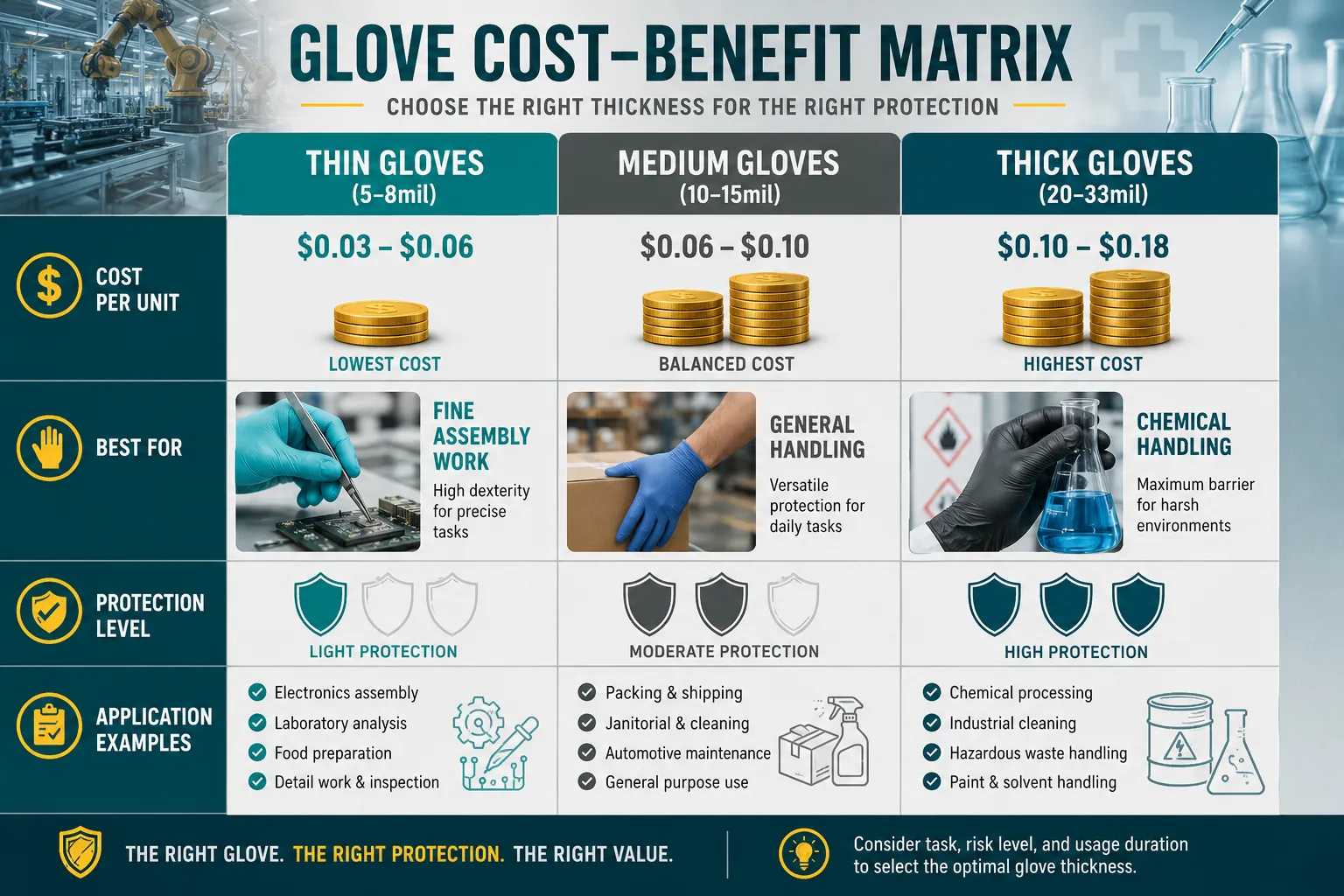
15mil nitrile gloves typically cost 3-5 times more than 5mil gloves on a per-unit basis. In 2026, standard 5mil examination gloves cost approximately $0.05-0.15 per glove when purchased in bulk (1,000+ units), while 15mil industrial gloves range from $0.25-0.50 per glove. However, the cost-per-use calculation often favors thicker gloves for appropriate applications because they last longer and require fewer changes during extended tasks.
Price variations depend on several factors beyond thickness: brand reputation, certification standards (FDA, ASTM, EN), texture (smooth vs. textured), color, packaging size, and market conditions. Medical-grade certification adds cost regardless of thickness, while industrial gloves without medical certification may cost less even at greater thickness.
Approximate 2026 pricing (per glove, bulk purchase):
- 4-5mil examination grade: $0.05-0.15
- 6-8mil premium examination: $0.10-0.20
- 8-10mil light industrial: $0.15-0.30
- 12-15mil medium industrial: $0.25-0.50
- 20-25mil heavy industrial: $0.50-1.00
- 28-33mil chemical resistant: $1.00-2.00
For high-volume, short-duration tasks like food service or medical examinations where gloves are changed every few minutes, thin gloves provide better value. For extended-wear applications like automotive repair or janitorial work where a single pair lasts several hours, thicker gloves reduce total consumption and may cost less per work shift despite higher unit prices.
Cost-effectiveness calculation example:
A mechanic using 5mil gloves might tear through 6-8 pairs during a 4-hour job, costing $0.48-1.20. Using 12mil gloves, the same mechanic might use only 2 pairs, costing $0.50-1.00 while providing better protection and fewer interruptions to change gloves.
Nitrile Gloves Tearing Too Easily: What Thickness Do I Need
If your nitrile gloves tear frequently, you likely need to increase thickness by at least 2-3mil or address quality issues with your current gloves. Frequent tearing indicates either insufficient thickness for your application’s mechanical stress, poor-quality gloves with manufacturing defects, or improper glove sizing causing stress points. For most applications experiencing tear problems, moving from 5mil to 8mil or from 8mil to 12mil resolves the issue.
Tearing can result from multiple factors beyond thickness. Gloves that are too small stretch excessively and tear at stress points, while oversized gloves bunch and catch on objects. Sharp edges, rough surfaces, and repetitive friction cause tears even in appropriately thick gloves. Chemical exposure can also degrade nitrile, causing premature failure that appears as tearing.
Common tearing scenarios and solutions:
- Medical/food service frequent tears: Upgrade from 4mil to 6mil, ensure proper sizing
- Automotive work tears: Move from 6-8mil to 10-12mil, consider textured grip
- Janitorial/cleaning tears: Upgrade from 5mil to 8-10mil, check chemical compatibility
- Construction/industrial tears: Move from 8-10mil to 15-20mil, inspect for sharp edges
- Chemical exposure tears: Check compatibility charts, may need specialized formulation not just thickness
Troubleshooting steps before increasing thickness:
- Verify correct glove size (snug but not tight)
- Check for manufacturing defects (pinholes, thin spots)
- Assess chemical exposure (degradation vs. mechanical failure)
- Identify specific tear locations (fingertips, palm, wrist)
- Consider textured gloves for better grip and reduced stress
If tears occur primarily at fingertips, you may be gripping sharp objects or using excessive force. Palm tears often indicate abrasion against rough surfaces. Wrist tears suggest improper donning technique or too-small sizing. Address the root cause along with increasing thickness for best results.
What Thickness Nitrile Gloves for Food Handling
Food handling typically requires 4-6mil nitrile gloves that meet FDA food contact standards (21 CFR 177.2600) and provide adequate barrier protection while maintaining the dexterity needed for food preparation tasks. 5mil gloves represent the industry standard, offering sufficient protection against cross-contamination and bacterial transfer while allowing workers to feel food texture, handle delicate items, and perform detailed cutting and assembly tasks.
Food service regulations focus more on frequent glove changes and proper hygiene practices than on thickness. Most health departments require glove changes between tasks, after touching non-food surfaces, and at regular intervals, making thin, cost-effective gloves more practical than thick, expensive options. The key is selecting food-safe nitrile gloves that resist oils and fats without degrading.
Food handling thickness by task:
- Food preparation and assembly: 4-5mil
- Meat and seafood handling: 5-6mil (better puncture resistance)
- Dishwashing and cleaning: 8-12mil (chemical and heat exposure)
- Food packaging and processing: 5-6mil
- Bakery and pastry work: 4-5mil (maximum sensitivity)
Nitrile gloves offer advantages over latex (allergy concerns) and vinyl (poor barrier protection and durability) for food handling. They resist animal fats, vegetable oils, and most food-related chemicals while providing better puncture resistance than vinyl. However, they are not heat-resistant and should not be used for handling hot items directly from ovens or fryers.
For comprehensive information about food safety requirements, review our guide on nitrile gloves for food handling and food safety considerations.
Can You Feel Through 20 Mil Nitrile Gloves
Tactile sensitivity through 20mil nitrile gloves is significantly reduced compared to thin gloves, but you can still feel large objects, detect pressure, and sense general shapes and textures. Fine detail work requiring precise touch feedback—such as feeling small components, detecting subtle texture differences, or performing delicate manipulations—becomes difficult or impossible with 20mil thickness. These gloves are designed for protection-priority applications where reduced sensitivity is an acceptable trade-off.
The relationship between thickness and tactile sensitivity is not linear. Moving from 5mil to 8mil causes a noticeable but manageable reduction in sensitivity. Jumping from 8mil to 15mil creates a more significant impact, and 20mil gloves feel substantially different from anything below 12mil. At 20mil thickness, you lose the ability to perform tasks requiring fingertip precision but retain adequate feedback for general handling, tool use, and gross motor tasks.
Tactile sensitivity comparison:
- 5mil: Can feel fine textures, small components, subtle differences
- 8mil: Slight reduction, still adequate for most precision work
- 12mil: Noticeable reduction, adequate for general mechanical work
- 15mil: Significant reduction, difficult for small part manipulation
- 20mil: Major reduction, suitable only for gross motor tasks
- 33mil: Minimal tactile feedback, protection-only applications
Workers in chemical processing or industrial cleaning who must use 20mil gloves often develop compensatory techniques, relying more on visual feedback and using modified grip strategies. Some applications benefit from double-gloving: a thin inner glove for sensitivity and a thick outer glove for protection, removing the outer glove when precision work is required.
If your application requires both chemical protection and tactile sensitivity, explore specialized gloves with reinforced palms and thinner fingertips, or consider 12-15mil gloves with enhanced chemical resistance formulations rather than defaulting to maximum thickness.
Common Mistakes When Choosing Nitrile Glove Thickness
The most common mistake when selecting nitrile glove thickness is choosing based solely on price rather than matching thickness to specific application requirements and total cost of ownership. Buyers often purchase the cheapest available gloves, then experience excessive tearing, inadequate protection, or frequent changes that increase total costs. Conversely, some buyers assume thicker always means better and purchase unnecessarily thick gloves that reduce productivity and cause hand fatigue.
Critical selection mistakes:
Mistake 1: Ignoring chemical compatibility Choosing thickness without checking chemical resistance charts. A 5mil glove might resist certain chemicals better than a 15mil glove of different formulation. Always verify compatibility for your specific chemicals.
Mistake 2: Wrong thickness for task duration Using thin gloves for extended-wear applications or thick gloves for frequent-change scenarios. Match thickness to how long gloves will be worn continuously.
Mistake 3: Overlooking sizing impact Purchasing incorrectly sized gloves that tear regardless of thickness. Proper fit is as important as appropriate thickness for preventing failures.
Mistake 4: Confusing thickness with quality Assuming all gloves of the same thickness perform equally. Manufacturing quality, nitrile formulation, and certification standards significantly impact performance beyond thickness alone.
Mistake 5: Not calculating cost per use Comparing only unit prices without considering how many gloves are consumed per task. A $0.50 glove that lasts all day costs less than six $0.10 gloves that tear within an hour.
Mistake 6: Ignoring industry standards Failing to verify that selected gloves meet regulatory requirements for medical, food service, or industrial applications. Compliance matters regardless of thickness.
Mistake 7: One-size-fits-all approach Using the same glove thickness for all tasks within a facility. Most operations benefit from stocking 2-3 thickness options for different applications.
Better selection approach:
- Identify specific hazards (chemical, biological, mechanical)
- Determine required wear duration per glove
- Assess dexterity requirements for the task
- Check regulatory and industry standards
- Calculate total cost per task, not just unit price
- Test multiple options with actual users before bulk purchase
- Review chemical compatibility charts for specific exposures
Are Thin Nitrile Gloves Safe for Cleaning with Bleach
Thin nitrile gloves (4-6mil) provide limited protection for brief bleach exposure but are not recommended for extended cleaning tasks or concentrated bleach solutions. Standard household bleach (5-6% sodium hypochlorite) can permeate thin nitrile within 10-30 minutes depending on concentration and glove quality. For routine cleaning with diluted bleach solutions, 8-10mil nitrile gloves offer better protection, while concentrated bleach or extended exposure requires 12-15mil thickness with verified chemical resistance ratings.
Bleach degrades nitrile over time through oxidation, causing the material to become brittle and lose barrier properties. This degradation accelerates with higher concentrations, elevated temperatures, and extended contact time. Thin gloves may appear intact while actually providing compromised protection after prolonged bleach exposure.
Bleach cleaning glove recommendations:
- Light household cleaning (diluted bleach, brief exposure): 6-8mil acceptable
- Regular janitorial cleaning (moderate exposure): 8-10mil recommended
- Heavy-duty cleaning (concentrated solutions): 12-15mil minimum
- Industrial bleach applications: 15-20mil with verified compatibility
Safety practices for bleach use:
- Check manufacturer’s chemical resistance charts for breakthrough times
- Replace gloves showing any signs of degradation (stiffness, discoloration)
- Limit continuous wear time even with appropriate thickness
- Rinse gloves with water during extended cleaning sessions
- Never reuse gloves after bleach exposure
- Consider double-gloving for extended exposure (thin inner, thick outer)
For comprehensive cleaning applications involving multiple chemicals beyond bleach, select gloves rated for the most aggressive chemical you’ll encounter. Many commercial cleaning products contain chemicals more aggressive than bleach, requiring thicker gloves or specialized formulations. Review what nitrile gloves protect against for detailed chemical resistance information.
What Mil Gloves Do Dentists Use
Dentists typically use 5-6mil nitrile gloves that provide adequate barrier protection against bloodborne pathogens while maintaining the tactile sensitivity required for oral examinations and dental procedures. 5mil represents the most common standard in dental practices, offering a balance between protection, comfort during extended wear, and the ability to feel subtle differences in tooth structure and tissue. Some dentists prefer 6mil for procedures involving more aggressive instrumentation or extended patient contact.
Dental work requires excellent tactile feedback to detect cavities, assess tissue condition, and manipulate small instruments in a confined space. Gloves that are too thick reduce the ability to feel these critical details, potentially compromising diagnostic accuracy and procedural precision. However, gloves below 4mil may not provide adequate protection against punctures from sharp instruments or sufficient barrier against oral fluids.
Dental procedure thickness preferences:
- Routine examinations: 4-5mil
- Restorative procedures (fillings, crowns): 5-6mil
- Surgical procedures: 6-8mil, often double-gloved
- Hygienist cleanings: 5-6mil
- Orthodontic work: 4-5mil (frequent glove changes)
Dental professionals often change gloves multiple times during a single patient appointment, making cost-effective thin gloves more practical than expensive thick options. The emphasis on frequent changes and proper infection control protocols means that moderate thickness with high-quality barrier protection outperforms maximum thickness with reduced dexterity.
Many dental practices stock both 5mil and 6mil options, allowing practitioners to choose based on procedure type and personal preference. Textured fingertips are popular in dental gloves because they improve grip on wet instruments and in the moist oral environment. For more information about medical-grade gloves, see our article on nitrile gloves in healthcare.
When Is 5 Mil Nitrile Glove Thickness Not Enough Protection
5mil nitrile gloves provide insufficient protection for tasks involving aggressive chemicals, sharp objects, abrasive materials, extended wear in harsh environments, or situations requiring prolonged chemical immersion. While adequate for brief contact with mild chemicals, routine medical examinations, and food handling, 5mil gloves fail quickly when exposed to solvents, concentrated acids or bases, petroleum products, or mechanical hazards like metal shavings and sharp edges.
Situations requiring thicker than 5mil:
Chemical exposure scenarios:
- Concentrated cleaning chemicals (use 10-15mil)
- Organic solvents and paint thinners (use 15-20mil)
- Industrial degreasers (use 12-15mil)
- Pesticides and agricultural chemicals (use 15-20mil)
- Automotive fluids for extended periods (use 8-12mil)
Mechanical hazard scenarios:
- Handling sharp metal parts or glass (use 8-12mil)
- Construction and demolition work (use 12-20mil)
- Automotive repair with sharp edges (use 10-15mil)
- Rough surface handling causing abrasion (use 8-12mil)
Duration and environment scenarios:
- Extended wear exceeding 2-3 hours (use 8-12mil)
- High-heat environments causing glove degradation (use 8-10mil)
- Tasks requiring glove immersion in liquids (use 12-15mil)
- Repetitive friction against abrasive surfaces (use 10-15mil)
Warning signs that 5mil is insufficient:
- Frequent tearing or punctures during normal use
- Visible degradation (discoloration, stiffness) within minutes
- Skin irritation suggesting chemical breakthrough
- Gloves failing before task completion
- Visible wear patterns after brief use
When 5mil gloves consistently fail in your application, increase thickness incrementally (try 8mil next) rather than jumping to maximum thickness. Often, a moderate increase provides adequate protection while maintaining better dexterity and cost-effectiveness than the thickest available options.
Understanding the Nitrile Glove Thickness Guide: Balancing Dexterity, Protection, and Cost Across 5mil to 33mil Specifications
Successfully balancing dexterity, protection, and cost requires understanding that no single thickness optimizes all three factors simultaneously. The Nitrile Glove Thickness Guide framework helps procurement teams and end users make informed decisions by mapping thickness ranges to specific applications, calculating total cost of ownership, and identifying where premium thickness delivers long-term savings versus where thin gloves outperform.
The thickness-performance triangle:
Each application sits at a different point on the triangle connecting three priorities:
- Dexterity priority: Medical examinations, food preparation, electronics assembly (4-6mil optimal)
- Protection priority: Chemical handling, industrial cleaning, hazardous materials (15-33mil optimal)
- Cost priority: High-volume disposable use, frequent changes (5-8mil optimal)
Decision framework by application category:
Medical and Healthcare:
- Primary concern: Barrier protection + tactile sensitivity
- Optimal range: 4-6mil
- Cost consideration: High volume, frequent changes favor thin gloves
- Protection level: Adequate for bloodborne pathogens, not for harsh chemicals
Food Service:
- Primary concern: Contamination prevention + dexterity
- Optimal range: 4-6mil
- Cost consideration: Frequent mandatory changes make thin gloves economical
- Protection level: Adequate for food contact, oils, and fats
Automotive and Mechanical:
- Primary concern: Durability + chemical resistance + grip
- Optimal range: 8-12mil
- Cost consideration: Longer wear time justifies higher unit cost
- Protection level: Good for petroleum products and moderate abrasion
Janitorial and Cleaning:
- Primary concern: Chemical resistance + durability
- Optimal range: 8-15mil depending on chemicals
- Cost consideration: Moderate thickness reduces consumption
- Protection level: Verify chemical compatibility for specific products
Industrial and Chemical:
- Primary concern: Maximum protection + breakthrough time
- Optimal range: 15-33mil depending on hazards
- Cost consideration: Safety requirements justify premium cost
- Protection level: Extended protection against aggressive chemicals
Total cost of ownership calculation:
Compare gloves not just on unit price but on cost per task or cost per shift:
- Scenario A: 5mil gloves at $0.08 each, 8 pairs used per 4-hour task = $0.64 total
- Scenario B: 12mil gloves at $0.35 each, 2 pairs used per 4-hour task = $0.70 total
Scenario B costs only $0.06 more while providing better protection and fewer interruptions to change gloves. Factor in the time cost of changing gloves (approximately 30 seconds per change), and thicker gloves often deliver better total value.
Long-term cost considerations:
- Reduced injury and exposure incidents
- Less downtime for glove changes
- Improved worker satisfaction and productivity
- Fewer workers’ compensation claims
- Better regulatory compliance
Frequently Asked Questions
What is the thickest nitrile glove available? The thickest commonly available nitrile gloves measure 33mil (0.033 inches), designed for industrial chemical handling and hazardous material work. Some specialized applications use custom gloves up to 40mil, but these are rare and typically custom-manufactured for specific industrial processes.
Can I use 8mil gloves instead of 5mil for medical examinations? Yes, 8mil gloves can be used for medical examinations, though they reduce tactile sensitivity compared to standard 5mil examination gloves. Some practitioners prefer slightly thicker gloves for procedures with higher puncture risk, but most medical applications optimize performance with 5-6mil thickness.
How do I know if my gloves are thick enough for chemical protection? Check the manufacturer’s chemical resistance chart for breakthrough times with your specific chemicals. If gloves show degradation (stiffness, discoloration, swelling) within your work period or if you experience skin irritation, increase thickness and verify chemical compatibility.
Do textured gloves affect thickness measurements? Texture patterns add minimal thickness (typically less than 0.5mil) and manufacturers measure base material thickness. Textured gloves provide better grip without significantly impacting protection levels or dexterity compared to smooth gloves of the same mil rating.
Are expensive thick gloves worth the cost for home use? For occasional home use with mild household chemicals, standard 6-8mil gloves provide adequate protection at reasonable cost. Reserve expensive thick gloves (15mil+) for specific tasks involving aggressive chemicals or extended exposure that justify the premium price.
Can I reuse thick nitrile gloves to justify their higher cost? Nitrile gloves are designed for single-use applications. While thick gloves may appear intact after use, they can have microscopic damage and chemical contamination that compromise protection. Reuse is not recommended for any application involving hazardous materials or hygiene concerns.
What thickness do professional cleaners use? Professional cleaning services typically use 8-12mil gloves depending on the chemicals and tasks involved. Light residential cleaning may use 6-8mil, while commercial and industrial cleaning with aggressive chemicals requires 10-15mil gloves.
How does cold weather affect nitrile glove thickness requirements? Cold temperatures make nitrile less flexible, potentially requiring slightly thicker gloves to maintain adequate protection. However, specialized cold-resistant nitrile formulations perform better than simply increasing thickness. For cold environments, look for gloves specifically rated for low-temperature use.
Do black nitrile gloves have different thickness than blue ones? Color does not affect thickness or protection level. Black, blue, purple, and other colors are achieved through pigment additives that don’t significantly impact material properties. Choose color based on preference or industry standards, not performance expectations.
What mil gloves do tattoo artists use? Tattoo artists typically use 5-6mil nitrile gloves that provide bloodborne pathogen protection while maintaining the tactile sensitivity needed for detailed artwork. Some artists prefer 6mil for extended sessions to reduce hand fatigue and ensure consistent barrier protection.
Can thin gloves be doubled for the same protection as thick gloves? Double-gloving with thin gloves increases total thickness but doesn’t provide equivalent protection to a single thick glove. The interface between layers can trap contaminants, and the outer glove may tear without the wearer noticing. Double-gloving works best for surgical applications with specific protocols, not as a substitute for appropriate thickness.
How often should I change gloves during extended tasks? Change gloves whenever they show visible damage, after chemical exposure even if they appear intact, when switching between tasks, and according to manufacturer recommendations for your specific chemicals. For extended tasks without visible damage, change gloves every 2-4 hours as a safety precaution.
Conclusion
Selecting the optimal nitrile glove thickness requires balancing three critical factors: the dexterity needed for your specific tasks, the protection level required for your hazards, and the cost constraints of your operation. This Nitrile Glove Thickness Guide demonstrates that thin gloves (5-8mil) excel in medical, food service, and high-volume applications where tactile sensitivity and frequent changes are priorities. Medium thickness gloves (10-15mil) serve automotive, janitorial, and light industrial work where durability and moderate chemical resistance matter most. Thick gloves (20-33mil) are essential for industrial chemical handling and hazardous material work where maximum protection justifies reduced dexterity and higher costs.
Actionable next steps:
- Assess your specific hazards: List all chemicals, sharp objects, and abrasive materials your gloves will encounter
- Determine required wear duration: Calculate how long gloves must remain effective per task
- Evaluate dexterity requirements: Identify tasks requiring fine motor control versus gross motor tasks
- Calculate total cost of ownership: Compare cost per task rather than unit price alone
- Verify regulatory compliance: Ensure selected gloves meet industry standards for your application
- Test before bulk purchase: Order samples of 2-3 thickness options and test with actual users
- Stock multiple thickness options: Most facilities benefit from having thin, medium, and thick gloves available
The most common mistake is choosing gloves based solely on price or assuming thicker always means better. Instead, match thickness to your specific application requirements, verify chemical compatibility through manufacturer charts, and calculate total cost including consumption rates and worker productivity. For medical and food service applications, 5-6mil gloves typically optimize all three factors. For automotive and cleaning work, 8-12mil gloves provide the best balance. For industrial chemical handling, 15-33mil thickness is necessary despite higher costs and reduced dexterity.
Remember that glove quality, proper sizing, and correct usage practices matter as much as thickness. A well-fitted 8mil glove from a reputable manufacturer outperforms a poorly made 12mil glove. Implement proper training on glove selection, donning techniques, and change protocols to maximize protection regardless of thickness chosen. By applying the framework in this Nitrile Glove Thickness Guide, you can make informed decisions that protect workers, maintain productivity, and optimize costs across your organization.
SEO Meta Title: Nitrile Glove Thickness Guide: 5mil to 33mil Specs