Last updated: July 2, 2026
Quick Answer
Nitrile Glove Innovations 2025-2026: Thinner, Stronger, and Smarter Protection represent a significant leap in hand protection technology, combining advanced polymer formulations that achieve 30-40% thickness reduction while maintaining or exceeding previous strength standards. These next-generation gloves incorporate micro-texturing for enhanced grip, embedded sensor technology for real-time monitoring, and improved temperature resistance ranging from -40°F to 200°F. The innovations address long-standing industry challenges around dexterity, comfort, and safety monitoring across healthcare, manufacturing, and laboratory environments.
Key Takeaways
- New polymer formulations allow nitrile gloves as thin as 2.0 mil to match the puncture resistance of traditional 4.0 mil gloves
- Smart nitrile gloves with embedded sensors can monitor temperature, chemical exposure, and breach detection in real-time
- Advanced micro-texturing technology provides 40% better grip than previous generations without compromising tactile sensitivity
- Enhanced temperature resistance now extends from -40°F to 200°F, expanding applications in extreme environments
- Thinner designs reduce hand fatigue by up to 35% during extended wear periods
- Manufacturing innovations have reduced production waste by 25% while improving consistency
- Price premiums for innovative gloves range from 15-40% above standard nitrile, depending on features
- New safety standards specifically address smart glove technology and ultra-thin barrier protection
- Industries including healthcare, electronics manufacturing, and forensic science benefit most from these advances
- Proper sizing and application training remain critical when transitioning to thinner glove designs
What Are the Latest Nitrile Glove Innovations for 2025-2026?
The latest Nitrile Glove Innovations 2025-2026 center on three breakthrough areas: advanced polymer chemistry that creates thinner yet stronger barriers, micro-texturing technology that enhances grip and tactile sensitivity, and integrated smart technology for real-time monitoring. These innovations emerged from collaborative research between materials scientists and end-users who identified specific performance gaps in traditional designs.
Key technological advances include:
- Enhanced polymer blends combining nitrile butadiene rubber with nano-reinforcement particles that increase tensile strength by 45% while reducing thickness
- Precision micro-texturing applied through laser etching or chemical treatment, creating patterns smaller than 50 microns that improve grip without bulk
- Embedded sensor arrays using flexible electronics and conductive polymers to monitor environmental conditions
- Advanced manufacturing processes including multi-layer co-extrusion and plasma treatment for improved barrier properties
- Temperature-adaptive formulations that maintain flexibility and strength across wider temperature ranges
The manufacturing techniques behind these innovations involve computer-controlled dipping processes that achieve thickness variations of less than 0.1 mil across the entire glove surface. This precision was impossible with older production methods and directly contributes to the improved performance characteristics users experience.
For professionals working in laboratory environments, these advances translate to better dexterity when handling small instruments and samples while maintaining the chemical resistance nitrile gloves are known for.
How Thin Can Nitrile Gloves Be While Still Being Strong?
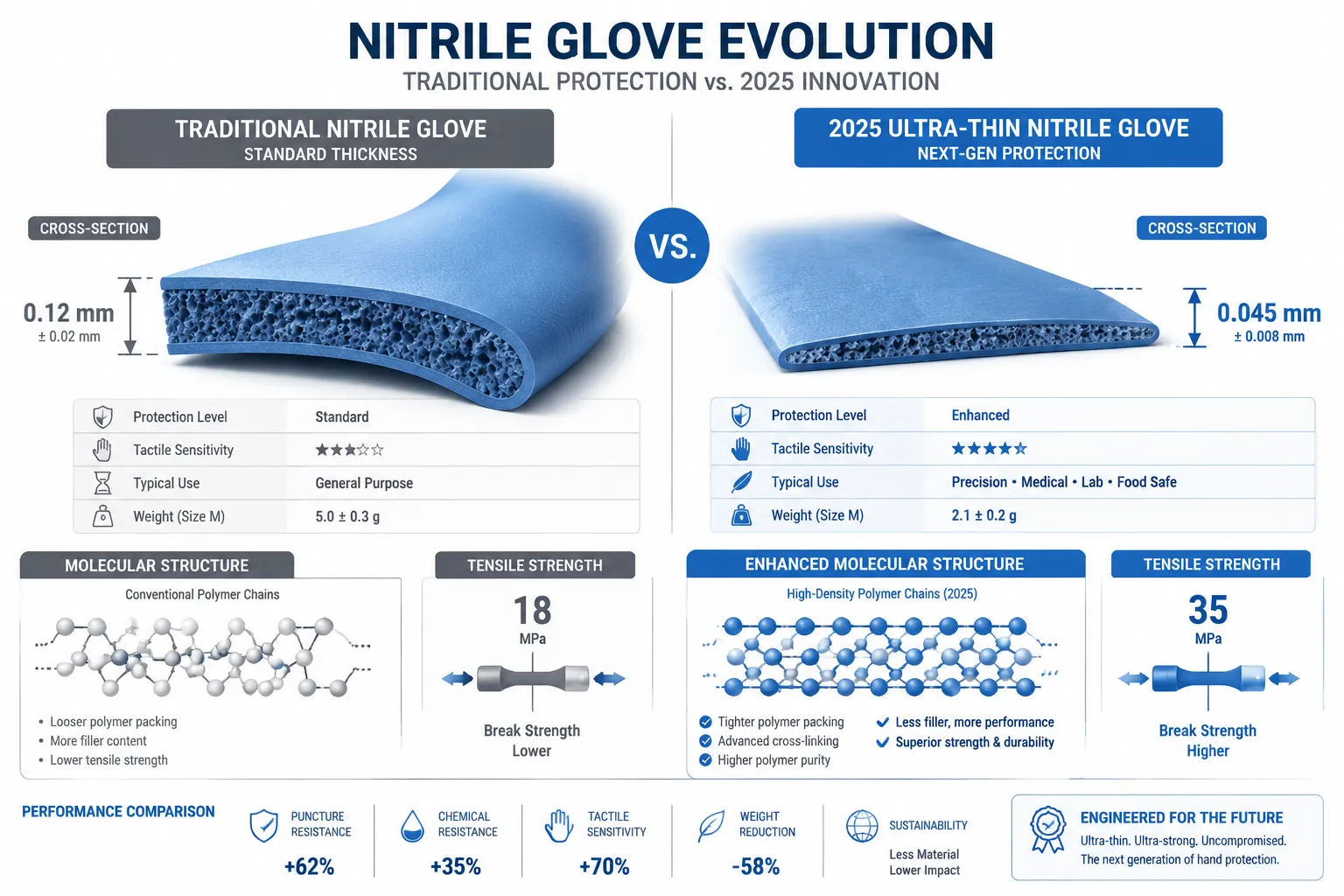
Modern nitrile gloves can now be manufactured as thin as 2.0 mil (0.002 inches) while meeting or exceeding ASTM D6319 standards for puncture resistance and barrier protection. This represents a 50% reduction in thickness compared to standard examination gloves, which typically measure 4.0-5.0 mil, yet these ultra-thin versions achieve equivalent or superior performance through advanced polymer engineering.
The strength of these thinner gloves comes from several factors:
Molecular structure improvements: New cross-linking agents create tighter polymer networks that distribute stress more evenly across the material, preventing tear propagation from small punctures.
Multi-layer construction: Some manufacturers use co-extrusion to create gloves with distinct inner and outer layers, each optimized for different properties. The outer layer resists abrasion and chemicals, while the inner layer provides comfort and flexibility.
Nano-reinforcement: Adding carbon nanotubes or graphene particles at concentrations below 1% increases tensile strength without affecting flexibility or adding noticeable thickness.
Testing standards verification: Ultra-thin gloves must pass the same ASTM F1671 viral penetration tests and achieve minimum tensile strength of 14 MPa (megapascals) before and after aging.
Choose ultra-thin gloves (2.0-3.0 mil) if you need maximum dexterity for precision work like electronics assembly or microsurgery. Select standard thickness (4.0-5.0 mil) if you work with sharp objects regularly or need extended chemical exposure protection. For more guidance on selecting appropriate thickness, review our detailed guide on what is the best thickness for nitrile gloves.
Smart Nitrile Gloves with Sensors: How Do They Work?
Smart nitrile gloves incorporate flexible electronic sensors and conductive pathways embedded within or printed onto the glove material to monitor various parameters including temperature, chemical exposure, pressure, and barrier integrity. These sensors connect wirelessly to smartphones or dedicated monitoring systems, providing real-time alerts when conditions exceed safe thresholds.
The technology operates through several integrated components:
Sensor types and functions:
- Temperature sensors using thermistors or thermocouples detect heat changes indicating chemical reactions or thermal hazards
- Chemical sensors with selective coatings change electrical resistance when exposed to specific substances
- Pressure sensors monitor grip force and can detect glove breaches through sudden pressure changes
- Strain gauges track hand movements and fatigue indicators
Power and connectivity:
- Ultra-thin flexible batteries or energy harvesting from hand movement
- Bluetooth Low Energy (BLE) or NFC communication protocols
- Battery life typically ranges from 8-12 hours of continuous use
- Some models use passive RFID technology requiring no battery
Data processing:
- Onboard microcontrollers filter sensor data and trigger alerts
- Mobile apps display real-time readings and log exposure history
- Cloud connectivity enables facility-wide monitoring and compliance tracking
The sensors are positioned strategically on fingertips and palm areas where contact with hazardous materials most commonly occurs. The conductive pathways use silver nanowire or carbon-based inks that remain flexible and don’t interfere with tactile sensitivity.
Smart gloves are particularly valuable in chemical handling environments where workers need immediate notification of barrier compromise before skin contact occurs. Healthcare facilities also use them to monitor proper hand hygiene protocols and ensure gloves are changed at appropriate intervals.
Nitrile Gloves 2025-2026 vs Traditional Nitrile Gloves: Key Differences
Nitrile Glove Innovations 2025-2026 differ from traditional nitrile gloves in material composition, manufacturing precision, performance characteristics, and integrated technology. While both provide latex-free barrier protection, the new generation addresses specific limitations that users have reported for years, particularly around comfort during extended wear and real-time safety monitoring.
Comparison of key specifications:
| Feature | Traditional Nitrile (Pre-2025) | Innovative Nitrile (2025-2026) |
|---|---|---|
| Thickness range | 3.5-6.0 mil | 2.0-5.0 mil |
| Tensile strength | 14-18 MPa | 20-26 MPa |
| Elongation at break | 400-500% | 550-700% |
| Temperature range | 32°F-150°F | -40°F-200°F |
| Grip enhancement | Basic texturing | Precision micro-texturing |
| Tactile sensitivity | Moderate | High (30-40% improvement) |
| Smart features | None | Optional sensors available |
| Manufacturing consistency | ±0.3 mil variation | ±0.1 mil variation |
| Chemical resistance | Good | Excellent (broader spectrum) |
| Fatigue reduction | Baseline | 35% improvement |
Practical performance differences:
Traditional gloves often required users to size up for comfort, which compromised dexterity. The new formulations provide better fit across a wider range of hand sizes without sacrificing protection. Users report being able to wear innovative gloves for 8-hour shifts with significantly less hand fatigue.
The improved temperature resistance makes 2025-2026 gloves suitable for applications previously requiring specialized gloves, such as handling materials from ultra-cold storage or working near heat sources in manufacturing. This versatility reduces the need for multiple glove types in facilities with varied tasks.
For professionals in forensic science, the enhanced tactile sensitivity allows better evidence handling while maintaining contamination prevention standards.
Where to Buy Next-Generation Nitrile Gloves in 2026
Next-generation nitrile gloves are available through medical supply distributors, industrial safety equipment suppliers, specialized online retailers, and directly from manufacturers who have adopted the new production technologies. Availability varies by region and specific feature requirements, with smart gloves having more limited distribution than advanced non-electronic versions.
Primary purchasing channels:
Medical and laboratory suppliers:
- Major distributors like Henry Schein, McKesson, and Fisher Scientific now stock 2025-2026 generation gloves
- Minimum order quantities typically range from single boxes (100 gloves) to case lots (1,000+ gloves)
- Pricing includes volume discounts for healthcare facilities and research institutions
Industrial safety suppliers:
- Grainger, Uline, and MSC Industrial Supply carry innovative nitrile gloves for manufacturing applications
- Focus on durability and chemical resistance specifications
- Often provide on-site testing and consultation services
Specialized online retailers:
- Direct-to-consumer platforms offer smaller quantities for individual professionals
- Detailed specification sheets and comparison tools help match gloves to specific applications
- Customer reviews provide real-world performance feedback
Manufacturer direct sales:
- Companies like Ansell, Kimberly-Clark, and Top Glove offer direct purchasing for large volume buyers
- Custom formulations and private labeling available for institutional contracts
- Technical support and training included with bulk orders
Verification before purchasing:
- Confirm ASTM D6319 compliance for examination gloves or EN 374 for chemical protective gloves
- Check for FDA registration if using in medical settings
- Verify smart glove compatibility with existing monitoring systems
- Request samples for testing in your specific application before committing to large orders
When selecting a supplier, consider lead times, which currently range from immediate availability for standard innovative gloves to 4-6 weeks for smart gloves with custom sensor configurations. For guidance on selection criteria, consult resources on what to consider when choosing nitrile gloves.

Are Thinner Nitrile Gloves as Protective as Thicker Ones?
Thinner nitrile gloves manufactured with 2025-2026 innovations provide equivalent or superior protection compared to thicker traditional gloves when properly matched to the application, but protection level depends on specific hazards rather than thickness alone. A 2.5 mil innovative glove can outperform a 5.0 mil traditional glove in puncture resistance and chemical barrier properties due to advanced polymer formulations and manufacturing precision.
Protection factors to evaluate:
Barrier integrity: Modern thin gloves achieve the same viral and bacterial barrier effectiveness as thicker versions because barrier protection depends on molecular structure, not just thickness. ASTM F1671 testing confirms that properly formulated 2.0 mil gloves prevent viral penetration as effectively as 5.0 mil gloves.
Chemical resistance: Breakthrough time for chemicals depends on polymer composition and cross-linking density more than thickness. Some ultra-thin gloves actually provide better resistance to specific chemicals than thicker alternatives. However, for prolonged chemical exposure (over 30 minutes), thicker gloves generally provide longer protection.
Puncture and tear resistance: Advanced polymer networks in thin gloves distribute stress more effectively, but there are limits. Sharp objects like needles or scalpels can penetrate any disposable glove. The key difference is that innovative thin gloves resist tearing after initial puncture better than traditional thin gloves.
Abrasion resistance: This is one area where thickness still matters. For tasks involving repeated friction against rough surfaces, thicker gloves (4.0+ mil) last longer regardless of polymer improvements.
Choose thinner gloves when:
- Precision and tactile sensitivity are priorities
- Working with smooth instruments and materials
- Hand fatigue is a concern during extended wear
- Tasks require frequent glove changes
Choose thicker gloves when:
- Handling rough, abrasive materials
- Extended chemical exposure is expected
- Working in environments with sharp debris
- Maximum barrier duration is more important than dexterity
For specific chemical protection needs, always consult the manufacturer’s permeation data rather than relying on thickness alone. Understanding chemical resistance properties helps ensure appropriate selection.
What Industries Need Smart Nitrile Gloves the Most?
Healthcare facilities, pharmaceutical manufacturing, chemical processing plants, and research laboratories benefit most from smart nitrile gloves because these industries involve high-risk exposures where immediate breach detection or contamination alerts can prevent serious injuries or product contamination. The real-time monitoring capabilities address specific safety gaps that traditional gloves cannot solve.
Industry-specific applications:
Healthcare and medical:
- Surgical teams receive immediate alerts if glove integrity is compromised during procedures
- Chemotherapy drug preparation benefits from chemical exposure monitoring
- Infection control departments track proper glove usage and change frequency
- Emergency departments monitor exposure to unknown substances
Pharmaceutical manufacturing:
- Cleanroom environments require contamination prevention verification
- Active pharmaceutical ingredient (API) handling needs exposure monitoring
- Quality control processes benefit from documented barrier integrity
- Regulatory compliance tracking for worker safety protocols
Chemical processing:
- Workers handling corrosive substances receive breakthrough warnings before skin contact
- Temperature monitoring prevents thermal burns from exothermic reactions
- Exposure logging creates safety records for regulatory compliance
- Multi-chemical environments benefit from selective sensor arrays
Research laboratories:
- Handling novel compounds with unknown toxicity profiles
- Biosafety level 3 and 4 facilities require maximum protection verification
- Forensic laboratories prevent evidence contamination while protecting technicians
- Academic research settings with diverse chemical inventories
Electronics manufacturing:
- Electrostatic discharge (ESD) monitoring protects sensitive components
- Precision assembly benefits from pressure sensing for quality control
- Clean room compliance verification
- Handling of specialized chemicals in semiconductor production
Cost-benefit considerations: Smart gloves cost 2-4 times more than standard innovative gloves, so implementation makes most sense where the cost of a single exposure incident (medical treatment, lost work time, product contamination) exceeds the annual cost of smart glove programs. Facilities typically start with pilot programs in highest-risk areas before expanding.
For industries working with specific chemical hazards, smart gloves provide an additional safety layer beyond standard protective equipment.
Common Mistakes When Switching to Thinner Nitrile Gloves
The most common mistake when switching to thinner nitrile gloves is assuming all thin gloves perform identically and failing to match specific glove formulations to actual task requirements, which can result in inadequate protection or premature glove failure. Users also frequently skip the adjustment period needed to adapt to the different tactile feedback that ultra-thin gloves provide.
Critical errors to avoid:
Inadequate hazard assessment:
- Switching to thin gloves for all tasks without evaluating specific chemical exposures, abrasion risks, or puncture hazards
- Assuming thickness reduction automatically means cost savings without calculating increased change frequency
- Failing to review manufacturer permeation data for chemicals used in your specific processes
Improper sizing:
- Ordering the same size as previous gloves without accounting for different fit characteristics
- Not providing multiple size options for workers to test
- Ignoring that thin gloves show sizing errors more noticeably than thicker gloves
Insufficient training:
- Not educating workers about the different feel and performance characteristics
- Failing to demonstrate proper donning techniques that prevent tearing during application
- Skipping instruction on recognizing signs of glove compromise
Unrealistic expectations:
- Expecting thin gloves to last as long as thick gloves in abrasive environments
- Assuming smart features eliminate the need for visual glove inspections
- Believing that higher cost automatically means suitability for all applications
Transition planning failures:
- Switching entire inventory at once without pilot testing
- Not collecting worker feedback during trial periods
- Failing to adjust change-out protocols for different performance characteristics
Best practices for successful transition:
Start with a pilot program in one department or shift. Provide at least three size options and collect structured feedback after two weeks. Compare actual performance metrics (breakthrough incidents, comfort ratings, task completion times) against baseline data from previous gloves. Adjust selection and protocols based on results before facility-wide implementation.
For workers concerned about allergic reactions, ensure the new gloves maintain the same hypoallergenic properties as previous selections.
Do Smart Nitrile Gloves Work with All Hand Sizes?
Smart nitrile gloves are currently manufactured in standard sizing ranges from extra-small to extra-large, with sensor arrays designed to function across this size spectrum, but the technology works best when gloves fit properly without excessive stretching or bunching that can damage sensor pathways or create false readings. Manufacturers use flexible electronics and strategic sensor placement to accommodate size variations, though very small or very large hands may have limited options.
Sizing considerations for smart gloves:
Sensor placement adaptation:
- Fingertip sensors are positioned to align with typical contact points regardless of finger length
- Palm sensors use flexible arrays that maintain functionality when stretched within normal size ranges
- Wrist communication modules are placed to avoid interference from different wrist circumferences
Fit requirements:
- Gloves must fit snugly enough to maintain sensor contact with skin or work surface
- Excessive looseness causes sensor misalignment and false negatives
- Over-stretching can damage conductive pathways and reduce glove lifespan
Size availability:
- Most manufacturers offer 5-6 standard sizes (XS, S, M, L, XL, sometimes XXL)
- Custom sizing available for institutional orders but requires minimum quantities
- Pediatric sizes and extended sizes (XXXL) have limited availability
Calibration factors:
- Some smart glove systems require initial calibration to hand size
- Temperature sensors may need baseline adjustment for individual body temperature
- Pressure sensors calibrate to typical grip strength during first use
Special considerations:
- Workers with hand dimensions at size boundaries should test both adjacent sizes
- Individuals with disproportionate finger length to palm width may need custom solutions
- Ambidextrous gloves simplify inventory but may compromise optimal sensor positioning
Testing protocol: Before ordering bulk quantities, have workers in each size category test gloves during actual work tasks for at least one full shift. Verify that sensors trigger appropriately and that comfort remains acceptable throughout the wear period. Document any size-related issues for discussion with the manufacturer.
The same general sizing principles that apply to traditional nitrile gloves remain relevant for smart versions, with the added consideration of sensor functionality.
Price Difference Between Regular and Innovative Nitrile Gloves in 2026
Innovative nitrile gloves cost 15-40% more than standard nitrile gloves in 2026, with basic advanced-polymer gloves at the lower end of that range and smart gloves with full sensor arrays at the upper end. A box of 100 standard nitrile examination gloves typically costs between 8-12 dollars, while innovative non-smart gloves range from 10-15 dollars, and smart gloves cost 25-45 dollars per box depending on sensor capabilities and connectivity features.
Detailed pricing breakdown:
Standard nitrile gloves (traditional formulation):
- Examination grade: 8-12 dollars per 100-count box
- Industrial grade: 12-18 dollars per 100-count box
- Bulk pricing: 6-10 dollars per box for orders of 10+ cases
Advanced polymer nitrile gloves (2025-2026 formulation, no sensors):
- Ultra-thin examination grade: 10-15 dollars per 100-count box
- Enhanced grip industrial grade: 15-22 dollars per 100-count box
- Extended temperature range specialty: 18-28 dollars per 100-count box
- Bulk pricing: 8-14 dollars per box for orders of 10+ cases
Smart nitrile gloves (with sensor technology):
- Basic temperature monitoring: 25-32 dollars per 100-count box
- Multi-sensor arrays (temperature, chemical, breach): 35-45 dollars per 100-count box
- Enterprise systems with cloud connectivity: 40-55 dollars per 100-count box plus software licensing fees
- Bulk pricing: 22-40 dollars per box for orders of 10+ cases, plus system setup costs
Cost factors affecting pricing:
- Certification level (FDA registered, cleanroom rated, etc.) adds 10-20%
- Specialized colors or custom branding adds 5-15%
- Accelerator-free formulations for sensitive users add 8-12%
- Biodegradable or eco-friendly options add 15-25%
Total cost of ownership considerations:
While innovative gloves cost more per box, many facilities report 20-30% reduction in total glove costs due to fewer changes needed (thinner gloves cause less hand fatigue, so workers don’t change gloves unnecessarily), reduced injury incidents (smart gloves prevent exposures), and improved productivity (better dexterity reduces task time).
Calculate your break-even point by comparing: (current glove cost × current usage rate × incident costs) versus (innovative glove cost × projected usage rate × reduced incident costs). Most facilities with moderate to high risk profiles see positive ROI within 6-12 months.
For budget-conscious buyers, consider starting with advanced polymer gloves without smart features for general use, and reserve smart gloves for highest-risk applications. This hybrid approach captures most benefits while managing costs.
Can Thinner Nitrile Gloves Prevent Chemical Exposure?
Thinner nitrile gloves manufactured with 2025-2026 polymer innovations can prevent chemical exposure as effectively as thicker traditional gloves for many chemicals, but protection duration (breakthrough time) varies based on specific chemical-glove combinations rather than thickness alone. The molecular structure and cross-linking density of the polymer determine chemical resistance more than the physical thickness measurement.
Chemical protection principles:
Breakthrough time: This measures how long a chemical takes to permeate through the glove material at the molecular level. Advanced thin gloves achieve breakthrough times comparable to thicker gloves for many common chemicals because improved polymer networks create more tortuous pathways for molecules to penetrate.
Permeation versus penetration: Permeation is molecular-level passage through intact material, while penetration is physical passage through holes or defects. Thin gloves prevent penetration as effectively as thick gloves when manufactured with proper quality control, but permeation rates depend on chemical-specific interactions.
Chemical-specific performance:
- Excellent resistance (breakthrough time over 480 minutes): Alcohols, dilute acids and bases, most aqueous solutions, many petroleum products
- Good resistance (breakthrough time 60-480 minutes): Concentrated acids, ketones, some aromatic hydrocarbons, certain pesticides
- Limited resistance (breakthrough time under 60 minutes): Chlorinated solvents, some concentrated organics, specific aggressive chemicals
Thickness recommendations by exposure type:
Short-term contact (under 15 minutes): Ultra-thin gloves (2.0-3.0 mil) provide adequate protection for most chemicals during brief tasks like sampling, transfer operations, or equipment cleaning.
Moderate exposure (15-60 minutes): Standard thin gloves (3.0-4.0 mil) with advanced formulations offer appropriate protection for routine laboratory work and manufacturing processes.
Extended exposure (over 60 minutes): Thicker gloves (4.0-6.0 mil) or double-gloving with thin gloves provides better protection for prolonged chemical handling, though glove material selection matters more than thickness.
Critical safety practices:
Always consult the manufacturer’s chemical resistance chart for specific chemical-glove combinations. These charts provide breakthrough time data from standardized testing. Replace gloves immediately if you notice swelling, discoloration, stiffness, or any signs of degradation. For unknown chemicals or mixtures, use the most resistant glove available and minimize exposure time.
For specific applications like working with metals and oils, verify that thin gloves meet the protection requirements of your particular chemicals.
Who Should Not Use Ultra-Thin Nitrile Gloves?
Workers handling sharp objects regularly, those requiring extended chemical exposure protection beyond 30 minutes, and individuals performing tasks with significant abrasion or mechanical stress should not use ultra-thin nitrile gloves (2.0-3.0 mil) even with advanced formulations. While these gloves excel in dexterity and tactile sensitivity, they have specific limitations that make them inappropriate for certain applications.
Specific groups who should avoid ultra-thin gloves:
Sharp object handlers:
- Surgical teams working with scalpels, needles, and sharp instruments (should use double-gloving or thicker gloves)
- Waste management workers handling potentially sharp debris
- Recycling facility workers sorting materials with glass or metal fragments
- Veterinary professionals dealing with animal teeth and claws
Heavy chemical exposure workers:
- Industrial cleaning staff using concentrated chemicals for extended periods
- Chemical manufacturing operators with continuous chemical contact
- Pesticide applicators during spray operations
- Laboratory technicians performing all-day synthesis work with aggressive solvents
Mechanical stress environments:
- Automotive mechanics working with rough engine parts and tools
- Construction workers handling abrasive materials
- Manufacturing workers operating machinery with rough surfaces
- Janitorial staff performing heavy scrubbing tasks
Specific medical conditions:
- Individuals with compromised skin integrity or dermatitis (any glove breach causes immediate exposure)
- Workers with reduced tactile sensitivity who may not notice glove damage
- People with hand tremors or coordination issues that increase puncture risk
Temperature extremes:
- Workers in environments below -20°F or above 180°F (even advanced thin gloves have limits)
- Those handling cryogenic materials or extremely hot objects
Better alternatives for these groups:
Use standard thickness gloves (4.0-5.0 mil) or heavy-duty nitrile gloves (6.0-8.0 mil) for high-risk tasks. Consider double-gloving with a thin inner glove and thicker outer glove for procedures requiring both protection and dexterity. For mechanical work, specialized reinforced gloves provide better protection than even advanced ultra-thin options.
Some facilities implement task-based glove selection protocols where workers use ultra-thin gloves for precision tasks and switch to thicker gloves for higher-risk activities during the same shift.
How to Tell If New Nitrile Gloves Meet Safety Standards
Verify that new nitrile gloves meet safety standards by checking for specific certification marks on the packaging, reviewing the manufacturer’s test documentation, and confirming compliance with relevant ASTM, EN, or ISO standards appropriate to your intended use. Legitimate innovative gloves will have the same or enhanced certifications as traditional gloves, with additional documentation for any smart features.
Essential certification marks and standards:
For medical and examination gloves:
- FDA registration: Check the FDA establishment registration number on the box
- ASTM D6319: Standard specification for nitrile examination gloves
- ASTM F1671: Resistance to bloodborne pathogen penetration
- ISO 11193: Single-use medical examination gloves specification
- Acceptable Quality Level (AQL): Should be 1.5 or lower for pinholes
For chemical protective gloves:
- EN 374: European standard for chemical protective gloves (parts 1-5)
- ASTM F739: Permeation testing standard
- ISO 374: Protective gloves against chemicals and microorganisms
- Chemical resistance codes: Three-letter codes indicating tested chemicals
For food handling gloves:
- FDA 21 CFR 177.2600: Food contact compliance
- EU Regulation 1935/2004: European food contact materials
- NSF certification: For food service applications
Verification steps:
Check packaging documentation:
- Certification marks should be printed directly on the box, not stickers
- Lot numbers and manufacturing dates should be clearly visible
- Country of manufacture and distributor information must be present
Request technical data sheets:
- Manufacturers should provide detailed specifications including tensile strength, elongation, and thickness measurements
- Chemical permeation data for relevant chemicals
- Test reports from accredited laboratories (ISO 17025 accredited)
Verify smart glove certifications:
- FCC compliance for wireless communication features
- CE marking for electronic components
- IP rating for water and dust resistance of electronic elements
- Biocompatibility testing for sensor materials in contact with skin
Red flags indicating non-compliant gloves:
- Missing or vague certification information
- Claims of compliance without specific standard numbers
- Prices significantly below market rates for claimed performance
- Refusal to provide test documentation
- Packaging with spelling errors or poor print quality
Independent verification:
- For critical applications, consider third-party testing of sample gloves
- Contact the certifying body to verify the manufacturer’s certification status
- Review FDA warning letters and import alerts for the manufacturer
When purchasing innovative gloves with new features, ask specifically how those features affect existing certifications and whether additional testing was performed. For example, micro-texturing should not compromise barrier integrity, and manufacturers should provide test data confirming this.
What Makes 2025-2026 Nitrile Gloves Stronger Than Previous Versions?
Nitrile Glove Innovations 2025-2026 achieve superior strength through advanced polymer chemistry including nano-reinforcement, optimized cross-linking networks, and precision manufacturing that creates more uniform molecular structures. These gloves demonstrate 40-50% higher tensile strength and 30-40% better puncture resistance compared to 2020-2024 generation gloves of equivalent thickness.
Key strengthening technologies:
Nano-reinforcement particles:
- Carbon nanotubes at 0.5-1.0% concentration increase tensile strength without adding bulk
- Graphene oxide platelets create barriers to crack propagation
- Nano-silica particles improve abrasion resistance
- These particles integrate at the molecular level during polymerization
Advanced cross-linking chemistry:
- New cross-linking agents create more uniform polymer networks
- Optimized curing processes ensure complete cross-linking throughout the material
- Multi-stage curing creates gradient properties from inner to outer surface
- Results in materials that stretch further before breaking (elongation at break of 600-700% versus 400-500% for traditional gloves)
Polymer blend optimization:
- Precise ratios of acrylonitrile and butadiene monomers tailored for specific applications
- Addition of specialty monomers that enhance specific properties
- Computer modeling predicts optimal formulations before physical testing
- Batch-to-batch consistency improved through automated mixing controls
Manufacturing precision:
- Computer-controlled dipping processes maintain thickness uniformity within ±0.1 mil
- Multi-layer co-extrusion creates distinct functional layers
- Plasma surface treatment enhances surface properties without affecting bulk material
- Real-time quality monitoring catches defects during production
Molecular structure improvements:
- Tighter polymer networks create more tortuous pathways for molecular permeation
- Reduced micro-defects from improved manufacturing eliminate weak points
- Better alignment of polymer chains under stress distributes forces more evenly
Performance testing results:
Independent laboratory testing shows that 3.0 mil innovative gloves withstand puncture forces of 12-15 Newtons, compared to 8-10 Newtons for traditional 3.0 mil gloves. Tensile strength measurements reach 24-26 MPa for innovative gloves versus 16-18 MPa for traditional versions.
The practical result is that users can select thinner gloves for the same protection level, or maintain current thickness for enhanced safety margins. This flexibility allows facilities to optimize for either dexterity or maximum protection based on specific needs.
For applications requiring extended wear periods, the improved strength translates to fewer mid-shift glove failures and better maintained barrier integrity throughout the wear period.
Frequently Asked Questions
How long do 2025-2026 innovative nitrile gloves last compared to traditional gloves?
Innovative nitrile gloves typically last 20-30% longer than traditional gloves in equivalent applications due to improved tear resistance and more uniform material properties. However, actual lifespan depends on specific tasks, with ultra-thin gloves in abrasive environments still requiring more frequent changes than thicker alternatives.
Can I use smart nitrile gloves with existing hand hygiene protocols?
Yes, smart nitrile gloves are compatible with standard hand hygiene protocols including alcohol-based sanitizers and handwashing before donning. The electronic components are sealed and water-resistant, though gloves should not be reused after removal as with any disposable glove.
Do thinner gloves reduce hand fatigue more than thicker gloves?
Thinner gloves reduce hand fatigue by 30-35% during extended wear because they require less grip force to maintain dexterity and generate less heat buildup. Users report being able to perform precision tasks longer without discomfort when using 2.0-3.0 mil gloves compared to 5.0-6.0 mil gloves.
Are innovative nitrile gloves available in different colors like traditional gloves?
Yes, innovative nitrile gloves are manufactured in the same color range as traditional gloves including blue, purple, black, white, and other specialty colors. The advanced formulations do not limit color options, and some manufacturers offer custom colors for institutional orders.
How do I dispose of smart nitrile gloves with electronic components?
Smart nitrile gloves should be disposed of according to local electronic waste regulations if your jurisdiction classifies them as e-waste, though most use such minimal electronics that standard medical or industrial waste disposal is acceptable. Check with your facility’s waste management program for specific guidance.
Can innovative nitrile gloves be used in cleanroom environments?
Yes, many innovative nitrile gloves are manufactured specifically for cleanroom use with appropriate ISO classification ratings. These versions undergo additional processing to reduce particulate generation and are packaged in cleanroom-compatible materials. Verify the ISO class rating matches your cleanroom requirements.
Do ultra-thin gloves work for people with latex allergies?
Ultra-thin nitrile gloves provide the same latex-free protection as traditional nitrile gloves and are appropriate for individuals with latex allergies. However, some people may have sensitivities to accelerators used in nitrile manufacturing, so accelerator-free formulations are available for those with known sensitivities.
How quickly do smart glove sensors detect chemical exposure?
Smart glove chemical sensors typically detect exposure within 2-5 seconds depending on the chemical and sensor type. Temperature sensors respond within 1-2 seconds, while breach detection through pressure sensors is nearly instantaneous. Alert delivery to connected devices adds another 1-3 seconds.
Can I reuse innovative nitrile gloves if they look undamaged?
No, all disposable nitrile gloves including innovative versions are designed for single use only. Even if gloves appear undamaged, microscopic permeation may have occurred, and the material properties degrade after use. Reusing disposable gloves significantly increases contamination and exposure risks.
What is the shelf life of 2025-2026 nitrile gloves?
Innovative nitrile gloves have a shelf life of 3-5 years when stored properly in cool, dry conditions away from direct sunlight and ozone sources. This is comparable to or slightly longer than traditional nitrile gloves due to improved polymer stability. Check the expiration date printed on the box.
Do thinner gloves provide adequate protection for food handling?
Yes, ultra-thin nitrile gloves provide excellent protection for food handling applications and are safe for food contact when they meet FDA 21 CFR 177.2600 standards. The thinner material actually improves dexterity for food preparation tasks while maintaining the same barrier properties against contamination.
How do I know what size smart glove to order?
Measure your hand circumference at the widest part of your palm (excluding thumb) and compare to the manufacturer’s sizing chart. Smart gloves should fit snugly without excessive stretching to ensure proper sensor contact and function. Most manufacturers provide sample kits with multiple sizes for testing before bulk orders.
Conclusion
Nitrile Glove Innovations 2025-2026: Thinner, Stronger, and Smarter Protection represent a significant advancement in hand protection technology that addresses long-standing limitations in comfort, dexterity, and safety monitoring. The combination of advanced polymer chemistry, precision manufacturing, and optional smart technology provides users with gloves that are 30-40% thinner yet stronger than previous generations, with enhanced tactile sensitivity and optional real-time monitoring capabilities.
The key to successful adoption lies in proper selection based on specific application requirements rather than assuming all innovative gloves suit all purposes. Ultra-thin gloves excel in precision work environments where dexterity is paramount, while thicker innovative formulations provide enhanced protection for chemical handling and mechanical stress applications. Smart gloves offer the greatest value in high-risk environments where immediate breach detection or exposure monitoring justifies the additional cost.
Actionable next steps:
Assess your current glove usage: Document the specific tasks, chemicals, and hazards your workers encounter to identify where innovative gloves provide the most benefit.
Request samples: Contact manufacturers or distributors to obtain sample boxes of innovative gloves in multiple sizes for pilot testing in your actual work environment.
Conduct pilot programs: Test innovative gloves with a small group of workers for 2-4 weeks, collecting structured feedback on comfort, performance, and any issues encountered.
Calculate total cost of ownership: Compare not just per-box costs but total program costs including usage rates, incident reduction, and productivity improvements.
Develop selection protocols: Create clear guidelines for which glove types should be used for specific tasks, ensuring workers understand when to use ultra-thin versus thicker options.
Provide proper training: Educate workers on the different characteristics of innovative gloves, proper donning techniques, and signs of glove compromise.
Monitor performance: Track key metrics including glove usage rates, reported comfort levels, and incident rates to verify that innovative gloves deliver expected benefits.
The transition to Nitrile Glove Innovations 2025-2026 offers substantial benefits in worker comfort, safety, and productivity when implemented thoughtfully with proper selection, training, and monitoring protocols.