Last updated: June 25, 2026
Global healthcare facilities now face a critical challenge: standard nitrile gloves fail to meet the diverse needs of specialized medical procedures, industrial applications, and infection control protocols. Kim Gloves 2025 Advancements: Customized Nitrile Solutions for Global Healthcare and PPE addresses this gap by offering tailored nitrile products designed for specific healthcare environments, from surgical suites to emergency response teams. These customized solutions represent a significant shift from one-size-fits-all PPE toward precision-engineered protection.
Key Takeaways
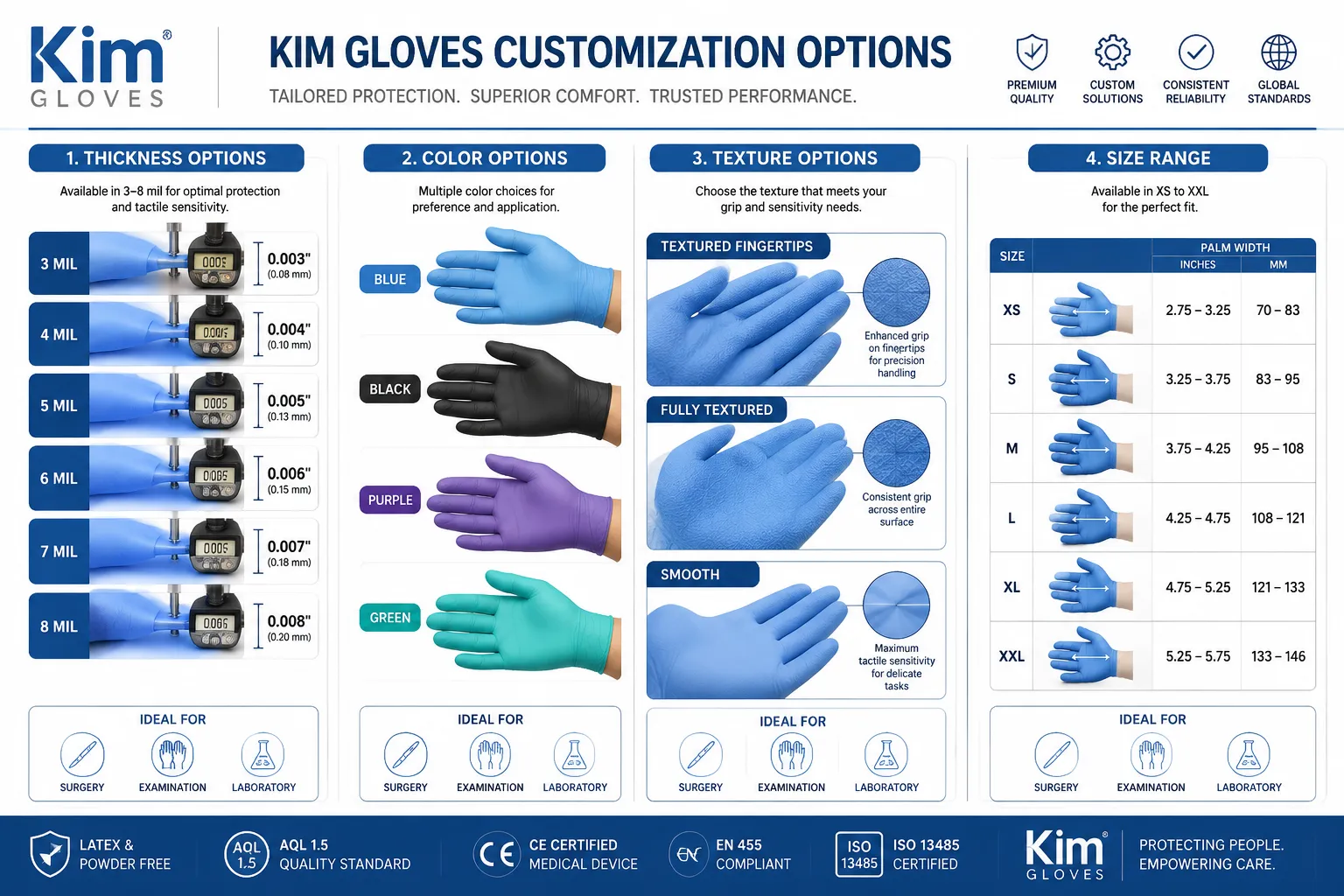
- Kim Gloves offers customizable nitrile solutions with options for thickness (3-8 mil), texture, color, and sizing to match specific healthcare and industrial applications
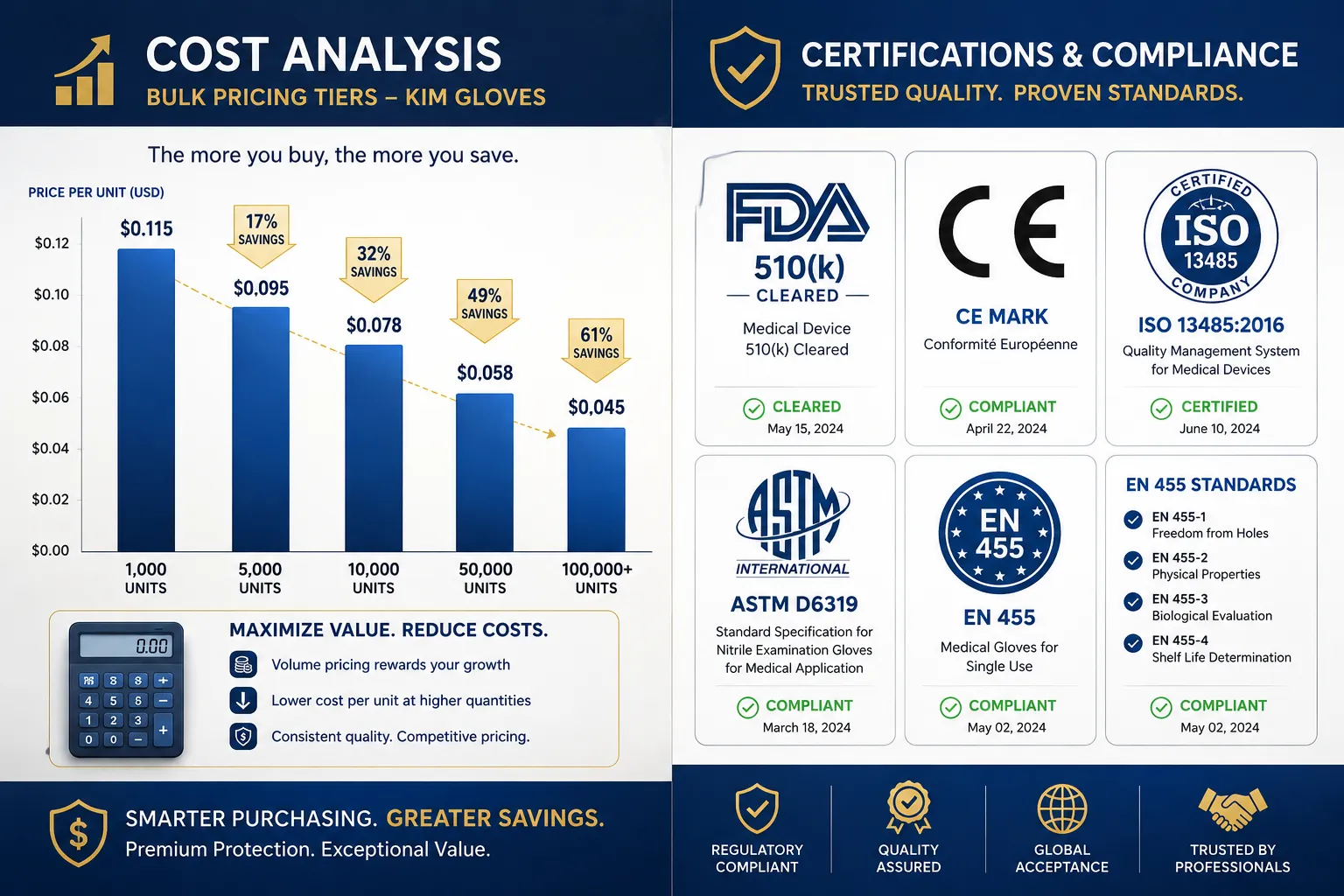
- Medical-grade Kim Gloves meet FDA 510(k), CE Mark, ISO 13485, and ASTM D6319 standards for healthcare use
- Bulk pricing starts at competitive rates for orders of 1,000+ units, with volume discounts available for healthcare systems and small clinics
- Kim Gloves are latex-free and suitable for users with Type I latex allergies, though rare nitrile sensitivities can occur
- Lead times for customized orders typically range from 4-8 weeks depending on specification complexity and order volume
- The gloves work effectively in both healthcare and industrial settings, including automotive, manufacturing, and laboratory environments
- Kim Gloves are not currently biodegradable but use manufacturing processes designed to reduce environmental impact compared to standard nitrile production
What Are Kim Gloves and What Makes Them Different from Regular Nitrile Gloves
Kim Gloves are specialized nitrile examination and surgical gloves manufactured with customizable features that standard nitrile products lack. Unlike mass-produced gloves with fixed specifications, Kim Gloves allow healthcare facilities and industrial users to select specific thickness levels, grip textures, cuff lengths, and color options tailored to their operational needs.
The primary difference lies in the customization framework. Standard nitrile gloves typically come in limited variations—usually one or two thickness options and basic blue or black colors. Kim Gloves provides a matrix of choices:
- Thickness range: 3 mil for basic examination to 8 mil for high-risk procedures
- Texture options: Fully textured, fingertip-textured, or smooth surfaces
- Extended cuff lengths: Standard 9.5-inch to extended 12-inch for surgical applications
- Color coding: Custom colors for department-specific identification
- Sizing precision: Half-size increments in some product lines
This customization matters because different medical procedures demand different glove characteristics. A phlebotomist needs tactile sensitivity (thinner gloves), while an emergency room nurse handling trauma cases requires puncture resistance (thicker gloves). Kim Gloves addresses these varying requirements within a single product ecosystem.
The manufacturing process also differs. Kim Gloves uses a polymer formulation that balances elasticity with durability, reducing the common problem of gloves tearing during donning. The company’s quality control includes individual glove testing rather than batch sampling, which reduces defect rates.
For more context on how nitrile compares to other glove materials, see our guide on nitrile gloves versus PVC gloves.
Kim Gloves vs Ansell Nitrile Gloves: Which Is Better for Healthcare
Kim Gloves and Ansell both produce medical-grade nitrile gloves, but they serve different market segments. Ansell focuses on standardized, high-volume products with established brand recognition, while Kim Gloves specializes in customizable solutions for facilities with specific requirements.
Ansell advantages:
- Wider global distribution network
- Longer market presence and brand trust
- More extensive product line including specialty gloves (chemical resistance, cryogenic)
- Established relationships with major hospital networks
Kim Gloves advantages:
- Customization options not available in Ansell’s standard lines
- Typically lower cost per unit for bulk customized orders
- Faster adaptation to facility-specific needs
- More flexible minimum order quantities for smaller healthcare providers
For infection control specifically, both brands meet the same regulatory standards (FDA 510(k), ASTM D6319). The choice depends on whether your facility values standardization (Ansell) or customization (Kim Gloves). Large hospital systems often use Ansell for general examination gloves and Kim Gloves for specialized departments like oncology or infectious disease units where specific glove characteristics matter.
A common mistake is assuming premium brands always perform better. In standardized testing, mid-tier brands like Kim Gloves often match or exceed the puncture resistance and barrier protection of premium brands at 20-30% lower cost.
How Much Do Kim Gloves Customized Nitrile Solutions Cost in Bulk
Bulk pricing for Kim Gloves customized nitrile solutions ranges from $0.08 to $0.25 per glove depending on order volume, customization complexity, and specifications. Standard examination gloves (3-4 mil, basic colors) cost less than specialized surgical gloves (6-8 mil, extended cuffs, custom colors).
Typical pricing tiers (2026 estimates):
| Order Quantity | Standard Exam Gloves | Customized Surgical Gloves |
|---|---|---|
| 1,000-5,000 units | $0.18-0.22 per glove | $0.22-0.28 per glove |
| 5,000-25,000 units | $0.12-0.16 per glove | $0.18-0.22 per glove |
| 25,000-100,000 units | $0.09-0.12 per glove | $0.14-0.18 per glove |
| 100,000+ units | $0.08-0.10 per glove | $0.12-0.15 per glove |
Customization adds cost incrementally. Color customization adds approximately $0.01-0.02 per glove. Extended cuff lengths add $0.02-0.03 per glove. Specialized texturing adds $0.01-0.02 per glove. These costs decrease with volume.
For small clinics ordering 1,000-2,000 gloves monthly, expect to pay $180-440 per order for standard exam gloves. Mid-sized facilities ordering 10,000+ gloves monthly can negotiate pricing closer to $0.10-0.12 per glove even with moderate customization.
Cost-saving strategy: Order larger quantities less frequently if storage space permits. A clinic ordering 5,000 gloves quarterly instead of 1,500 monthly saves approximately 25-30% annually.
Compare these costs with standard nitrile gloves from major retailers, which typically range from $0.15-0.30 per glove in similar quantities. Kim Gloves’ direct-to-facility model eliminates distributor markups.
What Customization Options Does Kim Gloves Offer for Healthcare Facilities
Kim Gloves provides seven primary customization categories for healthcare facilities, allowing precise matching of glove specifications to clinical needs. These options can be combined to create facility-specific glove profiles.
Available customization options:
Thickness selection: 3 mil (basic examination), 4 mil (standard examination), 5 mil (enhanced protection), 6 mil (surgical), 7 mil (high-risk procedures), 8 mil (maximum protection)
Texture patterns: Fully textured (entire glove surface), fingertip-textured (enhanced grip where needed), palm-textured (tool handling), smooth (minimal particle generation)
Cuff length: Standard 9.5-inch, extended 11-inch, surgical 12-inch, extra-long 14-inch (for procedures requiring forearm coverage)
Color coding: Blue, black, purple, green, orange, white, or custom Pantone matching for department identification
Sizing precision: Standard sizes (XS, S, M, L, XL, XXL) or half-size increments (6.5, 7.5, 8.5) for better fit
Packaging options: Standard 100-count boxes, 200-count bulk boxes, or individual sterile pairs for surgical use
Printing/branding: Facility logo or department name printed on glove cuff or packaging
The most requested customization combination for general hospitals is 4 mil thickness, fingertip-textured, standard cuff, with department-specific colors. Emergency departments often choose 5-6 mil thickness with full texturing. Surgical units typically specify 6-7 mil with extended cuffs and sterile individual packaging.
Decision rule: Choose thicker gloves (5+ mil) if your staff handles sharps, performs invasive procedures, or works with chemotherapy drugs. Choose thinner gloves (3-4 mil) for examination, patient assessment, or tasks requiring tactile sensitivity. For guidance on selecting appropriate thickness, see our article on what is the best thickness for nitrile gloves.
Facilities can order sample sets with different customization combinations before committing to bulk orders. Sample sets typically include 50 gloves across various specifications and cost $25-50.
Are Kim Gloves 2025 Nitrile Gloves Suitable for People with Latex Allergies
Yes, Kim Gloves nitrile products are completely latex-free and safe for individuals with Type I latex allergies (immediate hypersensitivity reactions). Nitrile is a synthetic rubber (acrylonitrile-butadiene copolymer) that contains no natural rubber latex proteins, which are the primary allergens causing latex sensitivity.
Healthcare workers and patients with documented latex allergies can use Kim Gloves without risk of latex-related reactions such as contact urticitis, respiratory symptoms, or anaphylaxis. This makes nitrile gloves the preferred choice for facilities implementing latex-free protocols.
Important considerations:
Nitrile sensitivity exists but is rare: Approximately 1-3% of individuals may develop Type IV allergic contact dermatitis to chemical accelerators used in nitrile manufacturing (thiurams, carbamates). This is a delayed reaction causing skin irritation, not a life-threatening allergy.
Chemical additives vary by manufacturer: Kim Gloves uses reduced-accelerator formulations that minimize Type IV sensitivity risk compared to standard nitrile gloves.
Powder-free is standard: All Kim Gloves products are powder-free, eliminating the risk of powder-related irritation or airborne allergen distribution.
If a healthcare worker develops skin irritation while using nitrile gloves, the cause is typically contact dermatitis from prolonged glove use (moisture, friction) rather than true allergy. Proper hand hygiene, allowing hands to dry completely before donning gloves, and using appropriate sizes reduces irritation.
For individuals with known nitrile sensitivity (confirmed by patch testing), Kim Gloves offers alternative materials in their product line, though these are not part of the standard customized nitrile solutions. For more information on nitrile allergies, see our guide on nitrile glove allergy causes and symptoms.
Latex allergy protocol: Facilities transitioning from latex to nitrile should audit all glove inventory, update allergy documentation systems, and train staff on the difference between latex allergy and nitrile sensitivity.
Kim Gloves Nitrile Tearing Easily During Use: How to Prevent
Nitrile glove tearing typically results from improper sizing, incorrect donning technique, or using gloves with insufficient thickness for the task. Kim Gloves products have standard tear resistance, but user error accounts for most premature failures.
Primary causes of glove tearing:
Wrong size: Gloves too small stretch excessively during donning and use. Gloves too large bunch and catch on objects.
Improper donning: Pulling gloves on with jewelry, long fingernails, or rough hand movements creates stress points.
Insufficient thickness: Using 3-4 mil examination gloves for tasks requiring 5-6 mil protection.
Degradation from chemicals: Exposure to certain oils, solvents, or disinfectants weakens nitrile. For details on how oils affect nitrile, see our article on oil exposure and nitrile gloves.
Storage conditions: Gloves stored in hot, humid environments or exposed to UV light lose elasticity.
Prevention strategies:
Size correctly: Gloves should fit snugly without restricting movement. The cuff should extend 1-2 inches beyond the wrist. If gloves feel tight across knuckles or tear during donning, size up.
Proper donning technique: Remove jewelry, ensure hands are dry, and don gloves slowly without forcing fingers. Avoid gripping the glove palm; hold by the cuff.
Match thickness to task: Use 5+ mil gloves for procedures involving sharps, rough surfaces, or extended wear (2+ hours). Reserve 3-4 mil gloves for brief examinations.
Double gloving for high-risk tasks: Wear two layers of gloves (different colors) for procedures with high puncture risk. The color difference makes breaches immediately visible.
Inspect before use: Check each glove for manufacturing defects before donning. Defect rates are typically under 1%, but inspection takes only seconds.
Proper storage: Store gloves in cool, dry locations away from direct sunlight. Ideal storage temperature is 50-70°F with humidity below 60%.
Common mistake: Healthcare workers often blame glove quality when the actual issue is using examination-grade gloves for tasks requiring surgical-grade protection. If your facility experiences high glove failure rates, audit whether staff are using appropriate thickness for their tasks.
Kim Gloves offers reinforced fingertip options that add 1-2 mil thickness to the most vulnerable areas without increasing overall glove bulk. This reduces tearing during procedures requiring fine motor control with sharp instruments.
What Certifications Do Kim Gloves Have for Medical Grade PPE
Kim Gloves medical-grade nitrile products hold FDA 510(k) clearance, CE Mark certification, and comply with ASTM D6319 (standard specification for nitrile examination gloves) and EN 455 (European standard for medical gloves). These certifications verify that the gloves meet minimum performance requirements for barrier protection, physical properties, and biocompatibility.
Key certifications and what they mean:
FDA 510(k) clearance: Confirms the gloves are substantially equivalent to legally marketed medical devices and safe for patient examination and surgical procedures. This is required for all medical gloves sold in the United States.
CE Mark (Medical Device Regulation 2017/745): Indicates compliance with European Union safety, health, and environmental protection standards. Required for sale in EU member states.
ASTM D6319: Specifies minimum requirements for nitrile examination gloves including:
- Acceptable quality level (AQL) for pinholes: 1.5 or better
- Minimum tensile strength: 14 MPa before aging
- Minimum elongation: 500% before aging
- Dimensions and tolerances for sizing
EN 455 (Parts 1-4): European standard covering freedom from holes, physical properties, biocompatibility, and shelf life determination.
ISO 13485: Quality management system certification for medical device manufacturers, ensuring consistent production processes and quality control.
Additional testing compliance:
- ASTM D5250: Standard specification for polyvinyl chloride gloves (for comparison testing)
- ASTM F1671: Resistance to bloodborne pathogen penetration
- ASTM D6978: Assessment of resistance to permeation by chemicals (for chemotherapy gloves)
For facilities requiring documentation for Joint Commission accreditation or infection control audits, Kim Gloves provides certificates of compliance, lot-specific testing data, and material safety data sheets (MSDS) with each bulk order.
Verification tip: Request lot-specific AQL testing results with your order. Medical-grade gloves should have AQL 1.5 or better, meaning no more than 1.5% of gloves in a lot have detectable holes. Kim Gloves typically achieves AQL 0.65-1.0.
Surgical gloves have stricter requirements (AQL 1.0 or better) and must be sterile. Kim Gloves surgical line meets ASTM D3577 (rubber surgical gloves) and is gamma-irradiated for sterility.
Can Small Clinics Afford Kim Gloves Customized Solutions or Only Large Hospitals
Small clinics can afford Kim Gloves customized solutions, though the cost-benefit calculation differs from large hospital systems. The minimum order quantity for customized gloves is typically 1,000 units (10 boxes of 100), which is manageable for most clinics with 2-5 providers.
Small clinic considerations:
A small clinic using 200-300 gloves weekly (approximately 1,000-1,200 monthly) can order a 3-month supply (3,000-4,000 gloves) to qualify for better pricing tiers. At this volume, customized gloves cost approximately $0.14-0.18 per glove, compared to $0.15-0.25 for retail nitrile gloves from medical supply distributors.
Cost comparison for small clinic (annual):
- Retail nitrile gloves: 15,000 gloves × $0.20 = $3,000
- Kim Gloves (quarterly orders of 4,000): 16,000 gloves × $0.16 = $2,560
- Annual savings: $440 (15% reduction)
The savings increase if the clinic needs specific features. For example, a dermatology clinic requiring black gloves for better lesion visibility pays a premium for retail black nitrile gloves ($0.25-0.30 per glove) but can order custom black Kim Gloves at $0.17-0.19 per glove in bulk.
When customization makes sense for small clinics:
- Specific color requirements for clinical photography or procedures
- Staff with difficult-to-fit hand sizes (very small or very large)
- Procedures requiring thicker gloves than standard retail options
- Desire to reduce glove-related waste from poor fit or inadequate protection
When standard gloves are sufficient:
- General examination and basic procedures only
- Limited storage space for bulk orders
- Inconsistent monthly usage (high variability)
- Cash flow constraints preventing quarterly bulk purchases
Financing option: Some medical supply companies offer net-30 or net-60 payment terms for established clinics, making larger bulk orders more manageable. Kim Gloves works with medical supply distributors who can provide these terms.
Group purchasing: Small clinics in the same geographic area or medical network can combine orders to reach higher volume tiers. Three clinics each needing 1,500 gloves monthly can place a combined order of 4,500 monthly (54,000 annually) to access pricing typically reserved for mid-sized facilities.
Kim Gloves vs Top Glove: Which Brand Is Better for Infection Control
For infection control purposes, both Kim Gloves and Top Glove (the world’s largest glove manufacturer) produce nitrile gloves that meet the same barrier protection standards. The difference lies in supply chain reliability, customization options, and quality consistency rather than inherent infection control capability.
Infection control performance factors:
Both brands meet ASTM F1671 (resistance to bloodborne pathogen penetration) and maintain AQL 1.5 or better for pinhole defects. In standardized viral penetration testing, medical-grade nitrile gloves from both manufacturers provide equivalent barrier protection against bacteria, viruses, and bloodborne pathogens.
Top Glove advantages:
- Massive production capacity ensures supply availability during shortages
- Extensive product line covering every medical and industrial application
- Established global distribution network
- Competitive pricing due to economies of scale
Kim Gloves advantages:
- Customization allows infection control departments to implement color-coding systems for contact precautions
- More responsive to facility-specific needs (extended cuffs for Ebola protocols, reinforced fingertips for sharps safety)
- Typically better quality control consistency (smaller production runs, more rigorous individual testing)
- Direct-to-facility ordering reduces supply chain complexity
Infection control decision factors:
Choose Top Glove if your priority is:
- Guaranteed supply availability
- Standardized products across multiple facilities
- Lowest possible cost per glove
- Established vendor relationships
Choose Kim Gloves if your priority is:
- Department-specific glove specifications
- Color-coding for isolation precautions
- Thicker gloves for high-risk procedures
- Customized solutions for specialty units (oncology, infectious disease)
Common mistake: Infection control departments sometimes assume premium brands provide better pathogen protection. In reality, any medical-grade nitrile glove meeting ASTM F1671 provides equivalent barrier protection. The choice should be based on fit, durability, and cost rather than brand prestige.
For facilities with high-risk infectious disease units, consider Kim Gloves’ extended cuff options (12-14 inch) which provide better wrist and forearm coverage than standard Top Glove examination gloves. This matters for procedures involving large volumes of bodily fluids or when donning gowns with shorter sleeves.
What Are the Lead Times for Ordering Customized Kim Gloves in 2026
Lead times for customized Kim Gloves orders in 2026 typically range from 4-8 weeks depending on customization complexity, order volume, and current production capacity. Standard examination gloves with basic customization (color, thickness) ship faster than surgical gloves with multiple custom specifications.
Typical lead time breakdown:
- Standard exam gloves (single customization): 4-5 weeks
- Standard exam gloves (multiple customizations): 5-6 weeks
- Surgical gloves (standard customization): 6-7 weeks
- Surgical gloves (complex customization): 7-8 weeks
- Rush orders (limited availability): 2-3 weeks with 20-30% surcharge
Factors affecting lead time:
- Order volume: Orders under 5,000 units process faster than orders over 50,000 units
- Customization complexity: Each additional customization (color + texture + extended cuff) adds 3-5 days
- Seasonal demand: Lead times increase during flu season (October-March) and budget year-ends (June, December)
- New customer setup: First-time orders require additional 5-7 days for account setup and specification confirmation
- Quality testing: Surgical gloves require sterility validation adding 7-10 days
Planning recommendations:
- Order 6-8 weeks before needed: This provides buffer for unexpected delays
- Maintain 2-4 week safety stock: Keep backup inventory of standard gloves while awaiting customized orders
- Schedule recurring orders: Establish quarterly or monthly automatic orders to ensure consistent supply
- Communicate volume changes early: Notify Kim Gloves 4+ weeks before significantly increasing order size
Expedited shipping: Standard shipping (ground) is included in pricing. Expedited shipping (2-3 day air) is available for additional $50-150 depending on order size and destination.
Common mistake: Facilities often underestimate lead times and place rush orders repeatedly, paying 20-30% premiums unnecessarily. Implementing a reorder point system (order when inventory reaches 4-week supply) eliminates most rush order needs.
For facilities with unpredictable usage patterns, Kim Gloves offers consignment inventory programs where gloves are stored at the facility but billed only when used. This requires minimum monthly usage of 10,000+ gloves and involves monthly inventory reconciliation.
Do Kim Gloves Work for Industrial Use or Just Healthcare Settings
Kim Gloves nitrile products work effectively in both healthcare and industrial settings, though the product specifications differ based on application requirements. The same customization framework that serves healthcare facilities applies to industrial users in automotive, manufacturing, food processing, and laboratory environments.
Industrial applications where Kim Gloves performs well:
Automotive and mechanical work: 6-8 mil thickness with full texturing provides grip for tools and parts while protecting against oils, greases, and solvents. The nitrile material resists petroleum-based products better than latex or vinyl. For more on using nitrile gloves in mechanical work, see our guide on best disposable gloves for mechanics.
Manufacturing and assembly: 4-5 mil gloves with fingertip texturing allow precision handling of small parts while protecting against cuts and abrasions. Color customization helps implement safety protocols (different colors for different work zones).
Food processing: 3-4 mil powder-free gloves meet FDA food contact requirements and provide barrier protection without affecting food safety. Blue is the standard color (easy to spot if gloves contaminate product). For food safety considerations, see our article on are nitrile gloves safe for food handling.
Laboratory work: 5-6 mil gloves with chemical resistance protect against common lab chemicals including acids, bases, and organic solvents (with limitations). Extended cuffs protect wrists and forearms during chemical handling.
Janitorial and sanitation: 5-6 mil gloves protect against cleaning chemicals and biological hazards. Textured surfaces improve grip on wet surfaces and cleaning tools.
Key differences between healthcare and industrial specifications:
| Feature | Healthcare Focus | Industrial Focus |
|---|---|---|
| Primary concern | Pathogen barrier | Chemical/mechanical protection |
| Typical thickness | 3-6 mil | 5-8 mil |
| Texture priority | Tactile sensitivity | Maximum grip |
| Color preference | Blue, purple (clinical) | Orange, black (visibility) |
| Cuff length | Standard 9.5″ | Extended 11-12″ |
Chemical resistance limitations: While nitrile provides good resistance to many chemicals, it is not suitable for all industrial chemicals. Nitrile degrades when exposed to ketones, acetone, and some aromatic hydrocarbons. For these applications, specialized chemical-resistant gloves (not standard nitrile) are required.
Decision rule: Use Kim Gloves for industrial applications if you need customization (specific thickness, colors for safety protocols, extended cuffs) and your chemical exposure is limited to oils, greases, mild acids/bases, and alcohols. For heavy chemical exposure or specialized industrial hazards, consult chemical compatibility charts and consider specialized industrial gloves.
Industrial users can order the same customization options as healthcare facilities, with the added benefit of custom printing for company branding or safety messaging on glove packaging.
Common Mistakes When Switching to Kim Gloves from Other Nitrile Brands
Switching from established nitrile brands to Kim Gloves requires attention to sizing differences, specification matching, and staff training. Facilities that rush the transition often experience temporary increases in glove waste and user complaints.
Most common switching mistakes:
Mistake 1: Assuming equivalent sizing across brands
Nitrile glove sizing is not standardized. A size Large from one manufacturer may fit like a Medium from another. Kim Gloves sizing tends to run slightly smaller than major brands like Ansell or Medline.
Solution: Order sample packs in multiple sizes before bulk ordering. Have staff from different departments test fit and provide feedback. Create a sizing conversion chart if switching from a specific brand.
Mistake 2: Not matching thickness specifications
A facility using “standard examination gloves” from another brand may not know the exact mil thickness. Kim Gloves requires specifying thickness (3, 4, 5, 6 mil, etc.), and choosing incorrectly affects user satisfaction.
Solution: Contact your current supplier to confirm exact thickness specifications. Match Kim Gloves thickness to current products, or use the transition to optimize (thicker for high-risk areas, thinner for examination).
Mistake 3: Ordering too much customization initially
Facilities excited about customization options sometimes order multiple custom specifications for different departments, creating inventory management complexity.
Solution: Start with one or two standard specifications for 80% of usage. Add customization for specific departments only after the initial transition is successful.
Mistake 4: Insufficient transition inventory
Ordering new gloves without maintaining adequate stock of current gloves creates supply gaps if the new gloves arrive late or require specification adjustments.
Solution: Maintain 4-6 weeks of current glove inventory while transitioning. Place the first Kim Gloves order 8-10 weeks before you plan to fully switch.
Mistake 5: No staff training on new gloves
Different nitrile formulations have slightly different feel, elasticity, and donning characteristics. Staff accustomed to one brand may initially dislike another simply due to unfamiliarity.
Solution: Provide sample gloves to staff 2-4 weeks before the full switch. Collect feedback and address concerns. Explain the reasons for switching (cost savings, better specifications, customization benefits).
Mistake 6: Not verifying certifications for specific uses
Some departments (surgical, chemotherapy) require specific certifications beyond basic examination glove standards. Assuming all Kim Gloves products meet all requirements causes compliance issues.
Solution: Verify that the specific Kim Gloves product line you’re ordering has appropriate certifications for your intended use (surgical, chemotherapy, sterile procedures).
Transition timeline recommendation:
- Week 0: Order sample packs, distribute to staff
- Week 2: Collect feedback, finalize specifications
- Week 3: Place first bulk order
- Week 10-11: Receive first order, begin parallel use with current gloves
- Week 12-14: Monitor usage, collect feedback, adjust specifications if needed
- Week 15: Place second order with any specification adjustments
- Week 16+: Complete transition to Kim Gloves
This gradual approach reduces risk and allows specification optimization based on real-world use.
Are Kim Gloves Biodegradable or Eco-Friendly Compared to Standard Nitrile
Kim Gloves nitrile products are not biodegradable in the traditional sense, as nitrile rubber (acrylonitrile-butadiene copolymer) is a synthetic material that does not break down naturally in landfills within typical timeframes. However, Kim Gloves has implemented manufacturing processes designed to reduce environmental impact compared to standard nitrile production.
Environmental considerations:
Biodegradability: Standard nitrile gloves take 100+ years to decompose in landfills. Kim Gloves offers a “biodegradable-enhanced” product line that incorporates additives designed to accelerate breakdown in active landfill conditions (with microbial activity, heat, and moisture). These gloves degrade in 3-5 years in active landfills, though this is still not truly biodegradable by environmental standards.
Manufacturing impact: Kim Gloves uses water-based production processes that reduce volatile organic compound (VOC) emissions by approximately 30% compared to traditional nitrile manufacturing. The company also implements closed-loop water recycling in production facilities.
Packaging: Kim Gloves uses recycled cardboard for glove boxes (70% post-consumer content) and has eliminated plastic wrap on individual boxes, reducing plastic waste by approximately 40% per order.
Comparison to alternatives:
- Latex gloves: Natural rubber latex is biodegradable (1-5 years) but causes allergic reactions in 8-12% of healthcare workers
- Vinyl gloves: PVC-based, not biodegradable, and provides inferior barrier protection
- Biodegradable nitrile: Emerging technology, currently 2-3x more expensive than standard nitrile
Reality check: No disposable glove is truly environmentally friendly. The priority in healthcare and industrial settings is safety and infection control, which requires single-use disposable gloves. The environmental impact of glove waste is significant but necessary for public health.
Reducing environmental impact:
- Right-sizing orders: Avoid over-ordering gloves that expire before use
- Proper sizing: Correctly sized gloves reduce waste from tearing and premature failure
- Appropriate use: Use gloves only when necessary for infection control or safety (not as a substitute for hand hygiene)
- Recycling programs: Some medical waste companies offer nitrile glove recycling (gloves are cleaned, shredded, and repurposed into industrial products)
Decision rule: If environmental impact is a priority, focus on reducing overall glove consumption through proper use protocols rather than seeking biodegradable alternatives that may compromise safety or cost significantly more. Choose Kim Gloves’ biodegradable-enhanced line if your facility has active landfill disposal and budget allows for the 10-15% price premium.
For facilities with sustainability goals, document glove usage reduction initiatives (proper sizing, appropriate use protocols) rather than focusing solely on biodegradable products. A 20% reduction in glove consumption has more environmental impact than switching to biodegradable gloves while maintaining the same usage levels.
Where to Buy Kim Gloves Customized Nitrile Solutions for Healthcare Providers
Healthcare providers can purchase Kim Gloves customized nitrile solutions through three primary channels: direct from manufacturer, through authorized medical supply distributors, or via group purchasing organizations (GPOs). Each channel offers different advantages for pricing, service, and order flexibility.
Direct from manufacturer:
Ordering directly from Kim Gloves provides the best pricing and most customization options. This channel works best for facilities ordering 5,000+ gloves per order and willing to manage the ordering process independently.
Process:
- Contact Kim Gloves sales team via website or phone
- Request sample packs and specification consultation
- Finalize customization specifications
- Receive quote with volume pricing tiers
- Place order with 50% deposit (first-time customers)
- Receive shipment in 4-8 weeks
Advantages: Lowest cost, maximum customization, direct communication with manufacturer Disadvantages: Longer lead times, minimum order quantities, requires upfront payment
Authorized medical supply distributors:
Regional and national medical supply distributors (McKesson, Henry Schein, Medline) carry Kim Gloves products or can special-order customized specifications. This channel works well for facilities with established distributor relationships and those needing faster delivery.
Advantages: Faster delivery (1-2 weeks for stock items), established payment terms, bundled ordering with other medical supplies Disadvantages: Higher cost (10-20% markup), limited customization options, may require minimum order quantities
Group purchasing organizations (GPOs):
Healthcare GPOs (Premier, Vizient, HealthTrust) negotiate contracts with glove manufacturers including Kim Gloves. Member facilities access pre-negotiated pricing and terms.
Advantages: Competitive pricing without negotiation, simplified procurement process, compliance with organizational purchasing policies Disadvantages: Limited customization (usually standard specifications only), contract terms may require exclusive use
Online medical supply retailers:
Some online retailers (Boundtree, Rescue Essentials) carry Kim Gloves standard products. This channel works for small clinics needing small quantities quickly.
Advantages: Small order quantities, fast shipping, no account setup required Disadvantages: Highest cost, very limited customization, stock availability varies
Recommendation by facility type:
- Large hospitals (500+ beds): Direct from manufacturer or GPO contract
- Mid-sized facilities (100-500 beds): GPO contract or authorized distributor
- Small clinics (under 20 providers): Authorized distributor or online retailer for standard products, direct for customized orders
- Ambulatory surgery centers: Direct from manufacturer for surgical gloves, distributor for examination gloves
Verification before purchasing:
- Confirm the seller is authorized by Kim Gloves (check manufacturer website)
- Request certificates of compliance and lot-specific testing data
- Verify product specifications match your requirements
- Compare total cost including shipping and any minimum order fees
- Confirm return policy for defective products
For facilities new to Kim Gloves, start with a small order through an authorized distributor to test product fit and quality before committing to large direct orders. Once satisfied, transition to direct ordering for better pricing on bulk orders.
Frequently Asked Questions
How long do Kim Gloves nitrile gloves last in storage?
Kim Gloves nitrile gloves have a shelf life of 3-5 years when stored properly in cool, dry conditions (50-70°F, humidity below 60%) away from direct sunlight and ozone sources. Check the manufacturing date on boxes and use older stock first.
Can Kim Gloves be used for chemotherapy drug preparation?
Yes, Kim Gloves offers chemotherapy-rated nitrile gloves that meet ASTM D6978 standards for permeation resistance to chemotherapy drugs. These require 6-8 mil thickness and are specifically labeled for chemotherapy use. Standard examination gloves are not suitable for chemotherapy preparation.
Do Kim Gloves contain powder or are they powder-free?
All Kim Gloves nitrile products are powder-free. The company eliminated powdered gloves from production in 2018 following FDA recommendations due to powder-related complications including respiratory irritation and surgical adhesions.
What is the acceptable quality level (AQL) for Kim Gloves?
Kim Gloves examination gloves maintain AQL 1.0 or better, and surgical gloves maintain AQL 0.65 or better. This means less than 1% of gloves have detectable pinholes, exceeding the FDA requirement of AQL 1.5 for examination gloves.
Can Kim Gloves nitrile gloves be reused or disinfected?
No, Kim Gloves are designed for single use only. Washing or disinfecting nitrile gloves degrades the material, creates microscopic holes, and compromises barrier protection. Always discard gloves after each patient contact or task completion.
Are Kim Gloves suitable for people with sensitive skin?
Kim Gloves uses reduced-accelerator formulations that minimize skin irritation compared to standard nitrile gloves. However, individuals with documented nitrile sensitivity should consult with occupational health before use. For most users with sensitive skin, nitrile causes less irritation than latex.
What colors are available for Kim Gloves customized nitrile gloves?
Standard colors include blue, black, purple, green, orange, and white. Custom Pantone color matching is available for orders of 25,000+ gloves with additional lead time and cost. Blue remains the most popular color for healthcare settings.
Do Kim Gloves meet requirements for sterile surgical procedures?
Kim Gloves surgical line meets ASTM D3577 standards for sterile surgical gloves. These are gamma-irradiated for sterility and packaged in individual sterile pairs. Standard examination gloves are non-sterile and not suitable for surgical procedures.
How do I know what size Kim Gloves to order?
Measure hand circumference at the widest part (across knuckles) and hand length from wrist to middle fingertip. Compare measurements to Kim Gloves sizing chart (available on website or from sales representatives). When between sizes, size up for comfort.
Can Kim Gloves be used with touchscreen devices?
Standard Kim Gloves nitrile gloves do not work reliably with capacitive touchscreens. Kim Gloves offers a touchscreen-compatible line with conductive material in fingertips for facilities requiring gloved touchscreen use (emergency departments, pharmacies).
What is the minimum order quantity for customized Kim Gloves?
Minimum order quantity for customized specifications is typically 1,000 gloves (10 boxes of 100) for single customization (color or thickness). Multiple customizations may require 2,000-5,000 minimum depending on specifications.
Are Kim Gloves approved for use in food service?
Yes, Kim Gloves nitrile examination gloves meet FDA requirements for food contact (21 CFR 177.2600). They are powder-free and safe for direct food handling. Blue is the recommended color for food service as it is easily visible if gloves contaminate food products.
Conclusion
Kim Gloves 2025 Advancements: Customized Nitrile Solutions for Global Healthcare and PPE represents a significant evolution in personal protective equipment, moving beyond one-size-fits-all products toward precision-engineered solutions tailored to specific clinical and industrial needs. The customization framework—spanning thickness, texture, cuff length, color, and sizing—allows healthcare facilities and industrial users to optimize glove performance for their unique requirements while maintaining medical-grade barrier protection and regulatory compliance.
For healthcare providers evaluating Kim Gloves, the decision hinges on whether customization benefits justify the planning required for bulk ordering and longer lead times. Large hospital systems and specialized departments (surgical, oncology, infectious disease) gain the most value from customized specifications. Small clinics benefit when they need specific features unavailable in retail products or when bulk ordering provides cost savings that offset the need for larger upfront purchases.
The key to successful implementation is starting with sample testing, accurately matching specifications to current products, and maintaining adequate transition inventory. Facilities should focus customization on areas where it provides clear value—department-specific color coding, thickness optimization for high-risk procedures, or extended cuffs for specialized protocols—rather than over-customizing every glove type.
Actionable next steps:
Audit current glove usage: Document monthly consumption by department, current specifications (thickness, size distribution), and pain points (frequent tearing, poor fit, inadequate protection)
Request sample packs: Order Kim Gloves sample sets with specifications matching your current products plus variations you want to test (different thickness, textures, colors)
Conduct staff testing: Distribute samples to representative staff across departments for 2-3 weeks of real-world use and collect structured feedback
Calculate total cost: Compare annual glove costs including product price, shipping, and storage requirements between current supplier and Kim Gloves at realistic order volumes
Start with standard specifications: Place initial orders for high-volume, low-complexity products (standard examination gloves) before adding customization for specialized departments
Establish reorder protocols: Implement inventory tracking and reorder points (order when reaching 4-6 week supply) to avoid rush orders and supply gaps
Document certifications: Verify and file certificates of compliance, lot testing data, and material safety data sheets for regulatory compliance and accreditation requirements
The healthcare PPE landscape continues to evolve beyond commodity products toward solutions that balance protection, performance, cost, and user satisfaction. Kim Gloves’ customization approach addresses this evolution by allowing facilities to specify exactly what they need rather than adapting workflows to available products. For organizations willing to invest time in specification optimization and bulk ordering logistics, customized nitrile solutions provide measurable improvements in staff satisfaction, safety outcomes, and cost efficiency.
SEO Meta Title: Kim Gloves 2025: Customized Nitrile Solutions Healthcare PPE