Last updated: June 25, 2026
Quick Answer
Nitrile gloves provide tattoo artists with superior protection against bloodborne pathogens, ink staining, and chemical exposure while eliminating latex allergy risks for both artists and clients. Professional-grade nitrile gloves in 4-6 mil thickness meet health department requirements for barrier protection during tattooing, resist punctures better than latex or vinyl alternatives, and maintain tactile sensitivity for precise work. Artists must use single-use disposable nitrile gloves that comply with ASTM D6319 standards and change them between clients, after any contamination, and during extended sessions to maintain proper infection control protocols.
Key Takeaways
- Nitrile gloves offer superior puncture resistance and chemical protection compared to latex while eliminating allergy concerns for artists and clients
- Tattoo-grade nitrile gloves should be 4-6 mil thick to balance protection with tactile sensitivity for detailed work
- Black nitrile gloves resist visible ink staining but must meet the same safety certifications as other colors
- Health departments require single-use disposable gloves that meet ASTM D6319 standards for bloodborne pathogen protection
- Artists must change gloves between every client, after touching non-sterile surfaces, and every 2-3 hours during extended sessions
- Non-sterile examination gloves are appropriate for tattooing; sterile surgical gloves are unnecessary and cost-prohibitive
- Quality nitrile gloves for tattoo work typically cost between $8-25 per 100-count box depending on thickness and certifications
- Proper glove selection prevents cross-contamination, protects against hepatitis B, hepatitis C, and HIV transmission, and demonstrates professional standards
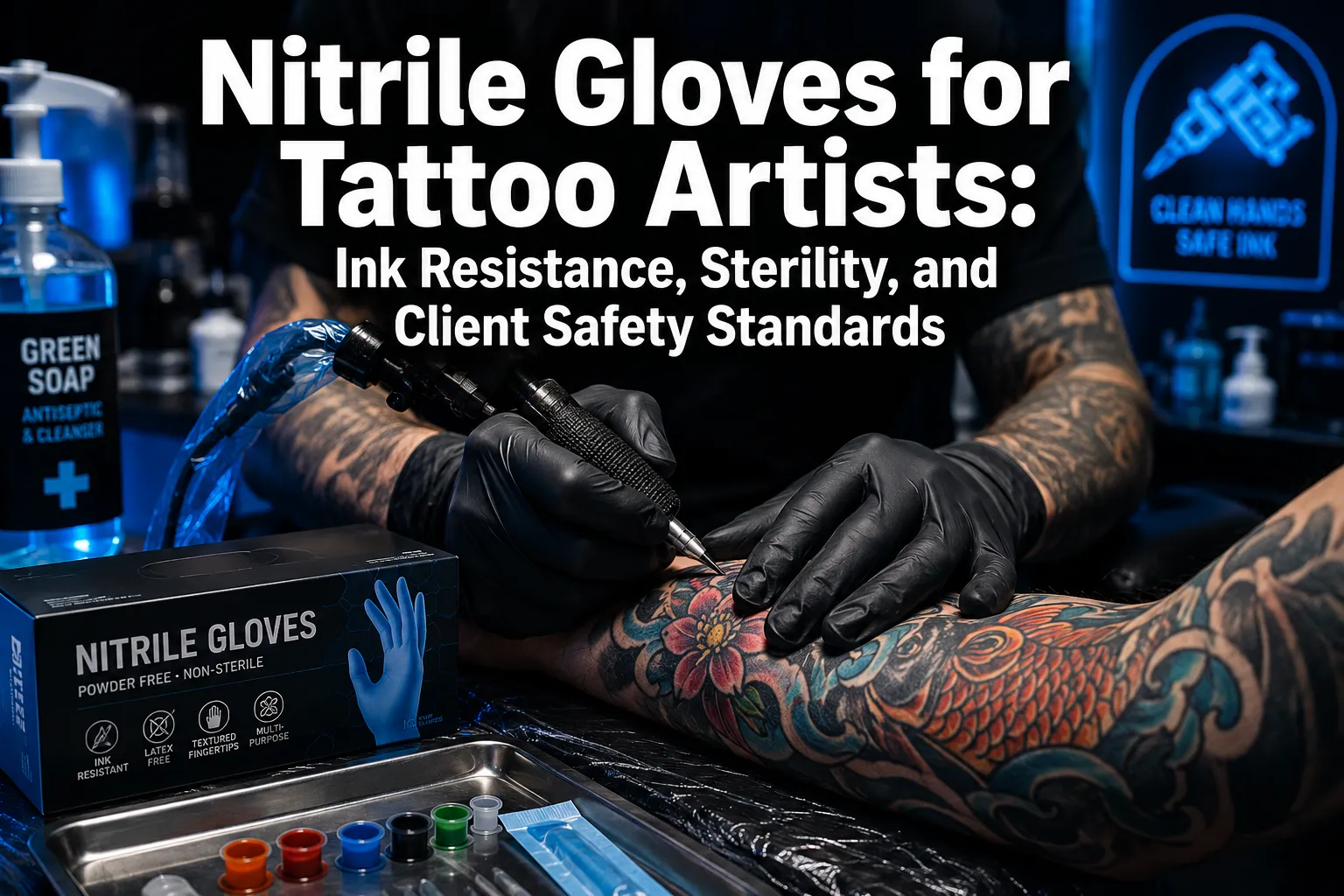
What Are Nitrile Gloves and Why Do Tattoo Artists Use Them
Nitrile gloves are synthetic rubber gloves made from acrylonitrile-butadiene copolymer that provide a latex-free barrier against bloodborne pathogens, inks, and cleaning chemicals used in tattoo studios. Tattoo artists prefer nitrile because it combines the elasticity and comfort of latex with superior chemical resistance and eliminates the risk of Type I latex allergies that affect approximately 1-6% of the general population.
The material properties of nitrile make it particularly suited for tattooing:
- Chemical resistance: Nitrile withstands prolonged exposure to tattoo inks, petroleum-based ointments, isopropyl alcohol, and green soap without degrading
- Puncture resistance: The synthetic rubber is three to five times more puncture-resistant than latex, reducing the risk of needle sticks during detailed work
- Tactile sensitivity: Modern nitrile formulations provide excellent dexterity for precise line work and shading
- Barrier protection: Nitrile creates an effective barrier against bloodborne pathogens including hepatitis B, hepatitis C, and HIV
Professional tattoo artists rely on nitrile gloves as their primary personal protective equipment because they meet or exceed OSHA bloodborne pathogen standards while accommodating the specific demands of tattoo application. The material doesn’t break down when exposed to the oils in skin ointments or the solvents in tattoo inks, maintaining barrier integrity throughout multi-hour sessions.
For clients with known latex sensitivities, nitrile gloves provide safe, reliable protection without triggering allergic reactions that could complicate the tattooing process or healing period.
Are Nitrile Gloves Better Than Latex for Tattooing
Nitrile gloves are superior to latex for tattooing because they eliminate allergy risks, resist ink and chemical degradation better, and provide stronger puncture protection without sacrificing the flexibility needed for detailed artwork. While latex gloves were once the industry standard, most professional tattoo studios switched to nitrile in the 2000s as manufacturing improvements made nitrile more affordable and comfortable.
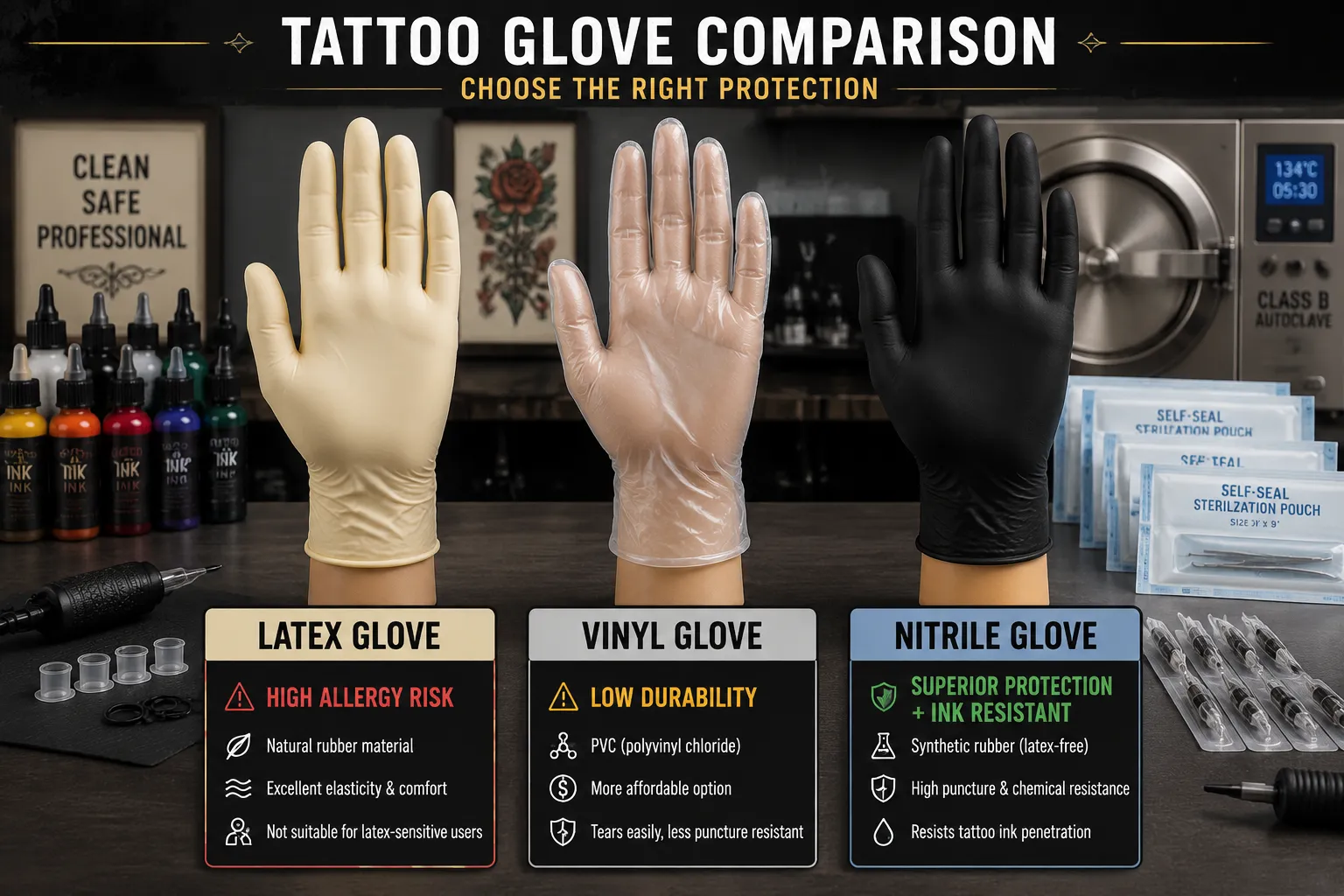
Comparison of glove materials for tattooing:
| Property | Nitrile | Latex | Vinyl |
|---|---|---|---|
| Puncture resistance | Excellent | Good | Poor |
| Chemical resistance | Excellent | Fair | Poor |
| Ink stain resistance | Excellent | Poor | Fair |
| Allergy risk | Minimal | High | Minimal |
| Tactile sensitivity | Excellent | Excellent | Fair |
| Cost per glove | $0.08-0.25 | $0.05-0.15 | $0.03-0.08 |
| Durability during sessions | 2-3 hours | 1-2 hours | 30-60 minutes |
Latex gloves pose significant problems in tattoo environments. The proteins in natural rubber latex can cause Type I hypersensitivity reactions ranging from contact dermatitis to anaphylaxis. Even if the artist isn’t allergic, latex proteins can transfer to the client’s open skin during tattooing, potentially sensitizing them to latex or triggering reactions in already-allergic individuals.
Vinyl gloves, while inexpensive and allergy-free, lack the durability and barrier protection required for tattooing. They tear easily, provide poor resistance to ink and chemicals, and don’t meet the performance standards most health departments require for bloodborne pathogen exposure.
Choose nitrile over latex if:
- You or your clients have any history of latex sensitivity
- You work with vibrant or dark inks that stain latex quickly
- You perform sessions longer than one hour
- You want maximum protection against needle stick injuries
- Your local health department requires ASTM D6319 compliance
The only scenario where latex might be preferable is if you have a confirmed Type IV hypersensitivity to nitrile accelerators (extremely rare) and no latex allergy. In that case, consult with an allergist and consider alternative synthetic materials like neoprene.
Understanding what happens if you tattoo without proper gloves underscores why material selection matters so much for both artist and client safety.
Do Nitrile Gloves Resist Tattoo Ink Staining
Nitrile gloves resist tattoo ink staining significantly better than latex or vinyl alternatives, though no glove material is completely stain-proof against prolonged exposure to concentrated pigments. Black and dark-colored nitrile gloves hide visible staining better than light-colored options, which is why many tattoo artists prefer black gloves for aesthetic and practical reasons.
The synthetic polymer structure of nitrile creates a non-porous surface that ink pigments cannot easily penetrate. When ink does contact nitrile gloves during tattooing, it typically sits on the surface and can be wiped away with a damp towel or alcohol prep pad. In contrast, latex gloves absorb ink pigments into the material, creating permanent stains within minutes of exposure.
Ink resistance by glove color:
- Black nitrile: Hides all ink stains; preferred for client-facing work
- Blue nitrile: Shows dark ink stains but hides most colors
- Purple nitrile: Moderate stain visibility; popular in medical settings
- White/light nitrile: Shows all ink colors; useful for identifying contamination
While ink staining is primarily a cosmetic concern, it can serve a practical purpose. Some experienced artists prefer light-colored gloves specifically because visible ink staining helps them identify when gloves have been contaminated and need changing. This visual cue can improve hygiene protocols, especially for newer artists still developing their glove-change habits.
Common mistake: Assuming that because nitrile resists staining, gloves don’t need to be changed when visibly soiled with ink. Even if the barrier isn’t compromised, heavily ink-stained gloves should be changed to maintain professional appearance and prevent ink transfer to clean surfaces or the client’s skin outside the tattoo area.
The ink resistance of nitrile also extends to the cleaning and sterilization chemicals used in tattoo studios. Nitrile maintains its integrity when exposed to:
- Isopropyl alcohol (70-90%)
- Quaternary ammonium compounds
- Hydrogen peroxide solutions
- Chlorhexidine gluconate
- Green soap and other surfactants
This chemical resistance means artists can clean their workstation, handle disinfectants, and prepare the client’s skin without needing to change gloves between these tasks and the actual tattooing.
What Does Sterile vs Non-Sterile Mean for Tattoo Gloves
Non-sterile examination gloves are appropriate and standard for tattooing, while sterile surgical gloves are unnecessary for routine tattoo application and would significantly increase costs without improving safety outcomes. The distinction between sterile and non-sterile refers to the manufacturing and packaging process, not the material quality or barrier protection level.
Non-sterile examination gloves are manufactured in clean facilities and packaged in bulk boxes. They’re free from defects and provide effective barrier protection against bloodborne pathogens, but they’re not individually packaged or subjected to sterilization processes like gamma irradiation or ethylene oxide treatment. These gloves meet ASTM D6319 standards for examination gloves and are appropriate for any procedure where the glove doesn’t enter a sterile body cavity.
Sterile surgical gloves are individually packaged, sterilized using validated processes, and intended for surgical procedures where maintaining a completely sterile field is critical. They cost 5-10 times more than examination gloves and provide no additional protection for tattooing purposes.
Tattooing is considered a clean procedure, not a sterile procedure. While artists must follow strict hygiene protocols including:
- Hand washing before gloving
- Using single-use needles and ink caps
- Maintaining a clean work surface
- Proper skin preparation with antiseptics
The procedure itself doesn’t require the sterile field necessary for surgery. The skin is not sterile before tattooing begins, and the tattoo process doesn’t involve entering sterile body cavities or internal tissues.
Health department requirements typically specify:
- Single-use disposable gloves only (no reusable gloves)
- Gloves must meet ASTM D6319 or equivalent standards
- Gloves must be changed between clients
- Gloves must be changed if torn or contaminated
- No requirement for sterile gloves for routine tattooing
Choose sterile gloves only if:
- Performing dermal implants or subdermal procedures
- Your specific jurisdiction requires them (extremely rare)
- Working with immunocompromised clients in consultation with their physician
For standard tattoo work, quality non-sterile nitrile examination gloves provide appropriate protection at a reasonable cost. The money saved by using examination gloves instead of surgical gloves can be invested in higher-quality nitrile formulations with better puncture resistance and comfort.
How Much Do Nitrile Gloves Cost for Tattoo Shops
Professional-grade nitrile gloves suitable for tattooing typically cost between $8-25 per 100-count box, with price varying based on thickness, certifications, and whether they’re textured or powder-free. At an average usage rate of 4-8 pairs per client (accounting for glove changes during setup, tattooing, and cleanup), glove costs represent approximately $0.32-2.00 per client session.
Price ranges by glove specifications (2026 estimates):
Budget nitrile (3-4 mil): $8-12 per 100 gloves
- Suitable for brief procedures or non-tattoo studio tasks
- May not meet puncture resistance needs for extended sessions
Standard tattoo-grade (4-5 mil): $12-18 per 100 gloves
- Meets ASTM D6319 standards
- Appropriate for most tattoo work
- Best value for high-volume studios
Premium thick nitrile (6+ mil): $18-25 per 100 gloves
- Enhanced puncture resistance
- Longer wear time during extended sessions
- Preferred for artists with heavy-handed techniques
Specialty colors/textures: Add $2-5 per box
- Black, purple, or custom colors
- Textured fingertips for enhanced grip
- Extended cuff lengths
For a busy tattoo studio performing 20-30 tattoos per week, monthly glove costs typically range from $80-200 depending on glove quality and artist preferences. This represents roughly 1-3% of gross revenue for most studios, making it a minor expense relative to the protection provided.
Cost-saving strategies that maintain safety:
- Buy in bulk (cases of 10 boxes) for 10-20% discounts
- Establish accounts with medical supply distributors
- Use standard-grade gloves for setup/cleanup, premium gloves for tattooing
- Train artists on proper glove change protocols to avoid waste
False economy warning: Some studios attempt to save money by purchasing 2-3 mil gloves or vinyl gloves. These cheaper alternatives tear more frequently, requiring more frequent changes that eliminate any cost savings. Worse, they may not meet health department standards and increase the risk of bloodborne pathogen exposure.
When calculating glove costs, factor in the liability protection they provide. A single needlestick injury involving bloodborne pathogen exposure can cost $3,000-10,000 in testing, prophylaxis, and follow-up care. Quality gloves that prevent such incidents pay for themselves many times over.
For detailed guidance on selecting appropriate thickness, see our article on what is a good thickness for nitrile gloves.
What Glove Thickness Should Tattoo Artists Use
Tattoo artists should use nitrile gloves in the 4-6 mil thickness range to balance puncture protection with the tactile sensitivity needed for detailed artwork. Gloves thinner than 4 mil increase the risk of tears and punctures during extended sessions, while gloves thicker than 6 mil can reduce dexterity and make fine line work more difficult.
Glove thickness is measured in mils (thousandths of an inch), with one mil equaling 0.001 inches or approximately 0.025 millimeters. The thickness directly affects both protection level and tactile feedback:
4 mil gloves:
- Minimum recommended thickness for tattooing
- Good balance of protection and sensitivity
- Suitable for artists with light to moderate hand pressure
- May wear thin during sessions exceeding 3 hours
- Best for: detailed line work, portrait tattoos, fine shading
5 mil gloves:
- Industry standard for professional tattooing
- Enhanced durability without significant loss of dexterity
- Appropriate for most tattoo styles and session lengths
- Best for: general tattooing, color work, medium-sized pieces
6 mil gloves:
- Maximum thickness before dexterity becomes noticeably affected
- Superior puncture resistance for heavy-handed artists
- Longer wear time during marathon sessions
- Best for: large-scale work, heavy shading, artists prone to glove tears
Thicker than 6 mil:
- Typically unnecessary for tattooing
- Reduced tactile sensitivity affects precision
- More appropriate for industrial or chemical handling
Choose thicker gloves (5-6 mil) if you:
- Frequently experience glove tears during sessions
- Perform large-scale work requiring 4+ hour sessions
- Use aggressive shading techniques
- Work with particularly sharp needle configurations
- Have experienced needlestick injuries in the past
Choose standard thickness (4-5 mil) if you:
- Specialize in fine line or detailed work
- Prioritize maximum tactile sensitivity
- Perform shorter sessions (under 2 hours)
- Have never experienced glove failures during work
Many professional artists keep multiple thickness options in their studio and select based on the specific tattoo they’re performing. A delicate script tattoo might call for 4 mil gloves to maximize precision, while a full-back shading session might warrant 6 mil gloves for extended durability.
The relationship between glove thickness and protection extends beyond just puncture resistance to include chemical barrier properties and overall durability during extended wear.
Can Tattoo Ink Seep Through Nitrile Gloves
Tattoo ink cannot seep through intact nitrile gloves because the synthetic polymer creates a continuous barrier that liquid pigments cannot penetrate. However, ink can reach the skin if gloves are torn, punctured, or improperly fitted, which is why selecting appropriate thickness and changing gloves when damaged is critical for maintaining barrier protection.
The molecular structure of nitrile rubber forms a dense, non-porous barrier that blocks particles much smaller than tattoo ink pigments. Tattoo inks consist of pigment particles suspended in a carrier solution, with particle sizes typically ranging from 50-500 nanometers. The nitrile polymer matrix has pore sizes well below this range, making it impossible for ink to pass through the material itself.
Scenarios where ink can reach skin despite wearing gloves:
Punctures from tattoo needles: The most common breach occurs when needles accidentally puncture the glove during tattooing. This creates a direct pathway through the barrier.
Tears from mechanical stress: Gloves can tear when caught on equipment, stretched excessively, or weakened by prolonged wear.
Degradation from chemicals: While nitrile resists most tattoo-related chemicals, prolonged exposure to certain solvents can weaken the material.
Improper fit: Gloves that are too large can bunch and tear; gloves that are too small can split at stress points.
Manufacturing defects: Quality control issues can result in thin spots or micro-perforations, though this is rare with reputable brands.
Protection verification:
- Visually inspect gloves before donning for tears or defects
- Perform a water test on suspicious gloves (fill with water and check for leaks)
- Change gloves immediately if you feel wetness or notice visible damage
- Use appropriate thickness for your technique and session length
The barrier protection of nitrile extends beyond just ink to include the more critical concern of bloodborne pathogen exposure. Blood and bodily fluids have similar or smaller particle sizes compared to ink pigments, so a glove that effectively blocks ink also blocks infectious agents when intact.
Common mistake: Continuing to work with gloves that have visible ink staining on the interior surface. This indicates a breach has occurred, and the gloves should be changed immediately even if the tear isn’t visible. Any ink on the inside of the glove means the barrier has been compromised.
For artists concerned about maximum protection, double-gloving (wearing two pairs of gloves simultaneously) is common in medical settings but rarely necessary for tattooing. The reduced dexterity typically outweighs the marginal increase in protection for routine tattoo work.
Understanding what nitrile gloves protect against helps artists appreciate the full range of hazards these barriers address beyond just ink exposure.
What Are the Health Department Requirements for Tattoo Glove Safety
Health departments require tattoo artists to use single-use disposable gloves that meet ASTM D6319 standards for medical examination gloves, change gloves between clients and whenever contaminated, and dispose of used gloves as regulated medical waste. Specific requirements vary by jurisdiction, but most regulations are based on OSHA’s Bloodborne Pathogens Standard (29 CFR 1910.1030) and CDC infection control guidelines.
Core requirements common across most jurisdictions:
- Glove type: Single-use disposable examination gloves (nitrile, latex, or other approved materials)
- Standards compliance: Must meet ASTM D6319 or equivalent international standards (EN 455 in Europe)
- Barrier integrity: Gloves must be free from holes, tears, or defects before use
- Proper sizing: Artists must have access to multiple sizes for proper fit
- Change protocols: New gloves required between clients, after touching non-sterile surfaces, and when damaged
- Hand hygiene: Hands must be washed before donning gloves and after removing them
- Disposal: Used gloves must be disposed of in designated biohazard waste containers
ASTM D6319 standard specifications include:
- Minimum tensile strength requirements
- Maximum allowable defect rates (typically 1.5-2.5 AQL)
- Viral penetration resistance testing
- Dimensional requirements for proper fit
- Labeling requirements for size and material
Some jurisdictions have additional requirements:
- California requires gloves to be powder-free to reduce airborne allergen exposure
- New York mandates specific documentation of glove lot numbers for traceability
- Florida requires artists to demonstrate proper glove donning and removal techniques during licensing
Documentation requirements: Most health departments require tattoo studios to maintain records showing:
- Glove supplier and product specifications
- Proof of ASTM D6319 compliance (usually provided by manufacturer)
- Training records showing artists understand proper glove use
- Infection control protocols including glove change procedures
Inspection focus areas: During health inspections, officials typically verify:
- Adequate glove supply in multiple sizes
- Proper storage (clean, dry location away from contamination)
- Correct disposal procedures
- Artist compliance with change protocols
- No evidence of glove reuse or washing
Penalties for non-compliance: Violations of glove safety requirements can result in:
- Written warnings for first-time minor violations
- Fines ranging from $100-1,000 per violation
- Temporary closure orders for serious or repeated violations
- License suspension or revocation for egregious violations
Artists should consult their local health department for specific requirements, as regulations can vary significantly. Most health departments provide written guidelines or conduct pre-opening consultations to ensure compliance before a studio begins operations.
The legal requirement to use proper gloves isn’t just bureaucratic red tape. It represents the minimum standard of care for protecting both artists and clients from serious infectious diseases. Studios that exceed minimum requirements demonstrate professionalism and commitment to client safety.
Do I Need to Change Gloves Between Each Tattoo Client
You must change gloves between every tattoo client without exception, as this is both a universal health department requirement and essential infection control practice to prevent cross-contamination of bloodborne pathogens between clients. Using the same gloves on multiple clients, even if they appear intact, creates direct risk of transmitting hepatitis B, hepatitis C, HIV, and other infectious agents.
The requirement to change gloves between clients is non-negotiable and appears in every jurisdiction’s tattoo safety regulations. This protocol exists because:
Bloodborne pathogen transmission risk:
- Tattoo needles create blood exposure on every client
- Microscopic blood particles contaminate glove surfaces
- Blood can remain infectious on surfaces for days or weeks
- Even invisible contamination can transmit disease
Surface contamination: During a tattoo session, gloved hands contact:
- The client’s skin and blood
- Tattoo machines and power supplies
- Ink bottles and caps
- Cleaning supplies and barriers
- Furniture and equipment
All of these surfaces become contaminated with that client’s blood and bodily fluids. Using the same gloves on a subsequent client transfers this contamination directly to the new client’s open skin.
Proper between-client glove protocol:
- Complete the tattoo and initial cleanup while wearing gloves
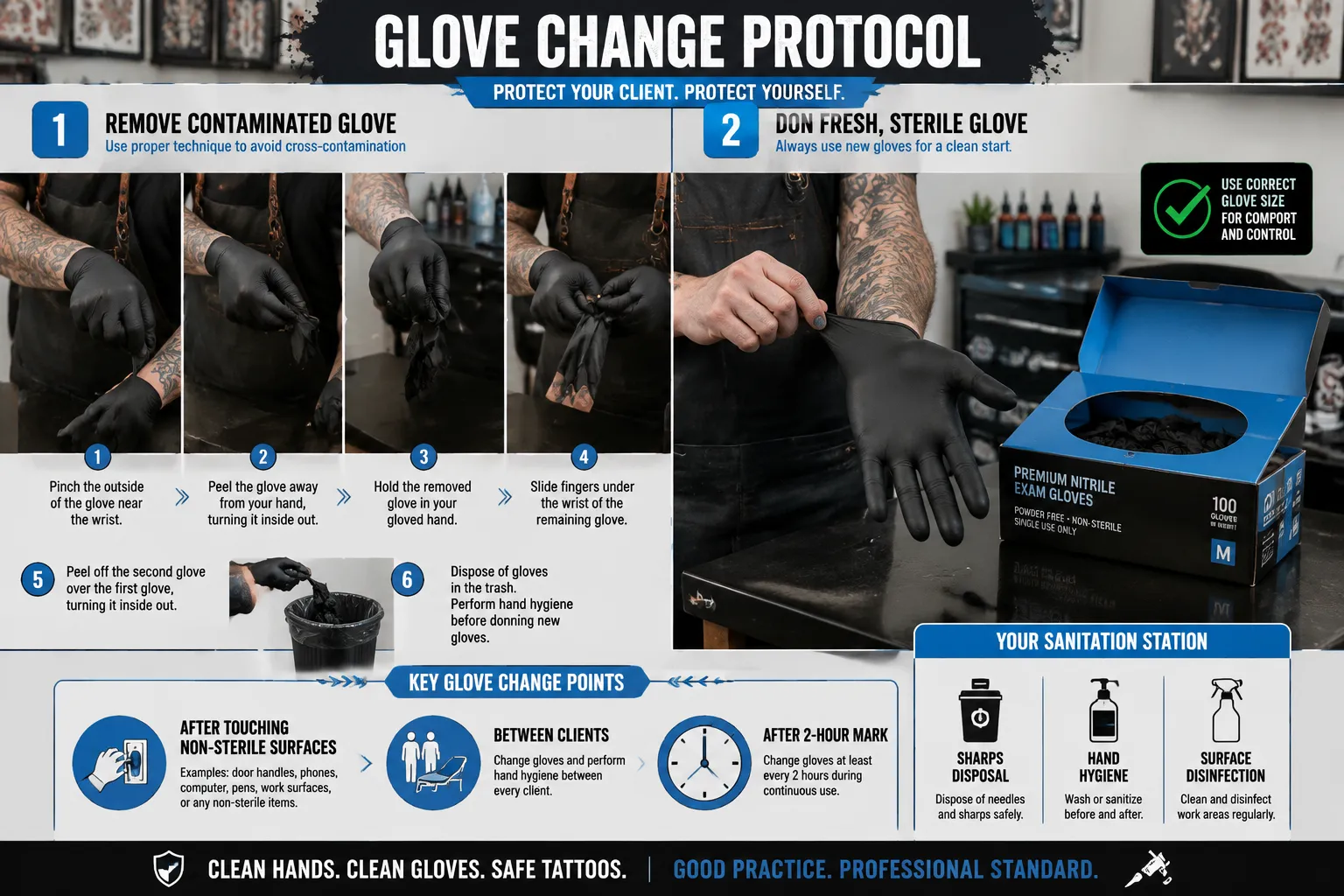
- Remove gloves using proper technique (pinch outside of one glove at wrist, peel off, hold removed glove in gloved hand, slide fingers under remaining glove at wrist, peel off turning inside out)
- Dispose of gloves in biohazard waste
- Wash hands thoroughly with soap and water
- Clean and disinfect all contaminated surfaces
- Wash hands again before donning new gloves
- Don fresh gloves for next client setup
Common mistake: Removing gloves after tattooing, cleaning the station with bare hands, then donning new gloves for the next client. This exposes the artist’s hands to the previous client’s blood during cleanup and can transfer contamination to the new gloves when donning them.
Best practice: Some artists use a two-glove system:
- First pair: Used during tattooing and immediate cleanup
- Second pair: Donned after hand washing for station disinfection and next client setup
This approach ensures hands never contact contaminated surfaces without barrier protection and fresh gloves are used for each client’s skin contact.
The between-client glove change is so fundamental to infection control that failure to comply can result in immediate license suspension in most jurisdictions. It’s not an area where shortcuts or judgment calls are acceptable.
What Happens If a Tattoo Artist Uses the Wrong Gloves
Using inappropriate gloves for tattooing can result in glove failure leading to bloodborne pathogen exposure, allergic reactions in artists or clients, health department violations with fines or license suspension, and increased liability if infections or complications occur. The specific consequences depend on what type of “wrong” gloves are used and whether any adverse events result.
Consequences of specific glove errors:
Using vinyl gloves:
- High tear rate during tattooing (vinyl is not puncture-resistant)
- Inadequate barrier protection against bloodborne pathogens
- Fails to meet ASTM D6319 standards in most cases
- Health department violation if discovered during inspection
- Significantly increased needlestick injury risk
Using latex gloves with allergic clients:
- Can trigger Type I hypersensitivity reactions ranging from hives to anaphylaxis
- Latex proteins can transfer to client’s open skin during tattooing
- May sensitize previously non-allergic clients to latex
- Creates liability for the artist and studio
- Can result in medical complications requiring emergency treatment
Using gloves that are too thin (under 4 mil):
- Increased puncture and tear rate during sessions
- May not provide adequate barrier protection for extended work
- Requires more frequent glove changes, increasing costs
- Greater risk of unnoticed breaches in barrier protection
Using non-medical grade gloves:
- May not meet viral penetration resistance standards
- Higher defect rates (holes, thin spots)
- Inadequate quality control and testing
- Health department violation
- Increased infection transmission risk
Using expired gloves:
- Nitrile can degrade over time, especially if stored improperly
- Reduced elasticity and increased brittleness
- Higher tear and puncture rates
- May not provide rated barrier protection
Real-world consequences:
If a client contracts a bloodborne pathogen infection and can demonstrate the artist used inappropriate gloves or failed to follow proper protocols, the artist and studio face:
- Civil liability for medical costs, lost wages, and damages (potentially hundreds of thousands of dollars)
- Criminal charges in some jurisdictions for reckless endangerment
- Professional license revocation
- Reputation damage and business closure
Even without infection transmission, health department inspectors who observe improper glove use can:
- Issue immediate violation notices
- Require corrective action plans
- Impose fines ($100-1,000 per violation typically)
- Order temporary closure until compliance is demonstrated
- Suspend or revoke operating licenses for repeated violations
Insurance implications: Professional liability insurance policies for tattoo artists typically require compliance with industry standards and health regulations. Using inappropriate gloves could void coverage, leaving the artist personally liable for any claims.
The relatively small cost difference between appropriate and inappropriate gloves makes using the wrong gloves an indefensible risk. Quality nitrile gloves meeting all requirements cost only pennies more per pair than inadequate alternatives.
Are Black Nitrile Gloves Safe for Tattooing or Just for Looks
Black nitrile gloves are equally safe as other colored nitrile gloves for tattooing provided they meet the same ASTM D6319 standards and specifications, with color being purely an aesthetic choice that doesn’t affect barrier protection, chemical resistance, or puncture resistance. The black color comes from carbon black pigment added during manufacturing, which doesn’t compromise the glove’s protective properties.
Advantages of black nitrile gloves for tattooing:
- Hides ink stains: Black gloves don’t show visible staining from tattoo inks, maintaining a clean professional appearance throughout sessions
- Professional aesthetic: Many clients perceive black gloves as more professional or artistic compared to medical blue or white
- Reduces visual distraction: The dark color creates less contrast against tattooed skin, making it easier to see the work clearly
- Conceals blood: While not a primary consideration, black gloves don’t show blood staining as obviously as light colors
Disadvantages of black nitrile gloves:
- Harder to spot contamination: Light-colored gloves make it easier to see when they’ve contacted ink, blood, or other contaminants
- Difficult to identify tears: Small punctures or tears are less visible on black gloves compared to light colors
- Slightly higher cost: Black gloves typically cost $1-3 more per box than standard blue gloves due to pigment costs
- Less common in medical settings: Some clients may perceive blue gloves as more “medical” and therefore safer
Safety verification for black gloves: When purchasing black nitrile gloves, verify they meet the same standards as medical-grade gloves:
- ASTM D6319 compliance for examination gloves
- Acceptable Quality Level (AQL) of 1.5 or better for pinholes
- Viral penetration resistance testing
- Appropriate thickness (4-6 mil for tattooing)
- Powder-free formulation
Common misconception: Some artists believe black gloves are “industrial grade” rather than medical grade. In reality, black nitrile gloves are available in both industrial and medical grades. The color doesn’t determine the grade; the manufacturing standards and testing do.
Choosing glove color: Select glove color based on:
- Black: If you prioritize professional appearance and don’t want visible ink staining
- Blue: If you want easy visibility of contamination and tears
- Purple: If you want a middle ground between aesthetics and visibility
- White: If you want maximum visibility of any contamination (useful for training)
Many studios stock multiple colors and let individual artists choose based on personal preference. Some artists use blue gloves during setup and cleanup (where contamination visibility is helpful) and switch to black gloves for the actual tattooing (where aesthetics matter more).
The safety of any nitrile glove depends on its specifications and proper use, not its color. Black gloves from reputable manufacturers that meet ASTM standards provide identical protection to their blue, purple, or white counterparts.
Can People with Latex Allergies Get Tattoos Safely with Nitrile Gloves
People with latex allergies can safely get tattoos when artists use nitrile gloves because nitrile is a synthetic material that contains no natural rubber latex proteins and doesn’t trigger Type I latex hypersensitivity reactions. Nitrile gloves have become the standard in professional tattoo studios specifically to accommodate latex-allergic clients and eliminate cross-contamination risks.
Why nitrile is safe for latex-allergic clients:
Latex allergies result from immune system reactions to proteins found in natural rubber latex (Hevea brasiliensis). These proteins are completely absent from nitrile, which is synthesized from petroleum-based chemicals (acrylonitrile and butadiene). The synthetic manufacturing process creates a material that’s chemically distinct from natural rubber.
Types of latex reactions and nitrile safety:
Type I hypersensitivity (immediate): IgE-mediated allergic reaction to latex proteins; can range from hives to anaphylaxis. Nitrile contains no latex proteins and cannot trigger this reaction.
Type IV hypersensitivity (delayed): Contact dermatitis from chemical additives used in glove manufacturing. This can occur with any glove type, including nitrile, but is unrelated to latex allergy.
Protocol for tattooing latex-allergic clients:
- Ask about allergies: Include latex allergy questions on client intake forms
- Verify glove material: Confirm you’re using nitrile (or other latex-free) gloves
- Check all supplies: Ensure other studio supplies (barrier films, rubber bands) are latex-free
- Inform the client: Let them know you’re using latex-free materials
- Have emergency protocols: Know how to respond if a reaction occurs despite precautions
Hidden latex sources in tattoo studios: Even with nitrile gloves, latex-allergic clients can react to:
- Rubber bands used on tattoo machines (use silicone or plastic alternatives)
- Latex-based barrier films or wraps
- Some adhesive products
- Rubber grips on equipment
Professional studios serving latex-allergic clients should maintain a completely latex-free environment to eliminate any cross-contamination risk.
Nitrile allergy considerations: While extremely rare, some individuals can develop Type IV contact dermatitis to chemical accelerators used in nitrile manufacturing (typically thiurams or carbamates). This is distinct from latex allergy and affects fewer than 1% of the population. Clients with known nitrile sensitivity should inform their artist, who can use alternative materials like vinyl or polyethylene gloves for non-tattooing tasks (though these aren’t suitable for the actual tattooing).
Documentation and liability: Studios should:
- Document latex allergy status on client intake forms
- Maintain records showing gloves and supplies are latex-free
- Train all artists on allergy protocols
- Have emergency response plans for allergic reactions
The widespread adoption of nitrile gloves in tattooing has made the art form accessible to the estimated 1-6% of the population with latex allergies. Prior to nitrile becoming standard, latex-allergic individuals often couldn’t safely get tattoos due to the risk of severe reactions.
For more detailed information about latex allergy safety, see our comprehensive guide on nitrile gloves and latex allergies.
How Often Should Tattoo Artists Change Gloves During One Session
Tattoo artists should change gloves during a single session whenever they touch non-sterile surfaces, after every 2-3 hours of continuous wear, immediately if gloves become torn or punctured, and any time gloves become heavily soiled with ink or blood. Proper glove change protocols during sessions prevent cross-contamination while maintaining barrier protection throughout extended tattoo work.
Mandatory glove change situations during a session:
After touching non-sterile surfaces:
- Answering phone or using computer
- Adjusting lighting or furniture
- Opening doors or drawers
- Touching personal items
- Handling payment or paperwork
After extended wear (2-3 hours):
- Nitrile can develop micro-tears from prolonged stress
- Moisture buildup inside gloves reduces barrier effectiveness
- Hand fatigue increases risk of accidents
When gloves are damaged:
- Visible tears or punctures
- Feeling wetness inside the glove
- Excessive stretching or thinning
When heavily soiled:
- Excessive ink or blood accumulation
- Contact with cleaning chemicals
- Any contamination that impairs visibility or dexterity
Proper mid-session glove change technique:
- Remove contaminated gloves using proper technique
- Dispose in biohazard waste
- Wash hands thoroughly
- Dry hands completely (moisture reduces glove integrity)
- Don fresh gloves
- Resume work
Time-based change recommendations by session length:
- Under 2 hours: One pair typically sufficient if no contamination occurs
- 2-4 hours: Change gloves at 2-hour mark minimum
- 4-6 hours: Change gloves every 2 hours (minimum 2 changes)
- 6+ hours: Change gloves every 2 hours plus additional changes as needed
Common mistakes:
- Not changing after touching phone: One of the most frequent contamination sources
- Continuing with torn gloves: “It’s just a small tear” thinking that compromises safety
- Skipping hand washing between changes: Defeats the purpose of fresh gloves
- Using same gloves for cleanup: Gloves used for tattooing should be removed before station cleanup
Best practice for extended sessions: Many professional artists establish a routine for marathon sessions:
- Set a timer for 2-hour intervals
- Schedule brief breaks for glove changes
- Use breaks to assess client comfort and hydration
- Inspect new gloves before donning
Cost considerations: Artists sometimes resist frequent glove changes due to cost concerns. However, the additional expense is minimal:
- Extra pair every 2 hours = $0.16-0.50 per session
- Prevents contamination that could cost thousands in liability
- Demonstrates professionalism and commitment to safety
Client communication: Inform clients when you’re changing gloves during their session. Most clients appreciate seeing this attention to hygiene and safety. A simple “I’m going to change gloves now” before stepping away reassures them that proper protocols are being followed.
The frequency of glove changes during sessions is one area where exceeding minimum requirements demonstrates professional excellence. When in doubt, change gloves. The minor interruption and small cost are insignificant compared to the protection provided.
What Certifications Should Tattoo Gloves Have for Bloodborne Pathogen Protection
Tattoo gloves must meet ASTM D6319 standards for medical examination gloves, which includes viral penetration resistance testing per ASTM F1671 or equivalent, and should have an Acceptable Quality Level (AQL) of 1.5 or better for pinholes to provide adequate bloodborne pathogen protection. These certifications ensure gloves create an effective barrier against hepatitis B, hepatitis C, HIV, and other infectious agents present in blood.
Essential certifications and standards:
ASTM D6319 (Standard Specification for Nitrile Examination Gloves for Medical Application):
- Defines minimum physical properties (tensile strength, elongation)
- Specifies dimensional requirements for proper fit
- Establishes acceptable defect rates
- Required by most health departments for medical and tattoo use
ASTM F1671 (Standard Test Method for Resistance of Materials Used in Protective Clothing to Penetration by Blood-Borne Pathogens):
- Tests barrier effectiveness against viral penetration
- Uses bacteriophage Phi-X174 as surrogate for bloodborne viruses
- Pass/fail test (gloves must show no viral penetration)
- Critical for bloodborne pathogen protection claims
Acceptable Quality Level (AQL):
- Statistical measure of maximum acceptable defect rate
- AQL 1.5 = 1.5% maximum defect rate (industry standard for medical gloves)
- AQL 2.5 = 2.5% maximum defect rate (acceptable but lower quality)
- Lower AQL numbers indicate higher quality
FDA Registration:
- Medical examination gloves must be registered with FDA
- Indicates manufacturer follows quality system regulations
- Provides traceability for safety issues
- Required for gloves marketed for medical use in the United States
Additional relevant certifications:
EN 455 (European standard for medical gloves):
- Part 1: Freedom from holes (AQL requirements)
- Part 2: Physical properties
- Part 3: Biological evaluation and biocompatibility
- Part 4: Shelf life determination
- Equivalent to ASTM standards for international products
ISO 13485 (Medical Device Quality Management):
- Indicates manufacturer follows quality management systems
- Ensures consistent production standards
- Required for medical device manufacturers
- Provides confidence in product reliability
What to look for on glove packaging:
Compliant glove boxes should display:
- “Meets ASTM D6319 standards” or equivalent
- AQL rating (1.5 or better preferred)
- FDA registration number
- Lot number and expiration date
- Material composition (nitrile)
- Size and thickness specifications
Red flags indicating inadequate gloves:
- No mention of ASTM standards
- Labeled “industrial use only” or “not for medical use”
- AQL higher than 2.5
- No FDA registration for US-marketed products
- Vague claims like “medical-style” instead of “medical grade”
- Unusually low prices (often indicates non-compliant products)
Verification steps:
- Request specification sheets from suppliers showing test results
- Check FDA registration at FDA’s medical device database
- Verify lot numbers match between packaging and specification sheets
- Inspect gloves for obvious defects before use
- Maintain documentation for health department inspections
Common misconception: “All nitrile gloves are medical grade.” In reality, nitrile gloves are manufactured for various industries (automotive, industrial, food service) with different standards. Only gloves specifically manufactured and tested to medical standards provide appropriate bloodborne pathogen protection.
The certifications and standards for tattoo gloves aren’t arbitrary bureaucracy. They represent validated testing that confirms gloves will protect against the specific hazards present in tattooing. Using gloves without proper certifications exposes both artists and clients to preventable risks.
Understanding what nitrile gloves protect against in various professional contexts helps artists appreciate why medical-grade certifications matter for tattoo work.
Frequently Asked Questions
Can I reuse nitrile gloves between tattoo clients if I wash them?
No, nitrile gloves are single-use disposable items that must never be washed and reused. Washing damages the material integrity, doesn’t effectively remove bloodborne pathogens, and violates health department regulations. Always use fresh gloves for each client.
Do textured nitrile gloves work better for tattooing than smooth gloves?
Textured fingertips provide slightly better grip on tattoo machines and needles, especially when gloves become wet from ink or blood. However, smooth gloves work fine for most artists. Choose based on personal preference, as both provide equal barrier protection.
How long can I store unopened boxes of nitrile gloves?
Unopened nitrile gloves typically have a shelf life of 3-5 years when stored in cool, dry conditions away from direct sunlight and ozone sources. Check expiration dates on boxes and rotate stock to use oldest gloves first.
Are powder-free nitrile gloves required for tattooing?
Most jurisdictions now require powder-free gloves to reduce airborne allergen exposure and prevent powder contamination of tattoo sites. Powder-free gloves are standard in modern tattoo studios and should be your default choice.
Can I use food-grade nitrile gloves for tattooing?
No, food-grade nitrile gloves don’t meet ASTM D6319 medical standards and haven’t been tested for bloodborne pathogen protection. Only use gloves specifically certified for medical examination use in tattooing applications.
What size gloves should I order for my tattoo studio?
Stock multiple sizes (small, medium, large, and extra-large minimum) to ensure proper fit for all artists. Improperly fitted gloves increase tear risk and reduce dexterity. Most artists use medium or large sizes.
Do I need to wear gloves when setting up my tattoo station before the client arrives?
Yes, wear gloves during setup when handling needles, tubes, and other equipment that will contact the client. This prevents contamination of sterile supplies. Use fresh gloves when the client arrives for skin preparation and tattooing.
Can nitrile gloves protect against tattoo ink allergies?
Nitrile gloves protect the artist from ink exposure but don’t prevent client allergic reactions to ink pigments injected into their skin. Clients with known pigment allergies should discuss alternatives with their artist before getting tattooed.
Are there eco-friendly alternatives to disposable nitrile gloves for tattooing?
No safe reusable alternatives exist for tattooing due to bloodborne pathogen exposure. Some manufacturers offer biodegradable nitrile gloves, but these still must be disposed of as medical waste. Single-use disposable gloves remain the only appropriate option.
What should I do if a glove tears during a tattoo session?
Stop immediately, remove both gloves, wash hands thoroughly, inspect for any blood exposure, apply fresh gloves, and resume work. If blood exposure occurred, follow your bloodborne pathogen exposure protocol including documentation and testing.
Do black nitrile gloves contain latex?
No, black nitrile gloves are latex-free synthetic rubber. The black color comes from carbon black pigment, not from any latex content. They’re safe for latex-allergic clients and artists.
How can I tell if my nitrile gloves meet medical standards?
Check the box for “ASTM D6319” compliance, FDA registration number, and AQL rating of 1.5 or better. Request specification sheets from your supplier showing test results. Avoid gloves labeled “industrial use only.”
Conclusion
Selecting appropriate nitrile gloves represents one of the most critical safety decisions tattoo artists make, directly impacting both artist and client protection against bloodborne pathogens, chemical exposure, and cross-contamination. Professional-grade nitrile gloves in the 4-6 mil thickness range that meet ASTM D6319 standards provide the optimal balance of puncture resistance, tactile sensitivity, and barrier protection required for safe tattooing practices.
The investment in quality nitrile gloves is minimal compared to the protection they provide. At approximately $12-18 per 100-count box for standard tattoo-grade gloves, the cost per client session ranges from $0.32-2.00, representing a fraction of service fees while delivering comprehensive protection against serious infectious diseases. This small expense eliminates latex allergy concerns, resists ink staining, and demonstrates professional commitment to client safety standards.
Actionable next steps for tattoo professionals:
Audit your current glove inventory to verify ASTM D6319 compliance, appropriate thickness (4-6 mil), and acceptable AQL ratings (1.5 or better)
Establish clear glove change protocols including between every client, after touching non-sterile surfaces, every 2-3 hours during extended sessions, and immediately when damaged
Stock multiple sizes and thicknesses to ensure proper fit for all artists and appropriate protection for different tattoo styles and session lengths
Document your glove specifications and maintain records showing compliance with health department requirements for inspection purposes
Train all studio artists on proper glove selection, donning and removal techniques, and change protocols to ensure consistent safety practices
Review your supplier relationships to ensure reliable access to certified medical-grade nitrile gloves at competitive prices through established medical supply distributors
Communicate your safety practices to clients, explaining your use of medical-grade nitrile gloves as part of your commitment to their safety and comfort
The tattoo industry has evolved significantly in its approach to infection control and client safety, with nitrile gloves playing a central role in this professionalization. Artists who prioritize proper glove selection and usage protocols not only protect themselves and their clients but also elevate the entire industry’s reputation and standards.
Quality nitrile gloves meeting appropriate certifications aren’t an optional upgrade or premium feature. They represent the baseline standard of care that every professional tattoo artist should provide. The consequences of using inadequate gloves, from health department violations to bloodborne pathogen transmission, far outweigh any perceived cost savings from cheaper alternatives.
By implementing the protocols and selection criteria outlined in this guide, tattoo artists can ensure they’re providing maximum protection while maintaining the tactile sensitivity and comfort needed for exceptional artistic work. The right gloves become invisible during the creative process, allowing artists to focus on their craft while maintaining uncompromising safety standards.
SEO Meta Title: Nitrile Gloves for Tattoo Artists: Safety Standards Guide