Up to 13% of healthcare workers experience contact dermatitis from disposable gloves, with chemical accelerators identified as the primary culprit in most cases. For anyone who develops redness, itching, or cracking after wearing standard nitrile gloves, understanding how to choose nitrile gloves for sensitive skin through accelerator-free, low-chemical, and comfort-focused options can transform daily hand protection from a source of irritation into genuine relief.
This guide explains the practical differences between standard and specialized formulations, identifies who benefits most from accelerator-free products, and provides actionable questions to ask suppliers before purchasing.
Key Takeaways
- Accelerator-free nitrile gloves eliminate sulfur-based chemicals (thiurams and dithiocarbamates) that trigger most glove-related contact dermatitis
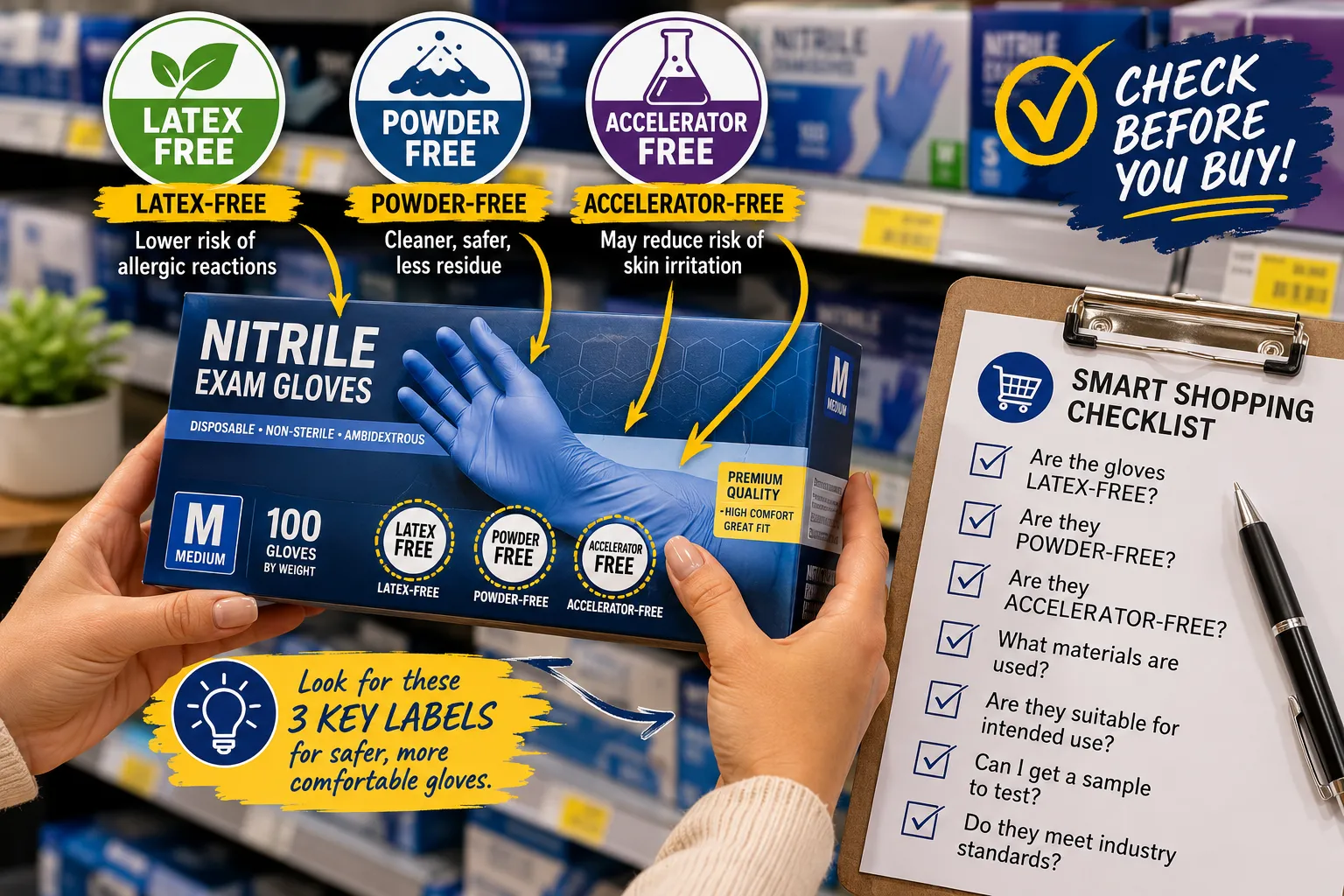
- Look for products labeled latex-free, powder-free, and accelerator-free together to address all major irritation pathways
- “Low Derma” is an industry marketing term for accelerator-free formulations, not a clinical standard
- Clinical observations show more than two-thirds of sensitive users experience complete symptom resolution after switching to accelerator-free options
- Comfort practices matter as much as chemistry: always apply gloves to clean, dry hands and moisturize after removal

Understanding Chemical Triggers in Standard Nitrile Gloves
Standard nitrile gloves rely on vulcanization accelerators during manufacturing to achieve their characteristic elasticity and durability. The most problematic chemicals are sulfur-based accelerators, particularly thiurams and dithiocarbamates, which repeatedly appear in dermatology literature as common causes of Type IV contact dermatitis.
When these chemicals remain as residues in finished gloves, they can penetrate the skin barrier during extended wear, triggering delayed allergic reactions that manifest as:
- Redness and inflammation
- Itching and burning sensations
- Dry, cracking skin
- Eczema-like patches
- Symptoms that worsen with repeated exposure
The challenge lies in distinguishing between irritant contact dermatitis (caused by friction, moisture, or frequent hand washing) and allergic contact dermatitis (caused by chemical sensitization). If your symptoms consistently appear after glove use and improve during glove-free periods, chemical accelerators are the likely cause.
How to Choose Nitrile Gloves for Sensitive Skin: The Accelerator-Free Advantage
Accelerator-free nitrile represents the clearest first choice for sensitive skin because these gloves are manufactured without common vulcanization accelerators while retaining nitrile’s superior barrier properties. Multiple industry sources position accelerator-free formulations as the preferred option for allergy-prone users.
What Makes Accelerator-Free Different
Manufacturers achieve accelerator-free production through alternative curing processes that eliminate or drastically reduce chemical residues. Products like AMPri’s Epiderm Protect line are explicitly free from vulcanization accelerators, sulfur, and typical chemical activators, with clinical validation for users with highly stressed skin.
A small clinical observation by Ansell found that all nine participants using accelerator-free gloves reported relief, with more than two-thirds experiencing complete symptom resolution. While this evidence base consists primarily of manufacturer guidance rather than independent trials, the consistency across sources supports accelerator-free nitrile as the current benchmark for sensitive users.
The “Low Derma” Label Explained
“Low Derma” appears on many product packages as shorthand for accelerator-free formulations. However, this is a marketing term rather than a formal clinical standard. Medtecs’ 2026 update explicitly equates Low Derma with accelerator-free nitrile gloves, but buyers should verify specific chemical exclusions rather than relying on the label alone.
Comfort-Focused Features Beyond Chemical Formulation
Chemistry alone does not guarantee comfortable wear. Even accelerator-free gloves can cause irritation if other factors create friction, moisture buildup, or mechanical stress.
Essential Comfort Practices
Clean, dry application: Always put gloves on clean, dry hands. Moisture trapped inside gloves creates a breeding ground for irritation and maceration.
Post-use moisturizing: Apply a fragrance-free, hypoallergenic moisturizer after removing gloves to restore the skin barrier. Avoid harsh cleansers that strip natural oils.
Cotton undergloves: For extended wear periods, thin cotton liners absorb perspiration and reduce direct friction between skin and nitrile. This practice is particularly valuable in food service, cooking applications, or industrial settings requiring long shifts.
Proper sizing: Gloves that are too tight create pressure points and restrict circulation, while oversized gloves bunch and rub. Consult sizing guides to find your correct fit.
The Triple-Free Standard
Look for gloves labeled latex-free, powder-free, and accelerator-free together. This combination addresses all major irritation pathways:
- Latex-free eliminates natural rubber proteins that cause Type I allergic reactions
- Powder-free removes cornstarch particles that can carry chemical residues and cause respiratory irritation
- Accelerator-free eliminates the primary chemical sensitizers
Many users assume nitrile is automatically hypoallergenic, but standard nitrile formulations can still trigger reactions through processing chemicals rather than the base polymer itself.
Who Benefits Most from Accelerator-Free Options
Healthcare Professionals
Medical staff who wear gloves for multiple hours daily face the highest exposure to chemical residues. For exam and procedure gloves, choose products that explicitly state medical-grade barrier compliance in addition to being accelerator-free. “Skin friendly” alone does not prove adequate barrier performance against bloodborne pathogens or infectious materials.
Food Service Workers
Food handling applications require both chemical safety and regulatory compliance. Accelerator-free nitrile gloves designed for food contact eliminate the risk of chemical migration into food products while protecting sensitive hands. Review food safety considerations before purchasing.
Tattoo Artists
Extended glove wear during detailed work makes tattoo professionals particularly vulnerable to contact dermatitis. Accelerator-free formulations maintain the chemical resistance needed for ink and cleaning agents while reducing skin stress.
Industrial and Automotive Workers
Mechanics and industrial workers who handle oils, solvents, and harsh chemicals benefit from nitrile’s inherent resistance properties. Accelerator-free versions maintain protection against petroleum-based substances without adding chemical sensitizers to already stressed skin.
Individuals with Diagnosed Accelerator Sensitivity
If patch testing has confirmed sensitivity to thiurams, dithiocarbamates, or other accelerators, accelerator-free nitrile is not merely preferable but medically necessary. Consult your dermatologist about specific chemical exclusions relevant to your test results.
Critical Questions to Ask Suppliers
When evaluating glove products for sensitive skin, request specific documentation rather than accepting general marketing claims:
What specific accelerators are excluded? Generic “low chemical” claims are insufficient. Ask for explicit confirmation that thiurams, dithiocarbamates, and sulfur-based accelerators are absent.
Is the product powder-free? Powder can carry chemical residues and should be avoided for sensitive users.
What barrier certifications does the product hold? For medical or high-risk applications, verify compliance with ASTM, EN, or ISO standards appropriate to your use case.
Are independent test results available? Clinical validation or third-party dermatological testing provides stronger evidence than manufacturer claims alone.
What is the shelf life and storage requirement? Chemical migration can increase as gloves age or are stored improperly. Understand expiration dates and optimal storage conditions.
Does the manufacturer offer sample sizes? Testing a small quantity before bulk purchase allows you to verify comfort and confirm the absence of reactions.
Why Nitrile Remains the Best Base Material for Sensitive Skin
Despite the focus on accelerator-free formulations, the choice of nitrile as the base polymer remains significant. Nitrile balances safety, elasticity, durability, and resistance to chemicals and microorganisms better than most alternatives.
Compared to vinyl gloves, nitrile offers superior puncture resistance and barrier protection. Compared to latex, nitrile eliminates natural rubber proteins that cause severe allergic reactions. When processed without chemical accelerators, nitrile retains these advantages while removing the primary sensitizers.
There is no strong evidence in 2026 of a breakthrough material replacing accelerator-free nitrile for sensitive skin applications. Current industry sources continue to position accelerator-free nitrile as the benchmark rather than describing a newer standard.
Practical Purchasing Strategy
Start with a clear assessment of your specific needs:
- Identify your primary use case: Medical, food service, industrial, or general protection
- Determine required barrier level: Chemical resistance, puncture protection, or basic contamination control
- Verify regulatory requirements: Food contact, medical device, or industry-specific standards
- Request samples from multiple manufacturers offering accelerator-free formulations
- Test for comfort during typical wear periods before committing to bulk orders
- Monitor skin response over several days of use to confirm compatibility
For users transitioning from standard gloves, allow a recovery period for existing dermatitis to heal before evaluating new products. Damaged skin may react to any glove material until the barrier function is restored.
Conclusion
Choosing nitrile gloves for sensitive skin requires understanding the distinction between the nitrile polymer itself and the processing chemicals that cause most reactions. Accelerator-free formulations eliminate sulfur-based chemicals like thiurams and dithiocarbamates, which trigger the majority of glove-related contact dermatitis cases.
The most effective approach combines chemical safety with practical comfort measures: select products labeled latex-free, powder-free, and accelerator-free; apply gloves only to clean, dry hands; moisturize after removal; and consider cotton liners for extended wear. Clinical observations show that more than two-thirds of sensitive users achieve complete symptom resolution after switching to accelerator-free options.
When purchasing, ask suppliers specific questions about chemical exclusions, barrier certifications, and independent testing rather than accepting generic marketing claims. Request samples to verify comfort and skin compatibility before committing to bulk orders.
For anyone experiencing persistent irritation from standard nitrile gloves, accelerator-free formulations offer a proven path to comfortable, effective hand protection in 2026. The investment in specialized products pays immediate dividends in reduced discomfort, improved skin health, and sustained protection across medical, food service, industrial, and personal care applications.
SEO Meta Title: Choose Nitrile Gloves for Sensitive Skin: Accelerator-Free