{“cover”:”Professional landscape format (1536×1024) hero image featuring bold text overlay ‘Supply Chain Traceability in Nitrile Gloves: Meeting Post-2024 OSHA Documentation Requirements’ in extra large 70pt white sans-serif font with dark shadow effect, centered in upper third. Background shows modern warehouse setting with stacked boxes of nitrile gloves, digital barcode scanners, tablet displaying supply chain tracking software, and quality control documentation on clipboard. Color scheme: deep navy blue, white, safety orange accents. High contrast lighting, magazine cover quality, editorial style with professional industrial aesthetic. Foreground includes gloved hands holding documentation with visible batch numbers and certification stamps.”,”content”:[“Detailed landscape format (1536×1024) image showing close-up of nitrile glove packaging with prominent batch number labels, QR codes, and traceability barcodes. Scene includes digital tablet displaying supply chain tracking dashboard with origin country flags, manufacturing dates, and shipment routes mapped on screen. Warehouse background slightly blurred with pallets of glove boxes. Professional lighting highlights documentation elements including OSHA compliance certificates, EU MDR certification stamps, and chain of custody forms. Color palette: industrial gray, safety blue, white labels with black text. Clean, organized composition emphasizing documentation and digital tracking systems.”,”Detailed landscape format (1536×1024) image depicting quality control inspection station for nitrile gloves with professional inspector in white coat examining gloves under bright lighting. Scene includes testing equipment like thickness gauges, tensile strength machines, and chemical resistance testing apparatus. Multiple clipboards with performance verification checklists visible. Digital monitor displays real-time quality metrics, defect rates, and compliance dashboards. Background shows organized storage system with color-coded batch identification tags. Professional industrial setting with stainless steel surfaces, safety signage, and documentation binders labeled with OSHA and EU MDR standards. Bright, clinical lighting with focus on precision and quality assurance processes.”}
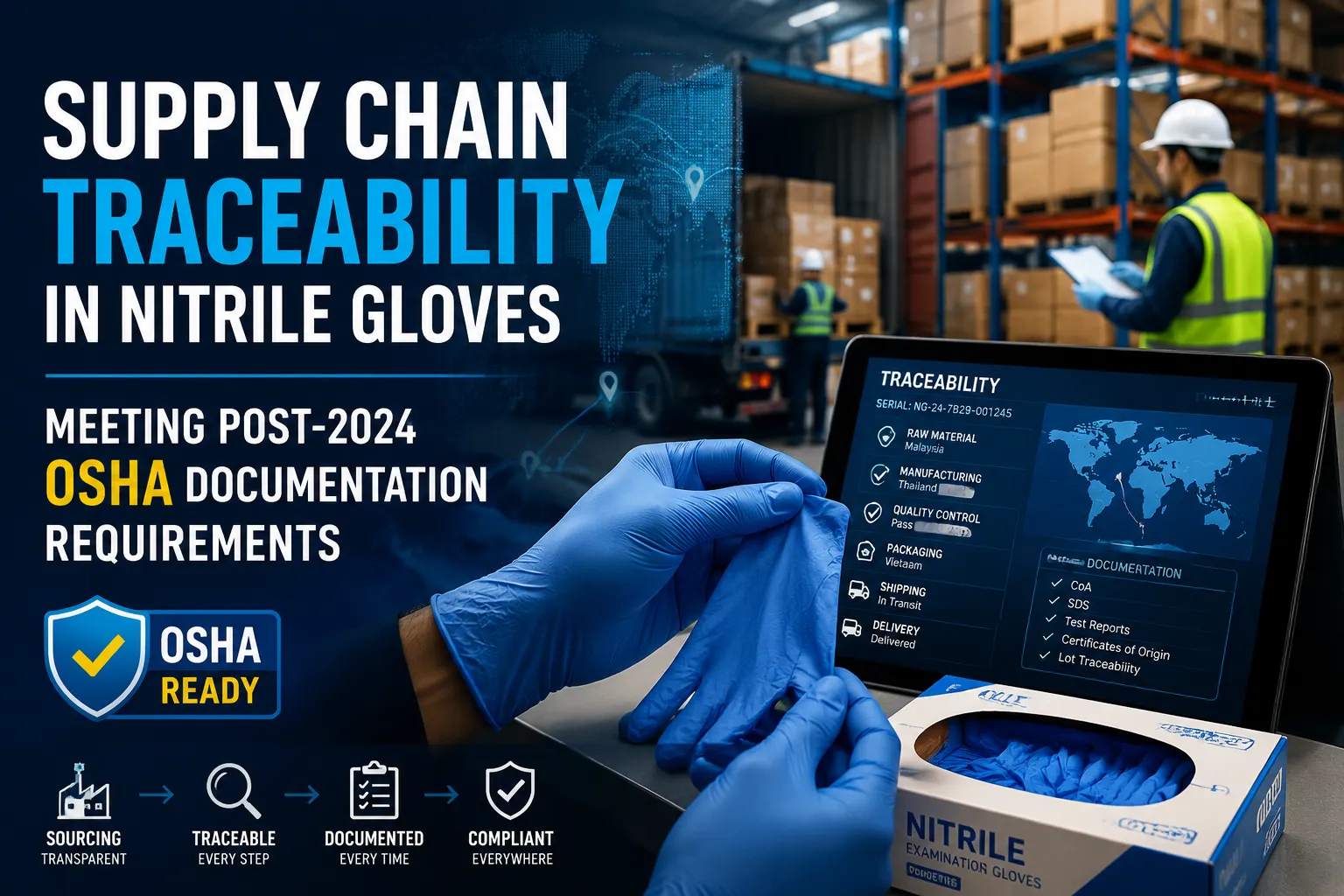
A 2025 industry survey revealed that 68% of nitrile glove suppliers failed initial OSHA documentation audits due to incomplete batch traceability records. As regulatory frameworks tighten in 2026, the gap between compliance requirements and actual supplier capabilities has never been more critical for workplace safety officers and procurement managers to address.
Supply Chain Traceability in Nitrile Gloves: Meeting Post-2024 OSHA Documentation Requirements has become a non-negotiable standard for organizations seeking to protect workers and avoid costly regulatory penalties. The convergence of expanded OSHA inspection protocols and EU Medical Device Regulation (MDR) harmonization demands comprehensive documentation systems that track nitrile gloves from raw material sourcing through end-user delivery.
Key Takeaways
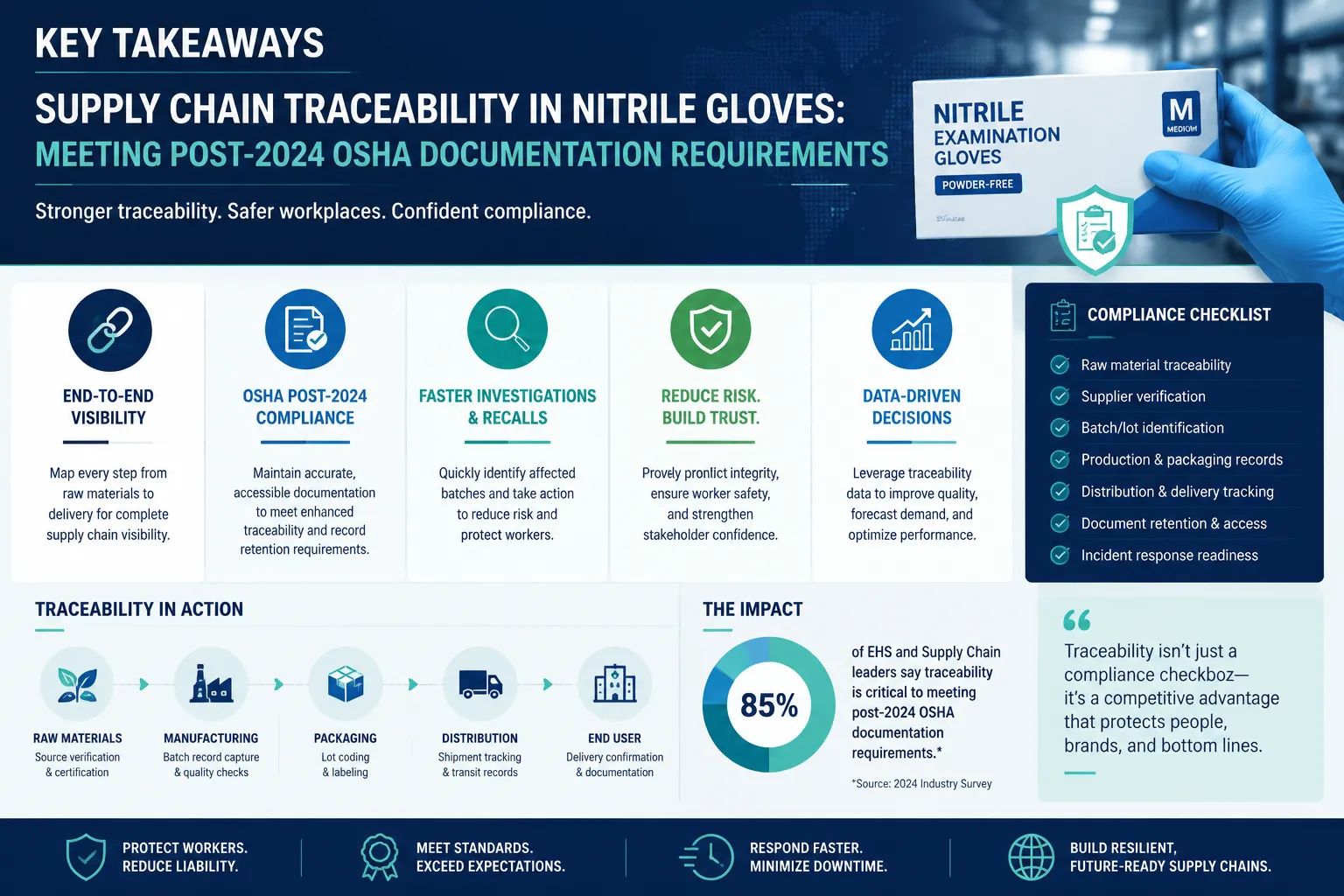
- Post-2024 OSHA requirements mandate complete batch-level traceability documentation for all personal protective equipment, including nitrile gloves
- Suppliers must maintain verifiable records covering raw material origins, manufacturing processes, quality testing, and distribution chains
- Digital tracking systems with QR codes and blockchain integration are becoming industry standards for compliance verification
- Performance verification testing must be documented at multiple production stages to satisfy both OSHA and EU MDR requirements
- Buyers should implement supplier qualification protocols that verify traceability capabilities before contract execution
Understanding Post-2024 OSHA Documentation Standards
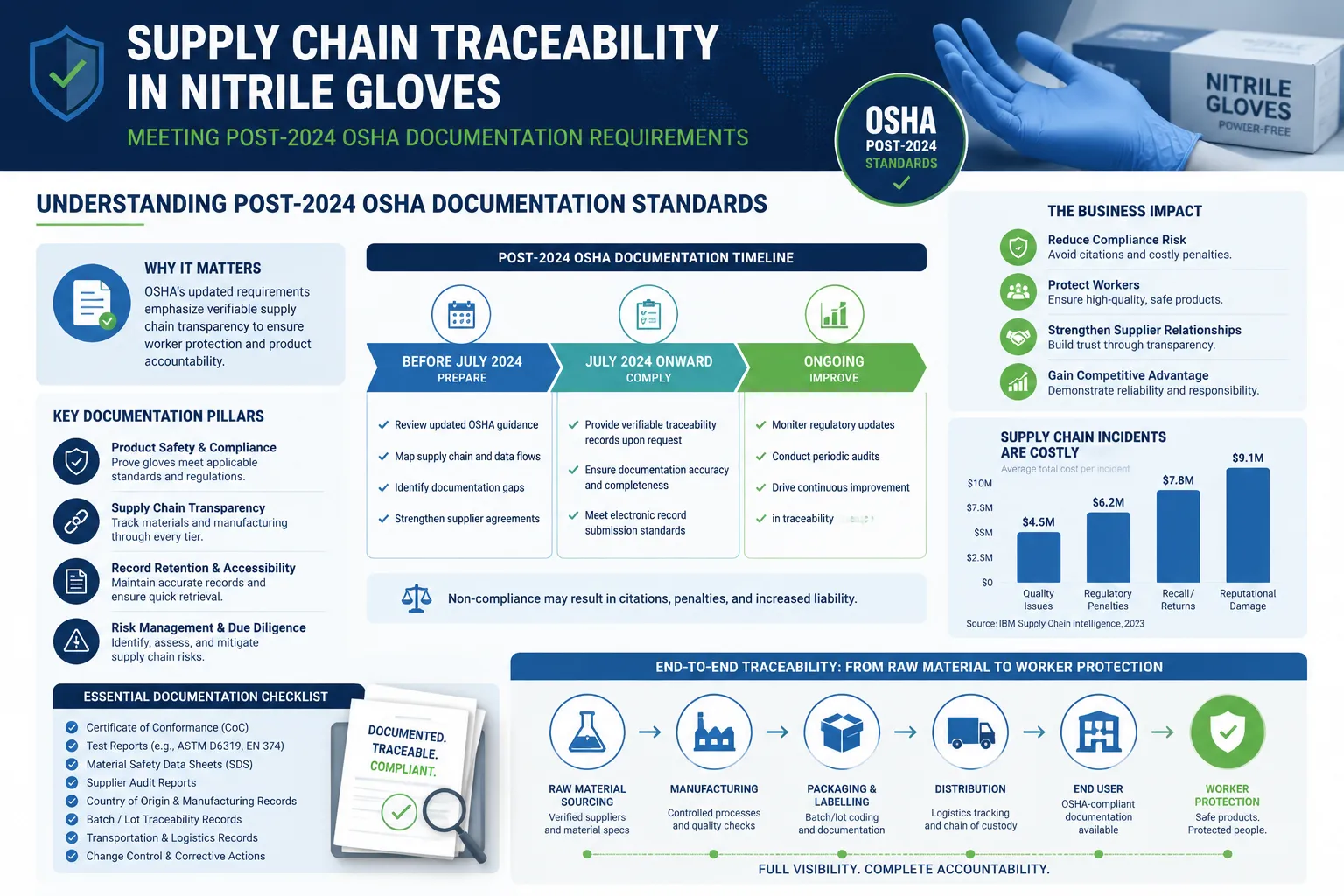
The regulatory landscape for disposable nitrile gloves shifted dramatically following the 2024 OSHA directive expansion. These updated standards require employers to maintain comprehensive documentation proving that protective equipment meets specified performance criteria and originates from verified manufacturing sources.
Core Documentation Requirements
OSHA now mandates that organizations maintain the following records for all nitrile glove purchases:
Batch Identification Records: Every glove shipment must include unique batch or lot numbers traceable to specific production runs. These identifiers link directly to manufacturing dates, facility locations, and raw material sources.
Certificate of Conformity: Suppliers must provide documentation certifying that gloves meet relevant ASTM standards for thickness, tensile strength, and chemical resistance appropriate to their intended use.
Chain of Custody Documentation: Complete shipping records showing movement from manufacturer through distributors to end users, including storage conditions and handling procedures.
Performance Testing Results: Laboratory test data confirming glove performance against specific hazards, particularly for specialized applications like chemical handling or food preparation.
EU MDR Harmonization Impact
The alignment between OSHA requirements and EU Medical Device Regulation standards has created unified documentation expectations for international suppliers. This harmonization affects manufacturers serving both North American and European markets, requiring:
- Technical file maintenance with complete design and manufacturing specifications
- Post-market surveillance data tracking product performance and incident reports
- Unique Device Identification (UDI) systems compatible with both FDA and EU databases
- Regular audits by notified bodies for medical-grade glove classifications
Organizations purchasing nitrile gloves for industrial settings must verify that suppliers maintain these comprehensive records even for non-medical applications, as OSHA increasingly adopts medical-grade traceability standards across all PPE categories.
Implementing Effective Traceability Systems
Successful Supply Chain Traceability in Nitrile Gloves: Meeting Post-2024 OSHA Documentation Requirements depends on implementing robust systems that capture data at every supply chain stage. Both suppliers and buyers must adopt technologies and processes that ensure documentation accuracy and accessibility.
Digital Tracking Technologies
Modern traceability systems leverage several technological approaches:
QR Code Integration: Each glove box receives a unique QR code linking to cloud-based databases containing complete batch information. Scanning these codes during receiving inspections provides instant access to certificates, test results, and manufacturing details.
Blockchain Verification: Leading suppliers now use blockchain technology to create immutable records of production and distribution events. This approach prevents documentation tampering and provides auditors with verifiable transaction histories.
RFID Tagging: Radio-frequency identification tags embedded in shipping containers enable automated tracking through distribution networks, reducing manual documentation errors and providing real-time location data.
Supplier Qualification Protocols
Buyers must establish rigorous qualification processes before selecting nitrile glove suppliers. Essential evaluation criteria include:
Manufacturing Facility Audits: Direct inspection of production facilities to verify quality management systems, testing equipment calibration, and documentation practices. These audits should assess whether facilities maintain ISO 9001 certification and follow Good Manufacturing Practices (GMP).
Traceability System Testing: Request sample batch documentation to evaluate completeness and accessibility. Suppliers should demonstrate their ability to trace any glove box back to raw material sources within 24 hours.
Performance Verification Capabilities: Confirm that suppliers conduct regular testing for critical parameters like chemical resistance, puncture resistance, and dimensional accuracy. Review their laboratory accreditation and testing frequency.
Documentation Retention Policies: Verify that suppliers maintain records for minimum required periods (typically 5-10 years) and have secure backup systems preventing data loss.
Batch Documentation Best Practices
Organizations should implement standardized procedures for managing traceability documentation:
- Receiving Inspection Protocols: Verify that all incoming shipments include complete documentation packages before accepting delivery
- Digital Archive Systems: Scan and store all certificates and test reports in searchable databases linked to inventory management systems
- Regular Compliance Audits: Conduct quarterly reviews of documentation completeness and accuracy
- Supplier Performance Monitoring: Track documentation quality metrics and address deficiencies through corrective action requests
For organizations choosing nitrile gloves for specific applications, traceability becomes even more critical when gloves must meet specialized performance requirements. Documentation must clearly demonstrate that selected products provide adequate protection for identified workplace hazards.
Performance Verification Requirements
Post-2024 standards require ongoing verification that gloves maintain specified performance characteristics throughout their shelf life. This includes:
Accelerated Aging Studies: Documentation proving that gloves retain protective properties under various storage conditions and time periods.
Statistical Process Control Data: Manufacturing records showing that production processes remain within control limits for critical quality parameters.
Field Performance Monitoring: Systems for collecting and analyzing user feedback regarding glove performance, including any reported failures or allergic reactions.
Organizations using nitrile gloves in food preparation environments face additional documentation requirements proving compliance with FDA food contact regulations. Traceability systems must capture this supplementary certification data alongside standard OSHA documentation.
Conclusion
Supply Chain Traceability in Nitrile Gloves: Meeting Post-2024 OSHA Documentation Requirements represents a fundamental shift in how organizations approach PPE procurement and management. The expanded regulatory framework demands comprehensive documentation systems that many suppliers and buyers are still developing.
Organizations must take immediate action to ensure compliance. Start by auditing current supplier documentation capabilities and identifying gaps in traceability systems. Implement digital tracking technologies that automate data capture and provide auditors with instant access to required records. Establish clear supplier qualification criteria that prioritize traceability capabilities alongside price and delivery considerations.
For procurement managers, the path forward involves partnering with suppliers who demonstrate mature quality management systems and robust documentation practices. Request detailed traceability demonstrations during supplier selection processes and build documentation requirements into purchase agreements with specific performance penalties for non-compliance.
The investment in comprehensive traceability systems pays dividends beyond regulatory compliance. Organizations gain better visibility into product quality, can respond more effectively to safety incidents, and build stronger relationships with suppliers committed to transparency. As OSHA continues refining inspection protocols throughout 2026, early adopters of advanced traceability systems will maintain competitive advantages while protecting worker safety through verifiable, documented protection standards.
SEO Meta Title: Nitrile Glove Traceability: OSHA Documentation Guide 2026