A single static discharge of just 10 volts can destroy a sensitive microchip—yet humans don’t feel static shocks until they reach 3,000 volts. This invisible threat costs the electronics industry billions annually in damaged components, making Nitrile Gloves with Electrostatic Discharge: Essential Protection for Electronics and Battery Manufacturing a critical investment for production facilities in 2026. As battery manufacturing scales up to meet electric vehicle demand and electronics become increasingly miniaturized, the right ESD-safe gloves aren’t just protective equipment—they’re essential quality control tools.
Key Takeaways
- ⚡ Standard nitrile gloves act as insulators and trap static charge, while ESD-certified versions dissipate charges safely through carbon fiber or nanotube additives
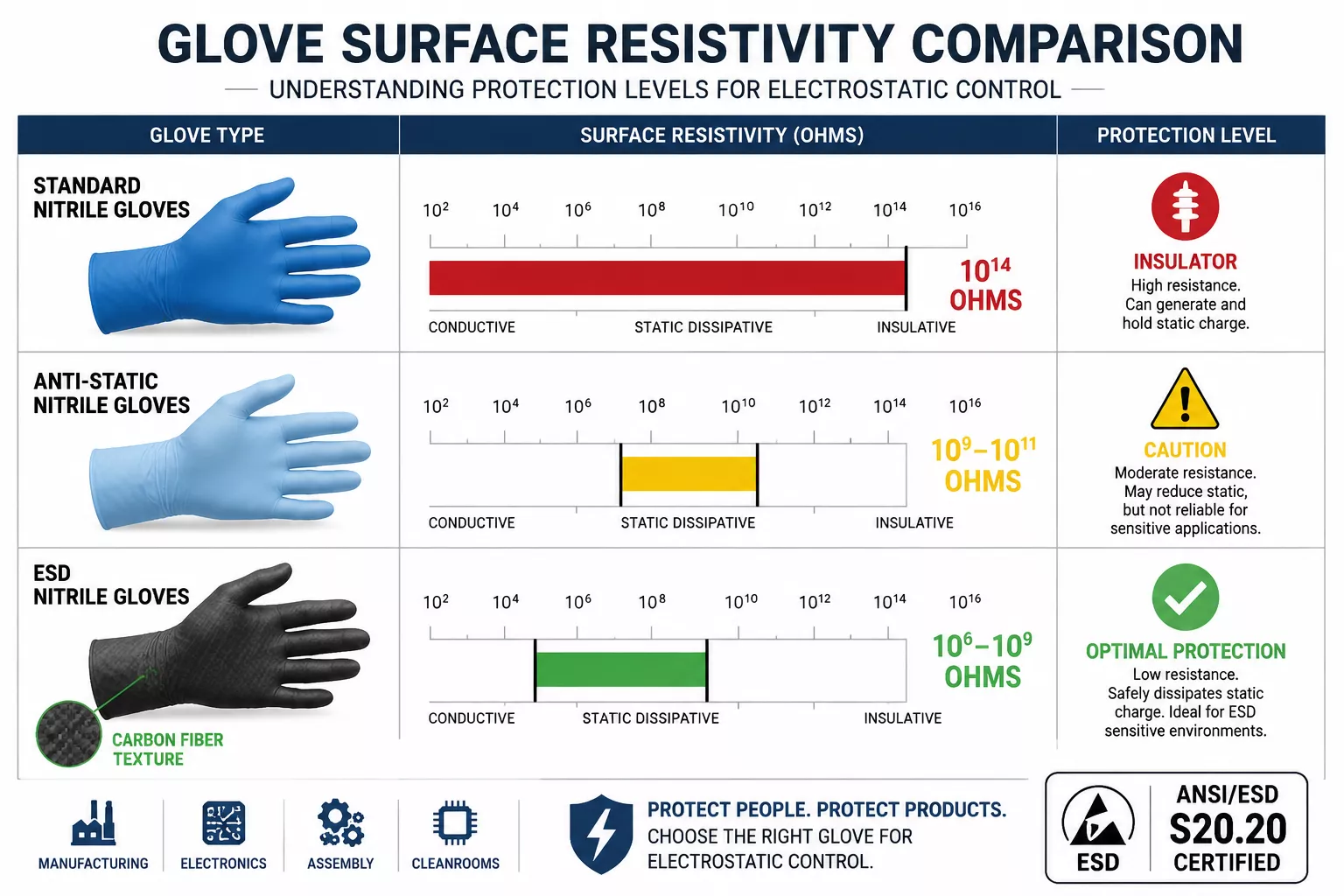
- 📊 Surface resistivity matters: Anti-static gloves measure 10^9–10^11 ohms, while true ESD gloves achieve 10^6–10^9 ohms for faster charge dissipation
- ✅ Certification is non-negotiable: Look for ANSI/ESD S20.20 and EN 16350 compliance to meet industry standards in electronics assembly
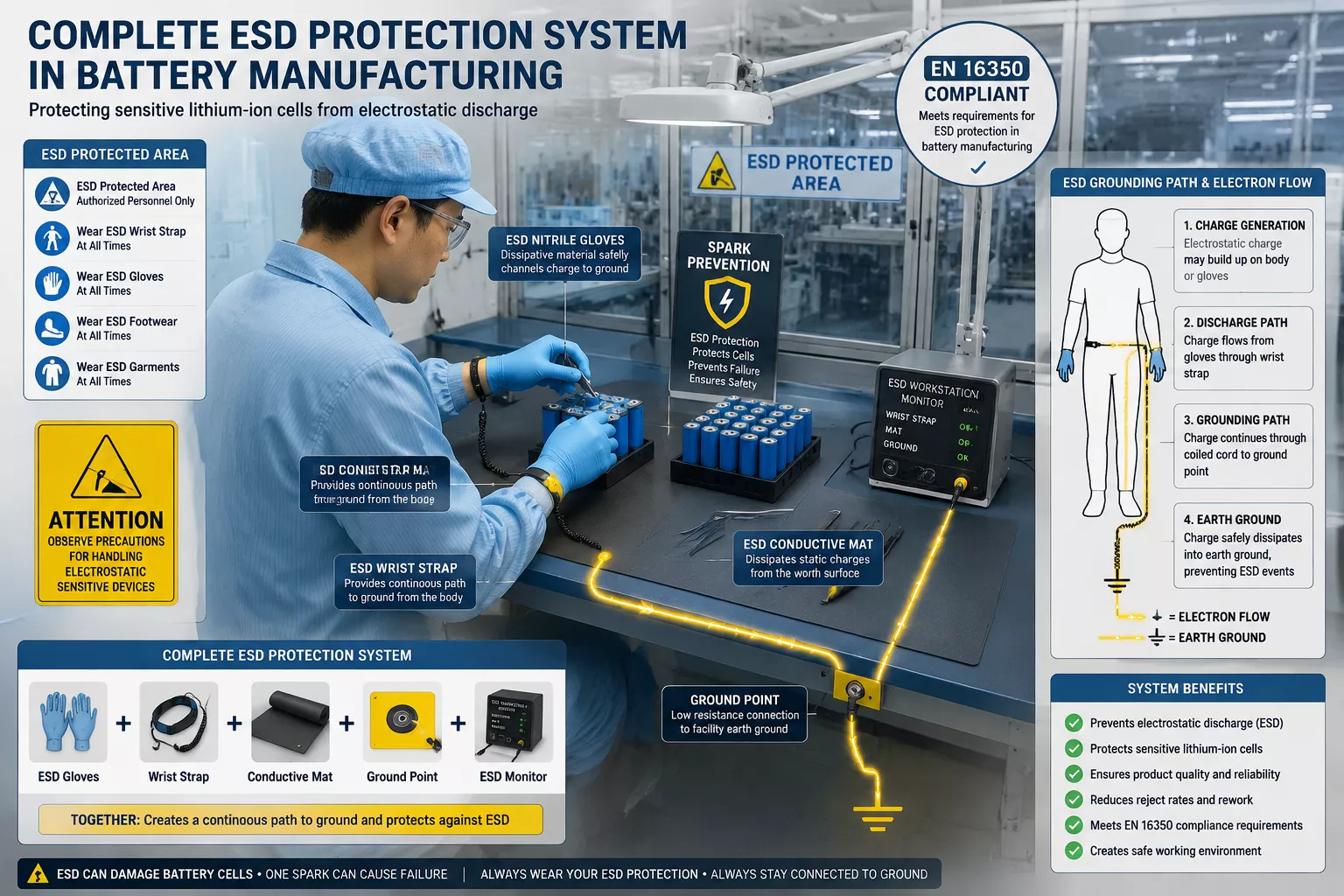
- 🔌 System integration required: ESD gloves must work with grounded wrist straps and conductive surfaces for complete protection
- 🔋 Battery manufacturing demands ESD protection to prevent sparks near flammable electrolytes and lithium compounds
Understanding ESD Protection: Why Standard Nitrile Gloves Fall Short
Standard nitrile gloves excel at chemical resistance and durability, making them popular across industries. However, their natural rubber composition creates an electrical insulator that traps static charge on the surface. When a technician wearing regular nitrile gloves handles a circuit board, static electricity accumulates with each movement—creating a discharge risk that can damage or destroy sensitive components.
The Science Behind Static Dissipation 🔬
Anti-static nitrile gloves incorporate specialized additives that fundamentally change their electrical properties:
- Carbon fibers: Woven throughout the glove material to create conductive pathways
- Carbon nanotubes: Microscopic structures that enable controlled charge dissipation
- Ionic compounds: Chemical additives that reduce surface resistance
These modifications allow charges to dissipate gradually rather than building up to dangerous levels. The result? Gloves that maintain nitrile’s protective qualities while preventing the static disasters that plague electronics manufacturing.
Conductivity Levels Explained: Anti-Static vs. ESD Nitrile Gloves
Not all static-safe gloves perform equally. Understanding the distinction between anti-static and ESD-rated options is crucial for choosing the right protection for your specific application.
Surface Resistivity Ranges
| Glove Type | Surface Resistivity (ohms/sq) | Best Applications |
|---|---|---|
| Standard Nitrile | >10^12 (insulative) | General purpose, non-ESD work |
| Anti-Static Nitrile | 10^9–10^11 | Moderate ESD sensitivity, general electronics |
| ESD Nitrile | 10^6–10^9 | High-sensitivity components, battery manufacturing |
| Conductive | <10^6 | Explosive environments (not typical for nitrile) |
Anti-static gloves reduce charge buildup and are suitable for handling less sensitive electronics. They prevent the wearer from generating excessive static but dissipate charges relatively slowly.
ESD gloves provide faster, more controlled dissipation—essential when working with:
- Microprocessors and integrated circuits
- Lithium-ion battery cells and assemblies
- OLED displays and touchscreen components
- Medical device electronics
- Aerospace avionics systems
The faster dissipation rate (10^6–10^9 ohms) ensures charges never accumulate to damaging levels, even during rapid, repetitive movements common in assembly line work.
Certification Standards for Electronics and Battery Manufacturing
In 2026, regulatory compliance isn’t optional—it’s a competitive necessity. Major electronics manufacturers require suppliers to demonstrate ESD control programs that meet international standards.
Key Certifications to Verify ✅
ANSI/ESD S20.20: The North American standard for ESD control programs. Gloves used in certified ESD Protected Areas (EPAs) must maintain system resistance below 3.5 × 10^7 ohms when combined with wrist straps and grounding equipment.
EN 16350: European standard specifically for ESD protective garments, including gloves. Ensures consistent performance across temperature and humidity variations common in manufacturing environments.
EN 1149-3: Tests for electrostatic dissipation in protective clothing materials, applicable to specialized nitrile formulations.
Real-World Testing Requirements
Third-party laboratory testing validates ESD glove performance under actual working conditions. Reputable manufacturers provide:
- Point-to-point resistance measurements: Testing conductivity from fingertip to palm
- In-use resistivity data: Performance metrics during wear with natural perspiration
- Humidity response curves: How dissipation rates change with environmental conditions
- Durability testing: Maintaining ESD properties after repeated donning/doffing
The best ESD nitrile gloves actually improve performance during wear as perspiration increases humidity inside the glove, enhancing conductivity—a significant advantage for extended wear periods on production lines.
Integrating ESD Nitrile Gloves into Complete Protection Systems
A common misconception: ESD gloves alone provide adequate protection. In reality, they’re one component of a comprehensive static control system.
Essential System Components 🔌
Grounded wrist straps: Create a direct path-to-ground for static charges. ESD nitrile gloves work in conjunction with wrist straps, not as replacements. The gloves prevent charge generation at the point of contact while wrist straps continuously drain accumulated body voltage.
ESD-safe work surfaces: Conductive or dissipative mats ensure components rest on surfaces that won’t generate or trap charges. Working with metals requires particular attention to surface conductivity.
Proper flooring: Static-dissipative flooring completes the grounding path, especially important in battery manufacturing where flammable electrolytes demand spark prevention.
Ionizers: Neutralize airborne static charges in cleanroom environments, complementing glove protection.
Battery Manufacturing Considerations 🔋
Battery production presents unique ESD challenges:
- Flammable electrolytes: Lithium-ion battery assembly involves volatile organic compounds that can ignite from static sparks
- Sensitive electronics: Battery management systems (BMS) contain microcontrollers vulnerable to ESD damage
- High-volume production: Assembly line speeds require gloves that maintain ESD properties through thousands of repetitive movements
ESD nitrile gloves rated at 10^6–10^9 ohms provide the fastest safe dissipation for these high-stakes environments. The controlled discharge prevents sparks while protecting workers from electrical shock—a critical balance.
Selecting Top-Rated ESD Nitrile Gloves for 2026 Production Lines
When evaluating ESD nitrile gloves for electronics or battery manufacturing, prioritize these factors:
Performance Criteria 📋
Thickness and dexterity: Most ESD nitrile gloves range from 4-6 mil thickness. Thinner options (4 mil) provide superior tactile sensitivity for precision assembly, while thicker variants offer enhanced durability for longer production runs.
Textured fingertips: Micro-textured surfaces improve grip on small components without generating additional static through friction.
Powder-free formulation: Powder can contaminate sensitive electronics and interfere with ESD properties. Modern ESD nitrile gloves use polymer coatings for easy donning instead.
Size availability: Proper fit ensures consistent electrical contact with skin. Loose gloves create air gaps that reduce ESD effectiveness. Popular sizes like large often sell out quickly—stock multiple sizes.
Proprietary Formulations to Consider
Leading manufacturers have developed specialized ESD nitrile compounds:
TechNiGlove ESD Series: Single-use disposable nitrile gloves with integrated carbon fiber networks, tested to dissipate charges safely around flammable battery materials.
ACL Staticide Nitrile Gloves: Third-party lab verified to meet EPA requirements, designed specifically for electronics laboratories and cleanroom assembly.
Shield Scientific ESD Nitrile: Formulated to enhance conductivity during wear as perspiration increases humidity—ideal for 8+ hour shifts.
Cost-Benefit Analysis 💰
ESD nitrile gloves typically cost 2-4x more than standard nitrile options. However, consider:
- Component replacement costs: A single damaged microprocessor can cost $50-$500
- Yield improvement: Reducing ESD failures by even 1% saves thousands in high-volume production
- Regulatory compliance: Avoiding customer audits and certification failures
- Worker safety: Preventing electrical shocks in battery manufacturing environments
The return on investment becomes clear when calculated against potential losses from ESD damage.
Implementation Best Practices for Maximum Protection
Purchasing certified ESD nitrile gloves is just the beginning. Proper implementation ensures they deliver promised protection.
Training Requirements 👷
Donning procedures: Teach workers to avoid touching glove exteriors during application to prevent contamination and maintain ESD properties.
Wrist strap connection: Verify proper grounding before handling sensitive components. Many facilities use continuous monitors that alarm if grounding fails.
Inspection protocols: Check gloves for tears, punctures, or degradation before each shift. Damaged gloves lose ESD protection.
Replacement schedules: Even undamaged gloves degrade over time. Establish replacement intervals based on manufacturer recommendations and usage intensity.
Environmental Controls 🌡️
Humidity management: Maintain 30-70% relative humidity in work areas. Low humidity increases static generation; high humidity can affect component integrity.
Temperature stability: ESD glove performance varies with temperature. Keep work areas within manufacturer-specified ranges (typically 60-80°F).
Cleanroom compatibility: Verify gloves meet cleanroom classification requirements (ISO Class 5-7) for electronics assembly.
Documentation and Auditing 📊
Maintain records of:
- Glove lot numbers and certification documents
- Wrist strap testing logs (daily verification recommended)
- ESD event reports and root cause analyses
- Training completion for all personnel
These records demonstrate compliance during customer audits and help identify system weaknesses before they cause damage.
Conclusion
Nitrile Gloves with Electrostatic Discharge: Essential Protection for Electronics and Battery Manufacturing represent a critical evolution beyond standard disposable gloves. As electronics become more sensitive and battery production scales to meet global demand, the invisible threat of static discharge demands specialized protection. ESD-certified nitrile gloves with surface resistivity of 10^6–10^9 ohms provide the controlled charge dissipation necessary to prevent component damage and safety hazards.
Success requires more than purchasing certified gloves—it demands understanding conductivity levels, verifying ANSI/ESD S20.20 and EN 16350 compliance, and integrating gloves into complete grounding systems with wrist straps and conductive surfaces. The investment pays dividends through improved yield rates, regulatory compliance, and worker safety in high-stakes manufacturing environments.
Next Steps for Your Facility 🎯
- Audit current glove inventory: Test existing nitrile gloves for surface resistivity—standard versions likely exceed 10^12 ohms
- Identify ESD-sensitive processes: Map where components with <100V sensitivity are handled
- Request certification documentation: Verify ANSI/ESD S20.20 compliance from potential suppliers
- Pilot test top-rated options: Evaluate dexterity, durability, and worker comfort during actual production
- Implement comprehensive training: Ensure all personnel understand proper use within complete ESD systems
For additional guidance on selecting the right nitrile gloves for specialized applications, explore our comprehensive resources on glove composition, thickness considerations, and industry-specific requirements. The right ESD protection today prevents costly failures tomorrow.
SEO Meta Title: ESD Nitrile Gloves for Electronics & Battery Manufacturing