Biodegradable nitrile gloves cost 19% more per pair than traditional options in 2026—a premium that persists despite mounting environmental regulations and corporate sustainability pledges. While healthcare systems and industrial buyers face pressure to adopt eco-friendly alternatives, the Nitrile Glove Cost Parity Challenge: Why Biodegradable Options Still Can’t Match Traditional Pricing remains a stubborn economic reality that procurement managers cannot ignore.
The gap between conventional and biodegradable nitrile pricing has widened rather than narrowed over the past year. Traditional nitrile glove boxes that cost around $8 before 2020 now average $11-$12 per box, yet biodegradable variants command even steeper premiums. This pricing disparity creates a fundamental tension: organizations want to reduce their environmental footprint, but budget constraints force difficult trade-offs.
Key Takeaways
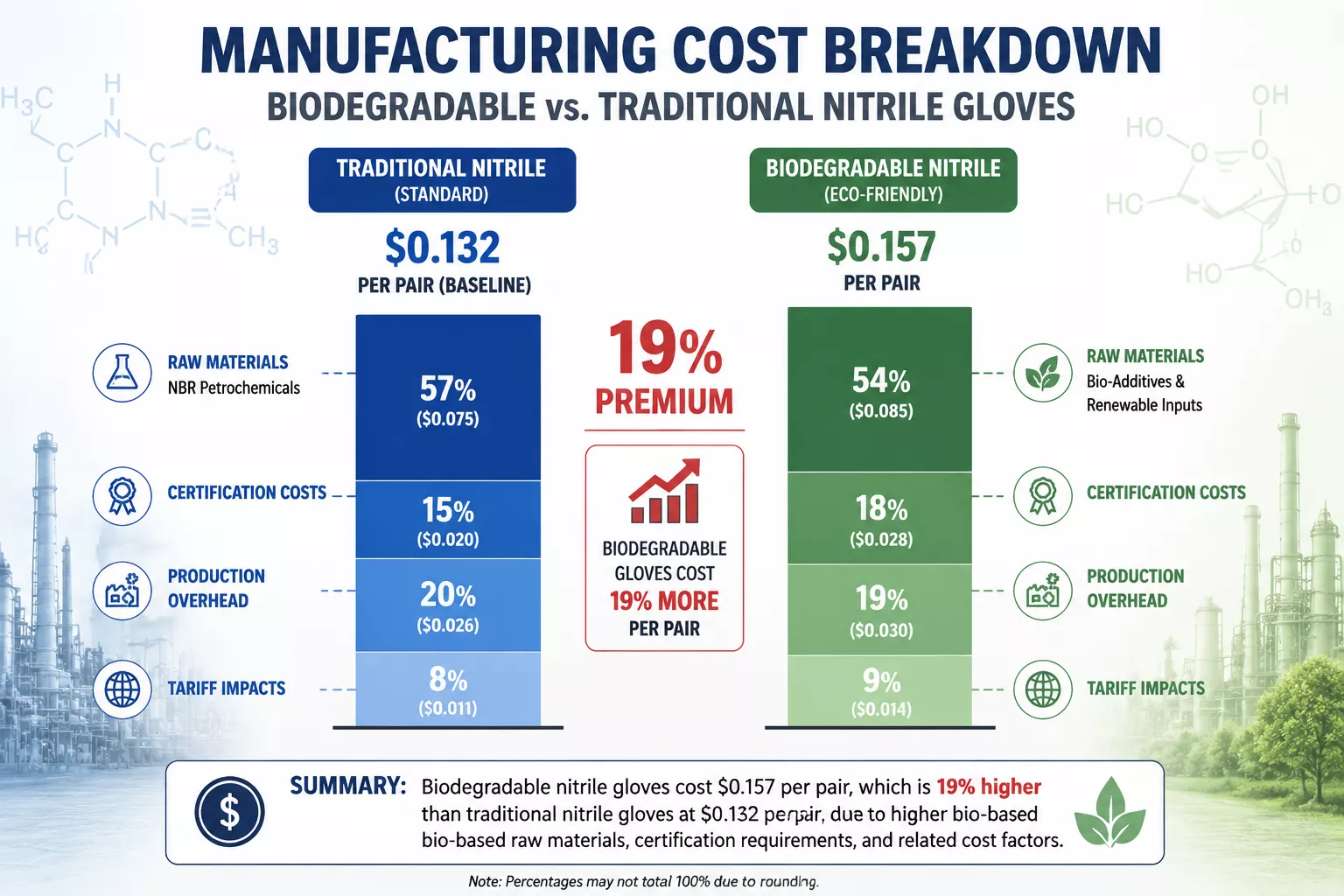
- Biodegradable nitrile gloves cost approximately 19% more per pair ($0.157 vs. $0.132) compared to traditional options as of 2026
- Raw material volatility has driven NBR prices up 120% in recent months due to geopolitical disruptions affecting petrochemical supplies
- U.S. tariffs on Chinese nitrile imports doubled to 100% in January 2026, adding significant cost pressure across all glove categories
- Certification and compliance expenses for biodegradable formulations add substantial overhead that manufacturers pass to buyers
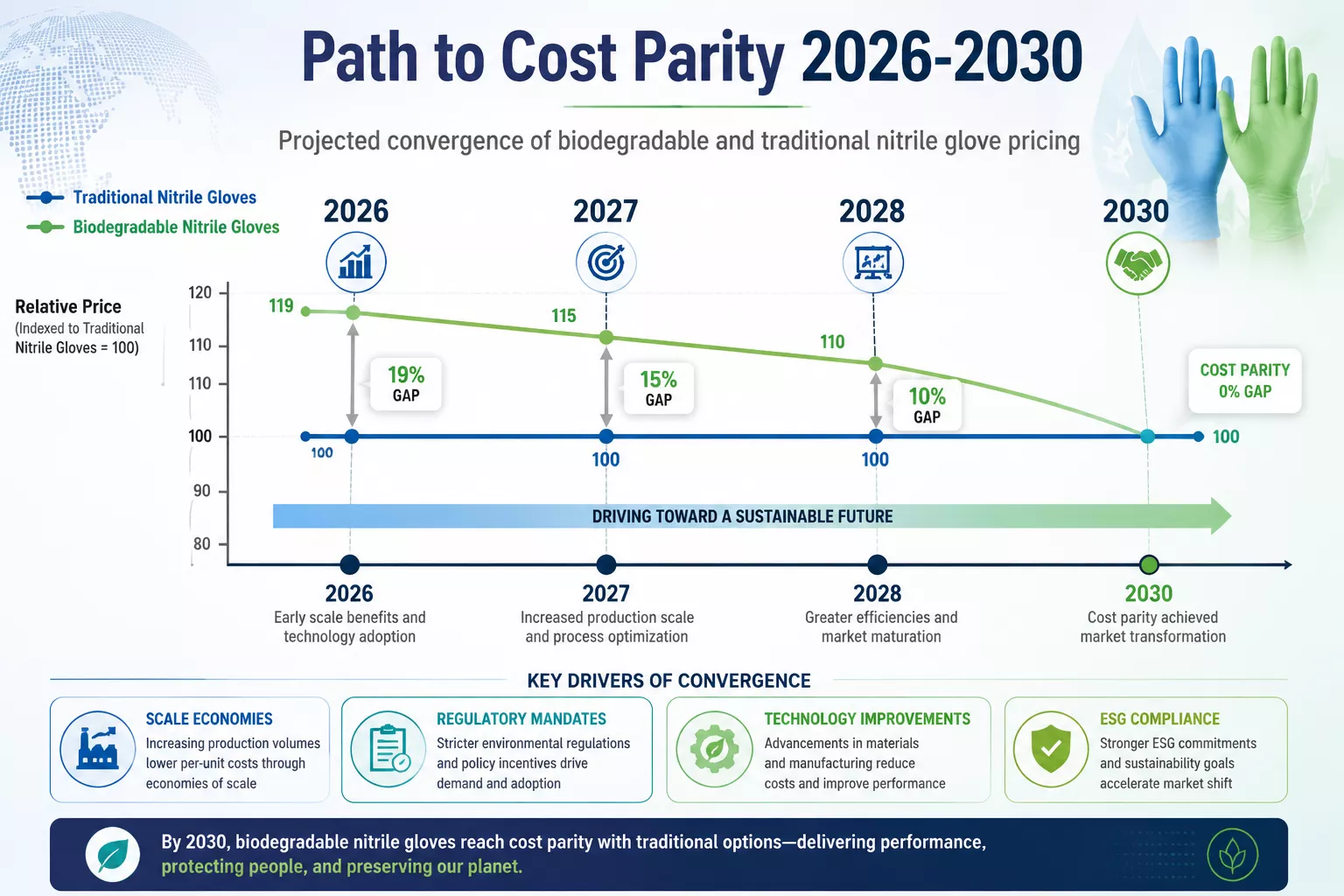
- Cost parity projections suggest biodegradable options won’t match traditional pricing until 2028-2030 at earliest
Understanding the Nitrile Glove Cost Parity Challenge: Why Biodegradable Options Still Can’t Match Traditional Pricing
The pricing gap between traditional and biodegradable nitrile gloves stems from multiple structural factors that compound throughout the supply chain. Unlike simple product comparisons, this challenge involves complex manufacturing economics, regulatory requirements, and market dynamics that resist quick solutions.
Raw Material Cost Differentials 💰
Traditional nitrile gloves derive from Nitrile Butadiene Rubber (NBR), a petroleum-based synthetic material with established supply chains and economies of scale. Biodegradable formulations require specialized additives and modified production processes that increase base material costs by 15-25%.
The situation worsened dramatically in April-May 2026 when geopolitical tensions around Iran and the Strait of Hormuz disrupted global NBR availability. Supply levels dropped to “nearly nonexistent” according to industry reports, triggering immediate price adjustments. In just 15 days during late April 2026, NBR prices surged 120%, with other raw materials climbing 15-25%.
Middle East conflicts have also elevated naphtha prices—a key feedstock for nitrile latex production. This pushed synthetic rubber medical glove prices up approximately 40% to around $29 per 1,000-count box. These petrochemical disruptions affect both traditional and biodegradable nitrile, but biodegradable variants face additional cost layers.
Manufacturing and Certification Premiums
Producing biodegradable nitrile requires:
- Modified formulation chemistry to incorporate biodegradation-enhancing additives
- Separate production lines to prevent cross-contamination with standard nitrile
- Extended quality testing to verify both performance and biodegradation claims
- Third-party certifications (ASTM D5511, D6400, or EN 13432) that add compliance costs
- Specialized storage and handling to maintain product integrity
These factors create fixed costs that manufacturers must recover through higher unit pricing. Unlike traditional nitrile gloves with decades of process optimization, biodegradable variants remain in earlier production maturity stages.
The Tariff Impact on Nitrile Glove Cost Parity Challenge: Why Biodegradable Options Still Can’t Match Traditional Pricing
U.S. Section 301 tariffs on medical-grade nitrile gloves from China reached 100% in January 2026—doubling from the previous 50% rate. This created immediate “sticker shock” for procurement managers already struggling with elevated post-pandemic pricing.
Tariff Effects Across the Supply Chain
| Cost Factor | Impact | Effect on Biodegradable |
|---|---|---|
| Import duties | +100% on Chinese gloves | Affects both equally |
| Alternative sourcing | +15-30% from Malaysia/Thailand | Higher for smaller biodegradable producers |
| Domestic production | Limited capacity, premium pricing | Few biodegradable manufacturers |
| Inventory carrying costs | Increased due to stockpiling | Proportionally higher for premium products |
The tariff situation disproportionately affects biodegradable options because fewer manufacturers produce them at scale. While traditional nitrile buyers can source from multiple countries, biodegradable variants have limited production facilities, reducing competitive pricing pressure.
Healthcare systems with annual glove expenditures exceeding $2 million face particularly difficult decisions. The combination of tariffs, raw material inflation, and biodegradable premiums can add hundreds of thousands of dollars to annual budgets.
Economic Barriers Preventing Biodegradable Adoption Despite Environmental Mandates
Despite growing environmental regulations and corporate ESG commitments, several economic barriers slow biodegradable nitrile adoption:
Volume Economics and Scale Limitations 📊
Traditional nitrile glove production operates at massive scale—the global medical nitrile gloves market reached $9.81 billion in 2025 and projects to hit $14.88 billion by 2034. This volume enables:
- Bulk raw material purchasing discounts
- Optimized production efficiency
- Distributed fixed costs across millions of units
- Competitive supplier bidding
Biodegradable nitrile production remains a fraction of this volume, preventing similar economies of scale. Smaller production runs mean higher per-unit costs for equipment setup, quality control, and distribution.
Certification and Compliance Expenses
Biodegradable claims require rigorous testing and certification:
- ASTM D5511 testing for anaerobic biodegradation: $3,000-$8,000 per formulation
- ASTM D6400 compostability certification: $5,000-$12,000
- EN 13432 European compostability standard: €4,000-€10,000
- Annual recertification and batch testing: ongoing costs
- Legal compliance documentation for environmental claims
These certification costs must be amortized across production volumes. For smaller biodegradable manufacturers, this adds significant per-unit overhead compared to established traditional producers who’ve already recovered such investments.
Performance Verification Requirements
Buyers need assurance that biodegradable gloves match traditional performance standards. This requires:
- Extended wear testing across multiple applications
- Chemical resistance validation (critical for lab work and automotive applications)
- Thickness consistency verification
- Abrasion resistance testing
- Shelf-life studies to ensure biodegradation doesn’t begin prematurely
Each verification study adds development costs that traditional manufacturers avoided decades ago during initial market entry.
When Will the Nitrile Glove Cost Parity Challenge: Why Biodegradable Options Still Can’t Match Traditional Pricing Be Resolved?
Industry analysts project cost parity won’t arrive until 2028-2030 at earliest, contingent on several factors:
Drivers Toward Cost Parity
Regulatory pressure 🌍: Extended Producer Responsibility (EPR) schemes and plastic taxes in Europe and North America will increase traditional nitrile costs while incentivizing biodegradable alternatives.
Scale improvements: As biodegradable production volumes grow, manufacturers can negotiate better raw material pricing and optimize production efficiency.
Technology advances: New biodegradation-enhancing additives and manufacturing processes may reduce formulation costs.
Market competition: More manufacturers entering the biodegradable space will drive competitive pricing pressure.
ESG mandates: Corporate sustainability commitments may create sufficient demand to justify volume investments.
Obstacles Delaying Parity
Petrochemical volatility: Ongoing geopolitical instability affecting NBR and naphtha supplies creates unpredictable cost fluctuations for both product types.
Tariff uncertainty: Trade policy changes can rapidly shift cost structures, particularly for import-dependent markets.
Certification barriers: Regulatory requirements for biodegradable claims remain complex and costly across different jurisdictions.
Performance skepticism: Conservative buyers in healthcare and industrial sectors resist switching without extensive validation.
Recycling alternatives: Growing interest in nitrile glove recycling programs may divert attention from biodegradable options.
Total Cost of Ownership: Beyond Per-Unit Pricing
While biodegradable nitrile costs 19% more per pair, some analysts argue this oversimplifies the economic comparison. A total cost of ownership (TCO) perspective considers:
Hidden Costs of Traditional Nitrile
- Waste disposal fees: Landfill tipping fees averaging $50-$100 per ton
- Scope 3 emissions reporting: Carbon accounting costs for sustainability reports
- Regulatory compliance: Potential future plastic taxes or disposal restrictions
- Reputational risk: Consumer and employee expectations for environmental responsibility
Value Propositions of Biodegradable Options
- Cost per protected hour: Biodegradable gloves may offer comparable protection duration, improving effective cost efficiency
- ESG benefits: Reduced landfill waste and lower carbon footprint support corporate sustainability goals
- Regulatory preparedness: Avoiding future compliance costs as environmental regulations tighten
- Brand differentiation: Marketing value for organizations highlighting environmental leadership
For organizations with strong sustainability commitments or operating in jurisdictions with strict environmental regulations, the 19% premium may represent acceptable TCO when these factors are quantified.
Strategic Considerations for Procurement Managers
Organizations evaluating biodegradable nitrile adoption should consider:
Phased Implementation Approach
Rather than wholesale conversion, consider:
- Pilot programs in specific departments or applications
- Performance validation across actual use cases
- Cost-benefit analysis incorporating TCO factors
- Gradual scaling as pricing improves and budgets adjust
Application-Specific Decisions
Not all glove applications justify biodegradable premiums equally:
- High-visibility settings (customer-facing, public spaces): Higher value for sustainability messaging
- High-volume, low-risk uses (food service, light cleaning): Traditional options may suffice
- Specialized applications (tattooing, forensics): Performance requirements may override cost considerations
- Regulated environments (healthcare, labs): Compliance requirements take precedence
Supplier Relationship Development
Building relationships with biodegradable manufacturers can:
- Secure volume pricing commitments
- Provide early access to improved formulations
- Enable customization for specific applications
- Create partnership opportunities as market matures
Conclusion
The Nitrile Glove Cost Parity Challenge: Why Biodegradable Options Still Can’t Match Traditional Pricing reflects fundamental economic realities rather than simple market inefficiencies. The 19% price premium stems from legitimate cost factors: specialized raw materials, certification requirements, limited production scale, and ongoing performance validation needs.
Current market conditions in 2026—including 100% tariffs on Chinese imports, 120% NBR price surges, and naphtha-driven cost inflation—have intensified pricing pressures across all nitrile categories. These disruptions affect both traditional and biodegradable options, but biodegradable variants face additional cost layers that prevent near-term parity.
Realistic projections suggest cost convergence won’t occur until 2028-2030, contingent on regulatory pressure, scale improvements, and technology advances. Organizations committed to sustainability must either accept current premiums or implement strategic approaches that balance environmental goals with budget constraints.
Actionable Next Steps
✅ Conduct TCO analysis incorporating waste disposal, regulatory compliance, and ESG value factors beyond per-unit pricing
✅ Pilot biodegradable options in high-visibility or low-volume applications to gain experience without budget shock
✅ Monitor market developments including new manufacturers, improved formulations, and regulatory changes affecting cost structures
✅ Engage suppliers about volume commitments that might secure preferential pricing as production scales
✅ Evaluate alternative glove materials and recycling programs as complementary sustainability strategies
The path to cost parity requires patience, strategic planning, and realistic expectations. Organizations that begin positioning now will be better prepared when economic conditions finally align with environmental imperatives.