Seventy-one percent of hand injuries in workplaces could be prevented with proper personal protective equipment—yet thousands of workers still suffer preventable injuries each year due to ill-fitting or improperly inspected gloves. The OSHA 2024 Glove Regulations Update: Compliance Checklist for Nitrile Users in Healthcare and Industry addresses this critical safety gap through expanded requirements that took effect in January 2025, fundamentally changing how employers must approach glove selection, inspection, and documentation.
The December 2024 OSHA final rule on proper fit for personal protective equipment represents the most significant update to workplace hand protection standards in years. While the regulation primarily targets construction, its principles extend to healthcare and industrial settings where nitrile gloves serve as frontline protection against chemical exposure, biological hazards, and mechanical risks.
Key Takeaways
✅ Proper fit is now mandatory: OSHA requires employers to provide gloves that fit each worker’s hand size and shape, eliminating one-size-fits-all approaches
✅ Documentation requirements expanded: Employers must maintain records of hazard assessments, glove selection criteria, and fit verification for compliance
✅ Inspection protocols intensified: Regular pinhole testing and visual inspections are essential to prevent exposure incidents and avoid penalties
✅ Compliance deadline passed: The January 13, 2025 effective date means businesses must already have updated protocols in place as of 2026
✅ Healthcare and industry both affected: While construction faces explicit mandates, general industry standards apply equally to nitrile users across all sectors
Understanding the OSHA 2024 Glove Regulations Update
The OSHA 2024 Glove Regulations Update: Compliance Checklist for Nitrile Users in Healthcare and Industry stems from OSHA’s recognition that poorly fitting protective equipment creates hazards rather than preventing them. The final rule aligns construction PPE standards with existing general industry requirements under 29 CFR 1910.132, explicitly stating that gloves must protect workers without introducing new risks.
What Changed in 2024-2025
The regulation addresses a persistent problem: male-designed gloves failing to fit female workers and smaller-handed employees. Loose gloves can catch in machinery, reduce tactile sensitivity, or slip during critical tasks. Conversely, overly tight gloves restrict circulation and cause fatigue.
For nitrile glove users in healthcare, this means hospitals and clinics must stock multiple sizes and ensure proper fit during hazard exposure scenarios. Industrial facilities using nitrile gloves for mechanical work face identical requirements.
Key Regulatory Components
Proper Fit Mandate 🔍
Employers must select PPE that fits each worker’s body size and shape. For gloves, this requires:
- Multiple size options available on-site
- Individual fit assessments for each employee
- Accommodation for hand size variations across workforce demographics
Hazard Assessment Requirements
Before selecting gloves, employers must document:
- Specific workplace hazards (chemical, biological, mechanical)
- Required protection levels per ANSI/ISEA 105-2024 standards
- Justification for nitrile versus other glove materials
No New Nitrile-Specific Rules
Importantly, OSHA did not create separate regulations for nitrile gloves. The 2024 update clarifies existing hand protection standards (29 CFR 1910.138) rather than introducing material-specific requirements.
Step-by-Step Compliance Checklist for Nitrile Glove Users
The OSHA 2024 Glove Regulations Update: Compliance Checklist for Nitrile Users in Healthcare and Industry requires systematic approaches to selection, inspection, and documentation. This checklist ensures compliance while maximizing worker protection.
Phase 1: Hazard Assessment and Selection ✔️
Step 1: Conduct Workplace Hazard Analysis
- Identify all hand hazards (chemicals, sharps, pathogens, abrasion sources)
- Document exposure frequency and duration
- Classify hazards using OSHA’s hierarchy (chemical, biological, physical)
Step 2: Select Appropriate Nitrile Gloves
- Match glove specifications to identified hazards
- Reference ANSI/ISEA 105-2024 pentagon marking for cut/puncture resistance
- Consider glove thickness requirements (2-mil for light tasks, 5-mil+ for heavy exposure)
- Verify chemical resistance for specific substances (e.g., acetone permeation rates)
Step 3: Establish Size Inventory
- Stock minimum four sizes (small, medium, large, extra-large)
- Consider extended sizing for diverse workforce
- Maintain adequate inventory levels to prevent shortages
Phase 2: Fit Verification and Training 📋
Step 4: Implement Individual Fit Testing
- Have each worker try on gloves before first use
- Check for proper finger length (no excess material at fingertips)
- Verify snug wrist fit without constriction
- Test tactile sensitivity and grip strength while wearing gloves
- Document fit verification for each employee
Step 5: Train Workers on Proper Use
- Demonstrate correct donning and doffing techniques
- Explain when glove replacement is necessary
- Cover limitations of nitrile protection
- Address potential allergic reactions and reporting procedures
Phase 3: Inspection and Documentation Protocols 🔬
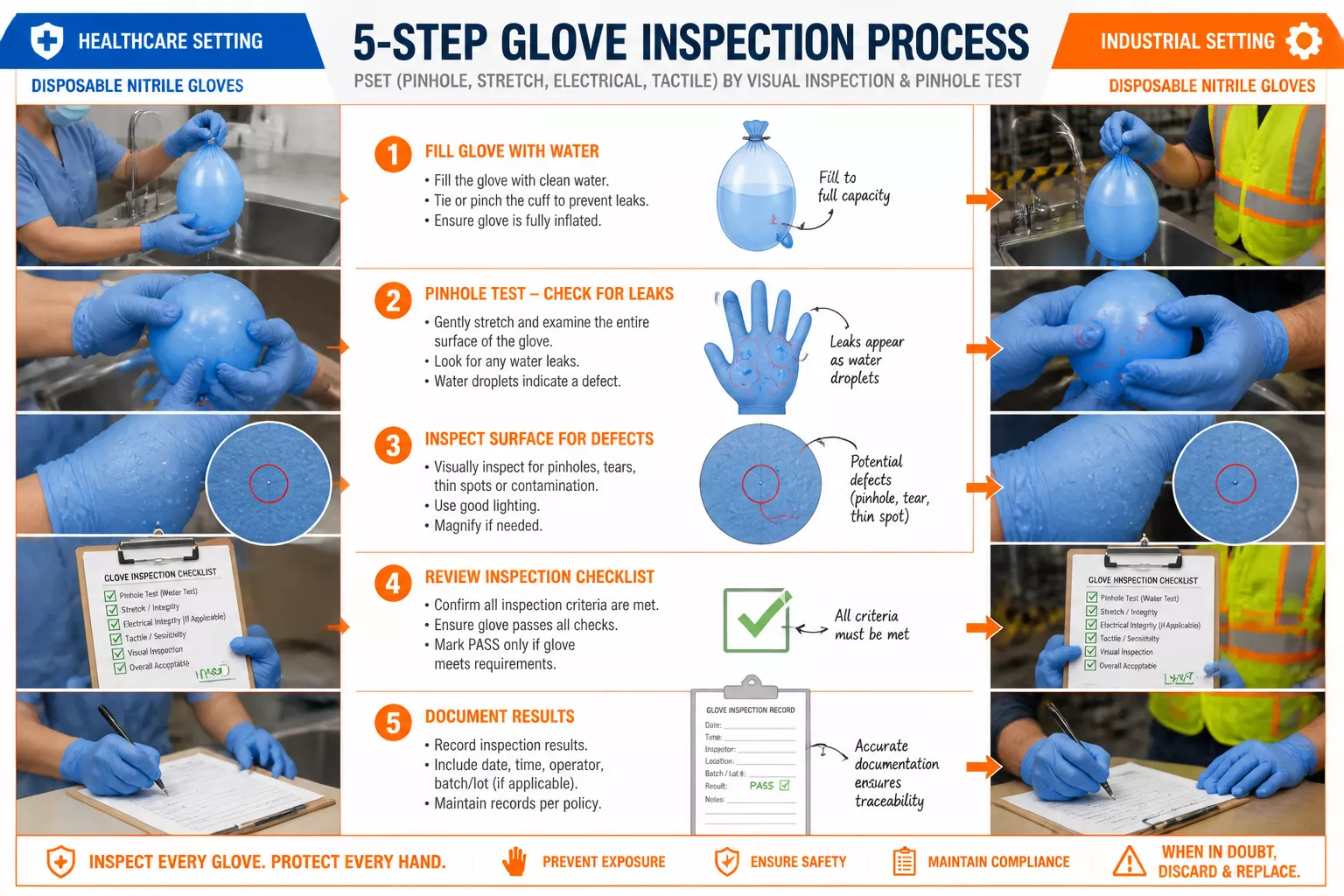
Step 6: Establish Pinhole Testing Procedures
The OSHA 2024 Glove Regulations Update: Compliance Checklist for Nitrile Users in Healthcare and Industry emphasizes regular integrity testing:
- Pre-use visual inspection: Check for tears, punctures, discoloration, or degradation before each use
- Water pinhole test: For reusable nitrile gloves, fill with water and inspect for leaks monthly
- Light test: Hold gloves up to bright light to detect micro-tears
- Immediate replacement protocol: Discard any glove showing defects
Step 7: Maintain Compliance Documentation
OSHA expects employers to produce records demonstrating:
| Document Type | Retention Period | Required Contents |
|---|---|---|
| Hazard Assessment | Duration of use + 3 years | Identified hazards, protection rationale |
| Glove Selection Justification | Duration of use + 3 years | Material choice, specification criteria |
| Fit Verification Records | Employment duration + 1 year | Individual worker fit confirmations |
| Inspection Logs | 1 year minimum | Dates, findings, corrective actions |
| Training Records | Employment duration + 1 year | Topics covered, dates, attendee signatures |
Step 8: Schedule Regular Audits
- Quarterly compliance reviews of glove inventory and sizing
- Monthly spot-checks of worker fit and usage
- Annual comprehensive hazard reassessment
- Immediate investigation of any hand injury incidents
Phase 4: Special Considerations for Healthcare vs. Industry ⚕️🏭
Healthcare-Specific Requirements
- Sterile vs. non-sterile glove protocols for surgical versus exam use
- Frequent glove changes per infection control standards
- Latex allergy accommodations with nitrile alternatives
- Integration with bloodborne pathogen exposure control plans
Industrial-Specific Requirements
- Enhanced cut/abrasion resistance for mechanical applications
- Chemical compatibility verification for specific solvents
- Consideration of temperature effects on glove performance
- Coordination with lockout/tagout and machine guarding procedures
Avoiding Fines and Ensuring Worker Safety
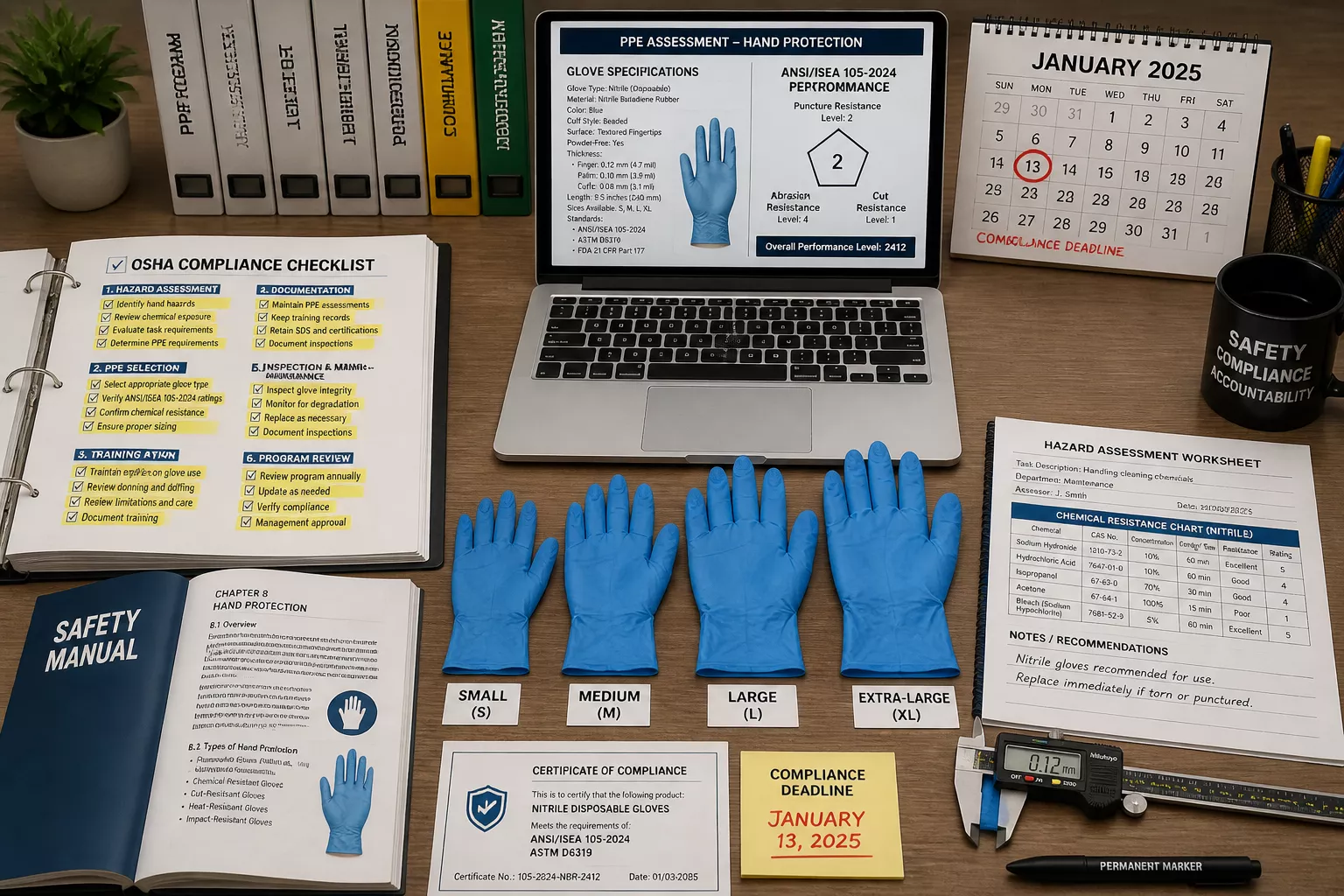
OSHA enforcement of the OSHA 2024 Glove Regulations Update: Compliance Checklist for Nitrile Users in Healthcare and Industry focuses on three primary violation categories:
Common Compliance Failures 🚫
Inadequate Size Selection
Providing only one or two glove sizes violates the proper fit mandate. Inspectors look for evidence of size variety and individual fit verification.
Missing Documentation
Failure to maintain hazard assessments and selection justifications results in citations. Digital or paper records must be readily accessible during inspections.
Improper Inspection Protocols
Using damaged gloves or lacking systematic inspection procedures demonstrates inadequate PPE management. Regular pinhole testing and replacement protocols are essential.
Proactive Compliance Strategies 💡
Implement Digital Tracking Systems
Modern PPE management software can:
- Track glove inventory by size and type
- Schedule automatic inspection reminders
- Maintain digital compliance records
- Generate audit reports for OSHA inspections
Establish Clear Replacement Criteria
Define specific conditions requiring glove disposal:
- Any visible damage or defect
- After chemical exposure exceeding breakthrough time
- Following maximum use duration (typically single-shift for disposables)
- When fit becomes compromised due to degradation
Create Visual Compliance Aids
Post workplace reminders showing:
- Proper glove inspection techniques
- Size selection guidance
- Donning/doffing procedures
- Reporting protocols for damaged gloves
Integration with Broader Safety Programs
The glove regulations don’t exist in isolation. Successful compliance requires integration with:
- Hazard Communication Standard (HazCom): Updated in 2024 with compliance extended to January 2026, affecting chemical hazard classification but not glove requirements directly
- Bloodborne Pathogen Standard: For healthcare settings using nitrile exam gloves
- Respiratory Protection Standard: Coordinating PPE selection across multiple protection types
- General Duty Clause: Addressing emerging hazards not covered by specific standards
Conclusion
The OSHA 2024 Glove Regulations Update: Compliance Checklist for Nitrile Users in Healthcare and Industry represents a fundamental shift toward individualized PPE protection. With the January 2025 compliance deadline now passed, businesses operating in 2026 must have robust systems in place for glove selection, fit verification, inspection, and documentation.
Immediate Action Steps
- Audit your current glove inventory to ensure adequate size variety for your workforce
- Review and update hazard assessments to document nitrile glove selection rationale
- Implement systematic inspection protocols including pinhole testing and visual checks
- Establish comprehensive documentation systems to demonstrate compliance during OSHA inspections
- Train all workers on proper fit, use, and inspection procedures
The regulation’s emphasis on proper fit and systematic inspection ultimately serves worker safety—preventing the 71% of hand injuries that appropriate PPE could eliminate. By following this compliance checklist, employers protect both their workers and their organizations from preventable injuries and regulatory penalties.
For specialized applications, remember that nitrile glove composition and performance characteristics vary significantly. Whether selecting gloves for beauty and personal care or heavy industrial use, the fundamental compliance principles remain constant: assess hazards, ensure proper fit, inspect regularly, and document thoroughly.
The path to compliance isn’t complex—it simply requires systematic attention to selection, fit, inspection, and documentation. Start today by reviewing your current practices against this checklist, and make 2026 the year your organization achieves full OSHA glove regulation compliance.