Janitorial teams face a hidden cost drain: glove failures during chemical cleaning tasks can triple protective equipment expenses while compromising hygiene standards. In 2026, with U.S. tariffs on Chinese nitrile gloves doubling to 100%, selecting the right hand protection has become both a safety imperative and a budget challenge. Nitrile Gloves in Janitorial Services: Best Picks for Disinfectants, Multi-Surface Cleaning, and Cost Efficiency addresses this critical intersection of worker protection, chemical compatibility, and financial sustainability for commercial cleaning operations.
Key Takeaways
✅ Chemical resistance: Nitrile gloves outperform vinyl and latex against bleach, quaternary ammonium compounds, and multi-surface disinfectants commonly used in janitorial work
✅ Cost efficiency: Despite higher upfront costs ($0.07-$0.15 per glove), nitrile’s durability reduces total cost per use by minimizing frequent replacements
✅ Thickness matters: 4-6 mil nitrile gloves provide optimal balance between dexterity and puncture protection for heavy-duty cleaning tasks
✅ Bulk buying strategies: Monthly pallet purchases from non-tariffed sources can offset 2026 price increases while ensuring consistent supply
✅ Safety compliance: OSHA recommends nitrile for high-touch surface disinfection to prevent chemical burns and cross-contamination
Why Nitrile Dominates Janitorial Chemical Resistance
The chemical warfare happening on every cleaned surface demands glove materials that won’t degrade mid-task. Nitrile gloves provide superior protection against the harsh disinfectants that define modern janitorial protocols. Unlike vinyl, which breaks down when exposed to petroleum-based cleaners, or latex, which degrades with prolonged solvent contact, nitrile maintains integrity across diverse chemical families.
Chemical Compatibility Breakdown
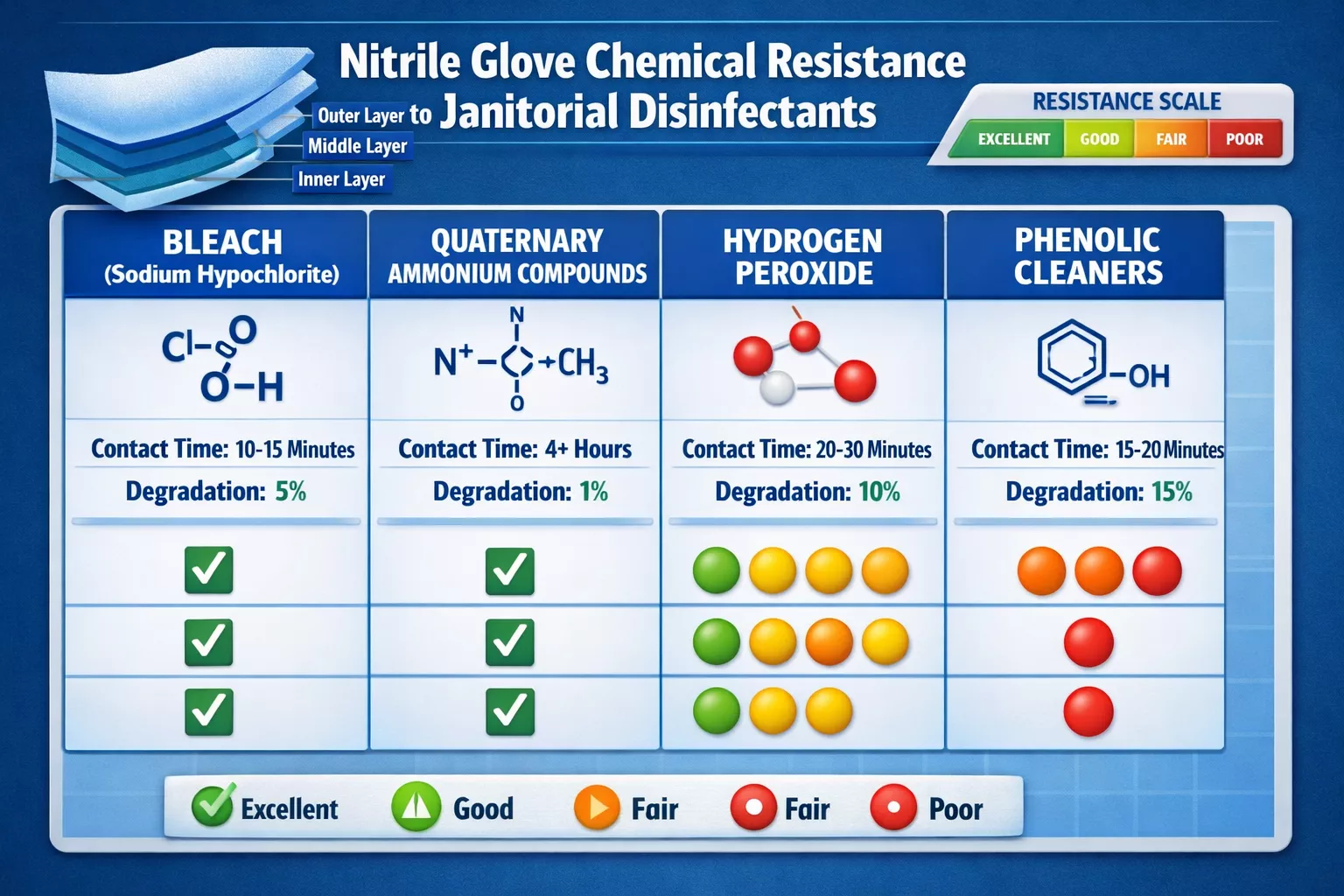
Common janitorial disinfectants test glove materials differently:
| Chemical Type | Nitrile Performance | Vinyl Performance | Latex Performance |
|---|---|---|---|
| Bleach (sodium hypochlorite) | Excellent (3-10 min contact) | Poor (rapid degradation) | Fair (limited duration) |
| Quaternary ammonium compounds | Excellent | Good | Fair |
| Hydrogen peroxide | Excellent | Fair | Poor |
| Phenolic cleaners | Excellent | Poor | Fair |
| Alcohol-based sanitizers | Excellent | Good | Good |
For facilities requiring EPA-registered disinfectants with 3-10 minute contact times—standard for healthcare and food service environments—nitrile prevents breakthrough that could expose skin to chemical burns. This protection extends to oil-based cleaning agents, where nitrile’s synthetic rubber composition resists breakdown that compromises vinyl’s thin structure.
The composition of nitrile gloves includes acrylonitrile and butadiene polymers that create molecular barriers against both polar and non-polar solvents. This dual resistance makes them ideal for teams switching between glass cleaners, degreasers, and disinfectants throughout a single shift.
Thickness Selection for Multi-Surface Cleaning Durability
Choosing the right thickness transforms nitrile gloves from adequate to exceptional for janitorial applications. The mil measurement (one-thousandth of an inch) directly impacts puncture resistance, chemical barrier effectiveness, and tactile sensitivity—all critical when cleaning high-touch surfaces like door handles, elevator buttons, and restroom fixtures.
Thickness Tiers for Janitorial Tasks
3-4 mil (light-duty): Suitable for general dusting and low-chemical tasks but prone to tears when handling abrasive surfaces or sharp edges. Best reserved for administrative cleaning in low-risk environments.
5-6 mil (medium-duty): The sweet spot for most janitorial services. Provides excellent dexterity for wringing microfiber cloths while withstanding repeated contact with disinfectant-soaked surfaces. At approximately $0.09 per glove in bulk, these offer optimal cost-per-task value.
7-8 mil (heavy-duty): Recommended for deep cleaning operations involving scrubbing, sharps disposal, or extended chemical exposure. While costing 30-40% more than 5-mil options, they eliminate mid-task changes that disrupt workflow and increase contamination risk.
For teams managing multi-surface cleaning in office environments, 5-6 mil nitrile gloves balance protection and precision. The snug fit prevents liquid pooling inside gloves—a common complaint with oversized vinyl alternatives that compromise grip on spray bottles and cleaning tools.
Understanding what thickness works best for your specific needs requires evaluating your facility’s cleaning frequency. Buildings requiring 2-3 daily disinfection cycles (schools, medical offices) benefit from thicker gloves that survive multiple surface contacts without degradation.
Cost Efficiency Strategies for Nitrile Gloves in Janitorial Services
The sticker shock of nitrile compared to vinyl ($0.07-$0.15 vs. $0.04-$0.08 per glove) disappears when calculating true cost per cleaning task. Vinyl’s frequent failures create a hidden expense: a janitor changing gloves four times during a restroom cleaning cycle spends $0.16 on vinyl versus $0.09 for a single nitrile pair that completes the job.
Bulk Purchasing Math in 2026
Recent tariff increases have reshaped procurement strategies. Here’s how smart janitorial services are adapting:
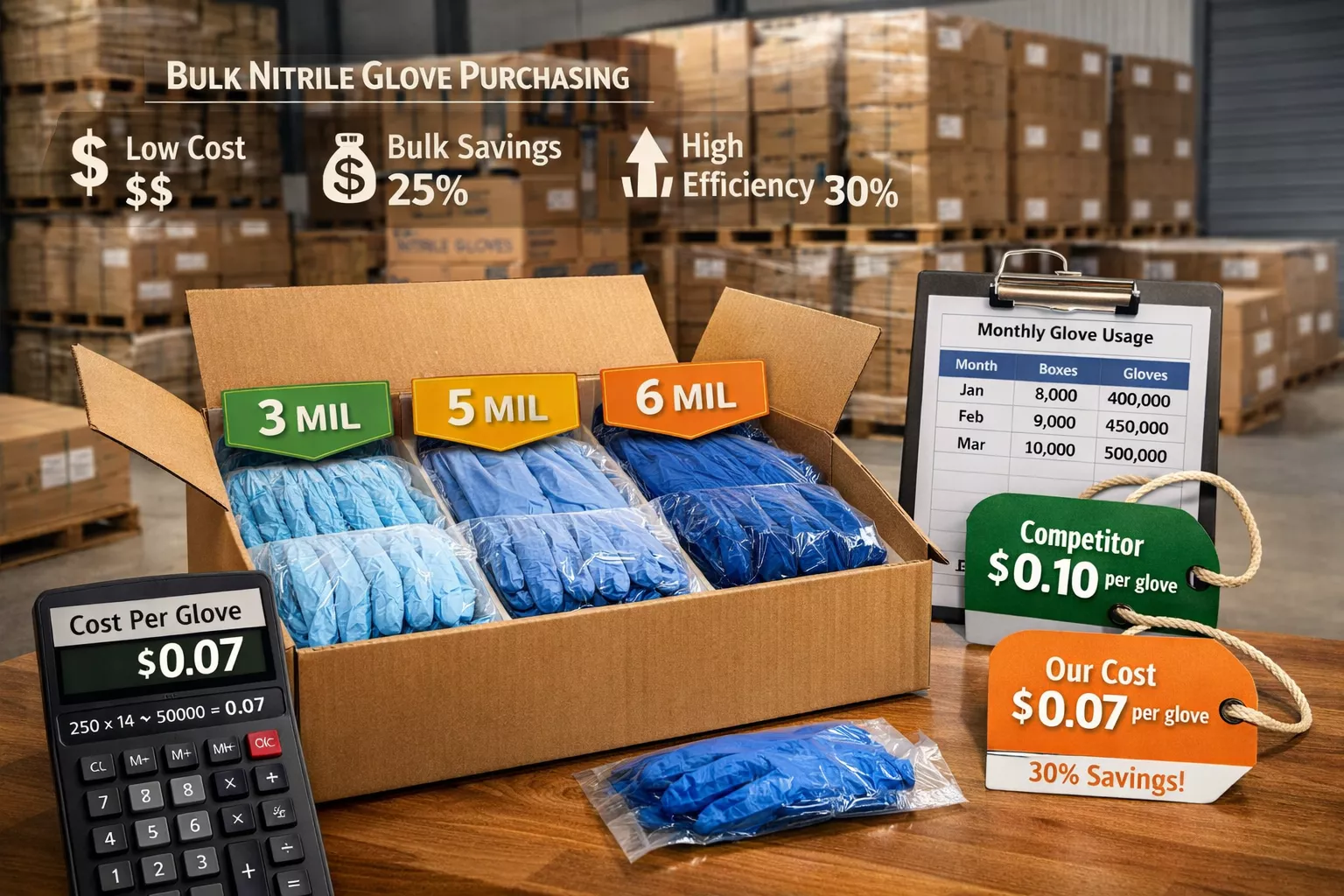
🔹 Monthly pallet orders: Purchasing 50,000-100,000 gloves at once locks in pricing and reduces per-unit shipping costs by 15-20%
🔹 Non-tariffed sourcing: Suppliers shifting production to Malaysia, Thailand, and Vietnam avoid the 100% Chinese import tariff, maintaining competitive pricing
🔹 Thickness optimization: Standardizing on 5-mil gloves across teams prevents over-specification waste (using 8-mil gloves for light tasks)
🔹 Usage tracking: Implementing glove dispensers with counters identifies waste patterns—some facilities reduce consumption 25% through accountability alone
The durability advantage compounds over time. A 500-room hotel using nitrile for daily housekeeping might spend $2,800 monthly on gloves versus $2,200 for vinyl—but vinyl’s 40% higher replacement rate actually costs $3,080 when accounting for labor time lost to mid-task changes.
For operations considering disposable gloves in industrial settings, nitrile’s puncture resistance prevents the cross-contamination incidents that trigger expensive re-cleaning protocols. A single pathogen spread from torn gloves can cost thousands in remediation and reputation damage.
Real-World Cost Comparison
Consider a mid-size office building (100,000 sq ft) with three daily cleaning shifts:
Vinyl approach:
- 12 gloves per shift × 3 shifts × 30 days = 1,080 gloves/month
- Cost: 1,080 × $0.06 = $64.80
Nitrile approach:
- 6 gloves per shift × 3 shifts × 30 days = 540 gloves/month
- Cost: 540 × $0.09 = $48.60
The nitrile strategy saves $16.20 monthly ($194.40 annually) while improving worker safety and reducing waste disposal costs. Scale this across a 50-building portfolio, and the savings reach nearly $10,000 yearly.
Best Nitrile Glove Picks for Janitorial Applications
Not all nitrile gloves perform equally in demanding cleaning environments. Top-performing options for 2026 combine chemical resistance, ergonomic design, and supply chain reliability:
Recommended Products
Intco SynGuard Nitrile Gloves 🏆
- Thickness: 5.5 mil
- Strengths: Textured fingertips for wet grip, excellent bleach resistance, consistent sizing
- Best for: Healthcare facility janitorial teams requiring frequent disinfectant use
- Bulk pricing: $0.08-$0.11 per glove (case of 1,000)
General-Purpose 6-Mil Nitrile
- Thickness: 6 mil
- Strengths: Extended cuff (12 inches) protects wrists during deep cleaning, ambidextrous design
- Best for: Restroom sanitation and floor care
- Bulk pricing: $0.10-$0.13 per glove
Powder-Free Exam-Grade Nitrile
- Thickness: 4 mil
- Strengths: Latex-free for allergy-prone staff, meets ASTM D6319 standards
- Best for: Light-duty office cleaning and food service areas
- Bulk pricing: $0.07-$0.09 per glove
When selecting gloves, verify they meet relevant safety standards. Understanding sterile versus non-sterile options matters less for janitorial work than chemical resistance ratings, but facilities with medical waste handling need appropriate certifications.
Preventing Cross-Contamination in Janitorial Workflows
Even the best nitrile gloves fail if used improperly. Hygiene protocols must address the human factors that undermine protective equipment:
Critical Best Practices
✔️ Color-coding systems: Assign blue gloves for restrooms, green for kitchens, yellow for general surfaces—prevents using contaminated gloves across zones
✔️ Change frequency: Replace gloves between rooms or every 30 minutes during continuous cleaning, whichever comes first
✔️ Proper removal technique: Peel from wrist to fingertips without touching exterior surface, dispose immediately in designated waste containers
✔️ Hand hygiene: Wash hands before gloving and after removal—nitrile isn’t a substitute for proper handwashing
✔️ Storage conditions: Keep gloves in cool, dry locations away from direct sunlight (UV degrades nitrile over 6-12 months)
OSHA guidelines for high-touch surface disinfection emphasize combining nitrile gloves with safety goggles when using concentrated disinfectants. The 2-3 daily cleaning cycles now standard in commercial buildings increase chemical exposure risks that proper PPE mitigates.
For teams managing food safety alongside janitorial duties, nitrile’s FDA compliance allows seamless transitions between kitchen cleaning and food prep areas—provided gloves are changed between tasks.
Addressing Nitrile Glove Allergies in Janitorial Staff
While nitrile eliminates latex allergy concerns, some workers experience reactions to chemical accelerators used in manufacturing. Identifying and managing sensitivities protects both employee health and operational continuity:
Allergy Management Strategies
- Symptom recognition: Redness, itching, or dry skin after glove use may indicate accelerator sensitivity, not true nitrile allergy
- Accelerator-free options: Specify gloves manufactured without thiurams or carbamates if staff report reactions
- Rotation protocols: Alternating between nitrile brands can reduce cumulative exposure to specific additives
- Medical documentation: Maintain records of reported sensitivities to inform purchasing decisions
True nitrile allergic reactions remain rare (affecting less than 1% of users), but facilities should stock alternative options like polyethylene gloves for confirmed cases. The slight cost increase for hypoallergenic nitrile ($0.02-$0.03 per glove) is negligible compared to workers’ compensation claims or turnover costs.
Future-Proofing Janitorial Glove Procurement
The 2026 landscape of rising tariffs and supply chain volatility demands strategic procurement approaches:
Diversified supplier networks: Establish relationships with 2-3 distributors across different manufacturing regions to prevent stockouts
Inventory buffering: Maintain 60-90 day glove supplies to weather price spikes and shipping delays
Quality audits: Request ASTM D6319 test reports verifying chemical resistance claims—not all “nitrile” gloves meet janitorial standards
Sustainability considerations: Explore nitrile recycling programs (emerging in 2026) that offset disposal costs while meeting ESG goals
Janitorial supply trends emphasize infection prevention alongside traditional cleaning, making nitrile’s barrier properties increasingly valuable. Facilities investing in UV-C disinfection technology still require manual pre-cleaning with chemical disinfectants—where nitrile gloves remain irreplaceable.
Conclusion
Nitrile Gloves in Janitorial Services: Best Picks for Disinfectants, Multi-Surface Cleaning, and Cost Efficiency represents a strategic investment in worker safety and operational excellence. The chemical resistance that protects against bleach, quaternary ammonium compounds, and multi-surface cleaners justifies the 30-50% price premium over vinyl alternatives. By selecting 5-6 mil thickness for standard tasks, implementing bulk purchasing strategies, and training staff on proper usage protocols, janitorial operations achieve lower total cost per cleaning cycle while maintaining hygiene standards.
Take Action Now
1️⃣ Audit current glove usage: Track failures and replacement frequency to calculate true cost per task
2️⃣ Request samples: Test 5-6 mil nitrile options from multiple suppliers with your specific disinfectants
3️⃣ Negotiate bulk contracts: Lock in 2026 pricing before additional tariff impacts materialize
4️⃣ Train teams: Implement color-coding and proper removal techniques to maximize glove lifespan
5️⃣ Monitor performance: Establish quarterly reviews of glove costs, worker feedback, and contamination incidents
The janitorial services that thrive in 2026’s challenging supply environment will be those treating glove selection as a strategic decision—not a commodity purchase. Nitrile’s proven performance across chemical resistance, durability, and worker safety makes it the clear choice for professional cleaning operations prioritizing both hygiene excellence and fiscal responsibility.