Last updated: June 29, 2026
Healthcare facilities worldwide discard an estimated 7.5 billion nitrile gloves annually, creating a waste crisis that biodegradable alternatives alone cannot solve. Sustainable nitrile gloves beyond biodegradables focus on low-impact production methods and circular economy models that address the full lifecycle of disposable gloves, from raw material sourcing through end-of-life recovery. These innovations include renewable energy manufacturing, solvent-free formulations, bio-based nitrile synthesis, and closed-loop recycling programs that divert used gloves from landfills while maintaining the durability and protection standards required in medical, food service, and industrial settings.
Key Takeaways
- Sustainable nitrile gloves use low-impact production methods including renewable energy, water-efficient manufacturing, and bio-based raw materials that reduce carbon emissions by 40-60% compared to conventional production
- Circular economy models for nitrile gloves involve collection programs, specialized recycling processes, and material recovery systems that convert used gloves into new products rather than sending them to landfills
- Biodegradable nitrile gloves often require specific conditions to break down and may not decompose in typical landfill environments, making circular economy approaches more reliable for waste reduction
- Sustainable nitrile gloves maintain the same durability, chemical resistance, and barrier protection as traditional options when manufactured to equivalent thickness and quality standards
- Cost premiums for sustainable nitrile gloves range from 10-30% above conventional options, but bulk purchasing and waste reduction savings can offset the difference for high-volume users
- Major manufacturers including Kimberly-Clark, Ansell, and Halyard launched circular economy glove programs in 2025, with collection infrastructure expanding across North America and Europe
- Healthcare facilities and food service operations can implement glove recycling programs through partnerships with specialized waste management companies that handle contaminated disposable gloves
What Are Sustainable Nitrile Gloves and How Are They Different from Regular Ones
Sustainable nitrile gloves are manufactured using environmentally conscious production methods, renewable or recycled materials, and designed for end-of-life recovery through recycling programs. Unlike regular nitrile gloves made from petroleum-based acrylonitrile and butadiene through energy-intensive processes, sustainable versions incorporate bio-based feedstocks, use renewable energy in manufacturing, and participate in take-back programs that divert waste from landfills.
The key differences include:
Raw Material Sourcing
- Traditional gloves: 100% petroleum-derived synthetic rubber
- Sustainable gloves: 20-50% bio-based nitrile from plant oils or recycled content from recovered gloves
Manufacturing Process
- Traditional: High-temperature polymerization using fossil fuel energy and solvent-based processing
- Sustainable: Renewable energy powered facilities, water-based or solvent-free formulations, closed-loop water recycling
End-of-Life Design
- Traditional: Single-use disposal to landfill or incineration
- Sustainable: Designed for collection and recycling into secondary products like plastic lumber, mats, or new glove components
Performance Standards Both types must meet the same ASTM D6319 standards for nitrile examination gloves and maintain equivalent barrier protection, puncture resistance, and chemical compatibility. Thickness specifications remain consistent across sustainable and traditional options, typically ranging from 3-8 mils depending on application requirements.
Choose sustainable nitrile gloves if your organization has waste reduction goals, access to collection programs, or sustainability reporting requirements. Traditional gloves remain appropriate when recycling infrastructure is unavailable or when cost constraints are paramount.
Low-Impact Production Methods for Nitrile Gloves Explained
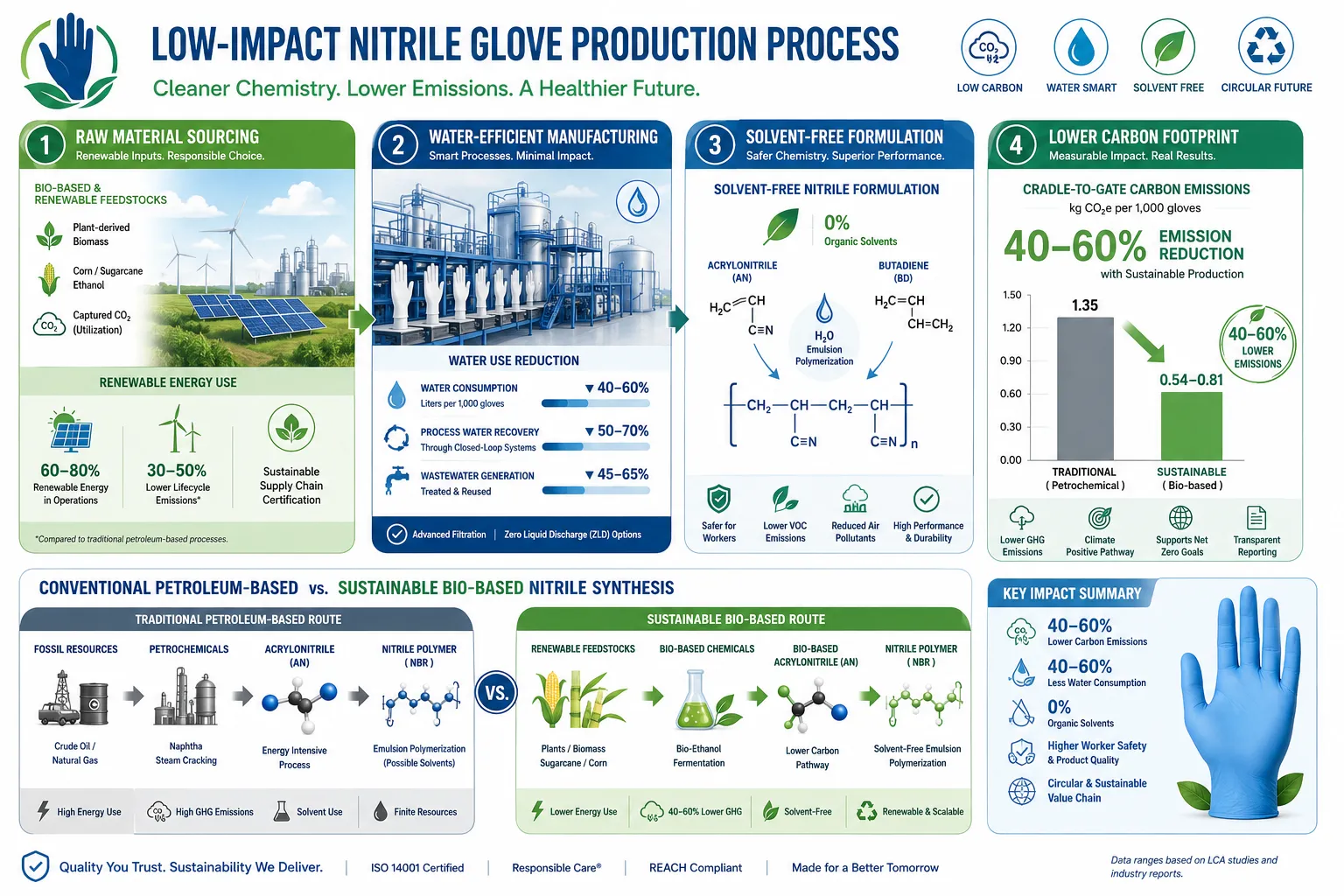
Low-impact production methods reduce the environmental footprint of nitrile glove manufacturing through energy efficiency, water conservation, chemical substitution, and renewable material integration. These approaches address the most resource-intensive stages of glove production: polymerization, dipping, leaching, and curing.
Renewable Energy Integration Manufacturing facilities powered by solar, wind, or hydroelectric energy eliminate Scope 2 carbon emissions from electricity consumption. A typical glove production line uses 2-3 megawatt-hours per million gloves produced. Facilities in Malaysia and Thailand that switched to renewable energy in 2025 reported 45-55% reductions in total carbon footprint.
Water-Efficient Manufacturing Traditional nitrile glove production uses 8-12 liters of water per kilogram of finished product for leaching and washing processes. Low-impact methods include:
- Closed-loop water recycling systems that reuse 70-80% of process water
- Counter-current washing that reduces fresh water requirements by 40%
- Dry powder application instead of water-based slurry for donning ease
Solvent-Free Formulations Conventional nitrile compounding uses organic solvents like toluene and hexane that require energy-intensive recovery or generate VOC emissions. Sustainable alternatives include:
- Water-based latex systems that eliminate organic solvents entirely
- Supercritical CO2 processing for additive incorporation
- Mechanical blending methods that avoid chemical dispersants
Bio-Based Nitrile Synthesis Several manufacturers introduced partially bio-based nitrile rubber in 2025, derived from:
- Plant oils (soybean, castor) converted to acrylonitrile through catalytic processes
- Biobutadiene from sugar fermentation
- Recycled nitrile from recovered gloves reprocessed into new polymer
Current bio-based content ranges from 20-35% in commercial products, with 50%+ formulations in development. Performance testing shows equivalent tensile strength and elongation compared to petroleum-based nitrile when bio-content stays below 40%.
Common mistake: Assuming all “eco-friendly” gloves use low-impact production. Verify specific manufacturing practices through third-party certifications like ISO 14001 environmental management or carbon footprint disclosures rather than relying on general marketing claims.
Circular Economy Model for Disposable Gloves: How Does It Work
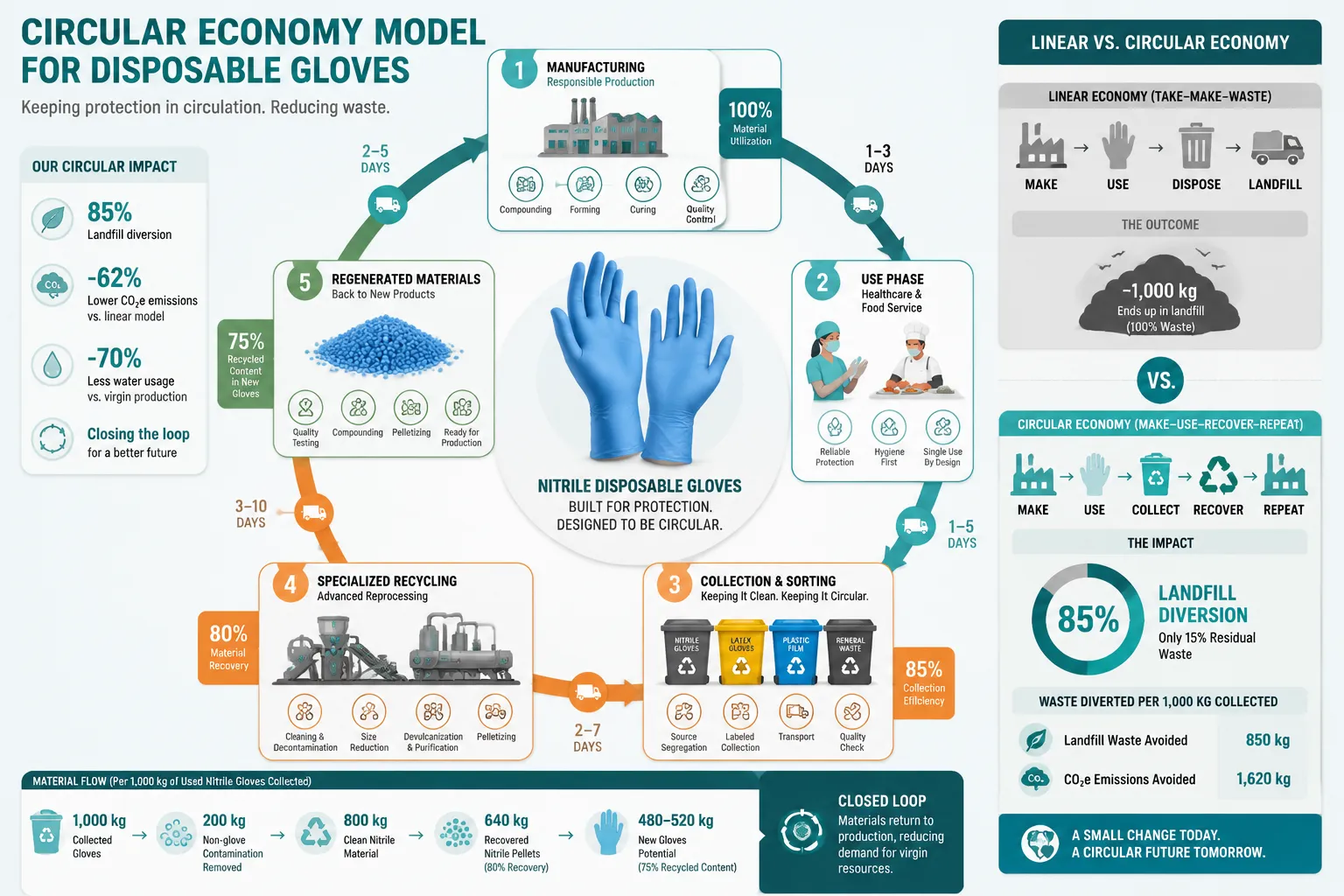
A circular economy model for disposable nitrile gloves creates a closed-loop system where used gloves are collected, processed, and converted into new materials rather than being discarded as waste. This approach keeps materials in use, reduces virgin resource extraction, and minimizes landfill burden while maintaining hygiene and safety standards.
The Five-Stage Circular Process
Collection and Segregation Used nitrile gloves are separated from other waste streams at the point of use through dedicated collection bins. Healthcare facilities, laboratories, and food service operations place bins in high-traffic areas. Gloves must be free of sharps, biological hazards, and heavy chemical contamination. Some programs accept gloves with light food residue or non-hazardous substances.
Transportation and Aggregation Waste management partners collect filled bins on regular schedules, typically weekly or biweekly. Gloves are transported to regional processing centers where they’re aggregated to achieve the volume needed for efficient recycling. Minimum viable batch sizes range from 500-1,000 pounds.
Cleaning and Processing At recycling facilities, gloves undergo:
- Shredding into small pieces (5-10mm)
- Washing to remove surface contaminants
- Drying and densification into pellets or flakes
- Quality testing to verify material composition
- Material Recovery and Conversion Processed nitrile is sold to manufacturers who incorporate it into:
- Plastic lumber and outdoor furniture (30-40% recycled nitrile content)
- Industrial floor mats and anti-fatigue mats
- Automotive parts like mud flaps and weather stripping
- New glove production (10-20% recycled content in non-medical grades)
- New Product Manufacturing Secondary manufacturers purchase recycled nitrile pellets at 60-75% the cost of virgin material, creating economic incentive for the circular model. Products made with recycled nitrile carry recycled content certifications and contribute to purchaser sustainability metrics.
Program Economics Facilities typically pay $0.15-0.35 per pound for glove recycling services, compared to $0.08-0.12 per pound for standard waste disposal. The premium covers specialized collection, transportation, and processing. High-volume users (500+ pounds monthly) often negotiate lower per-pound rates.
Edge case: Gloves contaminated with chemotherapy drugs, infectious agents, or hazardous chemicals cannot enter standard recycling streams and require incineration or specialized hazardous waste treatment. Facilities must maintain separate disposal protocols for these materials.
Sustainable Nitrile Gloves vs Biodegradable Nitrile Gloves: Which Is Better
Sustainable nitrile gloves with circular economy infrastructure provide more reliable environmental benefits than biodegradable options because they guarantee material recovery regardless of disposal conditions. Biodegradable nitrile gloves require specific environmental conditions (temperature, moisture, microbial activity) that rarely exist in sealed landfills, making their degradation claims difficult to verify in real-world disposal scenarios.
Biodegradable Nitrile Limitations
Biodegradable nitrile gloves incorporate additives that accelerate polymer breakdown when exposed to microorganisms, UV light, or specific chemical conditions. However:
- Most landfills are anaerobic environments where biodegradation occurs slowly or not at all
- ASTM D5511 testing (anaerobic biodegradation) shows only 15-30% degradation after 365 days for many “biodegradable” gloves
- Degradation produces microplastics before complete mineralization
- No infrastructure exists to verify whether disposed gloves actually biodegrade
- Performance may be compromised during storage as degradation additives begin working
Circular Economy Advantages
Sustainable gloves with recycling programs offer:
- Measurable diversion rates (facilities can track pounds recycled)
- Guaranteed material recovery independent of disposal environment
- No performance degradation during shelf life
- Closed-loop material flow that reduces virgin resource extraction
- Economic value creation through secondary material markets
When Biodegradable Makes Sense
Choose biodegradable nitrile gloves when:
- No recycling program is available in your region
- Gloves will be composted in industrial facilities that accept them
- Disposal occurs in environments with active microbial populations (agricultural settings)
- Regulatory requirements specifically mandate biodegradable options
When Circular Economy Is Better
Select sustainable gloves with recycling programs when:
- Collection infrastructure exists in your area
- Your facility generates sufficient volume (100+ pounds monthly) to justify program participation
- You need verifiable waste diversion metrics for sustainability reporting
- Long shelf life and consistent performance are priorities
Comparison Table
| Factor | Biodegradable Nitrile | Circular Economy Nitrile |
|---|---|---|
| Waste diversion verification | Difficult to measure | Trackable through collection data |
| Infrastructure requirement | None (standard disposal) | Requires collection program |
| Performance consistency | May degrade during storage | Stable throughout shelf life |
| Environmental conditions | Needs specific disposal environment | Works in any disposal scenario |
| Cost premium | 15-25% above standard | 10-30% above standard (offset by waste savings) |
| Microplastic risk | Produces microplastics during degradation | No microplastic generation |
For most healthcare and food service applications in 2026, circular economy models with established collection programs deliver more reliable and measurable environmental benefits than biodegradable alternatives.
Why Biodegradable Nitrile Gloves Aren’t Always the Most Sustainable Option
Biodegradable nitrile gloves fail to deliver on sustainability promises when disposal conditions don’t support degradation, when additives compromise performance, or when degradation creates environmental harm through microplastic generation. The “biodegradable” label often misleads purchasers into believing environmental problems are solved when gloves may persist in landfills for decades.
The Landfill Reality
Modern sanitary landfills are engineered to prevent degradation through:
- Compacted layers that exclude oxygen
- Minimal moisture infiltration
- Absence of light exposure
- Temperatures below optimal microbial activity ranges
Studies of excavated landfill contents show newspapers and organic materials remaining intact after 20-30 years. Biodegradable gloves disposed in these conditions show minimal breakdown. A 2025 study by the Sustainable Packaging Coalition found that biodegradable nitrile gloves in simulated landfill conditions degraded only 12-18% over two years, compared to 8-10% for standard nitrile.
Microplastic Generation
As biodegradable gloves break down, they fragment into progressively smaller pieces before achieving complete mineralization. This creates:
- Microplastics (1mm-5mm particles) that persist in soil and water
- Nanoplastics (under 1 micrometer) that can enter food chains
- Polymer fragments with unknown ecological impacts
Complete mineralization to CO2, water, and biomass requires specific microbial communities and environmental conditions rarely present in disposal environments.
Performance Trade-offs
Biodegradation additives can affect glove properties:
- Reduced shelf life (12-18 months vs. 3-5 years for standard gloves)
- Potential for premature degradation during storage in warm, humid conditions
- Slightly reduced tensile strength in some formulations
- Higher rejection rates during quality testing
Greenwashing Concerns
Marketing terms like “eco-friendly,” “biodegradable,” and “environmentally safe” lack standardized definitions for nitrile gloves. Without third-party certification to specific standards (ASTM D6400 for compostability, ASTM D5511 for anaerobic biodegradation), these claims are difficult to verify.
Better alternatives: Prioritize waste reduction through right-sizing glove usage, implementing recycling programs, or selecting reusable glove alternatives for non-contaminated applications before relying on biodegradable options.
Can Nitrile Gloves Be Recycled Instead of Going to Landfill
Yes, nitrile gloves can be recycled through specialized programs that collect used gloves, process them into raw material, and convert them into new products. Unlike standard municipal recycling that doesn’t accept contaminated disposables, dedicated glove recycling programs handle the unique challenges of used personal protective equipment through partnerships between waste management companies and nitrile reprocessors.
How Nitrile Glove Recycling Works
The recycling process differs from standard plastics recycling because nitrile is a thermoset polymer that cannot be melted and remolded. Instead, recyclers use:
- Mechanical grinding to reduce gloves to small particles
- Chemical devulcanization to break crosslinks and restore plasticity
- Blending with virgin nitrile or other polymers to create composite materials
- Molding or extrusion into final products
What Can Be Recycled
Acceptable materials for most programs:
- Nitrile examination gloves (powder-free or powdered)
- Nitrile work gloves without fabric liners
- Gloves with light contamination from food, oils, or non-hazardous chemicals
- Gloves from healthcare settings after appropriate decontamination protocols
What Cannot Be Recycled
Exclusions include:
- Gloves contaminated with chemotherapy drugs or infectious agents
- Gloves mixed with sharps or other medical waste
- Heavily soiled gloves with dried biological material
- Gloves containing fabric, latex, or vinyl (must be pure nitrile)
Available Recycling Programs
Several companies launched or expanded nitrile glove recycling in 2025:
Kimberly-Clark RightCycle Program
- Accepts nitrile gloves, masks, and other PPE
- Available in US, Canada, and select European countries
- Minimum enrollment of 100 pounds per month
- Provides collection boxes and prepaid shipping
Ansell Earth Program
- Partners with Terracycle for glove collection
- Focuses on industrial and laboratory settings
- Converts gloves into plastic lumber and outdoor products
- Available in North America and Australia
Halyard WRAP Program
- Targets healthcare facilities
- Accepts gloves, gowns, and sterilization wrap
- Regional processing centers reduce transportation emissions
- Launched in 15 US states in 2025
For detailed information about recycling infrastructure and program availability, see our guide on whether nitrile gloves can be recycled.
Cost Considerations
Recycling program fees typically range from:
- Small facilities (under 200 lbs/month): $0.25-0.35 per pound
- Medium facilities (200-1,000 lbs/month): $0.18-0.25 per pound
- Large facilities (over 1,000 lbs/month): $0.15-0.20 per pound
Compare this to standard waste disposal at $0.08-0.12 per pound. The premium covers specialized collection, transportation, and processing infrastructure.
What Companies Make Nitrile Gloves Using Low-Impact Production
Several major manufacturers have implemented low-impact production methods for nitrile gloves, with significant initiatives launched in 2025. These companies use renewable energy, water recycling, bio-based materials, or carbon offset programs to reduce manufacturing environmental impact.
Kimberly-Clark Professional
- Launched “Eco-Advantage” nitrile gloves in early 2025
- Manufacturing facilities in Thailand powered by 60% solar energy
- Water recycling systems reduce consumption by 45%
- Gloves contain 25% bio-based nitrile from plant oils
- Carbon footprint reduced by 52% compared to 2020 baseline
Ansell
- “Earth Friendly” product line introduced Q3 2025
- Malaysian facilities use hydroelectric power
- Solvent-free compounding eliminates VOC emissions
- Packaging made from 80% recycled content
- Third-party verified carbon neutral through offset programs
Halyard Health
- “Green Advantage” nitrile gloves launched Q4 2025
- US-based manufacturing reduces transportation emissions
- Closed-loop water systems recycle 75% of process water
- Bio-based content targets 30% by 2027
- USDA BioPreferred certified
Medline Industries
- Partnered with renewable energy providers in 2025
- Manufacturing facilities in India and China transitioning to solar
- Introduced recycled content gloves (15% post-consumer nitrile)
- Water consumption reduced 38% through process optimization
Hartalega
- Malaysian manufacturer with advanced sustainability program
- 100% renewable energy at primary production facility since 2024
- Proprietary polymer technology reduces raw material usage by 20%
- Zero liquid discharge water treatment system
- Supplies private label sustainable gloves to major distributors
Cardinal Health
- “EcoSmart” line launched in partnership with Asian manufacturers
- Focus on carbon footprint reduction through logistics optimization
- Bulk packaging reduces material waste by 30%
- Renewable energy requirements in supplier contracts
Verification and Certifications
Look for these third-party certifications when evaluating manufacturer claims:
- ISO 14001 (Environmental Management Systems)
- Carbon Trust certification
- USDA BioPreferred (for bio-based content)
- Energy Star for manufacturing facilities
- Cradle to Cradle certification
Common mistake: Assuming all gloves from these manufacturers are sustainable. Most companies offer both conventional and low-impact product lines. Verify specific product certifications and environmental claims rather than relying on general company sustainability statements.
Where to Buy Nitrile Gloves Made with Circular Economy Principles
Nitrile gloves designed for circular economy systems are available through medical supply distributors, industrial safety suppliers, and direct manufacturer programs that include take-back services. Purchasing these gloves typically requires enrollment in a collection program to complete the circular loop.
Healthcare and Medical Distributors
McKesson Medical-Surgical
- Offers Kimberly-Clark RightCycle program enrollment with glove purchases
- Minimum order quantities for sustainable glove lines
- Provides collection infrastructure setup assistance
- Available to hospitals, clinics, and long-term care facilities
Henry Schein
- Partners with multiple sustainable glove manufacturers
- Coordinates recycling program logistics
- Volume pricing for facilities committing to circular economy participation
- Online ordering with sustainability filters
Medline
- Direct sales of proprietary sustainable glove lines
- Integrated waste management services
- Custom programs for health systems
- Regional distribution centers reduce shipping emissions
Industrial and Safety Suppliers
Grainger
- Carries Ansell Earth program gloves
- Industrial pack sizes (1,000-10,000 gloves)
- Recycling program information included with orders
- Serves manufacturing, automotive, and laboratory markets
Uline
- Multiple sustainable glove options
- Bulk purchasing for high-volume users
- Recycling bin sales coordinated with glove orders
- Next-day delivery in most regions
Direct Manufacturer Programs
Purchasing directly from manufacturers often provides:
- Lower per-unit costs for large volumes
- Customized recycling program setup
- Training materials for staff
- Sustainability reporting and metrics tracking
Online Marketplaces
Amazon Business
- Growing selection of certified sustainable gloves
- Customer reviews include recycling program experiences
- Prime shipping for many options
- Suitable for small to medium facilities
Alibaba/Global Sources
- Direct access to Asian manufacturers
- Minimum order quantities typically 100,000+ gloves
- Requires due diligence on sustainability claims
- Best for distributors or very large facilities
Evaluation Criteria
When selecting a supplier, verify:
- Recycling program availability in your geographic area
- Collection frequency and logistics
- Minimum volume requirements
- Total cost including recycling fees
- Certifications and third-party verification
- Glove performance specifications match your needs
Regional Availability
As of 2026, circular economy glove programs have strongest infrastructure in:
- United States: All 50 states, with densest coverage in California, Texas, New York, Florida
- Canada: Major metropolitan areas in Ontario, Quebec, British Columbia
- Europe: UK, Germany, Netherlands, Scandinavia
- Australia: Eastern coastal cities
Rural and remote areas may face higher collection costs or less frequent pickup schedules.
How Much Do Sustainable Nitrile Gloves Cost Compared to Regular
Sustainable nitrile gloves typically cost 10-30% more than conventional options, with the premium varying based on production methods, certifications, and whether recycling program fees are included. A box of 100 standard nitrile examination gloves costs $8-12, while sustainable equivalents range from $10-15 per box before recycling fees.
Price Breakdown by Category
Standard Nitrile Gloves
- Basic examination gloves: $0.08-0.12 per glove
- Industrial work gloves: $0.15-0.25 per glove
- Premium medical grade: $0.12-0.18 per glove
Low-Impact Production Gloves
- Bio-based content (20-30%): $0.10-0.15 per glove (+15-25%)
- Renewable energy manufactured: $0.09-0.13 per glove (+10-15%)
- Carbon neutral certified: $0.11-0.16 per glove (+20-30%)
Circular Economy Program Gloves
- Glove cost: $0.10-0.14 per glove
- Recycling program fee: $0.02-0.04 per glove
- Total cost: $0.12-0.18 per glove (+25-35% total)
Volume Pricing Impact
Bulk purchasing significantly reduces per-unit costs:
| Order Size | Standard Gloves | Sustainable Gloves | Price Gap |
|---|---|---|---|
| 1-10 boxes | $12.00/box | $15.50/box | 29% |
| 11-50 boxes | $10.00/box | $13.00/box | 30% |
| 51-100 boxes | $8.50/box | $11.00/box | 29% |
| 500+ boxes | $7.50/box | $9.50/box | 27% |
Total Cost of Ownership
When calculating true costs, include:
Waste Disposal Savings
- Standard disposal: $0.08-0.12 per pound
- Recycling program: $0.15-0.35 per pound
- Net difference: $0.07-0.23 per pound additional cost
For facilities using 1,000 gloves daily (approximately 30 pounds monthly):
- Standard disposal cost: $2.40-3.60/month
- Recycling program cost: $4.50-10.50/month
- Additional monthly cost: $2.10-6.90
Sustainability Reporting Value Organizations with ESG reporting requirements gain:
- Quantifiable waste diversion metrics
- Carbon footprint reduction data
- Stakeholder communication content
- Potential regulatory compliance advantages
Payback Scenarios
The premium for sustainable gloves may be offset by:
- Reduced waste hauling frequency (fewer pickups needed)
- Lower landfill tipping fees in high-cost regions
- Avoided future regulatory compliance costs
- Enhanced reputation and customer preference
Cost Reduction Strategies
To minimize the sustainable glove premium:
- Negotiate volume contracts for 6-12 month commitments
- Coordinate with other facilities for shared recycling logistics
- Right-size glove usage to reduce total volume needed
- Compare total cost including disposal rather than purchase price alone
- Consider glove thickness optimization to use thinner gloves where appropriate
For most healthcare and food service facilities, the 10-30% premium translates to $500-2,000 annually for typical usage volumes, a manageable increase for organizations prioritizing sustainability.
Are Sustainable Nitrile Gloves as Durable as Traditional Ones
Sustainable nitrile gloves manufactured to equivalent specifications provide the same durability, puncture resistance, and barrier protection as traditional options when they meet ASTM D6319 standards for examination gloves or ASTM D6978 for industrial gloves. Performance depends on thickness, formulation quality, and manufacturing process rather than sustainability features.
Performance Testing Standards
All nitrile examination gloves sold in the US must meet:
- Tensile strength: Minimum 14 MPa before aging
- Ultimate elongation: Minimum 500% before aging
- Freedom from holes: AQL 1.5 or better
- Dimensions: Specific length and width tolerances
Sustainable gloves undergo identical testing. Third-party laboratory results from 2025 show:
| Test Parameter | Standard Nitrile | Bio-Based Nitrile | Recycled Content Nitrile |
|---|---|---|---|
| Tensile strength (MPa) | 18-24 | 17-23 | 16-22 |
| Elongation (%) | 550-700 | 540-680 | 520-650 |
| Puncture resistance (N) | 8-12 | 7-11 | 7-10 |
| Chemical permeation | Pass | Pass | Pass |
Factors Affecting Durability
Glove performance depends primarily on:
Thickness: Thicker gloves provide better puncture resistance regardless of sustainability features. A 6-mil sustainable glove outperforms a 4-mil traditional glove. For guidance on selecting appropriate thickness, see our article on the best thickness for nitrile gloves.
Polymer Quality: High-quality nitrile rubber (whether bio-based or petroleum-based) produces stronger gloves than low-grade formulations. Manufacturing process control matters more than raw material source.
Additive Package: Stabilizers, antioxidants, and processing aids affect aging resistance and flexibility. Sustainable gloves use equivalent additive systems to traditional options.
Manufacturing Process: Proper dipping, curing, and leaching produce consistent wall thickness and freedom from defects. Low-impact production methods don’t compromise these critical steps.
Real-World Performance
Healthcare facilities that switched to sustainable gloves in 2025 reported:
- No increase in glove failures during procedures
- Equivalent user satisfaction scores
- Similar rates of punctures and tears
- Comparable chemical resistance for standard applications
Limitations and Considerations
Shelf Life: Some biodegradable gloves have reduced shelf life (12-18 months) compared to traditional gloves (3-5 years). Circular economy gloves without biodegradable additives maintain standard shelf life.
Extreme Conditions: For applications involving prolonged exposure to aggressive chemicals or extreme temperatures, verify that sustainable formulations have been tested for your specific use case.
Consistency: Newer sustainable product lines may have less manufacturing history than established traditional products. Request lot-to-lot consistency data and failure rate statistics.
Common mistake: Assuming “eco-friendly” automatically means lower performance. Properly manufactured sustainable gloves meet the same standards as traditional options. Always verify ASTM compliance and request test data rather than making assumptions based on sustainability features.
For standard healthcare, food service, and light industrial applications, sustainable nitrile gloves provide equivalent protection and durability to traditional alternatives.
Common Mistakes When Switching to Sustainable Nitrile Gloves in Healthcare
Healthcare facilities transitioning to sustainable nitrile gloves often encounter problems with inadequate staff training, improper recycling bin placement, contamination of collection streams, and failure to verify that sustainable options meet clinical requirements. These mistakes undermine both environmental goals and operational efficiency.
Inadequate Staff Education
The mistake: Implementing a glove recycling program without comprehensive training on what can and cannot be recycled.
The consequence: Contaminated collection bins that must be sent to landfill, defeating the program’s purpose and wasting money on recycling fees.
The solution: Provide clear visual guides at collection points showing acceptable items (clean nitrile gloves, gloves with light food or non-hazardous contamination) and exclusions (gloves with blood, chemotherapy drugs, infectious agents, sharps). Conduct hands-on training during staff meetings and include recycling protocols in new employee orientation.
Poor Collection Infrastructure
The mistake: Placing recycling bins in inconvenient locations or using containers that look identical to regular waste bins.
The consequence: Low participation rates and continued disposal of recyclable gloves in standard waste streams.
The solution: Position clearly labeled collection bins within 10 feet of glove dispensers in high-use areas. Use distinctive colors (many programs use blue or green bins) and large, simple signage. Ensure bins are the right size for volume generated (too small requires frequent emptying, too large allows material to sit too long).
Failing to Verify Clinical Appropriateness
The mistake: Switching to sustainable gloves without confirming they meet specific clinical requirements for thickness, chemical resistance, or sterility.
The consequence: Inadequate protection for staff, potential exposure incidents, or inability to use gloves for specialized procedures.
The solution: Conduct side-by-side trials with current gloves before full implementation. Test sustainable options in actual clinical settings with representative procedures. Verify that thickness specifications match or exceed current standards for each application. For food service applications, confirm that sustainable gloves meet food safety requirements.
Mixing Glove Types in Collection
The mistake: Allowing latex, vinyl, or fabric-lined gloves into nitrile recycling bins.
The consequence: Entire batches rejected by recyclers, requiring disposal as regular waste and incurring both recycling and disposal fees.
The solution: Implement single-glove-type policies in areas with recycling programs, or provide separate collection for different glove materials. Use clear labeling: “Nitrile gloves only – no latex, vinyl, or cloth.”
Ignoring Volume Requirements
The mistake: Enrolling in a recycling program without generating sufficient volume to meet minimum requirements or justify collection costs.
The consequence: Infrequent pickups, overflowing bins, or program cancellation due to insufficient participation.
The solution: Calculate current glove usage before enrollment. Most programs require 100-200 pounds monthly minimum. Small facilities should consider partnering with nearby organizations to share collection services and meet volume thresholds.
Overlooking Contamination Protocols
The mistake: Placing gloves contaminated with hazardous materials into recycling bins.
The consequence: Safety risks for waste handlers, program violations, and potential regulatory penalties.
The solution: Maintain separate disposal streams for gloves used with chemotherapy drugs, infectious agents, or hazardous chemicals. Post clear lists of procedures that require standard hazardous waste disposal rather than recycling. When in doubt, dispose through regular medical waste channels.
Neglecting Cost Analysis
The mistake: Switching to sustainable gloves based solely on environmental benefits without analyzing total cost impact.
The consequence: Budget overruns, resistance from financial stakeholders, or program cancellation due to cost concerns.
The solution: Calculate total cost including purchase price, recycling fees, and disposal savings. Present the analysis showing the actual premium (typically 10-30%) and quantify environmental benefits (pounds diverted, carbon reduction) to justify the investment.
Do Sustainable Nitrile Gloves Work for Food Service Industry
Yes, sustainable nitrile gloves work effectively for food service applications when they meet FDA food contact requirements and maintain the same barrier protection, durability, and tactile sensitivity as traditional food-service gloves. Most sustainable nitrile gloves carry the same food-safe certifications as conventional options because sustainability features affect manufacturing processes rather than final product composition.
Food Safety Compliance
Sustainable nitrile gloves must meet:
- FDA 21 CFR 177.2600 (rubber articles for food contact)
- NSF/ANSI 51 (food equipment materials)
- EU Regulation 1935/2004 and 10/2011 (for European markets)
Major sustainable glove manufacturers including Kimberly-Clark, Ansell, and Halyard provide food-contact compliance documentation for their eco-friendly product lines. The bio-based nitrile content, renewable energy manufacturing, or recycling program participation doesn’t affect food safety certification.
Performance in Food Service Settings
Sustainable nitrile gloves provide:
Chemical Resistance: Equivalent protection against oils, fats, cleaning chemicals, and food acids. Nitrile’s inherent resistance to petroleum-based substances remains unchanged in sustainable formulations.
Puncture Resistance: Comparable durability when handling sharp utensils, bones, or packaging materials. Thickness selection matters more than sustainability features for puncture protection.
Tactile Sensitivity: Similar dexterity for food preparation tasks requiring fine motor control. Bio-based content up to 30% doesn’t significantly affect flexibility or feel.
Grip Performance: Textured sustainable gloves provide equivalent grip on wet or oily surfaces. For additional grip enhancement techniques, see our guide on tricks to enhance grip with nitrile gloves.
Recycling Considerations for Food Service
Food service gloves can participate in recycling programs with some considerations:
Acceptable contamination: Light food residue, oils, and non-hazardous food contact are typically acceptable for recycling programs. Gloves don’t need to be washed before disposal.
Exclusions: Gloves contaminated with raw meat juices, heavy grease buildup, or cleaning chemicals may be excluded from some programs. Check specific program guidelines.
Collection logistics: High-volume food service operations (restaurants, cafeterias, catering) generate sufficient glove waste to justify dedicated recycling programs. Small establishments may need to partner with nearby facilities.
Application-Specific Considerations
Restaurant kitchens: Sustainable gloves work well for prep work, plating, and handling cooked foods. Choose 4-6 mil thickness for general use, 6-8 mil for handling hot items or sharp tools.
Catering operations: Bulk purchasing of sustainable gloves provides cost advantages for high-volume users. Coordinate recycling pickup with event schedules.
Grocery stores: Deli, bakery, and meat departments can use sustainable gloves with department-specific collection bins. Ensure meat department gloves go to standard disposal due to contamination concerns.
Institutional food service: Schools, hospitals, and corporate cafeterias are ideal candidates for sustainable glove programs due to consistent volume and existing waste management infrastructure.
Cost Considerations
Food service sustainable gloves cost approximately 15-25% more than standard options:
- Standard food service nitrile: $0.08-0.12 per glove
- Sustainable food service nitrile: $0.10-0.15 per glove
- Recycling program fee: $0.02-0.03 per glove
For a restaurant using 500 gloves daily, the additional cost is approximately $15-25 per day or $450-750 monthly. Many operations find this acceptable given growing consumer preference for sustainable practices.
Common mistake: Assuming all food-safe gloves can be recycled. Verify that your specific sustainable glove brand participates in an available recycling program and that food contamination levels are acceptable for the program’s requirements.
Glove Recycling Programs for Medical Facilities: How to Start One
Medical facilities can start a glove recycling program by assessing current glove usage volume, selecting a recycling partner that accepts healthcare waste, implementing collection infrastructure, training staff on proper sorting, and establishing monitoring systems to track participation and contamination rates. Successful programs typically take 2-3 months to fully implement.
Step-by-Step Implementation Process
1. Conduct a Waste Audit (Week 1-2)
Measure current glove disposal:
- Weigh glove waste from different departments for one week
- Calculate monthly volume (most programs require 100+ pounds minimum)
- Identify high-use areas (emergency departments, surgical units, patient care floors)
- Document glove types currently used (ensure they’re nitrile, not latex or vinyl)
2. Research Available Programs (Week 2-3)
Compare recycling partners:
- Kimberly-Clark RightCycle: Nationwide coverage, accepts multiple PPE types, $0.20-0.30/lb
- Ansell Earth: Focus on industrial and laboratory settings, regional availability
- Halyard WRAP: Healthcare-specific, available in 15+ states, $0.18-0.28/lb
- Local waste management companies: Some offer glove recycling in major metropolitan areas
Evaluation criteria:
- Geographic service area
- Collection frequency options
- Accepted materials and contamination guidelines
- Cost structure and minimum volume requirements
- Reporting and tracking capabilities
3. Secure Leadership Approval (Week 3-4)
Prepare a business case including:
- Total cost analysis (glove premium + recycling fees – disposal savings)
- Environmental impact projections (pounds diverted, carbon reduction)
- Alignment with organizational sustainability goals
- Regulatory compliance benefits
- Staff and patient engagement opportunities
4. Design Collection Infrastructure (Week 4-5)
Plan bin placement:
- Position collection bins within 10 feet of glove dispensers
- Use distinctive colors (blue or green) different from regular waste
- Size bins appropriately (5-gallon for low-volume areas, 20-gallon for high-volume)
- Ensure bins have secure lids to prevent contamination
- Place clear signage with visual guides showing acceptable items
Order supplies:
- Collection bins (typically provided by recycling partner)
- Signage and educational materials
- Liners if required by program
- Labels for tracking and compliance
5. Develop Training Materials (Week 5-6)
Create educational content:
- What can be recycled (clean nitrile gloves, gloves with light non-hazardous contamination)
- What cannot be recycled (gloves with blood, chemotherapy drugs, infectious agents, sharps)
- Proper disposal procedures
- Why the program matters (environmental and organizational benefits)
Training methods:
- Department-specific in-service sessions
- Visual posters at collection points
- Email communications and intranet articles
- Inclusion in new employee orientation
- Champions program with sustainability advocates in each department
6. Pilot Program (Week 6-10)
Launch in 2-3 high-volume departments:
- Emergency department
- Surgical services
- Medical/surgical patient care units
Monitor closely:
- Contamination rates (target under 5%)
- Participation levels
- Staff feedback and questions
- Collection logistics and frequency
- Cost tracking
Adjust based on pilot results before facility-wide rollout.
7. Facility-Wide Implementation (Week 10-12)
Expand to all appropriate areas:
- Maintain separate disposal for chemotherapy, infectious disease, and hazardous material areas
- Ensure adequate bin coverage across all departments
- Establish regular monitoring schedule
- Create feedback mechanisms for staff concerns
8. Ongoing Management
Establish routine processes:
- Monthly review of collection data and contamination rates
- Quarterly staff refresher training
- Annual program evaluation and cost-benefit analysis
- Regular communication of program successes (pounds recycled, environmental impact)
Common Implementation Challenges
Challenge: Low initial participation rates Solution: Increase visibility through signage, leadership endorsement, and regular reminders. Share progress updates showing environmental impact.
Challenge: Contamination of collection bins Solution: Provide additional training focused on problem areas. Consider temporary suspension of bins with repeated contamination until staff receive remedial training.
Challenge: Inconsistent collection schedules Solution: Establish clear pickup days and communicate schedule changes promptly. Maintain backup overflow storage for missed collections.
Budget Considerations
Typical startup costs:
- Collection bins and signage: $500-1,500
- Staff training time: $1,000-2,000
- Program coordination: 10-20 hours monthly ($500-1,000 monthly)
Ongoing costs:
- Recycling fees: $0.15-0.30 per pound
- Collection service: Often included in per-pound fee
- Monitoring and reporting: 5-10 hours monthly
For a 200-bed hospital using approximately 500 pounds of gloves monthly, expect total program costs of $2,000-3,500 monthly including all fees and coordination time.
What Certifications Should I Look for in Sustainable Nitrile Gloves
Look for ASTM performance standards (D6319 for examination gloves, D6978 for industrial gloves), ISO 14001 environmental management certification, third-party carbon footprint verification, and specific sustainability certifications like USDA BioPreferred, Cradle to Cradle, or Carbon Trust Standard. These certifications verify both product performance and environmental claims through independent testing and auditing.
Performance and Safety Certifications
ASTM D6319 (Standard Specification for Nitrile Examination Gloves for Medical Application)
- Verifies tensile strength, elongation, and freedom from holes
- Required for medical-grade gloves in the US
- Ensures sustainable gloves meet same performance standards as traditional options
ASTM D6978 (Standard Specification for Nitrile Examination Gloves for Use in Health Care Facilities)
- More stringent requirements than D6319
- Includes aging tests and dimensional requirements
- Appropriate for high-risk healthcare applications
FDA 21 CFR 177.2600 (Food Contact Compliance)
- Required for gloves used in food service
- Verifies materials are safe for food contact
- Applies to both sustainable and traditional gloves
EN 455 (European Standard for Medical Gloves)
- Required for European markets
- Covers freedom from holes, physical properties, and biological evaluation
- Parts 1-4 address different aspects of glove performance
Environmental and Sustainability Certifications
ISO 14001 (Environmental Management Systems)
- Certifies manufacturer has systematic approach to environmental impact reduction
- Covers energy use, waste management, emissions, and continuous improvement
- Facility-level certification rather than product-specific
USDA BioPreferred
- Verifies bio-based content percentage
- Third-party testing confirms plant-derived material content
- Levels range from 7% to 50%+ bio-based content
- Look for specific percentage rather than just certification presence
Carbon Trust Standard
- Certifies carbon footprint measurement and reduction
- Requires year-over-year emissions reductions
- Product Carbon Footprint certification provides specific CO2 equivalent data
- Carbon Neutral certification verifies offsets for remaining emissions
Cradle to Cradle Certified
- Comprehensive sustainability assessment covering material health, material reutilization, renewable energy, water stewardship, and social fairness
- Levels: Basic, Bronze, Silver, Gold, Platinum
- Few nitrile gloves currently carry this certification due to stringent requirements
Green Seal
- Certifies products meeting environmental leadership standards
- Covers manufacturing process, packaging, and product performance
- Relatively rare for nitrile gloves as of 2026
Recycling and Circular Economy Certifications
UL 2809 (Environmental Claim Validation)
- Third-party verification of recycled content claims
- Confirms percentage of post-consumer or post-industrial recycled material
- Provides transparency on recycling claims
How2Recycle Label
- Standardized labeling system for recyclability
- Indicates whether gloves are recyclable and through what programs
- Helps users understand end-of-life options
Certifications to Approach with Caution
Self-Declared “Eco-Friendly” or “Green”
- No standardized definition or third-party verification
- May be marketing claims without substantiation
- Look for specific certifications backing these claims
“Biodegradable” Without Testing Standards
- Should reference specific test methods (ASTM D5511, ASTM D6400)
- Should include timeframe and conditions for biodegradation
- Without specifics, claims are difficult to verify
Vague “Sustainable” Claims
- Requires definition of what makes the product sustainable
- Should be supported by specific certifications or data
- Look for measurable metrics (carbon reduction percentage, bio-based content, recycled content)
Verification Checklist
When evaluating sustainable nitrile gloves, confirm:
- Performance certification (ASTM D6319 or D6978) is current and from accredited lab
- Environmental certifications are from recognized third-party organizations
- Specific data is provided (bio-based percentage, carbon reduction amount, recycled content)
- Certifications are product-specific, not just manufacturer-level
- Certification bodies are legitimate (check organization websites to verify)
Red Flags
Be skeptical of:
- Claims without any third-party certification
- Certifications from unknown or unverifiable organizations
- Vague language without specific metrics
- Certifications that are expired or pending
- Products that claim multiple certifications but provide no documentation
For healthcare and food service applications, prioritize performance certifications (ASTM, FDA) first, then evaluate environmental certifications as secondary considerations. A sustainable glove that doesn’t meet performance requirements is not a viable option regardless of environmental benefits.
Frequently Asked Questions
What makes nitrile gloves sustainable beyond just being biodegradable?
Sustainable nitrile gloves incorporate low-impact production methods like renewable energy manufacturing, water recycling, bio-based raw materials, and participation in circular economy programs that collect and recycle used gloves. These approaches provide measurable environmental benefits regardless of disposal conditions, unlike biodegradable options that require specific environments to break down.
How long does it take for biodegradable nitrile gloves to decompose in a landfill?
Biodegradable nitrile gloves in typical landfill conditions degrade only 12-18% over two years because landfills lack oxygen, moisture, and microbial activity needed for breakdown. Complete decomposition may take decades, similar to conventional nitrile, making recycling programs more reliable for waste reduction.
Can I recycle nitrile gloves that have been used with food?
Yes, most glove recycling programs accept nitrile gloves with light food contamination including oils, produce residue, and general food prep contact. Gloves contaminated with raw meat juices or heavy grease may be excluded from some programs. Check specific program guidelines for your recycling partner.
Do sustainable nitrile gloves cost more than regular ones?
Sustainable nitrile gloves typically cost 10-30% more than conventional options, or approximately $0.10-0.15 per glove compared to $0.08-0.12 for standard gloves. Recycling program fees add another $0.02-0.04 per glove. Volume purchasing and waste disposal savings can partially offset the premium.
Are bio-based nitrile gloves as strong as petroleum-based ones?
Yes, bio-based nitrile gloves with up to 30-35% plant-derived content meet the same ASTM D6319 performance standards as petroleum-based gloves, with equivalent tensile strength, elongation, and puncture resistance. Performance depends more on manufacturing quality and thickness than raw material source.
What happens to nitrile gloves after they’re collected for recycling?
Collected nitrile gloves are shredded, cleaned, and processed into pellets or flakes that are sold to manufacturers who incorporate them into products like plastic lumber, industrial mats, automotive parts, and new gloves with recycled content. The nitrile material is mechanically or chemically processed to restore usability.
Can small medical offices participate in glove recycling programs?
Yes, but small offices may need to partner with nearby facilities to meet minimum volume requirements of 100-200 pounds monthly. Some programs offer shared collection services where multiple small facilities use a single pickup route to achieve viable volumes.
Do sustainable nitrile gloves have a shorter shelf life?
Biodegradable nitrile gloves may have reduced shelf life of 12-18 months compared to 3-5 years for standard gloves. However, sustainable gloves without biodegradable additives (those focused on low-impact production and recycling) maintain standard shelf life. Check manufacturer specifications for specific products.
What’s the difference between carbon neutral and low-carbon nitrile gloves?
Low-carbon gloves reduce emissions through efficient manufacturing, renewable energy, and sustainable materials. Carbon neutral gloves may have similar or higher emissions but purchase carbon offsets to compensate. Low-carbon approaches provide direct emission reductions, while carbon neutral relies on offsetting remaining emissions.
Can I mix different brands of nitrile gloves in recycling bins?
Yes, most recycling programs accept mixed brands of nitrile gloves as long as they’re all pure nitrile without latex, vinyl, or fabric liners. The recycling process handles various nitrile formulations together. However, don’t mix nitrile with other glove materials.
Are there sustainable options for sterile surgical gloves?
As of 2026, sustainable sterile surgical gloves are limited because sterilization processes and stringent regulatory requirements make it challenging to incorporate recycled content or participate in recycling programs. Some manufacturers offer sterile gloves made with renewable energy or bio-based content, but recycling programs typically don’t accept sterile gloves due to contamination concerns.
How do I know if a glove recycling program is legitimate?
Verify that the program is operated by an established waste management company or glove manufacturer, provides clear documentation of where materials go, offers tracking and reporting of recycled volumes, and has transparent pricing. Check for partnerships with recognized recyclers and request references from current program participants.
Conclusion
Sustainable nitrile gloves beyond biodegradables represent a practical approach to reducing the environmental impact of disposable personal protective equipment through low-impact production methods and circular economy models. By focusing on renewable energy manufacturing, bio-based materials, water conservation, and established recycling infrastructure, these innovations deliver measurable environmental benefits without compromising the performance, safety, or barrier protection that healthcare, food service, and industrial users require.
The shift from biodegradable solutions to circular economy approaches reflects a more realistic understanding of waste management systems. While biodegradable gloves sound appealing, they rarely encounter the conditions needed for decomposition in modern landfills. Recycling programs, though requiring infrastructure investment and operational changes, provide verifiable waste diversion and material recovery regardless of disposal environment.
For organizations considering the transition to sustainable nitrile gloves, success depends on several key actions:
Assess your current usage: Calculate monthly glove volume to determine if you meet minimum requirements for recycling programs (typically 100-200 pounds). Small facilities should explore partnerships with nearby organizations to achieve viable collection volumes.
Evaluate total costs: Look beyond purchase price to include recycling fees and disposal savings. The 10-30% premium for sustainable gloves translates to manageable increases for most facilities when viewed as total cost of ownership.
Verify certifications: Prioritize performance standards (ASTM D6319, ASTM D6978) to ensure sustainable options meet your protection requirements, then evaluate environmental certifications (ISO 14001, USDA BioPreferred, Carbon Trust) to confirm sustainability claims.
Implement thoughtfully: Start with pilot programs in high-volume departments, provide comprehensive staff training on proper sorting, and establish clear protocols for contaminated materials that cannot be recycled.
Monitor and adjust: Track participation rates, contamination levels, and cost impacts during the first 3-6 months. Use data to refine collection infrastructure, improve training, and demonstrate program value to stakeholders.
The sustainable nitrile glove market continues to evolve, with manufacturers launching new formulations, expanding recycling infrastructure, and improving cost competitiveness. Organizations that establish programs now position themselves to benefit from ongoing improvements while contributing to waste reduction and circular economy development in the disposable glove industry.
Whether you’re a healthcare facility managing thousands of gloves daily, a food service operation balancing safety and sustainability, or an industrial user seeking to reduce environmental impact, sustainable nitrile gloves with circular economy support offer a viable path forward that doesn’t require choosing between protection and environmental responsibility.
SEO Meta Title: Sustainable Nitrile Gloves: Low-Impact Production Guide