Healthcare facilities waste thousands of dollars annually by using sterile gloves where non-sterile would suffice—or worse, risk patient safety by choosing non-sterile gloves for procedures that demand sterility. The distinction between sterile and non-sterile nitrile gloves isn’t just about labeling; it’s about validated sterilization processes, regulatory compliance, and matching the right barrier protection to each specific task. Understanding sterile vs. non-sterile nitrile gloves: how to choose the right option for medical, lab, and clean handling tasks can prevent both unnecessary costs and dangerous contamination events in 2026’s demanding clinical and laboratory environments.
Key Takeaways
- Sterile nitrile gloves undergo validated sterilization (gamma irradiation or ethylene oxide) and are individually packaged; non-sterile gloves are manufactured cleanly but not certified microorganism-free
- Use sterile gloves for invasive procedures, surgical tasks, sterile compounding, and any work requiring a sterile field
- Non-sterile exam gloves are appropriate for routine examinations, specimen handling, laboratory work, cleaning, and general barrier protection
- Packaging integrity and shelf-life matter: sterile gloves lose sterility once opened, while non-sterile gloves remain usable until damaged
- Choosing the wrong type creates infection risk (using non-sterile where sterile is needed) or budget waste (using sterile where non-sterile suffices)
What Makes Nitrile Gloves Sterile or Non-Sterile?
The fundamental difference between sterile and non-sterile nitrile gloves lies in post-manufacturing processing, not the nitrile material itself. All medical-grade nitrile gloves start with similar manufacturing steps, but sterile gloves undergo an additional validated sterilization process.
The Sterilization Process ⚙️
Sterile nitrile gloves are processed using one of two FDA-recognized sterilization methods:
- Gamma irradiation: Exposes gloves to ionizing radiation that destroys microorganisms
- Ethylene oxide (EtO) gas: Uses chemical sterilization in controlled chambers
Both methods achieve a sterility assurance level (SAL) of 10⁻⁶, meaning there’s less than a one-in-a-million chance of a viable microorganism remaining on the glove. This level of assurance is critical for procedures where introducing even a single pathogen could cause serious infection.
Non-Sterile Doesn’t Mean Dirty 🧼
Non-sterile nitrile gloves are manufactured in controlled, clean environments and meet quality standards for barrier protection. They’re safe, effective disposable gloves—they simply haven’t undergone the additional sterilization validation step. For many healthcare and laboratory tasks, this level of cleanliness is entirely appropriate and cost-effective.
To better understand the fundamental differences, explore our detailed guide on sterile vs nonsterile gloves.
Packaging Tells the Story 📦
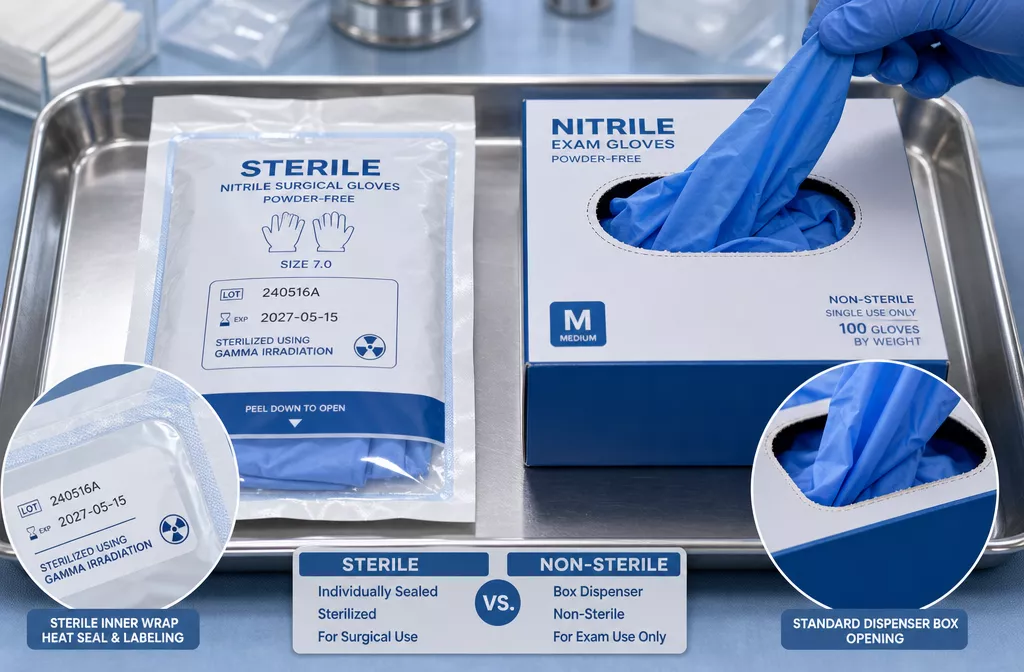
Sterile gloves come individually wrapped in sealed inner packaging that maintains sterility until opened. Each package displays:
- Clear “STERILE” labeling
- Sterilization method used
- Lot number and expiration date
- Instructions for maintaining sterile technique during donning
Non-sterile gloves typically come in bulk dispensing boxes of 100-300 gloves, designed for convenient access rather than sterility preservation.
When to Use Sterile vs. Non-Sterile Nitrile Gloves for Medical and Lab Tasks
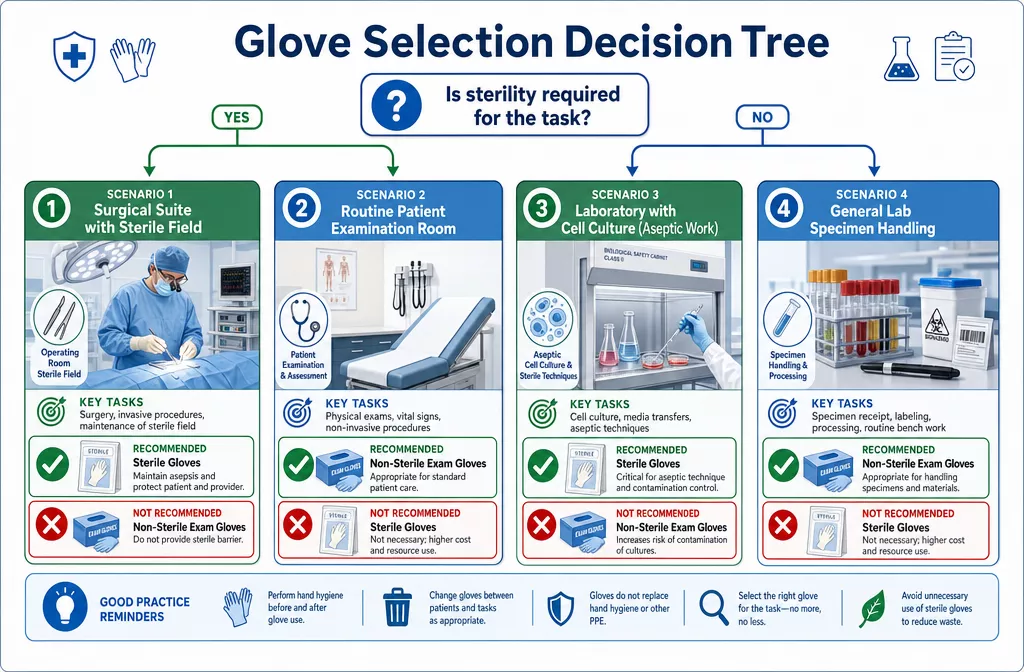
Choosing between sterile and non-sterile options requires understanding the contamination risk of each specific task. The decision framework is straightforward: does the procedure involve a sterile field or invasive access to the body?
Situations Requiring Sterile Nitrile Gloves 🏥
Use sterile gloves when:
- Surgical procedures: Any operation requiring a sterile field
- Invasive interventions: Central line insertion, catheter placement, wound debridement
- Sterile compounding: Preparing IV medications or chemotherapy in pharmacy clean rooms
- Sterile culture work: Inoculating media or handling sterile laboratory specimens
- High-risk wound care: Deep or complex wounds where infection could be catastrophic
For hospital settings requiring both surgical and exam gloves, review our comprehensive guide on nitrile gloves for hospitals.
When Non-Sterile Gloves Are Appropriate ✅
Non-sterile exam gloves are suitable for:
- Routine physical examinations: Taking vital signs, general patient assessment
- Dental procedures: Cleanings, non-surgical dental work
- Laboratory specimen handling: Processing blood samples, handling non-sterile cultures
- Environmental cleaning: Disinfecting surfaces, handling contaminated materials
- Contact precautions: Protecting against body fluid exposure during patient care
- General barrier protection: Food handling, chemical handling, cleaning tasks
Research shows that for minor skin surgeries and standard laceration repair in outpatient settings, high-quality non-sterile exam gloves do not significantly increase infection risk compared to sterile gloves when proper technique is maintained.
For laboratory-specific guidance, see our article on powder-free nitrile gloves for chemistry labs.
The Gray Areas: Clinical Judgment Matters 🤔
Some procedures fall into a middle zone where clinical judgment and facility protocols guide the choice:
| Procedure Type | Typical Choice | Considerations |
|---|---|---|
| Simple laceration repair | Non-sterile acceptable | Clean wound, low infection risk |
| Complex laceration (deep, contaminated) | Sterile preferred | Higher infection risk |
| Routine IV insertion | Non-sterile acceptable | Skin prep reduces contamination |
| PICC line insertion | Sterile required | Direct vascular access |
| Routine specimen collection | Non-sterile sufficient | No sterile field needed |
| Sterile fluid collection | Sterile required | Maintaining specimen sterility |
Practical Considerations: Packaging, Shelf Life, and Cost Management
Beyond the sterile/non-sterile distinction, several operational factors affect glove selection and inventory management in 2026.
Packaging Integrity and Storage 📋
Sterile gloves require careful handling:
- Store in original packaging until use
- Check for package integrity before opening
- Once opened, sterility is immediately lost—use immediately or discard
- Typical shelf life: 3-5 years when stored properly
- Avoid exposure to extreme temperatures or humidity
Non-sterile gloves offer more flexibility:
- Can be stored in open dispensers for convenient access
- Remain usable until physically damaged or contaminated
- Longer practical shelf life due to less stringent storage requirements
- Bulk packaging reduces per-unit storage space
Understanding how long nitrile gloves last helps optimize inventory rotation and reduce waste.
Cost Considerations 💰
The price difference between sterile and non-sterile nitrile gloves is significant:
- Sterile gloves: $1.50-$4.00+ per pair (depending on quality and features)
- Non-sterile exam gloves: $0.08-$0.25 per glove ($0.16-$0.50 per pair)
For a facility performing 1,000 routine procedures monthly, using sterile gloves unnecessarily could waste $18,000-$42,000 annually compared to appropriate non-sterile glove use.
Quality Standards Apply to Both Types ⭐
Whether sterile or non-sterile, quality nitrile gloves should meet:
- ASTM D6319 (nitrile exam glove standard) or ASTM D3577 (surgical glove standard)
- FDA 510(k) clearance for medical use
- AQL (Acceptable Quality Level) ratings for defects (typically 1.5 or better)
- Appropriate thickness for the task (typically 3-6 mil for exam gloves, 5-8 mil for surgical)
For guidance on selecting appropriate thickness, review our article on the best thickness for nitrile gloves.
Sterilization Method Matters for Sensitive Applications 🔬
Some laboratory and pharmaceutical applications require awareness of the sterilization method:
- Gamma irradiation can potentially affect certain chemical-sensitive applications
- Ethylene oxide requires adequate aeration time to remove residual gas
- For applications involving sensitive cell cultures or analytical chemistry, verify the sterilization method won’t interfere with your work
Note that while sterile gloves can be purchased pre-sterilized, standard nitrile gloves cannot be autoclaved for re-sterilization—they will degrade under autoclave conditions.
Making the Right Choice: A Decision Framework
When selecting between sterile and non-sterile nitrile gloves for your facility, follow this systematic approach:
Step 1: Assess the Task Risk Level 🎯
Ask these key questions:
- Does the procedure involve a sterile field? (Yes = sterile gloves)
- Will you have invasive access to body cavities or bloodstream? (Yes = sterile gloves)
- Are you handling materials that must remain sterile? (Yes = sterile gloves)
- Is this a routine exam or handling task? (Yes = non-sterile acceptable)
Step 2: Review Regulatory and Protocol Requirements 📜
- Check your facility’s infection control policies
- Review relevant professional guidelines (CDC, WHO, specialty organizations)
- Ensure compliance with accreditation standards (Joint Commission, CAP, etc.)
- Document your decision rationale for quality assurance
Step 3: Consider Practical and Economic Factors 💡
- Calculate volume and frequency of use
- Compare total cost of ownership (purchase price + storage + waste)
- Evaluate staff training needs for proper donning technique
- Plan inventory management to prevent expiration waste
Step 4: Implement and Monitor 📊
- Train staff on appropriate selection criteria
- Establish clear visual cues (color-coded storage, signage)
- Monitor compliance through observation and audits
- Track infection rates and adjust protocols as needed
Conclusion
Understanding sterile vs. non-sterile nitrile gloves: how to choose the right option for medical, lab, and clean handling tasks is essential for patient safety, regulatory compliance, and cost-effective operations in 2026. The key distinction is simple: sterile gloves undergo validated sterilization and are individually packaged for procedures requiring a sterile field or invasive access, while non-sterile exam gloves provide excellent barrier protection for routine examinations, laboratory work, and general handling tasks.
Choosing the right glove type isn’t about always selecting the “highest” level of protection—it’s about matching the glove to the task. Using sterile gloves for routine exams wastes resources without improving outcomes, while using non-sterile gloves for invasive procedures creates unacceptable infection risk.
Take Action Today ✅
- Audit your current glove usage across different departments and procedures
- Develop clear selection guidelines based on task risk assessment
- Train staff on the differences and appropriate selection criteria
- Optimize inventory to stock the right mix of sterile and non-sterile options
- Monitor outcomes to ensure your glove selection strategy protects both patients and budget
By implementing a thoughtful approach to glove selection, healthcare facilities and laboratories can enhance safety, maintain compliance, and optimize spending—ensuring the right protection is always available for every task.