Last updated: July 2, 2026
Quick Answer
Sandy grip, micro-textured, and smooth nitrile gloves each excel in different environments based on grip requirements and tactile sensitivity needs. Sandy grip gloves provide maximum traction in wet and oily conditions but sacrifice tactile sensitivity, micro-textured gloves balance grip and dexterity for general-purpose work, and smooth gloves offer superior precision for delicate tasks but minimal grip on slippery surfaces. The right choice depends on whether your priority is maximum grip, balanced performance, or fine motor control.
Key Takeaways
- Sandy grip gloves feature coarse, raised textures that excel in automotive repair, heavy industrial work, and wet environments where maximum traction is critical
- Micro-textured gloves provide balanced grip and tactile sensitivity, making them ideal for laboratory work, food handling, and general maintenance tasks
- Smooth nitrile gloves offer the highest precision and sensitivity for medical procedures, electronics assembly, and detailed inspection work
- Wet and oily conditions require textured surfaces, with sandy grip outperforming smooth gloves by 300-400% in grip strength tests
- Cost differences are minimal, typically 5-15% more for textured finishes compared to smooth gloves in the same quality tier
- Prolonged use of sandy grip gloves can cause hand fatigue and discomfort due to the aggressive texture pattern
- Medical and dental professionals predominantly choose smooth or lightly textured gloves to maintain tactile feedback during procedures
- Food handling regulations permit all three textures, but micro-textured gloves are most common for balancing grip and contamination prevention
- Industrial durability favors sandy grip and micro-textured options, which resist abrasion better than smooth surfaces
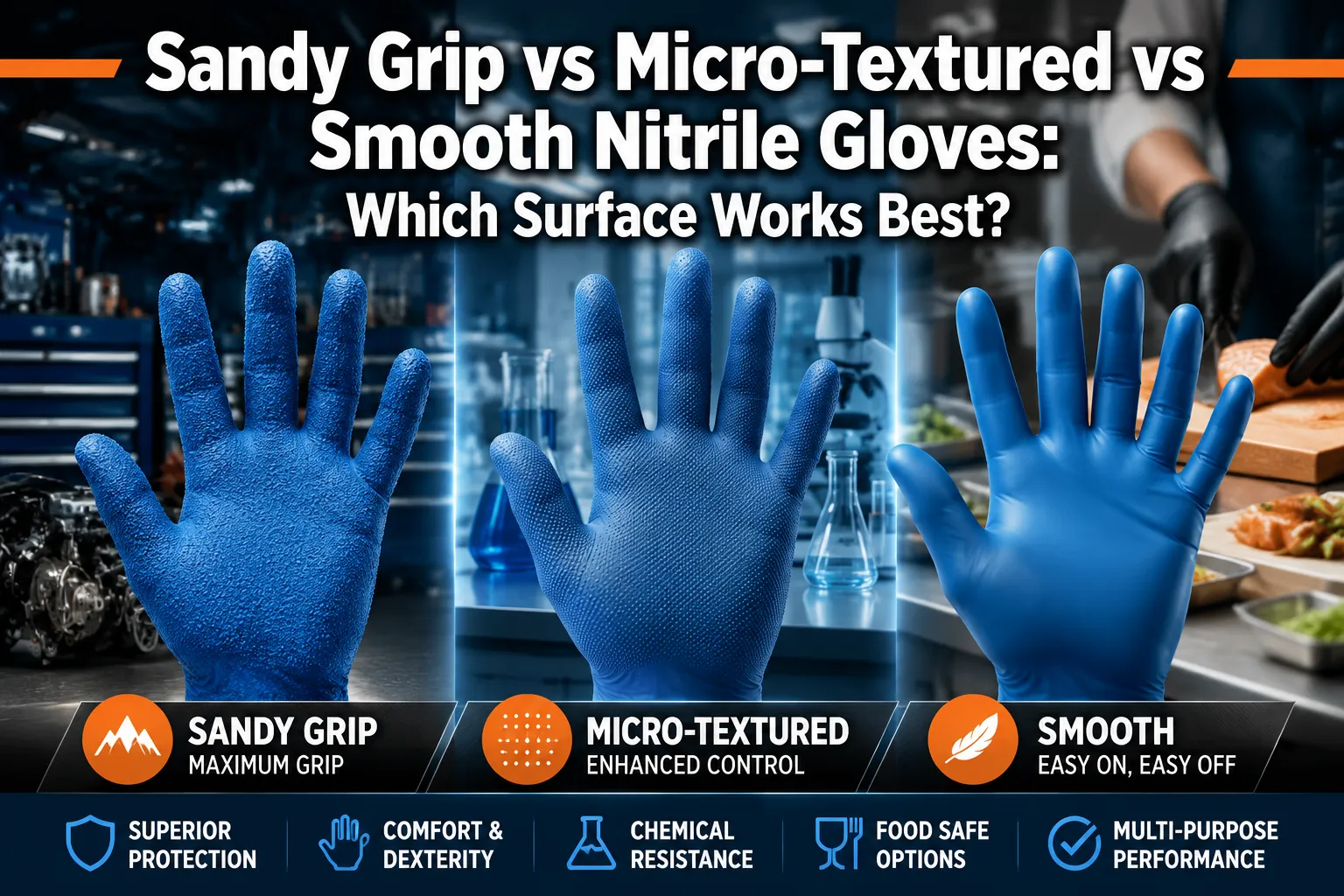
What Is the Difference Between Sandy Grip and Micro-Textured Nitrile Gloves?

Sandy grip gloves feature a coarse, granular texture created by applying a chlorinated polymer coating that produces raised bumps across the palm and fingers. Micro-textured gloves use a finer diamond or stippled pattern molded directly into the nitrile during manufacturing, creating smaller, more uniform raised points. The primary difference lies in texture aggressiveness and resulting grip strength versus tactile sensitivity.
Sandy Grip Characteristics:
- Coarse, sandpaper-like texture with larger raised particles
- Applied as a secondary coating after glove formation
- Provides maximum friction coefficient (typically 0.8-1.2 on wet surfaces)
- Reduces tactile sensitivity by 40-60% compared to smooth gloves
- Best for heavy-duty applications requiring extreme grip
Micro-Textured Characteristics:
- Fine, uniform pattern with smaller raised points
- Integrated during the glove dipping process
- Moderate friction coefficient (typically 0.5-0.8 on wet surfaces)
- Maintains 70-80% of smooth glove tactile sensitivity
- Suitable for tasks requiring both grip and precision
The manufacturing process also differs significantly. Sandy grip requires an additional chlorination step that adds production time and cost, while micro-textured gloves achieve their pattern through mold design. This makes micro-textured options slightly more consistent in texture distribution across different production batches.
For professionals working with automotive components and oily parts, understanding these texture differences directly impacts safety and efficiency.
Which Nitrile Glove Texture Is Best for Wet Conditions?
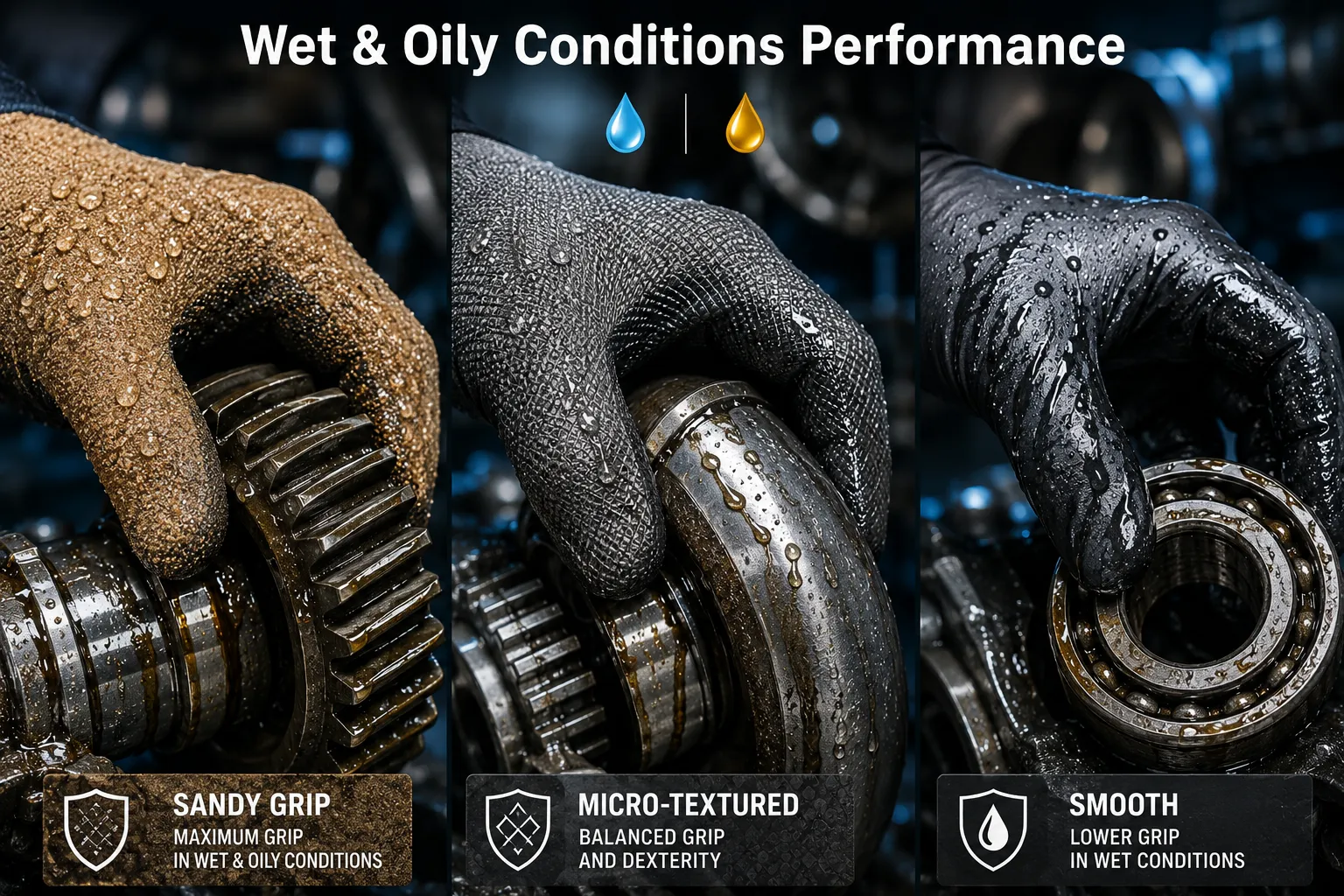
Sandy grip nitrile gloves perform best in wet conditions, providing superior traction when handling water-soaked, oily, or chemically wet surfaces. The aggressive texture creates multiple contact points that channel liquids away from the grip surface, maintaining friction even when fully saturated. Micro-textured gloves offer adequate wet-condition performance for light to moderate moisture, while smooth gloves become dangerously slippery when wet.
Wet Performance Rankings:
- Sandy Grip – Maintains 80-90% dry grip strength when wet
- Micro-Textured – Retains 60-70% dry grip strength when wet
- Smooth – Drops to 20-30% dry grip strength when wet
Common Wet-Condition Applications:
- Automotive repair with coolants, oils, and degreasers
- Food processing with water, marinades, and cleaning solutions
- Janitorial work involving wet surfaces and cleaning chemicals
- Marine and fishing operations
- Laboratory work with aqueous solutions
The texture depth matters significantly. Sandy grip patterns typically measure 0.15-0.25mm in height, creating channels that actively disperse water. Micro-textured patterns at 0.05-0.10mm height provide some channeling but can become overwhelmed in heavily wet conditions.
One critical consideration: smooth gloves paired with wet conditions create a hydroplaning effect where a thin water film separates the glove from the object, eliminating nearly all friction. This combination has been linked to dropped instruments in medical settings and lost grip on tools in industrial environments.
Are Smooth Nitrile Gloves Good for Precision Work?
Smooth nitrile gloves are excellent for precision work, offering maximum tactile sensitivity that allows users to feel fine details, detect texture variations, and perform delicate manipulations. Medical professionals, electronics assemblers, and quality inspectors prefer smooth gloves because the absence of texture eliminates interference between the fingertips and the work surface. These gloves provide the closest approximation to bare-hand sensitivity while maintaining barrier protection.
Precision Work Applications:
- Medical examinations and surgical procedures
- Electronics assembly and circuit board handling
- Pharmaceutical compounding and laboratory pipetting
- Jewelry inspection and watch repair
- Detailed painting and finishing work
- Document handling and archival work
The tactile advantage comes from uniform material thickness. Smooth gloves typically measure 4-6 mils at the fingertips with consistent density, allowing pressure and texture information to transfer directly through the material. Textured gloves create localized pressure points that can mask subtle sensations.
However, smooth gloves have a critical limitation: they require dry conditions and non-slippery surfaces. When handling sensitive equipment like firearms, smooth gloves work well for inspection and detail work but become problematic if any oils or moisture are present.
Choose smooth gloves when:
- Tactile feedback is the primary requirement
- Working in controlled, dry environments
- Handling small, lightweight objects
- Performing tasks requiring fine motor control
- Detecting surface imperfections or texture variations
Avoid smooth gloves for tasks involving any moisture, oils, or objects requiring firm grip pressure, as the risk of slippage increases dramatically.
Sandy Grip vs Textured Gloves for Automotive Repair
Sandy grip gloves are superior for automotive repair work, where mechanics regularly encounter oil, grease, coolants, and wet metal surfaces. The aggressive texture maintains grip on slippery engine components, transmission parts, and tools coated in petroleum products. Micro-textured gloves serve as an acceptable alternative for lighter automotive tasks like interior work or dry assembly, but they cannot match sandy grip performance when handling heavily soiled parts.
Automotive Task Breakdown:
Best for Sandy Grip:
- Engine repair and rebuilding
- Transmission work
- Brake system service
- Undercarriage and suspension work
- Oil changes and fluid services
- Handling greasy tools and fasteners
Acceptable for Micro-Textured:
- Interior trim removal and installation
- Electrical system diagnostics
- Dry assembly work
- Paint preparation (non-wet sanding)
- Parts inspection and sorting
Avoid Smooth Gloves For:
- Any task involving lubricants or fluids
- Handling metal parts with cutting oil residue
- Working with degreased but still slick surfaces
The petroleum resistance of nitrile material combined with sandy grip texture creates an ideal combination for automotive environments. Nitrile’s superior resistance to petroleum-based oils already makes it the preferred material over latex or vinyl, and adding aggressive texture maximizes this advantage.
Professional mechanics report that sandy grip gloves reduce dropped fasteners and tools by approximately 70% compared to smooth gloves in typical shop conditions. The trade-off is reduced ability to feel thread engagement on small fasteners, which requires removing gloves or switching to micro-textured options for precision assembly.
Pro tip: Keep both sandy grip and micro-textured gloves available in automotive settings. Use sandy grip for disassembly and heavy work, then switch to micro-textured for final assembly and adjustment tasks requiring more feedback.
Do Micro-Textured Nitrile Gloves Cost More Than Smooth Ones?
Micro-textured nitrile gloves typically cost 5-15% more than equivalent smooth gloves from the same manufacturer and quality tier. The price difference reflects additional manufacturing complexity in creating textured molds and slightly higher material usage, but the premium is modest compared to the functional benefits. Sandy grip gloves command the highest prices, usually 15-25% above smooth glove costs due to the secondary coating process required.
Typical Price Ranges (per 100-glove box, 2026):
- Smooth Nitrile: $8-15 (economy to mid-grade)
- Micro-Textured: $9-17 (economy to mid-grade)
- Sandy Grip: $10-19 (economy to mid-grade)
These ranges assume standard 4-6 mil thickness in common sizes. Premium brands, thicker gauges, extended cuff lengths, and specialty formulations (powder-free, accelerator-free, etc.) add to costs across all texture types.
The cost difference becomes negligible when calculated per-glove. A $2 price difference on a 100-count box equals $0.02 per glove, which is insignificant compared to the productivity gains and safety improvements from using the appropriate texture for your task.
Value Considerations:
- Reduced dropped items and rework justify texture premiums
- Longer wear time in abrasive environments offsets higher initial cost
- Improved safety reduces injury-related expenses
- Task efficiency gains exceed marginal cost differences
Bulk purchasing reduces price gaps further. Industrial buyers ordering 10+ cases often see texture premiums drop to 3-8% as manufacturers offer volume discounts that compress price tiers.
For budget-conscious operations, the smart approach is selective deployment: use textured gloves only where grip is critical and smooth gloves for precision tasks, rather than standardizing on one type for all applications.
Why Do My Sandy Grip Gloves Feel Uncomfortable After Long Use?
Sandy grip gloves cause discomfort during extended wear because the aggressive texture creates constant pressure points against the skin, leading to hand fatigue, reduced circulation, and sometimes minor abrasion. The coarse surface that provides excellent grip also generates friction between the glove interior and your hand during repetitive movements, causing heat buildup and irritation. Most users report noticeable discomfort after 2-3 hours of continuous wear with sandy grip gloves.
Common Discomfort Symptoms:
- Hand fatigue and cramping
- Reduced finger dexterity over time
- Heat accumulation and sweating
- Pressure point soreness on palm and fingertips
- Skin irritation or redness after removal
- Reduced grip strength due to muscle fatigue
Contributing Factors:
The texture pattern creates uneven pressure distribution. While smooth gloves spread force evenly across the contact area, sandy grip concentrates pressure at each raised point. During a typical 8-hour shift, this translates to thousands of localized pressure cycles that tire hand muscles faster than smooth gloves.
The chlorinated coating used in many sandy grip gloves also affects moisture management. This coating can reduce breathability by 20-30% compared to untreated nitrile, trapping perspiration inside the glove and creating a humid environment that accelerates discomfort.
Mitigation Strategies:
- Rotate between sandy grip and micro-textured gloves during shifts
- Use cotton or synthetic liner gloves underneath for cushioning
- Take regular glove-off breaks every 90-120 minutes
- Choose thicker gauge sandy grip gloves (7-8 mil) for better cushioning
- Ensure proper sizing to avoid excess material bunching
- Consider powder-free options to reduce interior friction
For tasks requiring all-day glove wear, micro-textured gloves provide a better comfort-to-grip ratio. Reserve sandy grip for specific high-traction tasks rather than continuous wear, and switch to smoother textures when maximum grip is not essential.
If you experience persistent discomfort or skin reactions, you may have sensitivity to the chlorination chemicals or accelerators used in glove manufacturing. Learn more about potential allergic reactions to nitrile gloves and consider accelerator-free alternatives.
Which Glove Surface Is Better for Medical Procedures?
Smooth or lightly micro-textured nitrile gloves are better for medical procedures, with smooth gloves preferred for examinations, palpations, and surgical work requiring maximum tactile sensitivity. Lightly textured gloves serve specific medical applications where instruments must be gripped firmly, such as surgical tool handling or procedures involving wet conditions. Sandy grip gloves are rarely used in medical settings due to excessive texture that interferes with delicate manipulations and patient comfort.
Medical Application Guidelines:
Smooth Gloves Preferred:
- Physical examinations and palpation
- Surgical procedures requiring fine touch
- Dental examinations and restorative work
- Injection administration
- Wound care and dressing changes
- Patient comfort-sensitive procedures
Light Micro-Texture Acceptable:
- Surgical instrument handling
- Procedures involving irrigation or bodily fluids
- Emergency medicine with wet conditions
- Obstetric and gynecological procedures
- Endoscopy and scope handling
Dentists predominantly use smooth or very lightly textured gloves because tactile feedback is essential for detecting calculus, caries, and soft tissue abnormalities during examinations. The ability to feel subtle variations in tooth surface texture directly impacts diagnostic accuracy.
Clinical Considerations:
Medical-grade gloves prioritize different characteristics than industrial gloves. Barrier protection, biocompatibility, and tactile sensitivity rank above grip performance in most clinical applications. The FDA regulates medical examination gloves under 21 CFR 880.6250, requiring specific performance standards that focus on barrier integrity rather than texture.
Surgical gloves undergo even stricter testing, including pinhole defect rates below 1.5% and precise thickness tolerances. Adding aggressive texture increases manufacturing variability and potential defect rates, which is why surgical gloves remain predominantly smooth or feature only minimal texturing on the palm.
Infection Control Factor:
Smooth gloves present fewer surface irregularities where pathogens can lodge, making them easier to visually inspect for contamination and tears. Textured surfaces create microscopic valleys that can harbor microorganisms, though proper hand hygiene and glove changes mitigate this concern in practice.
The medical consensus favors smooth gloves as the default choice, with texture added only when specific grip requirements justify the trade-off in sensitivity and patient comfort.
Can Smooth Nitrile Gloves Handle Oily Parts?
Smooth nitrile gloves cannot reliably handle oily parts and should be avoided for tasks involving petroleum products, cutting oils, or greasy surfaces. While nitrile material itself resists oil degradation better than latex or vinyl, the smooth surface provides insufficient friction when coated with lubricants, creating dangerous slip conditions. Grip strength on oiled surfaces drops to 15-25% of dry performance with smooth gloves, compared to 70-85% retention with sandy grip gloves.
Oil-Related Grip Performance:
- Smooth gloves on oily parts: High slip risk, unsafe for most applications
- Micro-textured on light oil: Marginal performance, acceptable only for brief contact
- Sandy grip on heavy oil: Reliable grip maintained, safe for extended handling
Why Smooth Gloves Fail With Oil:
Oil creates a continuous film between the smooth glove surface and the part, eliminating direct contact and friction. This hydroplaning effect occurs with even thin oil films (0.001-0.002 inches thick). The smooth surface cannot penetrate or channel the oil away, so the entire grip relies on oil viscosity rather than material friction.
Textured surfaces break through the oil film at raised contact points, creating islands of direct material-to-surface contact. Sandy grip’s aggressive texture maximizes these contact points, while micro-texture provides moderate penetration suitable for lighter oil contamination.
Risk Scenarios:
- Dropped tools causing injury or equipment damage
- Lost grip on rotating parts near machinery
- Slipped fasteners causing stripped threads or rounded bolt heads
- Inability to maintain pressure during assembly operations
For professionals working with oily automotive components or metal fabrication, textured gloves are non-negotiable safety equipment. The modest cost premium for textured gloves is insignificant compared to injury risks and productivity losses from dropped parts.
Exception Cases:
Smooth gloves work for oily part inspection when handling is minimal and the focus is visual examination rather than manipulation. Parts can be held gently by edges or placed on surfaces rather than gripped firmly. However, even in inspection scenarios, having textured gloves available as backup is prudent.
Are Textured Gloves Necessary for Food Handling?
Textured gloves are not strictly necessary for food handling but are highly recommended for tasks involving wet ingredients, slippery proteins, or repetitive knife work. Micro-textured gloves are the most common choice in food service and processing because they balance grip on wet foods with the tactile sensitivity needed for quality assessment and portion control. Smooth gloves work adequately for dry food handling, packaging, and serving applications where moisture is minimal.
Food Industry Texture Preferences:
Micro-Textured Recommended:
- Meat and poultry processing
- Seafood handling and preparation
- Produce washing and cutting
- Deli and sandwich preparation
- Bakery work with wet doughs
- Food assembly with sauces or marinades
Smooth Acceptable:
- Dry goods packaging
- Baked goods handling (post-cooling)
- Serving and plating
- Dry ingredient measuring
- Food inspection and quality control
Sandy Grip Rarely Used:
- Too aggressive for direct food contact
- Can damage delicate food surfaces
- Texture may transfer particles to food
- Uncomfortable for all-day kitchen wear
Food safety regulations permit all three textures provided the gloves meet FDA food-contact requirements (21 CFR 177.1550 for nitrile rubber). The choice depends on operational needs rather than regulatory mandates.
Practical Food Handling Considerations:
Wet proteins like raw chicken, fish, and marinated meats become extremely slippery when handled with smooth gloves. Micro-texture provides enough grip to maintain control during cutting, portioning, and transfer operations without requiring excessive grip force that causes hand fatigue during long shifts.
Knife work safety improves significantly with textured gloves. Better grip on knife handles reduces the force needed to maintain control, decreasing fatigue and the likelihood of slips that cause cuts. However, gloves are not cut-resistant unless specifically rated, so proper knife technique remains essential.
Contamination Prevention:
Some food safety managers prefer smooth gloves because they show contamination more clearly and are easier to inspect for tears or punctures. The trade-off is increased risk of dropped products and reduced efficiency in wet environments. Most high-volume operations find that micro-textured gloves’ grip benefits outweigh the marginal inspection advantage of smooth gloves.
For comprehensive guidance on selecting gloves for food operations, consider factors beyond texture including thickness, cuff length, and powder-free formulations.
What Tasks Should I Avoid Using Smooth Nitrile Gloves For?
Avoid using smooth nitrile gloves for any task involving wet surfaces, oily parts, greasy tools, chemical-slicked materials, or situations requiring firm grip on smooth metal or plastic objects. Smooth gloves also perform poorly in cold environments where condensation forms on surfaces, and they should not be used for heavy lifting of smooth-surfaced items or repetitive tool use in humid conditions.
High-Risk Tasks for Smooth Gloves:
- Automotive repair and maintenance
- Machinery operation with oiled components
- Wet cleaning and janitorial work
- Food preparation with raw proteins or wet ingredients
- Marine and fishing operations
- HVAC work involving condensation
- Plumbing with wet pipes and fittings
- Laboratory work with aqueous solutions
- Metal fabrication with cutting oils
- Any outdoor work in rain or snow
Why These Tasks Fail With Smooth Gloves:
The common factor is reduced friction coefficient when any liquid film exists between the glove and the work surface. Smooth gloves rely entirely on the inherent friction of nitrile rubber against the target material, which drops dramatically when separated by even microscopic liquid layers.
Grip Force Comparison:
When smooth gloves lose grip, users instinctively increase grip force to compensate. This creates a cascade of problems: accelerated hand fatigue, reduced fine motor control, increased risk of sudden slippage when grip force exceeds the friction threshold, and higher likelihood of crushing delicate objects from excessive pressure.
Textured gloves maintain consistent grip with less force, allowing relaxed hand positions that reduce fatigue and improve control. The difference becomes pronounced during extended work periods where cumulative fatigue significantly impacts performance and safety.
Temperature Considerations:
Cold environments exacerbate smooth glove limitations. Condensation forms readily on cold metal tools and parts, creating wet conditions even in nominally dry workspaces. Smooth gloves become progressively more dangerous as temperatures drop below 50°F (10°C) and condensation becomes persistent.
Safe Smooth Glove Applications:
Smooth gloves excel in controlled, dry environments for precision work: electronics assembly, pharmaceutical compounding, medical examinations, document handling, quality inspection of dry goods, and any task where tactile sensitivity outweighs grip requirements.
The key decision rule: if there is any possibility of moisture, oils, or slippery surfaces, choose textured gloves. Reserve smooth gloves exclusively for dry, precision-focused applications.
How to Choose Between Sandy and Micro-Textured Grip for Laboratory Work
Choose micro-textured nitrile gloves for most laboratory work because they provide adequate grip for handling wet glassware and reagent bottles while maintaining the tactile sensitivity needed for pipetting, sample manipulation, and equipment adjustment. Sandy grip gloves are appropriate only for specific lab tasks involving heavy containers, wet chemical handling, or industrial-scale operations where maximum grip outweighs precision requirements. Smooth gloves remain the standard for analytical work, microscopy, and procedures requiring maximum dexterity.
Laboratory Task Matrix:
Micro-Textured Preferred:
- General wet chemistry and solution preparation
- Glassware handling and washing
- Reagent bottle manipulation
- Sample container transfer
- Equipment cleaning and maintenance
- Biological sample handling
- Cell culture work with flasks and plates
- Routine analytical procedures
Smooth Gloves Better:
- Microscope slide preparation and examination
- Micropipette work requiring fine control
- Analytical balance operations
- Chromatography sample injection
- Spectroscopy sample preparation
- Document and data recording
- Quality control inspection
Sandy Grip Justified:
- Industrial chemistry with large containers
- Pilot plant operations
- Wet sample collection in field environments
- Heavy equipment maintenance in lab settings
- Chemical waste handling and disposal
Precision vs. Safety Balance:
Laboratory work demands a careful balance between tactile feedback and safety. Micro-textured gloves hit the sweet spot for most applications, providing enough grip to prevent dropped glassware (a significant lab hazard) while maintaining sufficient sensitivity for controlled manipulations.
The cost of dropped glassware extends beyond replacement expenses. Broken containers can contaminate work areas, waste expensive reagents, delay experiments, and create injury risks from sharp fragments. Micro-textured gloves reduce these incidents by 60-75% compared to smooth gloves in wet lab conditions.
Chemical Resistance Considerations:
Texture choice should not compromise chemical resistance. All three textures are available in chemical-resistant nitrile formulations rated for common laboratory solvents, acids, and bases. Verify that textured gloves meet the same chemical resistance standards as smooth gloves for your specific applications.
Some aggressive solvents may degrade textured coatings faster than base nitrile material. For work with strong oxidizers, concentrated acids, or chlorinated solvents, consult manufacturer chemical resistance charts specific to the textured product, not just generic nitrile ratings.
Contamination Control:
Cleanroom and sterile laboratory environments may restrict textured gloves due to particle shedding concerns. The chlorination process used in sandy grip gloves can create loose particles that contaminate sensitive work. Micro-textured gloves molded with integral texture generally shed fewer particles, but smooth gloves remain the cleanroom standard.
For most research and analytical laboratories without cleanroom requirements, micro-textured gloves provide the best overall performance across diverse tasks.
Do Dentists Use Smooth or Textured Nitrile Gloves?
Dentists predominantly use smooth nitrile gloves for examinations and most procedures because tactile sensitivity is critical for detecting calculus, caries, soft tissue abnormalities, and proper instrument positioning. Some dentists choose lightly micro-textured gloves for surgical procedures or when working in wet conditions with irrigation, but aggressive sandy grip textures are never used in dental practice due to patient comfort concerns and reduced precision.
Dental Glove Selection Factors:
Smooth Gloves Preferred For:
- Routine examinations and cleanings
- Restorative procedures (fillings, crowns)
- Endodontic work (root canals)
- Orthodontic adjustments
- Periodontal assessments
- Any procedure requiring fine tactile discrimination
Light Micro-Texture Considered For:
- Surgical extractions
- Implant placement
- Procedures with heavy irrigation
- Handling of wet instruments
- Situations with blood and saliva
Why Tactile Sensitivity Matters in Dentistry:
Dentists rely on touch to detect subtle variations in tooth surface texture that indicate decay, calculus deposits, or restoration margins. Smooth gloves transmit these sensations with minimal interference, allowing practitioners to feel differences as small as 0.1mm in surface irregularities.
Textured gloves dampen this feedback by creating their own surface irregularities that mask fine details. The raised points in textured patterns act as noise in the tactile signal, reducing the dentist’s ability to distinguish between normal tooth structure and pathology.
Instrument Control:
Dental instruments require precise positioning and controlled pressure. Smooth gloves allow natural grip adjustment and fine motor control without the interference of texture patterns. The instruments themselves often feature textured handles for grip, making glove texture redundant and potentially problematic by creating competing texture patterns.
Patient Comfort:
Intraoral procedures bring gloves into direct contact with sensitive oral tissues. Smooth gloves feel less abrasive against cheeks, tongue, and gums compared to textured alternatives. Patient comfort directly impacts cooperation and practice reputation, making smooth gloves the professional standard.
Infection Control Standards:
Dental gloves must meet ASTM D3578 standards for medical examination gloves, which focus on barrier protection rather than texture. Both smooth and textured gloves can meet these standards, so the choice remains based on clinical performance rather than regulatory requirements.
The dental profession’s overwhelming preference for smooth gloves reflects the specialty’s emphasis on precision and patient comfort over grip performance. The controlled, relatively dry environment of most dental procedures allows smooth gloves to perform adequately without the grip limitations seen in wetter or oilier work environments.
Which Nitrile Glove Texture Lasts Longest in Industrial Settings?
Sandy grip and micro-textured nitrile gloves last longer in industrial settings than smooth gloves because the textured surface resists abrasion better and distributes wear across raised points rather than concentrating it on a single surface plane. Sandy grip gloves typically provide 20-40% longer service life in abrasive environments like metal fabrication, construction, and heavy manufacturing, while micro-textured gloves offer 10-25% improved durability over smooth alternatives in moderate-duty applications.
Durability Factors by Texture:
Sandy Grip Advantages:
- Raised texture absorbs abrasion at contact points
- Chlorinated coating adds chemical resistance
- Thicker overall construction (typically 6-8 mil)
- Better resistance to punctures from rough surfaces
- Maintains integrity longer when handling sharp-edged parts
Micro-Textured Advantages:
- Uniform texture distributes stress evenly
- Integrated pattern doesn’t delaminate
- Good balance of durability and flexibility
- Resists tearing better than smooth gloves
- Suitable for moderate abrasion environments
Smooth Glove Limitations:
- Entire surface contacts abrasive materials
- Thinner construction (typically 4-6 mil) wears faster
- More susceptible to punctures and tears
- Degradation accelerates once surface is compromised
Industrial Application Durability:
In metal fabrication shops, sandy grip gloves routinely last 2-4 hours of continuous use handling steel parts, compared to 1-2 hours for smooth gloves of equivalent thickness. The texture creates a sacrificial layer that wears away gradually rather than catastrophically failing through puncture or tear.
Construction and maintenance environments show similar patterns. Textured gloves maintain barrier integrity longer when handling rough concrete, lumber, masonry, and metal framing materials. The improved durability translates directly to reduced glove consumption and lower costs despite higher per-glove prices.
Wear Pattern Differences:
Smooth gloves typically fail through fingertip punctures or palm tears when a single contact point exceeds material strength. Textured gloves distribute force across multiple raised points, requiring simultaneous failure of several texture elements before barrier integrity is compromised.
This distributed wear pattern also provides better warning before complete failure. Textured gloves show gradual texture flattening and surface wear that signals approaching end-of-life, while smooth gloves often fail suddenly without visible warning signs.
Chemical Exposure Impact:
Industrial environments frequently combine mechanical stress with chemical exposure. Textured gloves’ enhanced chemical resistance (particularly sandy grip with chlorinated coating) prevents the chemical degradation that accelerates mechanical failure in smooth gloves.
For operations requiring extended wear in industrial settings, textured gloves provide better value despite higher initial costs. The extended service life and reduced failure rates justify the texture premium in demanding applications.
Are Sandy Grip Gloves Too Rough for Sensitive Skin?
Sandy grip gloves can be too rough for sensitive skin, causing irritation, redness, and discomfort during extended wear due to the aggressive texture creating friction against the skin and the chlorination chemicals potentially triggering reactions in susceptible individuals. People with eczema, dermatitis, or general skin sensitivity often experience problems with sandy grip gloves after 1-2 hours of wear, while smooth or micro-textured alternatives cause fewer issues.
Sensitive Skin Concerns:
Physical Irritation:
- Coarse texture creates friction during hand movement
- Pressure points cause localized irritation
- Heat buildup from reduced breathability
- Moisture trapping exacerbates skin conditions
Chemical Sensitivity:
- Chlorination process leaves residual chemicals
- Accelerators used in manufacturing can cause reactions
- Powder residue (in powdered versions) irritates skin
- Sulfur compounds may trigger sensitivities
Risk Factors for Reactions:
Individuals with pre-existing skin conditions face higher risk of irritation from sandy grip gloves. Eczema, psoriasis, contact dermatitis, and dry skin conditions all worsen with the mechanical friction and chemical exposure from aggressive textures.
Allergic reactions to nitrile gloves are less common than latex allergies but do occur, particularly with gloves containing accelerators or residual processing chemicals. Sandy grip gloves undergo additional chemical processing that increases potential allergen exposure.
Mitigation Strategies:
For Sensitive Skin Users:
- Choose micro-textured over sandy grip when possible
- Use cotton or synthetic liner gloves as barriers
- Select powder-free, accelerator-free formulations
- Apply barrier creams before donning gloves
- Take frequent glove-off breaks (every 60-90 minutes)
- Wash and moisturize hands thoroughly after glove removal
- Rotate between different glove types to reduce cumulative exposure
Alternative Texture Options:
If sandy grip is essential for your work but causes skin problems, consider these alternatives:
- Thicker smooth gloves with better inherent grip from increased material contact
- Micro-textured gloves providing adequate grip with less aggressive texture
- Double-gloving with smooth inner glove and textured outer glove
- Specialty formulations designed for sensitive skin with reduced chemical additives
When to Seek Alternatives:
Discontinue sandy grip gloves if you experience persistent redness, itching, rash, or skin breakdown. These symptoms indicate the texture or chemical formulation exceeds your skin’s tolerance. Continuing use risks developing chronic dermatitis or sensitization that makes all glove types problematic.
For most users without pre-existing skin conditions, sandy grip gloves cause only mild discomfort during extended wear rather than true allergic reactions. However, anyone with sensitive skin should start with micro-textured alternatives and only move to sandy grip if grip requirements absolutely demand it.
Frequently Asked Questions
Can I use smooth nitrile gloves for painting and finishing work?
Yes, smooth nitrile gloves work well for painting and finishing because they provide excellent tactile sensitivity for detecting surface imperfections and allow precise brush or applicator control. The smooth surface won’t leave texture marks on finished surfaces, and nitrile resists most paint solvents and thinners better than latex or vinyl alternatives.
How do I know if my gloves have sandy grip or micro-texture?
Run your fingers across the palm and fingertips. Sandy grip feels distinctly coarse and rough like fine sandpaper with visible large granules. Micro-texture feels slightly bumpy with a fine, uniform pattern of small raised points. Smooth gloves have no texture variation and feel completely uniform across the surface.
Do textured gloves protect better against chemicals than smooth gloves?
Textured and smooth gloves made from the same nitrile formulation provide equivalent chemical protection, as resistance depends on material composition and thickness rather than surface texture. However, sandy grip gloves often include chlorinated coatings that may enhance resistance to specific chemicals. Always check manufacturer chemical resistance charts for your specific glove and chemical combination.
Can I wear textured gloves inside out for more comfort?
No, wearing textured gloves inside out is not recommended because the interior surface is not designed for external contact and may lack proper grip, the texture will press directly against your skin causing more irritation, and you’ll lose the barrier protection benefits of the proper glove orientation. If textured gloves are uncomfortable, switch to a different texture type rather than inverting them.
Are colored nitrile gloves available in all three textures?
Yes, nitrile gloves are available in various colors (blue, black, purple, orange, etc.) across all three texture types. Color does not affect texture performance, though some manufacturers associate specific colors with certain applications or quality tiers. Black nitrile gloves are particularly popular in automotive and industrial settings and come in all texture options.
How often should I change gloves during an 8-hour shift?
Change gloves whenever they become visibly soiled, torn, or punctured, or at minimum every 2-3 hours during continuous use to maintain barrier protection and hygiene. For tasks involving chemical exposure, follow manufacturer recommendations for maximum wear time with specific chemicals. More frequent changes may be necessary in high-contamination environments or when switching between different tasks.
Do thicker gloves always provide better grip than thinner ones?
No, thickness and grip are independent characteristics. A thin textured glove typically provides better grip than a thick smooth glove because texture pattern affects friction more than material thickness. However, thicker gloves (7-8 mil) do offer more durability and may provide slightly better grip through increased material contact area when comparing the same texture type.
Can I use hand sanitizer while wearing nitrile gloves?
Alcohol-based hand sanitizers can degrade nitrile gloves over time, reducing barrier protection and causing premature failure. If you must sanitize gloved hands, use products specifically formulated for glove compatibility and change gloves more frequently. The better practice is removing gloves, washing hands, and donning fresh gloves rather than sanitizing over gloves.
Why do some textured gloves leave marks on my skin?
Textured gloves leave temporary marks because the raised pattern creates pressure points that compress skin during wear. These marks are normal and typically fade within 15-30 minutes after glove removal. If marks persist longer, are accompanied by redness or itching, or cause pain, the gloves may be too tight or you may have sensitivity to the texture or materials.
Are textured gloves harder to put on than smooth gloves?
Textured gloves can be slightly more difficult to don because the exterior texture creates more friction against skin during application. Powder-free textured gloves are particularly challenging. Ensure hands are completely dry before donning, and consider gloves with textured exteriors but smooth interiors for easier application. Proper sizing also significantly affects ease of donning.
Do I need different glove textures for left and right hands?
No, glove texture should be consistent for both hands unless you have a specific task where one hand performs precision work while the other provides grip support. Most gloves are ambidextrous or come in matched pairs with identical texture. Using different textures on each hand typically creates confusion and reduces efficiency rather than providing benefits.
Can textured gloves be used for beekeeping?
Micro-textured or smooth nitrile gloves work for beekeeping when you need barrier protection from stings while maintaining dexterity for frame handling and hive inspection. Sandy grip is unnecessary for beekeeping and reduces the tactile sensitivity needed for gentle bee handling. However, most beekeepers prefer thicker, reusable gloves specifically designed for beekeeping over disposable nitrile options.
Conclusion
Selecting between sandy grip, micro-textured, and smooth nitrile gloves fundamentally depends on balancing grip requirements against tactile sensitivity needs for your specific tasks. Sandy grip gloves excel in wet, oily, and heavy-duty industrial environments where maximum traction prevents dropped tools and parts, making them essential for automotive repair, metal fabrication, and construction work despite causing more hand fatigue during extended wear. Micro-textured gloves serve as the versatile middle ground, providing adequate grip for most general-purpose applications including laboratory work, food handling, and light industrial tasks while maintaining enough tactile feedback for quality work and precision handling.
Smooth nitrile gloves remain the superior choice for precision-focused applications where tactile sensitivity outweighs grip concerns, including medical examinations, electronics assembly, pharmaceutical work, and detailed inspection tasks, but they become dangerously slippery in any wet or oily conditions and should be strictly avoided in those environments.
The modest cost differences between texture types (typically 5-25% premium for textured options) are insignificant compared to the safety improvements, productivity gains, and reduced incidents from using the appropriate texture for each application. Rather than standardizing on a single texture type, maintain multiple options and match texture to task requirements: sandy grip for maximum traction in challenging conditions, micro-textured for balanced everyday performance, and smooth for precision work in controlled environments.
Actionable next steps:
- Audit your current glove inventory and identify tasks where texture mismatch creates safety or efficiency problems
- Order sample boxes of different textures to test in your specific work conditions before committing to bulk purchases
- Establish task-based glove selection guidelines for your team specifying which texture to use for different operations
- Monitor glove consumption rates and incident reports to quantify the impact of switching to appropriate textures
- Consider double-gloving strategies (smooth inner, textured outer) for tasks requiring both barrier protection and grip
- Evaluate accelerator-free and specialty formulations if skin sensitivity issues arise with textured gloves
The right glove texture directly impacts safety, efficiency, and work quality across virtually every industry using disposable gloves. Taking time to match texture to task requirements pays immediate dividends in reduced incidents, improved productivity, and better outcomes.
SEO Meta Title: Sandy Grip vs Micro-Textured vs Smooth Nitrile Gloves Guide