Last updated: June 30, 2026
The U.S. Food and Drug Administration banned powdered medical gloves in January 2017, marking a watershed moment in healthcare safety that forced manufacturers and facilities worldwide to pivot to powder-free alternatives. This regulatory phase-out of powdered gloves, driven by documented health risks from cornstarch powder, has positioned powder-free nitrile gloves as the dominant solution across healthcare, dental, and surgical settings. The compliance roadmap extends beyond the initial FDA ban, with ongoing enforcement, inventory disposal requirements, and parallel regulations emerging in other markets.
Key Takeaways
- The FDA banned powdered surgeon’s gloves, powdered patient examination gloves, and absorbable powder for lubricating gloves effective January 18, 2017, citing unreasonable risk of illness and injury.
- Cornstarch powder in medical gloves causes respiratory complications, post-surgical adhesions, granulomas, and allergic reactions in both patients and healthcare workers.
- Powder-free nitrile gloves have become the industry standard, offering comparable or superior performance without powder-related health risks.
- Healthcare facilities had to dispose of existing powdered glove inventory by the compliance deadline, with no exceptions for stockpiled products.
- The transition to powder-free gloves typically costs 10-20% more per unit but reduces long-term healthcare costs by eliminating powder-related complications.
- Industries outside direct patient care, such as food service and general industrial use, are not covered by the FDA ban but increasingly adopt powder-free options.
- Common transition mistakes include inadequate staff training on donning techniques, insufficient inventory planning, and failure to update procurement specifications.
- Major glove manufacturers discontinued powdered medical glove production entirely, making compliance effectively permanent regardless of regulatory changes.

Why Are Powdered Gloves Being Banned?
Powdered gloves are banned because the cornstarch powder used as a donning lubricant poses serious health risks that outweigh any convenience benefits. The FDA determined that powder can become airborne, carry latex proteins into the respiratory system, cause post-surgical complications, and trigger severe allergic reactions.
The specific health concerns that drove the ban include:
- Respiratory complications: Airborne powder particles irritate airways and can cause asthma-like symptoms in healthcare workers with repeated exposure.
- Post-surgical adhesions: Powder entering surgical sites promotes granuloma formation and internal scarring that can require additional surgeries.
- Allergic sensitization: Powder acts as a carrier for latex proteins, increasing the risk and severity of latex allergies.
- Wound healing interference: Cornstarch particles in wounds can delay healing and increase infection risk.
- Environmental contamination: Powder settles on surfaces and equipment, creating contamination concerns in sterile environments.
The FDA reviewed adverse event reports spanning decades and found consistent patterns of serious complications linked specifically to powder, not the glove material itself. This evidence base made the ban scientifically justified and legally defensible.
Common mistake: Assuming the ban targets latex gloves specifically. The regulation applies to all powdered medical gloves regardless of material, including latex, nitrile, and vinyl. Powder-free latex gloves remain legal for medical use, though nitrile gloves have largely replaced latex due to allergy concerns.
What Is the FDA Regulation on Powdered Medical Gloves?
The FDA regulation banning powdered medical gloves is codified in 21 CFR 878.4460 (powdered surgeon’s gloves) and 21 CFR 880.6250 (powdered patient examination gloves), which went into effect January 18, 2017. The regulation prohibits the introduction or delivery for introduction into interstate commerce of these devices, classifying them as presenting an unreasonable and substantial risk of illness or injury.
Key provisions of the regulation include:
Scope of the ban:
- Powdered surgeon’s gloves (sterile gloves for surgical procedures)
- Powdered patient examination gloves (non-sterile gloves for patient contact)
- Absorbable powder for lubricating surgeon’s gloves (standalone powder products)
Compliance requirements:
- Manufacturers must cease production and distribution of banned products
- Distributors cannot sell or distribute powdered gloves after the effective date
- Healthcare facilities must remove powdered gloves from inventory and use
- No grandfathering or exemptions for existing inventory
Enforcement mechanisms:
- FDA can seize non-compliant products
- Civil penalties for violations
- Warning letters and facility inspections
- Import alerts preventing entry of powdered gloves from foreign manufacturers
The regulation does not require FDA approval for facilities to switch to powder-free alternatives, as powder-free versions of the same glove types remain Class I or Class II medical devices with existing clearances.
Edge case: The ban applies only to medical gloves intended for patient contact or surgical use. Industrial gloves, food service gloves, and other non-medical applications fall outside FDA medical device jurisdiction, though many organizations voluntarily adopted powder-free standards.
When Did the Powdered Glove Ban Take Effect?
The powdered glove ban took effect on January 18, 2017, giving manufacturers, distributors, and healthcare facilities approximately three months from the final rule publication on December 19, 2016, to achieve full compliance. This timeline was deliberately short because the FDA classified powdered gloves as presenting an unreasonable and substantial risk requiring immediate action.
Implementation timeline:
- December 19, 2016: FDA published final rule in Federal Register
- January 18, 2017: Ban became legally enforceable
- January-March 2017: Grace period for inventory depletion (informal, not regulatory)
- April 2017 onward: Active FDA enforcement and inspections
Most major healthcare systems had already begun transitioning away from powdered gloves before the formal ban, as clinical evidence of harm accumulated throughout the 2000s and early 2010s. The regulatory action formalized what had become best practice in leading institutions.
International timeline variations:
- European Union: No EU-wide ban as of 2026, though individual countries and hospital systems have implemented restrictions
- Canada: Health Canada issued advisories but no formal ban equivalent to the U.S. regulation
- Australia: Therapeutic Goods Administration (TGA) has not banned powdered gloves but discourages use through clinical guidelines
Healthcare facilities operating in multiple jurisdictions must navigate varying regulatory landscapes, though the trend globally favors powder-free alternatives regardless of formal mandates.
Difference Between Powdered and Powder-Free Nitrile Gloves
Powdered nitrile gloves contain cornstarch as a donning lubricant, while powder-free nitrile gloves use polymer coating or chlorination to achieve a smooth interior surface that slides onto hands without powder. The performance characteristics, barrier protection, and material composition remain essentially identical; only the donning method differs.
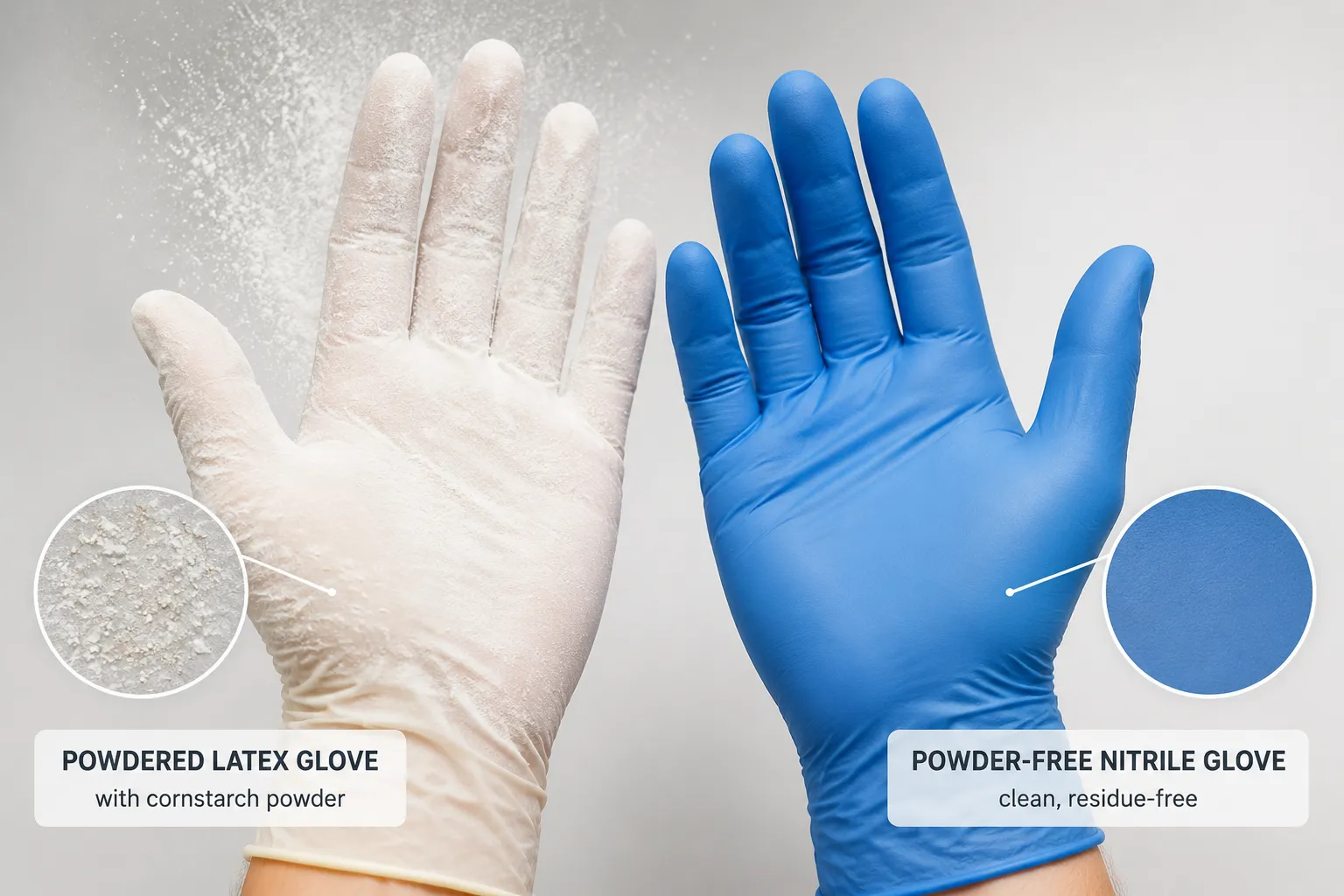
Key differences:
| Feature | Powdered Nitrile | Powder-Free Nitrile |
|---|---|---|
| Donning ease | Very easy, powder lubricates | Easy with polymer coating |
| Health risks | Respiratory issues, allergies, surgical complications | Minimal (material allergies only) |
| Residue | Leaves powder on hands and surfaces | Clean, no residue |
| Sterile field suitability | Not recommended | Fully suitable |
| Cost | 10-20% less expensive | Standard pricing |
| Regulatory status | Banned for medical use (U.S.) | Compliant, preferred |
| Tactile sensitivity | Slightly reduced by powder | Excellent, especially with thin formulations |
Manufacturing differences:
Powder-free nitrile gloves achieve their smooth interior through post-production treatments:
- Polymer coating: A thin layer of synthetic polymer creates a slippery surface
- Chlorination: Chemical treatment modifies the nitrile surface to reduce friction
- Double chlorination: Enhanced process for premium gloves with superior donning ease
These treatments add manufacturing steps and cost but eliminate all powder-related risks. Modern powder-free gloves match or exceed the donning ease of powdered versions, making the performance trade-off negligible.
Choose powder-free nitrile if: You work in healthcare, food service, cleanroom environments, or any setting where contamination control matters. Choose powdered only if you work in non-regulated industrial settings where cost is the primary concern and powder exposure poses no risk.
Are Powder-Free Gloves More Expensive Than Powdered Gloves?
Powder-free gloves typically cost 10-20% more than equivalent powdered gloves due to additional manufacturing processes required to create smooth, easy-donning interior surfaces. However, this upfront cost difference is offset by reduced healthcare costs from eliminated powder-related complications, making powder-free gloves more economical in total cost of ownership.
Price comparison (2026 market averages):
- Powdered nitrile examination gloves: $0.08-0.12 per glove (where still available for non-medical use)
- Powder-free nitrile examination gloves: $0.10-0.15 per glove
- Premium powder-free nitrile with advanced coatings: $0.15-0.25 per glove
Hidden costs of powdered gloves:
- Treatment of powder-related respiratory conditions in staff
- Additional surgeries for post-operative adhesions and granulomas
- Increased cleaning and environmental control in clinical areas
- Potential liability from powder-related adverse events
- Regulatory non-compliance penalties in jurisdictions with bans
Healthcare economic analyses consistently show that powder-free gloves reduce total system costs despite higher purchase prices. A facility using 1 million gloves annually might spend an additional $20,000-40,000 on powder-free options but avoid $100,000+ in powder-related complications.
Procurement tip: Bulk purchasing contracts and long-term supplier agreements can reduce the price gap between powdered and powder-free options to 5-10%, making the economic case even stronger. Many healthcare facilities negotiate volume discounts that effectively eliminate the cost difference.
How to Transition From Powdered to Powder-Free Gloves in Healthcare Facility
Transitioning from powdered to powder-free gloves requires a structured approach covering inventory management, staff training, supplier coordination, and compliance verification. Most healthcare facilities complete the transition in 30-90 days with proper planning.
Step-by-step transition checklist:
Conduct inventory audit (Week 1)
- Count all powdered glove stock by type, size, and location
- Identify expiration dates and storage conditions
- Calculate usage rates to determine replacement quantities
Select powder-free alternatives (Week 1-2)
- Test multiple powder-free brands for fit, comfort, and performance
- Gather staff feedback on donning ease and tactile sensitivity
- Verify regulatory compliance and quality certifications
- Negotiate pricing and delivery terms with suppliers
Develop disposal plan (Week 2)
- Determine if powdered inventory can be returned to supplier
- Identify non-medical uses for remaining stock (if permitted)
- Arrange proper disposal for non-returnable inventory
- Document disposal for compliance records
Train staff on powder-free donning techniques (Week 2-3)
- Demonstrate proper hand hygiene before donning
- Show technique for powder-free gloves (may require slight moisture)
- Address concerns about perceived difficulty
- Provide hands-on practice sessions
Update procurement systems (Week 3)
- Revise purchasing specifications to exclude powdered gloves
- Update inventory management systems with new product codes
- Establish reorder points for powder-free alternatives
- Implement controls to prevent accidental powdered glove orders
Phase in powder-free inventory (Week 3-6)
- Replace powdered stock as it depletes naturally
- Prioritize high-use areas and surgical departments
- Maintain adequate buffer stock during transition
- Monitor usage patterns and adjust orders accordingly
Verify compliance (Week 6-8)
- Conduct facility-wide audit to confirm no powdered gloves remain
- Review purchasing records for compliance
- Document transition completion for regulatory purposes
- Establish ongoing monitoring procedures
Common transition mistakes:
- Switching too quickly without adequate staff training, leading to complaints and resistance
- Failing to test multiple powder-free brands, resulting in poor fit or performance issues
- Inadequate inventory planning causing stockouts during transition
- Not updating procurement specifications, allowing accidental reordering of powdered gloves
- Disposing of powdered inventory prematurely when gradual phase-out would be more economical
Decision rule: If your facility uses more than 100,000 gloves annually, assign a dedicated transition coordinator. Smaller facilities can manage the transition through existing supply chain staff with 5-10 hours of dedicated time.
What Are the Health Risks of Cornstarch Powder in Medical Gloves?
Cornstarch powder in medical gloves causes respiratory irritation, allergic sensitization, post-surgical complications, and wound healing interference. The FDA’s ban decision cited extensive medical literature documenting these risks across multiple patient populations and healthcare worker groups.
Documented health risks:
Respiratory complications:
- Airborne powder particles irritate nasal passages, throat, and lungs
- Repeated exposure can cause occupational asthma in healthcare workers
- Symptoms include coughing, wheezing, shortness of breath, and chest tightness
- Risk increases with cumulative exposure over years of glove use
Allergic reactions:
- Powder acts as a carrier for latex proteins, increasing sensitization risk
- Can trigger severe allergic reactions including anaphylaxis in sensitized individuals
- Creates allergic symptoms even in powder-free environments through residual contamination
- Healthcare workers with latex allergies often must leave clinical roles due to powder exposure
Post-surgical complications:
- Powder entering surgical sites forms granulomas (inflammatory nodules)
- Causes peritoneal adhesions that can lead to bowel obstruction
- Increases risk of post-operative infections
- May require additional surgeries to address powder-related complications
- Documented cases of death from severe powder-related surgical complications
Wound healing interference:
- Cornstarch particles in wounds delay healing
- Can cause chronic inflammation at wound sites
- Increases infection risk by providing growth medium for bacteria
- Particularly problematic in burn treatment and chronic wound care
Environmental contamination:
- Powder settles on surfaces, equipment, and in ventilation systems
- Creates contamination concerns in sterile processing areas
- Difficult to remove completely once dispersed
- Can interfere with sensitive medical equipment
The cumulative evidence showed that powder-related risks affected both patients and healthcare workers, with no safe exposure threshold identified. This risk profile, combined with the availability of effective powder-free alternatives, justified the regulatory ban.
Do Powder-Free Nitrile Gloves Work as Well as Powdered Ones?
Powder-free nitrile gloves perform as well as or better than powdered versions in all critical performance metrics including barrier protection, puncture resistance, chemical resistance, and tactile sensitivity. Modern manufacturing techniques have eliminated any historical performance advantages of powdered gloves.
Performance comparison:
Barrier protection: Identical. The nitrile material provides the barrier, not the powder. Both versions meet the same ASTM and FDA standards for viral and bacterial barrier effectiveness.
Puncture resistance: Equivalent or better in powder-free versions. Some studies show powder-free gloves have slightly higher puncture resistance because manufacturing processes that replace powder (chlorination, polymer coating) can strengthen the material.
Chemical resistance: Identical. Nitrile’s resistance to oils, solvents, and chemicals is material-dependent, not affected by powder presence or absence.
Tactile sensitivity: Better in powder-free gloves. Powder can reduce sensitivity by creating a layer between skin and glove material. Powder-free gloves, especially thin formulations (3-4 mil), provide superior tactile feedback for detailed work.
Donning ease: Comparable with modern powder-free treatments. Early powder-free gloves were harder to don, but current polymer coatings and chlorination processes create surfaces as slippery as powdered versions. Some users report powder-free gloves actually don more smoothly because they don’t clump or stick from powder moisture absorption.
Grip: Better in powder-free gloves. Textured powder-free gloves provide superior grip on instruments and materials compared to powder-coated surfaces that can become slippery when wet.
Durability: Equivalent. Both types meet the same ASTM D6319 standards for nitrile examination gloves, with no difference in expected service life under normal use.
Real-world evidence: The complete transition of U.S. healthcare to powder-free gloves since 2017 has occurred without any documented performance deficits. Surgical outcomes, infection rates, and healthcare worker satisfaction have remained stable or improved, confirming that powder-free alternatives meet all clinical needs.
Choose thicker powder-free gloves (5-6 mil) if: You need extended wear time or work with sharp instruments. For most examination and patient care tasks, standard 3-4 mil powder-free gloves provide optimal performance. Learn more about selecting the right thickness for your application.
Which Industries Still Allow Powdered Gloves?
Industries outside direct patient care can still use powdered gloves legally in the United States, as the FDA ban applies only to medical devices used in healthcare settings. However, many non-medical industries have voluntarily adopted powder-free standards due to contamination concerns and worker safety considerations.
Industries where powdered gloves remain legal:
Food service and food processing: Not covered by the FDA medical device ban, though many food safety programs discourage powder due to contamination risk. Powder can fall into food products and create allergen concerns. Most major food processors have switched to powder-free options. For guidance on food service glove selection, see our comprehensive food glove buying guide.
General industrial and manufacturing: Powdered gloves remain available for automotive work, general maintenance, janitorial services, and light industrial tasks where powder exposure poses no specific risk. Cost considerations drive continued use in some settings.
Automotive and mechanical work: Mechanics and automotive technicians can still use powdered gloves, though powder-free options are increasingly popular for better grip and cleanliness.
Janitorial and cleaning services: Powdered gloves are legal but less common as cleaning chemical exposure can cause powder to become sticky and uncomfortable.
Laboratory work (non-medical): Research labs not involved in patient care can use powdered gloves, though cleanroom and precision work typically requires powder-free to prevent contamination.
Tattoo and body art: Not regulated as medical devices, so powdered gloves remain legal, though most professional tattoo artists prefer powder-free for client safety and cleanliness. See our guide on selecting gloves for tattooing.
Industries that have voluntarily eliminated powdered gloves:
- Pharmaceutical manufacturing (contamination control)
- Electronics assembly (powder interferes with sensitive components)
- Cleanroom operations (powder violates particulate standards)
- Dental practices (adopted medical standards voluntarily)
- Veterinary medicine (follows human healthcare best practices)
Trend: Even in industries where powdered gloves remain legal, market share is declining. Major manufacturers have reduced or eliminated powdered glove production, making powder-free the de facto standard across most professional applications.
Do Food Service Workers Need to Use Powder-Free Gloves?
Food service workers are not legally required to use powder-free gloves under FDA regulations, as the powdered glove ban applies only to medical devices, not food service gloves. However, food safety best practices and many state and local health codes recommend or require powder-free gloves to prevent powder contamination of food products.
Regulatory landscape for food service:
Federal level: The FDA Food Code (model guidance for state and local regulations) does not specifically ban powdered gloves but requires that gloves be suitable for food contact and not introduce contaminants. Powder can be considered a contaminant under general food safety principles.
State and local level: Many jurisdictions have adopted powder-free requirements in food service regulations. Check your local health department requirements for specific mandates.
Industry standards: ServSafe, the National Restaurant Association’s food safety certification program, recommends powder-free gloves to minimize contamination risk.
Practical reasons to use powder-free in food service:
- Powder can fall into food, creating texture and appearance issues
- Cornstarch powder may trigger allergies in sensitive customers
- Powder residue on food contact surfaces creates sanitation concerns
- Powder-free gloves provide better grip on utensils and containers
- Eliminates customer complaints about powder in food
Cost considerations: The price difference between powdered and powder-free food service gloves is minimal (typically $0.01-0.02 per glove), making the switch economically feasible for most operations.
Best practice: Use powder-free nitrile or vinyl gloves for all food handling tasks. Reserve powdered gloves (if used at all) for non-food-contact tasks like cleaning or trash handling. For detailed guidance, review our article on cooking with nitrile gloves.
Common Mistakes When Switching to Powder-Free Gloves
The most common mistakes when switching to powder-free gloves include inadequate staff training, poor product selection, insufficient inventory planning, and failure to update procurement systems. These errors can cause transition delays, staff resistance, and temporary compliance gaps.
Top transition mistakes and solutions:
Mistake 1: Switching brands without testing
- Problem: Different powder-free gloves have varying donning ease, fit, and feel
- Solution: Order sample boxes of 3-5 brands and conduct user trials before bulk purchasing
- Test with actual staff who will use the gloves daily
- Gather feedback on comfort, sizing accuracy, and performance
Mistake 2: Inadequate donning technique training
- Problem: Staff accustomed to powdered gloves may struggle initially with powder-free versions
- Solution: Demonstrate that slightly damp hands (from handwashing) help powder-free gloves slide on easily
- Provide hands-on training sessions, not just written instructions
- Address concerns proactively rather than waiting for complaints
Mistake 3: Ordering wrong sizes
- Problem: Powder-free gloves may fit differently than powdered versions from the same manufacturer
- Solution: Re-evaluate size distribution based on actual fit testing
- Order extra small and extra-large sizes as buffer stock
- Monitor size-specific usage rates during transition
Mistake 4: Insufficient inventory during transition
- Problem: Underestimating usage rates or delivery times causes stockouts
- Solution: Maintain 30-day buffer stock during transition period
- Establish backup suppliers for emergency orders
- Monitor inventory daily during first 60 days
Mistake 5: Not updating procurement specifications
- Problem: Purchasing systems still allow powdered glove orders, causing accidental non-compliance
- Solution: Update all product codes, specifications, and approved vendor lists
- Add system controls that flag or block powdered glove orders
- Train purchasing staff on new requirements
Mistake 6: Disposing of powdered inventory prematurely
- Problem: Throwing away usable powdered gloves wastes money
- Solution: Use powdered inventory for non-patient-care tasks where legal (cleaning, maintenance)
- Negotiate returns with suppliers for unopened boxes
- Donate to non-medical organizations if permitted
Mistake 7: Choosing cheapest powder-free option
- Problem: Low-quality powder-free gloves perform poorly, creating staff dissatisfaction
- Solution: Balance cost with quality and user satisfaction
- Calculate total cost including waste from poor-fitting gloves
- Invest in mid-tier or premium options for clinical staff
Mistake 8: No compliance verification
- Problem: Powdered gloves remain in some storage areas or departments
- Solution: Conduct facility-wide audit 30 days after transition
- Check all storage locations, including emergency carts and satellite clinics
- Document compliance for regulatory inspection readiness
Decision rule: If staff resistance exceeds 20% after two weeks, the problem is usually product selection (wrong brand or size) rather than powder-free gloves generally. Re-test alternative brands before concluding powder-free gloves are the issue.
Are There Any Exceptions to the Powdered Glove Ban?
There are no exceptions to the FDA’s powdered glove ban for medical use in the United States. The regulation applies universally to all powdered surgeon’s gloves, powdered patient examination gloves, and absorbable powder for lubricating gloves, regardless of manufacturer, facility type, or clinical circumstance.
What the ban covers (no exceptions):
- All healthcare facilities (hospitals, clinics, dental offices, surgical centers)
- All medical specialties (surgery, emergency medicine, primary care, etc.)
- All patient populations (adults, children, immunocompromised, etc.)
- All manufacturers and distributors (domestic and international)
- All existing inventory (no grandfathering of stockpiled gloves)
What the ban does NOT cover:
- Non-medical gloves for industrial, food service, or general use
- Powder-free medical gloves of any material (latex, nitrile, vinyl)
- Medical gloves used outside the United States (though many countries follow similar standards)
- Research or laboratory gloves not intended for patient contact
Enforcement approach:
The FDA enforces the ban through:
- Import alerts preventing powdered gloves from entering U.S. commerce
- Facility inspections and warning letters for non-compliance
- Seizure authority for banned products found in distribution
- Civil penalties for knowing violations
International considerations:
Healthcare facilities operating in multiple countries must comply with the most restrictive applicable regulation. A U.S.-based hospital system with international locations should adopt powder-free standards globally to ensure consistent safety practices and simplify supply chain management.
Historical context: The FDA considered but rejected a petition for exceptions in surgical specialties where some practitioners claimed powdered gloves were necessary. The agency determined that powder-free alternatives were available and adequate for all medical applications, making exceptions unjustifiable given the documented risks.
How to Dispose of Old Powdered Glove Inventory After Ban
Dispose of old powdered glove inventory through return to supplier, donation to non-medical organizations, repurposing for non-patient-care tasks, or standard waste disposal. The FDA ban prohibits sale or distribution for medical use but does not mandate specific disposal methods for inventory removed from medical service.
Disposal options ranked by cost-effectiveness:
Option 1: Return to supplier
- Best choice: Negotiate returns with your glove supplier, especially for unopened cases
- Many suppliers accepted returns during the transition period (2016-2017)
- May receive credit toward powder-free glove purchases
- Reduces waste and recovers some investment
Option 2: Repurpose for non-medical use
- Use powdered gloves for housekeeping, maintenance, or facilities tasks where patient contact doesn’t occur
- Appropriate for cleaning, trash handling, or general janitorial work
- Ensures inventory isn’t wasted while maintaining medical compliance
- Track usage separately to confirm no medical use
Option 3: Donate to non-medical organizations
- Some industrial, automotive, or community organizations may accept donations
- Verify recipient understands gloves cannot be used for medical purposes
- Document donation for tax purposes if applicable
- Reduces waste while supporting community organizations
Option 4: Standard waste disposal
- Dispose through regular waste streams (not medical waste)
- Powdered gloves are not hazardous waste unless contaminated
- Consider environmental impact of disposal
- Document disposal for compliance records
Disposal documentation:
Maintain records showing:
- Quantity and type of powdered gloves removed from medical inventory
- Disposal method and date
- Recipient organization (if donated) or waste hauler (if disposed)
- Confirmation that gloves were not sold or distributed for medical use
This documentation demonstrates compliance if questioned during FDA inspections or audits.
What NOT to do:
- Do not sell or give powdered gloves to other healthcare facilities
- Do not distribute to patients or healthcare workers for medical use
- Do not export for medical use in other countries (creates liability)
- Do not store indefinitely hoping regulations will change (they won’t)
Cost recovery: If you have significant powdered glove inventory (more than $10,000 value), consult with your supplier and legal counsel about the best disposal approach. Some facilities recovered 30-50% of inventory value through negotiated returns.
Best Powder-Free Nitrile Glove Brands for Hospitals
The best powder-free nitrile glove brands for hospitals in 2026 include Medline, Cardinal Health, Ansell, Kimberly-Clark, and Sempermed, all offering medical-grade products that meet ASTM standards and FDA requirements. Brand selection should prioritize consistent quality, reliable supply chain, appropriate certifications, and user satisfaction rather than price alone.
Top hospital-grade powder-free nitrile brands:
Medline
- Product lines: Aloetouch, SensiCare, Remedy
- Strengths: Broad size range, consistent quality, strong supply chain
- Best for: Large hospital systems needing high-volume reliability
- Certifications: FDA 510(k), ASTM D6319, ISO 13485
Cardinal Health
- Product lines: Flexal, Esteem
- Strengths: Integrated distribution, competitive pricing for GPO members
- Best for: Facilities using Cardinal as primary distributor
- Certifications: FDA 510(k), ASTM D6319, ISO 13485
Ansell
- Product lines: Micro-Touch, TouchNTuff
- Strengths: Premium quality, excellent tactile sensitivity, specialized formulations
- Best for: Surgical and high-precision applications
- Certifications: FDA 510(k), ASTM D6319, ISO 13485, EN 455
Kimberly-Clark
- Product lines: Purple Nitrile, Lavender Nitrile
- Strengths: Distinctive colors for easy identification, comfortable fit
- Best for: Facilities prioritizing user comfort and satisfaction
- Certifications: FDA 510(k), ASTM D6319, ISO 13485
Sempermed
- Product lines: Sempercare, Semperguard
- Strengths: European quality standards, good value proposition
- Best for: Mid-size facilities balancing quality and cost
- Certifications: FDA 510(k), ASTM D6319, EN 455, ISO 13485
Selection criteria for hospital purchasing:
Quality standards:
- FDA 510(k) clearance for medical use
- ASTM D6319 compliance (nitrile examination gloves)
- Acceptable Quality Level (AQL) of 1.5 or better
- Consistent lot-to-lot quality
Supply chain reliability:
- Multiple manufacturing locations to reduce disruption risk
- Proven track record during supply shortages
- Adequate inventory buffers
- Responsive customer service
User satisfaction:
- Comfortable fit across size range
- Easy donning without powder
- Good tactile sensitivity for clinical tasks
- Low complaint rates
Cost considerations:
- Total cost of ownership, not just unit price
- Waste rates from poor fit or quality issues
- Volume discounts and contract terms
- Supply chain costs and delivery reliability
Procurement strategy: Test 3-5 brands with clinical staff before committing to large contracts. User satisfaction directly impacts compliance with glove use protocols, making staff input essential. Consider establishing primary and backup suppliers to ensure supply continuity.
For specialized applications, explore our guides on latex-free glove performance and nitrile gloves for healthcare settings.
Frequently Asked Questions
Can I still buy powdered gloves for personal use?
Yes, you can buy powdered gloves for personal, non-medical use. The FDA ban applies only to medical devices used in healthcare settings. Powdered gloves remain available for industrial, household, and other non-medical applications, though selection has decreased as manufacturers focus on powder-free production.
Are powder-free gloves harder to put on than powdered gloves?
No, modern powder-free gloves are not harder to put on than powdered versions. Polymer coatings and chlorination treatments create smooth interior surfaces that slide on easily, especially when hands are slightly damp from handwashing. Early powder-free gloves (1990s-2000s) were more difficult to don, but current technology has eliminated this issue.
Do powder-free nitrile gloves cause more allergic reactions?
No, powder-free nitrile gloves cause fewer allergic reactions than powdered versions. Powder acts as a carrier for latex proteins and can cause respiratory sensitization. Powder-free nitrile gloves eliminate powder-related reactions and have very low rates of material-related allergies. For more information, see our guide on nitrile glove allergies.
How long do powder-free nitrile gloves last in storage?
Powder-free nitrile gloves typically have a shelf life of 3-5 years when stored properly in cool, dry conditions away from direct sunlight and ozone sources. Storage life is equivalent to powdered gloves. Check manufacturer specifications for specific products, as formulations vary.
Can dental offices still use powdered gloves?
No, dental offices cannot use powdered gloves for patient care. The FDA ban applies to all healthcare settings where gloves are used for patient examination or treatment, including dental practices. Dental offices must use powder-free gloves for all patient contact.
What should I do if I accidentally ordered powdered gloves?
Contact your supplier immediately to return the powdered gloves and replace them with powder-free alternatives. Reputable medical suppliers should not be selling powdered gloves for medical use and should accept returns. Do not use powdered gloves for patient care under any circumstances.
Are there powder-free surgical gloves available?
Yes, powder-free surgical gloves are widely available from all major manufacturers in both latex and nitrile formulations. Modern powder-free surgical gloves provide excellent tactile sensitivity and donning ease, meeting all requirements for surgical procedures. They have completely replaced powdered surgical gloves in U.S. healthcare.
Do powder-free gloves cost more to manufacture?
Yes, powder-free gloves cost slightly more to manufacture due to additional processing steps (polymer coating or chlorination) required to create smooth interior surfaces. This manufacturing cost difference translates to 10-20% higher retail prices, though bulk purchasing can reduce the gap.
Can I use powdered gloves for food preparation?
While not federally prohibited, powdered gloves are not recommended for food preparation because powder can contaminate food products. Many state and local health codes require powder-free gloves for food handling. Best practice is to use powder-free nitrile or vinyl gloves for all food contact.
What happens if an FDA inspector finds powdered gloves in my facility?
If FDA inspectors find powdered gloves in a healthcare facility, they may issue a warning letter, require corrective action, and potentially impose civil penalties for non-compliance. The facility must immediately remove all powdered gloves from medical use and document corrective actions. Repeated violations can result in more severe enforcement actions.
Are there any medical situations where powdered gloves are better?
No, there are no medical situations where powdered gloves are better than powder-free alternatives. The FDA’s ban decision was based on extensive evidence showing that powder-free gloves meet all clinical needs without the health risks associated with powder. Any perceived advantages of powdered gloves are outweighed by documented harms.
How do I train staff who prefer powdered gloves?
Train staff by demonstrating proper powder-free glove donning technique (slightly damp hands help), explaining the health risks that drove the ban, and allowing hands-on practice with the new gloves. Address concerns individually and consider testing multiple powder-free brands to find options that maximize user satisfaction. Most resistance resolves within 1-2 weeks of consistent use.
Conclusion
The regulatory phase-out of powdered gloves represents a permanent shift in healthcare safety standards, with powder-free nitrile gloves emerging as the dominant solution across medical, dental, and surgical applications. The FDA’s 2017 ban, driven by compelling evidence of respiratory complications, surgical adhesions, and allergic sensitization, has effectively removed powdered medical gloves from the U.S. market with no exceptions or grandfathering provisions.
Healthcare facilities that have not yet completed the transition must act immediately to achieve compliance. The process involves auditing existing inventory, selecting appropriate powder-free alternatives, training staff on proper donning techniques, and updating procurement systems to prevent accidental reordering of banned products. While powder-free gloves cost 10-20% more per unit, they eliminate powder-related health complications and reduce total healthcare costs.
Modern powder-free nitrile gloves match or exceed powdered versions in all performance metrics, including barrier protection, tactile sensitivity, and donning ease. Manufacturing advances in polymer coating and chlorination have eliminated historical disadvantages of powder-free options, making the transition seamless for properly trained staff.
Action steps for compliance:
- Verify your facility uses only powder-free gloves for all patient care activities
- Audit all storage locations to ensure no powdered glove inventory remains
- Review procurement specifications to prevent accidental powdered glove orders
- Train new staff on powder-free glove donning techniques as part of orientation
- Establish relationships with reliable powder-free glove suppliers with proven supply chains
- Document your compliance for regulatory inspection readiness
The trend toward powder-free gloves extends beyond regulatory requirements, with many non-medical industries voluntarily adopting powder-free standards for contamination control and worker safety. As manufacturers continue to reduce or eliminate powdered glove production, powder-free options will become the universal standard across all professional applications.
For healthcare organizations, the regulatory phase-out of powdered gloves is not merely a compliance obligation but an opportunity to improve patient safety, reduce occupational health risks, and align with evidence-based best practices. The transition to powder-free nitrile gloves represents a clear advancement in healthcare quality that benefits patients, staff, and organizations alike.
SEO Meta Title: Powdered Glove Ban: Nitrile Powder-Free Compliance Guide