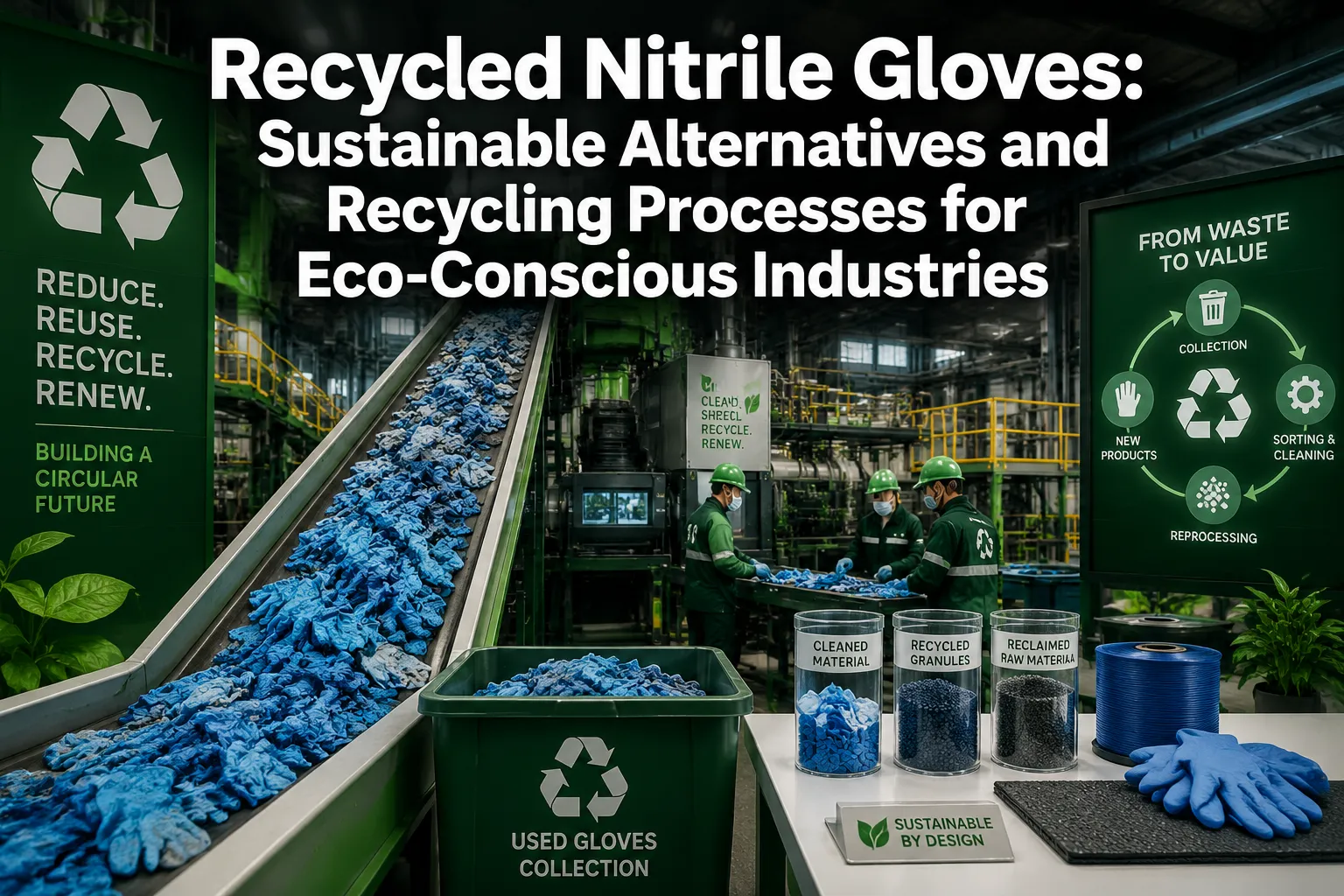
Global industries discard approximately 300 billion disposable gloves annually, with nitrile varieties accounting for over 60% of this waste stream. As environmental regulations tighten and corporate sustainability goals intensify in 2026, the demand for recycled nitrile gloves and viable recycling processes has reached a critical inflection point. Understanding Recycled Nitrile Gloves: Sustainable Alternatives and Recycling Processes for Eco-Conscious Industries is no longer optional for businesses committed to reducing their environmental footprint.
Key Takeaways
- Emerging chemical recycling technologies can break down nitrile gloves into reusable raw materials, reducing landfill waste by up to 85%
- Post-consumer recycled nitrile gloves are now commercially available with performance comparable to virgin material products
- Food service and automotive sectors are leading adoption of sustainable glove alternatives due to high-volume usage patterns
- Brands like Kimberly-Clark and Hartalega are pioneering closed-loop recycling programs for industrial glove waste
- Proper collection infrastructure remains the primary barrier to widespread nitrile glove recycling implementation
Understanding Nitrile Glove Composition and Recycling Challenges
Nitrile gloves are manufactured from synthetic rubber polymers—specifically acrylonitrile and butadiene—creating a durable, chemical-resistant material. This same durability that makes them ideal for medical, food service, and industrial applications also presents significant recycling challenges.
Traditional nitrile cannot be melted and reformed like thermoplastics. The vulcanization process that gives nitrile its strength creates cross-linked polymer chains that resist conventional recycling methods. As a result, most used nitrile gloves end up in landfills where they persist for decades.
The Environmental Impact of Disposable Nitrile Gloves
The healthcare sector alone generates over 7 million tons of glove waste annually. When combined with food service, automotive, and manufacturing industries, the environmental burden becomes staggering. Each pair of disposable nitrile gloves requires petroleum-based feedstocks and energy-intensive manufacturing processes.
Key environmental concerns include:
- Carbon emissions from production and transportation
- Non-biodegradable waste accumulation in landfills
- Microplastic pollution from degraded glove fragments
- Resource depletion from virgin material extraction
Emerging Recycling Technologies for Nitrile Waste
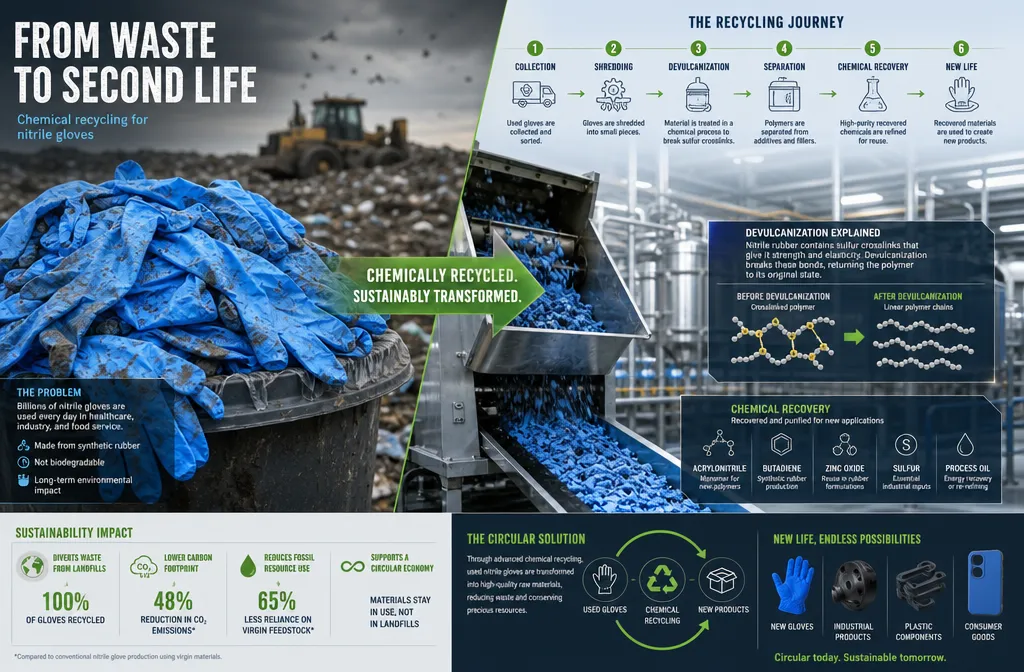
Recent technological advances have made Recycled Nitrile Gloves: Sustainable Alternatives and Recycling Processes for Eco-Conscious Industries increasingly viable. Three primary methods are gaining commercial traction in 2026.
Chemical Devulcanization
This process breaks the sulfur cross-links in vulcanized nitrile rubber, returning the material to a processable state. Companies like RightCycle have developed proprietary devulcanization techniques that recover up to 90% of the original polymer for remanufacturing.
The recovered material maintains approximately 85% of virgin nitrile’s mechanical properties, making it suitable for non-critical applications or blending with virgin material for premium products.
Pyrolysis and Thermal Decomposition
High-temperature pyrolysis breaks down nitrile gloves into basic chemical components including oils, gases, and carbon black. These recovered materials serve as feedstock for new chemical synthesis or fuel production.
While energy-intensive, pyrolysis offers a solution for contaminated gloves that cannot undergo mechanical recycling. Several European facilities now process mixed glove waste streams using this technology.
Mechanical Grinding and Repurposing
The simplest approach involves grinding used gloves into rubber crumb for incorporation into asphalt, playground surfaces, or industrial flooring. Though this represents downcycling rather than true recycling, it diverts substantial waste from landfills.
Comparison of Recycling Methods:
| Method | Material Recovery Rate | Energy Requirements | Output Quality | Best Applications |
|---|---|---|---|---|
| Chemical Devulcanization | 85-90% | Moderate | High | New glove production |
| Pyrolysis | 70-80% | High | Variable | Chemical feedstock |
| Mechanical Grinding | 95%+ | Low | Low | Construction materials |
Feasibility in High-Volume Sectors: Food Service and Automotive
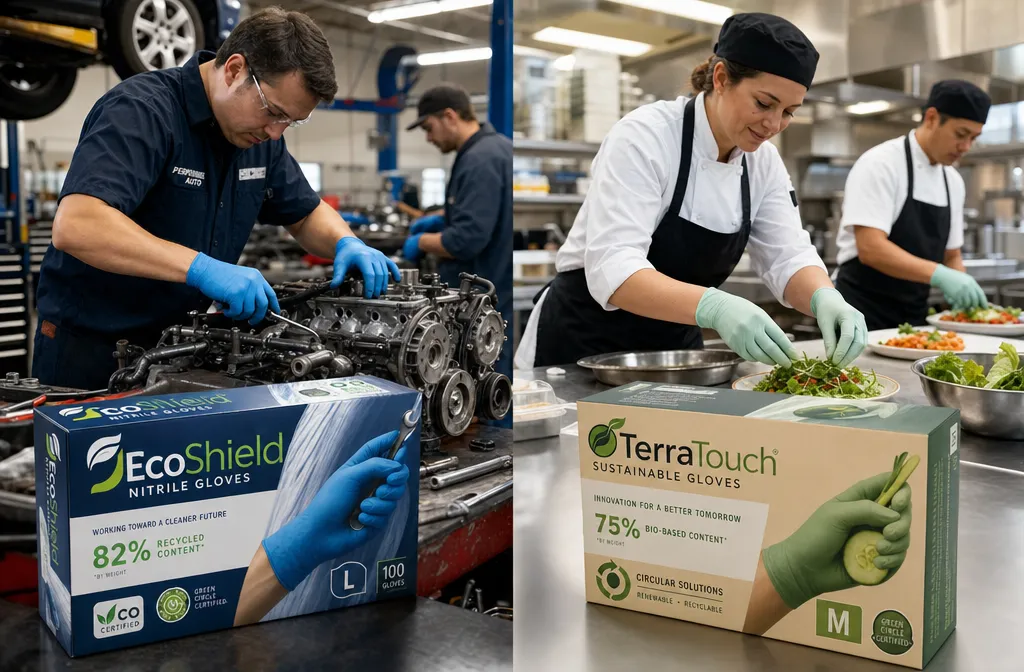
Food Service Industry Adoption
The food service sector uses an estimated 50 billion gloves annually, making it a prime candidate for sustainable alternatives. Disposable gloves for cooking must meet strict food safety standards while addressing environmental concerns.
Several major restaurant chains have piloted recycled nitrile glove programs in 2026. These initiatives typically involve:
- Dedicated collection bins for uncontaminated gloves
- Partnership with specialized recycling processors
- Gradual transition to gloves containing 20-30% post-consumer recycled content
- Staff training on proper disposal protocols
The primary challenge remains separating food-contaminated gloves from recyclable stock. Some facilities have implemented color-coded systems where specific tasks use designated glove colors for easier sorting.
Automotive and Manufacturing Applications
The automotive sector represents another high-volume opportunity for Recycled Nitrile Gloves: Sustainable Alternatives and Recycling Processes for Eco-Conscious Industries. Mechanics and assembly line workers use gloves extensively for oil changes and parts handling.
Unlike food service, automotive gloves often contact oils and chemicals that complicate recycling. However, the contamination is typically uniform and predictable, allowing for specialized processing protocols.
Major automotive manufacturers including Toyota and Ford have established glove recycling programs at their facilities. These programs collect used gloves in designated containers, which are then processed through chemical recycling to recover base materials.
The thickness of nitrile gloves used in automotive applications—typically 6-8 mil—provides more recoverable material per unit, improving recycling economics.
Brands Pioneering Post-Consumer Recycled Nitrile Gloves
Several manufacturers have introduced commercially available gloves containing recycled nitrile content in 2026, marking a significant industry shift.
Kimberly-Clark Professional
Kimberly-Clark’s RightCycle program has expanded beyond collection to manufacturing gloves with up to 30% post-consumer recycled content. Their Purple Nitrile Eco line maintains the performance standards of traditional nitrile gloves while reducing virgin material consumption.
Hartalega’s Sustainable Initiative
Malaysian manufacturer Hartalega has invested heavily in closed-loop recycling infrastructure. Their facilities now process production waste and post-consumer returns into new glove formulations, achieving a 40% reduction in virgin material usage for select product lines.
Showa and Ansell Innovations
Both companies have launched pilot programs offering take-back services for industrial gloves. Customers receive credits toward future purchases when returning used gloves for recycling, creating economic incentives for participation.
Performance Considerations
Current recycled nitrile gloves demonstrate:
- Tensile strength: 90-95% of virgin material equivalents
- Chemical resistance: Comparable performance for most common substances
- Tactile sensitivity: Minimal difference in applications requiring dexterity
- Cost: Typically 5-15% premium over conventional gloves
As production scales increase, price parity is expected by 2027-2028.
Implementation Challenges and Solutions
Despite technological progress, several barriers limit widespread adoption of Recycled Nitrile Gloves: Sustainable Alternatives and Recycling Processes for Eco-Conscious Industries.
Collection Infrastructure
The most significant challenge is establishing efficient collection systems. Used gloves are lightweight, bulky, and often contaminated, making transportation economics unfavorable.
Successful programs typically include:
- On-site collection bins with clear labeling
- Minimum volume thresholds for pickup
- Regional consolidation centers
- Integration with existing waste management routes
Contamination Management
Separating recyclable gloves from those contaminated with biohazards, heavy chemicals, or food waste requires careful protocols. Some facilities use color-coding systems where different glove colors indicate different contamination levels and disposal pathways.
Regulatory Compliance
Food safety and medical regulations create additional complexity. Recycled content gloves must undergo rigorous testing to ensure they meet the same standards as virgin material products. The FDA and USDA have established guidelines for recycled content in food-contact applications, which manufacturers must navigate carefully.
Economic Viability
Current recycling costs often exceed virgin material production costs. However, as landfill fees increase and carbon pricing mechanisms expand, the economic equation is shifting favorably toward recycling.
Future Outlook and Industry Trends
The trajectory for Recycled Nitrile Gloves: Sustainable Alternatives and Recycling Processes for Eco-Conscious Industries appears increasingly positive as 2026 progresses.
Regulatory Drivers
Extended Producer Responsibility (EPR) legislation is expanding globally, requiring glove manufacturers to fund end-of-life management. California and several European nations have implemented or proposed EPR schemes specifically targeting disposable gloves.
Technological Advancement
Research into bio-based nitrile alternatives and improved devulcanization catalysts promises to enhance both sustainability and recyclability. Several startups are developing enzymatic processes that could reduce recycling energy requirements by 60%.
Corporate Sustainability Commitments
Major corporations across healthcare, food service, and manufacturing have announced ambitious waste reduction targets. Many specifically identify disposable gloves as priority items for circular economy initiatives.
Consumer Awareness
Growing environmental consciousness among workers and consumers is creating market demand for sustainable options. Surveys indicate 73% of food service workers prefer employers who use recycled or recyclable gloves when performance is equivalent.
Conclusion
The evolution of Recycled Nitrile Gloves: Sustainable Alternatives and Recycling Processes for Eco-Conscious Industries represents a critical development in addressing the massive waste stream generated by disposable protective equipment. While challenges remain in collection infrastructure and processing economics, the technological foundation now exists for meaningful progress.
Industries with high glove consumption—particularly food service and automotive sectors—have both the greatest opportunity and responsibility to implement sustainable alternatives. The brands pioneering post-consumer recycled nitrile products are demonstrating that environmental responsibility and performance quality need not be mutually exclusive.
Actionable steps for organizations:
- Audit current glove usage volumes and disposal methods
- Contact manufacturers about recycled content options and take-back programs
- Implement segregated collection systems for uncontaminated gloves
- Educate staff on proper disposal protocols
- Set measurable targets for transitioning to recycled content gloves
- Partner with specialized recycling processors in your region
As recycling technologies mature and economies of scale develop, recycled nitrile gloves will transition from niche sustainable alternatives to mainstream industry standards. Organizations that establish recycling infrastructure and sustainable procurement practices now will gain competitive advantages while contributing meaningfully to environmental protection. The future of disposable gloves lies not in disposal, but in continuous material recovery and reuse.
SEO Meta Title: Recycled Nitrile Gloves: Sustainable Alternatives 2026