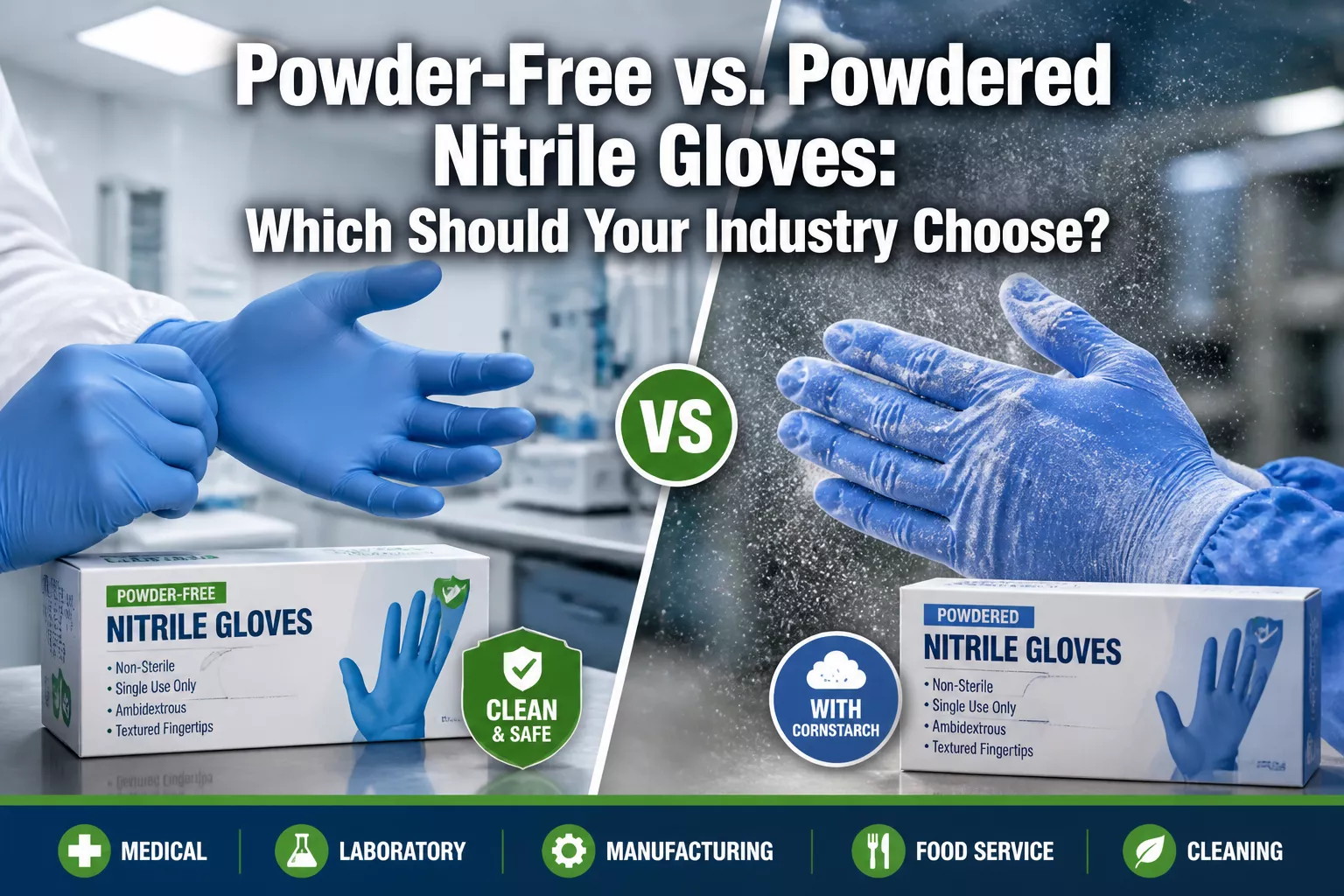
The FDA’s 2017 ban on powdered medical gloves eliminated an entire product category from healthcare facilities, forcing a complete industry transformation. By 2026, powder-free nitrile gloves command over 85% of the global disposable glove market, yet many industries still question whether this shift applies to their specific operations. Understanding powder-free vs. powdered nitrile gloves: which should your industry choose? has become essential for compliance, safety, and operational efficiency.
Key Takeaways
- 🏥 Powder-free nitrile gloves are mandatory in healthcare settings following the 2017 FDA ban on powdered medical gloves
- 🧪 Contamination risks from cornstarch powder make powder-free options superior for sterile environments, laboratories, and food service
- 💰 Cost differences between powder-free and powdered gloves have narrowed significantly as manufacturing scaled up post-2017
- 🤲 Grip performance in powder-free gloves exceeds powdered alternatives due to chlorination treatment
- ⚠️ Allergy reduction represents a critical advantage, as powder particles can carry latex proteins and trigger respiratory issues
Understanding the Fundamental Differences
The distinction between powder-free and powdered nitrile gloves centers on their manufacturing process and surface treatment. Powdered gloves use cornstarch coating to facilitate easier donning, allowing the glove to slide smoothly onto hands. This traditional method dominated the industry for decades due to its simplicity and lower production costs.
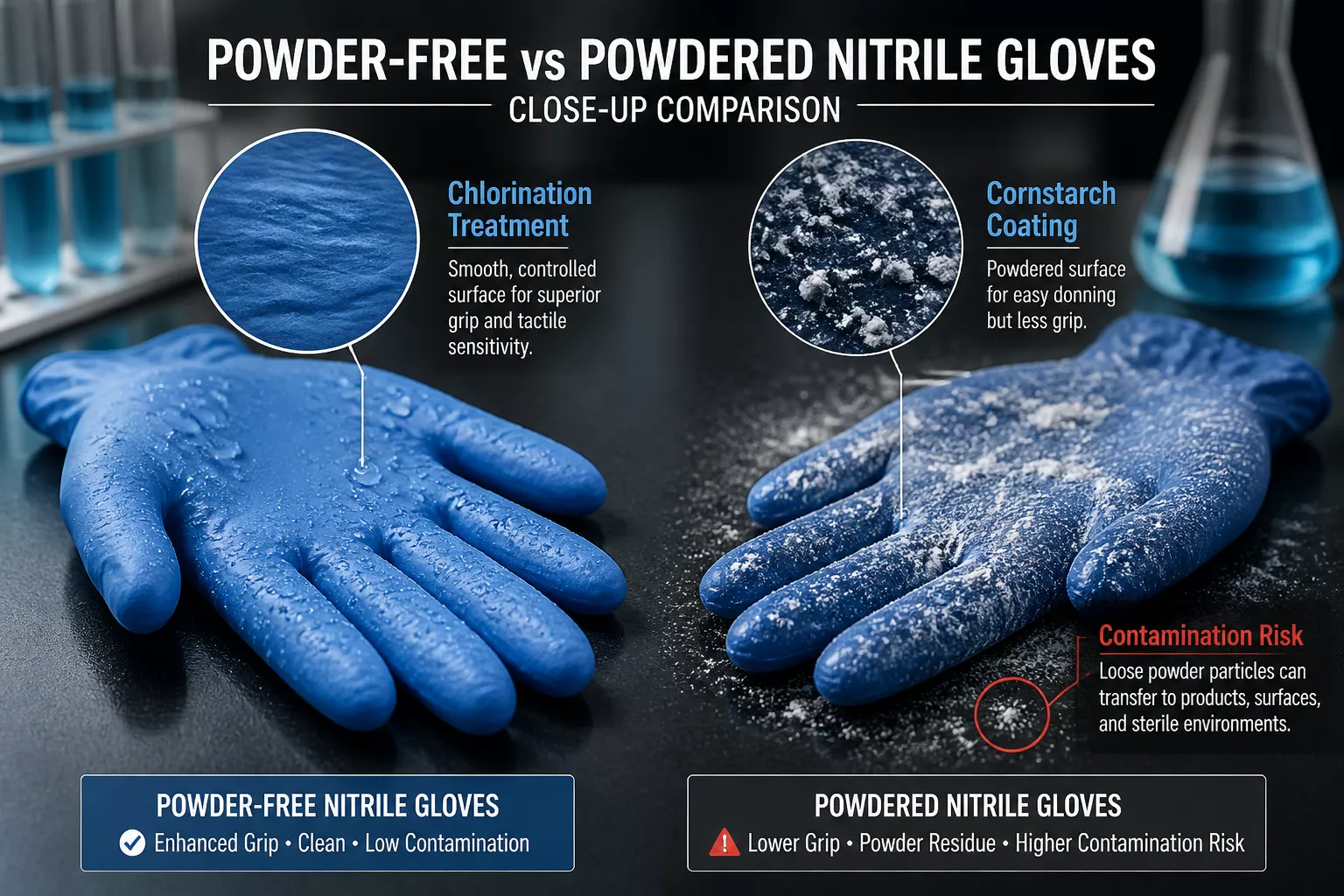
Powder-free gloves undergo additional processing steps, typically chlorination treatment, which modifies the glove surface to reduce tackiness without powder. This creates a smoother interior that still allows for comfortable wearing while eliminating the cornstarch entirely. The composition of nitrile gloves remains fundamentally similar, but the finishing process differs dramatically.
Manufacturing Process Comparison
| Feature | Powdered Gloves | Powder-Free Gloves |
|---|---|---|
| Surface Treatment | Cornstarch coating | Chlorination or polymer coating |
| Donning Ease | Very easy | Easy with proper technique |
| Production Cost | Lower | 10-15% higher |
| Processing Steps | Standard molding + powder | Standard molding + chlorination |
| Shelf Life | 3-5 years | 3-5 years |
Why Powder-Free Nitrile Dominates the 2026 Market
The overwhelming shift toward powder-free options stems from multiple converging factors that extend far beyond regulatory compliance. Understanding these drivers helps industries make informed decisions about powder-free vs. powdered nitrile gloves: which should your industry choose?
Regulatory Compliance and Healthcare Standards
The FDA’s 2017 ban specifically targeted powdered surgeon’s gloves, powdered patient examination gloves, and absorbable powder for lubricating surgical gloves. This regulatory action responded to documented cases of severe complications including respiratory issues, post-surgical adhesions, and allergic reactions. Healthcare facilities must exclusively use powder-free options, making them the industry standard for hospitals and medical facilities.
Contamination Reduction Benefits
Cornstarch particles become airborne during glove removal, settling on surfaces, equipment, and products. This creates significant contamination risks across multiple industries:
- Laboratory environments: Powder interferes with sensitive analytical equipment and experimental results, making powder-free nitrile gloves essential for chemistry labs
- Food service operations: Powder particles can contaminate food products and violate food safety standards, which is why choosing the right nitrile glove for cooking emphasizes powder-free options
- Electronics manufacturing: Powder residue damages sensitive components in cleanroom environments
- Pharmaceutical production: Powder contamination compromises sterile manufacturing processes
Superior Grip Performance
Contrary to common assumptions, powder-free gloves actually provide better grip than powdered alternatives in most applications. The chlorination process creates a slightly textured surface that enhances tactile sensitivity and grip, particularly when handling wet or oily materials. This makes powder-free gloves ideal for automotive work and oil changes where secure grip matters most.
Allergy Risk Mitigation
While nitrile gloves themselves rarely cause allergic reactions compared to latex, the powder in powdered gloves presents its own health concerns. Cornstarch particles can:
- Carry residual latex proteins in manufacturing facilities that produce multiple glove types
- Trigger respiratory irritation when inhaled repeatedly
- Cause skin dryness and irritation with prolonged exposure
- Exacerbate existing respiratory conditions
For workers concerned about allergic reactions to nitrile gloves, powder-free options significantly reduce risk factors.
Industry-Specific Considerations for Powder-Free vs. Powdered Nitrile Gloves
Different sectors face unique requirements when evaluating powder-free vs. powdered nitrile gloves: which should your industry choose? Here’s how various industries should approach this decision in 2026:
Healthcare and Medical Services ⚕️
Recommendation: Powder-free (mandatory)
Healthcare facilities have no choice—powder-free gloves are legally required. Beyond compliance, powder-free options protect patients from complications and reduce healthcare-associated infections.
Food Service and Processing 🍽️
Recommendation: Powder-free (strongly recommended)
Food safety regulations increasingly favor powder-free gloves to prevent contamination. The 5 primary uses for nitrile gloves in food service all benefit from powder-free construction.
Laboratory and Research 🔬
Recommendation: Powder-free (essential)
Scientific accuracy demands contamination-free environments. Powder particles interfere with experiments, analytical equipment, and research outcomes.
Manufacturing and Industrial 🏭
Recommendation: Powder-free (preferred)
While some industrial applications historically used powdered gloves, the improved grip and reduced contamination of powder-free options make them superior for most manufacturing tasks. Choosing the best nitrile gloves for farm work and agricultural applications also favors powder-free designs.
Office and Janitorial Services 🏢
Recommendation: Powder-free (recommended)
For maintaining germ-free office environments, powder-free gloves prevent powder residue on cleaned surfaces and reduce airborne particles.
Cost Analysis: The Price Gap Has Narrowed
In 2026, the cost difference between powder-free and powdered nitrile gloves has decreased substantially. While powder-free gloves once commanded a 25-30% premium, increased production volume and manufacturing efficiency have reduced this gap to approximately 10-15%.
When factoring in the total cost of ownership—including reduced contamination incidents, fewer allergy-related worker compensation claims, and improved regulatory compliance—powder-free gloves often prove more economical despite higher unit costs.
Hidden Costs of Powdered Gloves
- Cleaning expenses for powder residue on equipment and surfaces
- Product waste from contamination incidents
- Potential regulatory fines in restricted industries
- Worker health issues and associated costs
- Customer complaints about powder in products
Making the Right Choice for Your Organization
When evaluating powder-free vs. powdered nitrile gloves: which should your industry choose?, consider these decision factors:
- Regulatory requirements: Check industry-specific regulations that may mandate powder-free gloves
- Contamination sensitivity: Assess whether powder particles could compromise your products or processes
- Worker health: Consider employees with respiratory sensitivities or skin conditions
- Grip requirements: Evaluate whether enhanced tactile sensitivity benefits your operations
- Total cost: Calculate beyond unit price to include contamination and health costs
For most industries in 2026, powder-free nitrile gloves represent the optimal choice. The combination of regulatory compliance, contamination prevention, superior performance, and narrowed cost differences makes them the clear standard across sectors.
Conclusion
The question of powder-free vs. powdered nitrile gloves: which should your industry choose? has largely been answered by market forces, regulatory action, and performance advantages. Powder-free nitrile gloves dominate the 2026 landscape for compelling reasons: mandatory healthcare compliance, dramatic contamination reduction, superior grip performance, and significant allergy risk mitigation.
While powdered gloves may still appear in limited industrial applications, the trajectory clearly favors powder-free options across all sectors. Organizations should prioritize powder-free nitrile gloves unless specific circumstances absolutely require otherwise—and even then, carefully evaluate whether those circumstances truly justify the trade-offs.
Take action today: Audit your current glove inventory, assess your industry’s specific requirements, and transition to powder-free nitrile gloves if you haven’t already. The investment in worker safety, product quality, and regulatory compliance will pay dividends far beyond the modest cost difference.