Laboratory accidents involving chemical exposure through inadequate glove protection send hundreds of researchers to emergency rooms each year—yet most labs still rely on thin disposable nitrile gloves without understanding their actual breakthrough times. The reality is stark: a glove that looks perfectly intact can be actively permeating dangerous chemicals onto your skin. Understanding the Nitrile Gloves in Laboratories: Chemical Resistance Ratings and Breakthrough Protection Guide is essential for every lab professional working with hazardous substances in 2026.
Key Takeaways
- ⏱️ Breakthrough time over 8 hours is considered “excellent” protection, but many thin disposable nitrile gloves provide only 6-47 minutes depending on the chemical and brand
- 🧤 Hand movement reduces breakthrough time by an average of 18% compared to static testing, meaning real-world protection is significantly lower than manufacturer specifications
- 🔬 “Nitrile” is not a single performance category—breakthrough times can vary up to 7-fold between different nitrile glove products for the same chemical
- 👁️ Visual inspection is unreliable—chemical permeation often occurs without visible degradation like swelling or discoloration
- 📏 Thickness matters critically: 2.5-3 mil suits general bench work, 4-5 mil handles moderate chemical contact, while 7-8+ mil is necessary for extended solvent exposure
Understanding Chemical Resistance: Beyond the “Nitrile” Label
The term “nitrile gloves” creates a false sense of uniform protection. In reality, the composition of nitrile gloves varies significantly between manufacturers, and this directly impacts chemical resistance performance.
The Three Critical Protection Metrics
Laboratory safety professionals evaluate glove protection using three distinct measurements:
Breakthrough Time ⏰
The duration until a chemical is first detected on the inside surface of the glove. This is the single most important metric for lab workers. A glove with breakthrough time greater than eight hours earns an “excellent” rating, while anything under 10 minutes is considered inadequate for deliberate handling.
Degradation 🔍
Visible physical changes to the glove material—swelling, cracking, discoloration, or brittleness. However, degradation is an unreliable indicator because many chemicals permeate through nitrile without causing visible damage.
Permeation Rate 📊
The speed at which chemical molecules pass through the glove material after breakthrough occurs. Even after breakthrough, a low permeation rate may provide additional working time before dangerous exposure levels are reached.
Why Thin Disposable Nitrile Gloves Have Limitations
Common thin disposable nitrile gloves serve as excellent general-duty protection for biological materials and light contamination. However, they are not appropriate substitutes for chemical-specific glove selection. These gloves typically measure 2.5-4 mil in thickness and are designed for incidental contact scenarios—brief splashes or touching contaminated surfaces—rather than deliberate chemical handling or immersion.
The distinction between incidental and extended contact is crucial. Incidental contact means brief, unintended exposure during routine lab work. Extended contact includes handling highly contaminated materials, submerging hands in hazardous substances, or working with chemicals for prolonged periods. For extended contact scenarios, more substantial gloves with verified chemical resistance ratings are required.
Chemical-Specific Resistance: Oils, Acids, and Alcohols Performance
Understanding how nitrile performs against specific chemical classes helps lab managers make informed purchasing decisions and develop appropriate safety protocols.
Oils and Petroleum-Based Substances ⛽
Nitrile gloves excel against oils compared to latex alternatives. The synthetic rubber polymer structure provides excellent resistance to petroleum-based oils, hydraulic fluids, and greases. This makes nitrile the preferred choice when comparing resistance of nitrile gloves to latex gloves for petroleum-based oils.
However, how oil exposure affects nitrile gloves depends heavily on glove thickness and exposure duration. For routine handling of oil-contaminated equipment, 4-5 mil nitrile provides adequate protection. For immersion or extended contact, 7-8 mil or specialized chemical-resistant gloves are necessary.
Acids and Bases 🧪
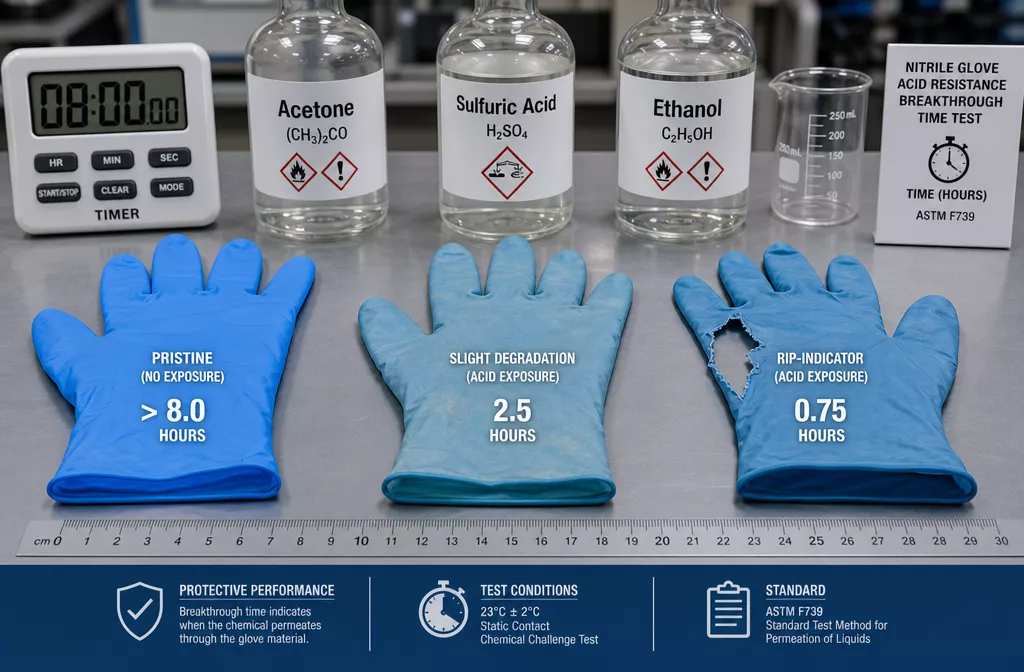
Nitrile demonstrates good resistance to dilute acids and bases, making it suitable for many common laboratory procedures. For concentrated acids (particularly sulfuric, nitric, and hydrochloric acid), breakthrough times vary dramatically:
- Dilute acids (10-30%): Most quality nitrile gloves provide 30+ minutes of protection
- Concentrated acids (>70%): Breakthrough can occur in under 10 minutes with thin disposable gloves
- Strong bases: Similar performance to dilute acids, with sodium hydroxide showing moderate breakthrough times
Critical safety note: Always consult manufacturer chemical resistance charts for the specific concentration you’re handling. A glove rated “excellent” for 10% sulfuric acid may fail rapidly against 98% concentration.
Alcohols and Solvents 🧴
This category presents the greatest challenge for nitrile gloves. Common laboratory solvents show highly variable breakthrough performance:
Good Resistance:
- Ethanol and isopropanol (short-term exposure)
- Dilute alcohol solutions
Poor Resistance:
- Acetone (breakthrough often under 5 minutes)
- Methyl ethyl ketone (MEK)
- Toluene and xylene
- Chlorinated solvents
For acetone specifically, acetone permeation through nitrile gloves occurs rapidly regardless of glove thickness. Labs working routinely with acetone should consider butyl rubber or laminated gloves instead.
Similarly, when evaluating whether disposable nitrile gloves can safeguard against ketones, the answer is generally “only for very brief incidental contact.” Extended ketone exposure requires specialized glove materials.
The Movement Factor: Real-World vs. Laboratory Testing
One of the most significant findings in recent glove research reveals that hand movement substantially reduces chemical protection. Laboratory testing typically uses static conditions—gloves stretched over collection vessels without flexing or manipulation. Real laboratory work involves constant hand movement, gripping, and material handling.
Research demonstrates that simulated movement causes:
- 18% average decrease in breakthrough time across most glove products
- 58% average increase in total chemical exposure over 30 minutes
- Some products showing exposure increases ranging from 23% to 277%
This means the breakthrough time listed on a manufacturer’s specification sheet represents a best-case scenario. During actual laboratory work involving dexterity tasks, repeated flexing, and manipulating glassware, protection levels drop significantly.
Practical Implications for Lab Safety Protocols
This movement effect has several important implications:
✅ Change gloves more frequently than static breakthrough times suggest
✅ Use thicker gloves when extended manipulation is required
✅ Implement double-gloving protocols for high-hazard chemicals
✅ Train staff that “looks fine” doesn’t mean “is protective”
Visible Rip Indicators: A Key Safety Feature
One significant advantage of nitrile over latex in laboratory settings is its tendency to visibly rip when punctured rather than forming small, difficult-to-detect holes. This characteristic serves as a built-in safety indicator.
When nitrile gloves are punctured or torn, they typically:
- 🔵 Create obvious tears with visible edges
- 🔵 Change color or appearance at the damage site
- 🔵 Provide immediate tactile feedback to the wearer
This contrasts with latex gloves, which may develop microscopic holes that allow chemical penetration without obvious visual cues. The visible failure mode of nitrile makes it easier for laboratory workers to recognize when glove integrity has been compromised.
Best practice: Implement a “visible damage = immediate replacement” policy. Train all laboratory personnel to inspect gloves before use and replace them immediately upon noticing any tears, discoloration, or texture changes.
Thickness Selection Guide for Laboratory Applications
How nitrile glove thickness impacts durability and protection is a critical consideration when establishing laboratory glove protocols. Here’s a practical framework for 2026:
2.5-3 Mil: Light Laboratory Work
Best for:
- Cell culture and tissue handling
- PCR setup and molecular biology
- General bench work without chemical exposure
- Situations requiring maximum dexterity
Not suitable for:
- Direct chemical handling
- Solvent work
- Extended wear with contaminated materials
4-5 Mil: Standard Chemical Handling
Best for:
- Routine chemical preparation
- Staining and histology procedures
- Moderate chemical contact scenarios
- Balance of protection and tactile sensitivity
Limitations:
- Insufficient for concentrated acids/bases
- Poor protection against aggressive solvents
- Not rated for immersion
6-8+ Mil: Heavy-Duty Chemical Protection
Best for:
- Extended solvent exposure
- Concentrated acid/base handling
- Cleaning contaminated equipment
- Situations where breakthrough time is critical
Trade-offs:
- Reduced dexterity and tactile sensitivity
- Higher cost per glove
- May require understanding what is the best thickness for nitrile gloves for your specific application
EN ISO 374 Standards: Decoding Chemical Resistance Labels
When purchasing nitrile gloves for laboratory use, look for EN ISO 374 compliance markings. This international standard provides a framework for evaluating and labeling chemical-resistant gloves.
Classification Types
Type A 🏆
Passed permeation testing against at least 6 chemicals from the standard list with breakthrough time ≥30 minutes for each
Type B ⭐
Passed permeation testing against at least 3 chemicals from the standard list with breakthrough time ≥30 minutes for each
Type C ✓
Passed permeation testing against at least 1 chemical from the standard list with breakthrough time ≥10 minutes
Chemical Code Letters
Gloves display letter codes indicating which specific chemicals they resist:
| Code | Chemical | Code | Chemical |
|---|---|---|---|
| A | Methanol | G | Diethylamine |
| B | Acetone | H | Tetrahydrofuran |
| C | Acetonitrile | I | Ethyl acetate |
| D | Dichloromethane | J | n-Heptane |
| E | Carbon disulfide | K | Sodium hydroxide 40% |
| F | Toluene | L | Sulfuric acid 96% |
A glove labeled “EN ISO 374 Type B (KLJ)” has been tested and passed permeation requirements for sodium hydroxide, sulfuric acid, and n-heptane.
Product Variability: Why Brand and Formulation Matter
Perhaps the most surprising finding from chemical resistance research is the massive variability between different nitrile glove products. Testing of multiple brands showed breakthrough times ranging from 6.6 minutes to 47.5 minutes for the same chemical—a 7-fold difference.
This variability stems from:
- Different nitrile polymer formulations
- Varying manufacturing processes
- Additive packages and plasticizers
- Quality control standards
- Thickness consistency
Critical recommendation: Don’t assume all nitrile gloves provide equivalent protection. When establishing laboratory protocols, specify gloves by manufacturer and model number, not just “nitrile gloves.” Request chemical resistance data sheets for your specific chemicals of concern.
Latex Allergy Considerations in Laboratory Settings
Beyond chemical resistance, nitrile gloves offer a significant safety advantage for laboratories: they eliminate latex allergy concerns. Exploring the different types of latex allergy reveals that latex proteins can cause serious allergic reactions ranging from contact dermatitis to life-threatening anaphylaxis.
For laboratory environments, nitrile gloves provide:
✅ Zero latex protein exposure
✅ Safe for latex-allergic personnel
✅ No sensitization risk for workers who might develop latex allergy with repeated exposure
✅ Compliance with inclusive workplace safety requirements
This makes nitrile the preferred choice for those wondering if nitrile gloves are safe for latex allergy—the answer is definitively yes.
Implementing a Laboratory Glove Selection Protocol
Based on the Nitrile Gloves in Laboratories: Chemical Resistance Ratings and Breakthrough Protection Guide principles, here’s a practical framework for establishing glove protocols:
Step 1: Conduct a Chemical Hazard Assessment
Document all chemicals used in your laboratory, including:
- Chemical names and concentrations
- Frequency and duration of exposure
- Type of contact (incidental vs. extended)
- Temperature conditions
- Physical hazards (sharp objects, extreme temperatures)
Step 2: Match Gloves to Specific Tasks
Create a glove selection matrix:
- Task A (cell culture): 3 mil nitrile, any brand
- Task B (acetone cleaning): Butyl rubber or laminated gloves
- Task C (dilute acid preparation): 5 mil nitrile, EN ISO 374 Type B minimum
- Task D (concentrated base handling): 8 mil nitrile with verified resistance to sodium hydroxide
Step 3: Establish Replacement Protocols
Define clear rules for glove changes:
- Maximum wear time before replacement
- Immediate replacement upon visible damage
- Replacement after chemical splash
- Replacement between different chemical exposures
Step 4: Train and Document
Ensure all laboratory personnel understand:
- Which gloves to use for which tasks
- How to inspect gloves before use
- When to replace gloves
- What to do if chemical contact occurs
Conclusion
The Nitrile Gloves in Laboratories: Chemical Resistance Ratings and Breakthrough Protection Guide reveals a critical truth: not all nitrile gloves provide adequate chemical protection, and selecting the right glove requires understanding breakthrough times, chemical-specific resistance, and the impact of real-world conditions like hand movement. While nitrile gloves excel against oils and provide good protection against dilute acids and bases, they show poor resistance to many common solvents like acetone and ketones.
The key to laboratory safety lies in moving beyond generic “nitrile glove” purchasing to chemical-specific glove selection based on EN ISO 374 ratings, verified breakthrough times, and appropriate thickness for the exposure scenario. Remember that breakthrough times decrease by an average of 18% during actual use compared to static testing, and that gloves can permeate chemicals without visible degradation.
Take Action Now
- Audit your current glove inventory against the chemicals you actually use
- Request chemical resistance data sheets from your glove suppliers for your specific chemicals
- Implement task-specific glove protocols rather than one-size-fits-all approaches
- Train staff on visible rip indicators and immediate replacement protocols
- Consider double-gloving for high-hazard chemical work
- Establish maximum wear times that account for the movement factor
By applying the principles in this Nitrile Gloves in Laboratories: Chemical Resistance Ratings and Breakthrough Protection Guide, laboratory managers can significantly reduce chemical exposure risks and create safer working environments for all personnel in 2026 and beyond.
SEO Meta Title: Nitrile Gloves Lab Guide: Chemical Resistance & Protection