Last updated: July 2, 2026
Quick Answer
Nitrile Gloves in Emergency Response and Disaster Relief: Surge Demand Planning and Stockpiling Best Practices involves calculating demand based on population served, maintaining 30-90 day supplies with proper size distribution, storing gloves in climate-controlled conditions (60-75°F, 40-60% humidity), implementing FIFO rotation systems, and establishing relationships with multiple suppliers. Organizations should plan for 3-5 times normal usage during surge events and verify shelf life of 3-5 years when stored correctly.
Key Takeaways
- Nitrile gloves are the preferred choice for emergency response due to latex-free composition, chemical resistance, and durability in field conditions
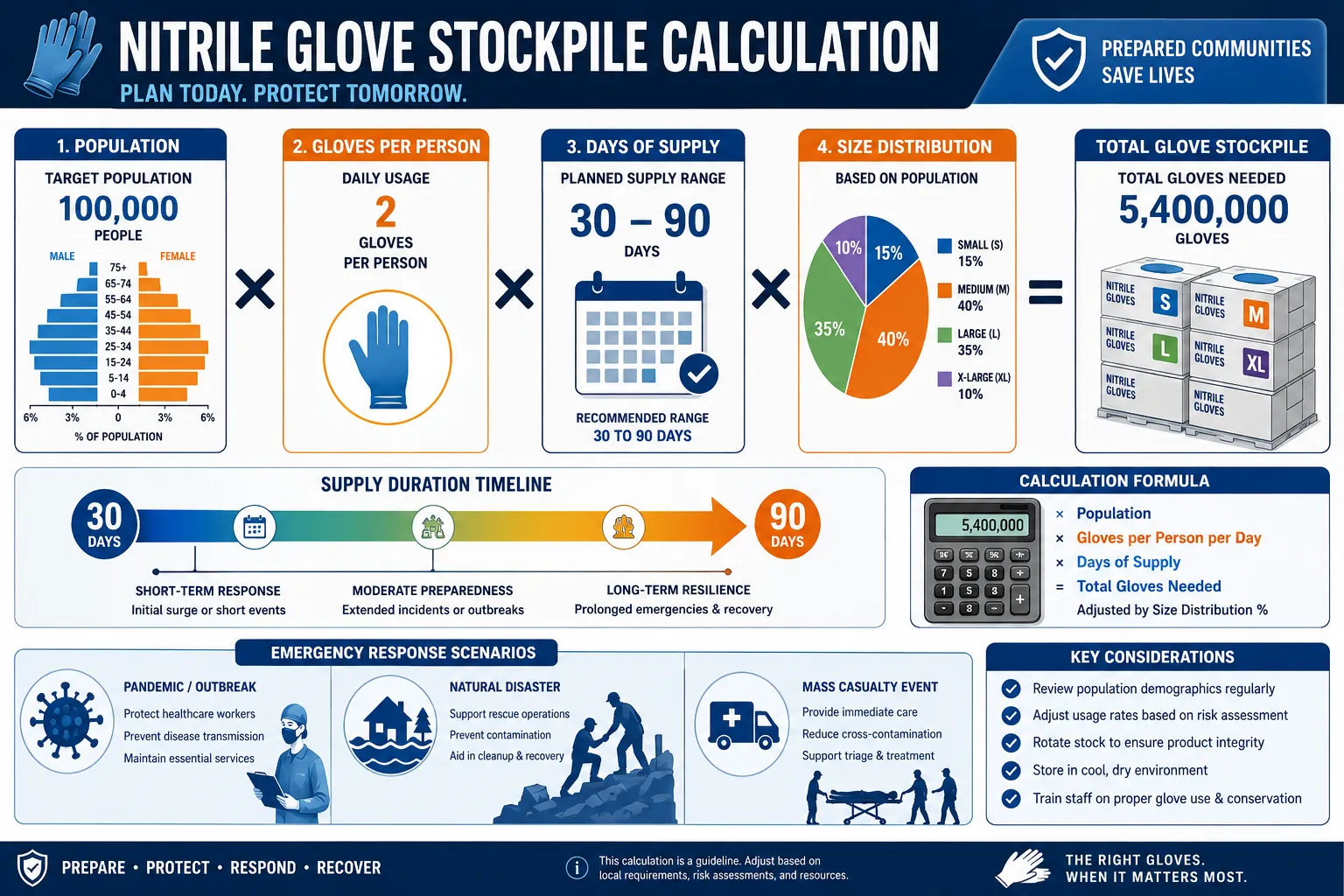
- Calculate stockpile needs using the formula: (daily usage × surge multiplier × days of supply) + 20% safety buffer
- Maintain size distribution of approximately 15% small, 40% medium, 35% large, and 10% extra-large for diverse response teams
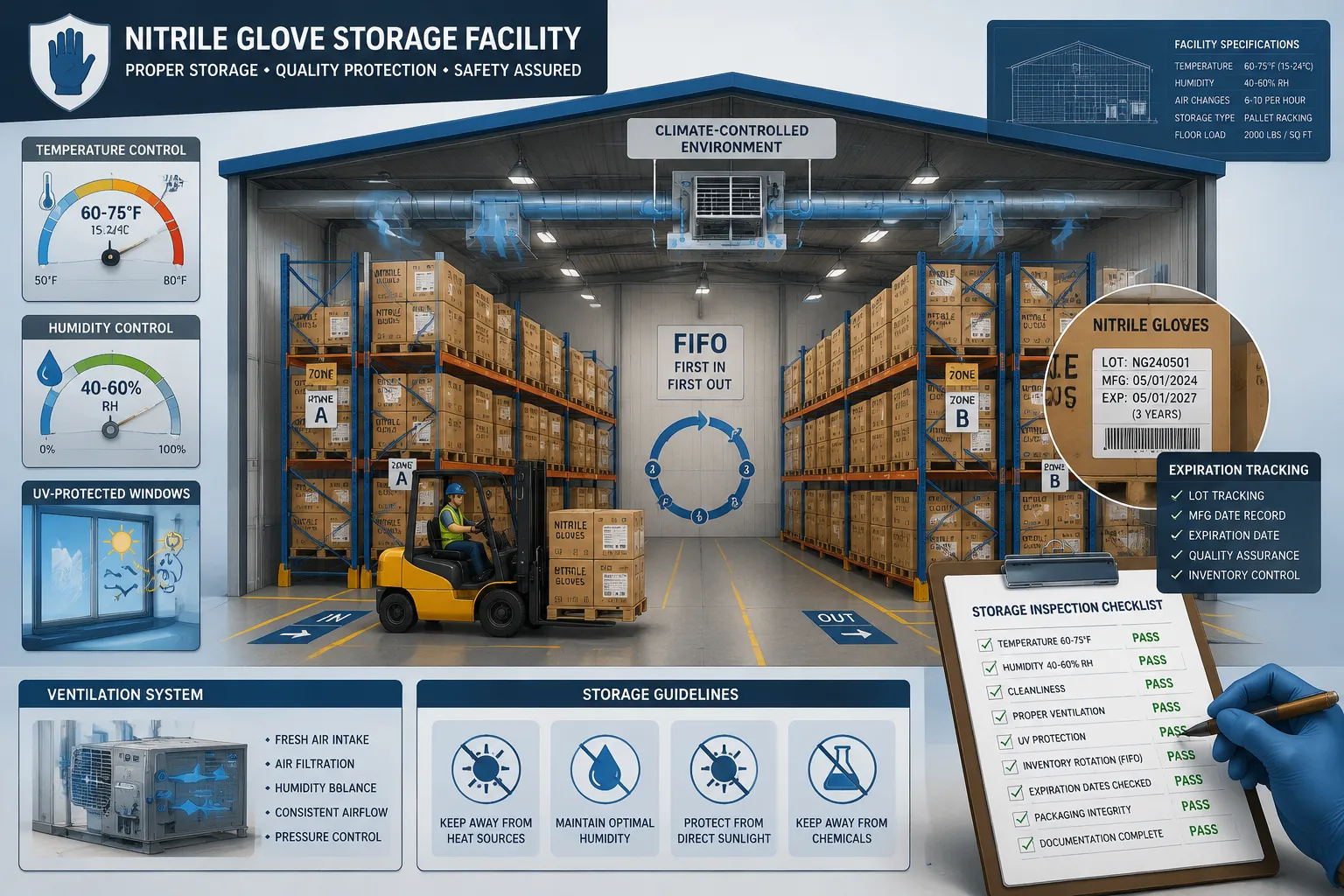
- Store gloves at 60-75°F with 40-60% humidity to preserve shelf life of 3-5 years
- Implement first-in-first-out (FIFO) rotation every 6-12 months to prevent expiration waste
- Establish contracts with at least three suppliers across different geographic regions to mitigate supply chain disruptions
- Budget $40-$120 per 1,000 gloves for bulk emergency stockpiles, with prices varying by thickness and certification level
- Common mistakes include inadequate size variety, improper storage conditions, and failure to account for surge demand multipliers during pandemics or mass casualty events
What Are Nitrile Gloves and Why Are They Used in Disaster Relief
Nitrile gloves are synthetic rubber gloves made from acrylonitrile-butadiene copolymer, offering superior puncture resistance, chemical protection, and latex-free safety for emergency responders. They have become the standard for disaster relief operations because they protect against bloodborne pathogens, hazardous materials, and infectious diseases while accommodating the 8-12% of healthcare workers with latex allergies.
During emergency response situations, nitrile gloves serve multiple critical functions:
- Infection control: Prevent disease transmission during medical triage, mass casualty treatment, and pandemic response
- Chemical protection: Shield responders from hazardous materials, cleaning agents, and contaminated water during flood or industrial disasters
- Durability: Withstand rough field conditions better than latex or vinyl alternatives, with 3-4 times the puncture resistance
- Versatility: Suitable for medical care, food distribution, debris removal, and decontamination operations
The demand for nitrile gloves in healthcare surged dramatically during the COVID-19 pandemic, demonstrating how quickly emergency stockpiles can be depleted. Organizations learned that relying solely on just-in-time supply chains leaves them vulnerable during global crises when demand spikes 300-500% above normal levels.
Choose nitrile over latex when building emergency stockpiles because they eliminate allergy concerns, store longer without degradation, and perform better in extreme temperatures. Choose nitrile over vinyl when puncture resistance and chemical protection are priorities, as vinyl gloves tear more easily and offer limited protection against oils and solvents.
How Many Nitrile Gloves Should Be Stockpiled for Emergency Response
Calculate your nitrile glove stockpile using this formula: (daily usage × surge multiplier × days of supply) + 20% safety buffer. For a hospital serving 50,000 people, normal daily usage might be 2,000 gloves, but during a pandemic or mass casualty event, multiply by 3-5 times to account for surge demand, resulting in 6,000-10,000 gloves per day.
Recommended stockpile levels by organization type:
| Organization Type | Normal Daily Usage | Surge Multiplier | Recommended Days Supply | Total Stockpile |
|---|---|---|---|---|
| Small clinic (5,000 patients) | 200 gloves | 3-4x | 60 days | 36,000-48,000 |
| Medium hospital (50,000 patients) | 2,000 gloves | 4-5x | 90 days | 720,000-900,000 |
| Large hospital system (200,000+) | 10,000 gloves | 5x | 90 days | 4,500,000 |
| Emergency management agency | 500 gloves | 10x | 60 days | 300,000 |
| First responder unit (50 personnel) | 100 gloves | 5x | 30 days | 15,000 |
The surge multiplier varies by disaster type. Pandemic response requires 5-7 times normal usage because every patient interaction demands fresh gloves. Natural disasters like hurricanes or earthquakes typically need 3-4 times normal levels. Mass casualty events may spike to 10 times normal for 24-72 hours but then stabilize.
Common mistake: Organizations often calculate based on normal usage without accounting for surge scenarios. During the 2020 pandemic, facilities that stockpiled only 30 days of normal usage ran out within one week of surge demand.
Decision rule: If your organization serves vulnerable populations (elderly care, immunocompromised patients), add an additional 30% to your calculated stockpile. If you’re in a remote location more than 4 hours from major supply hubs, increase your days of supply from 60 to 90 days minimum.
Nitrile vs Latex Gloves for Emergency Medical Situations
Nitrile gloves outperform latex in emergency medical situations due to superior chemical resistance, longer shelf life, and elimination of allergic reaction risks. While latex offers slightly better elasticity and tactile sensitivity, nitrile provides 3-4 times greater puncture resistance and maintains integrity when exposed to petroleum-based products, disinfectants, and many chemicals encountered in disaster zones.
Performance comparison for emergency response:
Nitrile advantages:
- No latex protein allergies (critical when treating unknown patients)
- Resistant to oils, fuels, and most chemicals
- Shelf life of 3-5 years vs. 2-3 years for latex
- Better performance in temperature extremes (maintains flexibility in cold)
- Lower permeation rates for bloodborne pathogens
Latex advantages:
- Superior elasticity and comfort for extended wear
- Better tactile sensitivity for delicate procedures
- Typically 20-30% lower cost per glove
- Biodegrades faster than nitrile (environmental consideration)
For emergency stockpiling, nitrile is the clear choice because latex allergies affect 8-12% of healthcare workers and up to 17% of frequent glove users. During mass casualty events, you cannot screen every responder for allergies before deployment. One allergic reaction in the field diverts resources and potentially removes a trained responder from service.
The comparison between nitrile and latex resistance to petroleum-based oils shows nitrile maintains barrier integrity for 4-6 hours of continuous exposure while latex degrades within 15-30 minutes. This matters during industrial accidents, vehicle extrications, and fuel spill responses.
Edge case: For surgical procedures requiring maximum dexterity, some emergency medical teams maintain a small latex supply alongside their primary nitrile stockpile, but only for use by confirmed non-allergic personnel in controlled settings.
How Long Do Nitrile Gloves Last in Storage Before They Expire
Nitrile gloves stored properly maintain full protective capability for 3-5 years from manufacture date, with some manufacturers guaranteeing up to 5 years when kept in climate-controlled conditions between 60-75°F and 40-60% relative humidity. The shelf life depends primarily on storage temperature, humidity levels, and exposure to UV light and ozone.
Factors affecting nitrile glove shelf life:
- Temperature: Each 10°F increase above 75°F can reduce shelf life by 30-50%
- Humidity: Above 70% humidity promotes mold growth on packaging; below 30% causes brittleness
- UV exposure: Direct sunlight degrades nitrile polymers, reducing shelf life to 6-12 months
- Ozone: Industrial environments with ozone exposure accelerate degradation
- Packaging integrity: Damaged boxes expose gloves to contaminants and moisture
Most manufacturers print a manufacture date rather than an expiration date on boxes. Add 3-5 years to the manufacture date to determine when to rotate stock. Some premium brands now include explicit expiration dates to simplify inventory management.
Signs of degraded nitrile gloves:
- Discoloration (yellowing or darkening)
- Sticky or tacky texture
- Brittleness or cracking when stretched
- Strong chemical odor
- Visible surface deterioration
Test a sample from each lot annually by stretching a glove to check for tears, performing a water leak test, and inspecting for discoloration. If more than 2% of a sample batch fails, rotate that entire lot out of emergency reserves.
Storage best practice: Keep gloves in original sealed boxes on pallets (not directly on concrete floors) in a dedicated climate-controlled space. Stack no more than 6 feet high to prevent compression damage to bottom boxes. For more guidance on storage conditions, see how cold temperature affects nitrile gloves.
What Size Distribution of Nitrile Gloves to Order for Disaster Stockpile
Order nitrile gloves in a size distribution of approximately 15% small, 40% medium, 35% large, and 10% extra-large to match typical adult population hand sizes and accommodate diverse emergency response teams. This distribution differs from normal healthcare settings because disaster response often involves non-medical volunteers, construction workers, and military personnel with larger average hand sizes.
Recommended size distribution by response scenario:
| Scenario Type | Small | Medium | Large | X-Large |
|---|---|---|---|---|
| General disaster response | 15% | 40% | 35% | 10% |
| Medical facility surge | 20% | 45% | 30% | 5% |
| Construction/debris removal | 10% | 30% | 40% | 20% |
| Community volunteer operations | 25% | 40% | 25% | 10% |
The 40% medium allocation serves as your baseline because it fits the broadest range of users and can accommodate both smaller hands (with reduced dexterity) and larger hands (with tighter fit) in emergency situations when perfect sizing is secondary to availability.
Sizing mistakes to avoid:
- Ordering equal quantities of all sizes wastes budget on sizes that won’t be used
- Underestimating large and extra-large needs for male-dominated response teams
- Failing to account for double-gloving practices (some responders size up for outer glove)
- Not considering that cold weather response requires sizing up to accommodate hand swelling
Decision rule: If your emergency response plan relies heavily on community volunteers (typically more women), shift 5-10% from large/XL to small/medium. If you support industrial disaster response or work with predominantly male first responders, shift 5-10% from small/medium to large/XL.
Survey your current response team hand sizes during training exercises to refine your distribution. Track glove usage by size during drills and adjust future orders based on actual consumption patterns rather than generic recommendations.
How to Calculate Surge Demand for Nitrile Gloves During Pandemic
Calculate pandemic surge demand by multiplying baseline daily usage by 5-7 times for healthcare facilities and 3-5 times for emergency services, then extending the supply duration to 90-120 days instead of the typical 30-60 day stockpile. The COVID-19 pandemic demonstrated that global supply chains can remain disrupted for 6-12 months, making extended stockpiles essential.
Pandemic surge calculation formula:
- Baseline daily usage: Count gloves used per patient encounter × daily patient volume
- Pandemic multiplier: Apply 5-7x for infectious disease scenarios
- Extended duration: Plan for 90-120 days (vs. 30-60 for other disasters)
- Supply chain buffer: Add 30% for potential delivery delays
- Total pandemic stockpile = (baseline × multiplier × days) × 1.3
Example calculation for 200-bed hospital:
- Normal daily usage: 3,000 gloves
- Pandemic multiplier: 6x
- Extended duration: 90 days
- Supply chain buffer: 30%
- Total: (3,000 × 6 × 90) × 1.3 = 2,106,000 gloves
Pandemic demand differs from other emergencies because it’s sustained over months rather than days or weeks. A hurricane may spike demand for 7-14 days before returning to normal. A pandemic maintains elevated demand for 3-6 months during each wave, with multiple waves possible.
Factors increasing pandemic glove consumption:
- Universal precautions for all patient interactions (not just high-risk)
- Increased frequency of glove changes (every 15-20 minutes vs. per-procedure)
- Screening stations requiring gloves for every person checked
- Decontamination procedures using multiple glove layers
- Non-clinical staff (security, housekeeping, food service) requiring gloves
The 2020 pandemic revealed that facilities planning for 60 days of surge demand exhausted supplies in 15-20 days because they underestimated the multiplier effect. Hospitals that calculated 5x surge found actual usage reached 7-8x normal levels during peak periods.
Common mistake: Calculating surge demand based on bed capacity rather than actual patient encounters. A 200-bed hospital might see 500+ patient interactions daily when including emergency department visits, outpatient procedures, and testing centers.
Best Practices for Rotating Nitrile Glove Inventory in Emergency Stockpiles
Implement a first-in-first-out (FIFO) rotation system every 6-12 months by moving older stock to active use areas and replenishing stockpiles with fresh inventory, ensuring no gloves exceed 70% of their shelf life in emergency reserves. This rotation prevents waste from expiration while maintaining a constantly refreshed strategic reserve.
Effective rotation system components:
- Date tracking: Mark each pallet with manufacture date and rotation deadline
- Physical organization: Store newest stock at back, oldest at front of storage area
- Scheduled rotation: Set calendar reminders every 6 months for inventory review
- Active integration: Route rotating stock to high-usage departments first
- Documentation: Maintain spreadsheet tracking lot numbers, dates, and quantities
Rotation schedule by shelf life:
- Year 1-2: Keep in strategic reserve
- Year 2-3: Begin rotating to active use in non-emergency operations
- Year 3-4: Accelerate rotation to high-volume departments
- Year 4+: Complete rotation within 6 months or donate to training programs
Partner with your purchasing department to align new orders with rotation schedules. When you rotate 100,000 gloves out of reserves, immediately order 100,000 replacement gloves to maintain stockpile levels. This creates a continuous cycle preventing both expiration waste and stockpile depletion.
Cost-effective rotation strategies:
- Use rotating stock for training exercises and drills
- Supply low-risk departments (food service, housekeeping) with rotating inventory
- Donate gloves approaching expiration to community clinics or schools (with 12+ months remaining)
- Negotiate with suppliers for credit toward new purchases when rotating large quantities
Some organizations maintain a “hot stock” system where 20-30% of the stockpile rotates annually while 70-80% remains untouched for true emergencies. This balances the need for fresh inventory with the reality that a major disaster might never occur during a 5-year period.
Technology solution: Implement barcode scanning or RFID tracking for large stockpiles (500,000+ gloves) to automate rotation alerts and track lot numbers. This investment pays for itself by preventing expiration waste on orders exceeding $50,000.
Do Nitrile Gloves Degrade in Hot or Humid Storage Conditions
Nitrile gloves degrade significantly faster in hot or humid conditions, with shelf life reduced by 40-60% when stored above 85°F or in humidity exceeding 70%. Heat accelerates polymer breakdown, causing brittleness and reduced elasticity, while high humidity promotes mold growth on packaging and can compromise glove integrity through moisture absorption.
Temperature impact on nitrile degradation:
- 60-75°F (ideal): Full 3-5 year shelf life
- 76-85°F: Shelf life reduced to 2-3 years
- 86-95°F: Shelf life reduced to 12-18 months
- Above 95°F: Shelf life reduced to 6-12 months
Humidity impact:
- 40-60% RH (ideal): Optimal preservation
- 61-70% RH: Increased packaging deterioration
- 71-80% RH: Risk of mold growth on boxes
- Above 80% RH: Significant degradation risk, moisture penetration
Storage in non-climate-controlled warehouses in hot, humid climates (Gulf Coast, Southeast US, tropical regions) can reduce glove lifespan by half. A stockpile expected to last 4 years might need rotation after just 2 years when stored in a metal building reaching 100°F+ during summer months.
Signs of heat/humidity damage:
- Gloves stick together in the box
- Powdery residue on glove surface
- Musty odor from packaging
- Gloves tear easily during donning
- Discoloration or yellowing
Mitigation strategies for challenging climates:
- Install climate control systems in storage areas (cost: $2,000-$10,000 depending on space size)
- Use dehumidifiers to maintain 40-60% humidity (cost: $200-$500 per unit)
- Insulate storage buildings to reduce temperature fluctuations
- Store gloves in interior rooms away from exterior walls and roofs
- Use reflective roofing or shade structures to reduce heat absorption
For organizations unable to afford climate control, consider distributed storage where smaller quantities are kept in multiple climate-controlled locations (offices, medical facilities) rather than one large non-controlled warehouse. This approach costs less than retrofitting a warehouse while protecting inventory.
Cost-benefit analysis: Climate control for a 1,000 square foot storage area costs approximately $3,000-$5,000 annually in electricity. If it prevents premature replacement of a 2-million glove stockpile worth $80,000-$120,000, the investment pays for itself many times over.
Where to Buy Bulk Nitrile Gloves for Disaster Preparedness
Purchase bulk nitrile gloves for disaster preparedness through medical supply distributors, direct manufacturer relationships, government purchasing cooperatives, and emergency management supply networks, with prices ranging from $40-$120 per 1,000 gloves depending on thickness, certification level, and order volume. Establish relationships with at least three suppliers across different geographic regions to ensure supply chain resilience.
Supplier categories and characteristics:
Medical supply distributors:
- Examples: McKesson, Cardinal Health, Medline
- Minimum order: 10,000-50,000 gloves
- Price range: $60-$100 per 1,000
- Advantages: Established logistics, quality assurance, multiple brands
- Best for: Healthcare facilities, established organizations
Direct manufacturers:
- Examples: Ansell, Kimberly-Clark, Hartalega (through US distributors)
- Minimum order: 100,000+ gloves
- Price range: $40-$80 per 1,000
- Advantages: Lowest cost, customization options, long-term contracts
- Best for: Large hospital systems, government agencies
Government purchasing cooperatives:
- Examples: GSA Schedule, state purchasing consortiums
- Minimum order: Varies by contract
- Price range: $50-$90 per 1,000
- Advantages: Pre-negotiated pricing, simplified procurement, quality standards
- Best for: Government agencies, public institutions
Emergency management suppliers:
- Examples: Emergency Medical Products, Bound Tree Medical
- Minimum order: 5,000-20,000 gloves
- Price range: $70-$120 per 1,000
- Advantages: Emergency-focused, rapid delivery, disaster response expertise
- Best for: First responder units, emergency management agencies
Procurement best practices:
- Diversify suppliers: Contract with 3-5 suppliers to prevent single-point failure
- Geographic distribution: Choose suppliers in different regions (West Coast, Midwest, East Coast)
- Verify certifications: Confirm FDA registration, ASTM standards compliance, ISO certification
- Negotiate contracts: Lock in pricing for 12-24 months to avoid market volatility
- Test samples: Order small quantities from new suppliers before committing to large purchases
Red flags when selecting suppliers:
- Prices significantly below market (40%+ lower suggests counterfeit or substandard products)
- Unwillingness to provide certification documentation
- No physical US address or only P.O. box
- Pressure tactics or “limited time” offers
- Inability to provide references from other emergency management organizations
During the 2020 pandemic, counterfeit and substandard nitrile gloves flooded the market, with some products failing to meet basic ASTM standards for barrier protection. Verify supplier credentials through the FDA’s Medical Device Establishment Registration database and request third-party testing certificates.
Budget planning: For a medium-sized hospital stockpiling 1 million gloves, budget $60,000-$100,000 for initial purchase plus $15,000-$25,000 annually for rotation and replenishment. Factor in storage costs ($3,000-$8,000 annually) and inventory management labor.
Common Mistakes When Stockpiling Nitrile Gloves for Emergencies
The most common mistakes when stockpiling nitrile gloves include inadequate size variety, improper storage conditions, failure to account for surge multipliers, lack of rotation systems, and single-supplier dependence. These errors can render stockpiles useless during actual emergencies when gloves have expired, don’t fit responders, or cannot be replenished due to supply chain failures.
Critical stockpiling mistakes and solutions:
Mistake 1: Ordering only medium and large sizes
- Problem: 15-25% of responders cannot use available gloves
- Solution: Maintain full size distribution including small and extra-large
- Impact: Reduces effective workforce by up to 25% during response
Mistake 2: Storing gloves in non-climate-controlled spaces
- Problem: Shelf life reduced by 40-60%, premature degradation
- Solution: Invest in climate control or distributed storage in controlled environments
- Impact: $50,000+ stockpile may need premature replacement
Mistake 3: Calculating stockpile based on normal usage
- Problem: Supplies exhausted in days instead of weeks during surge events
- Solution: Apply 3-7x surge multipliers based on disaster type
- Impact: Stockpile depletion forces rationing or response suspension
Mistake 4: No rotation system
- Problem: Gloves expire before use, creating waste and gaps
- Solution: Implement FIFO rotation every 6-12 months
- Impact: 20-40% of stockpile may expire unused
Mistake 5: Single supplier dependence
- Problem: Supply chain disruption leaves no alternatives
- Solution: Establish relationships with 3-5 suppliers across regions
- Impact: Complete inability to replenish during crisis
Mistake 6: Ignoring thickness requirements
- Problem: Thin gloves inadequate for hazmat or rough field conditions
- Solution: Stock multiple thicknesses (4-6 mil for general use, 8+ mil for hazmat)
- Impact: Increased injury rates, inadequate protection
Mistake 7: Failing to verify certifications
- Problem: Counterfeit or substandard gloves provide false security
- Solution: Require FDA registration, ASTM compliance, third-party testing
- Impact: Responder exposure to pathogens, legal liability
Mistake 8: No documentation system
- Problem: Cannot track lot numbers, expiration dates, or usage patterns
- Solution: Implement inventory management software or detailed spreadsheets
- Impact: Inability to manage recalls, rotation, or replenishment
For guidance on selecting appropriate glove thickness for different emergency scenarios, review what is the best thickness for nitrile gloves.
Edge case: Organizations in remote locations often make the mistake of calculating delivery times based on normal conditions. During disasters, transportation infrastructure may be compromised, extending delivery from 2-3 days to 2-3 weeks. Remote facilities should maintain 90-120 day stockpiles instead of the standard 60 days.
What Organizations Need Nitrile Glove Stockpiles for Disaster Response
Healthcare facilities, emergency medical services, fire departments, law enforcement agencies, emergency management offices, public health departments, schools, correctional facilities, and large employers all need nitrile glove stockpiles for effective disaster response. Any organization responsible for public safety, mass care, or continuation of essential services during emergencies should maintain strategic reserves.
Organizations requiring nitrile glove stockpiles:
Healthcare sector:
- Hospitals (all sizes)
- Urgent care centers
- Nursing homes and assisted living facilities
- Dialysis centers
- Mental health facilities
- Home health agencies
Emergency services:
- Fire departments and rescue squads
- Emergency medical services (EMS)
- Law enforcement agencies
- Emergency management offices
- Public health departments
- Medical examiner offices
Government and public facilities:
- Schools and universities
- Correctional facilities
- Military installations
- Government office buildings
- Public transportation systems
- Water and wastewater treatment plants
Private sector:
- Large employers (500+ employees)
- Food processing facilities
- Manufacturing plants
- Hotels and hospitality venues
- Retail distribution centers
- Corporate campuses
Stockpile size recommendations by organization type:
- Small clinic (under 10,000 patients): 25,000-50,000 gloves
- Medium hospital (50,000 patients): 500,000-1,000,000 gloves
- Large hospital system: 2,000,000-5,000,000 gloves
- Fire department (50 personnel): 15,000-30,000 gloves
- School district (5,000 students): 10,000-25,000 gloves
- Large employer (1,000 employees): 20,000-50,000 gloves
Organizations often overlook the need for glove stockpiles beyond healthcare settings. During the COVID-19 pandemic, schools, correctional facilities, and food processing plants faced critical shortages because they hadn’t planned for universal glove use during infectious disease outbreaks.
Decision rule: If your organization provides direct services to 100+ people daily, maintains 24/7 operations, or has regulatory requirements for infection control, you need a nitrile glove stockpile. Calculate your needs based on daily contact volume multiplied by surge scenarios relevant to your risk profile.
For specialized applications beyond emergency response, organizations may also reference guides on choosing nitrile gloves for specific uses.
Alternatives to Nitrile Gloves if Supply Chain is Disrupted
If nitrile glove supply chains are disrupted, alternatives include vinyl gloves for low-risk tasks, polyethylene gloves for food service, reusable rubber gloves for cleaning, and latex gloves for medical personnel without allergies. However, no alternative provides the same combination of protection, durability, and allergy safety as nitrile, making these true substitutes only for specific limited applications.
Alternative glove types and appropriate uses:
Vinyl gloves:
- Best for: Food handling, light cleaning, low-risk patient care
- Not suitable for: Bloodborne pathogen exposure, chemical handling, extended wear
- Cost: 30-50% less than nitrile
- Limitations: Poor puncture resistance, limited chemical protection
Latex gloves:
- Best for: Medical procedures requiring dexterity (for non-allergic users only)
- Not suitable for: Universal use (allergy concerns), petroleum product exposure
- Cost: 20-30% less than nitrile
- Limitations: Allergy risk, shorter shelf life, chemical sensitivity
Polyethylene gloves:
- Best for: Food service, light-duty tasks, cost-sensitive applications
- Not suitable for: Medical use, chemical exposure, tasks requiring durability
- Cost: 60-70% less than nitrile
- Limitations: Very poor durability, no chemical resistance
Reusable rubber gloves:
- Best for: Cleaning, decontamination, non-sterile applications
- Not suitable for: Patient care, sterile procedures, single-use requirements
- Cost: Higher initial cost, lower per-use cost with proper cleaning
- Limitations: Requires decontamination, not suitable for infectious disease control
Chloroprene gloves:
- Best for: Medical procedures, users with both latex and nitrile sensitivities
- Not suitable for: Budget-constrained stockpiling (premium price)
- Cost: 50-100% more than nitrile
- Limitations: Expensive, limited availability
Supply chain disruption strategies:
- Maintain alternative glove types: Stock 10-20% of your reserve in vinyl or latex as backup
- Implement conservation protocols: Use gloves only when necessary, extend use when safe
- Reusable glove programs: Deploy washable gloves for appropriate non-patient-care tasks
- Regional supplier networks: Identify local manufacturers or distributors as alternatives
- Mutual aid agreements: Establish sharing agreements with nearby organizations
During the 2020 pandemic, some organizations successfully implemented “glove conservation hierarchies” where nitrile was reserved for high-risk medical procedures while vinyl or polyethylene gloves were used for screening, food service, and environmental cleaning. This stretched limited nitrile supplies by 200-300%.
Common mistake: Attempting to substitute vinyl gloves for nitrile in medical applications. Vinyl has 3-4 times higher failure rates and provides inadequate protection against bloodborne pathogens. Use vinyl only for truly low-risk applications.
For more information on glove alternatives and their appropriate applications, see alternatives to disposable nitrile gloves.
How to Prevent Nitrile Glove Shortages During Mass Casualty Events
Prevent nitrile glove shortages during mass casualty events by maintaining 90-day surge stockpiles, establishing mutual aid agreements with neighboring organizations, implementing conservation protocols, diversifying supplier relationships, and participating in regional emergency supply networks. Pre-event planning and coordination are essential because mass casualty events can consume 30-60 days of normal supply within 24-48 hours.
Shortage prevention strategies:
Pre-event preparation:
- Calculate mass casualty surge demand (10-20x normal usage for 48-72 hours)
- Stockpile dedicated mass casualty reserves separate from general emergency supplies
- Pre-position supplies at likely incident locations (stadiums, transportation hubs)
- Train staff on conservation protocols before shortages occur
Supply chain resilience:
- Contract with 3-5 suppliers in different geographic regions
- Establish emergency purchase agreements with expedited delivery
- Participate in regional healthcare coalitions for resource sharing
- Maintain relationships with government strategic stockpile coordinators
Conservation protocols:
- Extended glove use: Change only when visibly soiled or compromised (not between every patient)
- Selective use: Reserve gloves for direct patient contact, not administrative tasks
- Double gloving: Remove outer glove between patients, keep inner glove if intact
- Hand hygiene: Increase handwashing to reduce glove dependency
Mutual aid systems:
- Establish memorandums of understanding (MOUs) with nearby facilities
- Participate in regional supply sharing networks
- Coordinate with emergency management agencies for resource allocation
- Join healthcare coalitions for collective purchasing and stockpiling
Real-time monitoring:
- Track usage rates hourly during mass casualty events
- Implement alert systems when supplies drop below 48-hour thresholds
- Activate emergency procurement protocols at 72-hour supply levels
- Communicate needs to regional coordination centers immediately
During the 2013 Boston Marathon bombing, hospitals consumed 3-4 weeks of normal glove supplies within 12 hours. Facilities with pre-positioned mass casualty stockpiles maintained operations while those relying on normal inventory faced critical shortages within 6-8 hours.
Mass casualty glove calculation:
- Estimate casualties: Use venue capacity × 1-5% for planning
- Gloves per casualty: 20-40 gloves for initial treatment and stabilization
- Duration: Plan for 48-72 hours of surge operations
- Example: 500 casualties × 30 gloves × 2 days = 30,000 gloves minimum
Edge case: Active shooter or terrorist events may require law enforcement and fire personnel to use gloves for evidence preservation in addition to medical care, doubling or tripling normal mass casualty glove consumption. Include these agencies in your planning calculations.
How Much Do Nitrile Gloves Cost for Large Scale Emergency Stockpiling
Large-scale emergency stockpiling of nitrile gloves costs $40-$120 per 1,000 gloves depending on thickness (4-8 mil), certification level (exam vs. surgical grade), order volume, and market conditions. A medium-sized hospital stockpiling 1 million gloves should budget $60,000-$100,000 for initial purchase, with annual rotation and replenishment costs of $15,000-$25,000.
Price ranges by glove specifications (per 1,000 gloves):
| Specification | Small Order (10,000) | Medium Order (100,000) | Large Order (1,000,000+) |
|---|---|---|---|
| 4 mil exam grade | $80-$100 | $60-$80 | $40-$60 |
| 6 mil exam grade | $90-$120 | $70-$95 | $50-$75 |
| 8 mil industrial | $110-$140 | $85-$110 | $65-$90 |
| Surgical grade | $140-$180 | $110-$140 | $85-$120 |
Factors affecting bulk pricing:
- Order volume: Prices drop 20-40% when ordering 500,000+ gloves
- Contract terms: 12-24 month contracts secure better pricing than spot purchases
- Market conditions: Prices spiked 300-500% during 2020 pandemic, normalized by 2023
- Manufacturer: Premium brands (Ansell, Kimberly-Clark) cost 15-30% more than generic
- Certifications: FDA-registered, ASTM-compliant gloves cost 10-20% more than uncertified
Total cost of ownership for 1 million glove stockpile:
- Initial purchase: $60,000-$100,000
- Storage infrastructure: $5,000-$15,000 (one-time)
- Climate control: $3,000-$8,000 annually
- Inventory management: $2,000-$5,000 annually
- Rotation labor: $1,000-$3,000 annually
- Total first year: $71,000-$131,000
- Annual ongoing: $21,000-$41,000
Cost reduction strategies:
- Cooperative purchasing: Join group purchasing organizations (GPOs) for 10-25% discounts
- Long-term contracts: Lock in pricing for 2-3 years to avoid market volatility
- Direct manufacturer relationships: Eliminate distributor markup (15-30% savings)
- Strategic timing: Purchase during market lows, avoid panic buying during crises
- Government programs: Utilize FEMA grants or state emergency preparedness funding
Budget planning by organization size:
- Small clinic (50,000 gloves): $3,000-$5,000 initial, $800-$1,500 annual
- Medium hospital (500,000 gloves): $30,000-$50,000 initial, $8,000-$15,000 annual
- Large hospital system (3,000,000 gloves): $150,000-$250,000 initial, $40,000-$70,000 annual
- County emergency management (200,000 gloves): $12,000-$20,000 initial, $3,000-$6,000 annual
Funding sources for emergency stockpiles:
- FEMA Emergency Management Performance Grants (EMPG)
- Hospital Preparedness Program (HPP) grants
- State emergency preparedness funding
- Healthcare coalition shared resources
- Capital improvement budgets
- Risk management reserves
Common mistake: Organizations often budget only for initial purchase without accounting for ongoing rotation, storage, and replenishment costs. A $100,000 stockpile requires $20,000-$40,000 in annual maintenance, which must be built into operating budgets.
ROI consideration: While stockpiling represents significant upfront investment, the cost of not having adequate supplies during emergencies far exceeds stockpiling costs. During the 2020 pandemic, organizations without stockpiles paid 300-500% premiums for emergency purchases and faced operational disruptions worth millions in lost revenue and compromised care.
Frequently Asked Questions
How often should nitrile glove stockpiles be inspected? Inspect nitrile glove stockpiles quarterly for storage condition compliance (temperature, humidity) and annually for product integrity testing. Sample 1-2% of inventory each year by performing stretch tests, water leak tests, and visual inspections for discoloration or deterioration. Document all inspections with photos and test results.
Can expired nitrile gloves still be used in emergencies? Expired nitrile gloves may still provide some protection if stored properly and showing no visible degradation, but should be tested before use and reserved only for low-risk applications like food service or cleaning, never for medical procedures or bloodborne pathogen exposure. Test expired gloves by stretching and water leak testing before deploying.
What is the minimum stockpile size for a small rural hospital? A small rural hospital (25-50 beds) should maintain a minimum stockpile of 200,000-400,000 nitrile gloves representing 60-90 days of surge demand. Rural facilities need larger reserves because supply chain disruptions disproportionately affect remote locations, and mutual aid from neighboring facilities may not be available.
Should powder-free or powdered nitrile gloves be stockpiled? Stockpile only powder-free nitrile gloves because powdered gloves are banned by the FDA for medical use due to allergic reaction risks and airborne particle concerns. All modern nitrile gloves use polymer coatings or chlorination for easy donning instead of powder.
How do you dispose of expired nitrile gloves from stockpiles? Dispose of expired nitrile gloves through regular solid waste streams as they are not considered hazardous waste unless contaminated. Consider donating gloves with 12+ months before expiration to training programs, schools, or community organizations for non-medical use to reduce waste.
What documentation is required for emergency nitrile glove stockpiles? Maintain documentation including purchase orders with lot numbers, manufacturer certificates of compliance, ASTM test results, FDA registration verification, storage condition logs (temperature/humidity), inspection reports, rotation schedules, and usage tracking. This documentation is essential for regulatory compliance and recall management.
Can nitrile gloves be stored in shipping containers? Nitrile gloves can be stored in shipping containers only if climate control is installed to maintain 60-75°F and 40-60% humidity. Uncontrolled shipping containers experience temperature extremes (0-130°F) that rapidly degrade gloves, reducing shelf life to 6-12 months instead of 3-5 years.
What thickness of nitrile gloves is best for disaster response? Stock multiple thicknesses for disaster response: 4-6 mil for general medical use and patient care, 6-8 mil for field operations and debris removal, and 8-15 mil for hazmat response and chemical exposure. A balanced stockpile contains 60% medium thickness (6 mil), 30% light (4 mil), and 10% heavy duty (8+ mil).
How do you calculate glove needs for pandemic vs. natural disaster? Calculate pandemic glove needs using 5-7x surge multiplier over 90-120 days because demand is sustained and affects all operations. Natural disasters use 3-5x multiplier over 14-30 days because impact is geographically limited and temporary. Pandemics require 3-4 times larger stockpiles than natural disaster planning.
Are there grants available for nitrile glove stockpiling? Yes, FEMA Emergency Management Performance Grants (EMPG), Hospital Preparedness Program (HPP) grants, and state emergency preparedness funding can support nitrile glove stockpiling. Healthcare facilities may also access capital improvement funds or risk management reserves. Apply through state emergency management agencies or healthcare coalitions.
What is the difference between exam grade and surgical grade nitrile gloves for stockpiling? Exam grade nitrile gloves meet ASTM D6319 standards for general medical use and cost $40-$75 per 1,000 gloves, while surgical grade meets stricter ASTM D3577 standards with lower defect rates and costs $85-$120 per 1,000. Stock primarily exam grade (90%) with small surgical grade reserve (10%) for procedures requiring sterile technique.
How do you prevent theft or unauthorized use of emergency glove stockpiles? Prevent unauthorized use by storing stockpiles in locked, access-controlled areas with sign-out logs, implementing inventory management systems with regular audits, clearly labeling supplies as “Emergency Use Only,” training staff on proper access protocols, and designating specific personnel as stockpile managers with accountability.
Conclusion
Nitrile Gloves in Emergency Response and Disaster Relief: Surge Demand Planning and Stockpiling Best Practices requires strategic planning that balances adequate supply levels, proper storage conditions, systematic rotation, and supply chain resilience. Organizations must calculate stockpile needs based on surge multipliers of 3-7 times normal usage, maintain 60-90 day supplies with appropriate size distribution, and store gloves in climate-controlled conditions to preserve their 3-5 year shelf life.
The lessons from the COVID-19 pandemic demonstrated that just-in-time supply chains fail during global crises, making strategic stockpiles essential for operational continuity. Organizations that maintained 90-day reserves with diversified supplier relationships continued operations while those dependent on normal supply chains faced critical shortages within days.
Immediate action steps for building effective nitrile glove stockpiles:
- Calculate your organization’s surge demand using the formula: (daily usage × surge multiplier × days of supply) + 20% buffer
- Establish relationships with 3-5 suppliers across different geographic regions
- Implement climate-controlled storage maintaining 60-75°F and 40-60% humidity
- Create a FIFO rotation system with 6-12 month review cycles
- Maintain size distribution of 15% small, 40% medium, 35% large, 10% extra-large
- Document all purchases with lot numbers, certifications, and expiration tracking
- Budget for total cost of ownership including storage, rotation, and annual replenishment
- Develop conservation protocols and mutual aid agreements for extended shortages
The investment in strategic nitrile glove reserves represents insurance against supply chain disruptions that can compromise emergency response capabilities. While stockpiling requires significant upfront capital and ongoing management, the cost of inadequate supplies during disasters—measured in compromised patient care, responder safety, and operational disruptions—far exceeds the investment in proper preparedness.
Organizations should review and update their stockpile plans annually, adjusting for changes in service volume, emerging threats, and lessons learned from recent disasters. The goal is not simply to accumulate supplies but to maintain a dynamic, well-managed reserve that can be rapidly deployed when needed while avoiding waste through systematic rotation and proper storage.
SEO Meta Title: Nitrile Gloves Emergency Stockpiling: Surge Demand Planning