Fifteen percent of foodborne illness outbreaks in food service operations can be traced back to improper glove selection and usage. This alarming statistic reveals a critical gap in food safety protocols that many restaurants, processors, and catering operations overlook. Understanding Nitrile Gloves for Food Safety: What Buyers Need to Know About Compliance, Color, and Contamination Control isn’t just about purchasing disposable gloves—it’s about protecting customers, meeting regulatory standards, and preventing costly contamination incidents.
In 2026, food safety regulations continue to tighten, making proper glove selection more important than ever. Whether managing a busy restaurant kitchen, operating a food processing facility, or running a catering business, choosing the right nitrile gloves requires knowledge of compliance standards, color-coding systems, and contamination prevention strategies.
Key Takeaways
✅ FDA compliance is mandatory: Food-safe nitrile gloves must meet FDA Title 21 CFR Part 177 standards and display proper certification markings
🔵 Blue is the industry standard: Blue nitrile gloves provide immediate visual detection of contamination in most food products
🧤 Powder-free is required: The FDA banned powdered gloves in food service due to contamination and health risks
💪 Material matters: Nitrile offers superior puncture resistance and eliminates latex allergy concerns compared to other disposable glove options
📋 Certification verification is essential: Always confirm current certification status before purchasing, as manufacturing consistency varies
Understanding FDA Compliance and Certification Requirements for Food-Safe Nitrile Gloves
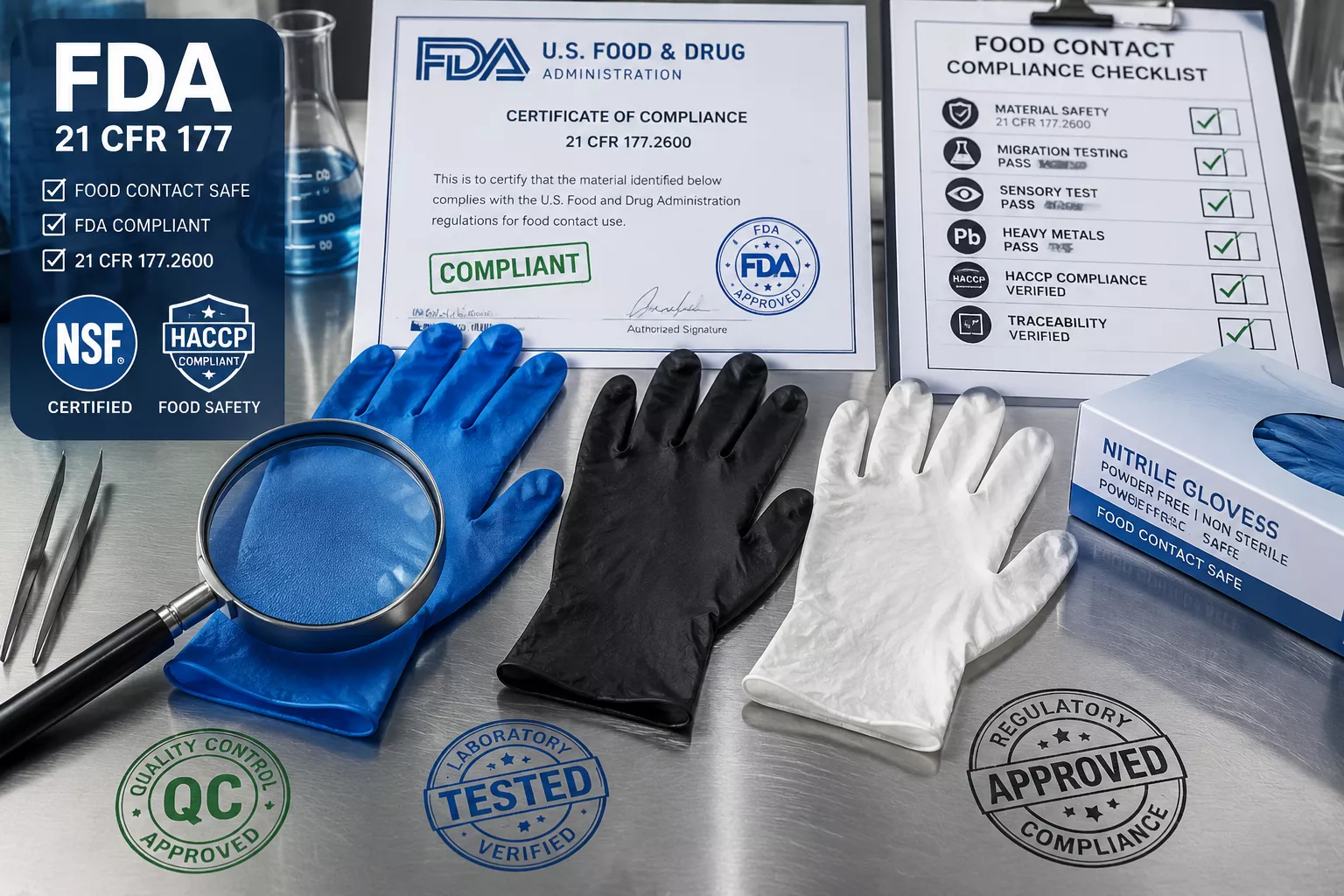
When selecting Nitrile Gloves for Food Safety: What Buyers Need to Know About Compliance, Color, and Contamination Control, regulatory compliance forms the foundation of any purchasing decision. Food-safe nitrile gloves must comply with FDA Title 21 CFR Part 177, which establishes that glove materials must be recognized as safe for food contact and cannot transfer harmful substances to food products.
Essential Certifications to Look For
Food-grade nitrile gloves should display multiple industry-recognized certifications:
- FDA 510K clearance – Confirms medical-grade quality standards
- NSF Food System Certification – Validates food-contact safety
- ASTM D3578 – Establishes quality standards for nitrile examination gloves
- EN 1186 safety standard – European food-contact compliance (for international operations)
- BRC Global Standard for Food Safety – Comprehensive food safety management certification
⚠️ Critical Warning: Not all nitrile gloves are food-safe. Understanding which disposable gloves are food safe prevents serious compliance violations and health risks.
Why Certification Verification Matters
Manufacturing consistency varies significantly across suppliers. Some manufacturers may hold letters of compliance or previous test certifications, but these documents don’t guarantee current production batches meet the same standards. Always verify current certification status before making bulk purchases.
Look for clear certification markings directly on the packaging. Legitimate food-safe nitrile gloves will prominently display FDA approval statements, EN 1186 compliance, or equivalent regional certifications. If certification information isn’t clearly visible, request documentation from the supplier before committing to purchase.
Approved Food Contact Applications
FDA-compliant nitrile gloves are certified safe for direct contact with:
- Raw meats, poultry, and seafood 🥩
- Dairy products and eggs 🥛
- Ready-to-eat foods and deli items 🥪
- Fresh vegetables and produce 🥗
- Baked goods and pastries 🥐
This versatility makes nitrile the preferred choice for diverse food preparation environments, from quick-service restaurants to large-scale food processing facilities.
The Strategic Importance of Color Selection in Food Safety Compliance
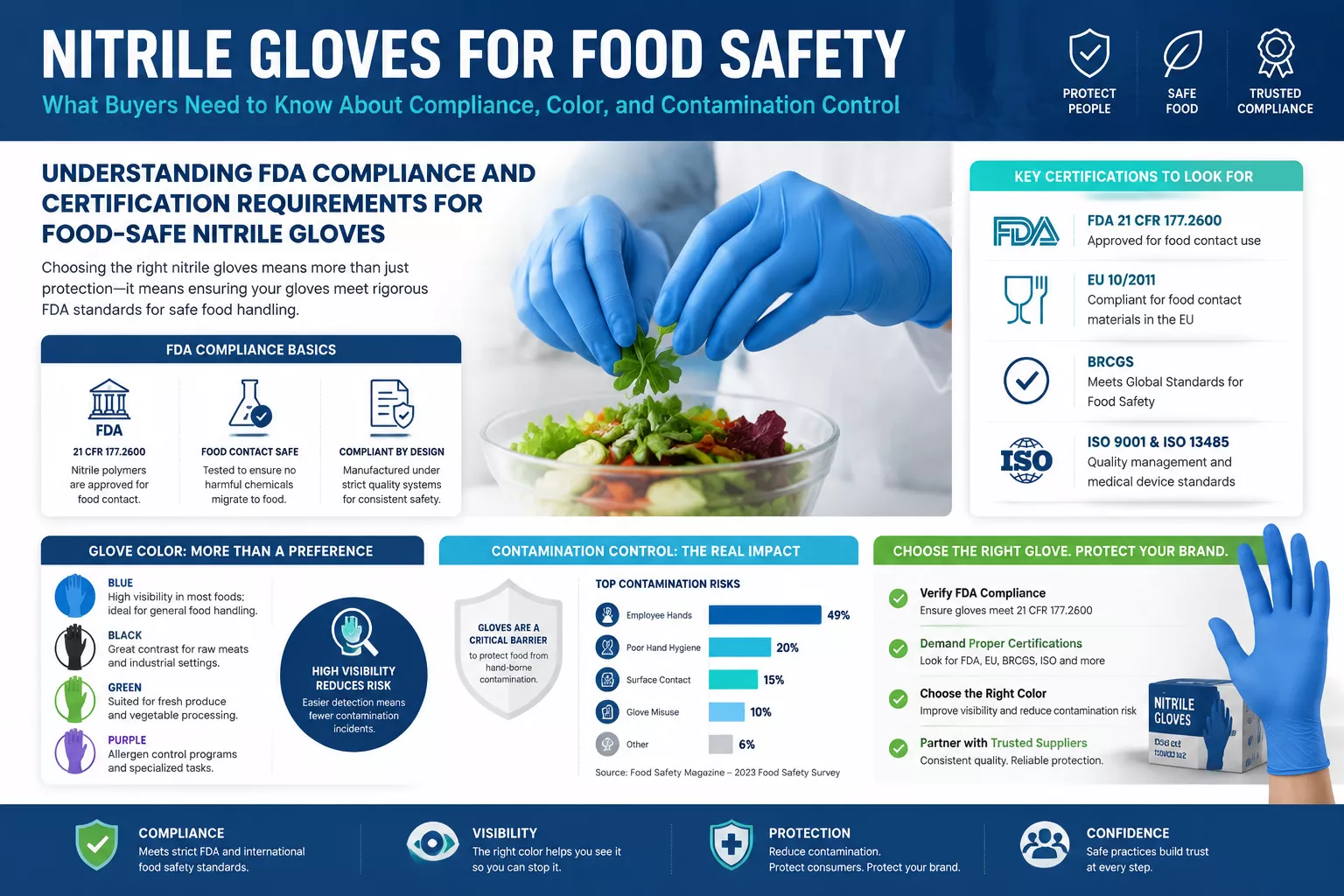
Color selection in Nitrile Gloves for Food Safety: What Buyers Need to Know About Compliance, Color, and Contamination Control extends far beyond aesthetics—it’s a critical contamination control strategy recognized by HACCP (Hazard Analysis Critical Control Points) programs worldwide.
Why Blue Nitrile Gloves Dominate Food Service
Blue nitrile gloves represent the industry standard for food safety compliance for one compelling reason: blue does not naturally occur in most foods. This makes torn glove fragments immediately visible and detectable during food preparation, preventing contamination from reaching consumers.
When a blue glove tears during food handling, the bright blue material stands out against:
- White bread and baked goods
- Green vegetables and salads
- Red meats and poultry
- Brown sauces and gravies
- Yellow dairy products
This instant visibility allows food handlers to quickly identify and remove contaminated products before they leave the kitchen.
Alternative Color Options and Their Applications
While blue remains the gold standard, other colors serve specific purposes:
| Glove Color | Best Use Case | Visibility Advantage |
|---|---|---|
| Blue | General food prep, HACCP compliance | Highest visibility in most foods |
| Black | High-end restaurants, aesthetic preference | Professional appearance, hides stains |
| White | Bakeries, dairy processing | Shows contamination on glove surface |
| Orange | Seafood processing, specialized tasks | Distinct from most food products |
⚠️ Important Note: Regardless of color choice, gloves must still meet FDA food-contact compliance standards. Color doesn’t determine safety—certification does.
Implementing Color-Coded Systems
Many large food operations implement color-coded glove systems to prevent cross-contamination between different food preparation areas:
- Blue gloves for raw meat handling
- White gloves for ready-to-eat food assembly
- Green gloves for produce preparation
- Orange gloves for seafood processing
This systematic approach reduces human error and creates clear visual protocols that all staff members can easily follow. For operations comparing different glove materials, reviewing nitrile versus vinyl gloves for food safety provides valuable insights into material performance differences.
Material Advantages: Why Nitrile Outperforms Other Disposable Glove Options
Understanding material properties is essential when evaluating Nitrile Gloves for Food Safety: What Buyers Need to Know About Compliance, Color, and Contamination Control. Nitrile gloves offer distinct advantages over latex and vinyl alternatives in food service environments.
Superior Puncture Resistance and Durability
Nitrile gloves are manufactured from nitrile butadiene rubber, a synthetic material that provides exceptional puncture resistance compared to vinyl and other disposable options. This durability matters significantly when handling:
- Sharp utensils and knives
- Bone fragments in meat processing
- Rough vegetable surfaces
- Abrasive cleaning tasks
Food-grade nitrile gloves are available in 3-mil to 8-mil thicknesses depending on task requirements. For guidance on selecting appropriate thickness, explore what is a good thickness for nitrile gloves to match glove specifications to specific food handling tasks.
Latex Allergy Elimination
One of the most significant advantages of nitrile gloves is the complete elimination of latex allergy concerns. Natural latex proteins can trigger severe allergic reactions in both food handlers and consumers with latex sensitivities. Nitrile’s synthetic composition provides a safe alternative that protects everyone in the food chain.
For operations transitioning from latex gloves, understanding latex allergy considerations helps ensure proper staff training and customer safety protocols.
Chemical and Oil Resistance
Quality food-grade nitrile gloves provide excellent resistance to:
- Water and moisture
- Cooking oils and fats
- Common cleaning chemicals
- Food acids (vinegar, citrus, tomatoes)
- Sanitizing solutions
This chemical resistance maintains glove integrity throughout extended food preparation tasks, reducing the need for frequent glove changes and improving operational efficiency.
The Powder-Free Requirement
The FDA banned powdered gloves in food service due to potential health risks and contamination concerns. Modern food-safe nitrile gloves are powder-free, eliminating:
- Powder residue contamination in food products
- Respiratory irritation for food handlers
- Interference with food texture and appearance
- Cross-contamination between preparation areas
Always verify that nitrile gloves are explicitly labeled as powder-free before purchasing for food service applications.
Common Contamination Control Mistakes and How to Avoid Them
Even with proper glove selection, operational mistakes can compromise food safety. Understanding these errors helps buyers implement comprehensive contamination control protocols.
Mistake #1: Extended Glove Wear Without Changes
The Problem: Wearing the same pair of gloves for extended periods or across multiple tasks creates cross-contamination opportunities.
The Solution: Implement strict glove change protocols:
- Change gloves between handling raw and ready-to-eat foods
- Replace gloves after touching non-food surfaces (phones, door handles, cash registers)
- Change gloves every 2 hours during continuous food preparation
- Replace immediately if gloves become torn or visibly soiled
Mistake #2: Improper Glove Donning and Removal
The Problem: Contaminating clean gloves during application or contaminating hands during removal defeats the purpose of glove use.
The Solution: Train all staff on proper glove hygiene:
- Wash hands thoroughly before putting on gloves
- Avoid touching glove exterior with bare hands
- Remove gloves by pulling from the wrist, turning inside-out
- Wash hands immediately after glove removal
- Never reuse disposable gloves
Mistake #3: Using Gloves as a Substitute for Handwashing
The Problem: Gloves are a barrier, not a replacement for proper hand hygiene. Contaminated hands inside gloves still transfer pathogens.
The Solution: Maintain rigorous handwashing protocols:
- Wash hands before glove application
- Wash hands after glove removal
- Wash hands between glove changes
- Use proper 20-second handwashing technique with soap and warm water
Mistake #4: Ignoring Heat Limitations
The Problem: While nitrile gloves offer some heat resistance, they’re not designed for direct contact with hot surfaces or foods.
The Solution: Use specialized heat-resistant gloves in combination with nitrile gloves for high-temperature applications. Never use standard nitrile gloves to:
- Remove items from ovens or fryers
- Handle hot pots and pans
- Touch heated cooking surfaces
- Work with steam equipment
For comprehensive guidance on glove selection, review what to consider when choosing nitrile gloves to ensure all operational requirements are addressed.
Mistake #5: Purchasing Based on Price Alone
The Problem: Choosing the cheapest gloves without verifying certifications and quality standards exposes operations to compliance violations and contamination risks.
The Solution: Prioritize certification and quality over cost:
- Verify FDA compliance documentation
- Request certification letters for current production batches
- Test gloves with actual food handling tasks before bulk purchasing
- Calculate total cost including glove change frequency and waste
Practical Decision Guide for Food Service Operations
When evaluating Nitrile Gloves for Food Safety: What Buyers Need to Know About Compliance, Color, and Contamination Control, use this practical framework to make informed purchasing decisions:
Step 1: Assess Your Specific Needs
Restaurant Operations: Prioritize blue nitrile gloves with 4-6 mil thickness for general food preparation, with specialized thicker gloves for meat processing areas.
Food Processing Facilities: Select gloves based on specific production lines—thicker gloves (6-8 mil) for raw material handling, thinner gloves (3-4 mil) for delicate assembly work.
Catering Operations: Choose versatile blue nitrile gloves with good tactile sensitivity for detailed food presentation work, ensuring adequate supplies for high-volume events.
Step 2: Verify Compliance Documentation
Before finalizing any purchase:
✓ Request current FDA compliance letters
✓ Verify NSF certification status
✓ Confirm ASTM D3578 compliance
✓ Check for EN 1186 certification (if applicable)
✓ Review manufacturing quality control documentation
Step 3: Test Before Bulk Ordering
Order sample boxes to evaluate:
- Fit and comfort for your staff
- Tactile sensitivity for specific tasks
- Durability during actual food handling
- Ease of donning and removal
- Absence of defects or tears
Step 4: Calculate True Cost Per Use
Consider these factors beyond unit price:
- Glove change frequency requirements
- Waste from torn or damaged gloves
- Staff productivity with proper-fitting gloves
- Compliance violation costs avoided
- Customer safety and reputation protection
Step 5: Establish Supplier Relationships
Partner with suppliers who provide:
- Consistent certification documentation
- Reliable inventory availability
- Technical support and training resources
- Competitive pricing for volume orders
- Quality guarantees and return policies
For operations also using nitrile gloves in cooking applications, explore nitrile gloves for cooking to understand additional considerations for heat exposure and food preparation techniques.
Conclusion
Nitrile Gloves for Food Safety: What Buyers Need to Know About Compliance, Color, and Contamination Control encompasses far more than simply ordering disposable gloves. Success requires understanding FDA compliance requirements, implementing strategic color-coding systems, selecting appropriate materials, and avoiding common contamination control mistakes.
The 15% of foodborne illness outbreaks linked to improper glove usage demonstrates the real-world consequences of inadequate glove selection and protocols. By prioritizing FDA-certified nitrile gloves, implementing blue glove standards for visibility, maintaining powder-free requirements, and training staff on proper usage, food service operations can significantly reduce contamination risks while meeting regulatory compliance standards.
Take Action Now
- Audit your current glove inventory – Verify all gloves display proper FDA compliance markings
- Implement color-coded systems – Establish blue nitrile gloves as your standard for general food preparation
- Train your staff – Conduct comprehensive training on proper glove usage, change protocols, and contamination prevention
- Test before committing – Order samples from certified suppliers and evaluate performance in your actual operations
- Document your protocols – Create written procedures for glove selection, usage, and change requirements
The investment in proper nitrile gloves and comprehensive food safety protocols protects your customers, your staff, and your business reputation. In 2026’s increasingly regulated food service environment, compliance isn’t optional—it’s essential for operational success and public health protection.