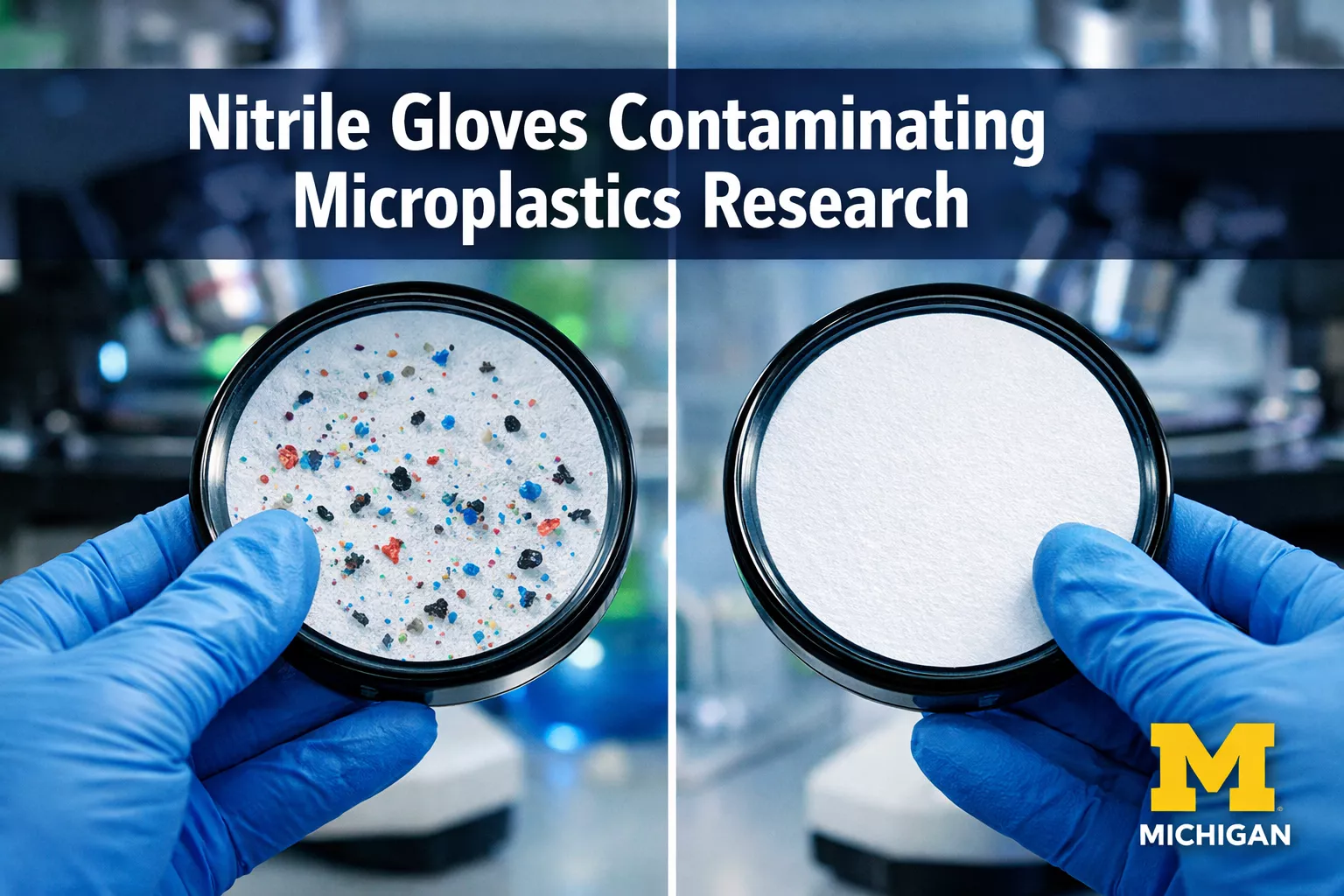
Scientists studying microplastics pollution just discovered they’ve been accidentally measuring their own gloves. A groundbreaking University of Michigan study published in March 2026 found that standard nitrile and latex lab gloves release thousands of stearate particles that perfectly mimic microplastics—potentially skewing years of environmental research data. This revelation has sent shockwaves through the scientific community, forcing researchers to question whether we’ve been overestimating microplastics pollution all along.
The discovery happened by accident when researcher Madeline Clough detected microplastics levels thousands of times higher than expected on carefully prepared metal substrates. The culprit? The very nitrile gloves scientists wear to prevent contamination were actually causing it.
Key Takeaways
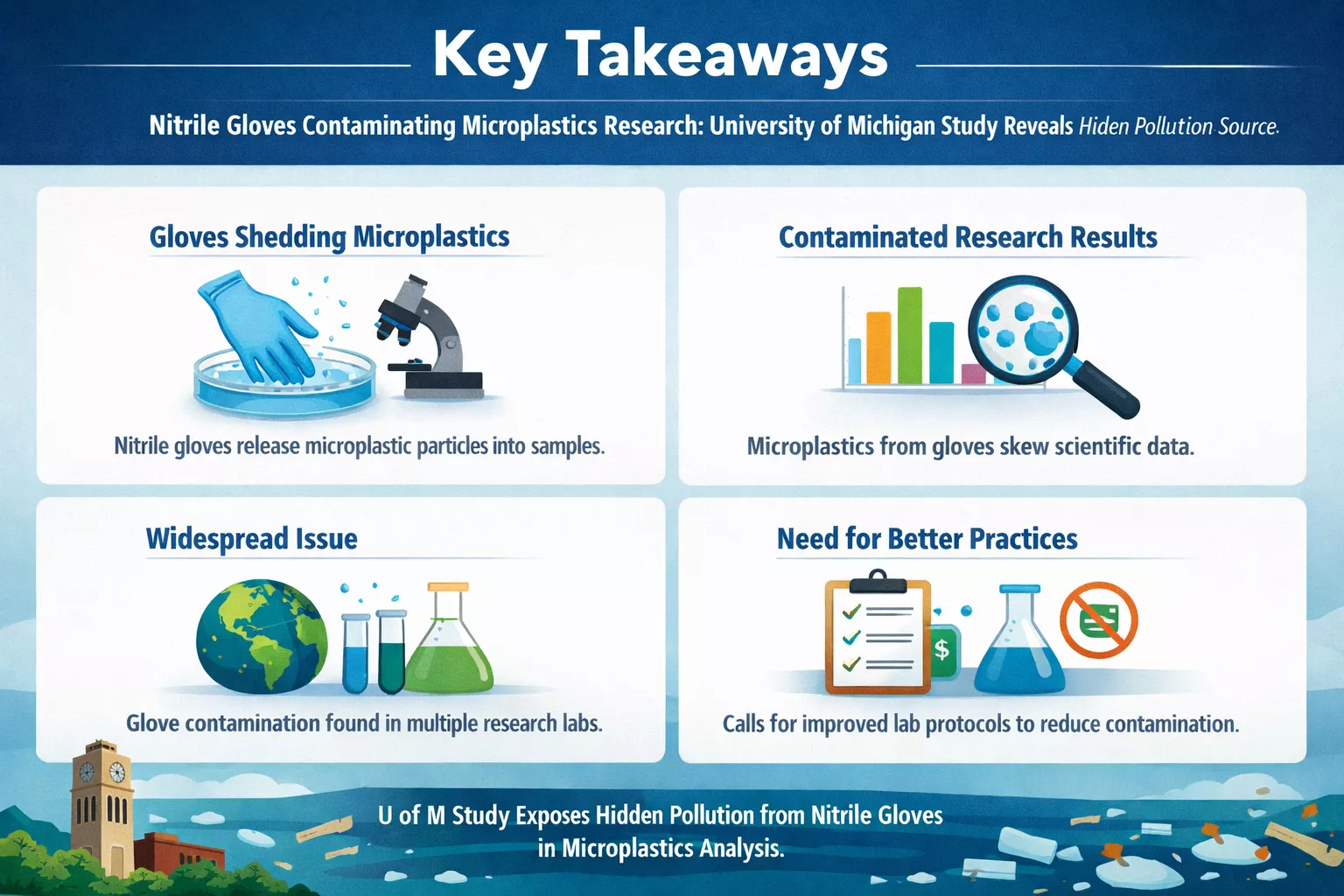
- Standard nitrile and latex gloves release stearate particles that infrared spectroscopy and electron microscopes mistake for polyethylene microplastics
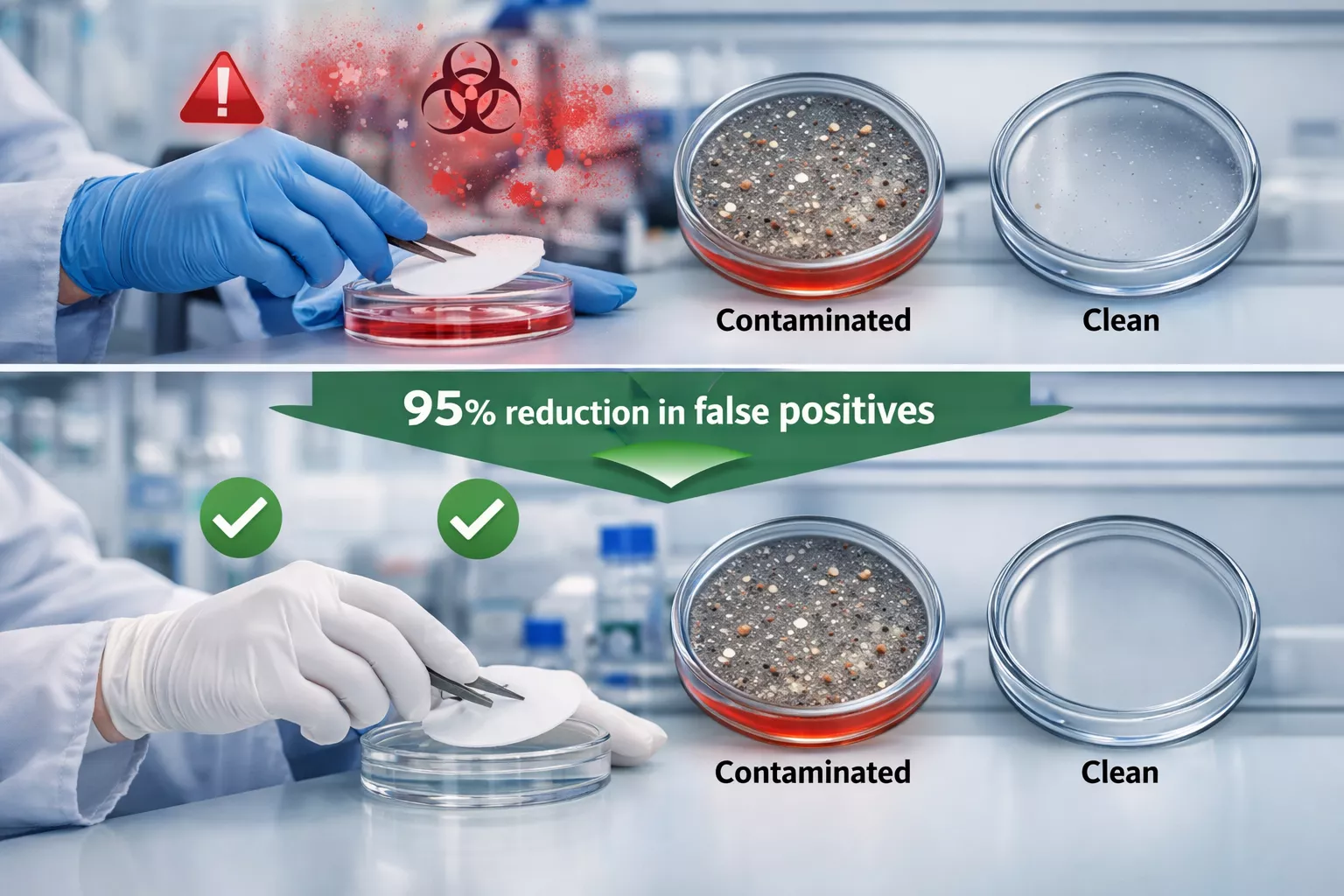
- 2,000 false positives per square millimeter occur on average when using regular lab gloves during sample preparation
- Cleanroom nitrile gloves reduce contamination by 95%, dropping false positives to just 100 per square millimeter
- Years of microplastics research data may be inflated, particularly for particles smaller than 10 micrometers
- The University of Michigan team has created new workflows and spectral libraries to help researchers identify and remove glove contamination from existing datasets
How Nitrile Gloves Contaminating Microplastics Research Went Undetected for Years
The irony is almost painful: scientists have been wearing protective gloves to keep samples clean, but those same gloves were secretly contaminating their research. The problem stems from stearates—non-volatile residues used during glove manufacturing to prevent the material from sticking to molds.
When researchers handle filters, slides, or equipment with standard nitrile gloves, these stearate particles transfer onto surfaces through simple dry contact. The real trouble begins when scientists analyze these samples using traditional identification methods.
Why the contamination fooled everyone:
- 🔬 Identical spectral signatures – Stearates produce vibrational spectra that match polyethylene perfectly
- 🧪 Standard protocols recommended gloves – Scientific literature actually encouraged wearing nitrile gloves during microplastics prep
- 📊 Automated library matching – Computer systems flagged stearates as legitimate microplastics
- 🔍 Tiny particle size – Contamination especially affects particles under 10 micrometers, which are hardest to verify visually
The University of Michigan team tested seven different glove types, including various nitrile, latex, and cleanroom varieties. Every single standard glove type showed the same problem—an average of 2,000 false positives per square millimeter of contact area.
The University of Michigan Study That Changed Everything
Madeline Clough wasn’t looking for glove contamination when she made her discovery. She was researching airborne microplastics and preparing metal substrates in conditions similar to a cleanroom. Following published protocols, she wore standard nitrile gloves—the same type used in countless labs worldwide.
The numbers didn’t make sense. Her carefully controlled samples showed microplastics concentrations thousands of times higher than atmospheric levels could explain. Something was very wrong.
The investigation process:
- Ruled out obvious sources – Plastic squirt bottles, lab air, and other equipment checked clean
- Tested multiple glove types – Seven varieties examined, including nitrile, latex, and specialized cleanroom gloves
- Recreated lab conditions – Controlled experiments confirmed gloves as the contamination source
- Developed identification methods – Created new spectral libraries to distinguish stearates from real microplastics
Chemistry professor Anne McNeil, a study co-author, explained the findings on WBUR’s Here & Now in April 2026. The implications were staggering: environmental microplastics numbers might be significantly overstated, especially in studies analyzing small particles.
The research, published in RSC Analytical Methods, provides detailed workflows for researchers to reanalyze existing datasets. This is crucial because proper disposal and handling of contaminated materials has always been important, but now we understand contamination works both ways.
What This Means for Microplastics Research Moving Forward
The discovery doesn’t mean microplastics pollution isn’t real—it absolutely is. But it does mean scientists need to recalibrate their understanding of how much plastic pollution exists, particularly in specific size ranges.
Key implications:
| Research Area | Impact Level | Action Required |
|---|---|---|
| Atmospheric microplastics | High | Reanalyze datasets for particles <10 µm |
| Water sample analysis | Medium-High | Review glove protocols, retest suspicious samples |
| Soil contamination studies | Medium | Verify particle identification methods |
| Marine microplastics | Medium | Cross-check small particle counts |
| Food contamination research | High | Critical review needed for food safety studies |
The good news? The solution is relatively simple. Nitrile cleanroom gloves (stearate-free varieties) reduced false positives by 95% in the University of Michigan experiments. These specialized gloves cost more than standard versions, but they’re essential for accurate microplastics research.
Practical Solutions: Choosing the Right Gloves for Laboratory Work
Not every lab needs to switch to expensive cleanroom gloves immediately. The contamination issue primarily affects microplastics research and other studies where tiny particles matter. However, understanding how different glove types perform helps researchers make informed decisions.
Glove selection guide for different applications:
For microplastics research:
- ✅ Use stearate-free cleanroom nitrile gloves
- ✅ Minimize direct contact with samples and filters
- ✅ Consider using tweezers or other tools when possible
- ✅ Implement new spectral libraries to identify stearate contamination
For general laboratory work:
- Standard nitrile gloves remain appropriate for most applications
- Chemical resistance properties aren’t affected by stearate content
- Durability and abrasion resistance remain unchanged
- Cost-effectiveness still makes them ideal for routine tasks
For specialized applications:
- Food handling can continue with standard food-safe nitrile gloves
- Medical and surgical applications unaffected by this discovery
- Tattooing and other body art work doesn’t require cleanroom varieties
The University of Michigan study also provides protocols for researchers who need to reanalyze existing data. By applying the new spectral libraries, scientists can identify which “microplastics” in their datasets are actually glove-derived stearates and remove those false positives.
The Bigger Picture: Environmental Research Accuracy
This discovery highlights a fundamental challenge in environmental science: contamination can come from unexpected sources, even from the very tools designed to prevent it. The nitrile gloves contaminating microplastics research issue serves as a reminder that scientific methods constantly need refinement.
What researchers are doing now:
- 🔄 Reviewing past studies – Labs worldwide are reexamining data, especially for small particle counts
- 📋 Updating protocols – New standard operating procedures specify glove types for microplastics work
- 🤝 Sharing knowledge – The University of Michigan team’s spectral libraries are being distributed freely
- 💡 Developing alternatives – Research into even better contamination-free sample handling methods continues
The environmental implications remain serious. Even with corrected data, microplastics pollution is a genuine threat to ecosystems and potentially human health. But accurate measurements are essential for understanding the true scope of the problem and developing effective solutions.
Professor McNeil emphasized that this discovery actually strengthens environmental science by improving measurement accuracy. Better data leads to better policy decisions and more effective pollution prevention strategies.
Beyond the Lab: What This Means for Glove Users Everywhere
While the contamination issue primarily affects scientific research, it raises interesting questions about nitrile glove applications across industries. The stearate particles that confused microplastics researchers don’t pose health risks—they’re essentially harmless fatty acid salts used in many products.
Industries unaffected by this discovery:
- Healthcare and medical settings
- Food service and preparation
- Automotive and mechanical work
- Cleaning and janitorial services
- Personal protective equipment applications
The future of disposable gloves may include more specialized varieties for specific applications, but standard nitrile gloves remain excellent choices for their intended purposes. Their chemical resistance, durability, and latex-free composition make them ideal for countless applications where particle-level contamination isn’t a concern.
For researchers and quality control professionals working with microscopic particles, however, the message is clear: glove selection matters more than previously thought. Understanding the composition and manufacturing process of protective equipment helps prevent unintended consequences.
Conclusion
The University of Michigan study revealing how nitrile gloves contaminating microplastics research has fundamentally changed how scientists approach environmental pollution analysis. By identifying stearate particles as a major source of false positives—averaging 2,000 per square millimeter with standard gloves—researchers can now correct existing data and prevent future contamination.
This discovery doesn’t diminish the reality of microplastics pollution, but it does provide a more accurate picture of the problem’s scope. The solution is straightforward: use stearate-free cleanroom nitrile gloves for microplastics research and apply new spectral libraries to distinguish real contamination from glove-derived particles.
Action steps for different audiences:
For researchers:
- Switch to cleanroom nitrile gloves for microplastics work
- Download and implement the University of Michigan spectral libraries
- Review existing datasets for potential glove contamination
- Update laboratory protocols and train staff on proper glove selection
For laboratory managers:
- Assess which projects require specialized gloves
- Budget for cleanroom varieties where particle contamination matters
- Establish clear guidelines for glove selection by application type
- Consider recycling programs for used gloves to minimize environmental impact
For science communicators and the public:
- Understand that corrected data still shows significant microplastics pollution
- Recognize that scientific self-correction strengthens research credibility
- Support continued environmental monitoring with improved methods
- Stay informed about evolving research on plastic pollution
The nitrile gloves contaminating microplastics research revelation demonstrates science working as it should—identifying problems, developing solutions, and continuously improving measurement accuracy. As we move forward in 2026 and beyond, this discovery will lead to more reliable environmental data and better-informed decisions about addressing plastic pollution worldwide.