Last updated: July 3, 2026
Quick Answer
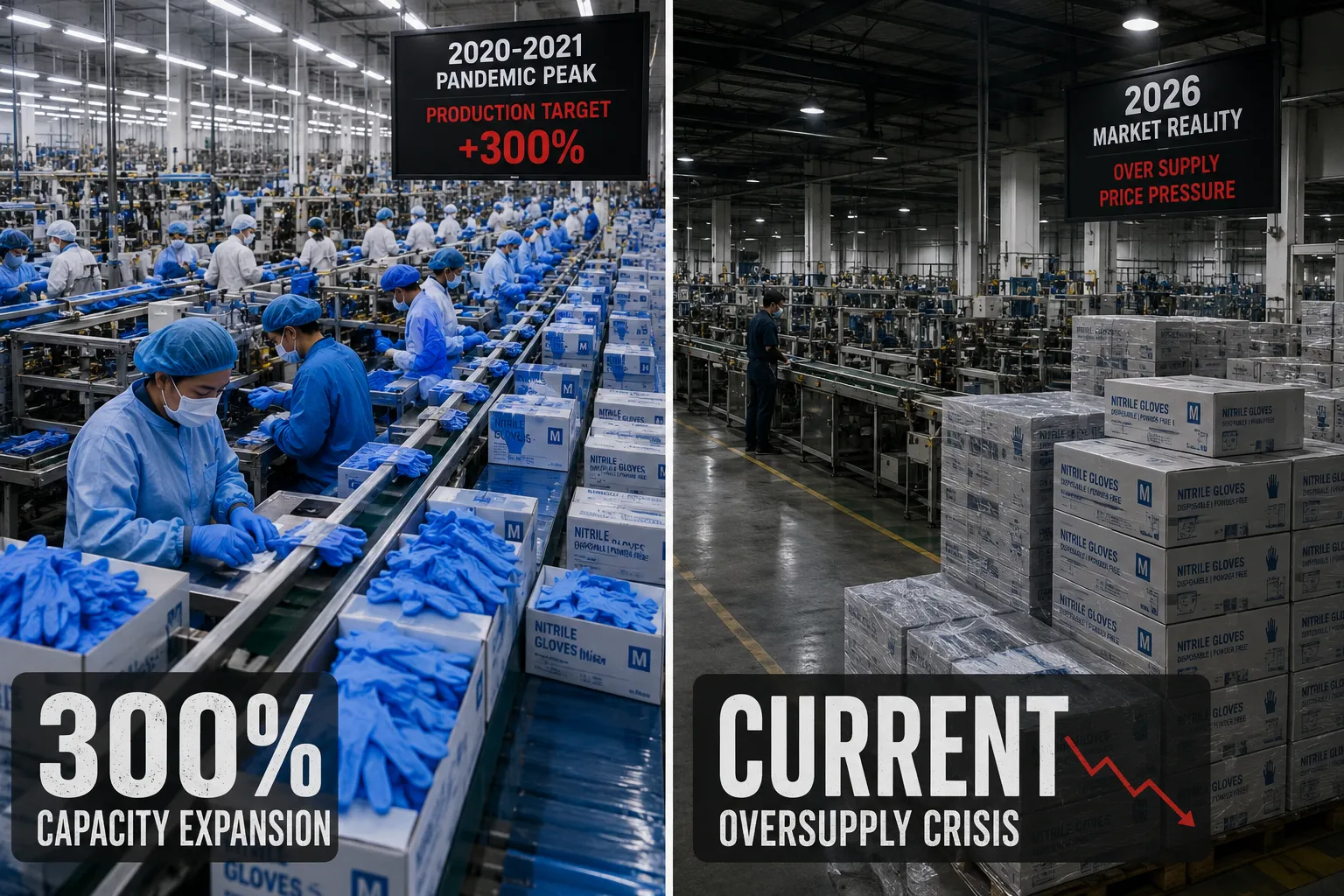
The global nitrile glove market faces severe oversupply in 2026 after manufacturers expanded production capacity by over 300% during the COVID-19 pandemic, causing prices to plummet by 70-80% from peak levels. Buyers can now leverage this capacity glut through strategic bulk purchasing, aggressive contract negotiation, and quality verification protocols to secure premium gloves at historically low prices. The oversupply is expected to persist through 2027, creating an extended window for cost-effective procurement.
Key Takeaways
- Nitrile glove prices dropped 70-80% from 2020 peaks due to massive manufacturing overcapacity built during the pandemic
- Global production capacity now exceeds demand by approximately 40%, creating sustained downward price pressure through 2027
- Bulk buyers can negotiate contracts 30-50% below list prices by leveraging supplier competition and oversupply conditions
- Quality verification remains critical as some manufacturers cut corners to stay competitive during the price collapse
- Hospitals and businesses should focus on 12-18 month supply contracts to balance storage costs with price advantages
- The current oversupply creates optimal conditions for stockpiling, but proper storage protocols are essential for maintaining glove integrity
- Small businesses can access wholesale pricing previously reserved for large institutions by forming purchasing cooperatives
- Future shortages remain possible if manufacturers exit the market, but current capacity suggests stable supply through 2028
- Contract negotiation leverage is highest in Q1 and Q4 when manufacturers need to meet annual targets
- Quality certifications (ASTM D6319, FDA 510(k), ISO 13485) should be verified before committing to low-price suppliers
What Caused the Nitrile Glove Oversupply After COVID?
The nitrile glove oversupply stems directly from unprecedented manufacturing expansion during 2020-2021 when pandemic demand created severe shortages and prices surged to 10-15 times pre-pandemic levels. Manufacturers in Malaysia, Thailand, China, and new entrants globally rushed to build production capacity, adding an estimated 800 billion gloves annually to global output. When pandemic restrictions eased and demand normalized in late 2022, the market was left with roughly 40% excess capacity that persists today.
Several factors compounded the oversupply crisis:
- Speculative capacity additions: Companies that had never produced nitrile gloves entered the market expecting sustained high prices
- Government incentives: Southeast Asian nations offered tax breaks and subsidies for glove manufacturing expansion
- Long construction timelines: Factories approved in 2020-2021 came online in 2022-2023, after demand had already declined
- Inventory destocking: Hospitals and distributors that stockpiled during shortages released excess inventory, further depressing prices
- Reduced healthcare utilization: Post-pandemic healthcare visits declined below 2019 levels in many markets, reducing glove consumption
The Malaysian Rubber Glove Manufacturers Association reported that member companies operated at just 60% capacity utilization in late 2025, down from 120% (including overtime shifts) during the pandemic peak.
Common mistake: Assuming oversupply means inferior products. Many premium manufacturers now offer high-quality gloves at reduced prices simply to maintain market share and factory utilization.
Why Are Nitrile Gloves So Cheap Now Compared to 2020?
Nitrile gloves cost 70-80% less in 2026 than at the 2020-2021 peak because supply now vastly exceeds demand, eliminating the scarcity premium that drove pandemic pricing. A box of 100 examination-grade nitrile gloves that sold for $80-120 in mid-2020 now typically costs $8-15, returning close to pre-pandemic pricing with additional downward pressure from overcapacity.
The price collapse reflects fundamental supply-demand economics:
Supply factors pushing prices down:
- Production capacity increased from approximately 600 billion gloves annually in 2019 to over 1,400 billion in 2026
- New manufacturers compete aggressively for market share
- Established producers run factories below optimal capacity, accepting lower margins to cover fixed costs
- Raw material costs (nitrile butadiene rubber) declined as petrochemical demand normalized
Demand factors limiting price recovery:
- Global glove consumption stabilized at roughly 900-1,000 billion units annually, well below available capacity
- Healthcare demand returned to pre-pandemic growth rates of 8-10% annually
- Reduced infection control protocols in non-healthcare settings decreased industrial and food service consumption
- Economic pressures pushed buyers toward cheaper alternatives like vinyl gloves for non-critical applications
Choose nitrile over alternatives if: You need superior puncture resistance, chemical protection, or latex-free options for allergy concerns, as the current price environment makes nitrile competitive even for cost-sensitive applications.
How Long Will Nitrile Glove Prices Stay Low?
Nitrile glove prices will likely remain at current low levels through 2027 and potentially into 2028, as the industry requires 18-24 months of sustained demand growth or significant capacity exits to rebalance supply and demand. Market analysts project prices will stabilize 20-30% above current levels once equilibrium returns, still well below pandemic peaks but higher than today’s oversupply-driven pricing.
Several scenarios could affect this timeline:
Factors that could extend low prices:
- Additional manufacturing capacity still under construction comes online
- Economic recession reduces healthcare spending and industrial glove consumption
- Manufacturers continue operating at losses to preserve market position
- New low-cost producers in Vietnam, Indonesia, and India enter the market
Factors that could accelerate price recovery:
- Major manufacturers exit the market or declare bankruptcy (already occurring with smaller players)
- Consolidation through mergers reduces competitive pressure
- New infectious disease outbreak increases demand
- Environmental regulations increase production costs
- Raw material price spikes due to petrochemical supply disruptions
Industry observers note that at least 15-20% of pandemic-era capacity additions need to permanently exit the market before pricing power returns to manufacturers. This process typically takes 2-3 years as companies exhaust financial reserves and lenders force closures.
Edge case: A sudden supply shock (natural disaster affecting Malaysian production, which represents 65% of global capacity) could trigger temporary price spikes, but the current oversupply buffer would limit duration and magnitude compared to 2020.
Should I Stock Up on Nitrile Gloves or Wait for Better Prices?
Stock up now if you have adequate storage capacity and can use the inventory within 3-5 years, as current prices represent the lowest levels since 2018 and are unlikely to decline further. Waiting for better prices carries minimal upside (perhaps 5-10% additional savings) but risks missing the optimal purchasing window if manufacturers begin exiting the market or demand unexpectedly increases.
Decision framework for stockpiling:
Stock up now if:
- You have climate-controlled storage space (temperature 50-70°F, humidity below 60%)
- Your organization uses gloves consistently with predictable consumption patterns
- You can negotiate bulk pricing at least 30% below current retail rates
- Cash flow allows upfront investment with 12-24 month payback period
- You can verify supplier quality certifications and product consistency
Wait or buy smaller quantities if:
- Storage space is limited, expensive, or lacks climate control
- Usage patterns are unpredictable or declining
- Working capital is constrained
- You lack expertise to verify quality from unfamiliar suppliers
- Your current supplier offers favorable just-in-time delivery terms
Optimal stockpile size: Most procurement experts recommend 12-18 months of inventory at current consumption rates, balancing price advantages against storage costs and product shelf life. Nitrile gloves for hospitals typically maintain quality for 5 years when properly stored, providing a comfortable safety margin.
Nitrile Gloves Bulk Buying Tips for Hospitals Right Now
Hospitals should leverage the current oversupply to negotiate multi-year contracts with tiered pricing, quality guarantees, and flexible delivery schedules that lock in savings while maintaining supply chain security. The optimal approach combines aggressive price negotiation with rigorous quality verification, as financial pressure on manufacturers creates both opportunities and risks.
Strategic bulk purchasing tactics:
Contract structure recommendations:
- Duration: 18-24 month contracts with quarterly price review clauses
- Volume commitments: 70-80% of projected needs with option to increase 20-30%
- Pricing: Fixed base price with commodity adjustment formula tied to nitrile rubber costs
- Quality provisions: Specify ASTM D6319 compliance, acceptable quality limits (AQL 1.5 or better), and third-party testing rights
- Delivery terms: Just-in-time delivery for 60-70% of volume, remainder in strategic stockpile
Supplier evaluation criteria:
- Manufacturing history (prefer established producers over pandemic-era entrants)
- Financial stability (request audited financials or credit reports)
- Certification portfolio (FDA 510(k), ISO 13485, CE marking for European standards)
- Production capacity utilization (suppliers running at 40-50% capacity may face closure risk)
- Geographic diversification (split orders between Malaysian and non-Malaysian sources)
Negotiation leverage points:
- Request quotes from 5-7 suppliers to establish competitive baseline
- Emphasize long-term partnership potential beyond current oversupply period
- Negotiate payment terms (net 60-90 days) to offset supplier cash flow pressures
- Bundle multiple product categories (exam gloves, surgical gloves, specialty sizes)
- Time negotiations for Q4 when manufacturers need year-end volume
Common mistake: Focusing solely on price without verifying quality consistency. Some manufacturers have reduced quality control staffing or substituted lower-grade raw materials to cut costs. Require batch testing and maintain relationships with multiple suppliers to ensure continuity if quality issues emerge.
How to Negotiate Nitrile Glove Contracts During Oversupply
Negotiate from a position of strength by obtaining multiple competitive bids, emphasizing volume potential, and requesting concessions beyond price including extended payment terms, quality guarantees, and flexible delivery schedules. Current market conditions give buyers unprecedented leverage, with manufacturers willing to accept 30-50% discounts from list prices to secure long-term contracts and maintain factory utilization.
Negotiation strategy framework:
Pre-negotiation preparation:
- Document current consumption by glove type, size, and application
- Obtain quotes from at least five suppliers (three established, two newer entrants)
- Research supplier financial health and production capacity
- Establish internal approval for 12-24 month inventory commitment
- Calculate total cost of ownership including storage, handling, and quality testing
Negotiation tactics that work in oversupply markets:
- Anchor low: Open negotiations 40-50% below initial quotes, as suppliers expect significant discounting
- Emphasize volume: Highlight total annual spend and multi-year potential, not just immediate order
- Request value-adds: Free shipping, extended payment terms, consignment inventory, quality testing services
- Create competition: Let suppliers know you’re evaluating multiple options (without revealing specific competitors)
- Negotiate timing: Request best pricing for Q1 or Q4 delivery when manufacturers face quarterly targets
- Bundle strategically: Combine multiple SKUs or facilities to increase total contract value
Contract provisions to include:
- Price protection: Most-favored-customer clause ensuring you receive any better pricing offered to comparable buyers
- Quality guarantees: Right to reject shipments failing ASTM standards, with replacement at supplier expense
- Supply assurance: Commitment to maintain production capacity and prioritize your orders
- Exit clauses: Ability to terminate if supplier changes ownership, relocates production, or fails quality audits
- Transparency: Right to audit manufacturing facilities and quality control processes
For small businesses: Form purchasing cooperatives with similar organizations to achieve volume thresholds that unlock institutional pricing. Groups of 5-10 small medical practices, dental offices, or laboratories can collectively negotiate contracts comparable to mid-size hospital systems.
Best Time to Buy Nitrile Gloves in Bulk for Small Business
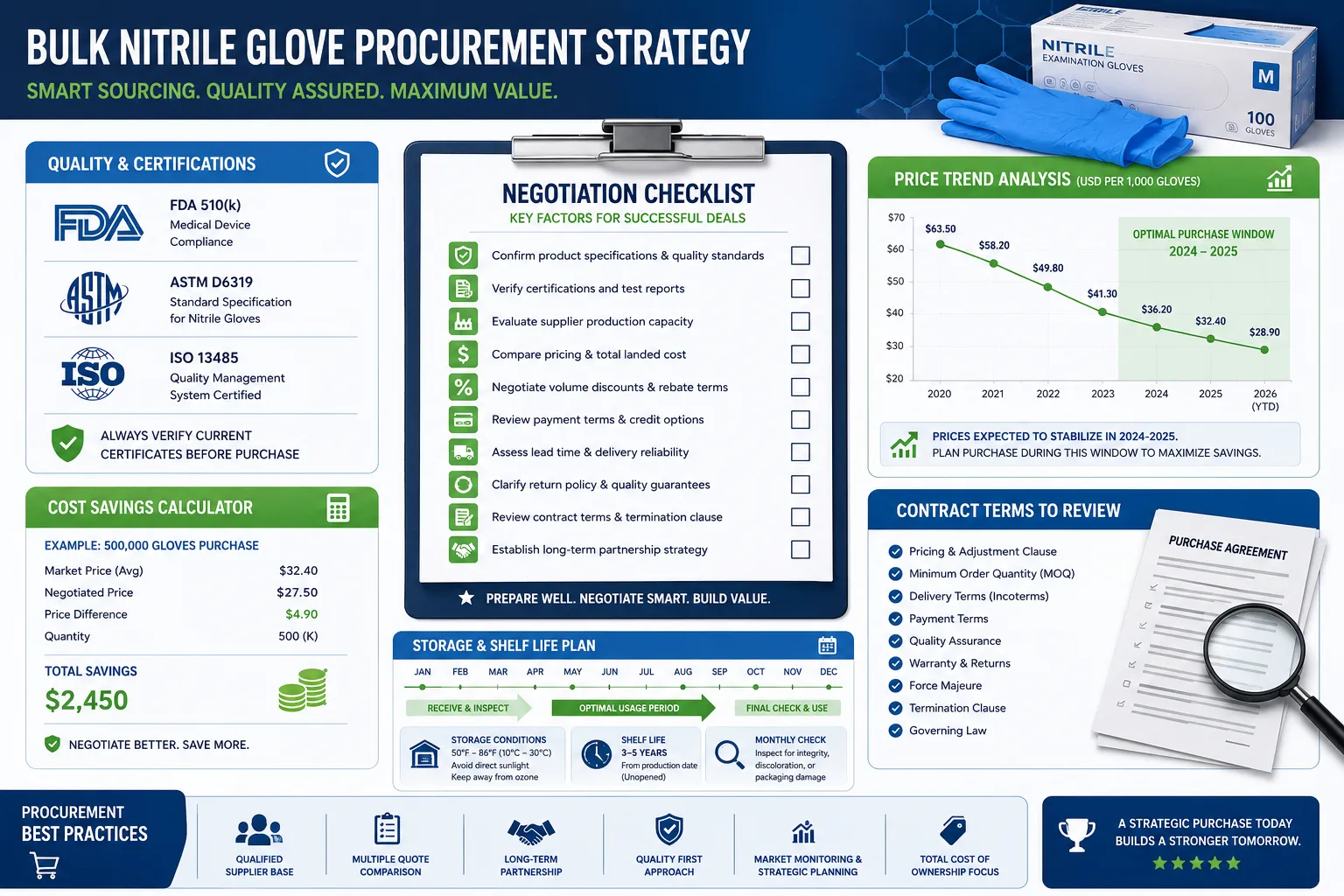
The best time for small businesses to buy nitrile gloves in bulk is Q4 (October-December) or Q1 (January-March) when manufacturers offer aggressive discounts to meet annual sales targets or start the new year with strong order books. Additionally, purchasing during these periods allows businesses to lock in pricing before any potential market corrections in the second half of the year.
Seasonal purchasing patterns:
Q4 advantages (October-December):
- Manufacturers need year-end revenue to satisfy investors and lenders
- Sales teams have quota pressure, increasing negotiation flexibility
- Suppliers clear inventory to reduce year-end carrying costs
- Budget cycles for many organizations allow capital deployment
Q1 advantages (January-March):
- Manufacturers seek strong starts to the fiscal year
- New production capacity often comes online in Q1, increasing supply
- Post-holiday cash flow needs make suppliers more flexible
- Buyers can leverage previous year’s consumption data for accurate forecasting
Avoid if possible:
- Q2 (April-June): Mid-year period with less urgency from suppliers
- Q3 (July-September): Summer slowdown in healthcare and industrial sectors reduces buyer leverage
Optimal order size for small businesses:
- Calculate 12 months of consumption based on previous year’s usage
- Add 20% buffer for growth or unexpected demand
- Verify storage capacity can accommodate volume (typically 40-60 cubic feet per 10,000 gloves)
- Ensure capital investment pays back within 18 months through savings versus ongoing smaller purchases
Practical example: A dental practice using 500 gloves monthly (6,000 annually) should target a 7,200-glove purchase (12 months plus 20% buffer). At current bulk pricing of $6-8 per 100-glove box versus $12-15 retail, the practice saves $430-630 annually while investing $430-575 upfront.
Are Cheap Nitrile Gloves Lower Quality Than Pandemic Era Ones?
Cheap nitrile gloves in 2026 are not inherently lower quality than pandemic-era products; many premium manufacturers now offer the same specifications at reduced prices due to overcapacity and competitive pressure. However, some manufacturers have cut quality control measures or use lower-grade materials to remain profitable at current price levels, making supplier verification essential before committing to unfamiliar brands.
Quality assessment framework:
Indicators of maintained quality despite low prices:
- Established manufacturer with pre-pandemic production history
- Current ASTM D6319 certification (for exam gloves) or ASTM D3578 (for surgical gloves)
- FDA 510(k) clearance with recent inspection history
- ISO 13485 quality management certification
- Acceptable Quality Limit (AQL) of 1.5 or better for critical defects
- Willingness to provide batch testing results and certificates of analysis
Warning signs of compromised quality:
- Manufacturer entered market during 2020-2021 with no prior glove production experience
- Certifications are outdated, pending, or from unrecognized bodies
- Refusal to provide batch testing data or manufacturing location details
- Prices significantly below market average (more than 40% under comparable products)
- Inconsistent product specifications across shipments
- High defect rates (pinholes, tears, sizing variations)
Testing protocols for quality verification:
- Visual inspection: Check 100 gloves from random boxes for pinholes, tears, discoloration, or sizing inconsistencies
- Water leak test: Fill gloves with water per ASTM D5151 protocol; reject batches exceeding 1.5% failure rate
- Tensile strength: Verify minimum 14 MPa tensile strength and 500% elongation per ASTM D6319
- Thickness measurement: Confirm specifications match labeled thickness (typically 3-6 mil for exam gloves)
- Chemical resistance: Test against common chemicals in your application if used beyond basic exam purposes
Choose established brands if: Your application involves high-risk procedures, chemical exposure, or regulatory scrutiny. The 10-20% premium for recognized manufacturers provides insurance against quality failures and compliance issues. For more information on nitrile glove quality considerations, review certification requirements for your specific use case.
What Happens to Nitrile Glove Manufacturers During Oversupply?
Nitrile glove manufacturers during oversupply face severe financial pressure, with many operating at losses or minimal margins, leading to factory closures, bankruptcies, and industry consolidation. Since 2023, an estimated 15-20% of pandemic-era production capacity has exited the market through closures or conversions to other products, with additional exits expected through 2027 as financially weaker producers exhaust reserves.
Industry restructuring patterns:
Manufacturer responses to oversupply:
- Capacity reduction: Running factories at 50-70% utilization, eliminating overtime shifts
- Cost cutting: Reducing workforce, delaying maintenance, minimizing quality control staffing
- Product diversification: Converting lines to other rubber products (seals, gaskets, industrial components)
- Market exits: Permanent closure of facilities, especially among pandemic-era entrants
- Consolidation: Mergers and acquisitions as stronger players absorb distressed competitors
- Geographic shifts: Relocating production to lower-cost regions (Vietnam, Indonesia, India)
Financial impact on different manufacturer types:
Established producers (pre-2019 operations):
- Better positioned with paid-off equipment and established customer relationships
- Accept lower margins to maintain market share and factory utilization
- Focus on premium products and value-added services (custom packaging, just-in-time delivery)
- Typically survive oversupply periods, though profitability suffers
Pandemic-era entrants (2020-2021 startups):
- Carry heavy debt from rapid expansion at peak equipment and construction costs
- Lack established customer relationships and brand recognition
- Face intense pressure from lenders as revenue projections fail to materialize
- High bankruptcy and exit rates (estimated 40-50% will not survive to 2028)
Buyer implications: Diversify suppliers across both established and newer manufacturers, but weight contracts toward financially stable producers for critical applications. Monitor supplier financial health quarterly and maintain backup sources for essential products.
Latex vs Nitrile Gloves: Which Is Better Deal in 2026?
Nitrile gloves offer a better overall value in 2026 for most applications despite similar pricing to latex, providing superior puncture resistance, chemical protection, and latex-free composition that eliminates allergy concerns. Current oversupply has compressed the traditional 20-30% price premium for nitrile to just 5-15% over latex, making nitrile the preferred choice unless specific tactile sensitivity requirements favor latex.
Comparative analysis:
| Factor | Nitrile Gloves | Latex Gloves |
|---|---|---|
| Current Price (per 100) | $8-15 | $7-13 |
| Puncture Resistance | Excellent (3x latex) | Good |
| Chemical Resistance | Excellent (oils, solvents) | Fair (limited) |
| Allergy Risk | Minimal (latex-free) | Moderate (latex proteins) |
| Tactile Sensitivity | Good | Excellent |
| Shelf Life | 5 years | 3 years |
| Best Applications | Medical, dental, laboratory, industrial, food service | Surgical procedures requiring maximum sensitivity |
Choose nitrile if:
- Any staff or patients have latex allergies or sensitivities
- Applications involve chemicals, oils, or solvents
- Puncture resistance is critical (dental, laboratory, industrial use)
- Long-term stockpiling is planned (better shelf life)
- Cost difference is less than 15% versus latex
Choose latex if:
- Maximum tactile sensitivity is essential (surgical procedures, fine manipulation)
- No allergy concerns exist in your population
- Latex is significantly cheaper (more than 20% savings)
- Chemical exposure is minimal
For detailed comparison, see our guide on latex versus nitrile gloves. The current market environment makes nitrile the default choice for most buyers, with latex reserved for specific applications where its superior tactile properties justify the allergy risk and reduced durability.
Common Mistakes When Buying Nitrile Gloves During Price Drops
The most common mistake when buying nitrile gloves during price drops is prioritizing cost savings over quality verification, leading to purchases of substandard products that fail in use, create liability exposure, or require costly replacement. Other frequent errors include over-ordering beyond storage capacity, failing to verify supplier stability, and neglecting to negotiate favorable contract terms beyond unit price.
Critical mistakes to avoid:
Quality and compliance errors:
- Skipping certification verification: Assuming low prices indicate legitimate products without confirming ASTM, FDA, or ISO certifications
- Ignoring batch testing: Accepting shipments without sampling and testing for defects or specification compliance
- Overlooking AQL ratings: Purchasing gloves with acceptable quality limits above 2.5, increasing defect rates
- Neglecting application fit: Buying exam-grade gloves for applications requiring surgical or chemotherapy-grade specifications
- Forgetting allergy considerations: Not verifying accelerator-free formulations for users with nitrile glove allergies
Procurement and logistics mistakes:
- Over-ordering: Buying quantities that exceed storage capacity or shelf life, leading to degraded products
- Single-source dependency: Concentrating all purchases with one supplier, creating vulnerability if quality or supply issues emerge
- Ignoring storage requirements: Failing to provide climate-controlled storage, causing premature degradation
- Poor inventory rotation: Not implementing first-in-first-out systems, resulting in expired stock
- Inadequate documentation: Failing to maintain batch records, certificates of analysis, and quality test results
Financial and contractual errors:
- Paying upfront: Providing full payment before delivery without inspection rights or quality guarantees
- Missing payment term opportunities: Accepting standard terms instead of negotiating net 60-90 day payment in current market
- Ignoring total cost: Focusing on unit price without calculating storage, handling, quality testing, and potential waste costs
- Short contract duration: Locking in current prices for only 3-6 months instead of 18-24 months
- Weak quality provisions: Accepting contracts without clear rejection rights, replacement guarantees, or audit provisions
Prevention strategy: Develop a standardized procurement checklist covering quality verification, supplier evaluation, contract terms, storage planning, and inventory management. Assign responsibility for each element and require sign-off before finalizing purchases over $5,000.
Will Nitrile Glove Shortage Happen Again?
Another nitrile glove shortage is possible but unlikely in the near term (through 2028) given current massive overcapacity, though a severe pandemic, major natural disaster affecting Malaysian production, or rapid industry consolidation could create temporary supply constraints. The market has learned from 2020 shortages, with buyers maintaining larger strategic reserves and manufacturers preserving more capacity than pre-pandemic levels, creating better resilience against demand spikes.
Shortage risk assessment:
Low-probability scenarios that could trigger shortages:
- New pandemic: Infectious disease outbreak with transmission characteristics similar to or worse than COVID-19
- Natural disaster: Major earthquake, tsunami, or flooding affecting Malaysian production (65% of global capacity)
- Geopolitical disruption: Trade restrictions, export bans, or supply chain breakdowns affecting raw materials or finished goods
- Rapid capacity exits: Accelerated manufacturer bankruptcies removing 30-40% of capacity faster than demand can adjust
- Raw material shortage: Disruption in nitrile butadiene rubber supply from petrochemical production issues
Factors reducing shortage risk:
- Overcapacity buffer: Current 40% excess capacity provides substantial cushion for demand increases
- Geographic diversification: New production in Vietnam, Thailand, China, and India reduces Malaysian concentration
- Strategic reserves: Healthcare systems and governments maintain larger stockpiles than pre-2020
- Demand patterns: Post-pandemic healthcare utilization remains below peak levels, limiting baseline consumption
- Manufacturing flexibility: Producers can increase utilization from current 60% to 90-100% relatively quickly
Preparedness recommendations:
- Maintain 6-12 month strategic inventory for critical applications
- Establish relationships with suppliers in multiple geographic regions
- Include force majeure and supply priority provisions in contracts
- Monitor industry capacity utilization rates quarterly (shortage risk increases above 85%)
- Develop contingency plans including alternative products (vinyl, latex) for non-critical uses
Historical context: The 2020 shortage was unprecedented due to simultaneous global demand spike, limited production capacity, and supply chain disruptions. Current market structure makes a shortage of similar magnitude highly unlikely, though regional or temporary constraints remain possible.
How to Verify Nitrile Glove Quality When Prices Are Low
Verify nitrile glove quality during low-price periods by confirming current certifications (ASTM, FDA, ISO), conducting batch testing for defects and specifications, and requesting certificates of analysis from accredited laboratories. Implement a three-tier verification process: documentation review, visual inspection, and performance testing before accepting large shipments or committing to long-term contracts.
Comprehensive quality verification protocol:
Tier 1: Documentation and certification review
Request and verify certifications:
- ASTM D6319 (exam gloves) or ASTM D3578 (surgical gloves) compliance
- FDA 510(k) clearance with establishment registration number
- ISO 13485 quality management system certification
- CE marking for European standards (if applicable)
- Manufacturing facility inspection reports
Validate certification authenticity:
- Contact certifying bodies directly to confirm validity
- Check FDA establishment registration database
- Verify ISO certification through issuing body website
- Request recent audit reports (within 12 months)
Review product specifications:
- Acceptable Quality Limit (AQL) rating (prefer 1.5 or lower)
- Tensile strength (minimum 14 MPa for exam gloves)
- Elongation at break (minimum 500%)
- Thickness specifications by size
- Chemical resistance claims with supporting data
Tier 2: Visual and physical inspection
- Sample selection: Randomly select 100 gloves from different boxes and production lots
- Visual defects: Check for pinholes, tears, discoloration, contamination, or sizing inconsistencies
- Water leak test: Fill gloves with 1 liter of water per ASTM D5151; reject if more than 1.5% fail
- Thickness measurement: Use micrometer to verify specifications at palm, fingers, and cuff
- Packaging integrity: Inspect boxes for damage, moisture exposure, or tampering
Tier 3: Performance testing
- Tensile strength testing: Send samples to accredited laboratory for ASTM D412 testing
- Puncture resistance: Conduct ASTM F1342 testing if application involves sharps or rough materials
- Chemical permeation: Test against specific chemicals in your application per ASTM F739
- Protein content: Verify low protein levels (below 50 micrograms per gram) if latex-free claims are critical
- Accelerator content: Test for common allergens if users have chemical sensitivities
Red flags requiring additional scrutiny:
- Supplier refuses to provide batch-specific certificates of analysis
- Certifications are expired, pending, or from unrecognized bodies
- Visual defect rates exceed 2% in sampling
- Specifications vary significantly between batches
- Supplier cannot provide manufacturing facility location or inspection history
- Prices are more than 40% below comparable certified products
Ongoing quality assurance: Implement receiving inspection protocols for every shipment, maintain batch traceability, and conduct quarterly performance testing even with established suppliers. Market pressures may cause quality drift over time as manufacturers seek cost reductions.
Nitrile Glove Storage Tips for Long-Term Stockpiling
Store nitrile gloves long-term in climate-controlled environments at 50-70°F with humidity below 60%, away from direct sunlight, ozone sources, and chemicals to maintain quality for the full 5-year shelf life. Implement first-in-first-out inventory rotation, keep gloves in original packaging until use, and conduct quarterly inspections for signs of degradation including discoloration, brittleness, or tackiness.
Optimal storage conditions:
Environmental requirements:
- Temperature: 50-70°F (10-21°C) with minimal fluctuation
- Humidity: 40-60% relative humidity (avoid extremes)
- Light exposure: Dark or low-light conditions; UV exposure accelerates degradation
- Air quality: Well-ventilated area free from ozone, solvents, or chemical fumes
- Cleanliness: Dry, clean environment protected from dust, pests, and moisture
Storage infrastructure:
- Shelving: Metal or plastic shelving (avoid wood which can harbor moisture and pests)
- Elevation: Store at least 6 inches off floor to prevent moisture absorption
- Spacing: Allow air circulation between boxes; avoid tight stacking
- Organization: Group by size, type, and production date for easy rotation
- Access: Maintain clear aisles for inspection and retrieval
Inventory management practices:
First-in-first-out (FIFO) system:
- Label all shipments with receipt date and production lot number
- Store newest inventory behind older stock
- Pull from oldest inventory first for daily use
- Conduct monthly cycle counts to verify rotation compliance
- Flag inventory approaching 4-year age for priority use
Quarterly inspection protocol:
- Randomly select 20 gloves from different lots and storage locations
- Check for visual degradation (discoloration, brittleness, stickiness)
- Perform water leak test on 10 gloves
- Document findings and compare to baseline quality
- Investigate and address any degradation patterns
Signs of storage-related degradation:
- Color changes (yellowing, darkening, or fading)
- Surface tackiness or stickiness
- Brittleness or reduced elasticity
- Cracking or splitting when stretched
- Unusual odors
- Packaging damage or moisture infiltration
Storage capacity planning: Calculate approximately 40-60 cubic feet per 10,000 gloves (100 boxes of 100 gloves). A standard pallet holds 40-60 cases (4,000-6,000 gloves), requiring 8-10 square feet of floor space with 6-foot vertical clearance.
Common storage mistakes: Storing in unconditioned warehouses with temperature extremes, placing gloves near HVAC equipment that generates ozone, failing to rotate inventory leading to expired stock, and opening boxes prematurely which exposes gloves to environmental degradation.
Frequently Asked Questions
How much should I expect to pay for nitrile gloves in 2026?
Expect to pay $8-15 per 100-glove box for examination-grade nitrile gloves in 2026, with bulk purchases of 10,000+ gloves available at $6-10 per box. Surgical-grade gloves cost $15-25 per box, while specialty gloves (extended cuff, chemotherapy-rated) range from $20-40 per box depending on specifications.
Can I negotiate prices even lower than current market rates?
Yes, buyers can negotiate 30-50% below list prices by leveraging oversupply conditions, committing to larger volumes, accepting flexible delivery schedules, and timing purchases during Q1 or Q4 when manufacturers face quarterly targets. Multi-year contracts and bundled purchases across product categories provide additional negotiation leverage.
How do I know if a supplier will still be in business next year?
Assess supplier stability by requesting financial statements or credit reports, verifying they operated before 2020, checking capacity utilization rates (above 50% is healthier), confirming they supply major healthcare systems or distributors, and monitoring industry news for bankruptcy or closure announcements. Diversify across multiple suppliers to mitigate risk.
Are there quality differences between Malaysian and Chinese nitrile gloves?
Quality depends more on individual manufacturer standards than country of origin, though Malaysian producers generally have longer production histories and more established quality systems. Both countries produce excellent and poor-quality gloves; verify certifications, conduct testing, and evaluate each supplier individually rather than making assumptions based on manufacturing location.
Should small businesses form buying groups to get better prices?
Yes, small businesses can achieve 20-40% savings by forming purchasing cooperatives that aggregate volume to reach institutional pricing thresholds. Groups of 5-10 similar organizations (medical practices, dental offices, laboratories) can collectively negotiate contracts comparable to mid-size hospital systems while maintaining individual delivery and payment arrangements.
What’s the minimum order quantity for bulk pricing?
Minimum order quantities for bulk pricing typically start at 5,000-10,000 gloves (50-100 boxes), with additional discounts at 25,000, 50,000, and 100,000+ glove thresholds. Some suppliers offer container-load pricing (200,000-500,000 gloves) for maximum savings, though this requires substantial storage capacity and capital investment.
How can I tell if gloves have been stored improperly before I receive them?
Inspect for discoloration (yellowing or darkening), brittleness when stretched, surface tackiness, unusual odors, or damaged packaging indicating moisture exposure. Request production dates and avoid inventory older than 2-3 years unless storage conditions are documented. Conduct water leak testing on samples from each shipment to identify degradation.
Is it worth switching suppliers to save 20% on glove costs?
Switching suppliers for 20% savings is worth considering if the new supplier has verified certifications, positive references from similar organizations, and acceptable quality test results. However, factor in transition costs including qualification testing, staff training on new products, and risk of supply disruption. For critical applications, maintain dual sources rather than complete switches.
What certifications are absolutely necessary for medical-grade nitrile gloves?
Medical-grade nitrile gloves require FDA 510(k) clearance, ASTM D6319 compliance (exam gloves) or ASTM D3578 (surgical gloves), and manufacturing under ISO 13485 quality management systems. Additional certifications like AQL 1.5 rating and specific chemical resistance standards may be necessary depending on application and regulatory requirements.
Can I return or exchange gloves if quality issues appear after delivery?
Return and exchange rights depend on contract terms; negotiate provisions allowing rejection of shipments failing ASTM standards, with replacement at supplier expense. Include quality guarantee periods (typically 30-90 days post-delivery) and clear defect rate thresholds triggering return rights. Document all quality issues with photos, test results, and batch numbers to support claims.
How often should I test gloves from my stockpile?
Test stockpiled gloves quarterly for the first year, then semi-annually if no degradation appears. Conduct visual inspection, water leak testing on 10-20 gloves, and annual laboratory testing for tensile strength and elongation. Increase testing frequency if storage conditions are suboptimal or if gloves approach 4-5 years of age.
What happens to glove prices if another pandemic occurs?
Another pandemic would likely cause temporary price increases of 200-500% depending on severity and duration, though current overcapacity would moderate spikes compared to 2020 when capacity was limited. Strategic stockpiles maintained by healthcare systems and governments would also dampen price volatility. Prices would likely stabilize within 6-12 months as manufacturers increase utilization of existing capacity rather than building new facilities.
Conclusion
The nitrile glove oversupply challenges stemming from pandemic-era capacity expansion have created unprecedented opportunities for strategic buyers in 2026. With prices down 70-80% from peak levels and expected to remain low through 2027, organizations that implement smart purchasing tactics can secure multi-year savings while building strategic reserves against future supply disruptions.
Success in the current market requires balancing aggressive price negotiation with rigorous quality verification. The financial pressure on manufacturers creates both opportunities for exceptional value and risks of compromised quality from struggling suppliers. Buyers should prioritize established manufacturers with verified certifications, conduct thorough testing protocols, and diversify across multiple suppliers to mitigate risk.
Actionable next steps:
- Assess current inventory and consumption patterns to determine optimal stockpile quantities (target 12-18 months)
- Obtain competitive quotes from 5-7 suppliers including both established manufacturers and newer entrants
- Verify certifications and quality through documentation review, batch testing, and reference checks
- Negotiate comprehensive contracts covering price, quality guarantees, delivery terms, and supply assurance provisions
- Prepare storage infrastructure with climate control, organization systems, and inventory rotation protocols
- Implement ongoing quality monitoring through receiving inspection and quarterly testing programs
- Time major purchases for Q1 or Q4 to maximize negotiation leverage during supplier target periods
The current oversupply environment represents a temporary market dislocation that will eventually correct as manufacturers exit and capacity rebalances with demand. Organizations that act strategically now can lock in favorable pricing, build resilient supply chains, and position themselves advantageously for the inevitable market normalization ahead.
For healthcare facilities, the combination of low prices and high supplier competition makes this an ideal time to upgrade to premium nitrile gloves for hospitals while maintaining budget discipline. Small businesses should explore cooperative purchasing arrangements to access institutional pricing previously unavailable to them. All buyers should view the current market as an opportunity to strengthen supply chain resilience while capturing significant cost savings.
SEO Meta Title: Nitrile Glove Oversupply: Smart Buying Tactics for 2026