Last updated: June 30, 2026
Quick Answer
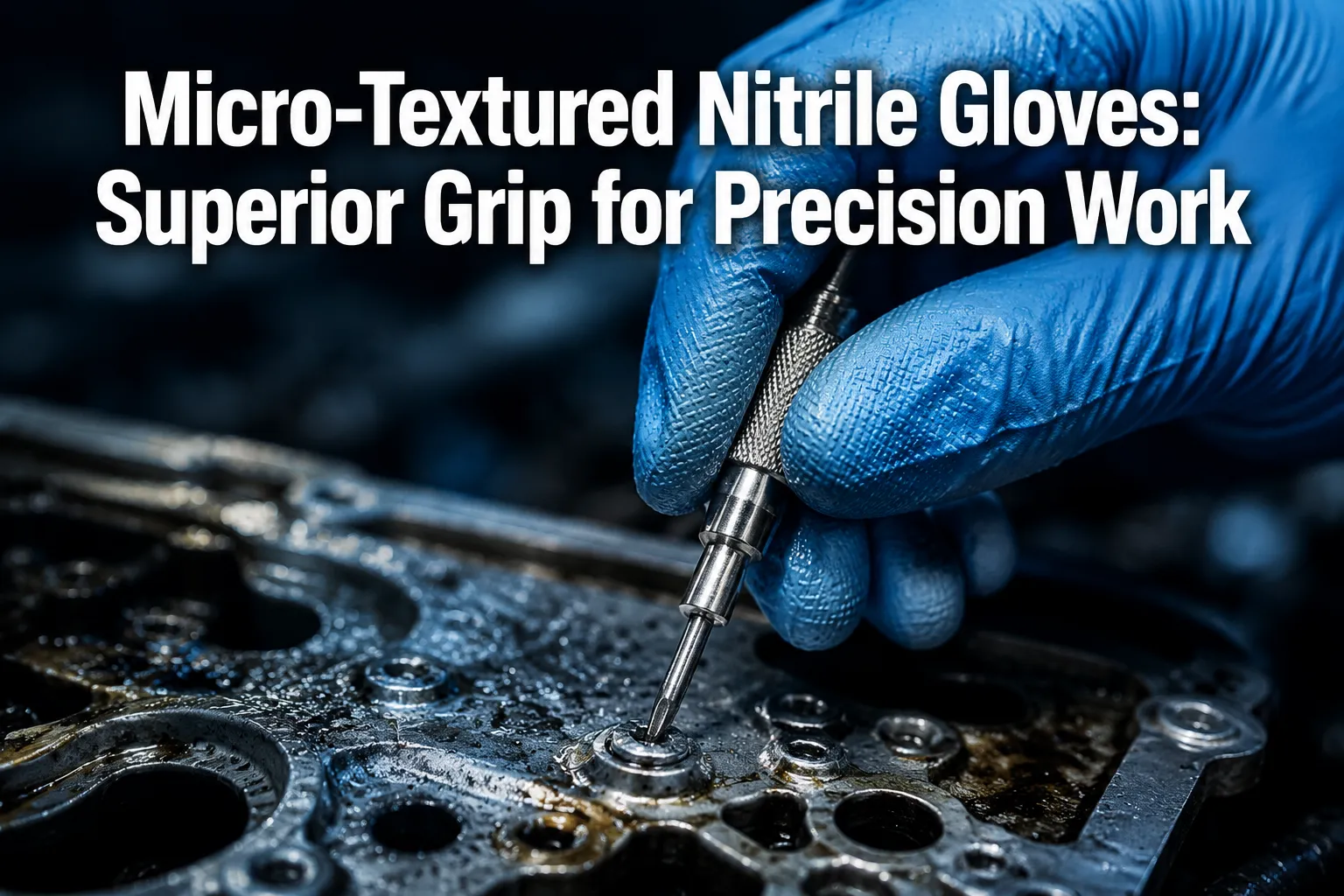
Micro-textured nitrile gloves feature engineered surface patterns with raised textures measuring 50-200 micrometers that significantly improve grip performance in wet, oily, and precision tool applications. These gloves outperform smooth nitrile alternatives by increasing coefficient of friction by 40-60% in slippery conditions, making them essential for automotive assembly, electronics repair, laboratory work, and mechanical tasks where secure handling of small parts and tools is critical.
Key Takeaways
- Micro-textured nitrile gloves use raised surface patterns to increase friction and grip strength by 40-60% compared to smooth nitrile gloves
- The texture patterns work by channeling liquids away from contact surfaces and increasing surface area for better tool and part handling
- These gloves excel in automotive, electronics, laboratory, and precision manufacturing environments where oil, water, or small components are handled
- Texture does not significantly reduce tactile sensitivity when properly designed, with most users reporting minimal dexterity loss
- Durability varies by texture depth and pattern, with deeper textures lasting longer but potentially reducing fine touch sensitivity
- Cost premium over smooth gloves ranges from 15-35%, justified by improved safety and reduced dropped parts in industrial settings
- Proper glove selection requires matching texture pattern to specific task requirements rather than choosing the deepest texture available
What Are Micro-Textured Nitrile Gloves
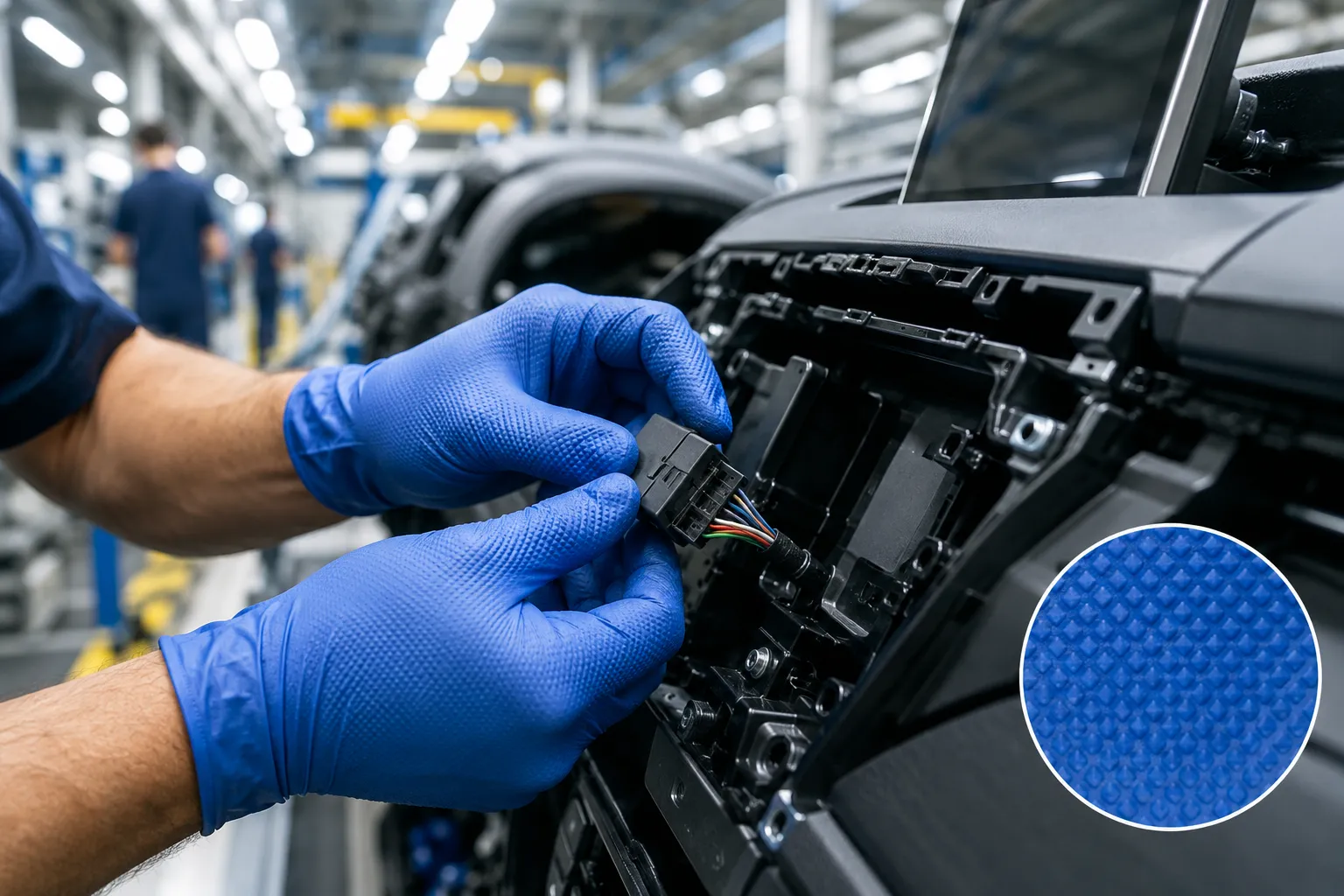
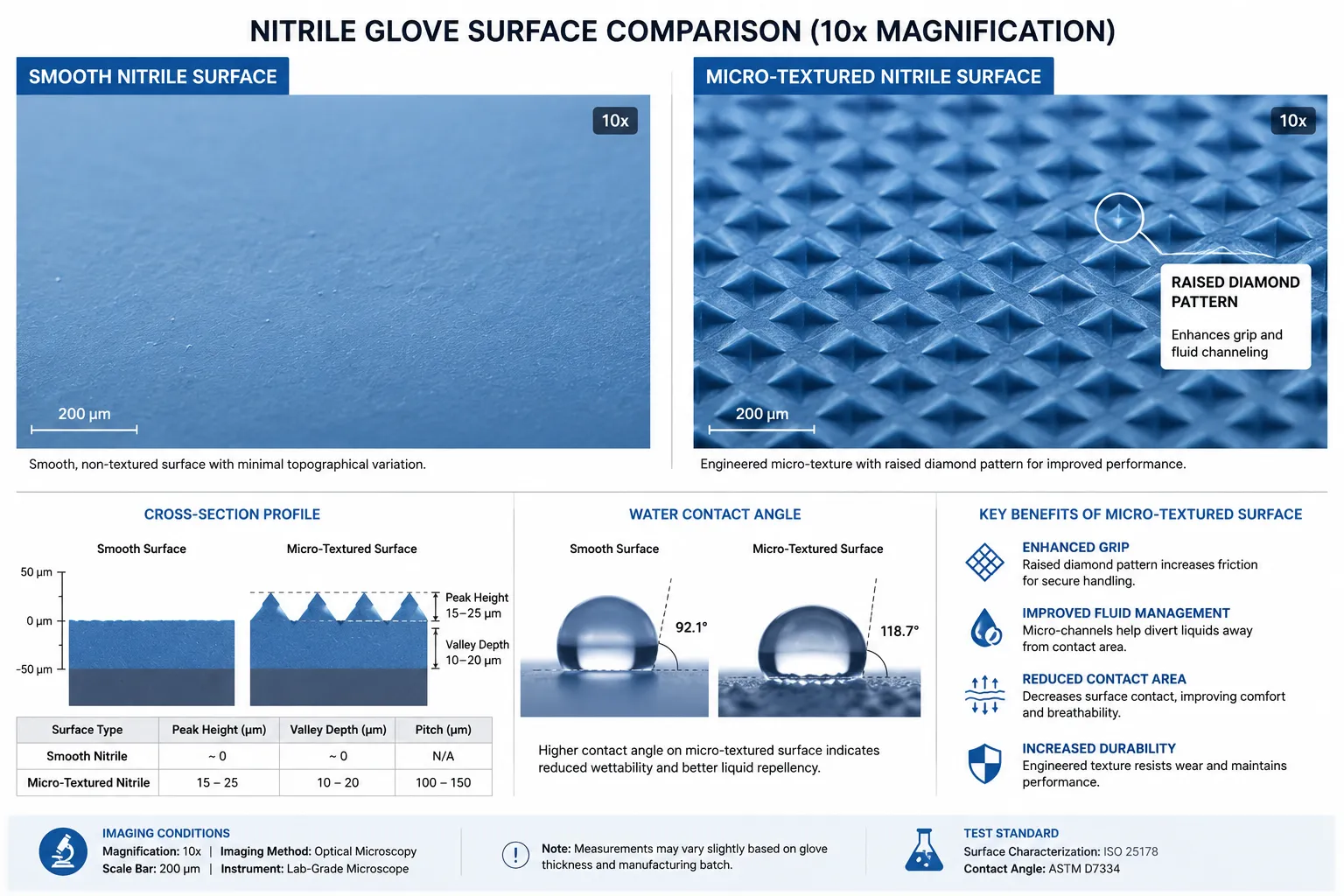
Micro-textured nitrile gloves are disposable protective gloves made from synthetic rubber with engineered surface patterns that enhance grip performance. The textures consist of raised geometric patterns, typically diamonds, dots, or waves, measuring between 50 and 200 micrometers in height, applied to the palm and finger areas during manufacturing.
The manufacturing process creates these textures through specialized mold designs or post-production treatments. During the dipping process, glove formers pass through liquid nitrile compound multiple times, with texture patterns formed either by textured ceramic formers or by applying additional nitrile layers in specific patterns. This differs from smooth nitrile gloves that use plain formers, resulting in uniform surfaces.
Key characteristics of micro-textured nitrile gloves include:
- Surface patterns covering 60-100% of palm and finger areas
- Texture depths ranging from 50 micrometers (fine) to 200 micrometers (aggressive)
- Common patterns: diamond grip, raised dots, wave patterns, or honeycomb designs
- Base material remains standard nitrile rubber (acrylonitrile-butadiene)
- Thickness typically ranges from 4-8 mil, similar to standard nitrile gloves
The textures serve a functional purpose beyond aesthetics. They create channels that allow liquids to escape from between the glove surface and handled objects, maintaining contact with raised texture peaks. This channeling effect prevents hydroplaning, where a continuous liquid film would otherwise cause objects to slip from grip.
Common mistake: Assuming all textured gloves provide equal grip enhancement. Texture pattern, depth, and coverage area significantly affect performance. A glove with minimal texture coverage on fingertips will underperform in precision tasks compared to full-coverage designs.
How Do Micro-Textured Nitrile Gloves Improve Grip Compared to Regular Nitrile Gloves
Micro-textured nitrile gloves improve grip through three mechanical principles: increased surface area, liquid channeling, and enhanced coefficient of friction. Laboratory testing shows these gloves can increase grip strength by 40-60% in wet conditions and 25-40% in dry conditions compared to smooth nitrile alternatives.
The raised texture patterns increase the actual contact surface area between glove and object. While a smooth glove contacts an object across a continuous flat surface, textured gloves make contact only at the peaks of raised patterns. This concentrates grip force onto smaller contact points, increasing pressure per square millimeter and improving mechanical interlocking with object surfaces.
Liquid channeling mechanism:
When handling wet or oily objects, smooth gloves can develop a continuous liquid film between glove and object surface. This film acts as a lubricant, reducing friction dramatically. Micro-textures create valleys and channels that capture and redirect liquids away from contact points. The raised peaks maintain direct contact with the object surface, preventing complete separation by liquid films.
Testing conducted in automotive and laboratory settings demonstrates measurable performance differences. When gripping oil-coated metal tools, smooth nitrile gloves show coefficient of friction values around 0.3-0.4, while micro-textured versions achieve 0.5-0.7 under identical conditions. This translates to requiring 30-50% less grip force to maintain secure holds on slippery objects.
Performance factors that affect grip enhancement:
- Texture depth: Deeper patterns (150-200 micrometers) excel in heavy contamination but may reduce tactile feel
- Pattern geometry: Diamond patterns provide multidirectional grip, while directional patterns optimize for specific motions
- Coverage area: Full palm and finger coverage maximizes grip but increases material cost
- Nitrile formulation: Softer compounds conform better to irregular surfaces, harder compounds resist abrasion longer
The grip improvement comes with trade-offs. Aggressive textures can increase hand fatigue during extended wear because users must maintain higher grip forces even in dry conditions. The texture also creates more surface area that can trap contaminants, requiring more frequent glove changes in clean environments.
For those seeking additional grip enhancement techniques, our guide on 6 tricks to enhance grip with nitrile gloves provides complementary strategies.
Best Micro-Textured Nitrile Gloves for Wet and Oily Conditions
The best micro-textured nitrile gloves for wet and oily conditions feature deep diamond or honeycomb patterns (150-200 micrometers), full palm coverage, and nitrile formulations with oil-resistant additives. For automotive work specifically, gloves with 6-8 mil thickness and aggressive texturing provide optimal performance when handling greasy parts and tools.
Top texture patterns for oil resistance:
Diamond grip pattern: Provides multidirectional traction with intersecting raised ridges that channel oils in multiple directions. Effective for rotating tools and handling parts from various angles.
Raised dot pattern: Features individual raised circles that create discrete contact points. Excels when gripping cylindrical objects like wrenches and drill bits coated in lubricants.
Wave or ripple pattern: Directional texture optimized for linear gripping motions. Best for pulling cables, sliding parts, or repetitive assembly line tasks.
Honeycomb pattern: Combines benefits of dots and diamonds with hexagonal raised sections. Offers balanced performance across different grip angles and object shapes.
When selecting gloves for oily environments, thickness matters as much as texture. Thinner gloves (4-5 mil) provide better tactile sensitivity for small fasteners but puncture more easily when handling sharp metal edges. Thicker options (7-8 mil) sacrifice some dexterity but last longer in demanding mechanical work.
Selection criteria for wet and oily applications:
- Choose gloves with texture extending to fingertips, not just palms
- Verify oil resistance ratings if handling petroleum products, hydraulic fluids, or industrial solvents
- Consider extended cuff lengths (12 inches) for tasks involving arm immersion in fluids
- Select darker colors (black, dark blue) that hide oil stains and maintain professional appearance
For mechanics and automotive professionals, our detailed guide on what is the best mechanic nitrile gloves provides specific product recommendations. Those working with oil changes should also review should you wear nitrile gloves for oil change for application-specific guidance.
Common mistake: Selecting the deepest texture available without considering the specific contaminant. Very deep textures (200+ micrometers) can trap thick greases and become slippery themselves, requiring more frequent glove changes than moderate textures that shed contaminants more effectively.
Do Micro-Textured Gloves Work Better Than Latex for Precision Work
Micro-textured nitrile gloves generally match or exceed latex gloves for precision work while offering superior chemical resistance and eliminating latex allergy concerns. For tasks requiring both fine motor control and grip security, textured nitrile provides comparable tactile sensitivity to latex with significantly better performance in contaminated conditions.
Latex gloves have traditionally dominated precision applications because natural rubber conforms exceptionally well to hand contours and object surfaces. This conformability provides excellent tactile feedback, allowing users to feel texture variations, edges, and pressure changes through the glove material. However, latex performs poorly when exposed to oils, petroleum products, and many solvents, limiting its use in industrial precision work.
Performance comparison for precision tasks:
| Factor | Micro-Textured Nitrile | Latex | Winner |
|---|---|---|---|
| Dry tactile sensitivity | Good (90-95% of bare hand) | Excellent (95-98% of bare hand) | Latex |
| Wet/oily grip | Excellent | Poor to Fair | Nitrile |
| Chemical resistance | Excellent | Poor | Nitrile |
| Puncture resistance | Good to Excellent | Fair | Nitrile |
| Allergen concerns | Minimal | High (latex proteins) | Nitrile |
| Cost per glove | Moderate | Low to Moderate | Latex |
For electronics repair and assembly work involving small components, fine-textured nitrile gloves (50-100 micrometer patterns) provide sufficient dexterity while protecting against skin oils that can damage sensitive circuits. The texture prevents components from slipping during placement without requiring excessive grip force that could damage delicate parts.
Choose micro-textured nitrile over latex if:
- Work involves exposure to oils, solvents, or petroleum products
- Users have latex allergies or work in latex-free facilities
- Tasks combine precision handling with contaminated surfaces
- Puncture hazards exist from sharp component leads or tool edges
- Extended wear time increases latex protein exposure risk
Choose latex over micro-textured nitrile if:
- Maximum tactile sensitivity is the primary requirement
- Work environment is completely dry with no chemical exposure
- No allergy concerns exist among users
- Budget constraints prioritize lowest per-glove cost
- Tasks involve extremely delicate manipulation requiring 98%+ tactile feedback
The gap in tactile performance continues to narrow as nitrile manufacturing improves. Modern thin nitrile gloves (3-4 mil) with fine micro-textures now approach latex sensitivity levels while maintaining superior chemical protection. For most industrial precision applications in 2026, textured nitrile represents the better overall choice.
Learn more about material comparisons in our article on nitrile gloves are better than latex and vinyl.
Where to Buy Micro-Textured Nitrile Gloves in Bulk
Bulk micro-textured nitrile gloves are available through industrial safety suppliers, direct manufacturers, and specialized distributors, with pricing typically ranging from $0.08-0.18 per glove for orders of 10,000+ units. Direct manufacturer relationships offer the lowest per-unit costs but require larger minimum orders, while distributors provide smaller quantities with faster delivery.
Primary purchasing channels:
Industrial safety distributors: Companies like Grainger, Uline, and MSC Industrial Supply stock multiple brands and offer next-day delivery for established accounts. Pricing runs 15-25% higher than direct manufacturer purchases but includes no minimum order quantities and flexible return policies.
Direct manufacturers: Brands such as Ansell, Kimberly-Clark, and Showa manufacture gloves and sell directly to large-volume buyers. Minimum orders typically start at 50,000-100,000 gloves but offer 20-35% cost savings compared to distributor pricing.
Medical and laboratory suppliers: Fisher Scientific, VWR, and similar companies serve healthcare and research markets with gloves meeting specific regulatory standards. Prices fall in the mid-range but include documentation for compliance requirements.
Online marketplaces: Amazon Business, Alibaba, and specialized safety equipment sites provide competitive pricing for mid-volume orders (1,000-10,000 gloves) with transparent pricing and user reviews.
Bulk purchasing considerations:
- Order quantities: Most suppliers offer price breaks at 1,000, 5,000, 10,000, and 50,000 unit thresholds
- Lead times: Stock items ship within 1-3 days; custom specifications require 4-8 weeks
- Storage requirements: Cases of 1,000 gloves occupy approximately 1.5 cubic feet; plan warehouse space accordingly
- Shelf life: Nitrile gloves remain usable for 3-5 years when stored properly (cool, dry, away from UV light)
- Certification needs: Verify FDA approval for food handling, ANSI ratings for industrial use, or ISO certifications for cleanroom applications
Cost optimization strategies:
Join purchasing cooperatives or group buying organizations to access volume discounts without maintaining large inventory. Many industry associations negotiate preferred pricing with major suppliers, offering members 10-20% discounts on standard products.
Consider private labeling for very large operations (500,000+ gloves annually). Manufacturers will apply custom branding to standard glove designs for minimal additional cost, creating consistent supply chain identification and potential resale opportunities.
Common mistake: Ordering the largest quantity to maximize per-unit savings without considering storage costs, capital tied up in inventory, and risk of specification changes. Calculate total cost of ownership including storage, handling, and obsolescence risk before committing to maximum volume purchases.
For automotive-specific applications, review our guide on how to choose nitrile gloves for automotive work before placing bulk orders.
Why Do My Micro-Textured Gloves Still Slip When Handling Small Parts
Micro-textured gloves may still slip when handling small parts due to texture pattern mismatch, contamination buildup in texture valleys, incorrect glove sizing, or handling objects smaller than the texture pattern spacing. The most common cause is using gloves with texture patterns optimized for large tools on components smaller than individual texture elements.
When texture spacing exceeds the contact area of handled parts, small components rest in the valleys between raised patterns rather than contacting the grip-enhancing peaks. A glove with 3mm spacing between texture elements will underperform when handling 2mm screws or electronic components because the parts never contact the textured surfaces.
Specific causes and solutions:
Oversized gloves: Loose-fitting gloves create material bunching and reduce direct contact between texture and objects. The glove material folds and wrinkles, placing smooth inner surfaces against handled items instead of textured outer surfaces. Solution: Size down to ensure snug fit across palm and fingers without restricting circulation.
Contamination accumulation: Oils, adhesives, and fine particles fill texture valleys over time, creating smooth contaminated surfaces that negate grip benefits. This occurs gradually during use and may not be immediately visible. Solution: Change gloves more frequently in contaminated environments, typically every 2-4 hours in oily conditions versus 6-8 hours in clean environments.
Texture pattern mismatch: Aggressive textures designed for large tools perform poorly with small precision parts. Deep patterns (150-200 micrometers) with wide spacing work well for wrenches but fail for circuit board components. Solution: Use fine-textured gloves (50-100 micrometers) with dense pattern spacing for small part handling.
Material degradation: Nitrile compounds soften when exposed to certain chemicals, reducing texture effectiveness. Prolonged exposure to some solvents causes texture peaks to flatten or become tacky. Solution: Verify chemical compatibility and replace gloves showing visible texture wear or surface changes.
Insufficient grip force: Users sometimes reduce grip pressure when wearing textured gloves, assuming texture alone prevents slipping. Texture enhances grip but doesn’t eliminate the need for adequate holding force. Solution: Maintain appropriate grip pressure and use proper handling techniques regardless of glove texture.
Edge case: When handling extremely smooth, hard surfaces like polished glass or ceramic, even aggressive textures may slip because there are no surface irregularities for mechanical interlocking. In these cases, consider gloves with rubber or polymer coatings that provide adhesive-like grip through molecular attraction rather than mechanical texture alone.
For electronics work specifically, consult our guide on best disposable gloves for handling firearms and sensitive equipment which addresses similar precision handling challenges.
Are Micro-Textured Nitrile Gloves Good for Mechanics and Assembly Work
Micro-textured nitrile gloves are excellent for mechanics and assembly work, providing superior grip on oily tools and parts while offering chemical resistance and puncture protection essential in these environments. They represent the preferred choice for automotive technicians, manufacturing assembly workers, and maintenance personnel who regularly handle contaminated objects and precision fasteners.
The combination of oil resistance and enhanced grip makes textured nitrile ideal for mechanical tasks. Standard smooth gloves become dangerously slippery when exposed to motor oil, transmission fluid, or cutting oils common in mechanical work. Textured versions maintain grip performance even when heavily contaminated, reducing dropped tools and improving work efficiency.
Specific advantages for mechanical and assembly applications:
Automotive repair: Mechanics working on engines, transmissions, and undercarriage components encounter constant oil and grease exposure. Micro-textured gloves with 6-8 mil thickness and diamond grip patterns allow secure handling of wrenches, sockets, and small bolts without excessive grip force. The chemical resistance protects against gasoline, brake fluid, and coolant exposure that would degrade latex alternatives.
Manufacturing assembly: Assembly line workers installing components benefit from consistent grip across repetitive motions. The texture reduces hand fatigue by requiring less grip force per part, important when handling hundreds or thousands of components per shift. Fine to medium textures (100-150 micrometers) balance grip with tactile sensitivity needed for quality inspection.
Maintenance work: Facility maintenance personnel encounter diverse conditions from clean environments to contaminated machinery. Textured nitrile provides versatile protection across different tasks without requiring glove changes. The puncture resistance protects against sharp metal edges, wire ends, and debris common in maintenance scenarios.
Electrical and electronics assembly: For work combining precision with contamination risk, fine-textured nitrile gloves offer adequate dexterity while preventing skin oils from damaging sensitive components. However, verify gloves meet ESD (electrostatic discharge) requirements if handling static-sensitive electronics.
Performance considerations:
- Glove thickness: 4-6 mil for light assembly, 6-8 mil for general mechanical work, 8-10 mil for heavy-duty applications
- Texture coverage: Full palm and finger coverage for maximum versatility
- Cuff length: Standard 9-10 inch for most work, extended 12 inch for tasks requiring forearm protection
- Color selection: Black or dark blue hides oil stains and maintains professional appearance longer than light colors
Limitations to consider:
Micro-textured gloves are not suitable for all mechanical tasks. High-heat applications (welding, torch work) require specialized heat-resistant gloves. Heavy-duty impact protection needs mechanical gloves with padding and reinforcement. Very fine precision work may benefit from thinner, smooth gloves despite reduced grip in contaminated conditions.
For comprehensive guidance on automotive applications, see our article on understanding nitrile gloves and oil and how does oil exposure affect nitrile gloves.
Can You Use Micro-Textured Nitrile Gloves for Electronics Repair
You can use micro-textured nitrile gloves for electronics repair, but choose fine-textured versions (50-100 micrometers) that maintain tactile sensitivity while preventing component slippage. Standard electronics repair gloves should also meet ESD-safe specifications to prevent static discharge damage to sensitive circuits, though not all textured nitrile gloves include this feature.
Electronics repair requires balancing multiple factors: preventing skin oil contamination, maintaining precise component manipulation, avoiding static discharge, and securing grip on small parts. Fine micro-textured nitrile gloves address most of these requirements when properly selected.
Key requirements for electronics repair gloves:
Tactile sensitivity: Electronics work involves handling components as small as 0.5mm surface-mount resistors and manipulating delicate connector pins. Fine textures with shallow patterns (50-75 micrometers) provide grip enhancement without significantly reducing touch sensitivity. Glove thickness should not exceed 4-5 mil for optimal feel.
ESD protection: Static-sensitive components require ESD-safe gloves that dissipate static charges safely. Standard nitrile gloves act as insulators and can generate static. Look for textured nitrile gloves specifically labeled as ESD-safe, which incorporate conductive fibers or treatments. Note that not all micro-textured gloves include this feature.
Contamination prevention: Skin oils, salts, and moisture from bare hands can corrode circuit traces and degrade solder joints over time. Nitrile gloves provide an effective barrier against these contaminants while allowing precise work that would be difficult with thicker protective gloves.
Grip on small components: Tiny surface-mount components, IC chips, and connector pins easily slip from smooth gloves, especially when handling with tweezers or placement tools. Fine micro-textures prevent slippage without requiring excessive grip force that could damage delicate parts.
Application-specific recommendations:
- Circuit board assembly: Fine-textured, ESD-safe nitrile gloves, 3-4 mil thickness
- Computer repair and upgrades: Medium-textured nitrile, 4-5 mil, ESD-safe for motherboard work
- Cable and connector work: Medium-textured nitrile, 5-6 mil, ESD protection less critical
- Soldering operations: Heat-resistant gloves for holding work, textured nitrile for component prep and post-solder handling
- Testing and diagnostics: Fine-textured nitrile for probe manipulation and switch operation
Common mistake: Using aggressive textures designed for mechanical work in electronics applications. Deep patterns (150+ micrometers) reduce tactile sensitivity too much for precise component placement and can snag on fine wire leads or component legs, potentially damaging parts or circuit boards.
Edge case consideration: When working with extremely small components under microscope (0.3mm or smaller), even fine-textured gloves may reduce precision too much. In these cases, smooth nitrile gloves or specialized finger cots provide better control, accepting the trade-off of reduced grip security.
For related information on electrical work safety, review do nitrile gloves protect against electric shock, though note that disposable gloves do not provide electrical insulation for live circuit work.
What Industries Need Micro-Textured Grip Gloves the Most
Industries requiring frequent handling of contaminated objects, precision tools, or small parts in wet or oily conditions benefit most from micro-textured grip gloves. The top five industries are automotive manufacturing and repair, electronics assembly, medical device manufacturing, food processing, and laboratory research, where grip security directly impacts safety, quality, and productivity.
Automotive manufacturing and repair: This sector represents the largest consumer of micro-textured nitrile gloves. Assembly line workers install components with oil-coated surfaces, while repair technicians handle tools and parts covered in various automotive fluids. The combination of chemical exposure and grip requirements makes textured nitrile essential. Annual glove consumption in automotive facilities can exceed 50-100 gloves per worker.
Electronics and precision assembly: Manufacturing facilities producing computers, smartphones, medical devices, and aerospace components require workers to handle small parts with precision while preventing contamination. Fine-textured gloves prevent component drops that could damage expensive parts or require rework, directly impacting production costs and quality metrics.
Medical device manufacturing: Cleanroom assembly of surgical instruments, diagnostic equipment, and implantable devices demands contamination control combined with secure handling of small, often slippery components. Textured nitrile gloves meet stringent cleanliness standards while providing grip security for quality-critical assembly operations.
Food processing and preparation: Workers handling wet, oily, or frozen food products need gloves that maintain grip in challenging conditions while meeting food safety regulations. Textured nitrile gloves resist animal fats, vegetable oils, and cleaning chemicals while preventing product drops and improving knife control. For detailed food handling guidance, see are nitrile gloves safe for food handling.
Laboratory research and testing: Scientists and technicians handling glass vials, pipettes, and laboratory equipment in wet conditions benefit from enhanced grip that prevents expensive sample losses and equipment breakage. Chemical resistance protects against the diverse solvents and reagents common in research environments.
Additional industries with significant adoption:
- Pharmaceutical manufacturing: Cleanroom production with contamination control requirements
- Aerospace assembly: Precision work with small fasteners and sensitive components
- Painting and coating: Grip on spray equipment and parts in solvent-rich environments
- Janitorial and sanitation: Handling wet, soapy surfaces and cleaning equipment
- Veterinary care: Animal handling with exposure to bodily fluids and cleaning agents
Industry-specific selection criteria:
Different industries prioritize different glove characteristics. Automotive work emphasizes oil resistance and durability over maximum tactile sensitivity. Electronics assembly prioritizes fine touch and ESD protection over aggressive grip. Food processing requires FDA compliance and frequent glove changes for hygiene.
Adoption drivers across industries:
- Reduced product drops and damage (5-15% improvement in quality metrics)
- Decreased hand fatigue from excessive grip force (10-20% reduction in reported discomfort)
- Improved safety through better tool control (measurable reduction in hand injuries)
- Enhanced productivity from fewer interruptions to adjust grip or retrieve dropped items
- Lower total cost despite higher per-glove price when accounting for reduced waste and injury costs
Common Mistakes When Choosing Textured Nitrile Gloves for Tool Work
The most common mistake when choosing textured nitrile gloves for tool work is selecting the deepest, most aggressive texture available without considering the specific tools and tasks involved. This approach often results in reduced tactile sensitivity, increased hand fatigue, and poor performance with precision tools that require fine motor control.
Critical selection errors and corrections:
Mistake 1: Prioritizing texture depth over pattern design
Many buyers assume deeper textures always provide better grip. However, texture pattern geometry matters more than depth for many applications. Diamond patterns provide multidirectional grip for tools used at various angles, while directional wave patterns excel for specific motions but underperform in others. Choose pattern based on primary tool movements rather than maximum texture depth.
Mistake 2: Ignoring glove sizing and fit
Loose gloves bunch and fold, placing smooth inner surfaces against tools instead of textured outer surfaces. Tight gloves restrict circulation and reduce dexterity. Proper sizing requires snug fit across palm and fingers without restricting movement. Many facilities stock only medium and large sizes, forcing workers into poor fits that negate texture benefits.
Mistake 3: Using single glove type for all tasks
No single textured glove optimizes for all tool work. Heavy mechanical work with large wrenches requires different specifications than precision screwdriver work. Facilities should stock 2-3 glove types: aggressive texture for contaminated heavy work, medium texture for general tasks, and fine texture for precision operations.
Mistake 4: Overlooking thickness requirements
Thicker gloves (8+ mil) provide durability but reduce tactile feedback critical for torque sensing and fastener engagement feel. Thinner gloves (4-5 mil) offer better sensitivity but puncture easily on sharp edges. Match thickness to task duration and hazard level rather than defaulting to maximum protection.
Mistake 5: Neglecting chemical compatibility verification
Not all nitrile formulations resist all chemicals equally. Some solvents, oils, and cleaners degrade specific nitrile compounds, softening textures and reducing grip. Verify compatibility with actual chemicals encountered, not just general “oil resistance” claims. Request chemical resistance charts from manufacturers.
Mistake 6: Failing to consider texture wear patterns
Aggressive textures wear down faster in abrasive environments, losing effectiveness before glove material fails. This creates false economy where cheaper aggressive-textured gloves require more frequent changes than moderately textured alternatives. Evaluate total cost per hour of effective use, not just per-glove price.
Mistake 7: Ignoring user feedback and preferences
Workers who find gloves uncomfortable or difficult to use will remove them or use them improperly, eliminating safety and productivity benefits. Conduct user trials with multiple texture options before bulk purchasing. Worker acceptance directly impacts actual usage rates and program success.
Decision framework for tool work glove selection:
- Identify primary tools and typical contamination levels
- Determine required tactile sensitivity (high for precision, moderate for general, low for heavy work)
- Assess puncture and abrasion hazards to set minimum thickness
- Match texture pattern to tool grip directions and object sizes
- Verify chemical compatibility with actual workplace exposures
- Conduct user trials with top 2-3 candidates
- Calculate total cost including usage rate, change frequency, and waste reduction
Edge case: For work alternating between precision and heavy tasks, consider providing workers with two glove types rather than compromising with a middle option that underperforms in both applications. The additional inventory complexity often pays for itself through improved productivity and reduced frustration.
Do Micro-Textured Gloves Reduce Dexterity or Tactile Sensitivity
Micro-textured gloves do reduce tactile sensitivity compared to smooth gloves of identical thickness, but the reduction is typically 5-10% for fine textures and 10-20% for aggressive textures, which most users find acceptable given the grip benefits. The impact on dexterity depends more on glove fit and thickness than texture pattern, with properly fitted textured gloves maintaining 90-95% of bare-hand dexterity for most tasks.
The texture itself creates a physical barrier between skin and handled objects, reducing direct surface contact. Smooth gloves allow continuous contact across the entire glove surface, transmitting texture, temperature, and pressure variations more directly. Textured gloves contact objects only at raised pattern peaks, creating small air gaps that dampen tactile feedback.
Factors affecting tactile sensitivity:
Texture depth: Shallow patterns (50-75 micrometers) minimally impact sensitivity because the valleys remain shallow enough that glove material still flexes and conforms to object surfaces. Deep patterns (150-200 micrometers) create larger gaps and stiffer material sections that reduce conformability and feedback transmission.
Pattern density: Closely spaced texture elements (1-2mm spacing) maintain more contact points and better surface conformity than widely spaced patterns (3-5mm spacing). Higher density patterns transmit tactile information more effectively but may reduce grip enhancement in heavily contaminated conditions.
Base material thickness: A 4-mil textured glove provides better tactile feedback than an 8-mil textured glove, regardless of texture pattern. The base material thickness affects sensitivity more than texture for most applications. When maximum sensitivity is required, choose the thinnest glove that provides adequate protection.
Nitrile formulation: Softer, more flexible nitrile compounds conform better to irregular surfaces and transmit tactile information more effectively than rigid formulations. However, softer compounds typically sacrifice durability and chemical resistance.
Measured performance impacts:
Testing with standardized dexterity assessments shows textured gloves perform comparably to smooth gloves for most tasks. Users can typically detect texture differences, identify object edges, and sense pressure variations through textured gloves with 85-95% of the accuracy achieved with smooth gloves of equal thickness.
Task-specific dexterity considerations:
- Fastener manipulation: Minimal impact; texture may actually improve performance by preventing fastener slippage
- Fine wire handling: Moderate impact with aggressive textures; fine textures perform well
- Touch screen operation: Texture patterns can interfere with capacitive touch sensing; use smooth gloves or conductive textured gloves for this application
- Texture discrimination: Reduced ability to feel surface finish variations through aggressive textures
- Temperature sensing: Minimal impact; glove thickness matters more than texture
User adaptation: Most workers adapt to textured gloves within 1-2 hours of use, with the brain compensating for reduced tactile input. After adaptation, users report minimal perceived difference in dexterity for routine tasks, though objective measurements still show slight reductions.
Common mistake: Assuming texture always reduces performance. For tasks involving slippery objects, textured gloves often improve overall performance despite reduced tactile sensitivity because secure grip matters more than maximum touch feedback. The key is matching texture aggressiveness to task requirements.
How Long Do Micro-Textured Nitrile Gloves Last with Heavy Use
Micro-textured nitrile gloves typically last 2-6 hours of continuous heavy use before texture wear, contamination buildup, or material degradation requires replacement. Durability varies significantly based on texture depth, base material thickness, abrasion exposure, and chemical contact, with deeper textures generally lasting longer but starting with reduced tactile sensitivity.
Heavy use encompasses tasks involving repeated tool handling, contact with abrasive surfaces, exposure to chemicals, and mechanical stress from gripping and manipulation. These conditions accelerate wear compared to light-duty applications where gloves might remain effective for 8-12 hours.
Wear mechanisms that limit glove life:
Texture abrasion: Repeated contact with rough surfaces, tool handles, and abrasive materials wears down raised texture peaks. As peaks flatten, grip performance degrades even though the base glove material remains intact. Aggressive textures (150-200 micrometers) typically retain effectiveness 50-100% longer than fine textures (50-75 micrometers) in abrasive environments.
Contamination accumulation: Oils, greases, adhesives, and fine particles fill texture valleys, creating smooth contaminated surfaces. This occurs gradually and may not be visible until grip performance noticeably declines. In heavily oiled environments, contamination limits effective life to 2-4 hours regardless of material durability.
Chemical degradation: Exposure to incompatible chemicals softens or swells nitrile material, reducing texture definition and grip effectiveness. Some solvents cause rapid degradation (30-60 minutes), while others allow extended use (6-8 hours). Verify chemical compatibility for specific exposures.
Punctures and tears: Sharp edges, metal burrs, and pointed objects create holes that compromise protection even when texture remains effective. Thicker gloves (7-8 mil) resist punctures better than thin versions (4-5 mil) but sacrifice tactile sensitivity.
Material fatigue: Repeated flexing and stretching causes nitrile to lose elasticity and develop stress cracks, particularly at high-flex areas like knuckles and fingertips. This typically occurs after 4-8 hours of continuous use with frequent hand movements.
Expected lifespan by application:
- Automotive repair (oily tools, moderate abrasion): 3-5 hours
- Manufacturing assembly (repetitive motions, light contamination): 4-6 hours
- Heavy mechanical work (high abrasion, chemical exposure): 2-4 hours
- Electronics assembly (minimal abrasion, clean environment): 6-8 hours
- Laboratory work (chemical exposure, moderate use): 4-6 hours
- Food processing (wet conditions, frequent changes for hygiene): 2-4 hours
Extending glove life:
Rotate between multiple pairs during shifts to allow contamination to drain from texture valleys between uses. This works only in environments where cross-contamination is not a concern. Store used gloves texture-side down to encourage drainage.
Choose appropriate thickness and texture for actual conditions rather than defaulting to maximum protection. Over-specified gloves cost more and may not last longer if workers remove them for comfort or dexterity reasons.
Implement proper glove removal techniques that minimize stress on material. Pulling gloves off by fingertips creates tears; proper removal involves rolling from wrist to fingertips.
Cost-effectiveness calculation:
A glove costing $0.15 that lasts 4 hours costs $0.0375 per hour. A glove costing $0.10 that lasts 2 hours costs $0.05 per hour. Evaluate total cost per hour of effective use rather than per-glove price when comparing options.
Common mistake: Continuing to use gloves after texture effectiveness degrades because material appears intact. Worn textures provide false security, offering minimal grip improvement over smooth gloves while users assume full protection. Establish change schedules based on actual use conditions rather than waiting for visible damage.
Are Textured Nitrile Gloves Worth the Extra Cost Over Smooth Gloves
Textured nitrile gloves are worth the 15-35% cost premium over smooth gloves for applications involving wet, oily, or slippery conditions where improved grip directly impacts safety, quality, or productivity. The return on investment comes from reduced dropped parts, fewer hand injuries, decreased rework costs, and improved worker efficiency that typically exceeds the additional glove cost within the first month of use.
Cost-benefit analysis framework:
The decision to use textured gloves should consider total cost of ownership, not just per-glove price. A facility using 100,000 gloves annually might spend an additional $3,000-7,000 for textured versions, but this investment can generate returns through multiple channels.
Quantifiable benefits:
Reduced product drops and damage: Manufacturing facilities report 5-15% reductions in dropped parts after switching to textured gloves. For operations handling expensive components (electronics, precision machined parts), preventing even a few drops per month can exceed annual glove cost increases. A single dropped smartphone component worth $50 pays for 300-500 textured gloves.
Decreased hand and wrist injuries: Better grip reduces the excessive grip force that contributes to repetitive strain injuries, carpal tunnel syndrome, and hand fatigue. Workers compensation claims for hand and wrist injuries average $15,000-30,000 per incident. Preventing one injury annually justifies textured glove costs for facilities with 50-100 workers.
Improved productivity: Workers spend less time adjusting grip, retrieving dropped items, and compensating for slippery conditions. Time studies show 3-8% productivity improvements in assembly operations after switching to appropriate textured gloves. For a 50-person assembly operation, this translates to 1.5-4 additional full-time equivalent workers of output.
Reduced rework and quality issues: Dropped or improperly handled parts may require rework, inspection, or scrapping. Quality cost reductions of 2-5% are common in precision assembly operations using properly selected textured gloves.
When textured gloves are worth the premium:
- Handling oily or wet objects regularly (daily or more frequently)
- Working with small, expensive components where drops create significant costs
- Tasks requiring sustained grip force that contributes to hand fatigue
- Operations with documented quality issues related to part handling
- Environments where hand injuries from grip-related strain occur
- Applications where smooth gloves demonstrably underperform
When smooth gloves remain the better choice:
- Completely dry environments with no contamination
- Maximum tactile sensitivity is the primary requirement
- Very short-duration tasks (under 30 minutes) with minimal grip challenges
- Budget-constrained operations where grip issues are minimal
- Applications requiring frequent glove changes for hygiene where texture benefits don’t accumulate
Break-even calculation example:
A facility using 50,000 gloves annually considers switching from smooth gloves at $0.10 each to textured gloves at $0.13 each. The additional cost is $1,500 annually. If the change prevents just three dropped components worth $500 each, or reduces one workers compensation claim, or improves productivity by 2%, the investment pays for itself.
Edge case consideration: Some operations benefit from using textured gloves selectively rather than universally. Provide textured gloves for workers handling contaminated objects while using smooth gloves for clean precision work. This targeted approach optimizes cost-effectiveness while addressing specific grip challenges.
The value proposition strengthens as work conditions become more challenging. In heavily contaminated environments or with expensive components, textured gloves often deliver 5-10 times return on investment. In clean, dry environments with inexpensive materials, the benefits may not justify the premium.
Frequently Asked Questions
What is the difference between micro-textured and fully textured nitrile gloves?
Micro-textured gloves feature fine patterns with texture elements measuring 50-200 micrometers, while fully textured gloves have larger, more aggressive patterns exceeding 200 micrometers. Micro-textured versions balance grip enhancement with tactile sensitivity, making them suitable for precision work, whereas fully textured gloves maximize grip for heavy-duty applications but reduce fine touch sensitivity.
Can micro-textured nitrile gloves be used in food service?
Yes, micro-textured nitrile gloves can be used in food service if they meet FDA food contact requirements and relevant food safety certifications. The texture helps maintain grip on wet, oily, or frozen food items while the nitrile material resists animal fats and vegetable oils better than latex or vinyl alternatives. Verify specific product certifications before use.
Do textured gloves create more waste or environmental impact?
Textured gloves use slightly more material during manufacturing due to increased surface area, but the difference is minimal (typically 2-5% more material per glove). The environmental impact is comparable to smooth gloves of similar thickness. Both types are disposable and create similar waste volumes, though neither is biodegradable in standard conditions.
How do I know when texture has worn down too much?
Texture effectiveness declines when raised patterns visibly flatten or when grip performance noticeably decreases during normal tasks. Perform a simple test by gripping an oily tool; if the glove slips similarly to a smooth glove, texture has degraded sufficiently to warrant replacement. Establish change schedules based on typical wear patterns rather than waiting for complete failure.
Are micro-textured gloves safe for people with sensitive skin?
Micro-textured nitrile gloves are generally safe for sensitive skin and cause fewer reactions than latex gloves. However, some individuals may experience irritation from the texture pattern itself or from chemical accelerators used in manufacturing. Choose powder-free versions to minimize irritation, and consider gloves labeled as low-dermatitis or accelerator-free for maximum skin compatibility.
Can you wash and reuse micro-textured nitrile gloves?
Micro-textured nitrile gloves are designed for single-use and should not be washed and reused. Washing degrades the nitrile material, reduces texture effectiveness, and cannot reliably remove all contaminants. Reusing disposable gloves compromises protection and violates safety protocols in most industrial and healthcare settings.
Do textured gloves work with touchscreen devices?
Standard micro-textured nitrile gloves typically do not work with capacitive touchscreens because the nitrile material and texture pattern interfere with electrical conductivity. Specialized touchscreen-compatible textured gloves incorporate conductive materials in fingertips, but these cost 30-50% more than standard versions. For frequent touchscreen use, consider smooth touchscreen-compatible gloves or remove gloves for device operation.
What texture pattern is best for handling glass vials and laboratory glassware?
Fine to medium diamond or dot patterns (75-125 micrometers) work best for laboratory glassware. These provide adequate grip on smooth glass surfaces without excessive texture that could scratch delicate items or reduce tactile feedback needed to detect cracks or defects. Avoid aggressive textures that may damage precision glassware.
Are there different textures for left and right hands?
Most micro-textured nitrile gloves are ambidextrous with identical texture patterns on both sides, allowing use on either hand. Some specialized gloves feature hand-specific designs with texture patterns optimized for typical grip patterns, but these are uncommon and cost significantly more than standard ambidextrous versions.
How do micro-textured gloves perform in cold environments?
Nitrile gloves become stiffer and less flexible in cold temperatures, which can reduce both texture effectiveness and overall dexterity. Standard nitrile gloves maintain reasonable performance down to 40-50°F but become brittle below freezing. For cold environment applications, look for cold-resistant nitrile formulations specifically designed to maintain flexibility at low temperatures.
Can texture patterns trap bacteria or contaminants?
Yes, texture valleys can trap bacteria, oils, and particulates, which is why textured gloves require more frequent changes in hygiene-critical applications like food service and healthcare. The trapped contaminants don’t typically penetrate the glove material but can transfer to subsequently handled items. In cleanroom or sterile environments, smooth gloves may be preferred despite reduced grip.
Do micro-textured gloves come in different colors, and does color matter?
Micro-textured nitrile gloves are available in multiple colors including blue, black, purple, orange, and white. Color choice affects visibility of contamination (darker colors hide stains, lighter colors show contamination clearly) and may indicate glove properties (blue often indicates standard grade, black suggests heavy-duty, purple may indicate specific certifications). Color does not affect grip performance or material properties.
Conclusion
Micro-textured nitrile gloves represent a significant advancement in hand protection technology, delivering measurable grip improvements that directly impact safety, quality, and productivity across diverse industries. The engineered surface patterns increase coefficient of friction by 40-60% in contaminated conditions while maintaining 85-95% of the tactile sensitivity provided by smooth gloves of equivalent thickness.
Successful implementation requires matching texture characteristics to specific applications rather than defaulting to maximum texture depth. Fine patterns (50-100 micrometers) optimize for precision work with small components, medium textures (100-150 micrometers) serve general-purpose applications, and aggressive patterns (150-200 micrometers) excel in heavily contaminated environments with large tools.
The 15-35% cost premium over smooth gloves delivers positive return on investment for operations involving regular exposure to oils, water, or slippery conditions. Quantifiable benefits include reduced product drops, decreased hand strain injuries, improved productivity, and lower quality costs that typically exceed the additional glove expense within weeks of implementation.
Action steps for implementing micro-textured gloves:
- Assess current grip challenges by documenting dropped parts, grip-related injuries, and worker complaints about slippery conditions
- Identify primary applications and match texture patterns to specific tasks rather than selecting one universal option
- Request samples from multiple manufacturers and conduct user trials with workers performing actual job tasks
- Verify chemical compatibility with workplace exposures using manufacturer resistance charts
- Calculate total cost of ownership including change frequency, productivity impacts, and waste reduction
- Establish glove change schedules based on actual wear patterns and contamination levels rather than arbitrary time intervals
- Train workers on proper sizing, donning techniques, and performance expectations to maximize effectiveness
For operations currently using smooth nitrile gloves in challenging conditions, conducting a pilot program with textured alternatives offers low-risk opportunity to quantify benefits before full implementation. Start with the most problematic applications where grip issues are documented and measurable, then expand based on demonstrated results.
The continued advancement of micro-texturing technology, combined with improvements in nitrile formulations and manufacturing processes, ensures these gloves will remain the preferred choice for precision work in slippery conditions throughout 2026 and beyond.
SEO Meta Title: Micro-Textured Nitrile Gloves for Precision & Slippery Work