Last updated: June 30, 2026
Quick Answer
E-commerce distribution models disrupting traditional nitrile glove supply in 2026 center on two competing approaches: direct-to-consumer (DTC) channels that eliminate middlemen and allow manufacturers to sell smaller quantities at higher margins, and B2B wholesale platforms that maintain bulk pricing but now operate through digital marketplaces like Amazon Business. Small businesses and medical practices can now purchase nitrile gloves directly from manufacturers with minimum order quantities as low as 10-20 boxes, compared to traditional distributor requirements of 50-100 cases. This shift has reduced prices for small buyers by 15-30% while forcing traditional medical supply distributors to adapt or lose market share.
Key Takeaways
- Direct-to-consumer nitrile glove sales allow manufacturers to capture 40-60% higher margins by eliminating distributor markups, but require investment in fulfillment infrastructure and customer service.
- Small medical practices and businesses can now access manufacturer-direct pricing through platforms like Amazon Business, with minimum orders reduced from 50+ cases to as few as 10 boxes.
- B2B wholesale maintains advantages for bulk purchases over 100 cases, typically offering 8-12% better per-unit pricing than DTC channels due to economies of scale.
- Traditional medical supply distributors have lost an estimated 20-25% market share since 2020 as manufacturers and buyers connect directly through e-commerce platforms.
- Shipping costs significantly impact DTC economics, adding $8-15 per case for small orders versus $2-4 per case for wholesale pallet shipments.
- Quality standards remain consistent across distribution channels when purchasing from FDA-registered manufacturers, but online marketplaces require careful vetting of third-party sellers.
- Regulatory compliance for selling nitrile gloves online requires FDA registration, proper labeling, and adherence to medical device regulations regardless of distribution model.
What Is the Difference Between Direct-to-Consumer and B2B Wholesale for Nitrile Gloves?
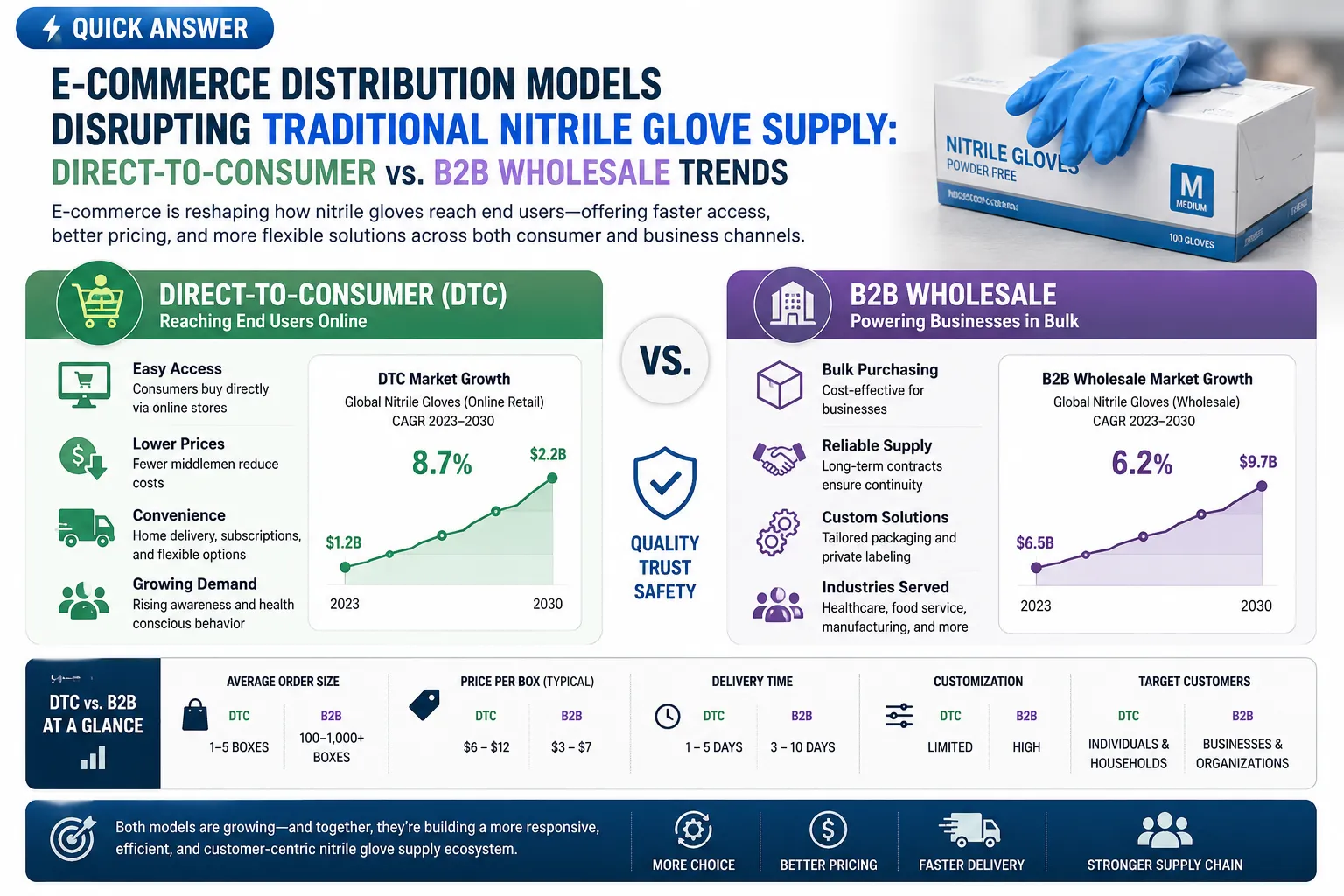
Direct-to-consumer nitrile glove distribution means manufacturers sell directly to end users through their own websites or platforms like Amazon, while B2B wholesale involves selling bulk quantities to distributors, medical supply companies, or large institutions that then resell to smaller buyers. The fundamental difference lies in order size, pricing structure, and the number of intermediaries between manufacturer and end user.
DTC models typically accept orders starting at 10-20 boxes (1,000-2,000 gloves) and price per box ranges from $8-15 depending on quality and thickness. Manufacturers handle fulfillment, customer service, and shipping directly. This approach works well for small medical practices, tattoo studios, salons, and other businesses that need quality nitrile gloves but cannot commit to pallet-sized orders.
B2B wholesale requires minimum orders of 50-100 cases (50,000-100,000 gloves) with per-box pricing between $5-9. Distributors purchase at these volumes, warehouse inventory, and resell to smaller buyers at marked-up prices. Traditional wholesale relationships involve credit terms, established purchasing agreements, and dedicated account managers.
Key structural differences:
- Order minimums: DTC 10-20 boxes vs. B2B 50-100 cases
- Pricing: DTC $8-15/box vs. B2B $5-9/box (manufacturer level)
- Payment terms: DTC typically prepaid vs. B2B often net-30 or net-60
- Shipping: DTC parcel delivery vs. B2B freight/pallet shipments
- Customer service: DTC manufacturer-direct vs. B2B through distributor
Choose DTC if your business uses fewer than 10,000 gloves monthly and values flexibility over bulk pricing. Choose B2B wholesale if you purchase 50,000+ gloves monthly and have storage capacity for pallet deliveries.
How Are Online Sales Changing the Nitrile Glove Supply Chain?
Online sales platforms have compressed the nitrile glove supply chain from a traditional four-tier system (manufacturer to importer to distributor to end user) into a two-tier or even one-tier model where manufacturers sell directly to businesses and consumers. This compression eliminates 30-50% of the markup that previously existed in the supply chain.
Amazon Business, Alibaba, and manufacturer-owned e-commerce sites now account for approximately 35-40% of nitrile glove sales to small and medium businesses in North America. These platforms provide price transparency that didn’t exist when buyers had to request quotes from multiple distributors. A small dental practice can now compare prices from 15-20 suppliers in minutes rather than spending days calling distributors.
The shift to online sales has also changed inventory management throughout the supply chain. Manufacturers now maintain smaller, more diverse SKU inventories to serve DTC customers who want specific sizes, colors, and thicknesses. Traditional wholesale focused on high-volume standard products, but online buyers demand variety. A manufacturer might now stock eight different thickness options instead of just two or three standard gauges.
Supply chain transformations:
- Reduced intermediaries from 3-4 layers to 1-2 layers
- Price transparency through online comparison shopping
- Faster order fulfillment with 2-3 day delivery becoming standard
- Increased SKU variety to meet diverse online buyer preferences
- Real-time inventory visibility replacing phone-based stock checks
- Digital payment processing replacing paper invoicing and credit terms
Common mistake: Assuming online prices always beat distributor pricing. For orders over 100 cases, established distributor relationships often still provide better per-unit costs due to their bulk purchasing power and freight optimization.
Can Small Businesses Buy Nitrile Gloves Directly From Manufacturers Now?
Yes, small businesses can purchase nitrile gloves directly from manufacturers in 2026, with most major producers now offering DTC sales channels through their websites or third-party platforms. Minimum order quantities have dropped from the traditional 50-100 case requirement to as low as 10 boxes, making manufacturer-direct purchasing accessible to businesses that use 500-1,000 gloves monthly.
Manufacturers like Hartalega, Top Glove, and Kossan now operate branded storefronts on Amazon Business and their own e-commerce sites. A small veterinary clinic or auto repair shop can order directly without establishing a formal business account or meeting high volume thresholds. This represents a fundamental shift from pre-2020 practices when manufacturers only sold to importers and large distributors.
The economics work for manufacturers because DTC margins offset the smaller order sizes. Selling 20 boxes at $12 each generates $240 in revenue with approximately $140 in margin after production costs. The same 20 boxes sold wholesale at $6 each would generate only $120 in revenue with roughly $20 in margin after distributor discounts.
What small businesses need to buy direct:
- Valid business tax ID or EIN number for most manufacturer sites
- Business email address and company information
- Credit card or business checking account for payment
- Shipping address (residential delivery available but may cost more)
- Understanding of needed specifications (size, thickness, powder-free, etc.)
Edge case: Some manufacturers still require minimum first orders of 25-50 boxes to establish an account, then allow smaller reorders. Always check the specific manufacturer’s DTC policy before assuming you can order any quantity.
What Are the Profit Margins for DTC vs. Wholesale Nitrile Glove Distribution?
Direct-to-consumer nitrile glove distribution typically generates 40-60% gross margins for manufacturers, compared to 15-25% margins on wholesale sales to distributors. A manufacturer selling a box of nitrile gloves for $12 DTC might have $5 in production costs and $2 in fulfillment costs, leaving $5 profit (42% margin). The same box sold wholesale at $6.50 leaves only $1.50 profit (23% margin).
Distributors and wholesalers operate on thinner margins of 20-35% when reselling to end users. They purchase at $6.50 per box and sell at $9-11, generating $2.50-4.50 per box. Their costs include warehousing, sales staff, delivery, and working capital tied up in inventory. High-volume distributors with efficient operations achieve the higher end of this range.
DTC sellers face different cost structures that can erode margins if not managed carefully. Shipping costs for small orders run $8-15 per case compared to $2-4 per case for wholesale pallet shipments. Customer acquisition costs through digital advertising can add $3-8 per customer. Returns and customer service for small buyers cost more per unit than wholesale’s minimal service requirements.
Margin comparison by distribution model:
| Distribution Model | Gross Margin | Net Margin | Key Cost Drivers |
|---|---|---|---|
| Manufacturer DTC | 40-60% | 25-35% | Shipping, marketing, customer service |
| Manufacturer Wholesale | 15-25% | 12-20% | Production scale, logistics |
| Distributor Resale | 20-35% | 8-15% | Warehousing, sales staff, working capital |
| Amazon Marketplace | 30-45% | 15-25% | Platform fees (15%), fulfillment, advertising |
Choose DTC if you can achieve customer lifetime value over $200 through repeat purchases, making the higher acquisition costs worthwhile. Wholesale makes more sense for manufacturers focused on production efficiency and volume rather than brand building.
Why Are Traditional Medical Supply Distributors Losing Market Share in Gloves?
Traditional medical supply distributors have lost approximately 20-25% of their nitrile glove market share since 2020 because manufacturers now bypass them to sell directly to end users, and because digital platforms offer better prices and convenience to small buyers. Distributors that once controlled access to manufacturers through exclusive relationships and credit terms no longer hold that leverage in an era of transparent online pricing.
The core problem for traditional distributors is their value proposition has weakened. They historically provided three main services: access to manufacturer inventory, credit terms for buyers, and local delivery. E-commerce platforms now provide instant access to dozens of manufacturers, credit card payments eliminate the need for net-30 terms, and parcel carriers deliver in 2-3 days at reasonable costs.
Price transparency particularly hurts distributors. When a small medical practice can see that a distributor charges $11 per box while the manufacturer’s Amazon storefront charges $9, the distributor must justify that $2 difference. Many cannot, especially for commodity products like standard nitrile exam gloves where quality differences are minimal between major brands.
Factors driving distributor market share loss:
- Manufacturer DTC channels eliminating distributor markups
- Amazon Business providing one-stop shopping with competitive pricing
- Small buyers no longer needing credit terms with card payments available
- Digital price comparison making distributor markups visible
- Reduced switching costs as buyers can easily try new suppliers online
- Pandemic-era supply shortages that damaged distributor relationships
Distributors maintaining market share focus on value-added services like inventory management programs, custom kitting, and specialized products that require technical expertise. Those competing purely on price for commodity gloves continue losing ground.
Which Distribution Model Is Better for Bulk Nitrile Glove Purchases?
B2B wholesale distribution remains superior for bulk nitrile glove purchases exceeding 100 cases (100,000 gloves), typically offering 8-12% better per-unit pricing than DTC channels plus freight optimization that reduces shipping costs by 60-70%. A hospital purchasing 500 cases quarterly will pay $5.50-6.50 per box through wholesale versus $7.50-9.00 per box through DTC channels.
Wholesale’s advantages for bulk purchases stem from economies of scale in shipping and handling. A full truckload of 1,200 cases ships for approximately $800-1,200, or $0.67-1.00 per case. DTC parcel shipments cost $8-12 per case even with volume discounts. For a 500-case order, wholesale shipping costs $335-500 versus DTC shipping of $4,000-6,000.
Established wholesale relationships also provide supply chain stability that matters for large institutions. Distributors maintain safety stock, offer consistent pricing through annual contracts, and provide dedicated account management. A hospital cannot risk running out of gloves because a DTC supplier’s website crashed or a manufacturer’s production line went down.
When to choose wholesale for bulk purchases:
- Orders consistently exceed 100 cases per quarter
- Storage space available for pallet deliveries
- Predictable usage patterns allowing contract pricing
- Need for supply chain reliability and backup inventory
- Multiple product types ordered together (gloves, masks, gowns)
- Established purchasing processes requiring formal quotes and POs
When DTC might work even for larger volumes:
- Flexible storage allowing multiple smaller deliveries
- Willingness to manage multiple manufacturer relationships
- Price sensitivity outweighs convenience factors
- Testing new products before committing to wholesale contracts
Edge case: Some manufacturers now offer hybrid models with wholesale pricing for large orders but DTC convenience. Orders over 100 cases qualify for freight shipping and wholesale pricing while still processing through the manufacturer’s website.
What Mistakes Do New Sellers Make When Switching to Direct-to-Consumer Glove Sales?
New sellers entering direct-to-consumer nitrile glove sales most commonly underestimate fulfillment costs and customer service demands, leading to margins 15-20 percentage points below projections. A manufacturer expecting 45% margins often realizes only 25-30% after accounting for returns, customer inquiries, and small-order shipping inefficiencies.
The second major mistake is inadequate investment in digital marketing and customer acquisition. Manufacturers accustomed to wholesale relationships where distributors handled marketing often allocate only 3-5% of revenue to customer acquisition, when successful DTC operations require 10-15% in the growth phase. Without sufficient marketing spend, traffic remains low and fixed costs overwhelm the business model.
Quality control issues damage DTC brands faster than wholesale operations because individual consumers leave public reviews. A wholesale customer might quietly return a defective case, but a DTC buyer posts a one-star Amazon review that affects future sales. New DTC sellers often lack the quality assurance processes needed for direct consumer feedback.
Common DTC transition mistakes:
- Underpricing products by failing to account for full fulfillment costs
- Insufficient inventory of popular sizes (large and extra-large typically sell 3x faster)
- Poor website user experience making it hard to find the right product
- Inadequate product information and specifications on listings
- Slow response to customer service inquiries (DTC buyers expect same-day responses)
- No strategy for managing returns and defective product claims
- Failure to collect customer emails for repeat purchase marketing
- Ignoring the need for FDA registration and proper medical device labeling
Avoid these mistakes by: calculating true landed costs including all fulfillment expenses before setting prices, investing in professional e-commerce platform setup, implementing automated customer service tools, and building email marketing systems from day one.
How Do Minimum Order Quantities Compare Between DTC and B2B Nitrile Glove Suppliers?
Direct-to-consumer nitrile glove suppliers typically require minimum orders of 10-20 boxes (1,000-2,000 gloves), while B2B wholesale suppliers require 50-100 cases (50,000-100,000 gloves) for initial orders. This 50-100x difference in minimum order quantities represents the most significant barrier determining which distribution model small businesses can access.
DTC minimums have decreased substantially since 2020. Major manufacturers like Hartalega and Kossan now accept orders as small as 10 boxes through their Amazon storefronts, compared to 50-case minimums through traditional channels. Some specialty DTC brands accept single-box orders, though per-unit pricing increases significantly at these volumes.
B2B wholesale minimums remain high because the economics of freight shipping and distributor handling require volume. A distributor cannot profitably process, warehouse, and deliver orders smaller than 20-30 cases. Their systems are built for pallet-level transactions, not box-level fulfillment. Manufacturers selling wholesale maintain these minimums to avoid fragmenting their production and logistics operations.
Minimum order quantity comparison:
| Supplier Type | Minimum Order | Typical Range | Best For |
|---|---|---|---|
| Manufacturer DTC | 10-20 boxes | 10-50 boxes | Small businesses, testing new products |
| Amazon/Marketplace | 1-10 boxes | 5-30 boxes | Very small buyers, one-time needs |
| Regional Distributor | 20-50 cases | 30-100 cases | Mid-size facilities, monthly usage |
| National Wholesaler | 50-100 cases | 100-500 cases | Hospitals, large practices, resellers |
| Direct Import | 500-1,000 cases | 1,000-5,000 cases | Major institutions, distributors |
For small medical practices using 2,000-5,000 gloves monthly, DTC channels with 10-20 box minimums align perfectly with monthly purchasing needs. Practices using 20,000+ gloves monthly should negotiate with regional distributors for better pricing at the 30-50 case level.
Are There Quality Differences Between Nitrile Gloves Sold Online vs. Through Distributors?
No inherent quality differences exist between nitrile gloves sold online versus through distributors when purchasing from the same FDA-registered manufacturer, but online marketplaces carry higher risk of encountering unvetted third-party sellers offering substandard products. A box of Hartalega nitrile gloves purchased through a medical distributor has identical specifications to the same product bought on Amazon directly from Hartalega.
The quality risk in online channels comes from marketplace sellers who source from unknown manufacturers or misrepresent product specifications. Amazon, Alibaba, and other platforms host thousands of third-party sellers, some offering gloves that don’t meet ASTM D6319 standards for medical examination gloves or lack proper FDA registration. Distributors typically vet their supplier relationships more carefully.
Quality assurance when buying online requires checking several factors: FDA establishment registration number, ASTM certification claims, seller ratings and reviews, and country of origin. Reputable manufacturers provide this information prominently. Third-party sellers often omit these details or provide vague specifications.
How to verify quality for online nitrile glove purchases:
- Confirm FDA registration number on product listing and verify at FDA.gov
- Check for ASTM D6319 certification for medical exam gloves
- Review seller ratings (look for 95%+ positive with 500+ reviews)
- Verify manufacturer name matches known brands (Hartalega, Top Glove, Kossan, etc.)
- Check glove thickness specifications match intended use
- Read recent negative reviews for quality complaint patterns
- Avoid listings with stock photos instead of actual product images
Common mistake: Assuming all gloves on Amazon Business are medical-grade. Many listings are for industrial or food-service gloves that don’t meet medical examination standards. Always verify ASTM certification for medical use.
What Happens to Pricing When Nitrile Glove Brands Cut Out Middlemen?
When nitrile glove manufacturers eliminate distributors and sell directly to end users, retail prices typically decrease 15-30% while manufacturer margins increase 25-40 percentage points. A box of nitrile gloves that cost $13 through a traditional distributor might sell for $9-11 through manufacturer DTC channels, saving buyers $2-4 per box while the manufacturer captures more profit.
This pricing dynamic works because traditional distribution chains stack multiple markups. A manufacturer sells to an importer at $5.50 per box, the importer sells to a distributor at $7, and the distributor sells to the end user at $13. Each intermediary adds 25-35% markup to cover their costs and profit. Eliminating two layers removes $5.50 in markups.
However, manufacturers don’t pass all savings to buyers. A manufacturer selling DTC at $9 instead of $5.50 wholesale captures an additional $3.50 per box in margin. This extra margin funds the fulfillment infrastructure, customer service, and marketing required for DTC operations. The buyer saves $4 compared to the distributor price, and the manufacturer gains $3.50 compared to wholesale margin.
Price breakdown comparison:
Traditional Distribution Chain:
- Manufacturer cost: $4.50
- Manufacturer wholesale price: $5.50 (22% margin)
- Importer price: $7.00 (27% markup)
- Distributor price: $9.50 (36% markup)
- End user price: $13.00 (37% markup)
Direct-to-Consumer Model:
- Manufacturer cost: $4.50
- Fulfillment cost: $2.00
- Manufacturer DTC price: $10.00 (35% margin)
- End user price: $10.00
- Buyer saves: $3.00 (23%)
- Manufacturer gains: $2.50 margin increase
Not all product categories see the same price compression. Commodity products like standard nitrile exam gloves see the full 15-30% price reduction, while specialty gloves with technical requirements see smaller decreases because distributors add value through product expertise.
Is Direct-to-Consumer Nitrile Glove Selling Worth It for Small Medical Practices?
Direct-to-consumer purchasing is worth it for small medical practices using 2,000-10,000 nitrile gloves monthly, typically saving $150-400 annually compared to traditional distributor pricing while maintaining adequate quality and supply reliability. Practices using fewer than 2,000 gloves monthly see minimal savings due to shipping costs, while those using over 10,000 monthly should negotiate directly with regional distributors for better pricing.
The calculation depends on usage volume and storage capacity. A dental practice using 5,000 gloves monthly (50 boxes) can purchase directly from manufacturers at $9-10 per box for total monthly costs of $450-500. The same quantity through a traditional distributor costs $11-13 per box or $550-650 monthly. Annual savings of $1,200-1,800 justify the minor inconvenience of managing online orders.
DTC purchasing requires practices to handle tasks distributors previously managed: monitoring inventory levels, placing orders proactively, and managing multiple supplier relationships if buying different products. Practices with dedicated administrative staff handle this easily, but very small practices where the dentist or physician manages ordering may find the time cost exceeds the savings.
When DTC makes sense for medical practices:
- Monthly glove usage between 2,000-10,000 units
- Storage space for 2-3 months of inventory
- Administrative staff to manage online ordering
- Willingness to try new suppliers if primary source has issues
- Price sensitivity due to tight margins or high-volume procedures
When to stick with distributors:
- Monthly usage under 2,000 gloves (shipping costs negate savings)
- Monthly usage over 10,000 gloves (negotiate distributor contracts)
- No storage space for advance inventory
- Need for same-day emergency delivery occasionally
- Preference for consolidated ordering of multiple supply types
Edge case: Some practices use hybrid approaches, buying commodity items like standard nitrile gloves through DTC channels while maintaining distributor relationships for specialized supplies and emergency needs.
How Do Shipping Costs Affect DTC vs. Wholesale Nitrile Glove Economics?
Shipping costs create a 10-15 percentage point margin difference between direct-to-consumer and wholesale nitrile glove distribution, with DTC parcel shipping costing $8-15 per case compared to wholesale freight shipping at $2-4 per case. For a manufacturer selling 20-case orders, shipping costs consume $160-300 of revenue in DTC versus $40-80 in wholesale, fundamentally changing the economics.
Parcel carriers like UPS and FedEx charge dimensional weight pricing that penalizes the bulky, lightweight nature of glove boxes. A case of nitrile gloves weighing 12 pounds but measuring 18x12x10 inches gets charged for 22 pounds due to dimensional weight calculations. Ground shipping from a West Coast manufacturer to an East Coast buyer costs $12-18 per case even with commercial discounts.
Wholesale freight shipping achieves dramatically lower per-unit costs through pallet consolidation. A full pallet of 60 cases ships via LTL freight for $180-240, or $3-4 per case. A full truckload of 1,200 cases costs $900-1,200, or $0.75-1.00 per case. These economies of scale are impossible to achieve with small parcel shipments.
Shipping cost comparison by order size:
| Order Size | DTC Parcel Cost | Wholesale Freight Cost | Cost Difference |
|---|---|---|---|
| 10 cases | $100-150 | N/A (too small) | N/A |
| 20 cases | $160-300 | $80-120 (LTL) | $80-180 |
| 60 cases | $480-900 | $180-240 (pallet) | $300-660 |
| 100 cases | $800-1,500 | $250-350 (LTL) | $550-1,150 |
| 500 cases | $4,000-7,500 | $600-900 (truckload) | $3,400-6,600 |
DTC sellers mitigate shipping costs through several strategies: negotiating volume discounts with carriers, using regional fulfillment centers to reduce shipping distances, offering free shipping thresholds that encourage larger orders, and building shipping costs into product pricing rather than charging separately.
What Regulations Apply to Selling Nitrile Gloves Directly to Consumers Online?
Selling nitrile gloves directly to consumers online requires FDA registration as a medical device manufacturer or distributor, compliance with 21 CFR Part 820 quality system regulations, and proper labeling per 21 CFR Part 801 if marketing gloves for medical use. Sellers must register their establishment with FDA and list their devices, renewing annually between October 1 and December 31.
Medical examination gloves are Class I medical devices requiring FDA registration but not premarket approval. Sellers must maintain device master records, design history files, and complaint handling procedures even for DTC sales. The FDA can inspect facilities and request documentation at any time, with violations resulting in warning letters, product seizures, or sales prohibitions.
Labeling requirements mandate specific information on packaging: intended use, size, quantity, manufacturer name and address, lot number, and expiration date if applicable. Claims about barrier protection, chemical resistance, or medical applications trigger additional substantiation requirements. Sellers making unsubstantiated claims face FDA enforcement action.
Key regulatory requirements for DTC nitrile glove sales:
- FDA establishment registration (annual renewal required)
- Medical device listing for each product
- Quality system procedures per 21 CFR Part 820
- Proper labeling with required information
- Adverse event reporting within required timeframes
- Records retention for complaints and distribution
- Import compliance if sourcing from overseas manufacturers
State-level requirements:
- Business licenses and sales tax collection
- State medical device distributor licenses (varies by state)
- Professional liability insurance for medical products
- Compliance with state consumer protection laws
Common mistake: Assuming FDA registration isn’t required for “industrial” or “food service” gloves. If a seller markets gloves for any medical purpose or if buyers use them in medical settings, FDA medical device regulations apply regardless of how the seller labels them.
Non-medical gloves sold purely for industrial, food service, or household use face fewer regulations but must still comply with FTC advertising standards and state consumer protection laws.
Can Hospitals Still Get Better Deals Through Traditional Distributors or Should They Buy Direct?
Hospitals purchasing over 100 cases of nitrile gloves quarterly typically achieve 8-15% better pricing through traditional distributors with established contracts compared to direct purchasing, due to distributors’ bulk buying power, freight optimization, and value-added services like inventory management. A 300-bed hospital using 2,000 cases annually will pay $5.50-6.50 per box through distributor contracts versus $7.00-8.50 buying direct.
Large healthcare distributors like McKesson, Cardinal Health, and Medline negotiate directly with manufacturers for pricing that individual hospitals cannot match. They purchase in container-load quantities (20,000-40,000 cases) at prices 15-20% below what manufacturers offer for direct sales. These savings partially pass through to hospital customers even after distributor markups.
Distributors also provide supply chain services that matter for hospitals: just-in-time delivery reducing storage needs, emergency same-day delivery for stockouts, consolidated ordering of multiple product types, and automated inventory replenishment systems. The value of these services often exceeds any price difference between distributor and direct purchasing.
When hospitals should use traditional distributors:
- Annual glove usage exceeds 500 cases
- Part of group purchasing organization (GPO) with negotiated contracts
- Limited storage space requiring frequent smaller deliveries
- Need for supply chain reliability and backup inventory
- Purchasing multiple medical supply categories from same distributor
- Established relationships with dedicated account management
When hospitals might consider direct purchasing:
- Very large systems (1,000+ beds) with purchasing power to negotiate manufacturer-direct contracts
- Willingness to manage multiple manufacturer relationships
- Adequate warehouse space for container-load deliveries
- In-house supply chain expertise to handle direct importing
- Specific product requirements not well-served by distributor catalogs
Hybrid approach many hospitals use:
- Primary supply through GPO distributor contracts (80-90% of volume)
- Direct manufacturer relationships for specialized products
- Backup suppliers for emergency situations
- Periodic market testing of direct pricing to ensure distributor competitiveness
Edge case: During supply shortages like the 2020-2021 pandemic period, direct manufacturer relationships provided access to inventory when distributors were sold out. Some hospitals maintain small direct purchasing relationships as supply chain insurance even when distributor pricing is better.
Frequently Asked Questions
What is the typical markup on nitrile gloves from manufacturer to end user?
Traditional distribution chains add 80-120% markup from manufacturer cost to end user price, with manufacturers selling at $5-6 per box, distributors buying at $7-8, and end users paying $10-13. Direct-to-consumer models reduce total markup to 40-60% by eliminating intermediaries.
How long does shipping take for DTC nitrile glove orders compared to distributor delivery?
DTC orders typically ship within 2-3 business days via ground parcel service, arriving in 3-5 days total. Distributor orders often deliver next-day or same-day for local customers with established accounts, but may take 5-7 days for first-time buyers or special orders.
Can I return nitrile gloves purchased online if they don’t fit properly?
Most DTC sellers accept returns of unopened boxes within 30 days, though buyers typically pay return shipping costs. Distributors rarely accept returns of correctly shipped products unless defective. Always verify the return policy before purchasing, especially when trying a new brand or size.
Do I need a business license to buy nitrile gloves wholesale?
Yes, wholesale suppliers require valid business documentation including tax ID or EIN number, business license, and sometimes professional licenses for medical practices. DTC channels typically require only basic business information without formal verification.
Are nitrile gloves from Amazon the same quality as those from medical distributors?
Nitrile gloves from verified manufacturers on Amazon match distributor quality when specifications are identical, but Amazon also hosts third-party sellers offering lower-quality products. Always verify FDA registration, ASTM certification, and manufacturer identity before purchasing.
What size orders qualify for wholesale pricing on nitrile gloves?
Wholesale pricing typically requires minimum orders of 50-100 cases (50,000-100,000 gloves) directly from manufacturers or 20-30 cases from regional distributors. Orders below these thresholds receive retail or small-quantity pricing.
How do I know if a nitrile glove supplier is FDA registered?
Check the FDA’s searchable database at accessdata.fda.gov/scripts/cdrh/cfdocs/cfRL/rl.cfm using the manufacturer name or registration number. Legitimate suppliers provide their FDA registration number on product listings and packaging.
What happens if my DTC nitrile glove supplier runs out of stock?
DTC buyers must find alternative suppliers when their primary source stocks out, unlike distributor relationships where the distributor maintains safety stock and sources from multiple manufacturers. Maintain relationships with 2-3 DTC suppliers to avoid supply interruptions.
Can small businesses negotiate better prices with DTC nitrile glove sellers?
Volume discounts become available at 50-100 box order quantities with most DTC sellers, reducing per-box costs by 10-15%. Negotiation is possible for recurring orders over 100 boxes monthly, though discounts rarely match true wholesale pricing.
Are there minimum monthly purchase requirements for DTC nitrile glove accounts?
No, most DTC sellers have no minimum monthly purchase requirements, allowing buyers to order only when needed. This flexibility benefits small businesses with variable usage patterns but means no guaranteed supply during shortage periods.
How do I choose between powder-free and powdered nitrile gloves when buying online?
Choose powder-free nitrile gloves for medical use, as powdered gloves are banned by FDA for medical purposes due to allergy and contamination risks. Powder-free gloves cost slightly more but are the only option for healthcare applications.
What payment methods do DTC nitrile glove sellers accept?
DTC sellers typically accept credit cards, PayPal, and business checking accounts through ACH transfer. Some offer net-30 terms for established customers with credit approval. Wholesale distributors commonly provide net-30 or net-60 terms for qualified businesses.
Conclusion
E-commerce distribution models disrupting traditional nitrile glove supply in 2026 have fundamentally reshaped how small businesses, medical practices, and institutions purchase protective equipment. The shift from distributor-dominated supply chains to direct manufacturer relationships and digital marketplaces has reduced prices by 15-30% for small buyers while creating new opportunities and challenges for all participants.
Direct-to-consumer channels work best for businesses using 2,000-10,000 gloves monthly, offering manufacturer-direct pricing with minimum orders as low as 10 boxes. B2B wholesale remains superior for bulk purchases over 100 cases, providing 8-12% better per-unit pricing and freight optimization. The choice between models depends on usage volume, storage capacity, and whether price or convenience takes priority.
Traditional medical supply distributors maintain advantages in supply chain reliability, value-added services, and bulk pricing for large institutions, but must adapt to increased competition from manufacturer DTC channels and digital marketplaces. Successful distributors focus on services that online channels cannot easily replicate: same-day emergency delivery, inventory management programs, and technical expertise for specialized products.
Action steps for buyers:
- Calculate your monthly glove usage to determine which distribution model offers the best economics
- Test 2-3 DTC suppliers with small orders before committing to larger purchases
- Verify FDA registration and ASTM certification for any new supplier
- Compare total landed costs including shipping, not just per-box prices
- Maintain relationships with backup suppliers to ensure supply continuity
- Review purchasing strategy annually as market conditions and your volume change
Action steps for sellers:
- Invest in proper fulfillment infrastructure before launching DTC channels
- Calculate true costs including shipping, returns, and customer service
- Implement quality assurance processes to maintain reputation in direct consumer feedback environments
- Ensure full regulatory compliance with FDA registration and labeling requirements
- Build email marketing systems to encourage repeat purchases and improve customer lifetime value
- Consider hybrid models offering wholesale pricing for larger orders while maintaining DTC convenience
The nitrile glove distribution landscape will continue evolving as manufacturers refine their DTC operations and traditional distributors adapt their value propositions. Buyers who understand the economics of each model and maintain flexibility in their purchasing approach will achieve the best combination of price, quality, and supply reliability.
SEO Meta Title: Nitrile Glove Distribution: DTC vs B2B Wholesale 2026