Last updated: June 25, 2026
A mechanic’s black nitrile gloves can hide oil stains that would immediately flag contamination on blue gloves, while a surgeon’s purple gloves reveal even microscopic tears that could compromise sterility. The color of your nitrile gloves isn’t just aesthetic—it directly impacts contamination detection, workplace safety compliance, and operational efficiency across industries from automotive repair to food service.
Quick Answer
This Colored Nitrile Gloves Guide: Benefits of Black, Purple, and Green for Specific Industries and Visibility explains how glove color affects contamination visibility, industry-specific applications, and safety outcomes. Black gloves hide grease and dirt for automotive work, purple gloves provide high contrast for medical and food service contamination detection, and green gloves offer moderate visibility for general industrial use. Color choice impacts both practical performance and regulatory compliance, with no difference in chemical resistance between colors of the same glove specification.
Key Takeaways
- Black nitrile gloves conceal oil, grease, and dirt, making them ideal for automotive, tattooing, and janitorial work where visible staining affects professional appearance
- Purple nitrile gloves provide maximum contrast for detecting contamination, punctures, and residue in medical, dental, and food service environments
- Green nitrile gloves offer moderate visibility and are commonly used in industrial settings, manufacturing, and general maintenance work
- Glove color does not affect chemical resistance, thickness, or durability—these properties depend on the glove formulation and manufacturing specifications
- FDA approval for food handling depends on the glove’s material composition and manufacturing process, not its color
- Colored gloves typically cost 5-15% more than standard blue gloves due to pigmentation additives in the manufacturing process
- Choosing the wrong glove color can compromise contamination detection protocols and violate industry-specific safety standards
- Black gloves are generally not recommended for food handling because they make it difficult to spot food particles and contamination
- Purple and green gloves show punctures and tears more clearly than black gloves, improving workplace safety in high-risk environments
- Industry-specific color coding helps organizations maintain consistent safety protocols and simplify inventory management
What Are the Benefits of Colored Nitrile Gloves vs Clear Ones
Colored nitrile gloves provide superior contamination detection compared to clear gloves because they create visual contrast that makes dirt, bodily fluids, food particles, and chemical residues immediately visible. Clear gloves blend with both the glove wearer’s skin tone and many contaminants, making it difficult to identify when the glove surface has been compromised.
The primary advantage of colored gloves lies in their ability to serve as a visual inspection tool. When working in environments where cross-contamination poses health or safety risks, colored gloves act as an early warning system:
- Contamination visibility: Colored backgrounds make white powders, clear liquids, and translucent substances stand out immediately
- Puncture detection: Tears and holes are easier to spot against solid color backgrounds than through clear material
- Professional appearance: Colored gloves maintain a cleaner look even when lightly soiled, while clear gloves show every smudge
- Color coding: Different departments or tasks can use specific colors to prevent cross-contamination between work areas
- Reduced inspection time: Workers can quickly scan gloves for contamination without holding them up to light
Clear gloves do offer one specific advantage: they allow direct visual inspection of the skin underneath, which can be important for medical professionals monitoring for allergic reactions or skin conditions during extended wear. However, for most industrial, food service, and automotive applications, the contamination detection benefits of colored gloves outweigh this single advantage.
Common mistake: Assuming clear gloves are more “pure” or less likely to contain additives. In reality, both clear and colored nitrile gloves can be manufactured to identical purity standards—the pigmentation doesn’t affect the glove’s chemical composition or safety profile.
Why Do Mechanics Use Black Nitrile Gloves Instead of Blue
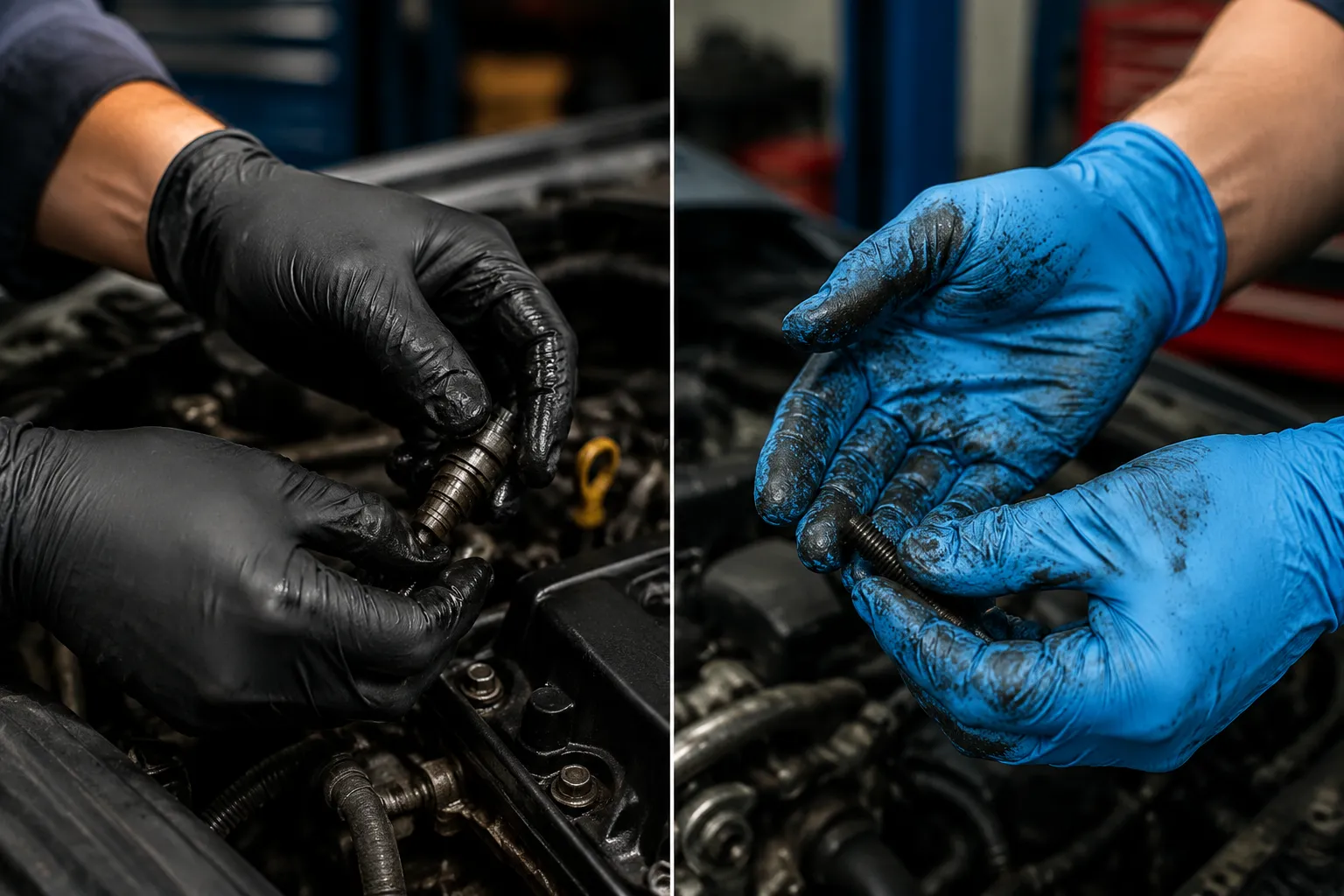
Mechanics prefer black nitrile gloves because they conceal oil, grease, and automotive fluids that would create unsightly stains on lighter-colored gloves. This aesthetic advantage maintains a professional appearance when interacting with customers and prevents the gloves from looking excessively dirty even after handling heavily soiled components.
Black gloves offer several practical benefits in automotive environments:
- Stain concealment: Motor oil, transmission fluid, and brake dust blend into black material rather than creating visible marks
- Extended perceived usability: Mechanics can wear black gloves longer before they appear too dirty to customers
- Professional presentation: Clean-looking gloves when greeting customers or handling their vehicle interiors
- Reduced glove waste: Less frequent changes based on appearance rather than actual contamination
- Heat resistance visibility: Some black automotive gloves include heat-resistant formulations, and the color has become associated with heavy-duty protection
The trade-off is that black gloves make it harder to detect certain contaminants. For example, coolant leaks, brake fluid, or gasoline may not be immediately visible on black gloves. Mechanics working with these substances should still change gloves regularly based on time and exposure rather than visual inspection alone.
For detailed guidance on selecting gloves for automotive work, including thickness and chemical resistance considerations, see our guide on choosing nitrile gloves for automotive work.
Choose black gloves if: You work primarily with dark oils and greases, interact with customers while wearing gloves, or need to maintain a professional appearance throughout extended wear periods. Avoid black gloves if you need to detect clear or light-colored chemical contamination quickly.
What Industries Use Purple Nitrile Gloves the Most
Healthcare facilities, dental offices, and food service operations use purple nitrile gloves most frequently because the color provides excellent contrast for detecting contamination, blood, and food particles. Purple has become particularly popular in medical settings as a latex-free alternative that maintains the high visibility standards required for patient safety.
Industries that commonly specify purple gloves include:
- Medical and dental: Hospitals, clinics, dental practices, and emergency medical services
- Food service: Commercial kitchens, catering operations, and food processing facilities
- Laboratories: Research labs, pharmaceutical manufacturing, and quality control testing
- Childcare: Daycare centers and schools where diaper changing and food preparation occur
- Veterinary: Animal hospitals and veterinary clinics requiring contamination visibility
- Tattoo and piercing: Body art studios where blood visibility is critical for safety
The popularity of purple in healthcare stems from several factors. When latex allergies became a widespread concern in the 1990s and 2000s, many facilities switched to nitrile gloves. Purple became a visual signal that the gloves were latex-free, helping prevent accidental exposure for allergic patients and staff. The color also provides strong contrast against both light and dark skin tones, making it easier to spot blood, bodily fluids, and other contaminants.
In food service, purple gloves serve a dual purpose. They’re easily distinguishable from food items (few foods are naturally purple), making it immediately obvious if a piece of glove contaminates a dish. Additionally, many food safety protocols require gloves that contrast with the products being handled.
Regulatory note: Purple color alone doesn’t indicate FDA approval for food contact. Always verify that gloves carry appropriate certifications for your specific application. Learn more about food handling glove requirements.
Are Green Nitrile Gloves Better for Visibility or Safety
Green nitrile gloves offer moderate visibility that balances contamination detection with stain concealment, making them suitable for general industrial work, manufacturing, and maintenance tasks. They provide better contamination visibility than black gloves but don’t show every minor smudge like purple or blue gloves do.
The safety benefits of green gloves depend entirely on the application context:
Visibility advantages:
- Light-colored contaminants (dust, powders, light oils) show clearly against green backgrounds
- Punctures and tears are easier to spot than on black gloves
- Provides sufficient contrast for most industrial safety protocols
- Easier to see in low-light conditions than black gloves
Practical considerations:
- Moderate stain visibility means gloves look professional longer than white or blue options
- Common in industries where some soiling is expected but contamination control matters
- Often chosen for janitorial work, general maintenance, and light manufacturing
- Popular in biodegradable or eco-conscious glove lines where green signals environmental focus
Green gloves don’t inherently provide better safety than other colors—the safety profile depends on the glove’s thickness, chemical resistance, and puncture resistance specifications. A 4-mil green glove offers the same protection as a 4-mil purple glove made from identical nitrile formulation.
Industry-specific usage: Green gloves are common in electronics manufacturing (where they provide adequate contamination visibility without the stark contrast of purple), general industrial settings, and facilities management. They’re less common in food service and healthcare, where purple and blue dominate due to established color-coding systems.
For more information on glove thickness and protection levels, see our guide on the best thickness for nitrile gloves.
Do Colored Nitrile Gloves Cost More Than Regular Blue Gloves
Colored nitrile gloves typically cost 5-15% more than standard blue gloves due to the additional pigmentation additives required during manufacturing. The exact price difference varies based on order volume, glove specifications, and whether the color is a standard offering or a custom formulation.
Price factors that affect colored gloves:
| Factor | Impact on Price | Explanation |
|---|---|---|
| Pigment cost | +3-8% | Colorants add material expense to base nitrile formulation |
| Production volume | +2-10% | Less common colors require smaller batch runs with higher per-unit costs |
| Custom colors | +15-30% | Non-standard colors require dedicated production runs and minimum order quantities |
| Brand positioning | +5-20% | Some manufacturers charge premium prices for specialty colors marketed to specific industries |
| Bulk ordering | -10-25% | Large volume purchases reduce per-unit cost regardless of color |
Standard colors (blue, purple, black, green) are widely available and competitively priced because manufacturers produce them in high volumes. Specialty colors (orange, red, pink, yellow) command higher premiums because they’re produced in smaller quantities.
Cost-benefit analysis: The modest price increase for colored gloves often justifies itself through improved contamination detection, reduced cross-contamination incidents, and enhanced workplace safety compliance. A facility that prevents even one contamination event typically saves far more than the incremental cost of colored gloves.
Common mistake: Choosing gloves based solely on price without considering the total cost of contamination incidents, regulatory violations, or workplace injuries that could result from poor visibility. The cheapest glove isn’t always the most economical choice when total risk is factored in.
For budget-conscious buyers, standard blue gloves remain the most economical option, but the small premium for purple, black, or green gloves rarely represents a significant budget impact when weighed against their functional benefits.
Which Color Nitrile Glove Hides Stains and Dirt Best
Black nitrile gloves hide stains and dirt most effectively because dark pigmentation conceals oil, grease, soil, and most common workplace contaminants. Dark gray gloves offer similar stain-hiding properties, while navy blue provides moderate concealment compared to lighter colors.
Stain visibility ranking (from most concealing to most revealing):
- Black – hides nearly all stains except light-colored substances
- Dark gray – conceals most oils and dirt effectively
- Navy blue – moderate stain concealment
- Green – shows dark stains but hides light contamination
- Royal blue – standard visibility, shows most contamination
- Purple – high visibility, reveals most contaminants clearly
- White – shows every type of contamination immediately
The ability to hide stains serves different purposes depending on the work environment. In automotive repair, tattooing, and janitorial services, stain concealment maintains professional appearance and extends the perceived usability of gloves. However, in food service, healthcare, and laboratory settings, visible contamination is a critical safety feature rather than a drawback.
Industry-specific considerations:
- Automotive and mechanical work: Black gloves maintain clean appearance when handling engines, transmissions, and oily components. See our guide to mechanic nitrile gloves for more details.
- Tattooing: Black gloves hide ink stains and blood, maintaining professional appearance during sessions
- Janitorial services: Dark gloves look cleaner when handling waste, cleaning chemicals, and soiled surfaces
- Food service: Stain-hiding colors are generally inappropriate because contamination visibility is required for safety
- Healthcare: High-visibility colors are mandatory to detect blood and bodily fluid exposure immediately
Important safety note: Never rely on visual appearance alone to determine when to change gloves. Establish change protocols based on time, task completion, or known exposure regardless of how clean gloves appear. Stain-hiding gloves can create false confidence that contaminated gloves are still safe to use.
Can You Use Black Nitrile Gloves for Food Handling
Black nitrile gloves can be used for food handling only if they carry FDA approval for food contact, but they’re generally not recommended because the dark color makes it difficult to detect food particles, contamination, and glove fragments. Most food safety experts and regulatory guidelines recommend light-colored gloves (blue, purple, or white) for food preparation environments.
The primary concerns with black gloves in food service include:
- Contamination detection: Food debris, raw meat juices, and cross-contamination are nearly invisible on black surfaces
- Glove fragment visibility: If a black glove tears, the fragments are hard to spot in food products
- Regulatory compliance: Many health departments and food safety auditors prefer or require high-visibility glove colors
- Best practice standards: Industry guidelines from organizations like the FDA and USDA emphasize contamination visibility
When black gloves might be acceptable:
- Back-of-house cleaning and sanitation tasks (not direct food contact)
- Handling packaged goods that won’t be opened
- Maintenance work in food facilities when not preparing food
- Specific applications where the gloves are FDA-approved and facility protocols allow them
Better alternatives for food handling:
- Purple or blue gloves: Provide excellent contrast with most food items
- Green gloves: Offer good visibility while being less common in food products
- White gloves: Show contamination immediately but soil quickly
For comprehensive guidance on selecting gloves for food service, review our article on things to think about when buying gloves for food. You can also learn more about cooking with nitrile gloves and specific food safety considerations.
Regulatory requirement: Always verify that any glove used for food contact carries appropriate FDA compliance certifications, regardless of color. The FDA regulates glove materials and manufacturing processes, not colors specifically.
What Color Gloves Should Tattoo Artists Wear
Tattoo artists should wear black nitrile gloves because they conceal ink stains and blood, maintain a professional appearance throughout sessions, and provide the latex-free protection required in body art environments. Black gloves have become the industry standard in tattooing, with some artists preferring dark purple as an alternative.
Why black gloves dominate tattoo studios:
- Ink concealment: Tattoo ink immediately stains lighter gloves, requiring frequent changes that disrupt workflow
- Blood visibility management: While blood detection is important, excessive visibility can be unsettling for nervous clients
- Professional aesthetic: Clean-looking gloves throughout multi-hour sessions maintain studio professionalism
- Client comfort: Dark gloves appear less clinical and intimidating than bright medical colors
- Reduced waste: Artists can work longer between glove changes without visible staining
- Industry standard: Black gloves signal professionalism and experience in tattoo culture
Alternative color considerations:
Dark purple gloves offer a compromise between stain concealment and contamination visibility. They hide ink reasonably well while making blood and cross-contamination more visible than black gloves. Some artists prefer purple for:
- Clients with blood-borne pathogen concerns who want visible safety protocols
- Studios emphasizing medical-grade hygiene standards
- Artists who want better visibility of blood for immediate cleanup
Safety requirements: Regardless of color, tattoo gloves must be:
- Latex-free to prevent allergic reactions
- Changed between clients and whenever contaminated
- Appropriate thickness (typically 4-6 mil) for puncture resistance
- Textured for secure needle grip
For more information on the importance of gloves in tattooing, see our article on what happens if you tattoo without gloves.
Common mistake: Choosing gloves based solely on appearance without verifying puncture resistance and barrier protection. Tattoo needles can penetrate thin gloves, so thickness and quality matter more than color alone.
Do Different Colored Nitrile Gloves Have Different Chemical Resistance
Different colored nitrile gloves do not have different chemical resistance properties—chemical resistance depends on the nitrile formulation, thickness, and manufacturing process, not the pigmentation. A 5-mil black nitrile glove and a 5-mil purple nitrile glove made from the same base formulation offer identical protection against chemicals.
What determines chemical resistance:
- Nitrile polymer composition: The ratio of acrylonitrile to butadiene in the polymer chain
- Glove thickness: Measured in mils (thousandths of an inch), typically ranging from 2-8 mil for disposable gloves
- Manufacturing process: Dipping method, curing time, and quality control standards
- Additives and treatments: Accelerators, stabilizers, and surface treatments that affect barrier properties
What doesn’t affect chemical resistance:
- Color pigmentation
- Texture (smooth vs. textured)
- Powder vs. powder-free coating
- Brand or marketing claims about color-specific protection
The small amount of pigment added to create colored gloves (typically less than 1% of the total formulation) doesn’t meaningfully alter the glove’s chemical barrier properties. Manufacturers add colorants during the compounding process, and these pigments are inert substances that don’t interact with the nitrile polymer’s protective characteristics.
Verification method: Always check the manufacturer’s chemical resistance chart, which should specify breakthrough times for various chemicals. These specifications are based on the glove model and thickness, not the color. Two different colors of the same glove model will have identical chemical resistance ratings.
For detailed information on nitrile glove resistance to specific substances, see our comparison of nitrile gloves resistance to petroleum-based oils.
Common misconception: Believing that black gloves are “heavy-duty” and therefore more chemically resistant. While many heavy-duty gloves are black, the color itself doesn’t create the protection—thicker material and better formulation do.
Are Purple Gloves Only for Medical Use or Can Anyone Use Them
Purple nitrile gloves are not restricted to medical use and can be used by anyone in any industry where their contamination visibility and latex-free properties are beneficial. While purple gloves are popular in healthcare settings, they’re equally suitable for food service, laboratory work, childcare, and any application requiring high-contrast contamination detection.
Common applications for purple gloves outside healthcare:
- Food service and catering: Restaurants, cafeterias, and food trucks use purple gloves for food prep visibility
- Childcare facilities: Daycare centers use them for diaper changing and food handling
- Cleaning services: Commercial and residential cleaning where contamination tracking matters
- Laboratory work: Research and testing facilities requiring contamination control
- Pet care: Grooming salons and veterinary clinics needing visible protection
- Personal use: Home cooking, cleaning, hair dyeing, and craft projects
The association between purple gloves and medical use stems from their introduction as a latex-free alternative in healthcare during the 1990s. Many manufacturers marketed purple as a visual indicator that gloves were nitrile rather than latex, helping prevent allergic reactions. This color coding became widespread in hospitals and clinics, creating the perception that purple gloves are “medical gloves.”
No regulatory restrictions: There are no regulations limiting purple gloves to medical applications. The FDA regulates glove materials and manufacturing standards for medical and food contact use, but color choice is not restricted by industry.
Practical considerations for choosing purple gloves:
- High visibility needs: Choose purple when contamination detection is critical
- Professional appearance: Purple maintains a clean, professional look in customer-facing roles
- Color coding: Use purple to designate specific tasks or areas in your facility
- Latex allergy concerns: Purple’s association with latex-free protection can reassure allergic individuals
For information on allergic reactions to gloves, see our guide on allergic reactions to nitrile gloves.
Common Mistakes When Choosing Nitrile Glove Colors for Your Business
The most common mistake when choosing nitrile glove colors is prioritizing appearance over functional requirements, leading to compromised contamination detection, regulatory non-compliance, or inefficient operations. Businesses often select colors based on aesthetics, cost, or habit without analyzing their specific visibility and safety needs.
Critical mistakes to avoid:
1. Choosing black gloves for food service Black gloves hide food contamination and glove fragments, violating food safety best practices and potentially failing health inspections. Use purple, blue, or green gloves instead for proper contamination visibility.
2. Using light-colored gloves in automotive work White or light blue gloves show every oil stain, creating excessive waste and unprofessional appearance. Black gloves are more practical and economical for grease-heavy environments.
3. Selecting colors based on price alone The 5-15% cost difference between colors is negligible compared to the cost of contamination incidents, regulatory violations, or workplace injuries. Choose colors that support safety protocols first, then optimize cost.
4. Ignoring industry color-coding standards Many industries have established color conventions (purple for healthcare, black for automotive). Using non-standard colors can confuse workers, complicate training, and signal unprofessionalism to customers.
5. Failing to verify FDA approval for food contact Assuming all nitrile gloves are food-safe regardless of color. Always confirm FDA compliance certifications for food handling applications, as manufacturing processes vary by product line.
6. Not considering puncture visibility Choosing colors that hide tears and punctures in high-risk environments. Healthcare, laboratory, and food service workers need colors that reveal glove compromise immediately.
7. Using single colors for multiple departments Missing opportunities for color-coded contamination control. Different colors for raw meat handling, produce prep, and cleaning tasks prevent cross-contamination.
8. Overlooking worker preference and comfort Forcing color choices without considering user feedback. Workers who dislike their glove color may be less compliant with safety protocols.
Decision framework for choosing glove colors:
- Identify primary hazard: Contamination detection or stain concealment?
- Check regulatory requirements: Industry-specific color standards or restrictions
- Assess visibility needs: What contaminants must be immediately visible?
- Consider customer interaction: Do workers wear gloves when meeting clients?
- Evaluate cost-benefit: Does the color support safety goals worth any price premium?
- Test with users: Get feedback from workers who will wear gloves daily
For additional guidance on selecting appropriate gloves for specific work environments, see our article on choosing the best nitrile gloves for your farm.
How to Tell If Colored Nitrile Gloves Are FDA Approved
To verify if colored nitrile gloves are FDA approved for food contact, check the product packaging or specification sheet for explicit statements about FDA compliance with 21 CFR 177.2600 (rubber articles for repeated food contact) or confirm the gloves are manufactured in an FDA-registered facility following current Good Manufacturing Practices (cGMP).
Verification steps:
- Check product labeling: Look for statements like “FDA compliant,” “FDA approved for food contact,” or “meets FDA 21 CFR 177.2600”
- Review technical specifications: Request the manufacturer’s compliance documentation or certificate of conformity
- Verify facility registration: Confirm the manufacturing facility is registered with the FDA (registration numbers can be verified on the FDA website)
- Request test reports: Ask for migration testing results showing the gloves don’t transfer harmful substances to food
- Check for third-party certification: Look for NSF, ANSI, or other independent testing organization certifications
Important clarification: The FDA doesn’t “approve” gloves in the same way it approves drugs or medical devices. Instead, glove manufacturers must ensure their products comply with FDA regulations for materials that contact food. The manufacturer is responsible for demonstrating compliance through proper testing and documentation.
Red flags indicating non-compliant gloves:
- No mention of food safety or FDA compliance anywhere in product literature
- Vague claims like “food grade” without specific regulatory citations
- Extremely low prices that suggest substandard manufacturing
- Lack of manufacturer contact information or facility details
- Inability to provide compliance documentation upon request
Color-specific considerations: FDA compliance depends on the glove formulation and manufacturing process, not the color. However, some pigments used in colored gloves could potentially migrate into food if not properly formulated. Reputable manufacturers use FDA-compliant colorants, but this must be verified for each product.
For medical use: Medical-grade gloves require FDA 510(k) clearance and must meet ASTM standards for medical examination gloves. Check for statements like “FDA 510(k) cleared” or “meets ASTM D6319” (for nitrile examination gloves).
For more information on glove standards and selection criteria, review our guide on sterile vs nonsterile gloves.
What Color Gloves Are Best for Automotive Detailing Work
Black or dark gray nitrile gloves are best for automotive detailing work because they hide polish residue, wax, and light contamination while maintaining a professional appearance throughout the detailing process. These colors conceal the inevitable staining from detailing products without compromising the clean, premium image detailers want to project to customers.
Why black gloves excel in detailing:
- Product residue concealment: Car wax, polish, tire shine, and interior cleaners stain lighter gloves immediately
- Professional presentation: Detailers often work in front of customers; clean-looking gloves maintain credibility
- Extended wear time: Can complete entire detail jobs without gloves appearing excessively soiled
- Premium aesthetic: Black gloves complement the high-end service image of professional detailing
- Reduced glove changes: Less frequent changes improve workflow efficiency during multi-hour details
Alternative color considerations:
- Dark blue: Offers moderate stain concealment with slightly better contamination visibility than black
- Green: Provides balance between stain hiding and visibility for shops that also do mechanical work
- Purple: Not recommended for detailing due to high visibility of all product residues
Thickness recommendations for detailing:
- 4-5 mil: Standard thickness for most detailing tasks, balancing protection and tactile sensitivity
- 6-8 mil: Heavy-duty option for aggressive polishing or working with harsh chemicals
- 3 mil or less: Too thin for extended detailing work; prone to tearing during physical tasks
Texture preferences:
- Textured fingertips: Provide better grip on polishing pads, microfiber towels, and detail brushes
- Fully textured: Offer maximum grip for wet conditions and slippery products
- Smooth: Less common in detailing but acceptable for interior work requiring fine touch
For workers who also perform mechanical repairs, see our guide on choosing nitrile gloves for automotive work for comprehensive selection criteria.
Chemical resistance note: Verify that gloves offer adequate protection against the specific detailing chemicals you use. Most automotive detailing products are compatible with standard nitrile gloves, but some aggressive compounds may require specialized formulations. Review our article on nitrile gloves and oil resistance for more details.
Do Colored Nitrile Gloves Show Punctures Easier Than Other Colors
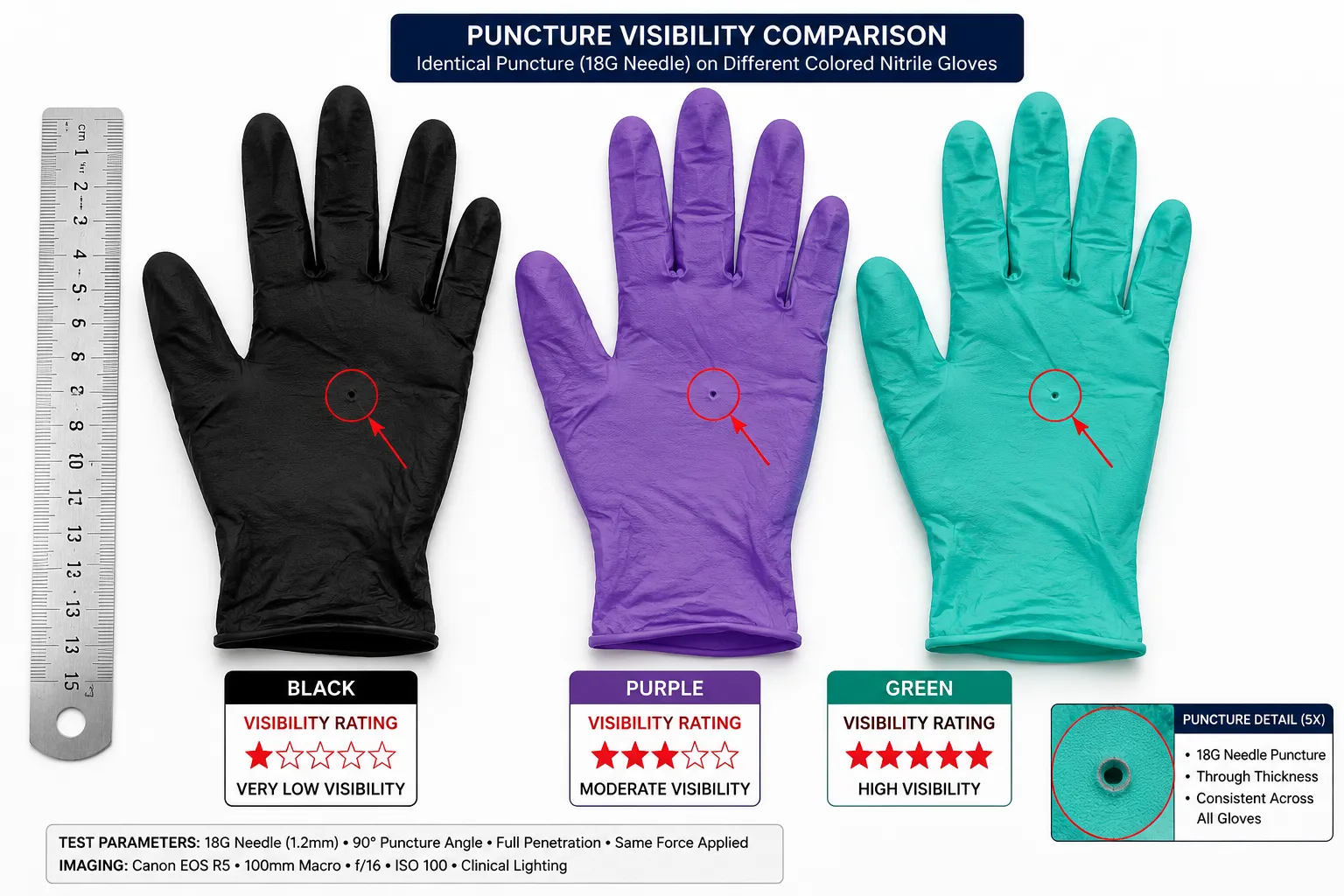
Colored nitrile gloves show punctures more easily than black gloves but not necessarily better than clear gloves, with visibility depending on the specific color and the viewing conditions. Purple, blue, and green gloves reveal tears and holes more clearly than black gloves because the puncture creates a contrasting dark spot or allows light to pass through the damaged area.
Puncture visibility ranking (from most visible to least visible):
- Light colors (white, light blue, light purple): Maximum contrast when punctured; light passes through holes easily
- Medium colors (royal blue, purple, green): Good puncture visibility with adequate contrast
- Clear gloves: Punctures visible when held to light but can be missed during normal use
- Dark colors (navy blue, dark green): Moderate puncture visibility depending on lighting
- Black gloves: Poorest puncture visibility; tears blend into dark background
Factors affecting puncture detection:
- Lighting conditions: Bright overhead lighting or backlighting makes punctures more visible on all colors
- Puncture size: Large tears are visible on any color; pinhole punctures require high-contrast colors
- Glove thickness: Thicker gloves (6+ mil) may not puncture completely through, making detection harder
- Inspection method: Active inspection (holding gloves to light, stretching material) vs. passive observation during use
Industry-specific implications:
Healthcare settings: Purple and blue gloves are preferred because puncture detection is critical for infection control. Medical professionals need to identify glove compromise immediately to prevent pathogen exposure.
Food service: Light-colored gloves help workers spot tears that could allow hand contact with food or permit food particles to contact skin, triggering allergen concerns.
Automotive and industrial: Black gloves’ poor puncture visibility is acceptable because workers typically change gloves based on time or task completion rather than visual inspection.
Laboratory work: High-visibility colors are essential when working with hazardous chemicals or biological materials where barrier integrity is critical.
Best practice: Regardless of glove color, establish protocols for regular glove inspection and replacement based on time, task type, and known exposure risks. Visual inspection should supplement, not replace, systematic glove change procedures.
Testing method: To compare puncture visibility across colors, inflate gloves slightly and use a pin to create identical small punctures. Observe which colors make the holes most obvious under normal working light conditions.
Frequently Asked Questions
Do colored nitrile gloves have latex in them?
No, colored nitrile gloves do not contain latex. Nitrile is a synthetic rubber made from acrylonitrile and butadiene polymers, making all nitrile gloves latex-free regardless of color. The pigments used to color nitrile gloves are also latex-free additives.
Can you wash and reuse colored nitrile gloves?
Disposable colored nitrile gloves should not be washed and reused because washing degrades the material’s barrier properties, creates microscopic tears, and can trap contaminants in the glove material. Use fresh gloves for each task to maintain proper protection and hygiene.
Why are some nitrile gloves different colors?
Nitrile gloves come in different colors to serve functional purposes including contamination visibility, industry-specific color coding, stain concealment, and professional aesthetics. Colors help workers quickly identify glove types, detect contamination, and maintain appropriate appearance for their specific work environment.
Are black nitrile gloves thicker than purple ones?
Black nitrile gloves are not inherently thicker than purple gloves. Thickness depends on the glove model and specification, not the color. Both black and purple gloves are available in various thicknesses ranging from 2-8 mil, with thickness clearly marked on product packaging.
What color nitrile gloves do hospitals use?
Hospitals most commonly use purple and blue nitrile gloves because these colors provide excellent contamination visibility for blood and bodily fluids. Some facilities use color coding systems with different colors for specific departments or procedures to prevent cross-contamination.
Do colored nitrile gloves expire?
Yes, colored nitrile gloves expire, typically 3-5 years from the manufacturing date when stored properly in cool, dry conditions away from direct sunlight. Expiration dates are printed on glove boxes. Expired gloves may become brittle, lose elasticity, and provide compromised barrier protection.
Can you use purple nitrile gloves for cleaning?
Yes, purple nitrile gloves are excellent for cleaning because they provide good visibility for contamination while offering chemical resistance against common cleaning products. Purple gloves are suitable for both residential and commercial cleaning applications.
Are green nitrile gloves biodegradable?
Most green nitrile gloves are not biodegradable despite the color’s environmental association. Standard nitrile takes decades to decompose. However, some manufacturers offer specialized biodegradable nitrile gloves in green and other colors that break down faster in landfill conditions. Check product specifications for biodegradability claims.
What’s the difference between exam grade and industrial grade colored gloves?
Exam grade colored gloves meet FDA and ASTM standards for medical use, including specific requirements for barrier protection, sizing consistency, and defect rates. Industrial grade gloves may not meet these stringent standards but still provide adequate protection for non-medical applications at lower cost.
Do tattoo artists have to use black gloves?
No, tattoo artists are not required to use black gloves by regulation. Black gloves are an industry preference for aesthetic and practical reasons, but artists can use any color that provides appropriate barrier protection. Some jurisdictions require latex-free gloves regardless of color.
Can colored nitrile gloves cause allergic reactions?
Colored nitrile gloves rarely cause allergic reactions, but some individuals may react to chemical accelerators used in manufacturing or, less commonly, to specific pigments. True nitrile allergies are extremely rare. Most reactions are irritant contact dermatitis rather than allergic responses. See our article on potential allergic reactions to nitrile gloves for detailed information.
Which color nitrile gloves are best for electronics work?
Green or blue nitrile gloves are commonly used for electronics work because they provide adequate contamination visibility without the excessive staining visibility of white gloves. Some electronics applications require ESD-safe gloves in specific colors, so verify your facility’s requirements before selecting gloves.
Conclusion
The Colored Nitrile Gloves Guide: Benefits of Black, Purple, and Green for Specific Industries and Visibility demonstrates that glove color is a functional choice with direct impacts on safety, contamination detection, and operational efficiency. Black gloves excel in automotive, tattooing, and janitorial applications where stain concealment maintains professional appearance. Purple gloves provide the high-contrast visibility required in healthcare, food service, and laboratory environments where contamination detection is critical. Green gloves offer balanced performance for general industrial and manufacturing applications.
When selecting colored nitrile gloves for your business, prioritize functional requirements over aesthetics. Evaluate your primary hazards, regulatory requirements, and contamination visibility needs before considering cost or appearance. Remember that color doesn’t affect chemical resistance, thickness, or durability—these properties depend on glove formulation and manufacturing specifications, not pigmentation.
Action steps for choosing the right colored gloves:
- Assess your contamination detection needs: Do you need to spot contaminants immediately or conceal normal soiling?
- Review industry standards and regulatory requirements for your specific application
- Verify FDA compliance or medical-grade certifications if required for your use case
- Test multiple colors with your team to evaluate practical performance in your actual work environment
- Establish clear protocols for glove changes based on time and exposure, not just visual appearance
- Consider color-coding systems for different departments or tasks to prevent cross-contamination
- Source gloves from reputable manufacturers who can provide compliance documentation and consistent quality
The modest price premium for colored gloves (typically 5-15% over standard blue) is a worthwhile investment when the color choice supports your safety protocols, regulatory compliance, and operational efficiency. Choose colors that enhance your ability to detect contamination, maintain professional standards, and protect both workers and customers in your specific industry context.
SEO Meta Title: Colored Nitrile Gloves Guide: Black, Purple & Green