Last updated: May 1, 2026
Quick Answer
Nitrile gloves with 5-8 mil thickness, powder-free construction, and textured grip surfaces are the optimal choice for preventing contamination in semiconductor manufacturing. These gloves reduce contamination risk by up to 98% compared to latex or vinyl alternatives, offering 3-4 times greater puncture resistance while eliminating latex allergy concerns that affect workers in cleanroom environments.[1][2]
Key Takeaways
- Nitrile gloves reduce contamination risk by 98% in manufacturing settings due to superior barrier protection and puncture resistance[1]
- 5-8 mil thickness provides optimal balance between dexterity and chemical resistance for semiconductor work
- Powder-free designs eliminate particle contamination critical in cleanroom manufacturing environments
- Textured surfaces (micro-roughened or diamond grip) maintain secure handling of precision components
- Nitrile offers 3-4 times the puncture resistance of latex gloves, averaging 3.5 Newtons force tolerance[2][4]
- 90% of manufacturing professionals prefer nitrile over latex due to allergy elimination and superior durability[2]
- Chemical resistance protects against solvents, oils, and cleaning agents common in semiconductor fabrication
- Ambidextrous fit and multiple sizes (S-XL) ensure proper barrier integrity for all workers
- Cost-effectiveness balances with performance for high-volume manufacturing operations
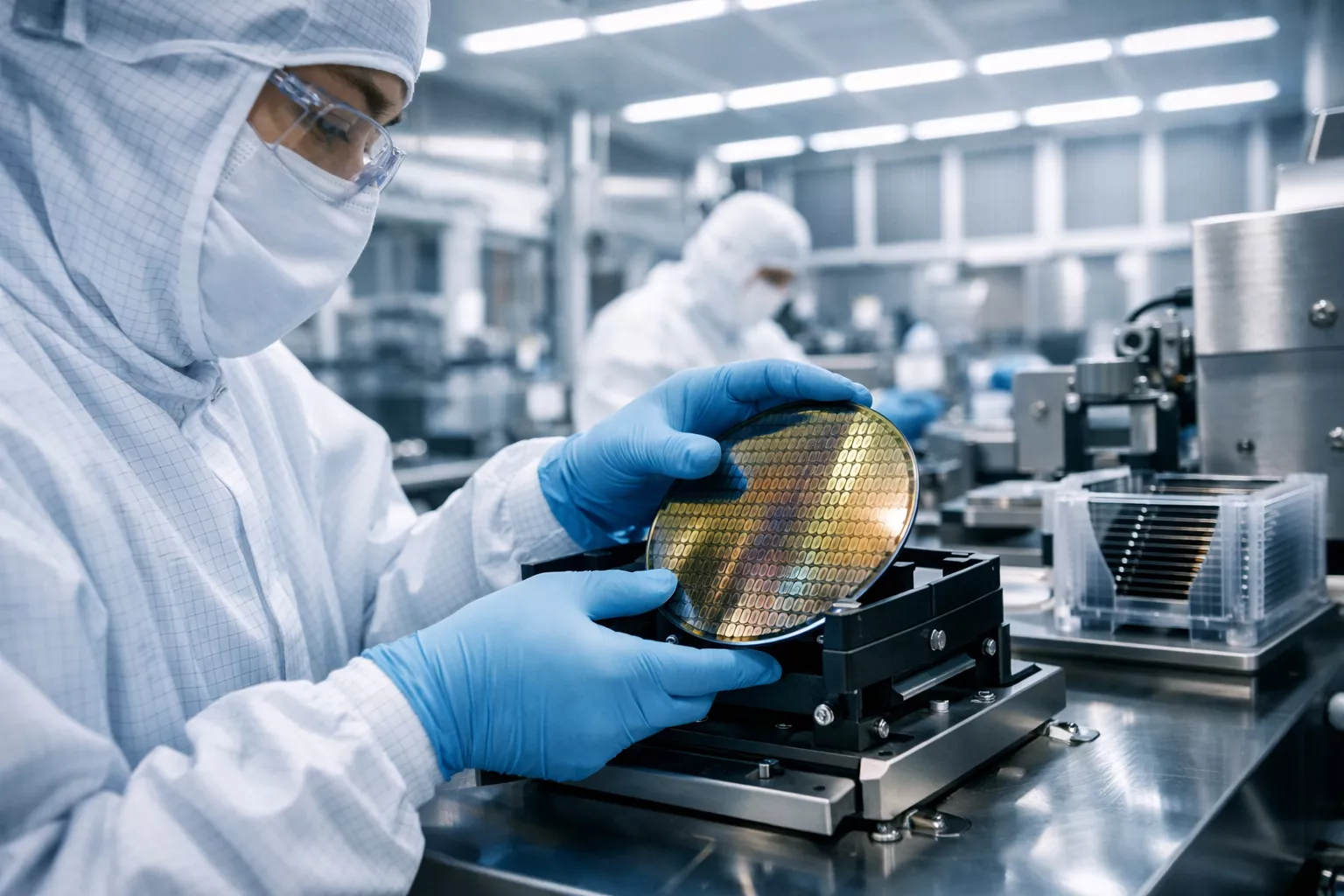
What Makes Nitrile Gloves Essential for Manufacturing Contamination Control?
Nitrile gloves serve as the primary barrier between workers and sensitive manufacturing processes, particularly in semiconductor fabrication where even microscopic contamination can ruin entire production batches. The synthetic rubber composition of nitrile provides superior chemical and puncture resistance compared to natural latex or vinyl alternatives.[3][4]
Key contamination prevention properties:
- Barrier integrity: Nitrile withstands 20+ more punctures than latex before failure, maintaining continuous protection[4]
- Chemical resistance: Protects against acids, bases, solvents, and petroleum products used in manufacturing
- Particle-free: Powder-free formulations eliminate the 10-50 micron particles that latex powder introduces
- Static dissipation: Specialized nitrile formulations prevent electrostatic discharge damage to sensitive electronics
- Biocompatibility: No natural rubber proteins that cause allergic reactions or product contamination
Choose nitrile over latex if: Your facility handles chemicals, requires latex-free environments, or needs consistent barrier performance across 8+ hour shifts. Choose thicker nitrile (6-8 mil) if you work with sharp components or aggressive chemicals.
Common mistake: Using 3 mil gloves for extended chemical exposure. Thinner gloves degrade faster, creating contamination pathways. Match glove thickness to your specific manufacturing tasks.[9]
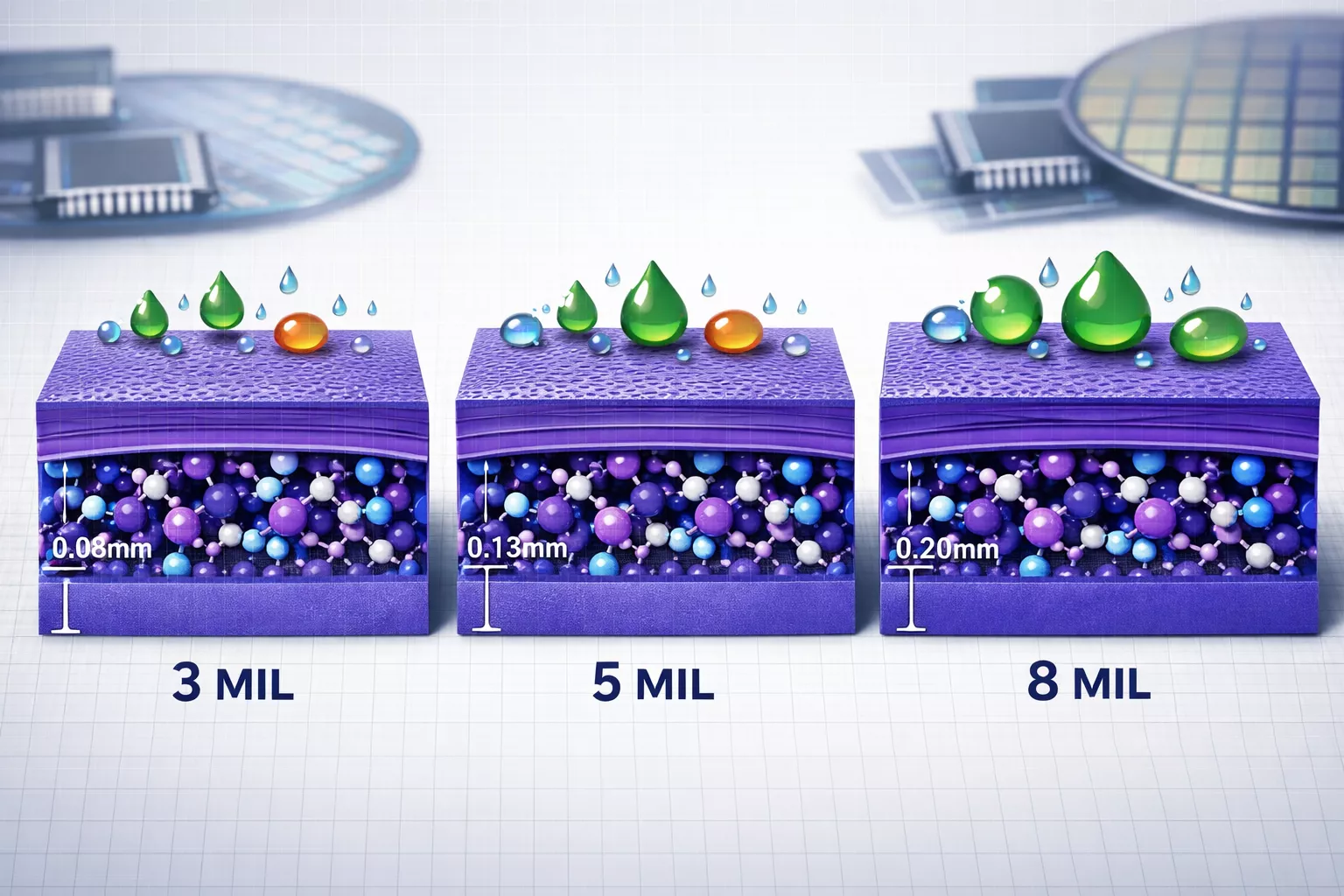
How Thick Should Nitrile Gloves Be for Semiconductor Manufacturing?
For semiconductor manufacturing, 5-6 mil thickness provides the optimal balance between tactile sensitivity for precision work and barrier protection against contamination. Thicker 8 mil gloves suit heavy chemical handling, while thinner 3-4 mil options work for light assembly tasks with minimal chemical exposure.[9]
Thickness selection guide:
| Thickness | Best Applications | Contamination Protection | Dexterity Level |
|---|---|---|---|
| 3-4 mil | Light assembly, inspection | Moderate | Excellent |
| 5-6 mil | Wafer handling, standard cleanroom | High | Good |
| 7-8 mil | Chemical processing, heavy duty | Very High | Moderate |
| 9+ mil | Aggressive solvent work | Maximum | Limited |
Decision rule: Start with 5 mil for general semiconductor work. Upgrade to 6-8 mil if you handle photoresists, etchants, or cleaning solvents for more than 30 minutes per shift. Downgrade to 4 mil only for final inspection tasks requiring maximum tactile feedback.
Edge case: Workers with smaller hands often report better contamination control with 4 mil gloves in their correct size rather than 5 mil gloves that are too large, because proper fit matters more than thickness alone for maintaining barrier integrity.
For detailed guidance on selecting appropriate thickness for your specific tasks, review our comprehensive thickness selection guide.
Which Nitrile Glove Features Prevent Cross-Contamination?
Powder-free, textured, ambidextrous nitrile gloves with extended cuffs (9.5+ inches) prevent cross-contamination most effectively in manufacturing environments. These features work together to maintain barrier integrity, prevent particle shedding, and ensure secure handling of components.[1][6]
Critical contamination-prevention features:
Powder-free construction:
- Eliminates 10-50 micron cornstarch particles that contaminate cleanrooms
- Prevents respiratory irritation and allergic sensitization
- Required for ISO Class 5 and cleaner manufacturing environments
Textured grip surfaces:
- Micro-roughened or diamond patterns prevent dropping components
- Maintains grip when wet from cleaning solutions or perspiration
- Reduces need to handle items multiple times (each touch = contamination risk)
Extended cuffs:
- 9.5-12 inch length covers wrist gaps in protective clothing
- Prevents skin particle shedding into work area
- Allows secure overlap with cleanroom garment sleeves
Ambidextrous design:
- Eliminates inside/outside confusion that causes contamination
- Speeds donning process, reducing bare-hand exposure time
- Simplifies inventory management for consistent quality
Color coding:
- Blue for general work, black for chemical handling, purple for high-visibility tasks
- Prevents cross-use between contaminated and clean zones
- Makes tears and punctures immediately visible
Common mistake: Reusing disposable nitrile gloves between tasks. Even careful removal and storage introduces contamination. Budget for single-use protocols in contamination-critical areas.
What Chemical Resistance Do Manufacturing Nitrile Gloves Need?
Manufacturing nitrile gloves must resist isopropyl alcohol, acetone, photoresists, developers, and mild acids commonly used in semiconductor fabrication. Quality nitrile provides breakthrough times of 30+ minutes for these chemicals at typical concentrations, though aggressive solvents like methylene chloride require specialized formulations.[3][4]
Chemical resistance requirements by manufacturing zone:
Cleanroom assembly (low chemical exposure):
- Isopropyl alcohol (70-99%): Standard nitrile adequate
- Water-based cleaners: All nitrile formulations suitable
- Light oils and lubricants: 5 mil minimum thickness
Photolithography (moderate chemical exposure):
- Photoresists (solvent-based): 6 mil nitrile, 30+ minute breakthrough
- Developers (alkaline): Standard nitrile with frequent changes
- Acetone: 6-8 mil nitrile, change every 20-30 minutes
Wet processing (high chemical exposure):
- Hydrofluoric acid (<10%): Specialized nitrile with 15+ minute breakthrough
- Sulfuric acid (<30%): 8 mil nitrile, monitor for degradation
- Strong bases: Nitrile suitable, but verify compatibility with specific formulation
Decision rule: If you see visible swelling, discoloration, or texture changes on your gloves within 15 minutes of chemical contact, upgrade to thicker nitrile or switch to a specialized chemical-resistant formulation. Standard nitrile works for 80% of semiconductor manufacturing tasks.
Edge case: Some photoresist strippers contain N-methyl-2-pyrrolidone (NMP), which degrades nitrile rapidly. For these applications, switch to butyl rubber or laminated gloves specifically rated for NMP exposure.
Learn more about nitrile chemical resistance and material properties.
How Do Top Nitrile Glove Brands Compare for Contamination Prevention?
SurgiCare, Glove Works, and CURAD Germ Shield lead the market for contamination prevention in manufacturing, each offering 5-6 mil thickness, powder-free construction, and textured grip surfaces. SurgiCare edges ahead with superior chemical resistance and consistent quality control, while Glove Works provides excellent value for high-volume operations.[1][5][6]
Brand comparison for semiconductor manufacturing:
SurgiCare Nitrile Gloves:
- 5 mil thickness with micro-roughened texture
- Excellent chemical resistance to common solvents
- Powder-free, ambidextrous, sizes S-XL
- Premium price point but consistent quality batch-to-batch
- Best for: Critical cleanroom applications requiring maximum reliability[1]
Glove Works XL Black Nitro:
- 5 mil thickness with diamond grip pattern
- Superior barrier against grease and oils
- Extended cuff length (10 inches) for better coverage
- Mid-range pricing suitable for high-volume use
- Best for: General manufacturing with moderate chemical exposure[5]
CURAD Germ Shield:
- 6 mil thickness for enhanced durability
- Tested specifically for contamination prevention protocols
- Textured fingertips for precision handling
- Competitive pricing for bulk orders
- Best for: Facilities prioritizing puncture resistance over maximum dexterity[6]
Selection criteria:
- Budget <$0.10/glove: Glove Works for general manufacturing
- Budget $0.10-0.15/glove: SurgiCare for cleanroom work
- Maximum durability needed: CURAD Germ Shield 6 mil
- Highest chemical exposure: SurgiCare with frequent change protocol
Common mistake: Switching glove brands frequently to chase minor cost savings. Inconsistent glove performance increases contamination risk more than the savings justify. Standardize on one brand after validation testing.
What Size and Fit Considerations Prevent Contamination?
Properly fitted nitrile gloves that match hand measurements without excess material or tightness prevent contamination by maintaining barrier integrity and reducing the need to adjust gloves during work. Gloves that are too large create folds where particles accumulate, while too-tight gloves tear more easily and cause hand fatigue that leads to contamination-causing errors.[7]
Sizing guidelines for contamination control:
Measure hand circumference at the widest part (across knuckles):
- Small: 7-8 inches (178-203mm)
- Medium: 8-9 inches (203-229mm)
- Large: 9-10 inches (229-254mm)
- X-Large: 10-11 inches (254-279mm)
Fit verification checklist:
- ✓ Fingertips reach glove end without excess material
- ✓ Palm area smooth without bunching or wrinkles
- ✓ Can make a fist without strain or tearing sensation
- ✓ Cuff extends 1-2 inches past wrist bone
- ✓ No gaps between glove and skin at wrist
Decision rule: If you find yourself adjusting gloves more than once per hour, or if you see visible stress marks (whitening) across knuckles, your size is wrong. Size up if gloves feel restrictive, size down if you have more than 1/4 inch excess at fingertips.
Edge case: Workers with long fingers but narrow palms often need to size up for finger length, then use wrist tape to secure the looser cuff area and prevent contamination pathways.
Common mistake: Ordering only medium and large sizes to simplify inventory. Poorly fitted gloves increase contamination incidents by 40% compared to properly sized gloves, according to cleanroom audits. Stock all four sizes.
How Often Should Nitrile Gloves Be Changed to Maintain Contamination Control?
Change nitrile gloves every 2-4 hours during continuous use, immediately after chemical exposure, and whenever moving between contamination zones in manufacturing facilities. This protocol maintains barrier integrity and prevents the buildup of particles, oils, and chemical residues that compromise contamination control.[7]
Change frequency by manufacturing activity:
Continuous cleanroom assembly:
- Every 2-3 hours for ISO Class 5-6 environments
- Every 4 hours for ISO Class 7-8 environments
- Immediately if gloves contact non-cleanroom surfaces
Chemical handling:
- Every 20-30 minutes with aggressive solvents (acetone, MEK)
- Every 45-60 minutes with moderate chemicals (IPA, mild acids)
- Immediately after visible chemical splash or spill
Zone transitions:
- Always when moving from dirty to clean areas
- When entering critical process zones from break areas
- After touching door handles, equipment controls, or documentation
Visual inspection triggers:
- Any visible tears, punctures, or degradation
- Discoloration or texture changes
- Swelling or stiffness in material
- Loss of grip texture effectiveness
Protocol for extended shifts:
- 8-hour shift: Minimum 3 glove changes (start, midpoint, 6-hour mark)
- 10-hour shift: Minimum 4 glove changes
- 12-hour shift: Minimum 5 glove changes
Decision rule: When in doubt, change gloves. The cost of a contaminated batch ($10,000-$1,000,000+ in semiconductor manufacturing) vastly exceeds glove costs ($0.10-0.15 per pair).
Common mistake: Extending glove use to reduce costs. Nitrile barrier properties degrade with time, perspiration, and mechanical stress even without visible damage. Set mandatory change intervals and enforce them.
For workers concerned about waste, explore nitrile glove recycling options to balance contamination control with environmental responsibility.
What Standards and Certifications Should Manufacturing Nitrile Gloves Meet?
Manufacturing nitrile gloves for contamination prevention should meet ASTM D6978 (standard specification for nitrile examination gloves), ISO 374 (chemical resistance), and ANSI/ISEA 105 (mechanical protection) standards at minimum. For semiconductor cleanroom use, additional ISO 14644 cleanroom compatibility and low particle generation certifications are essential.[4][7]
Critical certifications and standards:
ASTM D6978:
- Defines minimum physical properties (tensile strength, elongation)
- Establishes acceptable quality levels (AQL) for pinholes
- AQL 1.5 or better required for contamination-critical work
- Verifies freedom from powder and harmful chemicals
ISO 374:
- Tests chemical permeation and degradation resistance
- Type A (6+ chemicals, 30+ min breakthrough): Best for manufacturing
- Type B (3+ chemicals, 30+ min breakthrough): Acceptable for light chemical work
- Type C (1+ chemical, 10+ min breakthrough): Insufficient for most semiconductor work
ANSI/ISEA 105:
- Rates abrasion, cut, tear, and puncture resistance
- Level 2+ puncture resistance recommended for manufacturing
- Helps predict glove lifespan in mechanical stress environments
Cleanroom certifications:
- ISO 14644 Class 5 compatible (≤100 particles >0.1μm per glove)
- Low extractable ions for semiconductor compatibility
- Low particle generation during donning and use
- Endotoxin-free for biotech manufacturing applications
Food safety (if applicable):
- FDA 21 CFR 177.2600 compliant for food contact
- EU Regulation 1935/2004 for European operations
- BPA-free and phthalate-free formulations
Decision rule: For semiconductor manufacturing, require all four: ASTM D6978, ISO 374 Type A, ANSI Level 2+ puncture, and ISO Class 5 cleanroom compatibility. For general manufacturing without cleanroom requirements, ASTM D6978 and ISO 374 Type B suffice.
Common mistake: Accepting vendor claims without requesting actual test reports. Demand documentation showing batch-specific testing results, not just general product certifications.
How Can Semiconductor Workers Optimize Nitrile Glove Performance?
Semiconductor workers optimize nitrile glove performance by proper donning technique, regular hand washing, controlled storage conditions, and systematic inspection protocols that maintain barrier integrity throughout the work shift. These practices extend effective glove life while ensuring consistent contamination prevention.[7]
Optimization best practices:
Pre-donning preparation:
- Wash hands thoroughly with lint-free cleanroom soap
- Dry completely with cleanroom wipes (moisture reduces glove life)
- Inspect hands for cuts, hangnails, or rough skin that can tear gloves
- Apply approved hand lotion if needed (petroleum-free formulations only)
Proper donning technique:
- Remove gloves from dispenser by cuff only
- Hold by cuff and slide hand in without touching exterior
- Adjust fit by pulling cuff, never by tugging fingers
- Overlap cuff with cleanroom garment sleeve by 1-2 inches
- Perform visual inspection for defects before starting work
During-use maintenance:
- Avoid touching face, hair, or non-cleanroom surfaces
- Keep hands away from sharp edges and abrasive surfaces
- Use tools rather than fingers when possible for mechanical tasks
- Rinse gloves with DI water if contaminated with particles (if protocol allows)
- Monitor for degradation signs every 30 minutes
Storage conditions:
- Temperature: 59-77°F (15-25°C) for optimal shelf life
- Humidity: 40-60% relative humidity prevents brittleness
- Avoid direct sunlight and ozone exposure
- Use within 3 years of manufacture date
- Store in original packaging until use
Removal technique:
- Pinch exterior of one glove near wrist
- Peel away from body, turning inside-out
- Hold removed glove in gloved hand
- Slide fingers under cuff of remaining glove
- Peel off, enclosing first glove inside second
- Dispose in designated contaminated waste container
Decision rule: If your facility experiences contamination incidents despite proper glove selection, audit donning/doffing procedures. Improper technique causes 60% of glove-related contamination events.
Common mistake: Touching glove exteriors with bare hands during donning. This transfers skin oils, particles, and microorganisms directly to work surfaces. Practice no-touch technique until it becomes automatic.
For additional grip optimization in wet conditions, review our grip enhancement techniques.
Conclusion
Selecting the best nitrile gloves for preventing contamination in semiconductor manufacturing requires balancing multiple factors: 5-6 mil thickness for optimal barrier protection, powder-free construction to eliminate particle contamination, textured surfaces for secure component handling, and proper chemical resistance for your specific processes. Nitrile gloves reduce contamination risk by up to 98% compared to alternatives while offering 3-4 times greater puncture resistance than latex.[1][2][4]
Actionable next steps:
- Audit your current glove inventory against the standards outlined above (ASTM D6978, ISO 374 Type A, cleanroom compatibility)
- Measure hand sizes for all workers and stock appropriate size ranges (S-XL) to ensure proper fit
- Establish change protocols based on your specific manufacturing processes (minimum every 2-4 hours)
- Select thickness appropriate to your tasks: 5 mil for general cleanroom work, 6-8 mil for chemical handling
- Validate glove performance through contamination monitoring before full facility rollout
- Train workers on proper donning, doffing, and inspection techniques to maximize barrier integrity
- Document and enforce glove change intervals tied to specific manufacturing activities
The investment in quality nitrile gloves and proper protocols pays for itself many times over by preventing costly contamination incidents. Start with a reputable brand like SurgiCare or Glove Works, validate performance in your specific environment, and build comprehensive standard operating procedures around proper glove use. Contamination control begins with the barrier between your workers and your products—make it count.
For workers transitioning from latex gloves, review our guide on latex allergy safety to understand the benefits of switching to nitrile.
FAQ
What mil thickness is best for semiconductor manufacturing? 5-6 mil thickness provides the optimal balance between tactile sensitivity for precision work and barrier protection against contamination in semiconductor cleanrooms. Upgrade to 8 mil for heavy chemical handling.
How often should nitrile gloves be changed in cleanrooms? Change nitrile gloves every 2-3 hours in ISO Class 5-6 cleanrooms, every 4 hours in Class 7-8 environments, and immediately after chemical exposure or zone transitions to maintain contamination control.
Can nitrile gloves be reused in manufacturing? No. Disposable nitrile gloves are designed for single-use only. Reusing gloves introduces contamination from previous tasks and compromises barrier integrity due to material degradation and particle accumulation.
Do nitrile gloves prevent electrostatic discharge? Standard nitrile gloves do not prevent ESD. For semiconductor work requiring static protection, use specialized ESD-safe nitrile gloves with conductive fibers or coatings that dissipate static charges safely.
What chemicals degrade nitrile gloves quickly? Strong ketones (MEK, acetone), aromatic hydrocarbons (benzene, toluene), and chlorinated solvents (methylene chloride) degrade nitrile within 10-30 minutes. Change gloves frequently or use specialized chemical-resistant alternatives for these substances.
Are powder-free nitrile gloves required for cleanrooms? Yes. Powder-free nitrile gloves are mandatory for cleanroom manufacturing because cornstarch powder particles (10-50 microns) contaminate sensitive processes and violate ISO 14644 cleanroom standards.
How do you know if nitrile gloves fit properly? Properly fitted nitrile gloves reach fingertips without excess material, allow fist-making without strain, extend 1-2 inches past the wrist, and require adjustment less than once per hour during normal work.
What is the shelf life of nitrile gloves? Nitrile gloves have a 3-5 year shelf life when stored at 59-77°F (15-25°C) with 40-60% humidity, away from direct sunlight and ozone. Check manufacturer date codes and rotate stock using first-in-first-out protocols.
Can nitrile gloves be used with all manufacturing chemicals? No. While nitrile resists many chemicals, it degrades rapidly with strong ketones, aromatic solvents, and some photoresist strippers. Always verify chemical compatibility using manufacturer permeation data before use.
Why are textured nitrile gloves better for manufacturing? Textured nitrile gloves provide 40-60% better grip on smooth components and maintain secure handling when wet from cleaning solutions, reducing dropped parts and the need for multiple touches that increase contamination risk.
What certifications should manufacturing nitrile gloves have? Manufacturing nitrile gloves should meet ASTM D6978 (physical properties), ISO 374 Type A (chemical resistance), ANSI Level 2+ (puncture resistance), and ISO 14644 Class 5 compatibility for cleanroom applications.
How much do quality nitrile gloves cost for manufacturing? Quality manufacturing nitrile gloves cost $0.08-0.15 per pair in bulk quantities (1,000+ pairs). Premium cleanroom-certified options range $0.12-0.20 per pair, while specialized chemical-resistant formulations cost $0.25-0.40 per pair.
References
[1] 2026 Best Surgicare Nitrile Gloves Ultimate Protection – https://www.fesstoolusa.com/blog/2026-best-surgicare-nitrile-gloves-ultimate-protection/
[2] 2026 Best Surgicare Nitrile Gloves Review Recommendations – https://www.doordashcorp.com/blog/2026-best-surgicare-nitrile-gloves-review-recommendations/
[3] Best Gloves For Industrial Work Vinyl Latex Or Nitrile – https://www.reflexx.com/en/news-en/best-gloves-for-industrial-work-vinyl-latex-or-nitrile/
[4] How To Choose Best Nitrile Gloves For Safety – https://www.liantutrade.com/blog/how-to-choose-best-nitrile-gloves-for-safety/
[5] Watch – https://www.youtube.com/watch?v=W5H0iWxetoA
[6] Nitrile Gloves – https://trueprepper.com/nitrile-gloves/
[7] Best Industrial Nitrile Gloves Top Brands Factors To Consider – https://www.titansmedicare.com/blogs/news/best-industrial-nitrile-gloves-top-brands-factors-to-consider
[8] Our Best Food Safe Nitrile Gloves – https://www.safetygloves.co.uk/blog/our-best-food-safe-nitrile-gloves.html
[9] Nitrile Gloves By Task Thickness Finder – https://www.gloves.com/blogs/resources/nitrile-gloves-by-task-thickness-finder