Last updated: July 1, 2026
Between 2020 and 2026, the Asia Pacific region added over 400 billion units of annual nitrile glove production capacity, with Malaysia, Thailand, Vietnam, and China leading the expansion. This rapid growth has created unprecedented opportunities for buyers seeking competitive pricing and diverse supply chains, but it has also introduced significant quality assurance challenges and sourcing risks. The Asia Pacific Nitrile Production Boom: Quality Assurance, Sourcing Risks, and Vetting Emerging Suppliers landscape requires buyers to implement rigorous vetting frameworks to distinguish reliable manufacturers from those cutting corners to capture market share quickly.
Key Takeaways
- Asia Pacific now accounts for approximately 85% of global nitrile glove production, with Malaysia and Thailand dominating established capacity while Vietnam and China rapidly expand
- New entrants can offer 15-30% lower pricing than established suppliers, but quality control failures, inconsistent certifications, and supply chain reliability remain major concerns
- Essential certifications include ISO 13485, ASTM D6319 or EN 455 compliance, FDA registration for US markets, and country-specific regulatory approvals
- Proper supplier vetting takes 3-6 months minimum and should include factory audits, sample testing across multiple production batches, and financial stability verification
- Common quality failures with emerging suppliers include inconsistent thickness, high defect rates (pinhole leaks), chemical residue issues, and poor lot-to-lot consistency
- Established suppliers offer proven track records and stable quality but often have limited capacity and higher minimum order quantities
- Risk mitigation strategies include phased onboarding, third-party quality inspections, performance bonds, and maintaining relationships with multiple suppliers
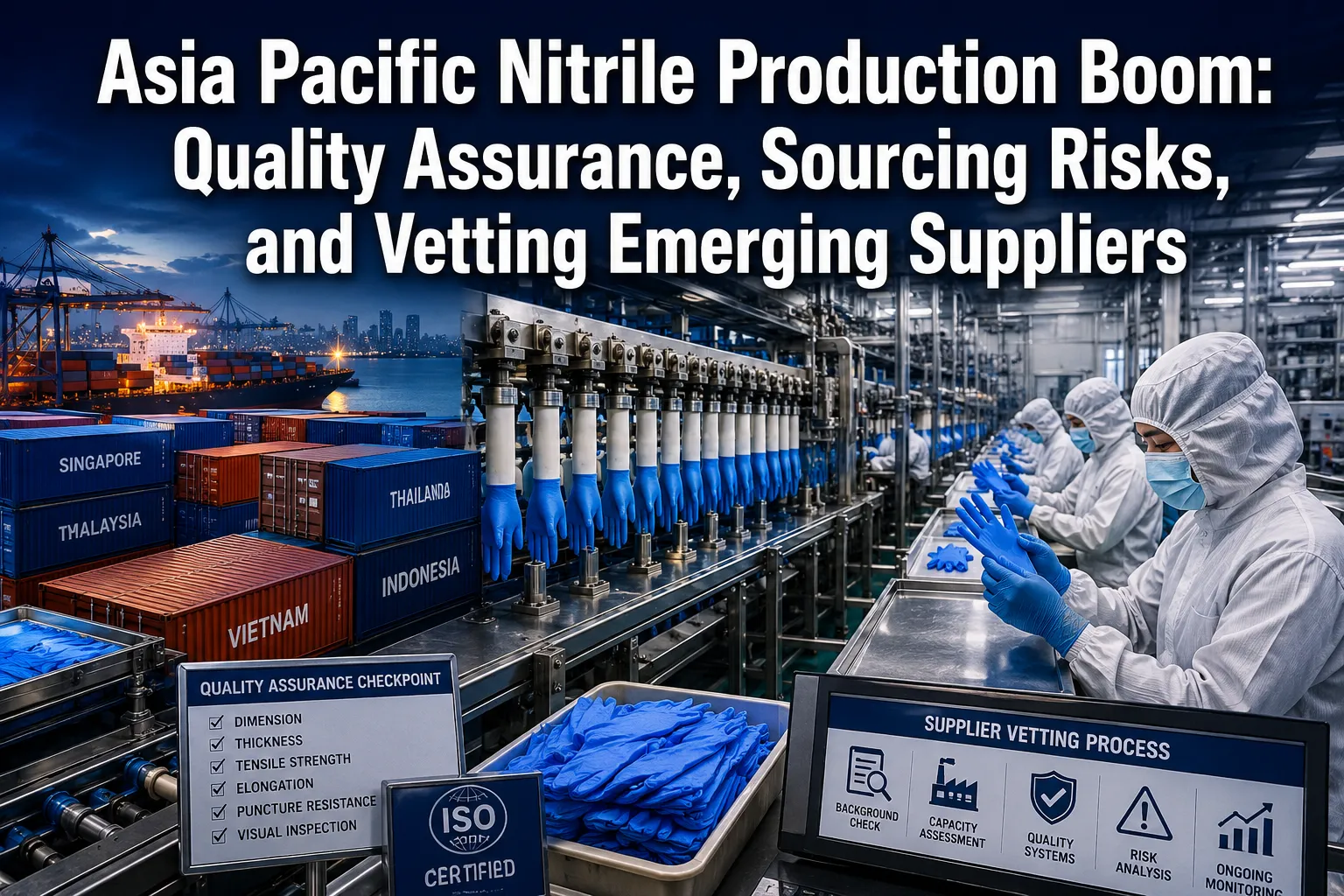
What Is Driving the Nitrile Glove Production Boom in Asia Pacific Region
The Asia Pacific nitrile production surge stems from three primary factors: pandemic-driven demand that revealed critical supply shortages, government incentives for medical manufacturing in Southeast Asian nations, and the region’s established rubber processing infrastructure. Malaysia and Thailand already possessed deep expertise in latex glove production, making the transition to nitrile manufacturing a natural evolution.
Government support has been substantial. Malaysia’s government provided tax incentives and expedited licensing for new glove manufacturers between 2020 and 2023. Thailand offered similar programs, while Vietnam positioned itself as a lower-cost alternative with newer facilities. China leveraged its chemical manufacturing capabilities to rapidly scale nitrile production, particularly for industrial-grade gloves.
The economics are compelling for manufacturers. Raw material costs in the region remain 10-20% lower than Western markets due to proximity to butadiene and acrylonitrile suppliers. Labor costs, while rising, still provide significant advantages. A production line that might cost $8-12 million to establish in North America can be built for $5-7 million in Vietnam or Thailand.
Key drivers include:
- Pandemic-exposed supply chain vulnerabilities that pushed buyers to diversify sourcing
- Regional trade agreements (RCEP, ASEAN) reducing tariffs and facilitating exports
- Established logistics infrastructure connecting factories to major shipping ports
- Growing domestic healthcare markets in China, India, and Southeast Asia
- Technology transfer from established manufacturers to new entrants
The boom has not been without challenges. Rapid expansion led to oversupply by late 2022, causing price crashes that forced some newer manufacturers to close or consolidate. This market correction actually benefits buyers who can now be more selective, but it also means some suppliers may be operating under financial stress.
How to Verify Quality Standards for Nitrile Suppliers in Southeast Asia
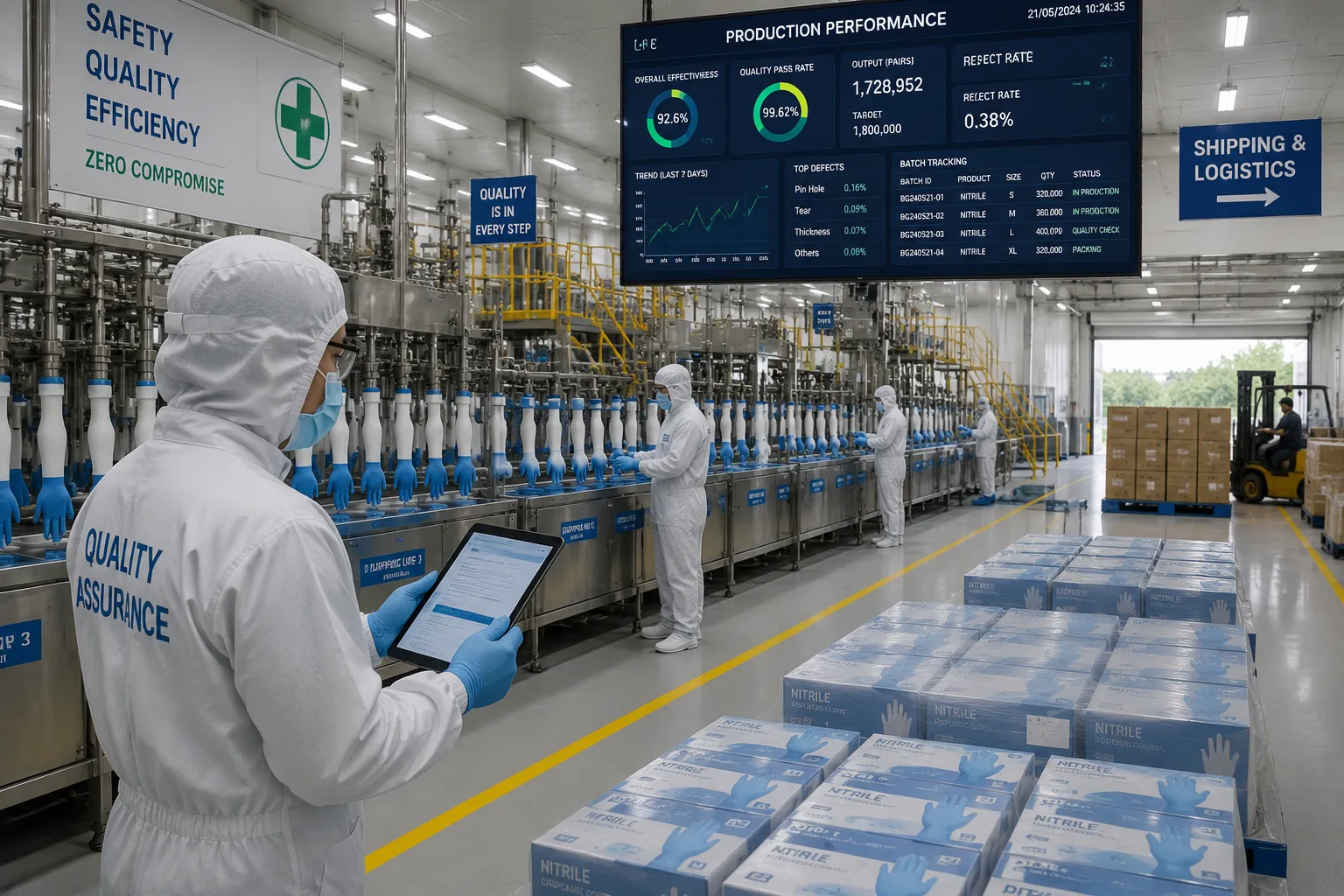
Verifying quality standards requires a multi-layered approach combining documentation review, physical testing, and on-site verification. Start by requesting copies of all relevant certifications and confirming their validity directly with issuing bodies rather than accepting supplier-provided documents at face value.
Essential verification steps:
- Certification validation: Contact certification bodies directly to confirm ISO 13485, ISO 9001, and product-specific certifications are current and cover the specific manufacturing facility you’re sourcing from, not just corporate headquarters
- Regulatory database checks: Verify FDA establishment registration numbers in the FDA database, check EU MDR compliance for European markets, and confirm local regulatory approvals
- Third-party testing: Send samples to independent laboratories for ASTM D6319 testing (for medical gloves) or EN 455 compliance, including AQL testing, tensile strength, and chemical residue analysis
- Supply chain transparency: Request documentation showing raw material sourcing, particularly for nitrile rubber compounds, to ensure consistency and quality of inputs
- Production capacity verification: Cross-reference claimed production volumes with facility size, number of production lines, and workforce to identify unrealistic claims
For composition of nitrile gloves, understanding the material specifications helps identify quality variations. Reputable suppliers will provide detailed technical data sheets showing polymer composition, accelerator types, and additive specifications.
Common red flags during verification:
- Certifications that are expired, pending renewal, or issued to different legal entities
- Reluctance to provide factory addresses or allow unannounced audits
- Inconsistent product specifications across different sales materials
- Inability to provide batch-specific test reports or certificates of analysis
- Prices significantly below market rates without clear explanation
Choose verification partners carefully. Third-party inspection companies with local presence in Southeast Asia can conduct surprise audits and real-time quality checks. Companies like SGS, Bureau Veritas, and TUV offer specialized medical device inspection services.
What Are the Main Sourcing Risks When Buying Nitrile From New Asian Manufacturers
The primary sourcing risks fall into four categories: quality inconsistency, supply reliability, regulatory compliance gaps, and financial instability. New manufacturers often lack the process controls and quality management systems that established producers have refined over decades.
Quality inconsistency manifests as batch-to-batch variation in thickness, tensile strength, and defect rates. A supplier might deliver excellent samples during the vetting process but struggle to maintain those standards at production scale. This occurs because sample production often receives extra attention while regular production runs may use less experienced operators or lower-grade raw materials.
Supply reliability risks include:
- Inability to meet committed delivery schedules due to production bottlenecks
- Raw material shortages that halt production unexpectedly
- Power supply issues in regions with unstable electrical infrastructure
- Labor shortages during peak agricultural seasons when workers return to farming
- Shipping and logistics delays due to limited freight forwarder relationships
Regulatory compliance gaps pose serious risks, especially for medical-grade gloves. Some new manufacturers obtain basic certifications but lack understanding of ongoing compliance requirements. They may fail to report product changes, maintain proper documentation, or conduct required periodic testing. This can result in shipments being rejected at customs or, worse, product recalls after distribution.
Financial instability became more pronounced after the 2022 market correction. Some manufacturers expanded aggressively using debt financing, assuming sustained high prices. When prices normalized, these companies faced cash flow problems. Warning signs include requests for advance payment beyond industry norms, delayed responses to quality issues, and reports of unpaid suppliers in local business networks.
For buyers concerned about potential allergic reactions to nitrile gloves, new manufacturers may have less rigorous control over chemical residues and accelerators that can cause skin sensitivities.
Risk mitigation strategies:
- Start with small trial orders before committing to large contracts
- Require performance bonds or letters of credit for significant orders
- Implement third-party inspection at multiple production stages
- Maintain relationships with at least two qualified suppliers for critical products
- Include quality escape clauses in contracts with clear remediation terms
Established Nitrile Suppliers vs Emerging Suppliers in Asia Pacific Pros and Cons
Established suppliers like Top Glove, Hartalega, Kossan, and Ansell’s Asian facilities offer proven track records spanning decades. They have invested heavily in automation, quality systems, and regulatory compliance infrastructure. Their production processes are stable, and they maintain relationships with major global buyers including healthcare systems and Fortune 500 companies.
Established supplier advantages:
- Consistent quality with documented performance history
- Comprehensive certifications for multiple global markets
- Financial stability and insurance coverage
- Established customer service and technical support teams
- Ability to handle complex customization requirements
- Proven crisis management and business continuity planning
Established supplier disadvantages:
- Higher pricing, typically 15-30% above emerging competitors
- Limited flexibility on minimum order quantities (often 1-5 million pieces minimum)
- Longer lead times due to full order books
- Less willingness to accommodate special terms or rapid changes
- May prioritize large institutional buyers over smaller customers
Emerging suppliers include manufacturers established after 2018, often with modern facilities but limited operational history. Many are second-generation companies founded by individuals with experience at established manufacturers, bringing technical knowledge but lacking organizational maturity.
Emerging supplier advantages:
- Competitive pricing due to lower overhead and market entry strategies
- Flexibility on order sizes and customization
- Newer equipment and facilities in some cases
- Eagerness to build relationships and accommodate buyer needs
- Faster response times and decision-making
Emerging supplier disadvantages:
- Limited track record makes quality prediction difficult
- May lack full certification portfolio for all target markets
- Higher risk of production disruptions or business failure
- Less sophisticated quality management systems
- Potential for inconsistent performance as they scale production
- Limited technical support and problem-solving capabilities
Decision framework:
Choose established suppliers when you need guaranteed quality for critical applications like surgical gloves, have regulatory requirements that demand extensive documentation, or require large volumes with absolute reliability. Select emerging suppliers when price sensitivity is high, you have robust incoming quality inspection capabilities, or you’re sourcing for lower-risk applications like industrial or food handling uses.
A hybrid approach works well for many buyers: maintain a primary relationship with an established supplier for 60-70% of volume while developing one or two emerging suppliers for the remainder. This provides cost optimization while managing risk.
How Much Cheaper Are Nitrile Gloves From New Asia Pacific Producers
New Asia Pacific producers typically offer prices 15-30% below established manufacturers for comparable specifications, though the actual discount varies by product grade, order volume, and market conditions. As of 2026, examination-grade nitrile gloves from established Malaysian suppliers average $45-65 per 1,000 pieces for standard thickness (3-4 mil), while new entrants from Vietnam or smaller Thai manufacturers quote $35-50 for similar specifications.
The price differential stems from several factors. New manufacturers often operate with lower overhead, having built facilities during the recent construction boom when equipment prices were competitive. They also typically pay lower wages in emerging manufacturing zones compared to established industrial areas where labor costs have risen over time.
Price comparison by supplier type (per 1,000 pieces, FOB):
| Supplier Category | Exam Grade (3-4 mil) | Industrial Grade (5-6 mil) | Surgical Grade |
|---|---|---|---|
| Established (Malaysia/Thailand) | $45-65 | $65-85 | $90-120 |
| Mid-tier (5-10 years operation) | $40-55 | $55-75 | $80-105 |
| New entrants (Vietnam/China) | $35-50 | $50-70 | $75-95 |
| Spot market (variable quality) | $30-45 | $45-65 | N/A |
However, the headline price doesn’t tell the complete story. Hidden costs can erode apparent savings:
Additional cost factors:
- Higher defect rates requiring increased quality inspection labor
- Greater likelihood of rejected shipments and associated logistics costs
- Need for more frequent audits and quality verification
- Potential for delayed shipments requiring expedited freight
- Lower negotiating power on payment terms (may require larger deposits)
- Limited or no warranty support for quality issues
A buyer who switches from a $55 per 1,000 established supplier to a $40 new supplier might save $15 per 1,000 on paper. But if defect rates increase from 0.5% to 2.5%, the additional waste and handling costs can consume $8-12 of that saving. If one in ten shipments requires rejection and reordering, logistics costs can eliminate the remaining advantage.
When price advantages are genuine:
- New supplier has invested in modern automated equipment reducing labor costs
- Facility is located in a genuinely lower-cost region with good infrastructure
- Company is operating on thinner margins to build market share but has financial backing
- Raw material sourcing provides legitimate cost advantages
- Production efficiency is high due to experienced management team
When to be skeptical of low prices:
- Prices are more than 35% below established suppliers without clear explanation
- Supplier cannot provide detailed cost breakdowns
- Quality specifications are vague or don’t match international standards
- Supplier is unwilling to provide samples from regular production runs
- Payment terms heavily favor the supplier (large deposits, limited recourse)
For applications where quality is critical, such as medical examination gloves or food handling, the cost of quality failures far exceeds potential savings from cheaper suppliers.
Common Quality Control Failures With New Nitrile Manufacturers in Asia
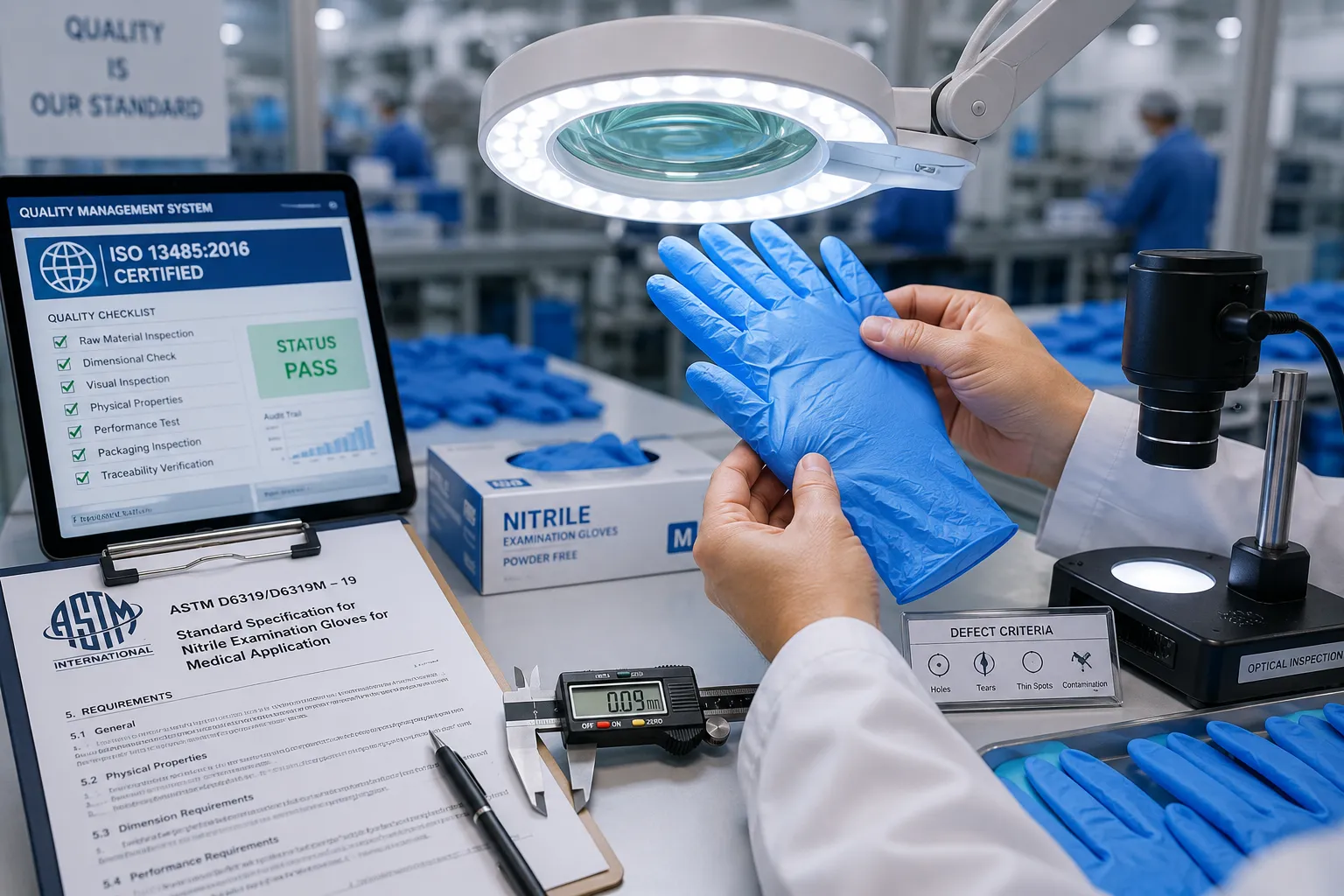
New manufacturers most frequently fail in process consistency, raw material quality control, and proper curing protocols. These failures manifest as specific, measurable defects that buyers can test for during qualification and ongoing quality assurance.
Pinhole and leak defects represent the most common failure mode. While established manufacturers maintain AQL (Acceptable Quality Limit) 1.5 or better for critical defects, new manufacturers may struggle to consistently achieve AQL 2.5. This occurs due to inadequate mold maintenance, contamination in dipping tanks, or improper polymer formulation. A single production line might produce acceptable quality one week and elevated defect rates the next.
Thickness inconsistency affects both performance and cost. Specifications might call for 4.0 mil ±0.3 mil, but new manufacturers may deliver gloves ranging from 3.5 to 4.8 mil within the same batch. This happens when automated thickness monitoring systems are absent or poorly calibrated, or when operators manually adjust dipping parameters without proper controls.
Chemical residue problems pose health risks and regulatory issues. Inadequate washing and leaching after production leaves excess accelerators, sulfur compounds, or other processing chemicals on finished gloves. This can cause skin reactions and may violate regulatory limits for extractable proteins and chemicals.
Tensile strength failures indicate poor polymer quality or incorrect curing. Gloves may pass initial inspection but fail during use, particularly when stretched or exposed to chemicals. This often traces to cost-cutting on raw materials or rushing production cycles to meet delivery deadlines.
Additional common failures:
- Inconsistent sizing (gloves marked as large fitting like medium)
- Poor packaging allowing contamination or damage during shipping
- Inadequate lot tracking making it impossible to trace problems to specific production runs
- Color variation between batches affecting customer perception
- Texture inconsistency affecting grip performance
- Shelf life issues due to improper storage or packaging
Root causes of quality failures:
- Insufficient process validation: New manufacturers may not have conducted proper process validation studies to identify critical control points
- Inadequate training: Operators lack experience recognizing early warning signs of quality drift
- Cost pressure: Management pushes for higher output or lower material costs, compromising quality
- Equipment limitations: Older or improperly maintained equipment cannot maintain tight tolerances
- Raw material variability: Inconsistent supplier relationships lead to batch-to-batch material variations
Testing protocols to catch failures:
- Conduct water leak testing on statistically significant samples from each shipment
- Measure thickness at multiple points on gloves from different boxes
- Perform tensile strength and elongation testing per ASTM D6319
- Test for extractable proteins and chemical residues
- Verify lot coding and traceability systems
- Conduct accelerated aging tests for shelf life validation
Understanding what is a good thickness for nitrile gloves helps buyers set appropriate specifications and catch thickness-related quality issues.
What Certifications Should Asia Pacific Nitrile Suppliers Have Before Ordering
Before placing orders, suppliers must hold certifications appropriate for your target markets and intended use. For medical-grade gloves destined for healthcare settings, ISO 13485 (Medical Devices Quality Management System) is non-negotiable. This certification demonstrates the manufacturer has implemented quality systems specifically designed for medical device production.
Essential certifications by market:
United States:
- FDA establishment registration and device listing
- ASTM D6319 compliance for examination gloves (or ASTM D3578 for surgical)
- 510(k) clearance if marketing as medical devices
European Union:
- CE marking under Medical Device Regulation (MDR 2017/745)
- EN 455 compliance (parts 1-4 covering freedom from holes, physical properties, biological evaluation, and shelf life)
- Notified Body certification
General markets:
- ISO 9001 (Quality Management Systems)
- ISO 13485 (Medical Devices Quality Management)
- ISO 14001 (Environmental Management) – increasingly important for sustainability-conscious buyers
Product-specific standards:
- ASTM D6319 (nitrile examination gloves)
- ASTM D3578 (surgical gloves)
- EN 374 (protective gloves against chemicals and microorganisms)
- EN 420 (general requirements for protective gloves)
Beyond basic certifications, look for evidence of ongoing compliance. Request copies of most recent audit reports, corrective action responses, and surveillance audit results. Certifications should be current (not expired or pending renewal) and issued to the specific manufacturing facility, not just corporate headquarters.
Additional valuable certifications:
- Good Manufacturing Practice (GMP) certification
- Occupational Safety and Health Administration (OSHA) compliance
- Local regulatory approvals (Malaysian Medical Device Authority, Thai FDA, etc.)
- Environmental certifications (especially for waste water treatment)
- Social compliance audits (SMETA, BSCI) demonstrating ethical labor practices
For specialized applications, verify application-specific certifications. Food handling gloves should meet FDA food contact requirements. Gloves for tattoo artists or automotive work may need different performance specifications.
Certification verification checklist:
- Obtain certificate numbers and verify directly with issuing bodies
- Confirm certificates cover the specific product types you’re ordering
- Check expiration dates and renewal status
- Verify the legal entity on certificates matches your supplier
- Request evidence of annual surveillance audits
- Ask for copies of most recent audit findings and corrective actions
Be wary of suppliers who claim certifications are “in progress” or “pending.” Legitimate certification processes are well-defined with clear timelines. A manufacturer claiming ISO 13485 is “almost complete” for more than 6-8 months likely faces serious compliance gaps.
How to Audit a New Nitrile Glove Factory in Malaysia or Thailand
A comprehensive factory audit takes 1-2 full days and should cover quality systems, production processes, raw material handling, and business operations. Conduct audits unannounced if possible, or with minimal advance notice, to see normal operations rather than specially prepared conditions.
Pre-audit preparation:
- Review all documentation provided by supplier (certifications, test reports, process flows)
- Prepare specific questions based on your quality requirements
- Assemble an audit team including quality engineer, production specialist, and if possible, someone familiar with local language and business practices
- Define clear audit criteria and scoring methodology
- Notify supplier of documentation you’ll need to review on-site
Facility and infrastructure assessment:
Start with the physical facility. Modern nitrile production requires cleanroom environments, climate control, and proper air filtration. Check for:
- Adequate separation between raw material storage, production, and finished goods
- Proper temperature and humidity controls (critical for consistent production)
- Clean, well-maintained equipment with visible maintenance schedules
- Appropriate personal protective equipment for workers
- Proper waste management and environmental controls
- Backup power systems to prevent production interruptions
Production process evaluation:
Observe actual production runs, not demonstrations. Watch for:
- Consistent operator procedures across different lines
- Proper documentation of process parameters
- Real-time quality checks at critical control points
- Appropriate handling of non-conforming products
- Proper lot identification and traceability systems
- Evidence of process validation and capability studies
Quality management system review:
Request to see actual quality records, not just procedures. Examine:
- Incoming raw material inspection records and supplier qualification
- In-process quality control data with statistical process control charts
- Finished product testing results across multiple batches
- Customer complaint logs and corrective action records
- Internal audit schedules and findings
- Management review meeting minutes
- Calibration records for testing equipment
Critical questions to ask:
- “Show me quality data from the last three months of production for the product type I’m interested in.”
- “Walk me through what happens when a batch fails quality testing.”
- “How do you qualify and monitor raw material suppliers?”
- “What is your actual defect rate by AQL, and how do you track it?”
- “Can you demonstrate your lot traceability system from raw material to finished product?”
- “What percentage of production is rework, and what are the main causes?”
Red flags during audits:
- Reluctance to show certain areas or records
- Inability to produce requested documentation quickly
- Significant differences between documented procedures and actual practices
- Poorly maintained equipment or facilities
- Lack of proper calibration or testing equipment
- Absence of statistical process control or quality trending
- High employee turnover or visible labor issues
- Inadequate raw material inventory (suggesting cash flow problems)
Financial and business stability assessment:
While on-site, gather information about business health:
- Ask about current capacity utilization and major customers
- Observe inventory levels (very high or very low can indicate problems)
- Note whether facility expansions are complete or abandoned mid-construction
- Inquire about ownership structure and financial backing
- Request business references from other international customers
Post-audit actions:
Document findings immediately while details are fresh. Rate the supplier against your predetermined criteria. For marginal suppliers, provide specific corrective action requests with timelines. Schedule follow-up audits before placing large orders.
For suppliers that pass initial audits, implement ongoing monitoring through periodic re-audits (annually or semi-annually) and continuous quality data review.
Are Smaller Nitrile Producers in Asia Pacific Reliable for Large Orders
Smaller producers (those with annual capacity under 5 billion pieces) can be reliable for large orders if they have proper capacity planning, financial stability, and quality systems, but they carry higher risk than established manufacturers. The key question is whether their capacity and capabilities match your order requirements.
A supplier with 3 billion pieces annual capacity can reliably handle orders of 50-100 million pieces per quarter, but will struggle with 500 million piece orders without compromising quality or delivery to other customers. Smaller producers often lack the buffer capacity that larger manufacturers maintain for demand surges or production issues.
Reliability factors for smaller producers:
Capacity utilization: Suppliers operating at 85-95% capacity have little flexibility for problems. Those at 60-75% utilization can better handle unexpected issues. Ask directly about current capacity utilization and major customer commitments.
Customer concentration: If one or two customers represent more than 60% of a small supplier’s business, you face risk of being deprioritized if those major customers increase orders. Conversely, if you would represent more than 40% of their business, you gain leverage but create dependency risk.
Financial resources: Smaller producers may lack working capital to purchase raw materials for large orders without advance payment. This isn’t necessarily disqualifying, but requires appropriate payment structures and possibly letters of credit.
Production line flexibility: Manufacturers with multiple production lines can dedicate specific lines to major customers, improving consistency. Single-line or two-line operations have less flexibility when problems occur.
Advantages of smaller producers for large orders:
- Greater attention and priority for significant customers
- More flexibility on customization and specifications
- Faster decision-making and problem resolution
- Willingness to accommodate special requirements
- Often more competitive pricing to win large contracts
Disadvantages and risks:
- Limited surge capacity for unexpected demand increases
- Higher vulnerability to supply chain disruptions
- Less sophisticated logistics and inventory management
- May lack resources for extensive testing and validation
- Business continuity risks if key personnel leave
Risk mitigation strategies:
- Phased onboarding: Start with smaller orders (10-20% of your requirement) and scale up over 6-12 months as reliability is proven
- Capacity reservation agreements: Formalize commitments for specific production capacity with penalties for non-performance
- Advance planning: Provide rolling forecasts and firm orders with longer lead times than you would with larger suppliers
- Quality assurance: Implement more frequent inspections and testing until track record is established
- Dual sourcing: Maintain a backup supplier relationship for critical products
- Financial protections: Use letters of credit, performance bonds, or staged payments tied to delivery milestones
When smaller producers work well:
- Your order represents 15-30% of their capacity (significant but not overwhelming)
- They have demonstrated stable operations for at least 2-3 years
- Financial backing from established parent company or investors is evident
- Quality systems and certifications are equivalent to larger competitors
- You have flexibility on delivery schedules and can work with their production planning
When to avoid smaller producers:
- You need guaranteed delivery for time-critical applications
- Your quality requirements are extremely stringent with zero tolerance for variation
- Order volumes would exceed 50% of their total capacity
- They show signs of financial stress or unstable operations
- You lack resources for intensive supplier management and monitoring
What Mistakes Do Buyers Make When Switching to New Asian Nitrile Suppliers
The most costly mistake is inadequate vetting driven by price pressure. Buyers, especially those facing budget constraints, sometimes prioritize cost savings over thorough due diligence. They accept certifications at face value, skip factory audits to save time and money, or place large orders based solely on sample quality.
Common critical mistakes:
Insufficient sample testing: Requesting only one sample batch and assuming it represents normal production. Samples should come from at least three different production runs over several weeks to assess consistency. Some suppliers maintain special “sample production” that doesn’t reflect regular output quality.
Ignoring financial stability: Focusing entirely on quality and price while overlooking the supplier’s financial health. A supplier offering great prices may be operating at a loss to gain market share, creating risk of sudden business failure or quality compromises as financial pressure mounts.
Inadequate contract terms: Using generic purchase orders without specific quality requirements, acceptance criteria, or remediation terms. Contracts should clearly define AQL levels, testing protocols, what constitutes acceptable delivery, and consequences for non-conformance.
Skipping reference checks: Failing to contact other customers to verify the supplier’s track record. Reputable suppliers will provide references from established customers. Reluctance to provide references is a significant red flag.
Overlooking cultural and communication differences: Underestimating how communication styles and business practices differ across cultures. What seems like agreement may actually be polite acknowledgment. Ensure critical requirements are documented in detail and confirmed in writing.
Additional frequent mistakes:
- Moving entire volume to new supplier immediately rather than phasing transition
- Failing to establish clear quality metrics and monitoring systems
- Not conducting regular audits after initial qualification
- Accepting vague explanations for quality issues rather than demanding root cause analysis
- Inadequate incoming inspection due to cost-cutting
- Failing to maintain backup supplier relationships
- Not understanding total cost of ownership beyond unit price
- Ignoring early warning signs of problems (delayed responses, quality drift, delivery issues)
Case example of mistake cascade:
A medical distributor switched from an established Malaysian supplier at $58 per 1,000 to a new Vietnamese supplier at $42 per 1,000, projecting $160,000 annual savings on 10 million pieces. They conducted minimal vetting, accepted one sample batch, and moved 80% of volume immediately.
Within three months, problems emerged: defect rates increased from 0.8% to 3.2%, two shipments failed incoming inspection and required return/replacement, and delivery delays forced expensive air freight on rush orders. Total additional costs exceeded $95,000, consuming most projected savings. The distributor spent another six months qualifying an alternative supplier while managing quality issues.
Best practices to avoid mistakes:
- Invest in proper vetting: Budget 3-6 months and appropriate resources for thorough supplier qualification
- Phase transitions: Move 20-30% of volume initially, scaling up only after 6-12 months of proven performance
- Maintain dual sources: Never become completely dependent on a single supplier, especially a new one
- Implement robust incoming inspection: Test every shipment until supplier proves consistent quality over extended period
- Document everything: Maintain detailed records of specifications, test results, communications, and issues
- Build relationships: Visit suppliers regularly, understand their operations, and maintain open communication
- Plan for problems: Have contingency plans for quality failures, delivery delays, or supplier business disruption
- Calculate total cost: Include quality control costs, potential waste, logistics, and risk mitigation in cost comparisons
How Long Does It Take to Properly Vet an Emerging Nitrile Supplier
Proper vetting of an emerging nitrile supplier requires 3-6 months minimum, with 4-5 months being typical for thorough evaluation. This timeline allows for multiple production batches to be tested, factory audits to be conducted, and reference checks to be completed while observing the supplier’s consistency and responsiveness.
Vetting timeline breakdown:
Weeks 1-2: Initial screening and documentation review
- Request and review certifications, quality documentation, and company information
- Verify certifications with issuing bodies
- Conduct preliminary financial and business stability research
- Review product specifications and capabilities
- Assess initial responsiveness and communication quality
Weeks 3-4: Sample request and initial testing
- Request samples from current production (not specially prepared samples)
- Conduct laboratory testing for key parameters (AQL, tensile strength, thickness, chemical residues)
- Request samples from at least two different production dates
- Evaluate packaging, labeling, and documentation
Weeks 5-8: Factory audit preparation and execution
- Schedule on-site audit with minimal advance notice
- Conduct comprehensive facility and quality system audit
- Review production records, quality data, and customer complaint history
- Assess production capacity and current utilization
- Evaluate raw material sourcing and supplier management
Weeks 9-12: Extended sample testing and reference checks
- Request additional samples from different production batches
- Conduct comparative testing to assess batch-to-batch consistency
- Contact provided references and verify their experience
- Research supplier reputation in industry networks
- Evaluate audit findings and request corrective actions if needed
Weeks 13-16: Trial order and performance evaluation
- Place small trial order (typically 1-5% of anticipated annual volume)
- Conduct thorough incoming inspection
- Evaluate delivery performance, documentation, and communication
- Test products in actual use conditions if possible
- Assess supplier’s handling of any issues or questions
Weeks 17-24: Extended trial and scale-up assessment
- Place larger trial order (10-20% of anticipated volume)
- Monitor quality consistency across multiple shipments
- Evaluate supplier’s capacity to handle larger volumes
- Assess logistics and supply chain performance
- Review any quality issues and corrective actions
Factors that extend vetting timeline:
- Complex or specialized product requirements requiring extensive testing
- Multiple product types or specifications being evaluated
- Significant quality issues discovered requiring corrective action and re-evaluation
- Difficulty scheduling factory audits due to location or access
- Regulatory requirements for specific markets (FDA submissions, etc.)
- Need for customer-specific testing or validation protocols
Factors that may allow faster vetting:
- Supplier has extensive track record with similar customers in your industry
- Strong references from trusted business partners
- Supplier is subsidiary or spinoff of established manufacturer
- Your quality requirements are less stringent (industrial vs. medical grade)
- Robust third-party quality monitoring systems are in place
Accelerated vetting risks:
Attempting to complete vetting in less than 8-10 weeks significantly increases risk. You may miss:
- Seasonal variations in quality or delivery performance
- Batch-to-batch consistency issues that only appear over time
- Financial stress indicators that develop gradually
- Supplier’s true capacity to handle your volume alongside other commitments
Red flags during vetting process:
- Supplier pressures you to place orders before completing evaluation
- Inconsistent information provided at different stages
- Difficulty accessing facilities or documentation
- Significant differences between sample quality and trial order quality
- Poor responsiveness to questions or concerns
- Unwillingness to accommodate reasonable vetting requirements
For critical applications like medical examination gloves or surgical gloves, extend vetting to 6-9 months and include more extensive testing protocols. For lower-risk industrial applications, 3-4 months may be sufficient if initial findings are strongly positive.
Which Countries in Asia Pacific Have the Most New Nitrile Production Capacity
Malaysia remains the dominant player with approximately 40% of global nitrile glove production capacity, but the most significant new capacity additions between 2020 and 2026 occurred in Thailand, Vietnam, and China. Thailand added an estimated 150-200 billion pieces of annual capacity, Vietnam added 80-120 billion pieces, and China expanded by 100-150 billion pieces during this period.
Country-by-country capacity overview:
Malaysia: Still the largest producer with established manufacturers like Top Glove, Hartalega, Kossan, and Supermax. New capacity additions have been more modest (50-80 billion pieces) as the industry is mature. Advantages include deep expertise, established supply chains, and comprehensive regulatory compliance. Disadvantages include higher labor costs and limited room for further expansion in some regions.
Thailand: Second-largest producer with aggressive expansion by companies like Sri Trang Gloves and numerous new entrants. Thailand offers good infrastructure, established rubber industry expertise, and government support. Quality ranges from excellent (established manufacturers) to variable (new entrants). Labor costs are moderate and rising.
Vietnam: The fastest-growing producer, attracting significant investment due to lower labor costs, government incentives, and trade advantages. Many facilities are new with modern equipment. Quality systems are still maturing at many manufacturers. Infrastructure is improving but can be challenging in some regions. Represents good opportunity for buyers willing to invest in supplier development.
China: Massive capacity expansion focused primarily on industrial-grade gloves rather than medical-grade. Chinese manufacturers leverage chemical industry expertise and domestic market demand. Quality varies widely from excellent to poor. Export-focused manufacturers generally maintain higher standards than domestic-only producers. Advantages include scale and integration with chemical suppliers; disadvantages include variable quality reputation and potential trade barriers in some markets.
Indonesia: Moderate capacity expansion with focus on both medical and industrial grades. Benefits from rubber industry infrastructure and lower labor costs. Quality systems are developing but generally lag Malaysia and Thailand. Represents emerging opportunity but requires careful vetting.
India: Limited nitrile capacity despite large latex glove industry. Most expansion has been in latex rather than nitrile. Domestic market focus with limited export orientation for nitrile products.
Capacity quality assessment by country:
| Country | Total Capacity | New Capacity (2020-2026) | Quality Tier | Cost Tier |
|---|---|---|---|---|
| Malaysia | Highest | Moderate | Highest | Higher |
| Thailand | High | High | High to Variable | Moderate |
| Vietnam | Moderate | Very High | Variable to Developing | Lower |
| China | High | Very High | Variable | Lower to Moderate |
| Indonesia | Moderate | Moderate | Developing | Lower |
Regional considerations for sourcing:
Choose Malaysia when: Quality and regulatory compliance are paramount, you need established track records, or you’re sourcing for highly regulated markets (US medical, EU medical).
Choose Thailand when: You want balance of quality and cost, need good infrastructure and logistics, or prefer suppliers with moderate experience and modern facilities.
Choose Vietnam when: Cost is a primary driver, you’re willing to invest in supplier development, or you want to diversify away from more established markets. Best for buyers with strong quality management capabilities.
Choose China when: You need industrial-grade products, want integration with chemical suppliers, or are sourcing for Asian markets. Exercise more caution for medical-grade products.
Geographic risk diversification: Smart buyers maintain suppliers across multiple countries to mitigate country-specific risks including natural disasters, political instability, trade policy changes, or pandemic-related disruptions.
What Happens If My New Asian Nitrile Supplier Fails Quality Testing Mid Contract
When a supplier fails quality testing during contract execution, your response depends on the severity of the failure, contract terms, and the supplier’s willingness to address issues. The first step is to immediately halt acceptance of affected product and notify the supplier in writing with detailed test results and specific non-conformances.
Immediate actions:
- Quarantine affected product: Segregate all potentially non-conforming product from your inventory to prevent distribution or use
- Document everything: Photograph defects, preserve samples, maintain detailed test records, and document all communications
- Notify supplier formally: Provide written notice citing specific contract terms, quality specifications violated, and test data
- Assess scope: Determine whether the issue affects only current shipment or potentially previous deliveries
- Evaluate risk: Assess whether any non-conforming product has already been distributed and potential liability
Contract-based remedies:
Well-written contracts should specify remedies for quality failures:
- Rejection and replacement: Right to reject non-conforming shipments and require replacement at supplier’s expense
- Price adjustment: Reduced pricing for product that is usable but doesn’t meet full specifications
- Inspection costs: Reimbursement for additional testing and inspection required
- Consequential damages: Coverage for costs resulting from quality failures (customer returns, recalls, etc.)
- Performance bonds: Ability to claim against financial guarantees for non-performance
Supplier response scenarios:
Cooperative supplier: Acknowledges issue, conducts root cause analysis, implements corrective actions, and replaces non-conforming product. This is the best outcome and may allow relationship to continue with enhanced monitoring.
Defensive supplier: Disputes test results, claims specifications were unclear, or argues product is acceptable. This requires firm documentation and may need third-party testing to resolve. Consider whether relationship is salvageable.
Non-responsive supplier: Fails to respond adequately or delays action. This indicates serious problems and likely requires contract termination and alternative sourcing.
Practical resolution approaches:
For minor issues (slightly elevated defect rates, cosmetic problems not affecting function):
- Work with supplier on corrective action plan
- Implement enhanced incoming inspection temporarily
- Consider price adjustment for affected batches
- Monitor closely for recurrence
For moderate issues (defect rates exceeding AQL but product still functional):
- Require supplier to conduct thorough root cause analysis
- Implement 100% inspection at supplier’s expense
- Place relationship on probation with clear improvement requirements
- Accelerate backup supplier qualification
For major issues (safety concerns, regulatory non-compliance, widespread failures):
- Immediately cease accepting product
- Activate backup supplier or emergency sourcing
- Pursue contractual remedies including replacement and damages
- Consider relationship termination
- Evaluate whether product recalls are necessary
Legal and regulatory considerations:
If non-conforming product has been distributed, you may have regulatory reporting obligations depending on your industry and jurisdiction. For medical devices, FDA reporting may be required. For food contact items, food safety authorities may need notification.
Document your quality control processes and decision-making to demonstrate due diligence. This protects against liability claims if problems arise downstream.
Prevention strategies:
- Include detailed quality specifications and acceptance criteria in contracts
- Specify testing protocols and acceptance sampling plans
- Require supplier notification of any process changes
- Implement periodic audits and ongoing quality monitoring
- Maintain performance bonds or letters of credit for significant contracts
- Develop and maintain backup supplier relationships
- Never become completely dependent on a single supplier
Long-term relationship decisions:
A single quality failure doesn’t necessarily mean relationship termination, especially if:
- Supplier responds professionally and transparently
- Root cause is identified and corrected
- Corrective actions are verified effective
- Supplier demonstrates commitment to quality
However, repeated failures, defensive responses, or inability to implement effective corrections indicate fundamental problems requiring supplier change.
Is It Worth the Risk to Source From Untested Nitrile Manufacturers in Asia
Sourcing from untested manufacturers can be worthwhile if you implement appropriate risk mitigation, have strong quality management capabilities, and the potential cost savings justify the additional effort and risk. The decision depends on your specific situation, risk tolerance, and application requirements.
When the risk is justified:
Lower-risk applications: Industrial gloves for non-critical applications, where occasional quality issues don’t create safety hazards or significant liability. For example, general maintenance work or light industrial use can tolerate more quality variation than medical or food handling applications.
Strong internal quality capabilities: Organizations with robust incoming inspection, testing laboratories, and quality management systems can catch problems before they affect customers. If you can test every shipment thoroughly, you reduce risk significantly.
Significant cost pressure: When market conditions demand lower costs to remain competitive, and established suppliers cannot meet price requirements. The savings must be substantial enough to justify additional quality management costs.
Diversification strategy: When you need to reduce dependency on limited suppliers and are willing to invest in developing new sources. This is strategic risk-taking with long-term benefits.
Adequate time and resources: When you can invest 4-6 months in proper vetting and ongoing supplier development. Rushing the process dramatically increases risk.
When the risk is not justified:
Critical applications: Medical examination gloves, surgical gloves, or any application where quality failures create safety hazards or significant liability. The potential costs of failure far exceed any savings.
Highly regulated markets: When you’re supplying products for FDA-regulated medical use, EU MDR compliance, or other stringent regulatory environments. Regulatory non-compliance can result in product seizures, recalls, and legal liability.
Limited quality resources: If you lack the capability to conduct thorough incoming inspection and testing, you’re essentially trusting the supplier completely. This is high-risk with untested manufacturers.
Time-critical supply chains: When you cannot tolerate delivery delays or quality issues that disrupt operations. Established suppliers offer more predictable performance.
High-volume commitments: When you need to place large orders immediately without time for phased onboarding. Large initial orders with untested suppliers create concentrated risk.
Risk-adjusted decision framework:
Calculate total cost of ownership including:
- Unit price difference vs. established suppliers
- Additional quality control and testing costs
- Estimated cost of quality failures (waste, rework, returns)
- Supplier development time and resources
- Risk premium for potential disruptions
If total cost of ownership savings exceed 10-15% and you have appropriate risk mitigation capabilities, untested suppliers may be worth considering. Below 10% savings, the risk-reward ratio typically favors established suppliers.
Hybrid approach for risk management:
Rather than choosing between established and untested suppliers, many successful buyers use a portfolio approach:
- 60-70% of volume with established, proven suppliers for critical needs
- 20-30% with mid-tier suppliers (3-7 years operation) offering moderate cost savings
- 10-20% with new suppliers being developed for future diversification
This provides cost optimization while maintaining supply security and quality assurance.
Success factors for sourcing from untested manufacturers:
- Commit to thorough vetting (3-6 months minimum)
- Start with small volumes and scale gradually
- Implement robust incoming inspection and testing
- Maintain close communication and regular audits
- Have backup suppliers qualified and ready
- Set clear quality expectations and consequences
- Be prepared to walk away if standards aren’t met
Understanding the composition and quality factors of nitrile gloves helps buyers set appropriate specifications and evaluation criteria regardless of supplier maturity.
Frequently Asked Questions
How quickly can I switch to a new Asia Pacific nitrile supplier if my current supplier has problems?
Emergency supplier switches typically take 6-12 weeks minimum if you have pre-qualified backup suppliers, or 4-6 months if starting from scratch. Maintain relationships with at least one qualified backup supplier to enable faster transitions when needed.
What is the typical minimum order quantity for new nitrile manufacturers in Asia?
New manufacturers often accept smaller MOQs (500,000 to 2 million pieces) compared to established suppliers (2-5 million pieces) to attract customers. However, smaller orders typically come with higher per-unit pricing.
Can I trust certifications provided directly by Asian nitrile suppliers?
Always verify certifications independently by contacting the issuing body directly rather than accepting supplier-provided documents. Certificate fraud and expired certifications are common issues, particularly with newer manufacturers.
How much should I budget for factory audits of potential nitrile suppliers?
Budget $5,000-15,000 per audit including travel, auditor fees, testing, and translation services. For critical suppliers, this investment is essential and typically pays for itself by preventing costly quality problems.
What payment terms are standard when working with new Asia Pacific nitrile suppliers?
New suppliers typically require 30-50% deposit with balance on shipment or delivery, compared to established suppliers who may offer net 30-60 day terms. Use letters of credit for large orders to protect both parties.
How can I tell if a supplier’s low prices indicate quality problems or legitimate cost advantages?
Request detailed cost breakdowns, conduct factory audits to verify claimed efficiencies, and test multiple production batches. Prices more than 30% below market typically indicate quality compromises or unsustainable business practices.
Should I use a third-party inspection company for nitrile glove shipments from new suppliers?
Yes, third-party inspection (SGS, Bureau Veritas, TUV) is highly recommended for new suppliers until they prove consistent quality over 12-18 months. Cost is typically $300-800 per inspection and prevents expensive quality failures.
What defect rate should I accept from a new nitrile glove supplier?
For medical-grade gloves, accept no higher than AQL 1.5 for critical defects (pinholes, tears). Industrial-grade gloves may accept AQL 2.5. Established suppliers typically achieve AQL 1.0 or better.
How do I know if a new supplier has adequate production capacity for my needs?
Your orders should represent no more than 30-40% of the supplier’s total capacity to ensure they can handle your volume without compromising quality or delivery to other customers. Request capacity utilization data and verify during factory audits.
What should I do if my new supplier’s quality starts declining after initial good shipments?
Document all quality issues with test data, notify supplier formally in writing, require root cause analysis and corrective action plan, and implement enhanced inspection. If problems persist beyond 2-3 batches, activate backup supplier.
Are Chinese nitrile manufacturers as reliable as Malaysian or Thai suppliers?
Quality varies widely among Chinese manufacturers. Top-tier Chinese producers match Malaysian quality, but average quality is more variable. Chinese suppliers excel in industrial-grade products but require more careful vetting for medical-grade applications.
How long do nitrile gloves from new Asian suppliers typically last in storage?
Properly manufactured and stored nitrile gloves have 3-5 year shelf life. New manufacturers may have less rigorous storage and packaging controls, potentially reducing shelf life. Request accelerated aging test data and verify packaging integrity.
Conclusion
The Asia Pacific nitrile production boom presents significant opportunities for buyers seeking competitive pricing and supply chain diversification, but success requires disciplined supplier vetting, realistic risk assessment, and ongoing quality management. The region’s expanded capacity has created a two-tier market: established manufacturers offering proven quality at premium prices, and emerging suppliers providing cost advantages with higher risk.
Buyers who succeed in this environment invest 3-6 months in thorough supplier qualification, implement phased onboarding starting with 10-20% of volume, and maintain robust incoming inspection protocols. They recognize that headline price differences of 15-30% can evaporate quickly if quality failures, delivery delays, or compliance issues emerge. Total cost of ownership, not unit price, should drive sourcing decisions.
The most effective approach combines established suppliers for critical, high-risk applications with carefully vetted emerging suppliers for cost-sensitive, lower-risk needs. This portfolio strategy provides cost optimization while maintaining supply security and quality assurance.
Actionable next steps:
- Assess your current supplier portfolio and identify opportunities for diversification or cost reduction
- Develop clear quality specifications and acceptance criteria for your nitrile glove requirements
- Create a supplier vetting checklist based on the frameworks outlined in this article
- Budget appropriate time (4-6 months) and resources ($10,000-25,000) for thorough supplier qualification
- Identify 2-3 potential suppliers across different countries for evaluation
- Schedule factory audits and implement multi-batch sample testing before placing significant orders
- Establish ongoing quality monitoring systems including periodic re-audits and shipment testing
- Maintain relationships with backup suppliers to enable rapid response to quality or supply issues
The Asia Pacific nitrile production boom will continue evolving through 2026 and beyond, with ongoing consolidation, quality improvements, and new market entrants. Buyers who develop strong supplier relationships, implement rigorous quality systems, and maintain strategic flexibility will capture the benefits while managing the risks effectively.
SEO Meta Title: Asia Pacific Nitrile Production: Quality & Supplier Vetting