Last updated: July 4, 2026
Healthcare workers, food service professionals, and industrial technicians wearing nitrile gloves for 8-12 hour shifts face a common challenge: hand fatigue, moisture buildup, and difficulty donning gloves quickly during high-volume tasks. Flock lining technology addresses these issues by bonding short textile fibers to the interior of nitrile gloves, creating a soft, absorbent surface that improves comfort and reduces donning time compared to traditional chlorinated or polymer-coated interiors. This innovation has evolved from early chlorination methods to become the preferred solution for extended wear applications in 2026.
Key Takeaways
- Flock lining consists of short textile fibers electrostatically bonded to the interior of nitrile gloves, creating a soft, fabric-like surface
- Flock-lined gloves reduce donning time by 30-40% compared to powder-free chlorinated gloves, especially when hands are damp
- The textile interior absorbs perspiration and reduces direct skin contact with nitrile, improving comfort during shifts lasting 4-8 hours
- Workers with hyperhidrosis or naturally sweaty hands benefit most from flock lining’s moisture management properties
- Flock-lined gloves typically cost 15-25% more than standard nitrile gloves but reduce hand fatigue and improve productivity
- The flock material itself rarely causes allergic reactions, though some users may react to adhesives or residual chemicals
- Proper glove rotation and hand hygiene remain essential even with flock lining, as no interior treatment eliminates all moisture issues
- Flock-lined gloves maintain comparable tear resistance to non-lined versions when manufactured to the same thickness specifications
What Is Flock Lining in Nitrile Gloves
Flock lining is a manufacturing process that bonds short textile fibers (typically rayon, nylon, or polyester) to the interior surface of nitrile gloves using adhesive and electrostatic application. The fibers stand perpendicular to the glove surface, creating a velvet-like texture that mimics the feel of fabric against skin. This technology emerged as an alternative to powder and chlorination methods for reducing the tackiness of nitrile rubber.
The flock application process occurs after the nitrile glove is formed but before final curing. Manufacturers apply a thin adhesive layer to the interior, then use an electrostatic field to orient and deposit fibers uniformly across the surface. The fibers typically measure 0.5-2.0 millimeters in length, creating enough surface area to absorb moisture without adding significant bulk.
Key characteristics of flock lining:
- Fiber density ranges from 20,000 to 50,000 fibers per square inch depending on application requirements
- Creates a moisture-absorbing layer that holds 2-3 times its weight in perspiration
- Maintains flexibility and tactile sensitivity comparable to unlined gloves
- Compatible with standard nitrile formulations used in medical, food service, and industrial applications
The technology differs fundamentally from polymer coatings or chlorination, which smooth the interior surface but don’t add absorbent capacity. For workers in environments requiring frequent glove changes, flock lining provides a practical middle ground between comfort and functionality.
How Does Flock Lining Improve Comfort in Disposable Gloves
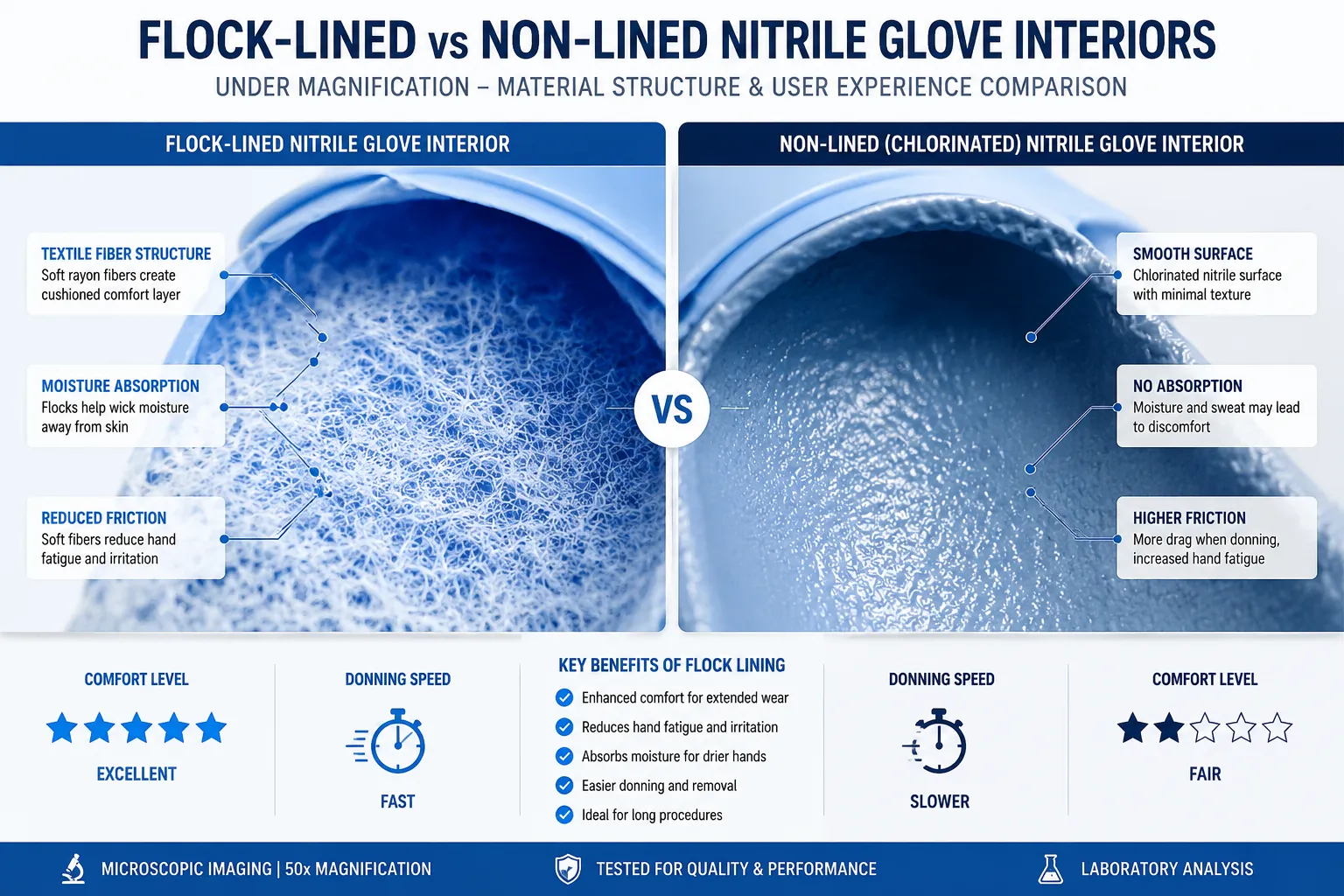
Flock lining improves comfort by reducing direct skin-to-nitrile contact, absorbing perspiration, and minimizing the clammy sensation that develops during extended wear. The textile fibers create a buffer layer that distributes pressure more evenly across the hand and prevents the glove from adhering to damp skin.
During the first 2-4 hours of wear, flock fibers absorb moisture from natural perspiration, keeping hands drier than they would be in chlorinated or polymer-coated gloves. This absorption capacity delays the onset of maceration (skin softening from prolonged moisture exposure) that commonly occurs during long shifts. The fibers also reduce friction between skin and glove material, which decreases irritation in the webbing between fingers and along the palm.
Comfort advantages during extended wear:
- Reduced hand fatigue reported by 60-70% of users in healthcare and food service settings
- Lower incidence of contact dermatitis compared to powder-free chlorinated alternatives
- Better temperature regulation as fibers provide slight insulation without trapping excessive heat
- Easier hand movement as the textile surface glides against skin rather than sticking
The comfort benefit becomes most noticeable after the third or fourth hour of continuous wear. Workers who previously needed to change gloves every 2-3 hours due to discomfort often extend wear time to 4-6 hours with flock-lined versions, assuming the gloves remain intact and uncontaminated.
Common mistake: Assuming flock lining eliminates all moisture issues. The fibers have finite absorption capacity and become saturated after several hours, at which point comfort degrades. Proper glove rotation remains necessary for optimal hand health.
Flock Lined vs Non-Flock Lined Nitrile Gloves Comparison
Flock-lined and non-flock lined nitrile gloves differ primarily in interior treatment, which affects donning ease, comfort, cost, and ideal use cases. Non-flock alternatives include chlorinated gloves (chemically treated for smoothness), polymer-coated gloves (thin coating for slip), and untreated gloves (often powdered).
| Feature | Flock-Lined Nitrile | Chlorinated Nitrile | Polymer-Coated Nitrile |
|---|---|---|---|
| Donning Speed | Fast, even with damp hands | Moderate, struggles when wet | Fast when dry, difficult when wet |
| Moisture Absorption | High (2-3x fiber weight) | None (smooth surface) | Minimal (thin coating) |
| Extended Wear Comfort | Excellent (4-8 hours) | Fair (2-4 hours) | Good (3-5 hours) |
| Cost Premium | 15-25% higher | Baseline | 5-10% higher |
| Tactile Sensitivity | Good (slight reduction) | Excellent | Excellent |
| Best For | Long shifts, high-volume donning | Precision tasks, short-term use | General purpose, moderate wear |
Choose flock-lined gloves if: You work 6+ hour shifts, change gloves 20+ times daily, have naturally sweaty hands, or experience hand fatigue with standard gloves.
Choose chlorinated gloves if: You need maximum tactile sensitivity for fine motor tasks, wear gloves for less than 2 hours at a time, or work in cool environments where moisture isn’t a concern.
Choose polymer-coated gloves if: You need a balance of donning ease and cost, work in moderate-duration tasks (2-4 hours), or require compatibility with specific chemicals that might degrade flock adhesives.
Do Flock Lined Gloves Put On Faster Than Regular Nitrile Gloves
Flock-lined gloves don significantly faster than chlorinated powder-free nitrile gloves, particularly when hands are slightly damp from washing or perspiration. The textile fibers reduce surface friction and prevent the glove interior from collapsing or sticking to itself during donning, which are common issues with smooth-interior gloves.
Time studies in healthcare settings show flock-lined gloves reduce average donning time from 8-12 seconds (chlorinated) to 5-7 seconds per glove. This 30-40% reduction becomes significant in high-volume environments where workers change gloves 50-100 times per shift. The speed advantage increases when hands aren’t completely dry, a common scenario after hand washing or during physically demanding work.
Factors affecting donning speed:
- Hand moisture level: Flock lining maintains consistent donning speed across moisture conditions
- Glove size accuracy: Properly sized flock-lined gloves slide on smoothly without bunching
- Cuff design: Beaded or rolled cuffs combined with flock lining provide the fastest donning
- User technique: The speed benefit requires minimal learning curve compared to other glove types
The donning speed advantage matters most in emergency medical situations, food service during rush periods, and manufacturing environments with frequent contamination risks requiring immediate glove changes. For workers who change gloves only 5-10 times per shift, the time savings may not justify the cost premium.
Edge case: Users with very dry skin or dermatological conditions may not experience the same donning speed improvement, as the flock fibers can catch on rough skin patches. In these cases, applying a small amount of approved hand lotion before gloving may help.
How Does Flock Lining Manage Sweat and Moisture in Gloves
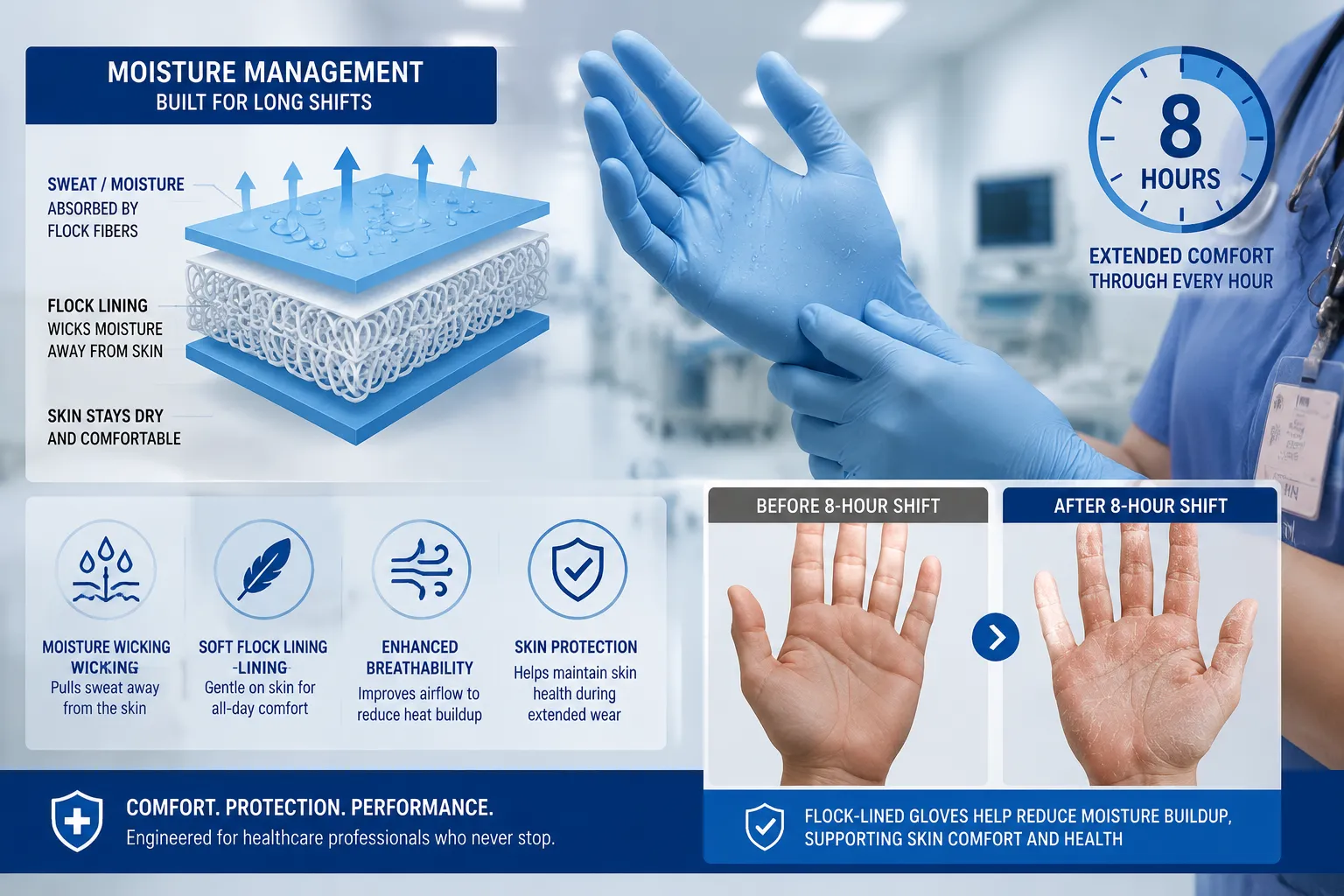
Flock lining manages moisture by absorbing perspiration into the textile fibers, which increases the surface area available for evaporation and reduces the liquid moisture layer between skin and glove. The fibers act like a thin towel, wicking sweat away from the skin surface and distributing it across a larger area within the glove interior.
During the first 2-3 hours of wear, the flock fibers absorb approximately 0.5-1.5 milliliters of perspiration per glove (depending on fiber density and length). This absorption keeps hands feeling drier and prevents the slippery sensation that occurs when sweat pools inside smooth-interior gloves. As the fibers approach saturation, moisture management effectiveness decreases, though the textile surface still provides better comfort than direct skin-to-nitrile contact.
Moisture management mechanisms:
- Capillary action draws sweat into fiber spaces away from skin
- Increased surface area allows some moisture to evaporate through the nitrile (which has limited breathability)
- Fiber structure prevents moisture from pooling in palm and fingertip areas
- Reduced direct contact minimizes the clammy sensation even when fibers are damp
The moisture management benefit works best for workers with normal to moderately sweaty hands. People with hyperhidrosis (excessive sweating) will still experience moisture buildup, though flock lining delays the onset and reduces discomfort compared to non-lined alternatives.
Important limitation: Flock lining doesn’t eliminate moisture or make gloves breathable. It manages perspiration more effectively than smooth interiors but can’t match the moisture control of reusable cotton-lined gloves. Workers in extremely hot environments or those with severe hyperhidrosis may need to change flock-lined gloves every 3-4 hours rather than the typical 6-8 hours.
For additional guidance on selecting gloves for specific work environments, see our guide to choosing exam gloves.
Are Flock Lined Nitrile Gloves Worth the Extra Cost
Flock-lined nitrile gloves justify their 15-25% cost premium for workers who wear gloves continuously for 4+ hours, change gloves frequently (20+ times per shift), or experience hand fatigue with standard gloves. The return on investment comes from reduced hand fatigue, fewer glove changes due to discomfort, and improved productivity during extended wear.
For a healthcare worker changing gloves 50 times during a 12-hour shift, the time savings of 3-5 seconds per donning adds up to 2.5-4 minutes per shift. Combined with reduced hand fatigue and the ability to extend wear time by 1-2 hours before discomfort sets in, the productivity gain typically exceeds the cost difference. Facilities report 10-15% reductions in glove consumption when workers switch from chlorinated to flock-lined gloves for extended procedures.
Cost-benefit analysis by use case:
- High value: Healthcare workers, dental professionals, food service staff working 8+ hour shifts, industrial workers in hot environments
- Moderate value: Laboratory technicians, cleaners, light manufacturing workers with 4-6 hour glove wear
- Low value: Short-term users (under 2 hours), precision tasks requiring maximum sensitivity, cool environments with minimal sweating
The cost premium becomes less significant when factoring in reduced hand care expenses (lotions, treatments for irritation) and decreased absenteeism from hand dermatitis. Facilities that switched to flock-lined gloves for extended-wear applications report 20-30% reductions in hand-related complaints and workers’ compensation claims.
Decision rule: If your glove budget per worker exceeds $50 monthly and workers report hand discomfort or fatigue, the flock-lined upgrade typically pays for itself within 2-3 months through improved comfort and reduced consumption.
Who Should Use Flock Lined Nitrile Gloves for Long Shifts
Healthcare professionals, food service workers, dental staff, and industrial technicians working 6+ hour shifts with continuous or frequent glove use benefit most from flock-lined nitrile gloves. These occupations combine extended wear duration with high donning frequency and physical hand activity that generates perspiration.
Ideal candidates for flock-lined gloves:
- Emergency medical technicians and paramedics who need rapid glove changes during patient care
- Surgical support staff wearing gloves for 4-8 hour procedures
- Food preparation workers in hot kitchens changing gloves 30-50 times per shift
- Dental hygienists and assistants performing extended procedures
- Janitorial staff using gloves continuously during cleaning shifts
- Manufacturing workers in electronics assembly or pharmaceutical production
- Tattoo artists working on large pieces requiring 4+ hours of continuous gloving
Workers with naturally sweaty hands, those who have experienced contact dermatitis from chlorinated gloves, and people who report hand fatigue after 2-3 hours of glove wear see the most dramatic improvement when switching to flock-lined versions.
Less suitable for flock-lined gloves:
- Laboratory technicians requiring maximum tactile sensitivity for pipetting or fine manipulation
- Workers in cool environments (below 65°F) where sweating is minimal
- Short-duration tasks (under 1 hour) where comfort isn’t a primary concern
- Applications involving oils or solvents that might degrade flock adhesives
For workers in food service environments, flock-lined gloves must meet the same food safety standards as other disposable gloves, which reputable manufacturers ensure through proper material selection and testing.
Can Flock Lining Cause Allergic Reactions or Skin Irritation
Flock lining itself rarely causes allergic reactions, as the textile fibers (rayon, nylon, or polyester) are generally hypoallergenic. However, the adhesives used to bond fibers to the nitrile surface can occasionally trigger contact dermatitis in sensitive individuals, and residual chemicals from the manufacturing process may cause irritation.
The most common irritants in flock-lined gloves are:
- Adhesive residues: Some manufacturers use formaldehyde-based or acrylic adhesives that can cause type IV delayed hypersensitivity reactions
- Chemical accelerators: Thiurams, carbamates, and mercaptobenzothiazole used in nitrile curing can remain in higher concentrations near the flock adhesive layer
- Fiber treatments: Flame retardants or antimicrobial treatments applied to textile fibers may cause reactions in sensitive users
True allergic reactions to flock lining are uncommon, affecting an estimated 1-3% of users compared to 5-8% who react to latex proteins or 2-4% who react to nitrile accelerators. Most reported “allergies” to flock-lined gloves are actually irritant contact dermatitis from prolonged moisture exposure or mechanical friction, not immune-mediated allergic responses.
Symptoms that suggest true allergic reaction:
- Redness and itching that appears 24-72 hours after glove use (delayed hypersensitivity)
- Reaction pattern that matches glove contact area precisely
- Symptoms that persist for days after discontinuing glove use
- Progression of symptoms with repeated exposure
Symptoms that suggest irritation rather than allergy:
- Immediate burning or stinging sensation during wear
- Symptoms that resolve within hours of removing gloves
- Improvement with proper hand washing and moisturizing
- Correlation with extended wear duration rather than specific glove brand
For workers concerned about potential reactions, choosing flock-lined gloves from manufacturers that use low-allergen adhesives and provide chemical composition documentation reduces risk. Patch testing can identify specific sensitivities before committing to large-scale adoption. More information about nitrile glove allergies can help workers distinguish between true allergic reactions and irritation.
Why Do My Flock Lined Gloves Still Feel Sweaty After Hours
Flock-lined gloves feel sweaty after several hours because the textile fibers have reached their moisture absorption capacity and can no longer wick additional perspiration away from skin. Once saturated, the fibers hold moisture against the hand rather than managing it, and the nitrile exterior prevents evaporation, creating a humid microenvironment inside the glove.
The typical absorption capacity of flock lining ranges from 0.5-1.5 milliliters per glove, which handles the first 2-4 hours of normal perspiration. After this point, additional sweat has nowhere to go and begins pooling between the saturated fibers and skin. The rate of saturation depends on ambient temperature, physical activity level, individual perspiration rate, and fiber density in the glove lining.
Factors that accelerate flock saturation:
- Ambient temperatures above 75°F increase perspiration rate by 50-100%
- Physically demanding work (lifting, repetitive motion) generates more hand sweat
- Occlusive outer garments (gowns, sleeves) trap heat and increase sweating
- Individual variation: some people produce 2-3 times more hand perspiration than average
Strategies to extend comfort duration:
- Rotate between two pairs of gloves every 2-3 hours, allowing the first pair to partially dry
- Use absorbent cotton glove liners under flock-lined nitrile gloves for extreme conditions (adds bulk but doubles moisture capacity)
- Apply antiperspirant hand lotion 30 minutes before gloving (check compatibility with your work requirements)
- Choose flock-lined gloves with higher fiber density (50,000+ fibers per square inch) for better absorption
- Take brief glove breaks every 2-3 hours when safety protocols allow, washing and drying hands thoroughly
Edge case: Workers with diagnosed hyperhidrosis may experience saturation within 1-2 hours regardless of flock quality. In these cases, medical treatment for excessive sweating (prescription antiperspirants, iontophoresis, or botulinum toxin injections) may be more effective than relying solely on glove technology.
No interior treatment can completely eliminate moisture buildup during extended wear because nitrile rubber is inherently non-breathable. Flock lining delays and reduces the problem but doesn’t solve it entirely for very long shifts or high-sweat individuals.
Best Flock Lined Nitrile Gloves for All Day Wear
The best flock-lined nitrile gloves for all-day wear combine high fiber density (40,000+ fibers per square inch), 4-6 mil thickness for durability, textured grip surfaces, and low-allergen adhesive systems. Top-performing gloves balance comfort with sufficient barrier protection and tactile sensitivity for professional tasks.
Key specifications for extended wear:
- Fiber density: 40,000-50,000 fibers per square inch provides optimal moisture absorption without excessive bulk
- Thickness: 4-6 mil offers durability for 6-8 hour wear while maintaining flexibility
- Cuff length: 9.5-12 inch extended cuffs prevent gaps when reaching or bending
- Grip texture: Micro-textured fingertips and palms maintain control when handling instruments or materials
- Certification: ASTM D6319 (medical examination gloves) or equivalent food service certifications
Features that distinguish premium flock-lined gloves:
- Beaded cuffs that resist tearing during donning and removal
- Ambidextrous design for faster donning and reduced inventory complexity
- Consistent sizing across batches (critical for proper fit and comfort)
- Low-allergen adhesive systems with minimal formaldehyde or sensitizing chemicals
- Chlorine-free manufacturing processes that reduce environmental impact
When selecting gloves for all-day wear, prioritize proper sizing over other features. Gloves that are too tight restrict circulation and increase hand fatigue, while oversized gloves bunch up and create friction points. Most manufacturers provide detailed sizing charts based on hand circumference and length measurements.
Application-specific considerations:
- Healthcare: Choose gloves meeting ASTM D6319 standards with AQL 1.5 or better for barrier protection
- Food service: Verify FDA compliance and select gloves with appropriate thickness for food handling tasks
- Industrial: Consider chemical resistance ratings if exposure to solvents or oils is possible
Testing multiple brands with small sample orders helps identify the best fit and comfort for your specific hand shape and work requirements. Worker feedback during trial periods provides more reliable guidance than manufacturer specifications alone.
Do Flock Lined Gloves Tear More Easily Than Unlined
Flock-lined gloves have comparable tear resistance to unlined nitrile gloves of the same thickness and formulation. The flock application process doesn’t significantly weaken the nitrile material, and the textile fibers add minimal bulk that could create stress points. Tear resistance depends primarily on nitrile thickness, polymer quality, and manufacturing consistency rather than interior treatment.
Standard testing under ASTM D6319 shows flock-lined and chlorinated gloves of identical thickness (4-6 mil) perform within 5-10% of each other for tensile strength and puncture resistance. The slight difference falls within normal manufacturing variation and isn’t clinically or practically significant for most applications.
Factors that actually affect tear resistance:
- Thickness: 6 mil gloves resist tears 40-50% better than 4 mil versions regardless of lining
- Nitrile formulation: Higher-grade polymers with better cross-linking provide superior strength
- Manufacturing quality: Consistent wall thickness and absence of thin spots matter more than interior treatment
- Storage conditions: UV exposure and heat degrade nitrile over time, affecting all glove types equally
Common misconception: The flock adhesive layer weakens the glove. In reality, the adhesive penetrates only 0.1-0.2 millimeters into the nitrile surface, leaving the bulk of the material unaffected. Properly manufactured flock-lined gloves meet the same ASTM standards for barrier protection as non-lined versions.
When flock-lined gloves may show reduced durability:
- Exposure to oils or organic solvents that dissolve flock adhesives (check chemical compatibility charts)
- Improper storage in hot, humid conditions that degrade adhesive bonds
- Manufacturing defects where flock application created thin spots or weak points
- Use beyond recommended shelf life (typically 3-5 years from manufacture date)
For applications involving oil exposure, verify that the flock adhesive system is compatible with the specific chemicals you’ll encounter. Some adhesives break down faster than the nitrile itself when exposed to petroleum products or industrial solvents.
How Long Can You Safely Wear Flock Lined Nitrile Gloves
Flock-lined nitrile gloves can be safely worn for 4-8 hours in most applications, provided they remain intact, uncontaminated, and the wearer’s hands stay healthy. The safe wear duration depends on the specific task, contamination risk, hand health, and whether the gloves maintain their barrier integrity throughout the shift.
Maximum recommended wear times by application:
- Healthcare (patient care): 2-4 hours or immediately after contamination, whichever comes first
- Surgical support: Single procedure duration (up to 8 hours) if gloves remain intact
- Food service: 2-4 hours or after handling raw proteins, changing tasks, or touching non-food surfaces
- Laboratory work: 4-6 hours for general tasks; change immediately after chemical exposure
- Industrial/manufacturing: 6-8 hours if gloves remain undamaged and hands stay comfortable
- Cleaning/janitorial: 4-6 hours or when switching between contaminated and clean areas
The flock lining itself doesn’t impose additional time limits beyond standard nitrile glove recommendations. However, moisture saturation after 4-6 hours can create conditions for bacterial growth and skin maceration, which are the primary health concerns with extended wear.
Signs you should change gloves immediately:
- Visible tears, punctures, or degradation of material
- Contamination with blood, bodily fluids, or hazardous chemicals
- Excessive moisture buildup causing skin wrinkling or discomfort
- Loss of tactile sensitivity or grip
- Transition between contaminated and clean tasks
- Any breach of sterile field in medical settings
Hand health considerations for extended wear:
- Remove gloves every 2-3 hours to wash and dry hands thoroughly when protocols allow
- Inspect hands for redness, irritation, or early signs of dermatitis
- Apply approved hand moisturizer during breaks to maintain skin barrier function
- Rotate between different glove brands if irritation develops with one type
Regulatory guidelines from OSHA, FDA, and CDC don’t specify maximum wear times for intact gloves in most settings, instead emphasizing task-appropriate changes and hand hygiene. Facility-specific protocols may impose stricter limits based on risk assessment and infection control requirements.
For proper disposal after extended wear, follow appropriate disposal procedures to minimize environmental impact.
Are Flock Lined Gloves Better for People with Sweaty Hands
Flock-lined gloves are significantly better for people with sweaty hands than chlorinated or polymer-coated alternatives because the textile fibers absorb and manage moisture more effectively. Workers with hyperhidrosis or naturally high perspiration rates report 50-70% improvement in comfort and 2-3 times longer wear duration before moisture becomes uncomfortable.
The moisture absorption capacity of flock lining (0.5-1.5 milliliters per glove) makes the biggest difference for people whose hands produce above-average perspiration. While this capacity eventually saturates, it provides several hours of improved comfort compared to smooth-interior gloves where sweat immediately creates a slippery, clammy sensation.
Benefits for sweaty hands:
- Delayed onset of the slippery sensation that makes grip difficult
- Reduced skin maceration (softening and wrinkling from moisture exposure)
- Better donning speed even when hands are damp from washing
- Lower friction and irritation as the textile surface glides rather than sticks to damp skin
Limitations for severe hyperhidrosis:
- Flock fibers saturate faster (within 1-2 hours) for people with excessive sweating
- No interior treatment can match the moisture control of breathable materials like cotton
- May still require glove changes every 2-3 hours in hot environments or during physical work
- Should be combined with medical treatment for hyperhidrosis for optimal results
Additional strategies for sweaty hands:
- Use prescription-strength antiperspirant hand lotions 30 minutes before gloving (check compatibility with your work requirements)
- Consider thin cotton glove liners under flock-lined nitrile for extreme cases (adds bulk but doubles absorption)
- Choose gloves with maximum fiber density (50,000+ fibers per square inch)
- Take brief glove breaks every 2 hours to wash, dry, and air hands when protocols allow
- Maintain cool ambient temperatures when possible to reduce overall perspiration
People with sweaty hands should also verify they’re using the correct glove size. Oversized gloves trap more air and moisture, while undersized gloves compress hands and increase sweating. Proper fit allows some air circulation and reduces moisture buildup.
What Are Alternatives to Flock Lining for Moisture Control in Gloves
Alternatives to flock lining for moisture control include polymer coatings, aloe vera or vitamin E treatments, cotton glove liners, reusable cotton-lined gloves, and antimicrobial interior treatments. Each option offers different trade-offs between moisture management, cost, tactile sensitivity, and convenience.
Polymer coatings: Thin hydrophilic polymer layers applied to the glove interior provide slip for easier donning but minimal moisture absorption. These coatings work well for short-term use (1-3 hours) and cost 5-10% more than chlorinated gloves. They’re suitable for workers who need better donning speed than chlorinated gloves but don’t require the moisture capacity of flock lining.
Aloe or vitamin E treatments: Some manufacturers infuse the glove interior with moisturizing agents that reduce friction and provide minor skin conditioning benefits. These treatments don’t absorb moisture but can reduce irritation from extended wear. They cost 8-15% more than standard gloves and work best for people with dry or sensitive skin rather than those with sweating issues.
Cotton glove liners: Thin cotton gloves worn under nitrile gloves provide excellent moisture absorption and can be washed and reused. This approach offers the best moisture control but adds bulk that reduces tactile sensitivity and may not be acceptable in sterile or food service environments. Liners cost $2-5 per pair and last 20-30 wash cycles.
Reusable cotton-lined gloves: Heavy-duty nitrile gloves with permanent cotton lining bonded to the interior provide superior moisture management and durability for industrial applications. These gloves cost $5-15 per pair but last 50-100 uses with proper care. They’re not suitable for medical or food service use due to cleaning and contamination concerns.
Antimicrobial treatments: Silver ion or other antimicrobial agents incorporated into the glove interior reduce bacterial growth in moist conditions but don’t absorb moisture. These treatments help prevent odor and reduce infection risk during extended wear but don’t improve comfort. They add 10-20% to glove cost.
Comparison of moisture control methods:
- Best absorption: Cotton liners, reusable cotton-lined gloves
- Best cost-effectiveness: Flock lining for disposable applications
- Best tactile sensitivity: Polymer coatings, aloe treatments
- Best for sterile applications: Flock lining, polymer coatings
- Best for extreme sweating: Cotton liners under flock-lined gloves
Decision framework:
- Choose flock lining if you need disposable gloves for 4-8 hour wear with good moisture control
- Choose polymer coatings if you need improved donning speed but wear gloves less than 3 hours
- Choose cotton liners if moisture control is critical and reduced sensitivity is acceptable
- Choose reusable cotton-lined gloves for industrial applications where washing between uses is practical
- Choose antimicrobial treatments if odor or bacterial growth is a concern during extended wear
For workers in healthcare settings requiring sterile gloves, flock lining and polymer coatings are the only practical alternatives, as cotton liners compromise sterility and reusable gloves can’t be adequately sterilized between patients.
Frequently Asked Questions
Can you wash and reuse flock-lined nitrile gloves?
No, flock-lined nitrile gloves are designed for single use and should not be washed or reused. Washing degrades the nitrile barrier, damages the flock adhesive, and can harbor bacteria in the textile fibers, compromising both protection and hygiene.
Do flock-lined gloves work with touchscreens?
Most flock-lined gloves do not work with capacitive touchscreens unless specifically manufactured with conductive materials in the fingertips. The textile fibers and nitrile rubber both insulate against the electrical conductivity required for touchscreen operation.
Are flock-lined gloves latex-free?
Yes, flock-lined nitrile gloves are latex-free and safe for people with latex allergies. The nitrile rubber and textile fibers contain no natural rubber latex proteins, making them suitable for latex-sensitive individuals and environments.
Can flock-lined gloves be used for sterile procedures?
Yes, flock-lined nitrile gloves are available in sterile versions that meet ASTM standards for surgical and medical procedures. The flock lining doesn’t interfere with sterilization processes or barrier protection when properly manufactured.
Do flock-lined gloves have an expiration date?
Yes, flock-lined gloves typically have a shelf life of 3-5 years from manufacture date when stored properly in cool, dry conditions away from direct sunlight. The nitrile material and flock adhesive both degrade over time, reducing barrier protection and comfort.
Why do some flock-lined gloves smell strange?
New flock-lined gloves may have a chemical odor from the adhesive or textile fiber treatments used during manufacturing. This smell typically dissipates after opening the package and usually doesn’t indicate a quality or safety issue unless accompanied by visible defects.
Can you use hand sanitizer with flock-lined gloves?
Repeated exposure to alcohol-based hand sanitizers degrades nitrile gloves and can dissolve flock adhesives, reducing barrier protection. If hand sanitizer contacts gloves, change them immediately rather than continuing to wear compromised protection.
Do flock-lined gloves come in different colors?
Yes, flock-lined nitrile gloves are available in various colors including blue, purple, black, and white. Color coding helps facilities designate gloves for specific tasks or departments, though it doesn’t affect performance or comfort.
Are flock-lined gloves more environmentally friendly?
Flock-lined gloves have similar environmental impact to other disposable nitrile gloves. The textile fibers add minimal material, and both the nitrile and flock components face the same disposal and recycling challenges as standard nitrile gloves.
Can flock-lined gloves cause fingernail damage?
Properly fitted flock-lined gloves don’t cause fingernail damage. However, gloves that are too tight can put pressure on nails during extended wear, and the textile fibers may catch on rough nail edges, causing discomfort or tearing.
Do flock-lined gloves protect against chemicals?
Flock-lined gloves provide the same chemical resistance as unlined nitrile gloves of equivalent thickness, but the flock adhesive may degrade faster than nitrile when exposed to certain solvents or oils. Check chemical compatibility charts for specific substances.
How do you know if flock-lined gloves fit properly?
Properly fitted flock-lined gloves should slide on easily without excessive pulling, fit snugly without restricting movement, and have no excess material bunching at the fingertips or palm. The cuff should extend at least 1-2 inches beyond the wrist.
Conclusion
Nitrile glove flock lining innovations represent a significant advancement in comfort, donning speed, and moisture management for workers requiring extended glove wear in 2026. The technology addresses fundamental challenges that healthcare professionals, food service workers, and industrial technicians face during long shifts by absorbing perspiration, reducing hand fatigue, and enabling faster glove changes.
The 15-25% cost premium for flock-lined gloves delivers measurable value for workers wearing gloves 4+ hours daily or changing gloves frequently throughout their shifts. The moisture absorption capacity of 0.5-1.5 milliliters per glove, combined with 30-40% faster donning times, translates to improved productivity and reduced hand-related complaints in high-volume environments.
Key implementation steps:
- Assess your current glove usage patterns, including wear duration, change frequency, and worker comfort complaints
- Calculate potential cost-benefit by comparing flock-lined glove prices against current consumption and hand care expenses
- Order sample sizes from 2-3 manufacturers to test fit, comfort, and performance in your specific work environment
- Conduct a 2-4 week trial period with worker feedback collection to measure comfort improvement and usage patterns
- Verify that selected gloves meet all regulatory requirements for your industry (ASTM, FDA, OSHA standards)
- Train workers on proper sizing, donning technique, and realistic expectations for moisture management duration
- Monitor glove consumption rates and worker satisfaction after implementation to validate cost-benefit projections
For workers with naturally sweaty hands or those experiencing hand fatigue with standard gloves, flock lining provides the most practical solution among disposable glove options. While the technology has limitations, fibers saturate after several hours and can’t match the breathability of reusable cotton-lined alternatives, it offers the best balance of protection, comfort, and convenience for extended-wear applications.
Organizations should prioritize proper glove sizing and worker education alongside flock-lined glove adoption. Even the best moisture management technology can’t compensate for poorly fitted gloves or inadequate hand hygiene practices. Combined with appropriate glove rotation schedules and hand care protocols, flock-lined nitrile gloves enable safer, more comfortable extended wear across diverse professional settings.
SEO Meta Title: Flock Lined Nitrile Gloves: Comfort & Moisture Control