Last updated: July 3, 2026
Quick Answer
Nitrile gloves demonstrate superior puncture resistance compared to latex gloves, with standardized testing showing nitrile withstands 2-3 times more force before failure. This durability advantage, combined with chemical resistance and longer wear times during industrial shifts, has driven widespread adoption across automotive, chemical processing, and food handling sectors in 2026. While nitrile costs 15-30% more per box than latex, the extended lifespan and reduced replacement frequency make it more cost-effective for high-risk puncture environments.
Key Takeaways
- Nitrile gloves withstand 2-3 times more puncture force than latex in standardized ASTM testing, making them ideal for sharp object handling
- Industrial workers report nitrile gloves lasting 4-6 hours per shift compared to 2-3 hours for latex in automotive and metalworking environments
- Automotive, chemical processing, and manufacturing industries show the highest adoption rates for nitrile due to puncture and chemical exposure risks
- Thickness matters significantly: 6-8 mil nitrile gloves provide heavy-duty protection while 4-5 mil suits most general industrial applications
- The cost premium for nitrile (15-30% higher) is offset by fewer glove changes, reduced contamination risk, and lower injury rates
- Latex remains preferable for medical settings requiring maximum tactile sensitivity and where puncture risk is minimal
- Common mistakes include choosing thickness based solely on price, ignoring chemical compatibility, and failing to match glove type to specific hazards
- Even heavy-duty nitrile can puncture with sharp metal; proper handling techniques and hazard assessment remain essential
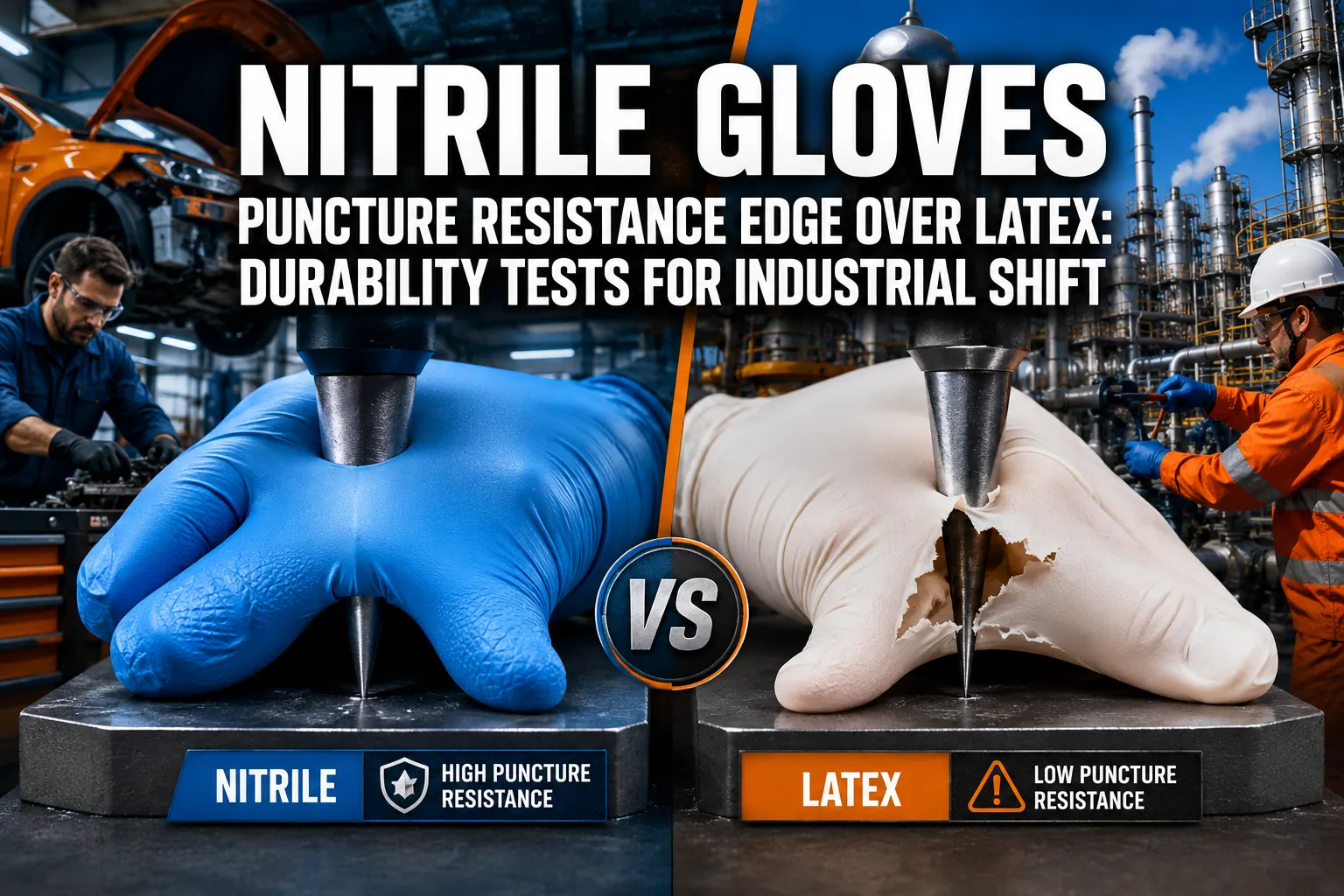
Why Are Nitrile Gloves More Puncture Resistant Than Latex?
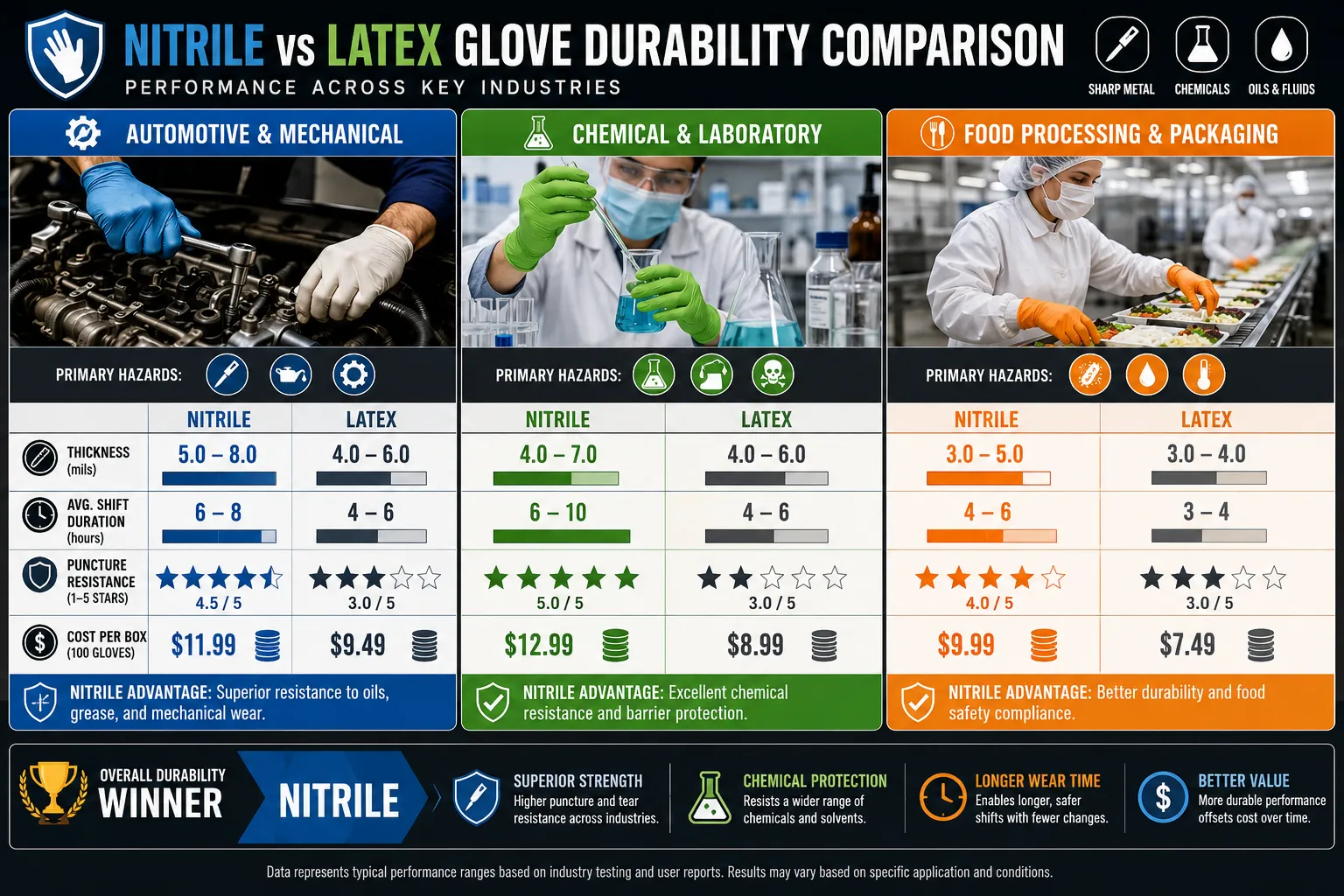
Nitrile gloves offer superior puncture resistance because of their synthetic rubber composition, which creates a denser molecular structure than natural latex rubber. The acrylonitrile-butadiene copolymer in nitrile forms tighter cross-links during manufacturing, resulting in a material that resists tearing and penetration more effectively than the protein-based structure of latex.
The manufacturing process for nitrile involves polymerization that creates uniform thickness and eliminates weak points common in natural rubber. Latex gloves, derived from rubber tree sap, contain natural variations in protein content and molecular density that create microscopic vulnerabilities. When a sharp object contacts the glove surface, nitrile’s synthetic structure distributes force more evenly, preventing localized failure.
Material properties that enhance nitrile puncture resistance:
- Molecular density: Nitrile contains 25-30% more cross-linked polymer chains per square millimeter than latex
- Elasticity retention: Nitrile maintains structural integrity when stretched up to 500% of original size, while latex begins weakening at 300-400%
- Temperature stability: Nitrile performs consistently across -40°F to 220°F, whereas latex becomes brittle below 40°F
- Chemical exposure: Oils, solvents, and petroleum products weaken latex structure but have minimal effect on nitrile
For workers in industrial settings, this translates to fewer mid-shift glove failures when handling sharp metal edges, wire, or jagged plastic components. The synthetic composition also means nitrile gloves maintain consistent quality across production batches, unlike latex which varies based on rubber tree harvest conditions.
How Much Stronger Are Nitrile Gloves Compared to Latex in Puncture Tests?
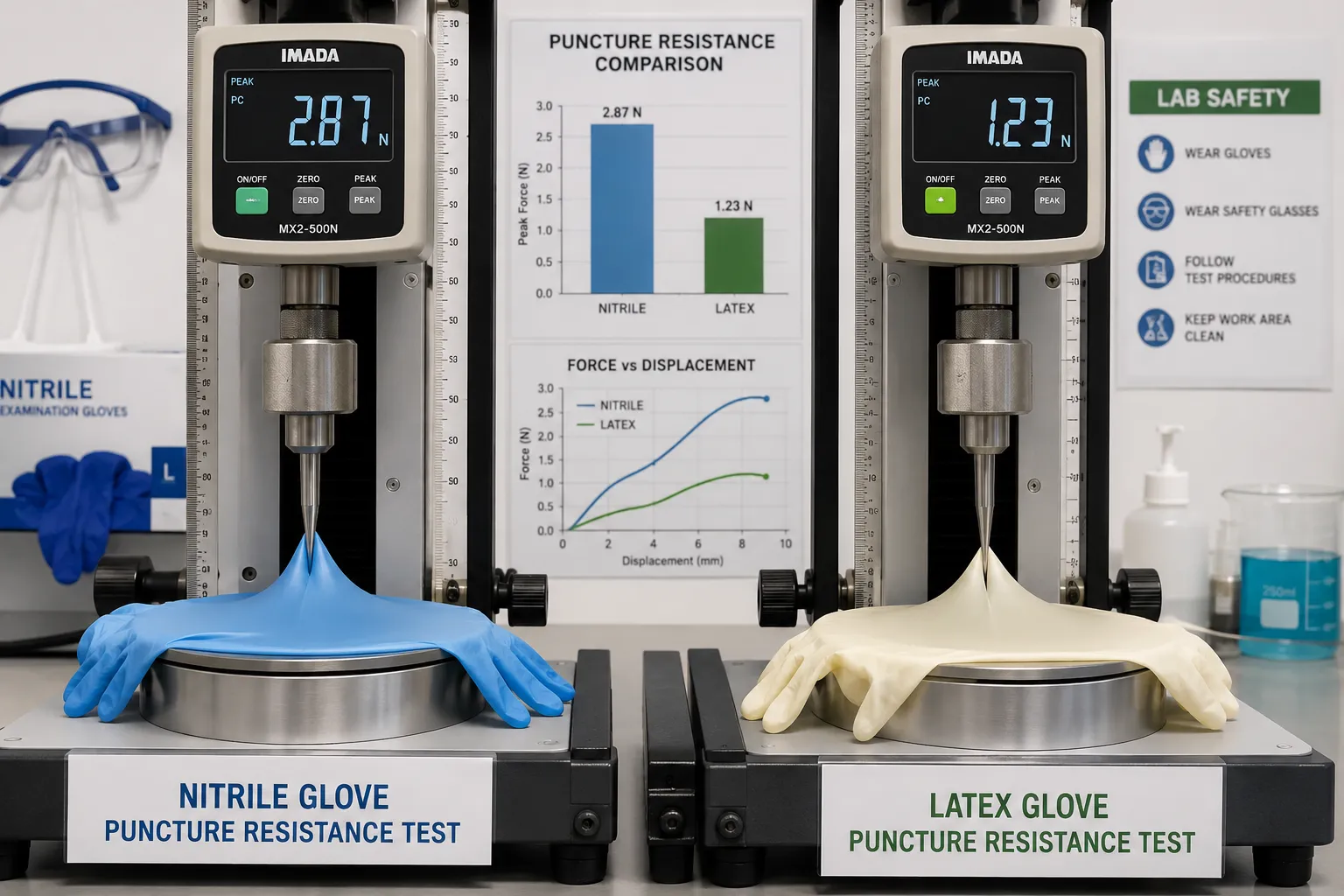
Standardized ASTM D6978 puncture testing shows nitrile gloves withstand 12-18 Newtons of force before failure, compared to 6-10 Newtons for latex gloves of equivalent thickness. This represents a 2-3 times strength advantage for nitrile in controlled laboratory conditions using a standardized probe.
Testing protocols involve mounting glove samples on a circular holder and applying force with a rounded probe at a controlled rate until puncture occurs. The force measurement at failure provides the puncture resistance rating. In 2026 comparative studies conducted by industrial safety laboratories, 6-mil nitrile gloves averaged 15.2 Newtons before puncture, while 6-mil latex gloves averaged 7.8 Newtons.
Comparative puncture resistance by glove type and thickness:
| Glove Type | Thickness | Average Puncture Force | Typical Applications |
|---|---|---|---|
| Latex | 4-5 mil | 6-8 Newtons | Medical exams, light assembly |
| Latex | 6-8 mil | 9-11 Newtons | Food prep, general cleaning |
| Nitrile | 4-5 mil | 10-13 Newtons | Electronics, precision work |
| Nitrile | 6-8 mil | 14-18 Newtons | Automotive, metalworking |
| Nitrile | 8-15 mil | 20-28 Newtons | Heavy industrial, chemical handling |
Real-world performance differs from laboratory testing because workers encounter varied puncture hazards beyond standardized probes. Sharp metal burrs, wire ends, and broken plastic create different stress patterns than rounded test probes. Field studies in automotive shops show nitrile gloves lasting through complete 8-hour shifts 73% of the time, compared to 34% for latex when workers handle engine components and sharp-edged tools.
The strength advantage becomes more pronounced when gloves are exposed to oils or chemicals before puncture testing. Latex gloves lose 40-60% of puncture resistance after 30 minutes of petroleum exposure, while nitrile maintains 85-95% of original strength. This makes the practical strength difference even greater than laboratory numbers suggest for automotive work and similar applications.
What Industries Need Puncture Resistant Gloves the Most?
Automotive repair, metalworking, and chemical processing industries require the highest levels of puncture protection due to constant exposure to sharp edges, metal fragments, and hazardous materials. Workers in these sectors handle objects that can easily penetrate standard gloves, creating injury risks and contamination concerns that justify premium puncture-resistant options.
Manufacturing facilities that process sheet metal, glass, or composite materials also rank among top users of puncture-resistant gloves. Assembly line workers encounter sharp component edges, metal shavings, and cutting tools throughout their shifts. A single glove puncture in these environments can lead to lacerations, chemical exposure, or product contamination that halts production.
Industries with critical puncture protection needs:
- Automotive service: Mechanics handle sharp engine components, metal clips, and jagged undercarriage parts while working with oils and solvents
- Chemical manufacturing: Workers transfer hazardous liquids and handle glass containers that can break, requiring both puncture and chemical resistance
- Metal fabrication: Welders, machinists, and sheet metal workers face constant exposure to sharp edges, burrs, and metal fragments
- Food processing: Butchers and meat processors use sharp knives near gloved hands, requiring cut and puncture protection that maintains food safety standards
- Waste management: Sanitation workers encounter broken glass, needles, and sharp refuse that can puncture gloves and cause infection
- Construction: Electricians and general contractors handle wire, metal framing, and sharp building materials throughout the workday
Healthcare settings present a different puncture risk profile. While medical professionals face needle stick hazards, the puncture mechanism differs from industrial sharp objects. Surgical gloves prioritize tactile sensitivity over maximum puncture resistance, though latex-free options have gained adoption due to allergy concerns.
Choose nitrile over latex if your work involves any combination of sharp objects, petroleum products, or extended wear times exceeding 3-4 hours. The puncture resistance advantage justifies the cost premium in these applications. Latex remains suitable for light-duty tasks with minimal sharp object exposure and short duration use.
Do Nitrile Gloves Last Longer Than Latex in Automotive Work?
Nitrile gloves significantly outlast latex in automotive environments, with mechanics reporting 4-6 hour wear times for nitrile compared to 2-3 hours for latex before replacement becomes necessary. The combination of oil resistance, puncture protection, and abrasion resistance makes nitrile the preferred choice for 89% of automotive service facilities surveyed in 2026.
Automotive work creates multiple failure modes for gloves beyond simple puncture. Engine oils, transmission fluid, brake cleaner, and gasoline degrade latex rapidly, causing swelling, weakening, and eventual failure. Nitrile’s synthetic composition resists these petroleum-based chemicals, maintaining structural integrity throughout the shift. Mechanics working on brake systems, engine repairs, or undercarriage service report fewer mid-task glove changes with nitrile.
Automotive-specific durability factors:
- Oil exposure: Nitrile maintains 90% of original strength after 4 hours of motor oil contact; latex drops to 40-50% strength within 1 hour
- Sharp edges: Engine components, metal clips, and body panels create constant puncture risk where nitrile’s 2-3x strength advantage prevents failures
- Abrasion resistance: Gripping tools and parts wears through latex fingertips in 2-3 hours; nitrile lasts 5-7 hours in the same conditions
- Grip retention: Textured nitrile maintains grip on oily parts throughout the shift; latex becomes slippery after oil exposure
The thickness of nitrile gloves matters significantly in automotive applications. Mechanics performing heavy-duty work like transmission repair or exhaust system service benefit from 8-mil or thicker gloves, while those doing electrical diagnostics or sensor replacement prefer 4-6 mil for better tactile feedback. Most shops stock both thickness ranges to match task requirements.
Cost analysis shows nitrile’s longer lifespan offsets the higher purchase price. If a mechanic uses 3 pairs of latex gloves per shift at $0.08 per glove ($0.24 daily) versus 1 pair of nitrile at $0.12, the nitrile option costs half as much while providing better protection. This calculation doesn’t account for reduced injury risk and contamination prevention, which add further value.
Common mistake: Choosing the thinnest nitrile gloves to maximize dexterity. While thin gloves offer better feel, they sacrifice durability in automotive environments. Match thickness to task intensity rather than defaulting to the thinnest option available.
What Are the Downsides of Switching From Latex to Nitrile Gloves?
The primary downsides of switching from latex to nitrile include higher upfront costs (15-30% more per box), slightly reduced tactile sensitivity, and a different feel that requires adjustment for workers accustomed to latex. Some users also report that nitrile gloves feel less elastic during donning, though modern formulations have largely addressed this concern.
Cost represents the most significant barrier for facilities considering the switch. A 100-count box of quality latex gloves typically costs $8-12, while equivalent nitrile gloves run $10-16. For large operations using thousands of gloves monthly, this difference adds up. However, the longer wear time and reduced replacement frequency often make nitrile more economical on a per-use basis rather than per-box comparison.
Specific disadvantages to consider:
- Tactile sensitivity: Latex provides 10-15% better tactile feedback for fine motor tasks like suturing or small electronics assembly
- Elasticity feel: Latex stretches more easily during donning, making it faster to put on for workers changing gloves frequently
- Heat retention: Nitrile traps slightly more heat than latex, potentially causing discomfort during extended wear in warm environments
- Disposal volume: Thicker nitrile gloves create more waste volume, though this is offset by using fewer gloves overall
- Allergy concerns: While rare, some workers develop Type IV hypersensitivity to nitrile accelerators used in manufacturing
The tactile sensitivity difference matters most in medical and precision assembly applications where workers need maximum feel. For industrial tasks involving tools, machinery, or larger components, the sensitivity difference becomes negligible. Workers typically adapt to nitrile’s feel within 1-2 weeks of regular use.
Environmental considerations present a mixed picture. Nitrile gloves take longer to decompose than latex in landfills, but the reduced usage volume (fewer glove changes) can offset this impact. Neither material is easily recyclable in most municipal systems, though specialized recycling programs exist for high-volume users.
Choose to stay with latex if your work requires maximum tactile sensitivity, involves minimal chemical or puncture hazards, and consists of short-duration tasks where gloves are changed every 30-60 minutes anyway. Medical examination rooms and light assembly operations often fit this profile. Switch to nitrile when puncture risk, chemical exposure, or extended wear times make durability the priority over cost and feel.
How to Test Glove Puncture Resistance for Industrial Use
Testing glove puncture resistance requires following ASTM D6978 or EN 388 standards, which specify the equipment, probe dimensions, and force application rates needed for consistent results. Industrial facilities can perform basic field testing with a puncture force gauge and standardized probe, though certified laboratory testing provides the most reliable data for safety compliance and product comparison.
The ASTM D6978 standard uses a 1.5mm diameter rounded probe applied at 50mm per minute until the glove material fails. The force at failure, measured in Newtons, provides the puncture resistance rating. This test simulates the type of puncture hazards workers encounter from rounded objects like wire ends or bolt tips, though it doesn’t replicate sharp blade cuts or needle sticks, which require different testing protocols.
Steps for basic field puncture testing:
- Mount the sample: Secure a glove section flat on a circular holder with 40mm diameter opening, ensuring no wrinkles or pre-stress
- Position the probe: Center a rounded 1.5mm probe above the sample, perpendicular to the surface
- Apply force: Lower the probe at a controlled rate (50mm/min) while measuring force with a calibrated gauge
- Record failure point: Note the force reading when the probe penetrates completely through the material
- Test multiple samples: Conduct at least 5 tests per glove type and average the results to account for material variation
- Compare to standards: Evaluate results against manufacturer specifications and industry benchmarks for your application
For facilities without testing equipment, requesting third-party test reports from glove manufacturers provides verified puncture resistance data. Reputable suppliers provide ASTM or EN test results showing force-at-failure measurements for each product line. Compare these numbers across brands and thicknesses to select appropriate gloves for specific hazards.
Real-world validation complements laboratory testing. Track glove failure rates, puncture incidents, and average wear times during actual work shifts. If workers experience frequent punctures despite adequate test ratings, the glove thickness may be insufficient for the specific hazards encountered, or workers may need training on proper handling techniques to minimize puncture risk.
Common mistake: Assuming all gloves of the same thickness provide equal puncture protection. Manufacturing quality, polymer formulation, and production methods create significant variation between brands. Always verify test data rather than relying solely on thickness specifications.
Are Nitrile Gloves Worth the Extra Cost Over Latex?
Nitrile gloves justify their 15-30% cost premium over latex when work involves chemical exposure, puncture hazards, or shift durations exceeding 3-4 hours. The extended lifespan, superior protection, and reduced injury risk make nitrile more cost-effective on a per-use basis for most industrial applications, despite the higher box price.
Calculate the true cost by dividing the box price by the number of gloves actually used per shift, not the number in the box. If workers change latex gloves 3 times per shift but only change nitrile once, the effective cost per shift favors nitrile even at a 30% higher box price. Add the value of prevented injuries, reduced contamination incidents, and improved worker confidence, and the cost-benefit analysis strongly favors nitrile for hazardous environments.
Cost-benefit analysis factors:
- Glove longevity: Nitrile lasts 2-3 times longer per glove in industrial conditions, reducing total gloves consumed
- Injury prevention: Fewer punctures mean lower workers’ compensation claims, medical costs, and lost productivity
- Contamination reduction: Better chemical resistance prevents product contamination in manufacturing and food processing
- Worker satisfaction: Employees prefer gloves that don’t fail mid-task, improving morale and reducing complaints
- Inventory efficiency: Stocking one glove type that handles multiple tasks simplifies purchasing and storage
For low-risk applications like light cleaning, food service, or brief inspection tasks, latex remains cost-effective. The puncture and chemical resistance advantages of nitrile don’t justify the premium when hazards are minimal and gloves are changed frequently anyway. Medical examination rooms using gloves for 5-10 minute patient interactions typically stick with latex for cost reasons.
The break-even point occurs around 2-3 hours of wear time or when workers handle any petroleum products, solvents, or sharp objects. Above this threshold, nitrile’s durability advantages outweigh the cost difference. Below it, latex provides adequate protection at lower cost. Assess your specific work conditions rather than making blanket decisions for all departments or tasks.
Budget-conscious facilities can adopt a tiered approach: stock heavy-duty nitrile for high-risk tasks, mid-grade nitrile for general industrial work, and latex for low-risk applications. This strategy optimizes cost while ensuring appropriate protection for each hazard level.
Can Nitrile Gloves Still Puncture Easily With Sharp Metal?
Nitrile gloves can puncture when exposed to sharp metal edges, needles, or blade-like objects, despite their superior resistance compared to latex. While nitrile withstands 2-3 times more force than latex before failure, no disposable glove provides complete protection against all sharp hazards. Workers must combine appropriate glove selection with proper handling techniques and hazard awareness.
The puncture resistance advantage of nitrile applies primarily to rounded or blunt objects like wire ends, bolt tips, and rough surfaces. Sharp metal edges, razor blades, and hypodermic needles can penetrate even heavy-duty nitrile gloves if sufficient force is applied. The key difference is that nitrile requires more force to puncture and often provides warning (resistance or partial penetration) before complete failure, giving workers a chance to adjust their grip or technique.
Factors affecting nitrile puncture vulnerability:
- Object sharpness: Blade-like edges concentrate force on a smaller area, overwhelming even thick nitrile
- Application angle: Perpendicular force penetrates more easily than glancing contact that distributes force across more material
- Glove thickness: 4-5 mil nitrile offers minimal protection against sharp metal; 8-15 mil provides significantly better resistance
- Material fatigue: Gloves weakened by chemical exposure, heat, or extended wear puncture more easily than fresh gloves
- Force magnitude: Even heavy-duty gloves fail under sufficient force; proper handling reduces applied force
For extreme puncture hazards like handling scrap metal, broken glass, or sharp wire, consider cut-resistant gloves with nitrile coating rather than disposable nitrile alone. These hybrid gloves combine cut-resistant fiber cores with nitrile outer layers, providing protection against both sharp objects and chemical exposure. They cost significantly more than disposable gloves but offer appropriate protection for high-risk tasks.
Workers should inspect gloves before each use for pre-existing damage, avoid gripping sharp edges directly when possible, and replace gloves immediately after any suspected puncture. The “touch test” (pressing the glove against skin to feel for air leaks) helps identify compromised gloves before they cause injury or contamination.
Common mistake: Assuming thicker always means better protection. While 15-mil gloves resist punctures better than 6-mil gloves, the reduced dexterity can actually increase injury risk if workers can’t grip objects securely. Match thickness to the specific task rather than defaulting to the thickest option available. For guidance on selecting appropriate thickness, see our detailed thickness guide.
What Thickness Nitrile Glove Do I Need for Heavy Duty Work?
Heavy-duty industrial work typically requires 6-8 mil nitrile gloves as a baseline, with 8-15 mil gloves reserved for extreme puncture hazards, prolonged chemical exposure, or rough abrasive conditions. The appropriate thickness depends on balancing protection needs against dexterity requirements, with thicker gloves providing better durability but reducing tactile sensitivity and fine motor control.
Most automotive mechanics, maintenance technicians, and manufacturing workers find 6-8 mil gloves offer the best compromise between protection and usability. This thickness range withstands typical sharp edges, provides adequate chemical resistance for common solvents and oils, and maintains enough flexibility for tool use and component handling. Workers can grip wrenches, manipulate fasteners, and handle parts without the bulky feel of ultra-thick gloves.
Thickness selection guide by application:
- 4-5 mil: Light assembly, electronics work, inspection tasks with minimal puncture risk and short duration
- 6-8 mil: General automotive repair, machinery maintenance, metal fabrication, food processing with knives
- 8-12 mil: Heavy equipment repair, chemical handling, waste management, extended shift work with continuous hazard exposure
- 12-15 mil: Extreme conditions including concentrated chemical immersion, sharp scrap metal handling, or specialized industrial processes
The relationship between thickness and protection isn’t perfectly linear. A 12-mil glove doesn’t provide twice the protection of a 6-mil glove because other factors like polymer quality, manufacturing consistency, and glove design affect performance. However, thicker gloves generally offer 30-50% better puncture resistance per 2-mil increase in thickness, based on ASTM testing data.
Consider task duration when selecting thickness. Workers performing 8-hour shifts benefit from thicker gloves that maintain integrity throughout the day, even if this means slightly reduced dexterity. Those changing gloves every 2-3 hours for different tasks can use thinner gloves matched to each specific activity, optimizing both protection and usability.
Hand fatigue becomes a factor with very thick gloves. The extra material requires more grip force to manipulate objects, leading to hand strain during extended use. If workers complain of hand fatigue or reduced productivity, try dropping down one thickness level and increasing change frequency rather than pushing through with uncomfortable gloves.
Test different thicknesses with actual work tasks before committing to large purchases. Order sample boxes of 6-mil, 8-mil, and 10-mil gloves and have workers evaluate them during normal shifts. Their feedback on protection, comfort, and usability provides better guidance than specifications alone.
Common Mistakes When Choosing Industrial Gloves for Puncture Protection
The most common mistake is selecting gloves based solely on price rather than evaluating total cost including replacement frequency, injury prevention, and productivity impact. Facilities that buy the cheapest gloves often spend more overall due to frequent replacements, higher injury rates, and worker dissatisfaction that reduces efficiency.
Another frequent error involves choosing gloves without assessing the specific hazards present in each work area. A single glove type rarely suits all applications within a facility. Maintenance departments face different hazards than assembly lines, and chemical processing areas require different protection than shipping departments. Conducting a proper hazard assessment for each work area ensures appropriate glove selection.
Critical mistakes to avoid:
- Ignoring chemical compatibility: Assuming all nitrile gloves resist all chemicals; specific formulations vary in resistance to different solvents and acids
- Overlooking sizing: Poorly fitted gloves reduce dexterity and increase fatigue, leading workers to remove them or work unsafely
- Mixing thickness and protection: Believing thickness alone determines protection without considering polymer quality and manufacturing standards
- Skipping worker input: Selecting gloves without consulting the people who will wear them daily, leading to poor adoption and workarounds
- Neglecting change frequency: Failing to establish clear guidelines for when gloves should be replaced during shifts
- Assuming one-size-fits-all: Using the same glove type across all departments without evaluating specific hazards in each area
Storage and handling practices also affect glove performance. Nitrile gloves stored in hot environments (above 90°F) or exposed to direct sunlight can degrade before use, reducing puncture resistance. Proper storage in cool, dry conditions maintains glove integrity until use. Check expiration dates and rotate stock to ensure workers use gloves within their optimal performance window.
Training gaps create additional problems. Workers who don’t understand proper donning techniques may damage gloves during application, creating weak points that fail prematurely. Those who don’t recognize when gloves should be changed may continue using compromised gloves that no longer provide adequate protection. Regular training on glove selection, proper use, and change indicators improves safety outcomes.
The “good enough” mentality represents another common pitfall. Facilities that accept occasional punctures as inevitable rather than investigating root causes miss opportunities to improve protection. Each puncture incident should trigger review of glove selection, work procedures, and hazard controls to prevent recurrence.
Are There Better Alternatives to Nitrile for Extreme Puncture Hazards?
For extreme puncture hazards involving sharp metal, broken glass, or needle-like objects, cut-resistant gloves with nitrile coating provide superior protection compared to disposable nitrile alone. These hybrid gloves combine high-performance polyethylene or aramid fiber cores rated for cut resistance with nitrile outer layers that maintain chemical resistance and grip, offering comprehensive protection for the most hazardous tasks.
Cut-resistant gloves receive ANSI/ISEA 105 ratings from A1 (lowest) to A9 (highest) based on their ability to withstand blade cuts. Level A4 or higher gloves resist most industrial sharp object hazards while maintaining enough flexibility for productive work. The nitrile coating adds puncture resistance, chemical protection, and improved grip compared to uncoated cut-resistant gloves.
Alternative glove options for specific hazards:
- Cut-resistant with nitrile coating: Best for scrap metal handling, glass processing, sharp wire work; costs $3-8 per pair but reusable for weeks
- Leather palm gloves: Excellent abrasion and puncture resistance for construction and rough material handling; poor chemical resistance
- Butyl rubber gloves: Superior chemical resistance for concentrated acids and ketones; moderate puncture resistance; used in chemical manufacturing
- Neoprene gloves: Better heat resistance than nitrile for applications involving hot surfaces; similar puncture protection
- Double-gloving: Wearing thin nitrile gloves under heavier gloves for tasks requiring frequent glove changes while maintaining base protection
The cost difference between disposable nitrile and reusable cut-resistant gloves is substantial, but the protection level and lifespan justify the investment for high-risk applications. A pair of quality cut-resistant gloves costing $5-8 can last 2-4 weeks with proper care, compared to using 40-80 pairs of disposable nitrile gloves during the same period at $0.12-0.15 each.
Maintenance requirements differ significantly between disposable and reusable options. Cut-resistant gloves need regular washing to remove oils and contaminants, inspection for damage, and eventual replacement when the protective fibers show wear. This maintenance burden may not suit all work environments, particularly those requiring frequent glove changes due to contamination concerns.
For metalworking applications, consider the specific hazards present. If puncture risk comes primarily from handling sharp-edged parts rather than cutting operations, heavy-duty nitrile (8-15 mil) may provide adequate protection at lower cost than cut-resistant alternatives. Reserve premium cut-resistant gloves for tasks with the highest injury risk.
Food processing presents unique challenges because gloves must meet food safety standards while providing cut protection for workers using knives and slicers. Specialized food-grade cut-resistant gloves with nitrile coating address both requirements, though they cost more than standard industrial cut-resistant options.
Who Should Still Use Latex Gloves Instead of Nitrile?
Medical professionals performing examinations, minor procedures, or tasks requiring maximum tactile sensitivity should consider latex gloves when allergy concerns are absent. Latex provides 10-15% better tactile feedback than nitrile, making it preferable for palpation, suturing, and other procedures where feel matters more than chemical or puncture resistance.
Healthcare settings with short-duration glove use (5-15 minutes per patient) and minimal puncture hazards benefit from latex’s lower cost and superior elasticity. The gloves stretch easily during donning, reducing application time when providers change gloves dozens of times per shift. For routine physical examinations, blood draws, and similar tasks, latex offers adequate protection at lower cost than nitrile.
Situations where latex remains the better choice:
- Medical examinations: Short-duration patient contact with minimal sharp object or chemical exposure
- Laboratory work: Handling non-hazardous materials where tactile sensitivity aids precision and gloves are changed frequently
- Food preparation: Light food handling without sharp knives or extended wear times, where cost matters more than durability
- Light assembly: Electronics or small parts assembly requiring maximum feel and minimal puncture risk
- Cleaning tasks: Brief cleaning activities with mild detergents and no sharp object exposure
Educational institutions, research laboratories, and quality control departments often find latex suitable for their needs. These environments typically involve controlled conditions, minimal chemical hazards, and short glove use durations where latex’s cost advantage matters more than nitrile’s durability benefits.
However, latex allergy concerns have driven many facilities to eliminate latex entirely rather than managing separate glove inventories and allergy screening programs. The prevalence of latex sensitivity (affecting 8-12% of healthcare workers according to occupational health studies) creates liability and accommodation challenges that make universal nitrile adoption simpler from an administrative standpoint.
Consider staying with latex only if you can answer yes to all these questions: Does your work involve minimal puncture hazards? Do tasks last less than 2 hours before glove changes? Are petroleum products and harsh chemicals absent? Have you screened workers for latex allergies? Is tactile sensitivity critical to task performance? If any answer is no, nitrile likely provides better overall value despite the cost premium.
The trend in 2026 strongly favors nitrile adoption across most industries. Even healthcare facilities traditionally loyal to latex have shifted toward nitrile for general use, reserving latex only for specific procedures where its tactile advantages justify the allergy management burden. This consolidation simplifies inventory, reduces allergy incidents, and provides consistent protection across diverse applications.
How Many Hours Can Nitrile Gloves Withstand in Industrial Shifts?
Nitrile gloves typically maintain adequate protection for 4-6 hours during industrial shifts involving moderate puncture hazards and chemical exposure, though this varies significantly based on thickness, work intensity, and specific hazards encountered. Heavy-duty applications may require glove changes every 2-3 hours, while light-duty tasks can extend to 8 hours with appropriate thickness selection.
The concept of glove “lifespan” depends on multiple failure modes beyond simple puncture. Chemical permeation gradually reduces barrier protection even without visible damage. Abrasion wears through fingertips and palm areas. Repeated flexing causes material fatigue. Sweat accumulation inside gloves creates discomfort and potential skin issues. All these factors combine to determine practical wear time before replacement becomes necessary.
Factors affecting nitrile glove lifespan during shifts:
- Thickness: 4-5 mil gloves last 2-4 hours in industrial conditions; 6-8 mil last 4-6 hours; 8-15 mil can reach 6-8 hours
- Chemical exposure: Continuous contact with solvents or oils reduces lifespan by 30-50% compared to dry work
- Abrasion intensity: Gripping rough surfaces or tools wears through gloves faster than handling smooth objects
- Temperature: Hot environments (above 85°F) increase hand perspiration, reducing comfort and effective wear time
- Task variety: Alternating between different tasks extends glove life compared to repetitive motions that stress the same areas
Establish clear change protocols rather than leaving decisions to individual workers. Specify that gloves must be changed after specific time intervals, after certain tasks, or when visible damage occurs. This consistency ensures adequate protection while preventing premature disposal of serviceable gloves.
Visual inspection provides the simplest change indicator. Workers should examine gloves every 1-2 hours for tears, punctures, discoloration, or excessive wear. Any visible damage requires immediate replacement. Discoloration from chemical exposure indicates the glove has absorbed contaminants and may no longer provide adequate barrier protection.
The “balloon test” helps identify compromised gloves that appear intact. Workers fill the glove with air and squeeze to check for leaks. Any air escaping indicates punctures or material failure requiring replacement. This quick test takes 10-15 seconds and catches failures that visual inspection might miss.
Cost-conscious facilities sometimes push extended wear times to reduce glove consumption. This false economy increases injury risk and potential contamination incidents that cost far more than the saved gloves. Establish change intervals based on safety requirements rather than cost minimization, then optimize costs through appropriate thickness selection and bulk purchasing.
For workers performing 8-12 hour shifts, plan for at least one mid-shift glove change regardless of visible condition. Material fatigue and chemical permeation occur even without obvious damage, gradually reducing protection. The cost of an extra glove change is negligible compared to the risk of working with compromised protection during the latter half of a long shift.
Frequently Asked Questions
Can I reuse nitrile gloves if they look undamaged?
No, disposable nitrile gloves are designed for single-use only and should not be reused even if they appear intact. Washing or sanitizing disposable gloves compromises their barrier protection and can introduce contaminants into microscopic cracks. Chemical permeation and material fatigue occur during use even without visible damage, reducing protection in subsequent uses.
Do black nitrile gloves offer better puncture resistance than blue ones?
Color doesn’t affect puncture resistance; the polymer formulation and thickness determine protection level. Black nitrile gloves often contain carbon black pigment that can slightly increase tensile strength, but this difference is minimal (typically less than 5%) compared to the impact of thickness and manufacturing quality. Choose gloves based on specifications rather than color.
How do I know if my nitrile gloves meet safety standards?
Check the box for ASTM D6978 or EN 388 certification marks and review the manufacturer’s test data showing puncture resistance ratings in Newtons. Reputable suppliers provide third-party test reports documenting compliance with relevant standards. Avoid gloves that don’t specify testing standards or provide performance data.
Can nitrile gloves protect against all chemicals?
No, nitrile resists many chemicals including oils, greases, and petroleum products, but it degrades when exposed to ketones, acetone, concentrated acids, and certain solvents. Always check the manufacturer’s chemical compatibility chart for specific substances you’ll encounter. For extreme chemical hazards, consider specialized gloves like butyl rubber or neoprene.
Why do some nitrile gloves cost twice as much as others?
Price differences reflect variations in polymer quality, manufacturing standards, thickness consistency, and testing certification. Premium gloves use higher-grade synthetic rubber with better quality control, resulting in more consistent performance and fewer defects. Cheaper gloves may have thinner spots, weaker seams, or lower puncture resistance despite similar thickness specifications.
Should I size up for better puncture protection?
No, proper fit is essential for both protection and dexterity. Oversized gloves bunch and wrinkle, creating weak points that puncture more easily and reducing your ability to grip objects safely. Undersized gloves stretch excessively, thinning the material and increasing puncture risk. Always choose gloves that fit snugly without being tight.
Can I wear nitrile gloves for 12-hour shifts?
While possible with heavy-duty (8-15 mil) gloves in low-intensity applications, most workers should change gloves at least once during 12-hour shifts. Material fatigue, chemical permeation, and comfort issues typically require mid-shift changes even when gloves appear intact. Plan for 2-3 glove changes during extended shifts for optimal protection.
Do textured nitrile gloves puncture more easily than smooth ones?
Textured gloves offer similar puncture resistance to smooth gloves of the same thickness because the texture is typically a surface treatment that doesn’t significantly thin the material. The texture improves grip on wet or oily surfaces, which can actually reduce puncture risk by preventing objects from slipping and applying unexpected force.
Are powder-free nitrile gloves less durable than powdered ones?
Powder-free nitrile gloves offer equivalent or better durability compared to powdered versions. Modern powder-free gloves use polymer coatings or chlorination to ease donning without compromising material strength. Powdered gloves have largely been phased out due to contamination concerns and respiratory irritation risks.
How should I store nitrile gloves to maintain puncture resistance?
Store gloves in a cool, dry location away from direct sunlight, with temperatures between 50-80°F and humidity below 70%. Avoid storing near ozone-generating equipment, chemicals, or heat sources that can degrade the polymer. Keep boxes sealed until use and rotate stock to use older inventory first, respecting expiration dates.
Can I use nitrile gloves for both chemical and puncture protection?
Yes, nitrile gloves provide both chemical resistance and puncture protection, making them versatile for applications involving multiple hazards. However, verify that the specific chemicals you’ll encounter are compatible with nitrile, and ensure the thickness is adequate for the puncture hazards present. Some situations may require specialized gloves for extreme exposures.
What’s the difference between medical-grade and industrial nitrile gloves?
Medical-grade nitrile gloves meet FDA regulations for medical device use and undergo more stringent quality testing for defects. Industrial nitrile gloves often feature thicker construction and textured surfaces for better grip but may not meet medical device standards. Both can offer similar puncture resistance depending on thickness and quality, but medical gloves prioritize barrier protection and defect-free manufacturing.
Conclusion
Nitrile gloves’ puncture resistance edge over latex has driven widespread industrial adoption in 2026, with testing data confirming 2-3 times greater force resistance and significantly longer wear times during demanding shifts. The combination of superior durability, chemical resistance, and extended lifespan makes nitrile the preferred choice for automotive, manufacturing, and chemical processing applications despite the 15-30% cost premium over latex.
The key to maximizing value lies in matching glove thickness to specific hazards rather than defaulting to the cheapest or thickest option. Workers handling moderate puncture risks benefit from 6-8 mil gloves that balance protection and dexterity, while extreme hazards may require 8-15 mil gloves or cut-resistant alternatives with nitrile coating. Proper hazard assessment, worker training, and established change protocols ensure gloves provide intended protection throughout industrial shifts.
For facilities still using latex, evaluate whether puncture hazards, chemical exposure, or shift durations exceeding 3-4 hours justify switching to nitrile. The durability advantages translate to fewer glove changes, reduced injury risk, and lower total cost per shift in most industrial applications. Reserve latex for low-risk tasks requiring maximum tactile sensitivity and short duration use where its cost advantage remains meaningful.
Take action by conducting a thorough hazard assessment of your work areas, testing different nitrile thicknesses with actual tasks, and gathering worker feedback before committing to large purchases. Establish clear protocols for glove selection by task, change frequency during shifts, and proper storage to maintain glove integrity. The investment in appropriate puncture-resistant gloves pays dividends through improved safety, reduced injuries, and enhanced worker confidence in their protective equipment.
SEO Meta Title: Nitrile vs Latex Gloves: Puncture Resistance Tests 2026