Last updated: July 2, 2026
Quick Answer
Winter-ready nitrile gloves designed for cold chain logistics combine a chemical-resistant nitrile outer shell with internal insulation layers (typically acrylic, fleece, or foam) to maintain hand warmth and dexterity in freezer environments ranging from -10°F to -40°F. These gloves preserve the puncture resistance and food-safe properties of standard nitrile while adding thermal protection that prevents the material from becoming brittle and cracking at sub-zero temperatures. For pharmaceutical and food logistics workers handling products in cold storage facilities, insulated nitrile gloves rated to the specific operating temperature of their environment provide the necessary balance of thermal protection, tactile sensitivity, and contamination control.
Key Takeaways
- Winter-ready nitrile gloves feature internal insulation layers (acrylic, fleece, or foam) that maintain flexibility and warmth in temperatures as low as -40°F, unlike standard nitrile gloves that become rigid below 32°F
- Insulated nitrile gloves retain approximately 70-85% of the dexterity of unlined versions, making them suitable for tasks requiring moderate precision like scanning barcodes and handling packaged goods
- Temperature ratings are critical: gloves should be rated at least 10°F below your coldest working temperature to account for wind chill and extended exposure periods
- Standard nitrile gloves begin losing flexibility around 40°F and can crack or tear below 20°F due to polymer chain stiffening
- Food-grade insulated nitrile gloves meeting FDA 21 CFR 177.1520 standards are available for direct food contact in cold storage applications
- Bulk pricing for cold chain logistics typically ranges from $1.50-$4.00 per pair depending on insulation type, with acrylic-lined options being most cost-effective
- Common mistakes include choosing gloves rated only to 0°F for -20°F freezers, selecting overly thick insulation that reduces grip, and failing to account for moisture accumulation inside gloves during long shifts
What Are Winter-Ready Nitrile Gloves and How Do They Differ from Regular Nitrile Gloves
Winter-ready nitrile gloves are specialized hand protection designed with internal thermal insulation layers bonded to or integrated with a nitrile rubber outer shell, specifically engineered to maintain flexibility and protection in sub-freezing temperatures. Standard nitrile gloves consist only of a thin nitrile polymer layer (typically 3-8 mil thick) that provides chemical resistance and tactile sensitivity but offers minimal thermal insulation.
The key structural differences include:
- Insulation integration: Winter versions incorporate acrylic knit liners, brushed fleece, closed-cell foam, or synthetic fiber batting between the nitrile shell and the interior surface
- Polymer formulation: Cold-weather nitrile uses plasticizers and polymer blends that remain pliable at lower temperatures compared to standard formulations
- Thickness profile: Insulated versions typically measure 12-25 mil total thickness versus 3-8 mil for standard disposable nitrile
- Cuff length: Extended cuffs (12-18 inches) are common in winter versions to prevent cold air entry and protect forearms
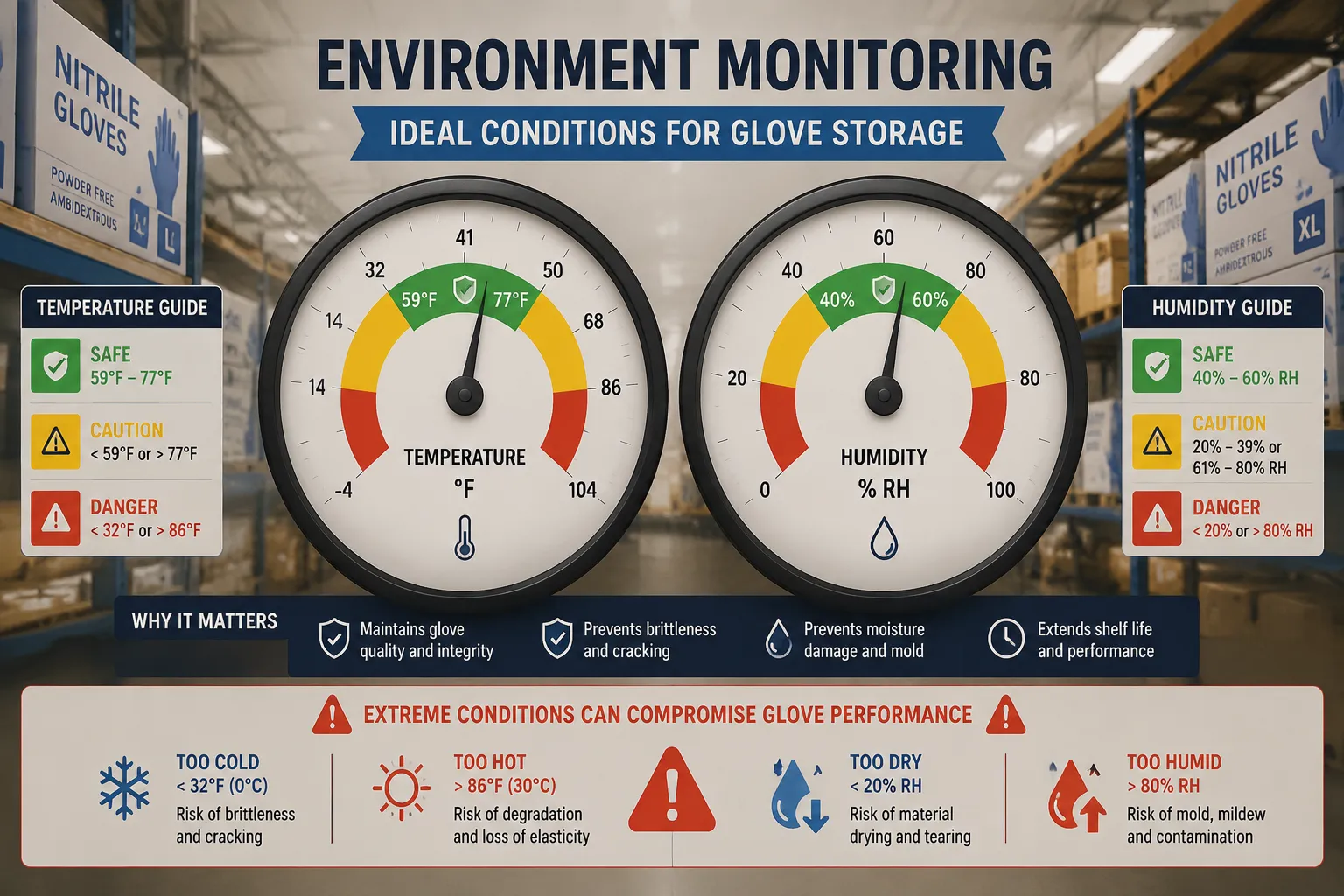
Standard nitrile gloves work well in ambient or slightly cool conditions (50°F and above) but lose their protective qualities in cold storage environments. The nitrile polymer chains stiffen as temperatures drop, reducing elasticity and increasing brittleness. Winter-ready versions address this limitation through both material science and insulation design.
For workers in pharmaceutical cold chains handling temperature-sensitive biologics or food logistics personnel managing frozen goods, this distinction matters significantly. A standard nitrile glove that tears in a -20°F freezer compromises both hand safety and product integrity.
How Do Insulation Layers Work in Cold Weather Nitrile Gloves
Insulation layers in cold weather nitrile gloves function by trapping air pockets that create a thermal barrier between the cold external environment and the skin, while the nitrile outer shell maintains chemical and puncture resistance. The most effective designs use materials with high loft (thickness relative to weight) that resist compression during gripping tasks.
Common insulation materials and their properties:
- Acrylic knit liners: Provide moderate warmth (effective to approximately -10°F), excellent moisture wicking, and maintain good dexterity. Most cost-effective option for bulk purchasing
- Brushed fleece: Offers superior warmth (effective to -25°F), soft comfort, but can compress over time reducing insulation value
- Closed-cell foam: Delivers maximum thermal protection (effective to -40°F), waterproof barrier, but reduces tactile sensitivity by 30-40%
- Thinsulate or synthetic fiber batting: Provides high warmth-to-thickness ratio (effective to -30°F), maintains loft well, premium price point
The thermal efficiency depends on the insulation’s ability to minimize conductive heat loss (direct contact with cold surfaces), convective loss (air movement), and radiant loss (heat emission). Layered construction works best when the insulation material has low thermal conductivity (measured in W/m·K) and high air permeability to allow moisture vapor escape while trapping warm air.
Choose insulation type based on these criteria:
- Acrylic liners if working temperatures stay above -10°F and dexterity is paramount
- Fleece lining for -10°F to -25°F environments with moderate handling requirements
- Foam insulation for extreme cold below -25°F where maximum protection outweighs dexterity concerns
- Thinsulate for the best balance of warmth and flexibility in -20°F to -30°F ranges
One common mistake is assuming thicker always means warmer. Compressed insulation loses its air-trapping ability, so a 15mm foam layer that compresses to 3mm during gripping provides less protection than a 10mm acrylic knit that maintains its loft.
Best Nitrile Gloves for Cold Storage Warehouse Workers
The best nitrile gloves for cold storage warehouse workers are insulated nitrile-coated gloves with acrylic or fleece liners rated to at least 10°F below the facility’s coldest zone temperature, featuring textured palm grips and extended cuffs. For most cold storage facilities operating between 0°F and -20°F, gloves rated to -30°F provide adequate safety margin.
Top selection criteria for warehouse applications:
- Temperature rating verification: Look for gloves tested to EN 511 (European cold protection standard) or ASTM F2625 with specific convective and contact cold ratings
- Grip performance: Diamond or raised dot patterns on palms and fingers for handling cardboard boxes, plastic totes, and metal racking
- Cuff length: Minimum 12-inch cuffs to overlap with jacket sleeves and prevent cold air entry during overhead reaching
- Sizing accuracy: Proper fit is critical; too tight restricts blood flow (increasing cold sensation), too loose reduces dexterity
- Durability markers: Reinforced fingertips and palm patches extend lifespan in high-abrasion environments
Recommended specifications by temperature zone:
- 0°F to -10°F zones: Acrylic-lined nitrile with 13-gauge knit, 3/4 nitrile coating, EN 511 rating of X2XX minimum
- -10°F to -25°F zones: Brushed fleece-lined nitrile with full coating, EN 511 rating of X3XX, textured finish
- Below -25°F zones: Foam-insulated nitrile with double-layer construction, EN 511 rating of X4XX, gauntlet cuff style
For workers performing mixed tasks (order picking, inventory scanning, pallet wrapping), prioritize gloves that maintain tactile sensitivity for touchscreen operation. Some manufacturers now offer conductive fingertip materials that work with mobile devices without removing gloves.
Avoid the mistake of selecting gloves based solely on temperature rating. A glove rated to -40°F but with smooth palms will be unsafe for handling boxes on elevated shelving. Similarly, gloves without moisture-wicking liners become uncomfortable during 8-hour shifts as perspiration accumulates.
For guidance on selecting appropriate nitrile glove thickness for different applications, consider both the thermal requirements and the tactile demands of your specific tasks.
Winter Nitrile Gloves vs Insulated Leather Gloves for Freezer Work
Winter nitrile gloves offer superior chemical resistance, easier decontamination, and better compliance with food safety standards compared to insulated leather gloves, while leather provides slightly better abrasion resistance and longer lifespan in dry freezer environments. For pharmaceutical and food logistics, nitrile is the preferred choice due to contamination control requirements.
Direct comparison:
| Feature | Winter Nitrile Gloves | Insulated Leather Gloves |
|---|---|---|
| Chemical resistance | Excellent (oils, solvents, mild acids) | Poor (absorbs liquids, stains permanently) |
| Food safety compliance | FDA-approved options available | Generally not food-contact approved |
| Cleaning/sanitization | Can be wiped with alcohol or quaternary ammonium | Cannot be effectively sanitized |
| Dexterity | Good to moderate (70-85% of bare hand) | Moderate to poor (60-75% of bare hand) |
| Abrasion resistance | Moderate (300-500 cycles ASTM D3389) | Excellent (1000+ cycles) |
| Moisture resistance | Waterproof outer shell | Absorbs moisture, loses insulation when wet |
| Cost per pair | $1.50-$4.00 | $8.00-$25.00 |
| Typical lifespan | 1-3 weeks daily use | 3-6 months daily use |
| Temperature range | -40°F to +50°F | -30°F to +50°F |
Choose winter nitrile gloves if:
- Working in food processing, pharmaceutical manufacturing, or any GMP environment
- Handling products that require contamination-free conditions
- Need to sanitize gloves between tasks or zones
- Working with chemicals, cleaning agents, or sanitizers
- Budget requires lower upfront cost per worker
Choose insulated leather gloves if:
- Working exclusively in dry cold storage with no food contact
- Primary tasks involve heavy material handling with high abrasion
- Workers can dedicate gloves to single-use zones (no cross-contamination risk)
- Budget allows for higher initial investment with longer replacement cycles
A critical consideration often overlooked: leather gloves that become damp from condensation or hand perspiration lose 40-60% of their insulation value and can actually accelerate heat loss through evaporative cooling. Nitrile-coated gloves with moisture-wicking liners maintain consistent thermal performance even when interior moisture accumulates.
For cold chain logistics operations that require both food handling safety and thermal protection, winter nitrile gloves are the clear choice despite their shorter lifespan.
How Cold Can Nitrile Gloves Withstand Before They Crack
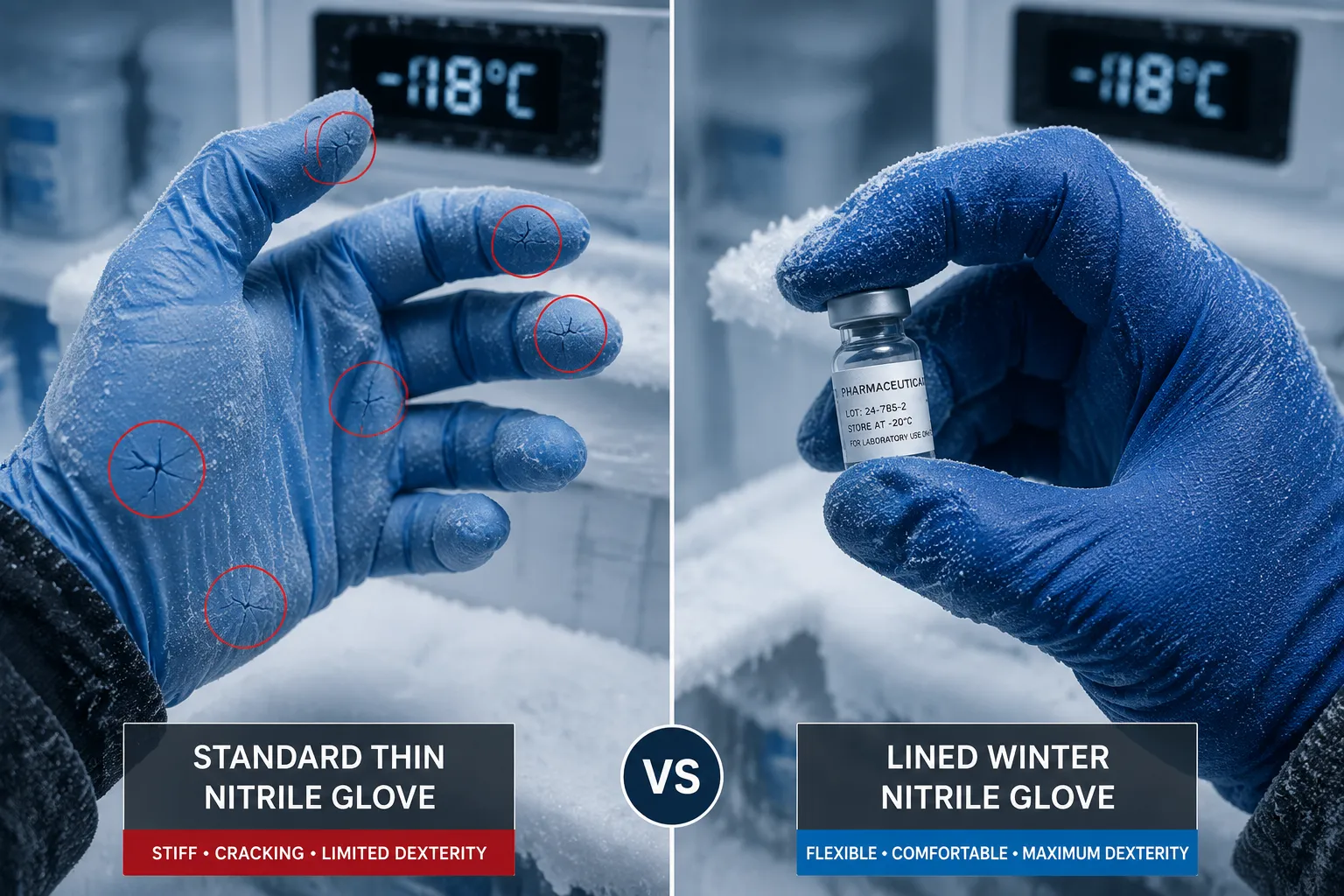
Standard unlined nitrile gloves begin losing flexibility around 40°F, become noticeably stiff at 20°F, and are prone to cracking and tearing below 0°F due to the glass transition temperature of the nitrile polymer. Winter-formulated nitrile gloves with cold-resistant polymer blends and insulation maintain flexibility down to -40°F or lower depending on formulation.
The glass transition temperature (Tg) is the point at which polymer chains lose mobility and the material shifts from a flexible rubber-like state to a rigid glass-like state. Standard nitrile rubber has a Tg around 14°F to 32°F, meaning the material becomes increasingly brittle as temperatures approach this range.
Temperature-dependent performance breakdown:
- Above 50°F: Standard nitrile performs optimally with full flexibility and tear resistance
- 40°F to 50°F: Slight stiffening noticeable, 10-15% reduction in elasticity
- 20°F to 40°F: Moderate stiffening, 30-40% reduction in elasticity, increased puncture risk
- 0°F to 20°F: Severe stiffening, 60-70% reduction in elasticity, high crack risk during flexing
- Below 0°F: Standard nitrile becomes brittle and will crack with minimal stress
Winter-formulated nitrile gloves incorporate plasticizers and co-polymers that lower the effective Tg to -40°F or below. These additives increase the free volume between polymer chains, allowing molecular movement at lower temperatures.
Why gloves crack in cold environments:
When nitrile gloves are exposed to temperatures below their Tg, the polymer chains cannot rearrange quickly enough to accommodate stress from bending or stretching. This creates micro-fractures that propagate into visible cracks, typically appearing first at high-stress points like knuckles and fingertips.
Workers often report that gloves feel “fine” initially in a freezer but crack after 15-30 minutes of work. This occurs because the glove material takes time to equilibrate to the ambient temperature. Surface layers cool first, creating a temperature gradient through the material thickness that generates internal stress.
Common mistake: Using standard nitrile gloves in 0°F to -10°F environments because they “seem okay” for short periods. The gloves may not crack immediately, but they provide inadequate protection and will fail unpredictably, potentially during critical handling tasks.
For operations requiring chemical resistance in cold environments, verify that the winter-formulated nitrile maintains its protective properties at operating temperatures, as some plasticizers can affect chemical permeation rates.
Do Lined Nitrile Gloves Lose Dexterity Compared to Unlined
Lined nitrile gloves typically retain 70-85% of the dexterity of unlined versions, with the exact reduction depending on insulation type, thickness, and liner construction. Acrylic knit liners cause minimal dexterity loss (15-20%), while thick foam insulation can reduce fine motor control by 30-40%.
Dexterity in gloves is measured by the ability to perform tasks requiring finger coordination, grip precision, and tactile feedback. The EN 388 standard includes a dexterity test (rated 1-5, with 5 being highest) that measures the ability to pick up small pins, though this test is conducted at room temperature and doesn’t account for cold-induced stiffness.
Factors affecting dexterity in insulated gloves:
- Total thickness: Each additional millimeter of material reduces tactile sensitivity by approximately 8-12%
- Liner mobility: Loose-fitting liners that bunch or shift inside the glove reduce control
- Finger taper: Gloves with poor anatomical shaping create excess material at fingertips
- Insulation compression: Materials that compress during gripping maintain better feel than rigid insulation
- Coating coverage: Full-dip nitrile coating (covering entire hand) provides better dexterity than palm-only coating due to consistent material thickness
Dexterity comparison by liner type:
- 13-gauge acrylic knit: Maintains 80-85% dexterity, suitable for tasks like barcode scanning, keypad operation, handling small packages
- Brushed fleece: Maintains 75-80% dexterity, adequate for general material handling, pallet wrapping, inventory management
- 3mm foam insulation: Maintains 65-70% dexterity, suitable for bulk handling but challenging for precision tasks
- 5mm+ foam insulation: Maintains 60-65% dexterity, appropriate only for gross motor tasks like pushing carts or moving large containers
For cold chain logistics workers who need to operate touchscreen devices, handle small pharmaceutical vials, or perform quality inspections, prioritize gloves with thin acrylic or fleece liners and anatomically shaped fingers. Some manufacturers offer “precision grip” models with thinner insulation on fingertips and heavier insulation on the back of the hand and palm.
Testing dexterity before bulk purchase:
Request samples and have workers perform actual job tasks: picking up coins, operating mobile scanners, opening box flaps, handling shrink-wrapped pallets. Test in actual cold storage conditions, not at room temperature, since cold exposure affects both the glove material and hand function.
Workers often adapt to reduced dexterity within 2-3 shifts, developing modified grip techniques. However, tasks requiring fine manipulation (like separating frozen product labels or adjusting small valves) may remain challenging regardless of adaptation.
Where to Buy Insulated Nitrile Gloves for Cold Chain Logistics Bulk Pricing
Insulated nitrile gloves for cold chain logistics are available through industrial safety distributors, specialized cold storage equipment suppliers, and direct from manufacturers, with bulk pricing (500+ pairs) typically ranging from $1.50 to $4.00 per pair depending on insulation type and temperature rating. Direct manufacturer relationships offer the best pricing for operations requiring 10,000+ pairs annually.
Primary purchasing channels:
- Industrial safety distributors: Grainger, Uline, MSC Industrial Supply offer broad selection with moderate pricing, typically $2.50-$4.50 per pair for quantities of 500-2,000 pairs
- Cold storage specialists: Companies like Polar King, Americold Supply provide gloves specifically tested for cold chain applications, $2.00-$4.00 per pair
- Direct manufacturers: Superior Glove, Wells Lamont, Showa offer best pricing for large volumes (10,000+ pairs), $1.50-$3.00 per pair
- Online industrial marketplaces: Amazon Business, Zoro, Global Industrial provide competitive pricing with fast shipping, $2.00-$4.50 per pair
Bulk pricing tiers (typical structure):
- 100-499 pairs: $3.50-$5.00 per pair
- 500-999 pairs: $2.50-$4.00 per pair
- 1,000-4,999 pairs: $2.00-$3.50 per pair
- 5,000-9,999 pairs: $1.75-$3.00 per pair
- 10,000+ pairs: $1.50-$2.50 per pair (direct manufacturer pricing)
Cost factors to evaluate beyond per-pair price:
- Shipping costs: Gloves are bulky; freight charges can add $0.20-$0.50 per pair for small orders
- Minimum order quantities: Some manufacturers require 5,000-10,000 pair minimums for best pricing
- Sizing distribution: Order based on actual worker hand measurements; typical distribution is 15% small, 35% medium, 35% large, 15% extra-large
- Trial period: Request sample quantities (50-100 pairs) before committing to bulk orders
- Replacement rate: Calculate total annual cost based on expected glove lifespan (typically 1-3 weeks for daily cold storage use)
Procurement strategy for large operations:
Establish relationships with 2-3 suppliers to ensure supply continuity and competitive pricing. Cold storage glove demand spikes seasonally (October-February in Northern Hemisphere), so place large orders in summer months when manufacturers offer promotional pricing and have better inventory availability.
For operations requiring food-safe gloves, verify that bulk purchases include FDA compliance documentation and lot traceability for quality assurance purposes.
Common purchasing mistake: Selecting gloves based solely on lowest per-pair cost without considering replacement frequency. A $1.50 glove that lasts one week costs more annually than a $3.00 glove that lasts three weeks.
Why Do My Nitrile Gloves Get Stiff in the Freezer
Nitrile gloves become stiff in freezers because the nitrile polymer undergoes a phase transition as it approaches its glass transition temperature (typically 14°F to 32°F for standard formulations), causing the flexible polymer chains to lose mobility and become rigid. This stiffening is a fundamental material property, not a defect, and occurs in all standard nitrile gloves exposed to sub-freezing temperatures.
The molecular explanation: Nitrile rubber consists of long polymer chains (acrylonitrile and butadiene monomers) that can slide past each other at normal temperatures, giving the material its flexibility. As temperature decreases, molecular motion slows, and the chains become locked in position. This transition happens gradually over a temperature range rather than at a single point.
Progressive stiffening stages:
- 50°F to 40°F: Slight increase in firmness, barely noticeable during use
- 40°F to 32°F: Noticeable stiffening, gloves feel less elastic when flexing fingers
- 32°F to 20°F: Significant stiffening, difficulty making tight fists, reduced grip strength
- 20°F to 0°F: Severe stiffening, gloves feel like thin plastic rather than rubber
- Below 0°F: Extreme rigidity, gloves may crack when bent sharply
Additional factors that worsen stiffening:
- Moisture accumulation: Condensation or perspiration that freezes inside or on the glove surface creates ice crystals that further restrict flexibility
- Wind chill: Air movement accelerates heat loss from the glove material, causing faster temperature equilibration
- Extended exposure: Gloves continue to stiffen over time as they reach thermal equilibrium with the environment
- Glove age: Older gloves with degraded plasticizers stiffen more readily than fresh gloves
Why this matters for safety and productivity:
Stiff gloves reduce grip strength by 30-50%, increasing the risk of dropping items or losing control of equipment. Workers compensate by gripping harder, which accelerates hand fatigue and can lead to repetitive strain injuries. Stiff gloves also reduce tactile feedback, making it difficult to detect whether objects are securely held.
Solution: Switch to winter-formulated nitrile gloves with plasticizers and polymer modifications that maintain flexibility at your operating temperature. These gloves cost 50-100% more than standard nitrile but prevent the stiffening problem entirely.
If you must use standard nitrile gloves temporarily in cold environments, pre-warm them in an interior pocket before use and rotate between two pairs, keeping one pair warming while wearing the other. This is not a long-term solution but can help in emergency situations.
Are Winter Nitrile Gloves Suitable for Food Handling in Cold Storage
Winter nitrile gloves are suitable for food handling in cold storage when they meet FDA 21 CFR 177.1520 compliance for food contact surfaces and carry appropriate certifications. Many insulated nitrile gloves designed for cold chain logistics are specifically manufactured to food-grade standards, making them safe for direct contact with frozen foods, refrigerated products, and food packaging.
Food safety requirements for cold storage gloves:
- FDA compliance: Gloves must be manufactured from materials approved for food contact under FDA regulations
- No migration: Insulation materials and adhesives must not transfer chemicals, dyes, or particles to food products
- Cleanability: Exterior surface must be non-porous and cleanable with approved food-safe sanitizers
- Allergen considerations: Nitrile is latex-free, eliminating latex allergen concerns in food facilities
- Color coding: Many facilities use color-coded gloves (blue for cold storage, white for processing) to prevent cross-contamination
Verification steps before purchasing:
- Request FDA compliance documentation from the manufacturer
- Confirm that both the nitrile shell AND the insulation liner meet food-contact standards
- Verify that any printed logos or coatings use food-safe inks
- Check that gloves are manufactured in facilities with appropriate food safety certifications (SQF, BRC, FSSC 22000)
Applications where food-grade winter nitrile gloves are essential:
- Handling unwrapped frozen meats, seafood, or produce
- Sorting and packing frozen foods in processing facilities
- Quality inspection of frozen products
- Temperature monitoring and sampling in cold storage
- Cleaning and sanitizing cold storage equipment
Applications where food-grade certification is less critical:
- Handling sealed packaged goods (boxes, bags, wrapped pallets)
- Operating forklifts and material handling equipment
- Inventory management with no direct food contact
- Maintenance work in cold storage areas
One common confusion: “Food-safe” and “food-grade” are not identical terms. Food-safe means the glove won’t contaminate food, while food-grade indicates the glove meets specific regulatory standards for food contact. Always request food-grade certification documentation for compliance purposes.
For facilities handling both food products and requiring chemical resistance, winter nitrile gloves offer advantages over vinyl or polyethylene alternatives, which lack durability and chemical protection.
Common mistake: Assuming all nitrile gloves are automatically food-safe. While nitrile polymer itself is generally food-safe, additives, plasticizers, and manufacturing processes can introduce non-compliant materials. Always verify certification rather than assuming compliance.
What Temperature Rating Should I Look for in Cold Chain Gloves
Cold chain gloves should be rated to at least 10°F below your facility’s coldest operating temperature to account for wind chill, extended exposure, and safety margins. For standard cold storage at 0°F, select gloves rated to -10°F minimum; for blast freezers at -20°F, choose gloves rated to -30°F or lower.
Temperature ratings for cold protection gloves are established through standardized testing, primarily EN 511 (European standard) or ASTM F2625 (North American standard). These tests measure both convective cold resistance (protection against cold air) and contact cold resistance (protection when touching cold surfaces).
EN 511 rating system explained:
The EN 511 marking shows as four digits (example: X3XX):
- First digit (0-4): Resistance to convective cold (cold air)
- Second digit (0-4): Resistance to contact cold (cold surfaces)
- Third digit (0-1): Water penetration (0 = failed, 1 = passed)
- Fourth digit (0-4): Dexterity rating
Higher numbers indicate better protection. An “X” means the test was not performed or not applicable.
Recommended ratings by application:
- Refrigerated storage (32°F to 40°F): Minimum X1XX rating, acrylic-lined gloves sufficient
- Cold storage (0°F to 32°F): Minimum X2XX rating, fleece or acrylic-lined gloves
- Freezer storage (-10°F to 0°F): Minimum X3XX rating, fleece-lined or light foam insulation
- Deep freeze (-20°F to -10°F): Minimum X3XX to X4XX rating, foam insulation required
- Blast freezers (below -20°F): X4XX rating, heavy foam or multi-layer insulation
Contact cold rating importance:
The second digit (contact cold) is particularly important for workers who handle frozen products, metal racking, or refrigeration equipment. Metal surfaces conduct heat away from hands 20-30 times faster than air at the same temperature, so gloves with poor contact cold ratings will feel inadequate even if air temperature protection is sufficient.
Temperature rating vs. comfort rating:
Manufacturers sometimes list both a “rated temperature” (the coldest temperature where the glove provides measurable protection) and a “comfort temperature” (the temperature where most users report adequate warmth during typical work periods). The comfort temperature is usually 10-15°F higher than the rated temperature.
Testing conditions matter:
Laboratory temperature ratings assume:
- Moderate activity level (not sedentary)
- Dry conditions (no moisture)
- Limited exposure duration (typically 30-60 minutes)
- No wind chill
Real-world cold storage work often involves longer exposure periods, moisture from condensation, and air movement from ventilation systems. This is why the 10°F safety margin is recommended.
Common mistake: Selecting gloves rated exactly to the facility temperature. A worker in a -20°F freezer wearing gloves rated to -20°F will experience cold hands because the rating represents the threshold of protection, not comfortable working conditions.
Common Mistakes When Choosing Gloves for Refrigerated Warehouse Work
The most common mistakes when choosing gloves for refrigerated warehouse work include selecting gloves based solely on temperature rating without considering dexterity requirements, choosing incorrect sizes that restrict circulation or reduce control, and failing to account for moisture accumulation during extended shifts. These errors lead to reduced productivity, increased injury risk, and higher glove replacement costs.
Critical selection mistakes and their consequences:
1. Ignoring task-specific dexterity needs
- Mistake: Choosing maximum insulation for all workers regardless of job function
- Consequence: Order pickers and quality inspectors struggle with precision tasks, slowing productivity by 20-30%
- Solution: Match insulation level to specific job requirements; use lighter insulation for detail work, heavier for bulk handling
2. Incorrect sizing
- Mistake: Ordering based on general size distribution rather than actual worker measurements
- Consequence: Too-tight gloves restrict blood flow causing cold hands despite adequate insulation; too-loose gloves bunch and reduce grip
- Solution: Measure each worker’s hand circumference and length, order accordingly
3. Overlooking grip requirements
- Mistake: Selecting smooth-palm gloves for environments with condensation or frost
- Consequence: Dropped products, safety incidents, damaged goods
- Solution: Specify textured palms (diamond, dots, or crinkle finish) for all cold storage applications
4. Neglecting moisture management
- Mistake: Choosing gloves without moisture-wicking liners for 8+ hour shifts
- Consequence: Perspiration accumulates, reducing insulation effectiveness and causing discomfort
- Solution: Select gloves with acrylic or synthetic liners that transport moisture away from skin
5. Focusing only on initial cost
- Mistake: Purchasing cheapest gloves without considering replacement frequency
- Consequence: Low-quality gloves fail in 3-5 days, requiring frequent reordering and higher total cost
- Solution: Calculate cost-per-day-of-use rather than cost-per-pair
6. Inadequate cuff length
- Mistake: Selecting standard wrist-length gloves for cold storage work
- Consequence: Cold air enters at wrist gap, causing discomfort and reducing effective insulation
- Solution: Choose gloves with minimum 12-inch cuffs that overlap with jacket sleeves
7. No trial period
- Mistake: Ordering full inventory without worker testing
- Consequence: Discovering fit or performance issues after committing to large quantities
- Solution: Order 50-100 pairs for 2-week trial before bulk purchase
8. Ignoring compliance requirements
- Mistake: Not verifying food-grade certification for food handling applications
- Consequence: Regulatory violations, failed audits, potential product recalls
- Solution: Request and verify FDA compliance documentation before purchase
9. Single-glove strategy
- Mistake: Expecting one glove type to work for all cold storage zones and tasks
- Consequence: Workers in -30°F blast freezers have inadequate protection while workers in 35°F refrigeration have excessive bulk
- Solution: Implement zone-specific glove selection with different insulation levels
10. Overlooking seasonal variation
- Mistake: Not adjusting glove selection for summer vs. winter ambient conditions
- Consequence: Workers entering -20°F freezers from 90°F summer loading docks experience more severe temperature shock than in winter
- Solution: Consider ambient-to-storage temperature differential when selecting insulation levels
For operations requiring both thermal protection and appropriate thickness for durability, balance these factors based on specific task requirements rather than defaulting to maximum protection.
Do Insulated Nitrile Gloves Work for Outdoor Winter Delivery Drivers
Insulated nitrile gloves work well for outdoor winter delivery drivers in temperatures above 10°F when performing tasks that require chemical resistance, touchscreen operation, and moderate dexterity, but they are not optimal for extreme cold below 0°F or for workers who spend extended periods outdoors without active movement. For delivery drivers alternating between heated vehicles and outdoor stops, insulated nitrile gloves rated to -10°F to -20°F provide an effective balance of warmth, grip, and functionality.
Advantages for delivery applications:
- Touchscreen compatibility: Many insulated nitrile gloves feature conductive fingertips for operating mobile devices without removal
- Grip in wet conditions: Nitrile coating provides superior grip on wet packages, icy handrails, and snow-covered surfaces compared to leather or fabric gloves
- Quick on/off: Easier to don and doff than bulky winter gloves when entering/exiting vehicles frequently
- Chemical resistance: Protects hands when handling packages with unknown contents or cleaning vehicle interiors
- Washability: Can be cleaned between shifts, important for drivers handling food deliveries
Limitations for delivery applications:
- Wind chill vulnerability: Nitrile gloves provide less wind protection than leather or synthetic shells with windproof membranes
- Limited warmth during idle periods: Insulation works best during active movement; hands get cold quickly when standing still
- Reduced warmth when wet: While nitrile is waterproof, if moisture enters through cuffs, insulation effectiveness drops
- Durability concerns: Thinner than traditional work gloves, may wear through faster with heavy package handling
Optimal use scenarios for delivery drivers:
- Urban/suburban routes with frequent stops (5-10 minutes outdoors per stop)
- Temperatures between 10°F and 40°F
- Package weights under 50 pounds (heavier loads benefit from more robust gloves)
- Routes requiring frequent device operation (scanning, signature capture)
- Mixed indoor/outdoor work (warehouse pickup to customer delivery)
When to choose alternatives:
- Rural routes with extended outdoor exposure (15+ minutes per stop)
- Temperatures consistently below 0°F
- Heavy freight delivery requiring maximum abrasion resistance
- Extreme wind chill conditions (below -20°F wind chill)
Hybrid strategy for delivery drivers:
Many drivers use insulated nitrile gloves as primary gloves with heavy-duty insulated mittens or gloves available for extreme conditions. The nitrile gloves handle 80-90% of daily tasks, while backup gloves address the coldest situations.
Specific features to prioritize for delivery work:
- Extended cuffs (14-16 inches) to tuck inside jacket sleeves
- High-visibility colors (orange, yellow, lime) for safety
- Reinforced fingertips for extended lifespan
- Elastic or knit wrist closures to seal out cold air
- Textured palms and fingers for package grip
For drivers who also handle food deliveries requiring food-safe gloves, insulated nitrile gloves offer the advantage of meeting both thermal and food safety requirements.
How Long Do Thermal Nitrile Gloves Last in Daily Cold Storage Use
Thermal nitrile gloves typically last 1-3 weeks in daily cold storage use, with lifespan varying based on insulation type, work intensity, and specific tasks performed. Acrylic-lined gloves generally last 7-14 days of 8-hour shifts, fleece-lined gloves last 10-21 days, and foam-insulated gloves last 14-28 days before developing holes, tears, or significant insulation compression.
Factors affecting glove lifespan:
- Abrasion exposure: Handling corrugated cardboard boxes causes faster wear than handling smooth plastic totes
- Sharp edges: Contact with metal racking, pallet bands, or box staples accelerates puncture failures
- Frequency of donning/doffing: Gloves removed and replaced multiple times per shift wear faster at cuff and finger areas
- Hand perspiration: Moisture degrades adhesive bonds between nitrile shell and insulation liner
- Storage conditions: Gloves stored in warm, humid areas between shifts degrade faster than those stored in cool, dry locations
- Individual grip strength: Workers who grip more forcefully compress insulation faster, reducing thermal effectiveness
Typical failure modes:
- Fingertip punctures (40% of failures): Most common in thumb, index, and middle fingers from gripping sharp edges
- Palm wear-through (25% of failures): Abrasion from repetitive handling of rough surfaces
- Seam separation (20% of failures): Stitching or bonding between liner and shell fails
- Insulation compression (10% of failures): Liner flattens, losing thermal protection even though shell remains intact
- Cuff tears (5% of failures): Stress from repeated donning/doffing causes cuff material to tear
Extending glove lifespan:
- Rotate between two pairs per shift, allowing each pair to dry completely between uses
- Store gloves in breathable mesh bags rather than sealed containers
- Inspect gloves at start of each shift and replace at first sign of damage
- Train workers on proper donning technique to reduce cuff stress
- Use glove clips or holders to prevent gloves from falling on dirty floors
- Implement task-specific glove selection (lighter gloves for scanning, heavier for loading)
Cost calculation example:
For a facility with 50 workers in cold storage:
- Glove cost: $2.50 per pair
- Average lifespan: 10 working days
- Annual working days: 250
- Annual glove consumption: 50 workers × 25 pairs/year = 1,250 pairs
- Annual glove cost: $3,125
If glove lifespan can be extended from 10 to 15 days through proper selection and care:
- New annual consumption: 50 workers × 17 pairs/year = 850 pairs
- New annual cost: $2,125
- Annual savings: $1,000 (32% reduction)
Quality indicators for longer-lasting gloves:
- Reinforced stress points (fingertips, palm, thumb crotch)
- Double-stitched seams rather than glued bonds
- Thicker nitrile coating (8+ mil vs. 5-6 mil)
- High-density insulation that resists compression
- Seamless knit liners (fewer failure points than cut-and-sewn)
When to replace gloves:
Replace immediately if:
- Any visible hole or tear appears
- Insulation is compressed flat in palm or fingers
- Seams are separating
- Grip texture is worn smooth
- Gloves feel noticeably colder than when new
Do not attempt to extend use of damaged gloves. A $2.50 glove replacement is far cheaper than treating a cold-related injury or dealing with a dropped product incident.
For operations concerned about glove durability across different applications, tracking actual lifespan data by job function helps optimize glove selection and budgeting.
Can You Wear Thin Glove Liners Under Nitrile Gloves for Extra Warmth
You can wear thin glove liners under nitrile gloves for extra warmth, and this layering approach is effective in moderately cold environments (20°F to 40°F) when using standard nitrile gloves, but it is less effective than purpose-built insulated nitrile gloves for temperatures below 20°F. The liner adds 5-10°F of effective temperature protection while maintaining reasonable dexterity if properly sized.
Effective liner materials for under-nitrile use:
- Silk liners: Thinnest option (0.5mm), adds minimal bulk, provides 5-8°F protection, excellent moisture wicking
- Merino wool liners: Moderate thickness (1-2mm), adds 8-12°F protection, superior warmth-to-weight ratio, naturally antimicrobial
- Synthetic (polyester/nylon) liners: Variable thickness (0.5-2mm), adds 5-10°F protection, fast-drying, most affordable
- Bamboo fiber liners: Thin (0.5-1mm), adds 5-8°F protection, soft comfort, good moisture management
Advantages of the liner-under-nitrile approach:
- Cost-effective: Liners cost $3-$8 per pair, reusable for months; cheaper than buying insulated nitrile gloves
- Adjustable warmth: Remove liners when moving between temperature zones
- Improved hygiene: Wash liners daily while using same nitrile gloves for multiple days
- Reduced hand perspiration: Liners wick moisture away from skin
- Better fit customization: Can adjust liner thickness to individual cold sensitivity
Disadvantages and limitations:
- Reduced dexterity: Two-layer system is bulkier than single insulated glove
- Sizing challenges: Nitrile gloves must be sized up to accommodate liner without restricting circulation
- Liner shifting: Liners can bunch or twist inside nitrile glove during use
- Limited protection: Not adequate for temperatures below 15-20°F
- Donning difficulty: Putting nitrile gloves over liners requires practice and time
Proper implementation technique:
- Select liners that fit snugly without wrinkles or excess material
- Size nitrile gloves one size larger than normal (if normally medium, use large)
- Put on liner first, ensuring fingers are fully extended into fingertips
- Smooth liner completely before donning nitrile glove
- Use powder-free nitrile gloves to reduce friction during donning
- Consider nitrile gloves with textured interior for better liner grip
When this approach works best:
- Transitional seasons (fall/spring) when cold storage work is borderline uncomfortable with standard gloves
- Workers with high cold sensitivity who need extra protection
- Facilities with variable temperature zones (moving between 40°F and -10°F areas)
- Budget-constrained operations seeking low-cost thermal improvement
- Short-term solution while waiting for insulated glove orders
When to use purpose-built insulated gloves instead:
- Sustained work in temperatures below 20°F
- Jobs requiring maximum dexterity (precision assembly, quality inspection)
- High-intensity work where hand perspiration is significant
- Food handling requiring single-layer food-grade gloves
- Operations where donning speed is critical
Common mistakes with liner-under-nitrile approach:
- Using thick liners that restrict circulation (defeats the purpose)
- Not sizing up nitrile gloves, creating tight fit that reduces warmth
- Choosing non-breathable liners that trap moisture
- Attempting to use this method in extreme cold (below 10°F)
- Using liners with seams that create pressure points
For workers who need both chemical resistance and thermal protection, the liner-under-nitrile approach provides a flexible solution for moderate cold exposure.
Frequently Asked Questions
What is the difference between winter nitrile gloves and regular nitrile gloves? Winter nitrile gloves include internal insulation layers (acrylic, fleece, or foam) and use cold-resistant polymer formulations that remain flexible below 32°F, while regular nitrile gloves are thin (3-8 mil) single-layer construction that becomes stiff and brittle in cold temperatures. Winter versions are typically 12-25 mil total thickness and rated for temperatures from -10°F to -40°F.
Can I use winter nitrile gloves for food handling? Yes, if they carry FDA 21 CFR 177.1520 compliance certification for food contact surfaces. Many winter nitrile gloves are manufactured to food-grade standards, but you must verify certification documentation from the manufacturer before using them for direct food contact in cold storage or processing facilities.
How do I know what temperature rating I need? Select gloves rated to at least 10°F below your coldest working temperature. For 0°F cold storage, choose gloves rated to -10°F minimum. For -20°F freezers, select gloves rated to -30°F. This safety margin accounts for wind chill, extended exposure, and contact with cold surfaces.
Why do my hands still get cold in insulated nitrile gloves? Common causes include gloves sized too tight (restricting blood flow), inadequate temperature rating for your environment, moisture accumulation inside gloves, extended static periods without movement, or gloves that have compressed insulation from extended use. Verify your glove temperature rating matches your environment and ensure proper fit.
How often should I replace winter nitrile gloves? Replace gloves every 1-3 weeks with daily use, or immediately when you notice holes, tears, seam separation, compressed insulation, or reduced thermal protection. Acrylic-lined gloves typically last 7-14 days, fleece-lined 10-21 days, and foam-insulated 14-28 days depending on work intensity.
Are winter nitrile gloves better than leather gloves for freezer work? Winter nitrile gloves are better for food handling, pharmaceutical work, and any application requiring chemical resistance or easy sanitization. Leather gloves provide better abrasion resistance and longer lifespan but cannot be effectively cleaned, absorb moisture, and are not food-safe. Choose based on your specific contamination control and durability requirements.
Can I wash and reuse insulated nitrile gloves? You can wipe the exterior with alcohol or food-safe sanitizers between uses, but insulated nitrile gloves are not designed for washing and reuse like traditional work gloves. Washing degrades the adhesive bonds between layers and compresses insulation. For hygiene, use disposable glove liners underneath that can be washed daily.
Do winter nitrile gloves work with touchscreens? Some winter nitrile gloves feature conductive materials in fingertips that work with touchscreens, but not all models have this feature. Check product specifications for “touchscreen compatible” or “conductive fingertips” if you need to operate mobile devices without removing gloves.
What causes nitrile gloves to crack in cold temperatures? Nitrile gloves crack when exposed to temperatures below their glass transition temperature (14-32°F for standard formulations), causing the polymer chains to lose flexibility and become brittle. Stress from bending or gripping creates micro-fractures that propagate into visible cracks. Winter-formulated nitrile with plasticizers maintains flexibility to -40°F or lower.
Can I use thin glove liners under regular nitrile gloves instead of buying insulated gloves? Yes, for moderate cold (20-40°F), thin silk or synthetic liners under sized-up nitrile gloves add 5-10°F of protection. This approach is cost-effective and allows adjustable warmth but provides less protection than purpose-built insulated gloves and reduces dexterity. Not adequate for temperatures below 15-20°F.
What is the best insulation type for cold storage warehouse work? Acrylic knit liners work best for temperatures above -10°F with high dexterity needs, fleece lining for -10°F to -25°F with moderate handling requirements, and foam insulation for extreme cold below -25°F where maximum protection is priority. Match insulation type to your specific temperature zone and task requirements.
How do I prevent moisture buildup inside insulated gloves during long shifts? Choose gloves with moisture-wicking liners (acrylic or synthetic), rotate between two pairs per shift allowing each to dry, use thin absorbent liner gloves underneath, and ensure proper glove sizing (too tight increases perspiration). Store gloves in breathable mesh bags between shifts rather than sealed containers.
Conclusion
Winter-ready nitrile gloves with proper insulation layers represent a critical safety investment for cold chain logistics operations, balancing thermal protection with the dexterity, chemical resistance, and hygiene requirements essential for pharmaceutical and food handling applications. The key to successful implementation lies in matching glove specifications to specific working conditions: temperature zones, task requirements, exposure duration, and compliance needs.
Essential action steps for cold chain operations:
Assess your temperature zones accurately: Measure actual working temperatures in each area, including wind chill from ventilation systems and contact temperatures of surfaces workers handle regularly.
Match insulation to requirements: Use acrylic-lined gloves for -10°F and above, fleece-lined for -10°F to -25°F, and foam-insulated for extreme cold below -25°F. Apply the 10°F safety margin rule when selecting temperature ratings.
Prioritize proper sizing: Measure worker hands individually and order appropriate size distributions. Too-tight gloves restrict circulation and cause cold hands regardless of insulation quality.
Verify compliance documentation: For food handling applications, obtain and maintain FDA 21 CFR 177.1520 certification documentation. For pharmaceutical applications, ensure gloves meet GMP requirements.
Implement trial periods: Order sample quantities (50-100 pairs) for 2-week worker testing before committing to bulk purchases. Evaluate actual performance in your specific conditions.
Calculate total cost of ownership: Consider replacement frequency, not just per-pair cost. A $3.00 glove lasting three weeks costs less than a $1.50 glove lasting one week.
Train workers on proper use: Teach correct donning technique, inspection procedures, and replacement criteria. Worker education significantly extends glove lifespan and effectiveness.
Monitor and adjust: Track glove performance, replacement rates, and worker feedback. Adjust selections seasonally and as operations change.
The cold chain logistics industry continues to grow, with increasing demands for temperature-controlled storage and distribution. As facilities expand into colder temperature zones and handle more sensitive products, the importance of proper hand protection intensifies. Winter-ready nitrile gloves that maintain flexibility at sub-zero temperatures while preserving contamination control represent the intersection of worker safety, product integrity, and operational efficiency.
For operations currently using inadequate hand protection in cold environments, the transition to properly specified insulated nitrile gloves delivers immediate benefits: reduced hand injuries, improved productivity, better product handling, and enhanced compliance with safety and food safety regulations. The investment in quality winter gloves pays for itself through reduced incident rates and improved worker performance in challenging cold storage conditions.
SEO Meta Title: Winter Nitrile Gloves for Cold Chain Logistics 2026