Last updated: July 2, 2026
Quick Answer
The FDA banned powdered medical gloves in January 2017 due to serious health risks including respiratory complications and surgical complications from powder residue. This regulatory shift has fundamentally changed procurement standards, requiring healthcare facilities, dental offices, and medical suppliers to transition exclusively to powder-free nitrile gloves. Organizations must now audit their supply chains, update procurement policies, and ensure all staff understand the compliance requirements to avoid regulatory penalties and protect patient safety.
Key Takeaways
- The FDA banned powdered surgeon’s gloves, powdered patient examination gloves, and absorbable powder for lubricating surgical gloves effective January 19, 2017
- Powder-free nitrile gloves cost approximately 10-15% more than powdered alternatives but eliminate health risks associated with cornstarch powder
- Healthcare facilities, dental offices, veterinary clinics, and surgical centers must comply with the ban for all medical procedures
- Non-medical industrial use of powdered gloves remains legal in sectors like food service, manufacturing, and janitorial work
- Organizations caught using banned powdered gloves face FDA warning letters, product seizures, and potential facility shutdowns
- Procurement policies must specify powder-free requirements, include supplier verification processes, and establish regular compliance audits
- Staff training on powder-free glove donning techniques is essential since these gloves require different application methods
- The regulatory compliance roadmap includes immediate inventory audits, supplier contract updates, and ongoing monitoring protocols
Why Are Powdered Gloves Being Phased Out
Powdered medical gloves are being phased out because the cornstarch powder used for lubrication causes serious health complications including allergic reactions, respiratory problems, and post-surgical adhesions. The FDA determined that these risks could not be mitigated and that safer alternatives existed.
The powder in medical gloves serves as a lubricant to make donning easier, but it creates multiple hazards:
Health Risks Documented by the FDA:
- Respiratory complications: Airborne powder particles carry latex proteins that trigger asthma and breathing difficulties
- Surgical site contamination: Powder acts as a foreign body in surgical wounds, causing granulomas and adhesions
- Wound healing interference: Cornstarch powder delays healing and increases infection risk
- Allergic sensitization: Repeated exposure to powder-bound latex proteins increases allergy development
Clinical Evidence:
Studies showed that powder from a single glove can disperse up to 600 micrograms of latex protein into the air, remaining airborne for hours. In surgical settings, powder particles found in wound sites led to peritoneal adhesions requiring additional corrective surgeries.
The phase-out represents a shift toward evidence-based safety standards where patient protection outweighs convenience factors. Healthcare facilities that previously relied on powdered gloves for ease of use must now implement alternative donning techniques and choose appropriate powder-free options that meet their specific clinical needs.
What Regulations Banned Powdered Medical Gloves
The FDA issued a final rule on December 19, 2016, banning powdered surgeon’s gloves, powdered patient examination gloves, and absorbable powder for lubricating surgical gloves, with the ban taking effect on January 19, 2017. This regulation applies to all medical gloves used in healthcare settings across the United States.
Regulatory Details:
The ban was issued under Section 516 of the Federal Food, Drug, and Cosmetic Act, which allows the FDA to ban medical devices that present substantial deception or unreasonable and substantial risk of illness or injury.
Specific Products Banned:
- Powdered surgeon’s gloves (sterile surgical gloves with powder)
- Powdered patient examination gloves (non-sterile exam gloves with powder)
- Absorbable powder intended for lubricating surgical gloves
Regulatory Authority:
The FDA classified these products as Class II medical devices and determined that the risks could not be corrected through labeling changes or usage restrictions. The agency received over 1,000 adverse event reports related to powdered gloves between 2011 and 2016, documenting severe complications.
International Alignment:
Several countries implemented similar restrictions before or after the U.S. ban. The United Kingdom’s National Health Service phased out powdered latex gloves in 2013. Germany, Austria, and several other European nations also restricted or banned powdered medical gloves due to latex allergy concerns.
The regulatory compliance roadmap for this ban required manufacturers to cease production and distribution, while healthcare facilities had to exhaust existing inventory and transition procurement systems to powder-free alternatives exclusively.
When Did the FDA Ban Powdered Gloves
The FDA ban on powdered gloves became effective on January 19, 2017, giving manufacturers and healthcare facilities 180 days from the December 19, 2016 announcement to comply. By mid-2017, all medical facilities were required to use only powder-free gloves for patient care.
Implementation Timeline:
- December 19, 2016: FDA published final rule in Federal Register
- January 19, 2017: Ban became effective; manufacturers could no longer introduce banned devices into interstate commerce
- July 2017: Grace period ended; all inventory should have been transitioned
Compliance Deadlines:
Healthcare facilities had to remove powdered gloves from clinical use by the effective date. The FDA did not provide an extended transition period for existing inventory, though enforcement focused initially on manufacturers and distributors rather than end users.
Current Status in 2026:
Nine years after implementation, the ban remains fully enforced. The FDA continues to monitor compliance through facility inspections and adverse event reporting. Healthcare organizations must maintain documentation proving their glove procurement meets powder-free requirements.
Organizations that failed to update their procurement systems by 2017 faced regulatory scrutiny. The regulatory compliance roadmap now includes ongoing verification that suppliers provide only compliant products and that purchasing agreements explicitly exclude powdered medical gloves.
Difference Between Powdered and Powder-Free Nitrile Gloves
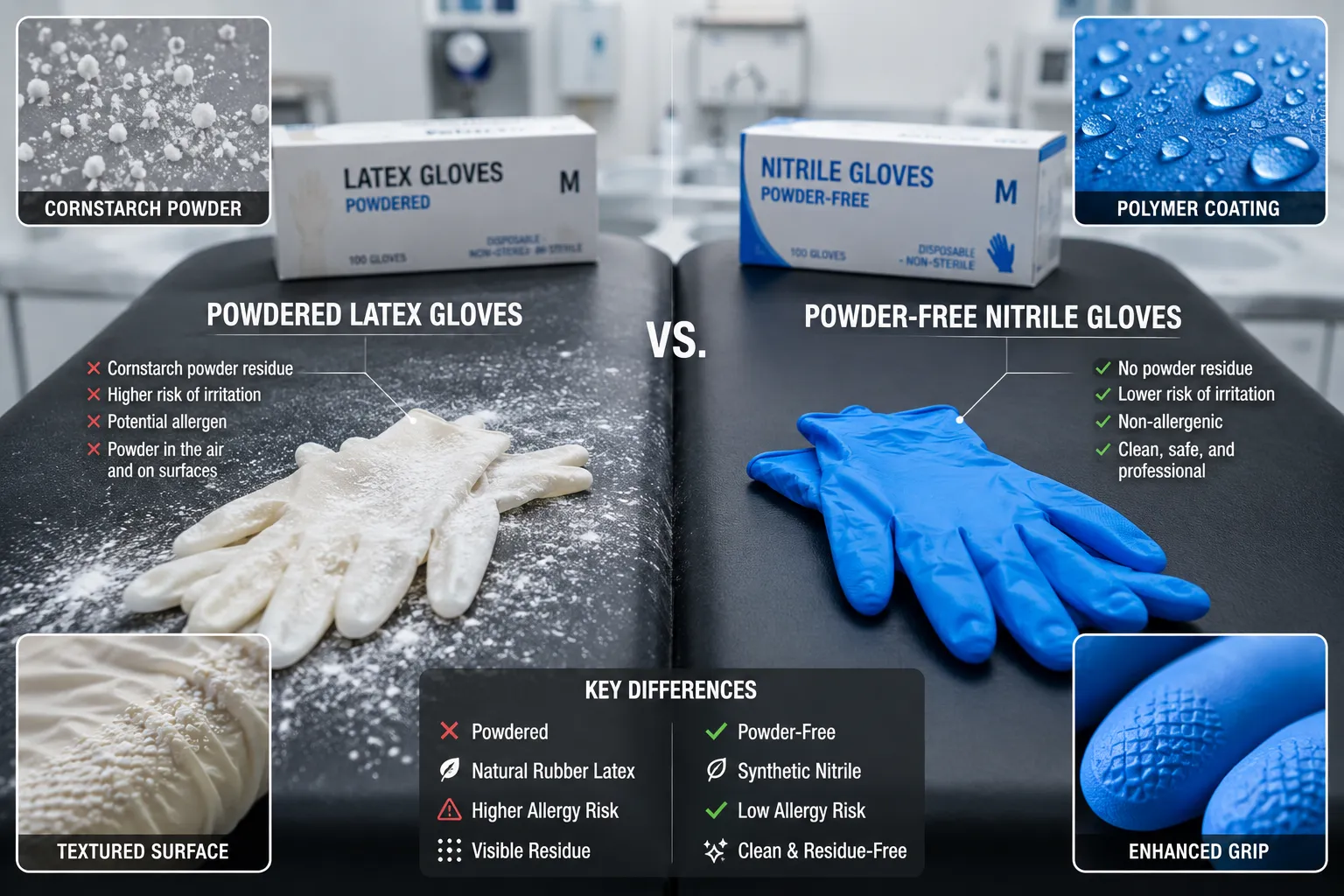
Powdered nitrile gloves contain cornstarch lubricant inside for easy donning, while powder-free nitrile gloves use polymer coatings or chlorination processes to achieve smooth interior surfaces without powder. The functional difference extends beyond the presence of powder to include manufacturing processes, donning techniques, and clinical applications.
Manufacturing Differences:
Powdered Gloves:
- Cornstarch powder applied during manufacturing
- Easier to don when hands are dry
- Lower manufacturing cost
- Powder can absorb moisture and latex proteins
Powder-Free Gloves:
- Chlorinated or polymer-coated interior surface
- Require slightly damp hands or specific donning technique
- Higher manufacturing cost due to additional processing
- No powder contamination risk
Performance Characteristics:
| Feature | Powdered | Powder-Free |
|---|---|---|
| Donning ease | Very easy (dry hands) | Moderate (technique required) |
| Contamination risk | High (powder dispersal) | None |
| Tactile sensitivity | Reduced | Enhanced |
| Grip quality | Good | Excellent |
| Allergen exposure | High | Minimal |
| Surgical suitability | Banned | Approved |
Clinical Implications:
Powder-free nitrile gloves provide better tactile sensitivity because the polymer coating is thinner than powder accumulation. They also maintain grip quality in wet conditions better than powdered alternatives. For detailed guidance on selecting appropriate nitrile gloves, consider factors beyond powder content including thickness, texture, and intended application.
Common Mistake:
Many facilities initially struggled with powder-free glove donning, leading to increased glove tearing. The solution involves training staff to apply gloves with slightly damp hands or using proper technique rather than forcing dry hands into powder-free gloves.
How to Update Glove Procurement Policy After Powder Ban
Update your glove procurement policy by explicitly specifying powder-free requirements in all purchase orders, adding supplier certification requirements, and implementing a three-stage verification process: pre-purchase specification, delivery inspection, and periodic compliance audits. This ensures the regulatory compliance roadmap is embedded in your supply chain management.
Step-by-Step Policy Update Process:
1. Revise Purchase Specifications:
- Add mandatory language: “All medical examination and surgical gloves must be powder-free as required by FDA regulation effective January 19, 2017”
- Include specific product codes or SKUs for approved powder-free gloves
- Specify acceptable manufacturing processes (chlorinated, polymer-coated)
2. Supplier Certification Requirements:
- Require suppliers to provide written certification that all gloves are powder-free
- Request FDA registration numbers for glove manufacturers
- Obtain certificates of compliance for each product line
3. Contract Language Updates:
- Include breach clauses for delivery of non-compliant powdered gloves
- Specify right to reject shipments containing banned products
- Require supplier indemnification for regulatory violations
4. Receiving Inspection Protocol:
- Train receiving staff to verify “powder-free” labeling on all boxes
- Implement spot-check procedures: open random boxes to inspect gloves
- Create rejection and return procedures for non-compliant products
5. Documentation Requirements:
- Maintain procurement records showing powder-free specifications
- Keep supplier certifications on file for FDA inspections
- Document staff training on compliance requirements
Decision Rule:
Choose suppliers who can provide batch-specific compliance documentation if your facility performs high-risk procedures. For general medical use, supplier-level certification may suffice, but surgical centers should require lot-specific verification.
Organizations should also review their food service glove policies if they operate cafeterias, as food preparation gloves are not subject to the medical glove ban but may benefit from powder-free standards for quality reasons.
Are Powder-Free Nitrile Gloves More Expensive Than Powdered
Powder-free nitrile gloves typically cost 10-15% more than powdered alternatives due to additional manufacturing steps required for chlorination or polymer coating. However, the total cost of ownership often favors powder-free gloves when accounting for reduced cleaning costs, eliminated powder-related complications, and regulatory compliance.
Price Comparison (2026 Market Rates):
- Powdered nitrile exam gloves: $8-12 per 100-count box (where still legal for non-medical use)
- Powder-free nitrile exam gloves: $10-14 per 100-count box
- Premium powder-free nitrile: $15-20 per 100-count box
Cost Factors Beyond Purchase Price:
Hidden Costs of Powdered Gloves (When They Were Used):
- Environmental cleaning to remove powder residue from surfaces
- HVAC filter replacement due to airborne powder accumulation
- Treatment costs for powder-related complications
- Potential litigation from adverse events
Value Factors of Powder-Free Gloves:
- Reduced cleaning and maintenance expenses
- Lower risk of patient complications and associated costs
- Compliance with regulations (avoiding penalties)
- Improved staff satisfaction due to better tactile sensitivity
Budget Planning Considerations:
For a 100-bed hospital using approximately 500,000 gloves annually, the price difference amounts to $5,000-7,500 per year. However, eliminating just one powder-related surgical complication (which can cost $10,000-50,000 in additional care) more than offsets the increased glove cost.
Procurement Strategy:
Negotiate volume contracts with manufacturers to reduce per-unit costs. Many suppliers offer tiered pricing where bulk purchases of powder-free gloves approach powdered glove pricing. Consider comparing different nitrile glove options to find the best value for your specific applications.
What Industries Are Affected by Powdered Glove Phase Out
The powdered glove ban affects all healthcare and medical industries including hospitals, surgical centers, dental offices, veterinary clinics, home healthcare providers, and medical device manufacturers. However, non-medical industries like food service, janitorial work, manufacturing, and automotive repair can still legally use powdered gloves.
Medical Industries Required to Comply:
- Hospitals and health systems: All inpatient and outpatient care
- Dental practices: Examinations, cleanings, and surgical procedures
- Veterinary medicine: Animal examinations and surgeries
- Surgical centers: Ambulatory and specialty surgical facilities
- Home healthcare: In-home patient care and wound management
- Long-term care facilities: Nursing homes and assisted living
- Medical laboratories: Clinical specimen handling
- Emergency medical services: Paramedic and EMT patient contact
Industries NOT Affected by the Ban:
- Food service and preparation: Restaurants, catering, food processing
- Janitorial and cleaning services: Commercial and residential cleaning
- Manufacturing: Assembly, quality control, parts handling
- Automotive repair: Mechanics and detailing
- Beauty services: Hair salons, nail salons (non-medical)
- Tattoo and body art: When not classified as medical procedures
Compliance Considerations by Sector:
Dental Offices:
Dental practices must comply fully with the ban. Some dental offices initially questioned whether the ban applied to them, but the FDA clarified that all patient examination and surgical gloves used in dental settings must be powder-free. For guidance on selecting appropriate gloves for specialized applications, consider the specific chemical and biological exposures in your environment.
Veterinary Clinics:
Veterinary medicine falls under the medical device regulations, requiring powder-free gloves for animal examinations and surgeries. The regulatory compliance roadmap for veterinary practices mirrors human healthcare requirements.
Common Mistake:
Some facilities assumed the ban only applied to surgical gloves, continuing to use powdered exam gloves. The FDA ban explicitly includes both surgical and examination gloves used in medical settings.
Common Mistakes When Switching to Powder-Free Gloves
The most common mistakes when switching to powder-free gloves include inadequate staff training on donning techniques, failing to adjust glove sizes, not updating emergency supply caches, and neglecting to verify that all departments have transitioned. These errors lead to increased glove waste, staff frustration, and potential compliance gaps.
Critical Mistakes and Solutions:
1. Improper Donning Technique:
Mistake: Staff try to don powder-free gloves using the same technique as powdered gloves, leading to tearing and frustration.
Solution: Train staff to slightly dampen hands or use proper rolling technique. Powder-free gloves require hands to be barely moist (not wet) for smooth application. Demonstrate the technique during mandatory training sessions.
2. Incorrect Size Selection:
Mistake: Ordering the same sizes as powdered gloves without accounting for fit differences.
Solution: Powder-free gloves may fit differently than powdered equivalents. Conduct fit testing with sample sizes before bulk ordering. Some staff may need to size up or down compared to their powdered glove size.
3. Overlooked Supply Locations:
Mistake: Updating central supply but missing satellite clinics, emergency carts, procedure rooms, and mobile units.
Solution: Create a comprehensive inventory of all glove storage locations. Assign department champions to verify complete transition in their areas. Check crash carts, procedure kits, and emergency supplies.
4. Inadequate Supplier Verification:
Mistake: Assuming suppliers automatically provide powder-free gloves without explicit specification.
Solution: Update all purchase orders with explicit powder-free requirements. Verify each shipment upon receipt. Maintain a rejected product log.
5. Missing Documentation:
Mistake: Failing to document the transition process and ongoing compliance.
Solution: Create a compliance file containing policy updates, staff training records, supplier certifications, and inspection logs. This documentation is essential for regulatory audits.
6. Ignoring User Feedback:
Mistake: Not collecting staff input on powder-free glove performance, leading to poor product selection.
Solution: Conduct user trials with multiple powder-free brands. Survey staff on comfort, durability, and tactile sensitivity. Select products that balance cost with user satisfaction.
Edge Case:
Facilities with automated glove dispensers designed for powdered gloves may experience jamming with powder-free alternatives. Test dispenser compatibility before full deployment or consider dispenser upgrades.
Do Dental Offices Need to Comply With Powdered Glove Ban
Yes, dental offices must fully comply with the FDA powdered glove ban. The regulation applies to all patient examination gloves and surgical gloves used in dental settings, including routine cleanings, examinations, and surgical procedures. There are no exemptions for dental practices.
Regulatory Scope for Dental Practices:
The FDA classifies dental examination and surgical gloves as medical devices subject to the same regulations as hospital gloves. Dental offices using powdered gloves for patient care violate federal regulations and risk enforcement action.
Compliance Requirements:
- Examination gloves: Must be powder-free for all patient contact including cleanings, examinations, and non-surgical procedures
- Surgical gloves: Must be powder-free for extractions, implants, and other surgical procedures
- Non-patient activities: Gloves used for cleaning instruments or environmental cleaning (not patient contact) are not technically covered, but most dental offices standardize on powder-free for all uses
Enforcement in Dental Settings:
State dental boards and FDA inspectors can cite dental practices for using banned powdered gloves. Violations may result in:
- FDA warning letters
- State licensing board disciplinary action
- Mandatory corrective action plans
- Fines and penalties for continued non-compliance
Practical Implementation:
Dental practices should update their procurement policies to specify powder-free gloves exclusively. Many dental suppliers automatically provide only compliant products, but practices should verify specifications on all orders. For practices concerned about allergic reactions to nitrile gloves, powder-free options actually reduce allergy risk compared to powdered alternatives.
Decision Rule:
If gloves touch patients, instruments used on patients, or surfaces in the operatory during patient care, they must be powder-free. When in doubt, use powder-free gloves to ensure compliance.
Best Powder-Free Nitrile Glove Suppliers for Hospitals
Leading powder-free nitrile glove suppliers for hospitals in 2026 include Medline Industries, Cardinal Health, McKesson Medical-Surgical, Ansell Healthcare, and Kimberly-Clark Professional. Selection should be based on product quality, supply chain reliability, compliance documentation, and total cost of ownership rather than price alone.
Evaluation Criteria for Hospital Suppliers:
1. Product Quality Metrics:
- AQL (Acceptable Quality Level) rating of 1.5 or better
- Consistent sizing across lots
- Durability testing results
- Tactile sensitivity ratings
2. Supply Chain Reliability:
- Domestic inventory levels
- Lead time consistency
- Surge capacity during shortages
- Geographic distribution network
3. Compliance Support:
- FDA registration documentation
- Batch-specific certificates of compliance
- Regulatory update notifications
- Audit support services
4. Value-Added Services:
- Clinical education programs
- Usage analytics and optimization
- Inventory management systems
- Sustainability programs
Supplier Comparison Framework:
| Supplier | Strengths | Best For |
|---|---|---|
| Medline Industries | Broad product range, strong distribution | Large health systems |
| Cardinal Health | Integrated supply chain, analytics | Multi-facility networks |
| McKesson Medical-Surgical | Competitive pricing, reliable delivery | Cost-conscious facilities |
| Ansell Healthcare | Premium quality, specialized products | Surgical centers |
| Kimberly-Clark Professional | Innovation, sustainability focus | Quality-driven organizations |
Procurement Best Practices:
Diversify Suppliers: Maintain relationships with at least two qualified suppliers to mitigate supply chain disruptions. The COVID-19 pandemic demonstrated the risk of single-source dependencies.
Standardize Strategically: Limit the number of SKUs while ensuring clinical needs are met. Most hospitals can operate effectively with 3-5 glove types (exam, surgical, extended cuff, specialty).
Negotiate Value, Not Just Price: Include supply guarantees, quality commitments, and compliance support in contracts. A slightly higher per-unit cost with guaranteed supply is more valuable than the lowest price with uncertain availability.
Monitor Performance: Track key metrics including defect rates, delivery performance, and user satisfaction. Review supplier performance quarterly and adjust contracts accordingly.
For specialized applications, consult resources on choosing the right nitrile gloves to ensure your procurement strategy addresses all clinical requirements.
Can I Still Buy Powdered Gloves for Non-Medical Use
Yes, powdered gloves remain legal for non-medical applications including food service, janitorial work, manufacturing, automotive repair, and other industrial uses. The FDA ban applies only to medical gloves used in healthcare settings for patient examination or surgical procedures.
Legal Non-Medical Uses:
- Food preparation and service: Restaurants, catering, food processing plants
- Cleaning and janitorial: Commercial and residential cleaning services
- Manufacturing and assembly: Electronics, automotive parts, general manufacturing
- Automotive repair: Mechanics, detailing, parts handling
- Beauty and personal services: Hair salons, nail salons (non-medical procedures)
- Painting and finishing: Spray painting, staining, coating applications
- General maintenance: Building maintenance, equipment repair
Important Distinctions:
Not Allowed: Using powdered gloves for any patient care activity, medical examination, surgical procedure, or handling of medical devices that will contact patients.
Allowed: Using powdered gloves for non-patient-contact activities even within healthcare facilities, such as food service in hospital cafeterias or environmental services cleaning non-clinical areas.
Practical Considerations:
Many organizations choose to standardize on powder-free gloves across all applications to:
- Simplify inventory management
- Eliminate confusion about appropriate use
- Reduce environmental powder contamination
- Minimize allergy risks for staff
Purchasing Guidance:
When purchasing gloves for non-medical use, clearly specify the intended application to suppliers. Some distributors have discontinued powdered glove lines entirely to avoid compliance complications, while others maintain separate product lines for industrial use.
For food service applications, review food-safe glove selection criteria to ensure your gloves meet both safety and regulatory requirements for food contact.
Common Mistake:
Purchasing powdered gloves for “general use” in a healthcare facility without clear controls to prevent their use in clinical areas. If your facility provides patient care, the safest approach is to purchase only powder-free gloves to eliminate compliance risk.
How to Train Staff on New Powder-Free Glove Standards
Train staff on powder-free glove standards through a three-component program: regulatory compliance education explaining the FDA ban and health risks, hands-on donning technique training demonstrating proper application methods, and ongoing competency verification through observation and feedback. This comprehensive approach ensures both understanding and proper execution.
Training Program Components:
1. Regulatory Compliance Education (15-20 minutes):
Content to Cover:
- FDA ban background and effective date
- Health risks that led to the ban (respiratory issues, surgical complications)
- Scope of the ban (all medical examination and surgical gloves)
- Consequences of non-compliance for the facility and patients
- Staff responsibility to report any powdered gloves found in clinical areas
Delivery Method: Online module, department meeting, or mandatory in-service
2. Hands-On Donning Technique Training (10-15 minutes):
Demonstration Steps:
- Show difference in texture between powdered and powder-free gloves
- Demonstrate proper hand preparation (slightly damp, not wet)
- Teach rolling technique for powder-free glove application
- Practice donning and doffing with supervision
- Troubleshoot common issues (tearing, difficulty getting gloves on)
Delivery Method: Skills station with return demonstration
3. Product Familiarization:
Content to Cover:
- Approved powder-free glove types available in the facility
- Location of glove supplies in each department
- Size selection guidance
- Reporting process for quality issues or supply shortages
4. Competency Verification:
Assessment Methods:
- Direct observation of glove donning technique
- Written or verbal quiz on compliance requirements
- Spot checks during routine work
- Annual competency reassessment
Training Schedule:
- Initial rollout: Mandatory training for all clinical staff before transition date
- New hires: Include in orientation program
- Annual updates: Brief refresher on compliance requirements
- Just-in-time: Quick reference cards at glove dispensers
Documentation Requirements:
Maintain training records including:
- Attendance rosters or completion certificates
- Competency assessment results
- Training materials and dates
- Trainer qualifications
Special Considerations:
For surgical teams: Emphasize that powder-free surgical gloves require different donning techniques, especially for double-gloving procedures. Scrub techs and surgeons may need additional practice time.
For high-volume users: Staff who use hundreds of gloves per shift (such as in emergency departments) may initially experience hand fatigue. Address this through proper sizing and technique rather than reverting to non-compliant products.
Edge Case:
Traveling or per-diem staff may have trained at facilities still using powdered gloves (if they work in non-medical settings). Verify that all temporary staff understand your facility’s powder-free requirements during orientation.
Are There Exceptions to the Powdered Glove Ban
No, there are no exceptions to the FDA powdered glove ban for medical use. The regulation applies universally to all powdered surgeon’s gloves, powdered patient examination gloves, and absorbable powder for lubricating surgical gloves used in healthcare settings, regardless of facility size, location, or patient population.
Scope of the Ban:
No Exceptions For:
- Small medical practices or clinics
- Rural or remote healthcare facilities
- Specific patient populations
- Emergency situations
- Existing inventory purchased before the ban
- Financial hardship claims
- Preference of healthcare providers
What the Ban Does NOT Cover:
The ban applies only to medical gloves. It does not restrict:
- Powdered gloves for non-medical industrial use
- Powder-free medical gloves (obviously)
- Other medical devices containing powder for different purposes
- Gloves used outside of patient care contexts
FDA Enforcement Position:
The FDA determined that the risks of powdered medical gloves could not be mitigated through labeling, restricted use, or special precautions. The agency concluded that a complete ban was necessary to protect public health, leaving no room for exceptions.
Regulatory Compliance Roadmap Implications:
Because no exceptions exist, the regulatory compliance roadmap for healthcare facilities must ensure 100% transition to powder-free alternatives. Partial compliance or phased approaches are not acceptable under the regulation.
International Variations:
While the U.S. ban has no exceptions, some countries have implemented different approaches:
- Some nations allow powdered gloves with enhanced warnings
- Others restrict but do not completely ban powdered gloves
- Several countries have followed the U.S. with complete bans
Healthcare organizations operating internationally must understand and comply with local regulations, which may differ from U.S. requirements.
Common Question:
Facilities sometimes ask if they can use remaining powdered glove inventory for non-patient activities. While technically legal, this creates confusion and compliance risk. Best practice is to remove all powdered gloves from healthcare facilities to eliminate any possibility of inappropriate use.
What Happens If Caught Using Powdered Gloves After Ban
Healthcare facilities caught using powdered gloves after the ban face FDA enforcement actions including warning letters, product seizure, mandatory recalls, civil penalties, and potential criminal prosecution for continued violations. The FDA can also require facilities to implement corrective action plans and conduct enhanced monitoring.
Enforcement Actions and Consequences:
1. Warning Letters:
The FDA’s initial response typically involves a warning letter documenting the violation and requiring corrective action within 15 business days. The letter becomes public record and may impact facility reputation and accreditation status.
2. Product Seizure:
FDA inspectors can seize non-compliant powdered gloves found during facility inspections. The facility bears the cost of seizure and destruction of the products.
3. Mandatory Corrective Action:
Facilities must submit a corrective action plan detailing:
- How the violation occurred
- Steps taken to remove all powdered gloves
- Process changes to prevent recurrence
- Staff training and education implemented
- Supplier verification procedures
4. Follow-Up Inspections:
The FDA may conduct unannounced follow-up inspections to verify compliance. Repeated violations escalate enforcement actions.
5. Civil Monetary Penalties:
The FDA can impose fines for violations. Penalty amounts depend on violation severity, duration, and whether the facility demonstrated good faith efforts to comply.
6. Facility Restrictions:
In severe cases, the FDA can restrict facility operations, suspend Medicare/Medicaid reimbursement eligibility, or refer cases to state licensing boards for additional disciplinary action.
7. Criminal Prosecution:
Willful and repeated violations can result in criminal charges against facility administrators or responsible individuals.
Real-World Enforcement:
The FDA prioritizes enforcement based on risk. Facilities with documented patient harm from powdered gloves face more severe consequences than facilities with inadvertent compliance gaps. However, ignorance of the regulation is not a defense.
State-Level Consequences:
Beyond federal enforcement, state health departments and licensing boards may take action:
- License suspension or revocation
- Mandatory corrective action plans
- Enhanced monitoring and inspection frequency
- Public disclosure of violations
Accreditation Impact:
Joint Commission, DNV, and other accrediting bodies consider FDA violations during surveys. Powdered glove violations can result in:
- Conditional accreditation status
- Required focused surveys
- Accreditation denial or loss
Liability Exposure:
Using banned powdered gloves creates significant legal liability:
- Malpractice claims if patients suffer powder-related complications
- Regulatory non-compliance as evidence of negligence
- Potential punitive damages for knowing violations
Prevention Strategy:
The best approach is proactive compliance through the regulatory compliance roadmap: comprehensive policies, staff training, supplier verification, and regular audits. The cost of compliance is minimal compared to enforcement consequences.
For facilities concerned about selecting appropriate alternatives, numerous high-quality powder-free options exist that meet or exceed the performance of banned powdered gloves.
Frequently Asked Questions
What makes powder-free nitrile gloves different from powdered ones?
Powder-free nitrile gloves use chlorination or polymer coating instead of cornstarch powder for easy donning. They eliminate powder contamination risks, provide better tactile sensitivity, and comply with FDA regulations for medical use.
Can dental offices still use powdered gloves?
No, dental offices must comply with the FDA ban on powdered medical gloves. All patient examination and surgical gloves used in dental settings must be powder-free, with no exceptions for dental practices.
Are powder-free gloves harder to put on?
Powder-free gloves require slightly different technique than powdered gloves. Applying them with barely damp hands or using proper rolling technique makes donning as easy as powdered gloves once staff learn the method.
How much more do powder-free nitrile gloves cost?
Powder-free nitrile gloves typically cost 10-15% more than powdered alternatives, ranging from $10-14 per 100-count box for standard exam gloves. However, total cost of ownership often favors powder-free when accounting for eliminated complications and cleaning costs.
Can I use powdered gloves for food service?
Yes, powdered gloves remain legal for food service and preparation since the FDA ban applies only to medical gloves. However, many food service operations choose powder-free gloves to avoid powder contamination of food products.
What industries must comply with the powdered glove ban?
All healthcare industries must comply, including hospitals, surgical centers, dental offices, veterinary clinics, home healthcare, long-term care facilities, medical laboratories, and emergency medical services. Non-medical industries are not affected.
When did the powdered glove ban take effect?
The FDA ban became effective January 19, 2017, with manufacturers and healthcare facilities required to transition immediately. As of 2026, the ban has been enforced for nine years with no exceptions.
What happens if my supplier accidentally ships powdered gloves?
Reject the shipment immediately and document the incident. Contact your supplier to arrange return and replacement with compliant powder-free gloves. Update your purchase orders to explicitly specify powder-free requirements.
Do powder-free gloves cause more allergic reactions?
No, powder-free gloves actually cause fewer allergic reactions than powdered gloves. Powder carries latex proteins and other allergens, increasing sensitization risk. Powder-free nitrile gloves minimize allergy exposure.
How do I train staff on powder-free glove use?
Implement a three-part training program covering regulatory compliance education, hands-on donning technique demonstration, and competency verification through observation. Include training in orientation for new hires and provide annual refreshers.
Are there any exceptions to the powdered glove ban?
No, the FDA ban has no exceptions for medical use. All healthcare facilities must use powder-free gloves for patient care regardless of facility size, location, patient population, or financial considerations.
Can veterinary clinics use powdered gloves?
No, veterinary clinics must comply with the powdered glove ban. The FDA regulation applies to all medical gloves used for animal examination and surgical procedures, treating veterinary medicine the same as human healthcare.
Conclusion
The regulatory compliance roadmap for the powdered glove phase-out represents a fundamental shift in medical glove procurement standards that continues to shape healthcare supply chains in 2026. Nine years after the FDA ban took effect, healthcare organizations must maintain vigilant compliance through comprehensive policies, staff training, supplier verification, and regular audits.
The transition to powder-free nitrile gloves has eliminated serious health risks including respiratory complications, surgical site contamination, and allergic sensitization while improving clinical outcomes and patient safety. Although powder-free gloves cost slightly more than their banned predecessors, the total value proposition strongly favors compliant products when accounting for eliminated complications, reduced cleaning costs, and avoided regulatory penalties.
Actionable Next Steps:
For Healthcare Facilities:
- Audit current inventory: Conduct a comprehensive review of all glove storage locations including satellite clinics, emergency carts, and procedure rooms to ensure no powdered gloves remain
- Review procurement policies: Verify that all purchase orders explicitly specify powder-free requirements and include supplier certification processes
- Verify supplier compliance: Request updated certificates of compliance from all glove suppliers and confirm FDA registration numbers
- Assess staff competency: Observe staff donning techniques and provide refresher training where needed
- Document compliance: Maintain organized files of policies, training records, supplier certifications, and inspection logs for regulatory audits
For Procurement Professionals:
- Standardize specifications: Create clear, detailed powder-free glove specifications for all medical applications
- Diversify suppliers: Establish relationships with at least two qualified suppliers to mitigate supply chain risks
- Negotiate value contracts: Focus on total cost of ownership including quality, reliability, and compliance support rather than lowest unit price
- Implement verification processes: Establish receiving inspection protocols to verify powder-free status of all shipments
- Monitor performance metrics: Track supplier delivery performance, product quality, and user satisfaction
For Clinical Leaders:
- Reinforce compliance culture: Regularly communicate the importance of powder-free glove requirements during staff meetings and safety huddles
- Address user concerns: Investigate and resolve any staff complaints about powder-free glove performance through product trials or sizing adjustments
- Monitor for violations: Establish reporting mechanisms for staff to flag any powdered gloves found in clinical areas
- Update protocols: Ensure all clinical procedures and policies reference powder-free glove requirements
- Support continuous education: Include powder-free glove compliance in orientation, annual competencies, and safety training
The phase-out of powdered gloves demonstrates how evidence-based regulation can drive meaningful improvements in healthcare safety. By maintaining rigorous compliance with powder-free standards, healthcare organizations protect patients, staff, and their regulatory standing while contributing to the broader evolution of medical device safety standards.
Organizations that embed the regulatory compliance roadmap into their standard operating procedures position themselves not just for current compliance, but for adaptability as medical device regulations continue to evolve. The lessons learned from the powdered glove transition—comprehensive policy development, thorough staff education, robust supplier management, and diligent monitoring—provide a framework for managing future regulatory changes in medical supply procurement.
SEO Meta Title: Powdered Gloves Phase-Out: Nitrile Compliance Guide