Last updated: July 1, 2026
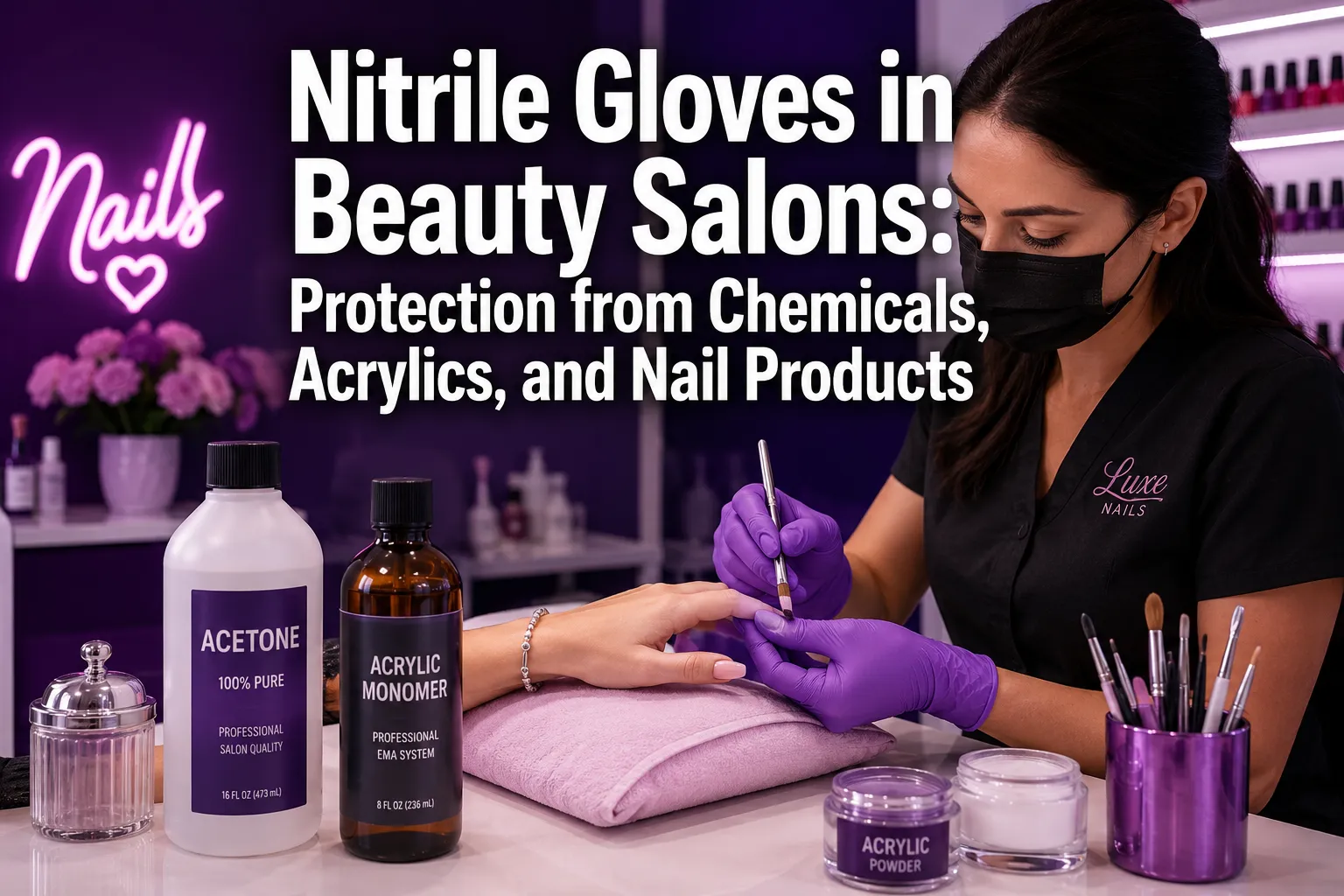
Nail technicians face daily exposure to harsh chemicals including acetone, acrylic monomers, and gel polish solvents that can cause contact dermatitis, chemical burns, and long-term skin sensitization. Nitrile gloves in beauty salons provide essential protection from chemicals, acrylics, and nail products while maintaining the dexterity needed for precise manicure work. Unlike latex gloves that trigger allergic reactions or vinyl gloves that offer minimal chemical resistance, nitrile gloves deliver a balance of barrier protection, tactile sensitivity, and hypoallergenic properties that make them the preferred choice for professional salon environments.
Key Takeaways
- Nitrile gloves offer superior chemical resistance to acetone, acrylic monomers, and gel polish removers compared to latex or vinyl alternatives
- Powder-free nitrile gloves in 4-6 mil thickness provide the best balance of protection and dexterity for detailed nail work
- Gloves should be changed between each client and immediately after chemical exposure or visible contamination
- Black and colored nitrile gloves are safe for salon use and offer the same protection as blue or purple medical-grade options
- Quality nitrile gloves cost approximately 8-15 cents per glove, translating to $120-$300 monthly for a busy salon
- Even with gloves, proper ventilation and technique remain essential since nitrile does not protect against inhaled chemical fumes
- Contact dermatitis can still occur with nitrile gloves if worn for extended periods without breaks or if gloves are too tight
- Common mistakes include reusing disposable gloves, wearing gloves that are too loose or tight, and failing to change gloves between tasks
Why Do Nail Techs Wear Nitrile Gloves Instead of Latex?
Nail technicians choose nitrile gloves over latex primarily because nitrile is hypoallergenic and provides better chemical resistance to salon products. Latex gloves contain natural rubber proteins that cause allergic reactions in 8-12% of healthcare workers and salon professionals, with symptoms ranging from skin rashes to severe respiratory reactions. Nitrile gloves eliminate this latex allergy risk entirely.
Beyond allergy prevention, nitrile gloves outperform latex in chemical resistance. Acetone, the primary ingredient in nail polish remover and gel polish removers, degrades latex gloves within minutes of contact. Acrylic monomers like ethyl methacrylate (EMA) and methyl methacrylate (MMA) also penetrate latex quickly, defeating the purpose of wearing gloves. Nitrile’s synthetic rubber composition resists these chemicals for significantly longer periods.
Key advantages of nitrile over latex for salon work:
- No latex protein allergens that cause Type I hypersensitivity reactions
- Three to five times greater resistance to acetone and ketone-based solvents
- Better puncture resistance for handling sharp nail tools and files
- Consistent quality without the natural variations found in latex rubber
- Longer shelf life without degradation from ozone or UV exposure
Salons that previously used latex often switched to nitrile after staff or clients developed latex sensitivities. Once a latex allergy develops, it typically worsens with continued exposure, making nitrile the safer long-term choice for both technicians and clients with sensitivities.
For more context on nitrile glove basics, see our guide on what is a nitrile glove.
Do Nitrile Gloves Protect Against Acrylic Monomer Fumes?
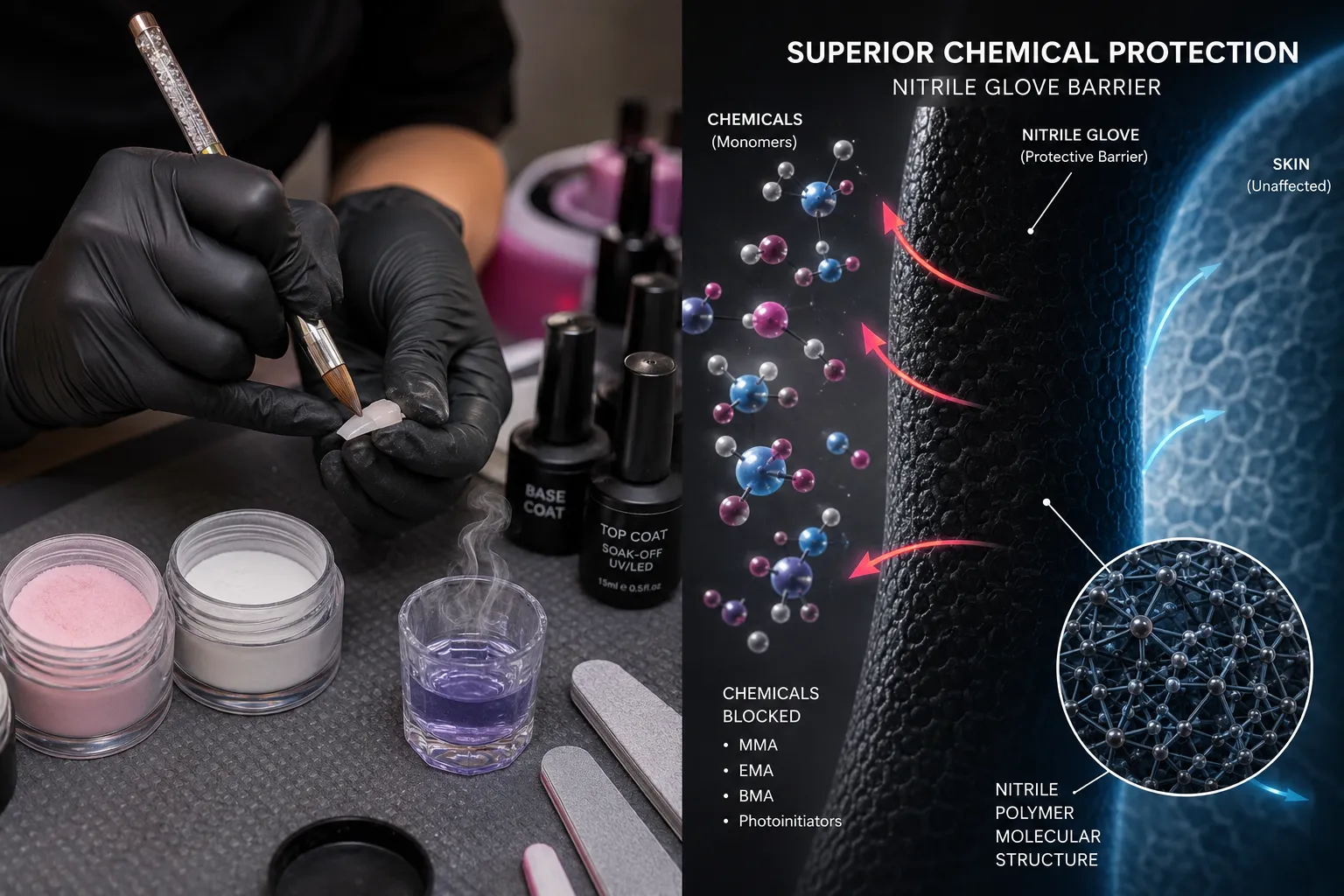
Nitrile gloves do not protect against inhaled acrylic monomer fumes because gloves only create a barrier on the skin, not in the respiratory system. While nitrile gloves effectively prevent liquid acrylic monomers from contacting and absorbing through the skin, they cannot filter airborne chemical vapors that enter through the nose and mouth.
Acrylic monomer vapors, particularly from ethyl methacrylate (EMA) and the more hazardous methyl methacrylate (MMA), become airborne during the application process. These vapors cause respiratory irritation, headaches, dizziness, and can lead to occupational asthma with chronic exposure. Nitrile gloves address only the dermal exposure route.
Complete protection from acrylic monomers requires:
- Nitrile gloves (4-6 mil thickness) to prevent skin contact with liquid monomer
- Proper ventilation systems with downdraft tables that capture fumes at the source
- Adequate general room ventilation with 10-15 air changes per hour
- Respiratory protection (N95 or organic vapor cartridge respirators) for high-exposure situations
- Proper technique to minimize monomer spills and vapor generation
The distinction matters because many salon workers assume gloves provide complete protection. Skin absorption represents one exposure pathway, but inhalation often contributes more to total chemical exposure in poorly ventilated salons. A technician wearing gloves but working without proper ventilation still faces significant health risks.
Choose gloves specifically rated for ketone and ester resistance when working with acrylic systems. Standard thin nitrile gloves (2-3 mil) may allow some permeation over extended contact periods, while thicker options (5-6 mil) provide longer breakthrough times.
What Thickness Nitrile Gloves Are Best for Salon Work?
The best thickness for salon nitrile gloves is 4-6 mil, which balances chemical protection with the tactile sensitivity needed for detailed nail work. This thickness range provides adequate barrier protection against acetone, gel polish, and acrylic monomers while maintaining enough dexterity to handle small nail art brushes, apply rhinestones, and perform precise cuticle work.
Glove thickness directly affects both protection and performance. Thinner gloves (2-3 mil) offer maximum sensitivity but provide minimal chemical resistance and tear easily during normal salon tasks. Thicker gloves (8+ mil) deliver excellent chemical protection but reduce tactile feedback to the point where fine detail work becomes difficult.
Thickness recommendations by salon task:
- Basic manicures and polish application: 4 mil nitrile gloves provide sufficient protection for standard nail polish and basic cuticle work
- Gel polish and removal: 5-6 mil gloves recommended due to extended acetone exposure during removal
- Acrylic nail application: 6 mil gloves offer better protection against monomer liquid splashes and extended chemical contact
- Nail art and detailed work: 4-5 mil gloves maintain the finger sensitivity needed for intricate designs
- Salon cleaning and disinfection: 6-8 mil gloves appropriate for handling concentrated cleaning chemicals
The mil measurement refers to one-thousandth of an inch. A 5 mil glove measures 0.005 inches thick, roughly the thickness of a standard sheet of paper. Most salon professionals cannot perform detailed work effectively in gloves thicker than 6-7 mil due to reduced tactile feedback.
Consider that glove thickness alone doesn’t determine chemical resistance. The nitrile formulation, manufacturing quality, and specific chemical exposure all affect breakthrough time. A high-quality 5 mil glove from a reputable manufacturer typically outperforms a cheap 6 mil glove in actual chemical resistance.
For detailed guidance on selecting appropriate thickness, review our comparison of thin vs. thick nitrile gloves.
How Often Should You Change Gloves During a Manicure Service?
Change nitrile gloves between each client and immediately after any visible contamination, chemical spill, or glove damage during service. At minimum, fresh gloves must be worn for each new client to prevent cross-contamination and maintain hygiene standards. During a single service, gloves should be changed whenever they contact non-client surfaces, become visibly soiled, or after extended chemical exposure.
Professional infection control standards require new gloves for each client regardless of the service type. This practice prevents the transmission of bacteria, fungi, and viruses between clients. Even if gloves appear clean, microscopic contamination occurs during normal use.
Specific situations requiring immediate glove changes during service:
- After touching door handles, phones, or other non-sanitized surfaces
- Following any chemical spill or heavy acetone exposure (change within 5-10 minutes)
- When gloves show visible tears, punctures, or degradation
- After handling payment, paperwork, or personal items
- Between different service phases (e.g., after nail prep before polish application)
- If gloves become loose or uncomfortable, compromising dexterity
- After removing gloves to perform any task, never re-glove the same pair
Extended acetone exposure degrades even high-quality nitrile gloves. When performing gel polish removal that involves prolonged acetone contact (10+ minutes), consider changing gloves midway through the removal process. Acetone can permeate nitrile after 15-20 minutes of continuous contact, reducing protection.
A common mistake involves touching contaminated surfaces while gloved and continuing to work on the client. This defeats the protective purpose of gloves. Train staff to recognize contamination events and develop the habit of immediate glove changes.
Budget for 2-4 pairs of gloves per client service on average. A basic manicure might require only one pair if no contamination occurs, while a full set of acrylic nails with art might require three or four pairs due to multiple chemical exposures and task transitions.
Can You Still Get Contact Dermatitis Wearing Nitrile Gloves in Salons?
Yes, salon workers can develop contact dermatitis even while wearing nitrile gloves, though the risk is significantly lower than working without gloves. Contact dermatitis from glove use typically results from three causes: irritation from moisture trapped inside gloves (irritant contact dermatitis), allergic reactions to chemical additives in the gloves themselves, or chemical breakthrough when gloves are worn too long or are inadequate for the exposure.
Irritant contact dermatitis represents the most common glove-related skin problem. Wearing occlusive gloves for extended periods traps sweat and moisture against the skin, causing maceration, redness, and irritation. This condition worsens in warm salon environments or when gloves are worn continuously for hours without breaks.
Factors that increase dermatitis risk despite glove use:
- Wearing gloves continuously for more than 2-3 hours without breaks
- Using gloves that are too tight, restricting circulation and increasing sweating
- Failing to dry hands thoroughly before gloving
- Pre-existing skin conditions like eczema or psoriasis
- Chemical breakthrough from worn, damaged, or inadequate gloves
- Allergic reactions to accelerators or processing chemicals in nitrile gloves
- Washing hands excessively between glove changes, stripping natural skin oils
Some individuals develop Type IV delayed hypersensitivity reactions to chemical accelerators used in nitrile glove manufacturing, such as thiurams, carbamates, or mercaptobenzothiazole. While less common than latex allergies, these reactions cause itching, redness, and dry, cracked skin appearing 24-48 hours after exposure.
Prevention strategies:
- Limit continuous glove wear to 2-3 hour periods with 10-15 minute breaks
- Apply fragrance-free, dye-free hand moisturizer before and after glove use
- Ensure hands are completely dry before putting on gloves
- Choose powder-free gloves to avoid cornstarch irritation
- Select gloves labeled “low dermatitis potential” or “reduced accelerator”
- Wear properly fitted gloves (not too tight or too loose)
- Consider cotton glove liners for extended wear situations
If dermatitis develops despite proper glove use, consult a dermatologist for patch testing to identify specific allergens. Some technicians require specialized gloves with alternative accelerator systems or may need to use glove liners as a barrier.
For information on nitrile glove allergies, see our article on allergic reactions to nitrile gloves.
Nitrile vs Vinyl Gloves for Nail Salon: Which is Better?
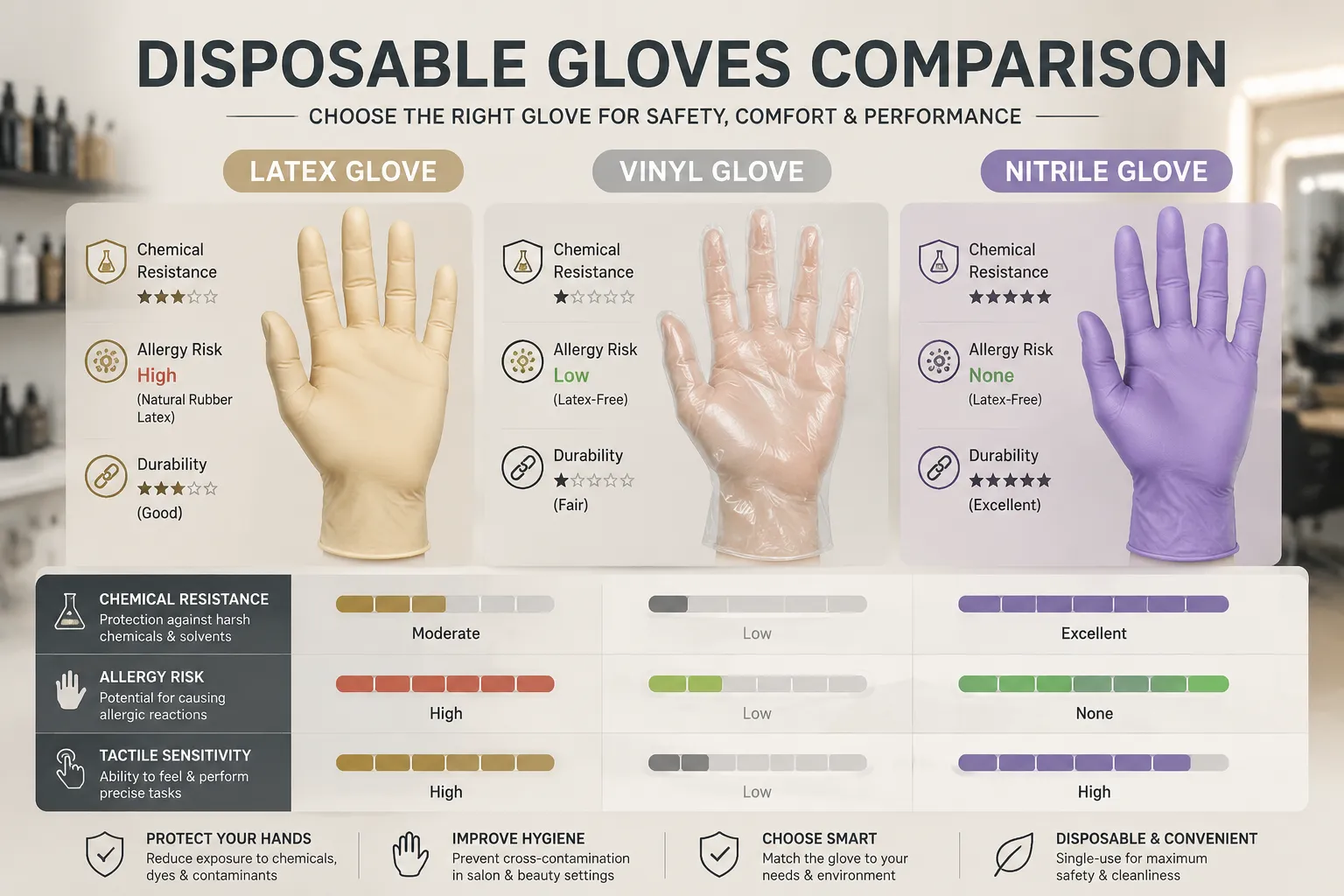
Nitrile gloves are significantly better than vinyl gloves for nail salon work due to superior chemical resistance, durability, and fit. Vinyl gloves offer minimal protection against acetone, acrylic monomers, and other salon chemicals, making them unsuitable for tasks involving chemical exposure. While vinyl gloves cost less (3-5 cents per glove versus 8-15 cents for nitrile), this savings comes at the expense of protection and performance.
Vinyl gloves are made from polyvinyl chloride (PVC), a rigid plastic that requires plasticizers to achieve flexibility. These plasticizers can leach out over time, and the material provides poor resistance to organic solvents commonly used in salons. Acetone penetrates vinyl gloves almost immediately, and the gloves often become brittle or sticky when exposed to nail products.
Direct comparison for salon applications:
| Feature | Nitrile Gloves | Vinyl Gloves |
|---|---|---|
| Acetone resistance | Good (15-20 min) | Poor (1-2 min) |
| Acrylic monomer resistance | Excellent | Poor |
| Puncture resistance | High | Low |
| Fit and dexterity | Excellent, form-fitting | Loose, baggy fit |
| Tactile sensitivity | High | Moderate to low |
| Durability during use | Rarely tears | Tears easily |
| Cost per glove | $0.08-0.15 | $0.03-0.05 |
| Allergy risk | Very low | Very low |
Vinyl gloves may be acceptable for very limited salon tasks that involve no chemical exposure, such as basic dry nail filing or applying pre-made press-on nails without adhesive. However, most salon services involve some chemical contact, making nitrile the more practical choice.
The loose fit of vinyl gloves creates another significant disadvantage for precision work. Vinyl doesn’t conform to the hand like nitrile, resulting in excess material at fingertips that interferes with detailed nail art, precise cuticle work, and handling small implements. This poor fit increases the risk of contamination as loose glove material can drag through wet polish or contact unintended surfaces.
Choose nitrile over vinyl when:
- Any chemical exposure is expected (polish, remover, acrylics, gels)
- Performing detailed work requiring tactile sensitivity
- Puncture risk exists from sharp tools or implements
- Extended wear time is needed
- Professional appearance matters to your salon brand
Vinyl might suffice only for:
- Very brief, non-chemical tasks
- Situations where cost is the absolute primary concern
- Tasks involving only dry materials with no sharp objects
For most salon professionals, the small additional cost of nitrile gloves is justified by the significantly better protection and performance. The difference amounts to roughly $5-10 per 100 gloves, a minimal investment for proper hand protection.
Learn more about glove selection in our guide to the best disposable gloves for salon services.
Do Cheap Nitrile Gloves Protect Against Acetone and Gel Polish?
Cheap nitrile gloves provide limited protection against acetone and gel polish, typically offering 5-10 minutes of barrier protection compared to 15-20 minutes for quality nitrile gloves. The protection level depends on the nitrile formulation, manufacturing quality, and actual thickness rather than just the advertised mil rating. Budget nitrile gloves often use thinner material, lower-grade nitrile compounds, or inconsistent manufacturing that creates weak spots and premature breakthrough.
Not all nitrile is created equal. Premium nitrile gloves use higher-quality synthetic rubber with specific additives that enhance chemical resistance. Cheap gloves may use recycled nitrile, lower-grade polymers, or thinner coatings that reduce protective properties. Some budget manufacturers also overstate thickness ratings, advertising 5 mil gloves that actually measure closer to 3-4 mil.
Signs of low-quality nitrile gloves:
- Inconsistent thickness (thin spots visible when stretched)
- Strong chemical odor when opening the box
- Gloves stick together or feel tacky
- Tears or punctures occur during normal donning
- Visible pinholes when held up to light
- Loose, baggy fit that doesn’t conform to the hand
- Rapid degradation when exposed to acetone (visible swelling or stickiness within 5 minutes)
Quality nitrile gloves should maintain integrity for 15-20 minutes of continuous acetone contact during typical gel polish removal. Cheap gloves may show degradation within 5-10 minutes, evidenced by the material becoming sticky, swollen, or discolored. Once degradation begins, chemical breakthrough occurs rapidly.
Testing glove quality:
- Stretch test: Quality nitrile stretches significantly before tearing
- Acetone test: Apply acetone to glove exterior and monitor for 10 minutes
- Thickness consistency: Check multiple gloves from the box for uniform thickness
- Fit test: Quality gloves conform to hand shape without excessive bagginess
For occasional, brief acetone exposure, budget nitrile gloves may provide adequate protection if changed frequently. For professional salon use with repeated daily chemical exposure, investing in quality gloves from reputable manufacturers provides better protection and often better value through reduced glove changes and fewer skin problems.
Expect to pay $8-15 per 100 gloves for quality salon-grade nitrile. Gloves priced below $6 per 100 typically sacrifice quality, though bulk purchasing from reputable suppliers can reduce costs. The price difference amounts to pennies per service but significantly impacts protection.
Are Powder-Free Nitrile Gloves Necessary for Beauty Salons?
Powder-free nitrile gloves are strongly recommended for beauty salons and should be considered necessary for professional nail services. The cornstarch powder used in powdered gloves can contaminate nail services by leaving residue on nails that interferes with polish adhesion, causes cloudiness in gel applications, and creates texture problems in acrylic work. Additionally, airborne powder particles can cause respiratory irritation in both technicians and clients.
Powdered gloves use cornstarch to make donning easier by reducing friction between the glove and skin. However, this powder transfers to everything the gloved hand touches. In nail services, even small amounts of powder residue prevent proper adhesion of gel polish, cause lifting of enhancements, and create visible texture in the finished work.
Problems caused by powdered gloves in salons:
- Powder residue on nail plate prevents gel polish from curing properly
- Contamination causes premature lifting and service failure
- Airborne powder irritates respiratory systems, especially in poorly ventilated salons
- Powder can trigger or worsen latex allergies when latex proteins bind to powder particles
- Creates visible white residue on dark clothing and salon surfaces
- Interferes with proper adhesion of nail tips and wraps
- Causes cloudiness or bubbling in liquid acrylic systems
Powder-free nitrile gloves use polymer coatings or chlorination treatments to reduce friction and ease donning without powder. Modern powder-free gloves don approximately as easily as powdered versions, eliminating the traditional advantage of powdered gloves.
Additional benefits of powder-free gloves:
- No contamination risk to nail services
- Reduced respiratory irritation for staff and clients
- Cleaner salon environment with less dust
- Better for technicians with sensitive skin
- No powder residue on clothing or surfaces
The cost difference between powdered and powder-free nitrile gloves is minimal, typically less than $1 per 100 gloves. Given the service quality issues and health concerns associated with powder, this small price difference makes powder-free gloves the clear choice for professional salons.
Some jurisdictions have banned or restricted powdered gloves in healthcare and food service settings due to health concerns. While beauty salons may not face the same regulations, the same health and contamination concerns apply.
What Chemicals in Nail Salons Require Glove Protection?
Nail salon chemicals requiring glove protection include acetone, acrylic monomers (EMA and MMA), gel polish removers, nail primers, dehydrators, and disinfectants. These chemicals can cause skin irritation, chemical burns, allergic sensitization, and long-term dermatological damage with repeated unprotected exposure. Nitrile gloves provide essential barrier protection against these substances, though glove selection must match the specific chemical exposure.
The most hazardous salon chemicals include acrylic monomers, which can cause severe allergic reactions and skin sensitization. Methyl methacrylate (MMA), though banned in many jurisdictions, still appears in some products and causes particularly severe reactions. Ethyl methacrylate (EMA), the legal alternative, also requires protection despite being less hazardous.
High-priority chemicals requiring glove protection:
- Acetone: Primary ingredient in polish removers and gel polish removers; causes skin drying, cracking, and dermatitis
- Acrylic monomers (EMA/MMA): Liquid component of acrylic systems; causes allergic sensitization and severe contact dermatitis
- Gel polish removers: Often contain acetone or acetonitrile; similar skin effects to pure acetone
- Nail primers: Contain methacrylic acid or other acids; can cause chemical burns
- Nail dehydrators: Contain isopropyl alcohol and other drying agents
- Disinfectants: Quaternary ammonium compounds, phenolics, or bleach solutions; cause skin irritation
Moderate-priority chemicals:
- Nail polish: Contains toluene, formaldehyde, and other solvents
- Cuticle removers: Contain sodium or potassium hydroxide (alkaline chemicals)
- Nail glues: Contain cyanoacrylate; bonds to skin instantly
- Dip powder liquids: Contain cyanoacrylate and other reactive chemicals
Even products marketed as “natural” or “non-toxic” may contain chemicals that irritate skin with repeated exposure. The cumulative effect of multiple low-level exposures throughout a workday can equal or exceed the impact of a single high-level exposure.
Glove protection should be used for any product that carries warning labels about skin contact, has a strong chemical odor, or causes any tingling, burning, or irritation sensation on skin. When in doubt, check the Safety Data Sheet (SDS) for the product, which lists required personal protective equipment.
For related information on chemical resistance, see our article on nitrile gloves for tattooing chemicals.
Can Nitrile Gloves Cause Allergic Reactions in Salon Workers?
Nitrile gloves can cause allergic reactions in salon workers, though this occurs far less frequently than latex allergies. Type IV delayed hypersensitivity reactions to chemical accelerators used in nitrile manufacturing affect approximately 1-2% of glove users compared to 8-12% for latex allergies. Symptoms include itching, redness, dry cracked skin, and eczema-like rashes appearing 24-48 hours after exposure, typically affecting the hands, wrists, and forearms.
The allergic reactions to nitrile gloves result from chemical additives used during manufacturing, not from the nitrile rubber itself. Common allergens include thiurams, carbamates, mercaptobenzothiazole (MBT), and thioureas used as accelerators in the vulcanization process. These chemicals remain in trace amounts in the finished gloves.
Distinguishing nitrile allergy from other causes:
- Type IV nitrile allergy: Delayed reaction (24-48 hours), dry scaly rash, affects areas contacted by gloves
- Irritant dermatitis: Immediate to several hours, red irritated skin, related to moisture and friction
- Latex allergy: Immediate to 1 hour (Type I) or delayed (Type IV), can include respiratory symptoms
- Chemical exposure: Immediate burning or irritation, often affects fingertips first
True nitrile allergies require patch testing by a dermatologist to identify the specific chemical accelerator causing the reaction. Once identified, affected individuals can switch to nitrile gloves manufactured with alternative accelerator systems that don’t contain their specific allergen.
Options for nitrile-sensitive individuals:
- Accelerator-free nitrile gloves (specialty products with alternative curing systems)
- Nitrile gloves with reduced accelerator content
- Polyethylene or polyisoprene gloves as alternatives
- Cotton glove liners worn under nitrile gloves to reduce direct contact
- Rotation between different glove brands using different accelerator systems
Symptoms that suggest true nitrile allergy rather than irritation include: reaction occurs with multiple nitrile glove brands, symptoms persist for days after stopping glove use, reaction spreads beyond gloved areas, and antihistamines provide some relief. Irritant dermatitis typically improves within 24 hours of stopping glove use and responds to moisturizers.
Prevention strategies include choosing gloves labeled “low dermatitis potential,” limiting continuous wear time, keeping hands dry before gloving, and using fragrance-free moisturizers. If symptoms develop, discontinue use and consult a dermatologist before permanent sensitization occurs.
For comprehensive information on nitrile allergies, review our guide on nitrile glove allergic reaction symptoms.
How Much Do Nitrile Gloves Cost for a Busy Nail Salon Per Month?
A busy nail salon typically spends $120-$300 per month on nitrile gloves, depending on client volume, services offered, and glove quality. This estimate assumes 150-300 clients per month, using an average of 2-4 pairs of gloves per client service. High-volume salons performing primarily acrylic or gel services requiring frequent glove changes may spend $400-$500 monthly, while smaller salons focusing on basic manicures might spend $80-$150.
Cost calculations depend on several variables: glove price per unit, number of technicians, services performed, and glove change frequency. Quality salon-grade nitrile gloves cost $8-15 per 100 gloves ($0.08-0.15 per pair), with bulk purchasing reducing unit costs.
Sample cost calculations:
Small salon (1-2 technicians, 150 clients/month):
- Average 2 pairs per client = 300 pairs monthly
- At $0.10 per pair = $30 per month
- Add 20% for cleaning/miscellaneous = $36 total
Medium salon (3-4 technicians, 300 clients/month):
- Average 3 pairs per client = 900 pairs monthly
- At $0.12 per pair = $108 per month
- Add 20% for cleaning/miscellaneous = $130 total
Large salon (5+ technicians, 500 clients/month):
- Average 3.5 pairs per client = 1,750 pairs monthly
- At $0.12 per pair = $210 per month
- Add 20% for cleaning/miscellaneous = $252 total
Factors increasing glove costs:
- Acrylic and gel services require more frequent changes than basic manicures
- Proper infection control protocols require changing gloves between tasks
- Training new staff often results in higher glove usage
- Offering services with extended chemical exposure
- Using premium gloves (6+ mil thickness) for better protection
Cost reduction strategies:
- Bulk purchasing (cases of 1,000+ gloves) reduces unit cost by 20-30%
- Proper staff training reduces unnecessary glove changes
- Right-sizing glove orders prevents waste from expired inventory
- Choosing appropriate thickness for each task (not always using thickest gloves)
- Establishing relationships with medical supply distributors for better pricing
Compare glove costs to other salon expenses: gloves typically represent 0.5-1.5% of total product costs and less than 0.3% of gross revenue for most salons. This minimal expense provides essential protection for staff health and demonstrates professional standards to clients.
Budget approximately $1-2 per client for glove costs when calculating service pricing. This ensures adequate protection without significantly impacting profitability. Cutting corners on glove quality or usage frequency to save money ultimately costs more through staff health problems, service quality issues, and potential liability.
Do You Need to Wear Gloves for Every Client in a Salon?
Yes, professional standards and infection control best practices require wearing fresh gloves for every client in a salon, regardless of the service performed. This practice prevents cross-contamination of bacteria, fungi, viruses, and chemicals between clients and protects both the technician and client from potential infections. Many jurisdictions legally require glove use for services involving potential blood exposure, such as cuticle work, though requirements vary by location.
Universal precautions in salon settings treat all clients as potentially infectious, similar to healthcare protocols. Even clients without visible infections can carry bloodborne pathogens or contagious skin conditions. Gloves create a barrier that prevents transmission in both directions.
Services requiring mandatory glove use:
- Any service involving potential blood exposure (cuticle cutting, callus removal)
- Working on clients with visible cuts, wounds, or skin conditions
- Applying or removing artificial nails (acrylics, gels, dips)
- Gel polish application and removal
- Handling contaminated implements before disinfection
- Cleaning and disinfecting workstations
Services where gloves are strongly recommended:
- Basic manicures and pedicures
- Nail polish application
- Nail art and design work
- Any service involving chemical products
- Working with clients of unknown health status
Some technicians question whether gloves are necessary for “dry” services like basic nail filing or buffing on healthy nails. However, microscopic skin particles, nail dust, and bacteria transfer during these services. Additionally, starting a service without gloves and then needing to glove mid-service (if bleeding occurs) creates contamination risks.
Regulatory requirements vary by jurisdiction:
- Some states require gloves for all services involving skin contact
- Others mandate gloves only for services with blood exposure risk
- Certain jurisdictions require gloves for chemical handling
- Local health departments may have additional requirements
Beyond regulatory compliance, glove use demonstrates professionalism and hygiene consciousness to clients. In 2026, clients increasingly expect to see their technician wearing gloves as a standard practice, viewing it as a sign of a quality, safety-conscious salon.
Exceptions and special considerations:
- Brief consultations or nail shape discussions without touching may not require gloves
- Demonstrating techniques on practice hands may not require gloves
- Administrative tasks between clients don’t require gloves
The cost of gloves per service ($0.20-0.60) is minimal compared to the protection provided and the professional image conveyed. Establish salon policies requiring glove use for all client services to ensure consistent standards across all staff members.
What Are Common Mistakes Salon Owners Make with Glove Usage?
Common mistakes salon owners make with glove usage include purchasing inadequate gloves to save money, failing to train staff on proper glove protocols, allowing glove reuse between clients, and not enforcing glove changes after contamination. These errors compromise both staff safety and service quality while creating potential liability issues. The most costly mistake is treating gloves as an optional expense rather than essential protective equipment.
Many salon owners underestimate the importance of glove quality, purchasing the cheapest available options without considering chemical resistance or durability. This false economy results in inadequate protection, more frequent glove changes, and potential skin problems for staff that lead to lost work time and workers’ compensation claims.
Critical glove usage mistakes:
- Buying inadequate gloves: Purchasing vinyl or thin nitrile gloves that don’t protect against salon chemicals
- Insufficient inventory: Running out of gloves and allowing staff to work unprotected or reuse gloves
- No glove protocols: Failing to establish clear policies about when gloves must be changed
- Poor training: Not teaching staff proper donning/doffing techniques or contamination awareness
- Wrong sizes: Stocking only medium gloves when staff need various sizes for proper fit
- Ignoring complaints: Dismissing staff reports of skin irritation or glove problems
- Reuse culture: Allowing or encouraging glove reuse to save money
Specific protocol failures:
- Staff touching phones, door handles, or money while gloved and continuing to work on clients
- Not changing gloves between different service phases (prep, application, cleanup)
- Wearing gloves for extended periods (3+ hours) without breaks
- Storing gloves improperly (in direct sunlight or near chemicals)
- Using expired gloves with degraded protective properties
Training gaps that create problems:
- Staff don’t understand which chemicals require glove protection
- Technicians don’t recognize signs of glove degradation
- No instruction on proper glove fit and sizing
- Lack of awareness about contamination events requiring glove changes
- No education about contact dermatitis prevention
The financial impact of these mistakes extends beyond the direct cost of gloves. Inadequate protection leads to occupational skin diseases that cause staff absences, workers’ compensation claims, and potential OSHA violations. Service quality suffers when glove contamination causes polish lifting, gel curing problems, or acrylic application issues.
Best practices for salon owners:
- Budget adequately for quality gloves (1-2% of product costs)
- Stock multiple sizes and maintain sufficient inventory
- Establish written glove protocols and train all staff
- Conduct periodic observations to ensure compliance
- Address skin problems immediately before sensitization occurs
- Calculate glove costs per service and include in pricing
- Choose gloves appropriate for specific services offered
Invest time in proper staff training when introducing new glove protocols. Explain the reasoning behind requirements rather than just mandating compliance. Staff who understand the health risks and service quality issues are more likely to follow protocols consistently.
Are Black Nitrile Gloves Safe for Salon Use or Just for Looks?
Black nitrile gloves are completely safe for salon use and provide the same chemical protection and barrier properties as blue, purple, or other colored nitrile gloves. The color difference results from pigments added during manufacturing and does not affect the glove’s protective qualities, chemical resistance, or safety. Black gloves have become popular in salons primarily for aesthetic reasons, creating a sleek, professional appearance that many salon owners and clients prefer.
The misconception that black gloves are inferior or “just for looks” likely stems from the medical industry’s traditional use of blue or white gloves, creating an association between those colors and quality. In reality, glove performance depends on the nitrile formulation, thickness, and manufacturing quality, not color.
Advantages of black nitrile gloves in salons:
- Hide stains from nail polish, acrylics, and other colored products
- Create a modern, professional aesthetic many clients prefer
- Show less visible wear during use
- Provide psychological comfort for clients who associate bright colors with medical settings
- Complement salon decor and branding
Potential considerations:
- Slightly harder to detect small tears or punctures compared to lighter colors
- May show powder residue more visibly (if using powdered gloves)
- Can make it harder to see product contamination on glove surface
- Some clients may initially associate black gloves with industrial rather than medical use
Quality matters far more than color. A premium black nitrile glove from a reputable manufacturer outperforms a cheap blue glove in every metric. When selecting black gloves, apply the same quality criteria used for any nitrile glove: appropriate thickness (4-6 mil for salon work), powder-free formulation, good chemical resistance ratings, and consistent manufacturing quality.
Verifying black glove quality:
- Check manufacturer specifications for chemical resistance
- Verify thickness ratings match actual measurements
- Test gloves with acetone to confirm adequate resistance
- Ensure gloves meet relevant standards (ASTM, EN, or ISO)
- Purchase from reputable medical or salon supply distributors
Some salons use color-coding systems with different colored gloves for different service types or to distinguish between technicians. Black gloves work well in these systems and can be combined with other colors for organizational purposes.
The choice between black and other colors ultimately comes down to salon preference and branding. Both provide equal protection when quality is equivalent. Many salons stock both black gloves for services where aesthetics matter and blue or purple gloves for services where visibility of contamination is more important.
For comprehensive information on black nitrile gloves, see our article on black nitrile gloves.
Frequently Asked Questions
Can nitrile gloves be washed and reused in salons?
No, nitrile gloves are designed for single-use only and should never be washed and reused. Washing damages the glove material, creates microscopic tears that compromise barrier protection, and cannot adequately remove chemical or biological contamination. Always use fresh gloves for each client and task.
How long can you safely wear nitrile gloves continuously?
Limit continuous nitrile glove wear to 2-3 hours maximum to prevent moisture buildup and skin irritation. Take 10-15 minute breaks without gloves to allow hands to dry and breathe. Extended wear increases the risk of irritant contact dermatitis even with quality gloves.
Do nitrile gloves protect against UV lamp exposure during gel curing?
Nitrile gloves provide minimal UV protection and should not be relied upon to prevent UV exposure during gel curing. The thin material allows significant UV penetration. Use fingerless gloves or apply sunscreen to hands before gel services for proper UV protection.
What should you do if a nitrile glove tears during service?
Immediately stop work, remove the torn glove, wash hands thoroughly, and don a fresh pair of gloves before continuing. Inspect the work area for any contamination from the tear. Never attempt to continue working with a torn glove or patch it with tape.
Are textured nitrile gloves better than smooth for salon work?
Textured fingertips provide better grip for handling tools and small objects, making them preferable for most salon work. Fully textured gloves offer maximum grip but may feel less comfortable. Smooth gloves work adequately for basic services but can be slippery when handling implements.
Can you develop a tolerance to salon chemicals by not wearing gloves?
No, repeated unprotected exposure to salon chemicals does not build tolerance. Instead, it increases the risk of developing chemical sensitization and allergic reactions that worsen with continued exposure. Once sensitization occurs, even minimal exposure can trigger severe reactions.
Do nitrile gloves expire and how should they be stored?
Yes, nitrile gloves typically have a shelf life of 3-5 years from manufacture. Store gloves in a cool, dry location away from direct sunlight, ozone sources, and chemicals. Expired gloves may have reduced elasticity and chemical resistance. Check packaging for expiration dates.
Should salon owners provide different glove sizes for staff?
Yes, providing multiple glove sizes (small, medium, large, extra-large) is essential for proper fit and protection. Ill-fitting gloves reduce dexterity, increase contamination risk, and cause discomfort that discourages proper use. Stock sizes based on your staff’s needs.
Are nitrile gloves safe for clients with sensitive skin?
Yes, nitrile gloves are hypoallergenic and safe for use on clients with sensitive skin. Unlike latex, nitrile contains no natural rubber proteins that trigger allergies. However, ensure gloves are powder-free to avoid irritation from cornstarch powder.
Can you use hand sanitizer while wearing nitrile gloves?
While alcohol-based hand sanitizer won’t immediately damage nitrile gloves, it’s not recommended as a substitute for changing gloves. Sanitizer doesn’t remove contamination from glove surfaces and repeated application degrades glove material over time. Change gloves instead of sanitizing them.
What certifications should quality salon nitrile gloves have?
Look for gloves meeting ASTM D6319 (nitrile examination gloves), FDA approval for medical use, or EN 374 (chemical resistance) standards. These certifications verify the gloves meet minimum quality and performance standards for protective use.
Do nitrile gloves protect against formaldehyde in nail products?
Nitrile gloves provide good protection against formaldehyde exposure through skin contact. However, formaldehyde is volatile and creates fumes that gloves cannot protect against. Proper ventilation is essential when working with formaldehyde-containing products.
Conclusion
Nitrile gloves in beauty salons provide essential protection from chemicals, acrylics, and nail products while maintaining the dexterity needed for precise nail services. Choosing quality powder-free nitrile gloves in the 4-6 mil thickness range offers the best balance of chemical resistance, tactile sensitivity, and comfort for professional salon work. Unlike latex gloves that cause allergic reactions or vinyl gloves that offer minimal protection, nitrile gloves deliver reliable barrier protection against acetone, acrylic monomers, gel polish removers, and other harsh salon chemicals.
Proper glove usage requires more than just purchasing quality gloves. Establish clear protocols for glove changes between clients, after contamination events, and during extended chemical exposure. Train staff to recognize signs of glove degradation, understand which chemicals require protection, and practice proper donning and doffing techniques. Budget adequately for gloves as essential protective equipment rather than viewing them as an optional expense.
Immediate action steps for salon owners:
- Evaluate current glove inventory and upgrade to quality nitrile gloves (4-6 mil, powder-free)
- Stock multiple sizes to ensure proper fit for all staff members
- Establish written glove protocols specifying when changes are required
- Train staff on proper glove use, contamination awareness, and skin protection
- Budget $120-$300 monthly for gloves based on salon volume
- Monitor staff for signs of contact dermatitis and address problems immediately
- Maintain adequate inventory to prevent running out of gloves
For nail technicians:
- Change gloves between every client without exception
- Limit continuous wear to 2-3 hours with breaks for hand health
- Apply moisturizer before and after glove use to prevent irritation
- Report any skin problems immediately before sensitization develops
- Never reuse disposable gloves or continue working with torn gloves
The minimal cost of quality nitrile gloves ($0.20-0.60 per service) provides substantial returns through staff health protection, service quality improvement, and professional image enhancement. Investing in proper hand protection demonstrates commitment to both employee safety and client care, distinguishing professional salons from those that cut corners on essential safety measures.
Remember that gloves protect only against dermal exposure. Combine glove use with proper ventilation, appropriate respiratory protection when needed, and good work practices to minimize total chemical exposure. Complete protection requires a comprehensive approach to salon safety, with quality nitrile gloves serving as a critical component of that system.
SEO Meta Title: Nitrile Gloves in Beauty Salons: Chemical Protection Guide