Last updated: June 30, 2026
Quick Answer
The nitrile glove market has shifted dramatically from the pandemic-era shortage to a significant oversupply, with global production capacity exceeding demand by approximately 30-40% in 2026. This buyer’s market enables procurement teams to negotiate substantially lower prices, secure better quality terms, and establish innovation partnerships with manufacturers competing for long-term contracts. Strategic sourcing now requires balancing immediate cost savings against supply chain stability as market consolidation eliminates weaker producers.
Key Takeaways
- Global nitrile glove production capacity expanded by over 200% during the pandemic but demand has returned to near pre-pandemic levels, creating substantial oversupply
- Prices have declined 70-85% from 2020 peak levels, with examination-grade nitrile gloves now trading near or below pre-pandemic pricing
- Market consolidation is accelerating as smaller manufacturers exit the market or merge, with an estimated 20-30% of pandemic-era capacity expected to close by 2027
- Procurement teams can leverage oversupply conditions to negotiate multi-year contracts with price protections, quality guarantees, and innovation commitments
- Tier-one manufacturers remain financially stable and are investing in automation and sustainability, making them preferred long-term partners
- Switching suppliers purely for cost savings carries risks including quality variability, regulatory compliance issues, and supply chain disruption
- The oversupply period is expected to persist through 2027-2028 before market equilibrium returns, providing an extended window for strategic sourcing initiatives
- Balancing cost reduction with supplier financial stability is critical to avoid supply chain disruptions when weaker manufacturers fail
- Quality standards are under pressure as manufacturers compete on price, requiring enhanced supplier audits and quality verification protocols
- Strategic buyers are using this period to consolidate supplier bases, establish preferred partnerships, and secure innovation commitments for next-generation products

What Is Nitrile Glove Market Consolidation and Why Is It Happening
Nitrile glove market consolidation refers to the ongoing process where manufacturers merge, exit the market, or reduce capacity in response to severe oversupply conditions that emerged after pandemic demand normalized. This consolidation is driven by unsustainable pricing pressure, overcapacity, and the financial strain on manufacturers who expanded aggressively during 2020-2021.
During the COVID-19 pandemic, nitrile glove prices surged 500-800% above baseline levels, prompting massive capacity expansion across Southeast Asia, particularly in Malaysia, Thailand, Vietnam, and China. Established manufacturers doubled or tripled production lines while hundreds of new entrants launched operations to capitalize on extraordinary profit margins. Global production capacity increased from approximately 400 billion pieces annually in 2019 to over 900 billion pieces by late 2021.
When pandemic-driven demand subsided in 2022, the market faced a structural imbalance. Healthcare facilities had built substantial inventory buffers, and non-healthcare sectors that temporarily increased glove usage returned to normal consumption patterns. The result was a rapid shift from acute shortage to significant oversupply, with capacity utilization rates falling from near 100% during the pandemic to 60-70% by 2023.
Key drivers of consolidation include:
- Unsustainable pricing below production costs for many manufacturers
- High debt burdens from pandemic-era expansion financing
- Inability of smaller producers to compete with established manufacturers’ economies of scale
- Tightening credit conditions and reduced investor appetite for glove sector financing
- Regulatory compliance costs that disproportionately impact smaller operations
- Strategic acquisitions by tier-one manufacturers seeking to gain market share
The consolidation process is expected to continue through 2027, with industry analysts projecting that 20-30% of pandemic-era capacity additions will permanently exit the market. This shakeout will likely favor large, financially stable manufacturers with diversified product portfolios and established customer relationships, particularly those serving healthcare sectors requiring consistent quality standards.
How Much Oversupply Exists in the Nitrile Glove Market Right Now
The nitrile glove market currently faces an oversupply of approximately 30-40% relative to global demand in 2026, with annual production capacity exceeding 900 billion pieces while actual consumption remains around 600-650 billion pieces. This represents one of the most significant supply-demand imbalances in the disposable glove industry’s history.
Capacity utilization rates provide the clearest indicator of oversupply severity. In 2026, average utilization across the industry ranges from 60-70%, compared to the 85-95% rates considered healthy for manufacturing operations. Tier-one manufacturers with diversified customer bases operate at higher utilization (70-80%), while smaller producers and new entrants often run below 50% capacity.
Regional oversupply breakdown:
- Malaysia (world’s largest producer): Capacity of approximately 400 billion pieces annually, utilization around 65-70%
- Thailand: Capacity of 200 billion pieces, utilization approximately 60-65%
- China: Capacity of 180 billion pieces, utilization around 55-60%
- Vietnam: Capacity of 80 billion pieces, utilization approximately 60%
- Other regions: Combined capacity of 40 billion pieces, utilization varies widely
The oversupply has created a buyer’s market with several characteristics that procurement teams can exploit. Manufacturers are competing aggressively for volume contracts, offering extended payment terms, consignment inventory arrangements, and willingness to customize products for specific applications. Lead times have shortened dramatically from the 6-12 month delays common during the pandemic to 2-4 weeks for standard products.
Inventory levels throughout the supply chain remain elevated. Distributors and healthcare systems built substantial safety stock during the shortage period and are now working through excess inventory while negotiating lower prices for replenishment. This inventory overhang extends the oversupply period beyond what production capacity alone would suggest.
The oversupply is not uniform across all product categories. Examination-grade nitrile gloves face the most severe oversupply, while specialized products including chemotherapy gloves, extended-cuff surgical gloves, and gloves for specific industrial applications maintain better supply-demand balance due to higher barriers to entry and specialized manufacturing requirements.
Nitrile Glove Prices in 2026 Versus 2020 Pandemic Pricing
Nitrile glove prices have declined 70-85% from pandemic peak levels, with examination-grade gloves now trading at prices near or slightly below pre-pandemic 2019 levels. In 2026, standard examination-grade nitrile gloves typically cost between 3.5-5.5 cents per piece for large volume buyers, compared to peak pandemic pricing of 25-35 cents per piece in mid-2020.
Price comparison across key periods:
| Period | Price Range (per piece) | Market Conditions |
|---|---|---|
| Pre-pandemic (2019) | 4-6 cents | Balanced supply-demand |
| Pandemic peak (mid-2020) | 25-35 cents | Severe shortage, allocation |
| Post-peak (2021) | 12-18 cents | Shortage easing, capacity expanding |
| Transition (2022-2023) | 7-10 cents | Oversupply emerging |
| Current (2026) | 3.5-5.5 cents | Significant oversupply |
The dramatic price decline reflects both the normalization of supply-demand dynamics and intense competition among manufacturers operating with excess capacity. Many producers are pricing at or near marginal cost to maintain production volumes and preserve market share, accepting minimal or negative margins in the short term.
Price variation in 2026 depends on several factors including order volume, contract duration, payment terms, and supplier tier. Large healthcare systems negotiating multi-year contracts with tier-one manufacturers secure pricing at the lower end of the range (3.5-4.5 cents), while smaller buyers purchasing spot quantities pay premium prices (5-6 cents). Specialized products including textured-finish gloves, extended-cuff versions, and gloves for food handling applications command 10-30% premiums over standard examination grades.
The pricing environment creates opportunities but also risks. Procurement teams can achieve substantial cost savings compared to pandemic-era budgets, but extremely low pricing may indicate supplier financial distress or quality compromises. Buyers should evaluate whether pricing is sustainable for suppliers and whether manufacturers can maintain quality standards and regulatory compliance at current price levels.
Forward pricing expectations suggest prices will remain depressed through 2027 before gradually recovering as market consolidation reduces excess capacity. However, prices are unlikely to return to pandemic peak levels absent another major supply disruption. The new equilibrium price point is expected to settle 10-20% below pre-pandemic levels due to manufacturing efficiency improvements and increased competition.
Best Strategies for Sourcing Nitrile Gloves in a Buyer’s Market
Strategic sourcing in the current buyer’s market requires balancing aggressive cost reduction with supply chain stability and quality assurance. The most effective approach combines multi-year volume commitments with tier-one suppliers, competitive bidding for secondary suppliers, and rigorous quality verification protocols.
Core sourcing strategies for 2026:
1. Establish preferred partnerships with financially stable tier-one manufacturers
Negotiate multi-year contracts (3-5 years) that lock in favorable pricing while ensuring supply continuity. Tier-one manufacturers offer financial stability, consistent quality, regulatory compliance, and innovation capabilities. Volume commitments of 60-70% of total requirements with 2-3 preferred suppliers provide leverage while maintaining competitive tension.
2. Implement competitive secondary sourcing
Allocate 20-30% of volume to secondary suppliers selected through competitive bidding. This maintains pricing pressure on preferred suppliers while providing backup capacity. Rotate secondary suppliers periodically to evaluate emerging manufacturers and prevent complacency.
3. Negotiate comprehensive contract terms beyond price
Leverage oversupply conditions to secure favorable terms including price protection clauses, quality guarantees with financial penalties, consignment inventory arrangements, extended payment terms (60-90 days), and innovation commitments for next-generation products. Many manufacturers will accept these terms to secure volume commitments.
4. Consolidate SKU complexity
Reduce the number of glove specifications and sizes to gain volume leverage and simplify inventory management. Standardization across departments and facilities increases purchasing power and reduces total cost of ownership.
5. Establish rigorous supplier qualification and monitoring
Enhanced due diligence is critical when evaluating new suppliers or those offering exceptionally low pricing. Verify financial stability, manufacturing capabilities, regulatory compliance, and quality management systems. Implement ongoing monitoring including periodic audits, batch testing, and performance scorecards.
6. Build strategic inventory buffers
While avoiding excess inventory, maintain 60-90 day safety stock for critical products. Current pricing makes inventory holding costs minimal compared to supply disruption risks if suppliers fail.
7. Explore innovation partnerships
Use volume commitments to negotiate early access to sustainable products, advanced barrier protection technologies, and customized solutions for specific applications. Manufacturers competing for long-term relationships will invest in innovation for strategic customers.
Common mistakes to avoid:
- Switching suppliers purely for marginal cost savings without evaluating total cost of ownership
- Accepting unsustainably low pricing that signals supplier financial distress
- Neglecting quality verification when evaluating new suppliers
- Over-concentrating supply with a single manufacturer to maximize volume discounts
- Failing to secure contractual protections against quality degradation or supply interruptions
For organizations using nitrile gloves across diverse applications from healthcare to food service to industrial settings, a tiered sourcing strategy works best. Allocate premium products from tier-one suppliers to critical applications while using competitive secondary sources for less demanding uses.
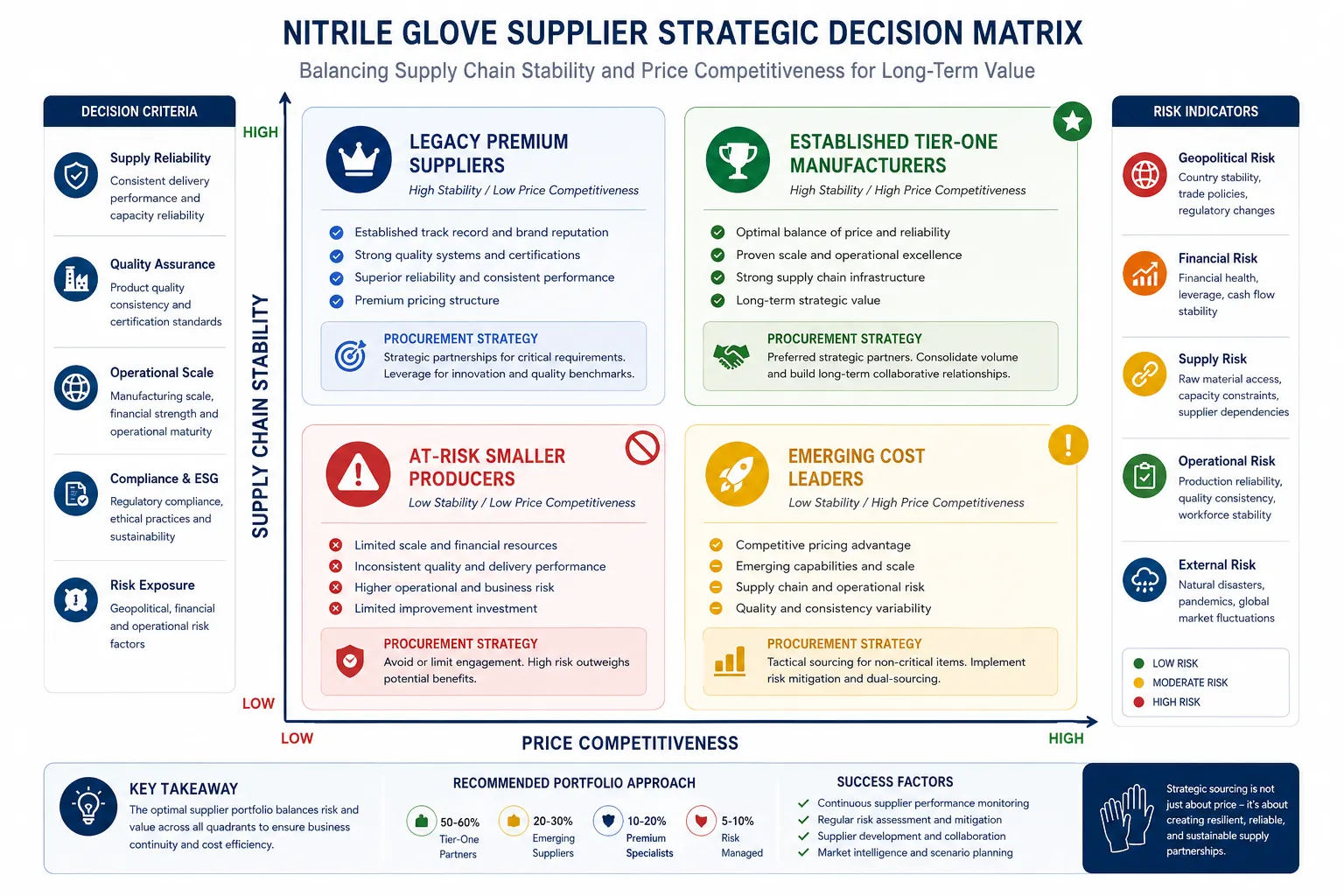
Which Nitrile Glove Manufacturers Are Consolidating or Exiting the Market
Market consolidation is accelerating across the nitrile glove industry, with numerous manufacturers reducing capacity, merging operations, or exiting the market entirely. While specific company financial information is proprietary, industry observers report that 15-25% of manufacturers that entered or expanded during the pandemic have already ceased operations or significantly reduced capacity by 2026.
Consolidation patterns by manufacturer category:
Tier-one established manufacturers including Top Glove, Hartalega, Kossan, Supermax, and Ansell remain financially stable and are using the downturn to gain market share through strategic acquisitions and capacity optimization. These companies have diversified customer bases, strong balance sheets, and established regulatory compliance, positioning them to weather the oversupply period.
Mid-tier manufacturers face the most pressure. Companies that expanded aggressively during the pandemic using debt financing now struggle with debt service obligations while operating at low capacity utilization. Several mid-tier manufacturers have announced capacity reductions, production line closures, or merger discussions. This segment is experiencing the most active consolidation.
New entrants and smaller producers face the highest exit risk. Hundreds of small manufacturers launched operations during 2020-2021, often with limited manufacturing expertise, minimal quality systems, and inadequate capitalization. Many of these operations have already closed or are operating sporadically. Buyers should exercise extreme caution when sourcing from manufacturers established after 2019 without proven track records.
Geographic consolidation trends:
- Malaysia: Some capacity rationalization among smaller producers, but major manufacturers remain stable
- Thailand: Moderate consolidation with several mid-tier manufacturers reducing capacity
- China: Significant exits among smaller producers; larger manufacturers maintaining operations
- Vietnam: Mixed picture with some new entrants struggling while established manufacturers expand
- Other regions: High exit rates among pandemic-era entrants in India, Indonesia, and other emerging markets
Warning signs of supplier financial distress:
- Pricing significantly below market rates (20%+ below comparable suppliers)
- Requests for advance payment or shortened payment terms
- Production delays or inconsistent lead times
- Quality issues or batch-to-batch variability
- Difficulty reaching management or lack of transparency
- Rumors of unpaid suppliers or employee layoffs
- Reduced investment in maintenance or quality systems
Procurement teams should conduct enhanced financial due diligence on suppliers, particularly those outside the tier-one category. Request audited financial statements, verify credit ratings, and monitor industry news for consolidation announcements. Diversifying supply across multiple financially stable manufacturers reduces risk if a supplier exits unexpectedly.
The consolidation process, while disruptive, ultimately benefits buyers by creating a more stable supplier base with manufacturers that can sustain operations through market cycles. Strategic buyers are using this period to establish relationships with survivors that will emerge stronger from the shakeout.
How to Negotiate Better Pricing with Nitrile Glove Suppliers Post-Pandemic
Negotiating favorable pricing in the current oversupply environment requires understanding supplier economics, leveraging competitive dynamics, and structuring contracts that balance cost reduction with supply assurance. Buyers with volume leverage can achieve pricing 20-40% below spot market rates through strategic negotiation.
Effective negotiation tactics for 2026:
Leverage volume commitments strategically
Offer multi-year volume commitments in exchange for aggressive pricing. Manufacturers value volume certainty in the current environment and will discount significantly to secure long-term contracts. Structure commitments with minimum volumes (80% of forecast) and maximum volumes (120% of forecast) to provide flexibility while giving suppliers planning certainty.
Create competitive tension
Conduct structured RFPs with 5-7 qualified suppliers. Share that you are evaluating multiple sources and that price is a significant but not sole selection criterion. Manufacturers competing for volume will sharpen pricing, particularly if they perceive risk of losing the business entirely.
Negotiate total cost of ownership, not just unit price
Request proposals that include extended payment terms (60-90 days), consignment inventory, free freight, vendor-managed inventory, and quality guarantees with financial penalties. These terms reduce total cost even if unit price is slightly higher.
Time negotiations strategically
Manufacturers face quarterly and annual sales targets. Negotiating near quarter-end or year-end can yield additional concessions as sales teams work to meet targets. Similarly, manufacturers with excess inventory may offer aggressive pricing to reduce working capital.
Request most-favored-customer clauses
Negotiate contract terms that automatically adjust your pricing if the supplier offers better terms to comparable customers. This protects against being disadvantaged if market prices decline further.
Bundle requirements across facilities or departments
Consolidate purchasing across your organization to maximize volume leverage. A healthcare system negotiating for multiple hospitals has significantly more leverage than individual facilities negotiating separately.
Negotiate innovation and service commitments
Beyond price, secure commitments for product innovation, technical support, training, and early access to new products. These value-adds differentiate suppliers and provide long-term benefits beyond cost reduction.
Use price benchmarking data
Reference market intelligence on current pricing levels to anchor negotiations. Suppliers are more likely to meet competitive pricing when presented with credible market data.
Structure price protection mechanisms
Include contractual provisions that protect against price increases during the contract term, or limit increases to specific indices (CPI, raw material costs). In an oversupply environment, suppliers will accept these terms to secure business.
Negotiation leverage by buyer type:
- Large healthcare systems: Highest leverage due to volume and multi-year commitment potential; can achieve lowest pricing tier
- Distributors: Strong leverage based on volume and market access; can negotiate favorable terms
- Mid-size organizations: Moderate leverage; should consider group purchasing organizations or buying consortiums
- Small buyers: Limited leverage; should focus on secondary suppliers seeking to build customer base or use distributors
Remember that negotiation is not purely adversarial. The goal is creating mutually beneficial relationships where suppliers earn reasonable margins while buyers achieve competitive pricing. Pushing suppliers below sustainable pricing levels risks quality compromises or supplier failure, ultimately harming your supply chain.
Should Hospitals and Healthcare Facilities Switch Nitrile Glove Suppliers to Save Money
Healthcare facilities should evaluate supplier switching opportunities carefully, as potential cost savings must be weighed against supply chain stability, quality consistency, regulatory compliance, and operational disruption risks. Switching suppliers can deliver 15-30% cost savings but requires thorough due diligence and risk mitigation.
The decision to switch suppliers depends on several factors including current supplier performance, pricing competitiveness, contract terms, and alternative supplier capabilities. Facilities paying above-market rates or locked into unfavorable contracts from the pandemic era have the strongest case for switching. Those with competitive pricing and strong supplier relationships may achieve better results by renegotiating existing contracts.
When switching suppliers makes sense:
- Current pricing is 20%+ above market rates for comparable products
- Existing supplier has quality issues, delivery problems, or poor service
- Contract terms are unfavorable (short payment terms, no price protection, limited flexibility)
- Current supplier shows signs of financial distress
- Alternative suppliers offer superior products, innovation, or service capabilities
- Organization is over-concentrated with a single supplier and needs diversification
When maintaining existing suppliers is preferable:
- Current pricing is competitive and supplier performance is strong
- Existing supplier is financially stable tier-one manufacturer
- Strong relationship enables preferential treatment during supply disruptions
- Switching costs (validation, training, inventory transition) exceed savings
- Current supplier is investing in innovation or sustainability initiatives aligned with your goals
Risk mitigation strategies when switching:
Conduct comprehensive supplier qualification
Verify manufacturing capabilities, quality management systems, regulatory compliance (FDA registration, ISO certification), and financial stability. Conduct on-site audits for significant volume switches. Request and verify customer references from comparable healthcare organizations.
Implement phased transition
Rather than switching 100% of volume immediately, transition gradually over 6-12 months. Start with 20-30% of volume, verify quality and service performance, then increase allocation if performance meets expectations. This limits risk if the new supplier underperforms.
Maintain backup supply
Keep qualified backup suppliers for critical products. If switching from Supplier A to Supplier B, maintain Supplier A as a qualified backup for 12-18 months in case issues arise with Supplier B.
Validate product equivalency
Conduct side-by-side testing comparing new supplier products to current products. Evaluate barrier protection, tactile sensitivity, comfort, and durability. Involve end users (clinicians, staff) in evaluation to ensure acceptance.
Secure strong contractual protections
Negotiate quality guarantees with financial penalties, supply assurance commitments, and exit clauses that allow switching back if performance is unsatisfactory. Include specific performance metrics (defect rates, on-time delivery, complaint response times).
Plan inventory transition carefully
Coordinate timing to avoid excess inventory of old supplier products while ensuring adequate safety stock during transition. Consider whether new supplier will buy back old inventory or provide consignment stock during transition.
For healthcare facilities using nitrile gloves across multiple departments from surgical suites to laboratories to food service, a tiered approach works well. Maintain tier-one suppliers for critical clinical applications while evaluating competitive alternatives for less demanding uses.
The optimal strategy for many healthcare organizations is not complete supplier switching but rather strategic renegotiation of existing contracts combined with competitive secondary sourcing. This approach captures cost savings while maintaining supply chain stability and supplier relationships.
What Are the Risks of Buying from Smaller Nitrile Glove Manufacturers During Consolidation
Sourcing from smaller manufacturers during market consolidation carries significant risks including supplier failure, quality variability, regulatory non-compliance, and supply disruption. While smaller manufacturers may offer attractive pricing, buyers must carefully evaluate whether cost savings justify the elevated risk profile.
Primary risks of sourcing from smaller manufacturers:
Financial instability and business failure
Smaller manufacturers often lack the financial reserves to sustain operations during extended periods of low pricing and excess capacity. Many are highly leveraged from pandemic-era expansion and struggle with debt service obligations. Supplier failure can leave buyers without supply, holding inventory of non-conforming products, or dealing with warranty and liability issues.
Quality inconsistency
Smaller manufacturers typically have less sophisticated quality management systems, limited technical expertise, and fewer resources for process control and testing. Quality can vary significantly between production batches or deteriorate as manufacturers cut costs to remain viable. This creates risk of product failures, user complaints, and potential patient safety issues in healthcare settings.
Regulatory compliance gaps
Maintaining regulatory compliance (FDA registration, ISO certification, country-specific requirements) requires ongoing investment in quality systems, documentation, and audits. Financially stressed smaller manufacturers may defer compliance investments, creating risk of regulatory action, product recalls, or inability to legally sell products in certain markets.
Supply disruption
Smaller manufacturers operating at low capacity utilization may idle production lines, reduce shifts, or experience operational disruptions due to cash flow constraints. This creates unpredictable lead times and potential supply gaps. Unlike tier-one manufacturers with multiple production lines and facilities, smaller producers offer limited redundancy.
Limited technical and customer support
Smaller manufacturers typically lack the technical staff to provide application support, troubleshooting, training, or product development assistance. This limits their value as strategic partners beyond basic product supply.
Intellectual property and product liability concerns
Some smaller manufacturers may use questionable manufacturing processes, infringe on patented technologies, or lack adequate product liability insurance. This creates potential legal and financial exposure for buyers.
Risk mitigation strategies:
If sourcing from smaller manufacturers, implement these protections:
- Limit allocation to 10-20% of total volume for non-critical applications
- Conduct thorough on-site audits of manufacturing and quality systems
- Verify financial stability through credit reports and financial statement review
- Require product liability insurance with adequate coverage limits
- Implement enhanced incoming inspection and batch testing
- Maintain higher safety stock levels to buffer against supply disruptions
- Include strong contractual protections and exit clauses
- Monitor supplier performance closely with monthly scorecards
When smaller manufacturers may be appropriate:
- Non-critical applications where supply disruption has limited impact
- Secondary or tertiary supplier role with limited volume allocation
- Specialized products where smaller manufacturer has unique capabilities
- Buyer has resources for enhanced supplier management and quality oversight
- Pricing differential is substantial (30%+) and justifies elevated risk
For most healthcare organizations and large commercial buyers, the risk-reward profile favors concentrating supply with financially stable tier-one manufacturers, even at modestly higher pricing. The cost of supply disruption, quality issues, or regulatory problems typically exceeds savings from lower-priced smaller suppliers.
Organizations with sophisticated supplier management capabilities and risk tolerance may successfully incorporate smaller manufacturers as secondary suppliers for non-critical applications, but this requires dedicated resources for supplier development, monitoring, and quality assurance.
How Long Will Nitrile Glove Oversupply Last
The nitrile glove oversupply is expected to persist through 2027 and into early 2028 before market equilibrium returns, based on current capacity reduction rates, demand growth projections, and consolidation timelines. However, the duration depends on several variables including the pace of capacity exits, demand recovery, and potential supply disruptions.
Factors determining oversupply duration:
Capacity reduction pace
Market rebalancing requires removing 250-300 billion pieces of annual capacity (approximately 30% of current excess). Capacity exits occur through permanent facility closures, production line decommissioning, and manufacturer bankruptcies. Current exit rates suggest this process will take 18-30 months from 2026, pointing to equilibrium in late 2027 or early 2028.
Demand growth trajectory
Global nitrile glove demand is growing at approximately 8-10% annually, driven by increasing healthcare utilization, hygiene awareness, and substitution of latex gloves. This organic growth absorbs some excess capacity over time. However, demand growth alone cannot eliminate the current oversupply without significant capacity reduction.
Manufacturer behavior
Manufacturers’ willingness to permanently close capacity versus maintaining idle production lines affects rebalancing speed. Permanent closures accelerate market recovery but require manufacturers to accept sunk costs. Some manufacturers may keep capacity idle hoping for market recovery, prolonging oversupply.
Raw material and energy costs
Increases in raw material costs (nitrile rubber, chemical additives) or energy prices could force additional capacity exits by making production uneconomical at current pricing levels. Conversely, cost reductions could enable more manufacturers to sustain operations longer.
Potential supply disruptions
Unexpected events including natural disasters, pandemics, geopolitical disruptions, or regulatory actions could rapidly tighten supply. However, planning based on potential disruptions is speculative.
Market equilibrium indicators:
The market will approach equilibrium when:
- Capacity utilization rates reach 80-85% industry-wide
- Pricing stabilizes and begins gradual recovery
- Manufacturer margins return to sustainable levels (8-12% operating margins)
- Consolidation activity slows as weaker players exit
- Inventory levels throughout supply chain normalize
Timeline scenarios:
Optimistic scenario (late 2027): Aggressive capacity exits, steady demand growth, and manufacturer discipline in closing unprofitable capacity enable market rebalancing by Q4 2027.
Base case scenario (mid-2028): Moderate capacity reduction pace and typical demand growth lead to equilibrium in mid-2028, with pricing beginning gradual recovery in late 2027.
Pessimistic scenario (2029): Slow capacity exits, manufacturers maintaining idle capacity, or demand softness extend oversupply into 2029.
Implications for procurement strategy:
The extended oversupply period provides a multi-year window for strategic sourcing initiatives. Procurement teams should:
- Lock in favorable pricing through multi-year contracts expiring in 2028-2029
- Complete supplier consolidation and optimization initiatives by mid-2027
- Build strategic inventory at current low prices before market tightens
- Establish preferred supplier relationships that will persist beyond the buyer’s market
- Avoid very short-term contracts that require renegotiation as market tightens
Organizations that act strategically during the oversupply period will secure lasting advantages through favorable contract terms, strong supplier relationships, and optimized supply chains that persist after market conditions normalize.
Common Mistakes to Avoid When Sourcing Nitrile Gloves in a Buyer’s Market
Procurement teams can undermine potential benefits of the buyer’s market through common mistakes including over-focusing on price, inadequate supplier due diligence, poor contract structuring, and neglecting quality verification. Avoiding these errors is critical to capturing value while maintaining supply chain integrity.
Critical mistakes and how to avoid them:
Mistake 1: Switching suppliers purely for marginal cost savings
Changing suppliers involves transition costs including validation, training, inventory management, and relationship development. Switching for 5-10% savings often results in negative total cost of ownership when transition costs and risks are included. Only switch suppliers when savings exceed 15-20% or when current supplier performance is deficient.
Mistake 2: Accepting unsustainably low pricing
Pricing significantly below market rates (20%+ below comparable suppliers) signals supplier financial distress, quality compromises, or unsustainable business models. While attractive short-term, these relationships often end in supply disruption, quality failures, or supplier bankruptcy. Verify that pricing allows suppliers reasonable margins (5-8% minimum).
Mistake 3: Inadequate supplier qualification
Failing to conduct thorough due diligence on new suppliers creates risk of quality issues, regulatory non-compliance, or supply disruption. Always verify manufacturing capabilities, quality systems, regulatory compliance, financial stability, and customer references before awarding significant volume.
Mistake 4: Over-concentrating supply
Consolidating 80-90% of volume with a single supplier to maximize volume discounts creates excessive concentration risk. If that supplier experiences disruption, your entire supply chain is at risk. Maintain 2-3 qualified suppliers with meaningful volume allocation (no single supplier above 60-70% of total volume).
Mistake 5: Neglecting contract protections
Focusing solely on unit price while accepting unfavorable contract terms (short payment terms, no quality guarantees, weak supply commitments, unlimited price increase rights) undermines value. Negotiate comprehensive contracts covering price protection, quality standards, supply assurance, and exit rights.
Mistake 6: Ignoring quality verification
Assuming that low-priced products meet quality standards without verification creates risk of product failures. Implement incoming inspection, batch testing, and periodic audits. For applications requiring specific performance characteristics, verify that products meet requirements through testing.
Mistake 7: Failing to secure long-term contracts
Negotiating only short-term contracts (1 year or less) means renegotiating as market conditions tighten. Lock in favorable pricing through multi-year contracts (3-5 years) while market conditions favor buyers.
Mistake 8: Overlooking total cost of ownership
Focusing on unit price while ignoring freight costs, inventory carrying costs, quality failure costs, and administrative costs can lead to suboptimal decisions. Evaluate suppliers based on total delivered cost including all direct and indirect costs.
Mistake 9: Neglecting supplier relationship management
Treating suppliers purely transactionally without investing in relationship development limits access to innovation, preferential treatment during disruptions, and collaborative problem-solving. Maintain regular communication, provide feedback, and recognize strong performance.
Mistake 10: Ignoring sustainability and ethical sourcing
Selecting suppliers solely on price without evaluating labor practices, environmental performance, or ethical standards creates reputational risk and potential regulatory exposure. Verify that suppliers meet acceptable standards for worker treatment, environmental compliance, and business ethics.
Mistake 11: Poor inventory management during supplier transitions
Inadequate planning during supplier switches can result in excess inventory of old products, stockouts during transition, or compatibility issues. Develop detailed transition plans coordinating timing, inventory levels, and communication.
Mistake 12: Failing to monitor supplier financial health
Not tracking supplier financial stability means being surprised by supplier failure. Implement ongoing monitoring of key suppliers including credit rating checks, financial statement review, and industry news monitoring.
Successful sourcing in the current environment requires balancing aggressive cost reduction with risk management, quality assurance, and strategic relationship development. Organizations that avoid these common mistakes will capture the full value of the buyer’s market while maintaining supply chain resilience.
Are Nitrile Glove Quality Standards Dropping Due to Price Competition
Quality standards are under pressure across the nitrile glove industry as manufacturers compete primarily on price in the oversupply environment. While tier-one manufacturers generally maintain quality standards, some manufacturers are reducing quality to cut costs, creating risk for buyers who do not implement robust quality verification processes.
Quality pressure indicators in 2026:
Increased defect rates: Some buyers report higher defect rates (pinholes, tears, inconsistent sizing) from certain suppliers compared to pre-pandemic periods. This suggests reduced quality control or use of lower-grade raw materials.
Thinner gauge products: Some manufacturers are reducing glove thickness to cut material costs while maintaining nominal specifications. Gloves at the minimum specification limit provide less margin for manufacturing variation and may have reduced durability.
Raw material substitution: Pressure to reduce costs may lead some manufacturers to use lower-quality nitrile rubber or chemical additives, potentially affecting barrier protection, durability, or user comfort.
Reduced testing and quality control: Financially stressed manufacturers may reduce testing frequency, eliminate certain quality checks, or reduce quality control staffing to cut costs.
Regulatory compliance gaps: Some manufacturers may defer investments in quality system maintenance, documentation, or regulatory compliance, creating risk of non-conforming products.
Quality variation by manufacturer tier:
Tier-one manufacturers (Top Glove, Hartalega, Kossan, Ansell, etc.) generally maintain quality standards despite pricing pressure. These companies have established reputations, sophisticated quality systems, and understand that quality failures damage long-term market position. They compete on total value proposition rather than price alone.
Mid-tier manufacturers face the most pressure. Some maintain quality standards while others make compromises to remain price-competitive. Quality consistency varies significantly within this segment, requiring careful supplier evaluation.
Smaller manufacturers and new entrants show the highest quality variability. Many lack sophisticated quality systems and may prioritize survival over quality investment. Quality issues are most common in this segment.
Protecting against quality degradation:
Implement enhanced incoming inspection
Increase sampling rates and inspection rigor for incoming products. Test for pinholes, barrier integrity, physical properties, and dimensional consistency. Reject non-conforming batches and require supplier corrective action.
Conduct periodic batch testing
Send samples from random production batches to independent laboratories for testing against relevant standards (ASTM D6319 for examination gloves, ASTM D3578 for surgical gloves). This verifies ongoing compliance.
Require third-party certification
Specify that suppliers maintain current ISO 13485 (medical devices quality management), ISO 9001 (quality management), and relevant regulatory certifications. Verify certifications are current and conduct periodic audits.
Include quality guarantees in contracts
Negotiate contractual quality standards with financial penalties for non-conformance. Specify acceptable quality levels (AQL), testing protocols, and remedies for quality failures.
Monitor user feedback
Establish systems to capture and analyze user complaints and feedback. Increases in complaints may indicate quality degradation requiring investigation.
Conduct supplier audits
Perform on-site audits of key suppliers focusing on quality management systems, manufacturing processes, testing capabilities, and raw material controls. Audit frequency should increase for suppliers showing quality issues.
Diversify supply
Maintain multiple qualified suppliers so quality issues with one supplier do not disrupt operations. This also provides leverage to demand quality improvements.
Verify raw material quality
For critical applications, require suppliers to provide certificates of analysis for raw materials and verify that specified materials are actually used.
The quality risk is not uniform across all suppliers or products. Buyers can mitigate risk through careful supplier selection, robust quality verification, and willingness to pay modestly higher prices to suppliers demonstrating consistent quality. For critical applications including healthcare use and food handling, prioritizing quality over minimal cost is essential.
Top-Tier Nitrile Glove Suppliers Still Reliable After Market Consolidation
Tier-one nitrile glove manufacturers remain financially stable and operationally reliable despite market consolidation, making them preferred partners for strategic sourcing. These established manufacturers have diversified customer bases, strong balance sheets, proven quality systems, and track records of supply reliability through market cycles.
Characteristics of reliable tier-one suppliers:
Financial stability: Strong balance sheets with manageable debt levels, positive cash flow, and adequate liquidity to weather extended periods of low pricing. Publicly traded companies provide transparency through financial disclosures.
Manufacturing scale and diversification: Multiple manufacturing facilities across different geographic regions, diversified product portfolios serving multiple market segments, and significant production capacity providing supply redundancy.
Quality and regulatory compliance: Established quality management systems, current regulatory certifications (FDA, ISO 13485, ISO 9001), and track records of consistent product quality with low defect rates.
Innovation capabilities: Investment in research and development, introduction of new products and technologies, and ability to partner with customers on customized solutions.
Supply chain resilience: Diversified raw material sourcing, inventory buffers, and logistics capabilities enabling consistent on-time delivery even during disruptions.
Customer service and support: Technical support teams, application expertise, training resources, and responsive customer service.
Sustainability commitment: Investment in environmental performance, worker welfare, and ethical business practices aligned with customer sustainability goals.
Evaluating supplier reliability:
When assessing potential suppliers, evaluate:
- Years in business and track record through previous market cycles
- Financial performance and stability (review annual reports for public companies)
- Customer references from comparable organizations
- Regulatory compliance status and audit results
- Manufacturing capacity and geographic diversification
- Quality metrics (defect rates, complaint rates, recall history)
- Innovation pipeline and R&D investment
- Sustainability and ethical sourcing practices
Building strategic partnerships:
Rather than treating tier-one suppliers purely transactionally, develop strategic partnerships that provide mutual value:
- Offer multi-year volume commitments in exchange for favorable pricing and preferential treatment
- Engage in regular business reviews discussing performance, opportunities, and challenges
- Collaborate on innovation initiatives for next-generation products
- Provide feedback on product performance and improvement opportunities
- Recognize strong performance and communicate expectations clearly
Balancing tier-one suppliers with competitive alternatives:
While tier-one suppliers should form the core of your supply base (60-70% of volume), maintaining competitive alternatives provides pricing leverage and backup capacity. Allocate 20-30% of volume to qualified secondary suppliers selected through competitive processes. This structure balances supply security with competitive pricing.
For organizations requiring gloves for specialized applications from healthcare to industrial to food service, tier-one manufacturers offer the breadth of product portfolio, technical expertise, and reliability needed to support diverse requirements.
The current market environment enables establishing favorable long-term relationships with tier-one suppliers who will remain viable partners after market consolidation completes. Organizations that build these strategic partnerships now will benefit from supply security, innovation access, and preferential treatment when market conditions tighten.
How to Balance Cost Savings Versus Supply Chain Stability for Nitrile Gloves
Balancing cost reduction with supply chain stability requires a structured approach that evaluates total cost of ownership, risk tolerance, and strategic priorities. The optimal balance varies by organization based on application criticality, risk appetite, and procurement sophistication.
Framework for balancing cost and stability:
Segment products by criticality
Categorize nitrile glove requirements into tiers based on application criticality:
- Critical: Products where supply disruption or quality failure has severe consequences (surgical gloves, chemotherapy gloves, critical care applications)
- Important: Products where disruption causes operational challenges but workarounds exist (general examination gloves in most healthcare settings)
- Standard: Products where disruption has minimal impact (non-healthcare industrial applications, food service)
Apply different sourcing strategies to each tier. Critical products warrant premium suppliers and higher safety stock despite higher costs. Standard products can tolerate more aggressive cost optimization and supplier risk.
Evaluate total cost of ownership
Compare suppliers based on comprehensive cost including:
- Unit price
- Freight and logistics costs
- Inventory carrying costs
- Quality failure costs (returns, user complaints, potential liability)
- Supply disruption costs (expedited freight, production downtime, lost revenue)
- Administrative costs (supplier management, quality verification, contract administration)
Lower unit price may result in higher total cost when other factors are included.
Quantify supply chain risk
Assess risk factors for each supplier:
- Financial stability (credit rating, financial performance, debt levels)
- Manufacturing capability (capacity, technology, quality systems)
- Geographic concentration (single facility vs. multiple sites)
- Customer concentration (over-reliance on few customers)
- Regulatory compliance status
- Track record of supply reliability
Assign risk scores and factor into sourcing decisions. Higher-risk suppliers require risk mitigation (lower volume allocation, higher safety stock, contractual protections).
Implement tiered supplier strategy
Structure supply base with multiple tiers:
- Tier 1 (60-70% of volume): 2-3 financially stable, high-quality suppliers for critical and important products
- Tier 2 (20-30% of volume): 2-3 competitive suppliers for standard products and backup capacity
- Tier 3 (10% of volume): Emerging suppliers being evaluated for potential promotion
This structure balances stability (concentration with reliable suppliers) and cost optimization (competitive pressure from multiple sources).
Optimize inventory strategy
Adjust safety stock levels based on product criticality and supplier risk:
- Critical products from stable suppliers: 30-45 days safety stock
- Critical products from higher-risk suppliers: 60-90 days safety stock
- Standard products: 15-30 days safety stock
Current low pricing makes inventory holding costs minimal compared to supply disruption risk.
Negotiate contractual protections
Include contract terms that balance cost and stability:
- Multi-year pricing with protection against increases
- Supply assurance commitments with financial penalties for non-performance
- Quality guarantees with remedies for non-conformance
- Flexibility for volume variation (80-120% of forecast)
- Exit clauses if supplier performance deteriorates
Monitor and adjust continuously
Implement ongoing monitoring of supplier performance, financial health, and market conditions. Adjust sourcing strategy as conditions change. Quarterly business reviews with key suppliers identify issues early and enable proactive management.
Decision rules for common scenarios:
Scenario: New supplier offers 25% cost savings
- If for critical products: Decline unless supplier is tier-one with proven track record
- If for important products: Pilot with 10-20% of volume, verify quality and reliability before expanding
- If for standard products: Acceptable if basic due diligence confirms capability
Scenario: Current supplier requests 10% price increase
- Verify whether increase is market-based or supplier-specific
- If market-based and supplier performance is strong: Negotiate but may need to accept some increase
- If supplier-specific: Leverage competitive alternatives to resist increase
Scenario: Supplier shows signs of financial distress
- Reduce volume allocation immediately
- Increase safety stock for products sourced from that supplier
- Accelerate qualification of alternative suppliers
- Prepare contingency plans for supplier failure
The optimal balance between cost and stability depends on organizational priorities and risk tolerance. Healthcare organizations typically prioritize stability for critical clinical applications while optimizing cost for non-critical uses. Industrial and commercial buyers may accept more risk for cost savings. The framework above enables each organization to find its appropriate balance point.
Will Nitrile Glove Prices Go Back Up or Stay Low Long-Term
Nitrile glove prices are expected to remain depressed through 2027 before beginning gradual recovery in 2028 as market consolidation reduces excess capacity. However, prices are unlikely to return to pandemic peak levels absent another major supply disruption, with the new equilibrium settling 10-20% below pre-pandemic levels due to manufacturing efficiency improvements and increased competition.
Price trajectory outlook:
Near-term (2026-2027): Prices remain at or near current levels (3.5-5.5 cents per piece for examination-grade gloves) as oversupply persists. Potential for further modest declines if capacity exits occur slower than expected or if additional manufacturers engage in aggressive pricing to maintain volume.
Medium-term (2028-2029): Gradual price recovery begins as capacity utilization improves to 80-85% through combination of capacity exits and demand growth. Prices increase 15-25% from current levels but remain well below pandemic peaks. Recovery pace depends on consolidation speed and demand trajectory.
Long-term (2030+): Market reaches new equilibrium with pricing stabilizing at sustainable levels supporting reasonable manufacturer margins (8-12% operating margins). Equilibrium price point expected at 5-7 cents per piece for examination-grade gloves, approximately 10-20% below 2019 pre-pandemic levels.
Factors supporting lower long-term pricing:
Manufacturing efficiency improvements: Automation, process optimization, and scale economies achieved during capacity expansion reduce production costs compared to pre-pandemic period.
Increased competition: More manufacturers and expanded capacity compared to pre-pandemic period create more competitive market structure.
Raw material cost reductions: Nitrile rubber and chemical additive prices have declined from pandemic peaks and are expected to remain moderate.
Buyer sophistication: Procurement teams have developed more sophisticated sourcing strategies and market knowledge, increasing pricing pressure on manufacturers.
Factors that could drive prices higher:
Supply disruptions: Natural disasters, pandemics, geopolitical events, or regulatory actions affecting major producing regions could rapidly tighten supply and drive price spikes.
Raw material cost increases: Significant increases in nitrile rubber, chemical additives, or energy costs would pressure manufacturers to increase prices.
Regulatory changes: New regulatory requirements increasing compliance costs could drive price increases.
Demand surges: Unexpected demand increases from new applications, healthcare utilization growth, or hygiene behavior changes could tighten supply-demand balance.
Consolidation to oligopoly: If consolidation results in excessive market concentration with few dominant manufacturers, pricing power could increase.
Implications for procurement strategy:
Lock in favorable pricing now: Negotiate multi-year contracts (3-5 years) at current favorable pricing before market tightens. Include price protection clauses limiting increases.
Build strategic inventory: Current low pricing makes inventory investment attractive. Build 60-90 day safety stock for critical products at today’s prices.
Avoid very short-term contracts: Contracts expiring in 2027-2028 will require renegotiation as market tightens and prices recover. Extend contract terms to 2029 or beyond.
Balance fixed and variable pricing: Consider contracts with fixed pricing for base volume (80% of forecast) and market-based pricing for variable volume (up to 120% of forecast). This locks in favorable pricing while maintaining flexibility.
Monitor market indicators: Track capacity utilization rates, manufacturer financial performance, consolidation activity, and pricing trends to anticipate market inflection point.
Maintain supplier relationships: Suppliers will remember which customers supported them during difficult periods. Organizations maintaining fair relationships during oversupply may receive preferential treatment when market tightens.
While predicting exact timing and magnitude of price recovery involves uncertainty, the directional trend is clear: current depressed pricing is temporary, gradual recovery will begin in 2028, and new equilibrium will settle above current levels but below pandemic peaks. Strategic buyers will use the current window to establish favorable long-term positions.
Frequently Asked Questions
What caused the nitrile glove market oversupply?
The oversupply resulted from massive capacity expansion during the COVID-19 pandemic when prices surged 500-800% and manufacturers globally added production lines. When pandemic demand normalized in 2022, capacity exceeded demand by 30-40%, creating the current buyer’s market.
How much can hospitals save by renegotiating nitrile glove contracts in 2026?
Healthcare organizations can typically achieve 20-40% cost savings compared to pandemic-era contracts through strategic renegotiation, depending on current pricing, contract terms, and negotiation leverage. Savings are largest for organizations locked into unfavorable pandemic-era agreements.
Is it safe to buy from new nitrile glove manufacturers that started during the pandemic?
New manufacturers carry higher risk including financial instability, quality variability, and limited track records. Only source from new manufacturers after thorough due diligence including on-site audits, financial verification, and quality testing. Limit volume allocation to 10-20% for non-critical applications.
What is the minimum acceptable quality level for nitrile examination gloves?
ASTM D6319 specifies requirements for nitrile examination gloves including AQL 1.5 for pinholes (maximum 1.5% defect rate). However, many buyers specify tighter requirements (AQL 1.0 or better) for critical applications. Verify that suppliers meet specified AQL through testing.
Should procurement teams prioritize price or supplier stability when sourcing nitrile gloves?
The optimal balance depends on application criticality. For critical healthcare applications, prioritize supplier stability and quality even at modestly higher prices. For non-critical applications, more aggressive cost optimization is acceptable. A tiered strategy balances both objectives.
How long should nitrile glove supply contracts be in the current market?
Multi-year contracts of 3-5 years are optimal in the current buyer’s market. This locks in favorable pricing before market conditions tighten while providing suppliers volume certainty they value. Include price protection clauses and flexibility for volume variation.
What are signs that a nitrile glove supplier is in financial trouble?
Warning signs include pricing significantly below market rates, requests for advance payment, production delays, quality issues, difficulty reaching management, rumors of unpaid suppliers, and reduced investment in facilities. Conduct financial due diligence on suppliers showing these signs.
Can buyers negotiate consignment inventory arrangements with nitrile glove suppliers?
Yes, many manufacturers will provide consignment inventory or vendor-managed inventory arrangements to secure volume commitments in the current oversupply environment. This reduces buyer working capital requirements while ensuring supply availability.
Are nitrile glove prices expected to increase again?
Prices are expected to remain depressed through 2027 before beginning gradual recovery in 2028 as market consolidation reduces excess capacity. However, prices are unlikely to return to pandemic peak levels, with new equilibrium settling 10-20% below pre-pandemic pricing.
What quality certifications should nitrile glove suppliers have?
For healthcare applications, suppliers should maintain FDA registration, ISO 13485 (medical devices quality management), and ISO 9001 (quality management). For food handling applications, verify FDA food contact compliance. Request current certification documentation and verify with issuing bodies.
How much safety stock should hospitals maintain for nitrile gloves?
Recommended safety stock levels are 30-45 days for critical products from stable suppliers, 60-90 days for critical products from higher-risk suppliers, and 15-30 days for standard products. Current low pricing makes higher safety stock economically attractive.
What is the difference between tier-one and tier-two nitrile glove manufacturers?
Tier-one manufacturers are large, established companies with strong financials, multiple facilities, proven quality systems, and track records of reliability (examples: Top Glove, Hartalega, Ansell). Tier-two manufacturers are smaller with more limited resources, higher risk profiles, but potentially competitive pricing.
Conclusion
The nitrile glove market has transformed from pandemic-era shortage to significant oversupply, creating unprecedented opportunities for strategic procurement. With production capacity exceeding demand by 30-40% and prices down 70-85% from pandemic peaks, buyers hold substantial leverage to negotiate favorable terms, consolidate supplier bases, and establish long-term partnerships that will persist beyond the current buyer’s market.
However, capturing full value requires balancing aggressive cost reduction with supply chain stability, quality assurance, and risk management. The most successful procurement strategies combine multi-year volume commitments with financially stable tier-one manufacturers, competitive secondary sourcing for non-critical applications, and rigorous supplier qualification and monitoring processes.
Key actions for procurement teams:
Immediate priorities (next 90 days):
- Benchmark current pricing against market rates to identify savings opportunities
- Conduct supplier financial health assessments to identify at-risk suppliers
- Initiate competitive RFPs for contracts expiring within 12 months
- Implement enhanced quality verification protocols for all suppliers
Near-term initiatives (3-12 months):
- Negotiate multi-year contracts (3-5 years) with tier-one suppliers locking in favorable pricing
- Complete supplier base consolidation reducing total supplier count while maintaining adequate diversification
- Build strategic inventory (60-90 days) for critical products at current favorable pricing
- Establish preferred supplier partnerships with innovation and sustainability commitments
Strategic positioning (12-24 months):
- Develop supplier relationship management programs for key suppliers
- Implement ongoing supplier performance monitoring and financial health tracking
- Establish contingency plans for potential supplier failures
- Position supply contracts to extend through 2028-2029 before market tightens
The current oversupply period provides a multi-year window to optimize nitrile glove sourcing, but this window will close as market consolidation progresses through 2027-2028. Organizations that act strategically now will secure lasting competitive advantages through favorable contract terms, strong supplier relationships, and resilient supply chains that deliver value long after market conditions normalize.
The post-pandemic buyer’s market for nitrile gloves represents a once-in-a-decade opportunity to fundamentally improve procurement outcomes. Success requires moving beyond transactional purchasing to strategic sourcing that balances cost, quality, stability, and innovation. Organizations that execute this transformation will emerge with supply chains that deliver superior value through all market conditions.
SEO Meta Title: Nitrile Glove Market Consolidation & Strategic Sourcing 2026