Last updated: June 28, 2026
Quick Answer
Nitrile gloves fail in real-world applications primarily due to mechanical stress from improper sizing, chemical exposure that degrades the polymer structure, and environmental factors like heat and aging that compromise material integrity. Most failures occur not because nitrile is inadequate, but because users select the wrong thickness, store gloves improperly, or expose them to incompatible chemicals. Understanding these failure modes helps frontline workers choose appropriate gloves and use them correctly to prevent unexpected tears, chemical breakthrough, and loss of tactile sensitivity.
Key Takeaways
- Improper sizing causes 40-60% of glove failures, with too-small gloves tearing during donning and too-large gloves snagging on equipment
- Ketones, strong acids, and aromatic hydrocarbons degrade nitrile polymer chains within minutes to hours, depending on concentration
- Thin gloves (2-4 mil) tear more easily but offer better dexterity, while thick gloves (6-8 mil) resist punctures but reduce tactile feedback
- Storage above 80°F or in direct sunlight accelerates polymer degradation, reducing glove lifespan by 50% or more
- Chemical breakthrough occurs invisibly before visible damage appears, making regular glove changes critical for safety
- Reusing disposable nitrile gloves increases failure risk by 300-400% due to microscopic damage and contamination
- Automotive and mechanical work requires 6+ mil thickness with textured grip to prevent tears from sharp edges and tools
- Stiffness and grip loss typically indicate chemical exposure, improper storage, or gloves past their shelf life (typically 3-5 years)
What Causes Nitrile Gloves to Tear During Normal Use
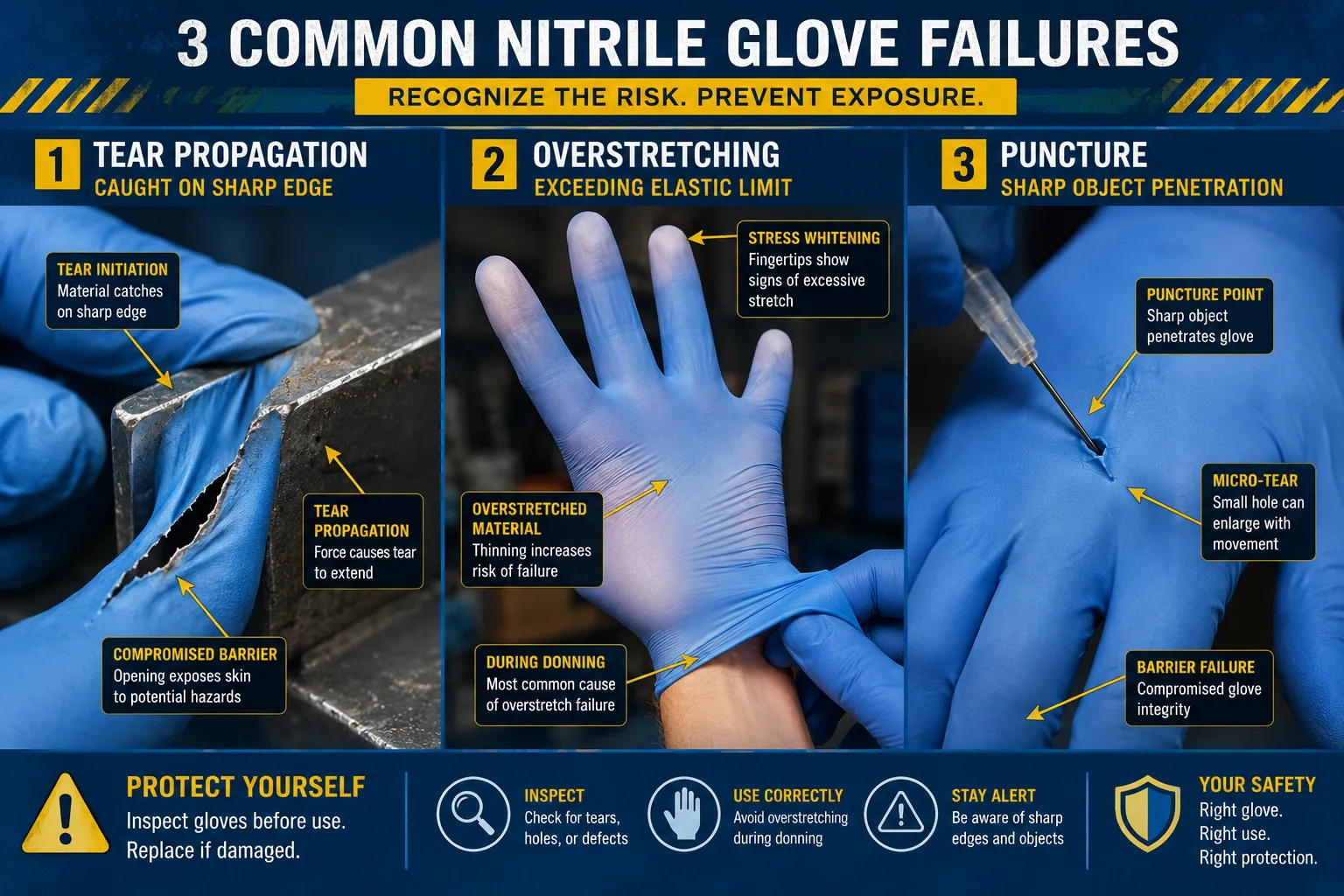
Nitrile gloves tear during normal use primarily due to mechanical stress from improper fit, sharp edges, and material fatigue from repeated stretching. The most common scenario involves gloves that are too small for the wearer’s hands, creating excessive tension across the fingertips and palm that leads to splitting during routine tasks.
Primary mechanical causes of tearing:
- Poor sizing: Gloves stretched beyond their elastic limit develop stress points at fingertips and webbing between fingers
- Sharp object contact: Edges on tools, equipment, metal burrs, and rough surfaces create punctures or initiate tears
- Donning damage: Fingernails, rings, and rushed application cause micro-tears that propagate during use
- Material fatigue: Repeated flexing and stretching weakens polymer chains, especially in high-stress areas like fingertips
- Manufacturing defects: Thin spots, incomplete curing, or contamination during production create weak points
The thickness of the glove matters significantly. Gloves in the 2-4 mil range tear more easily than 6-8 mil gloves, but the trade-off involves reduced dexterity and tactile sensitivity. For detailed guidance on selecting appropriate thickness, see our article on what is a good thickness for nitrile gloves.
Common mistake: Many workers assume all nitrile gloves offer equal puncture resistance. In reality, a 4 mil examination glove provides minimal protection against sharp objects compared to an 8 mil industrial glove designed for mechanical work.
Why Do Nitrile Gloves Break Down When Exposed to Certain Chemicals
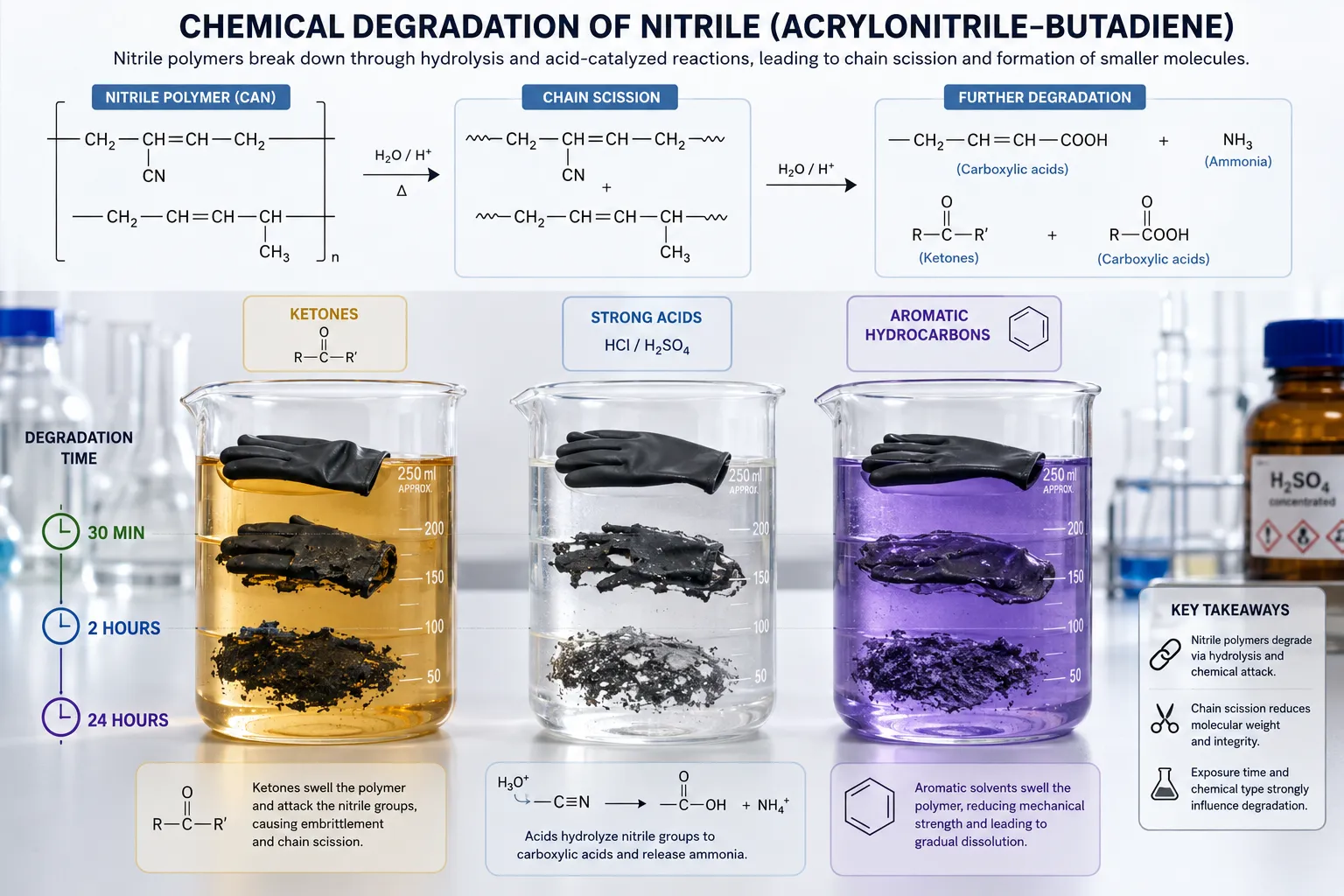
Nitrile gloves break down chemically when specific solvents and compounds attack the acrylonitrile-butadiene polymer chains that form the glove material. This degradation occurs at the molecular level, causing swelling, softening, brittleness, or complete dissolution depending on the chemical and exposure duration.
The nitrile polymer structure resists many chemicals well, including alcohols, dilute acids, and petroleum products, but fails rapidly against certain chemical families. Chemical breakdown differs fundamentally from mechanical tearing because it compromises the entire material structure, not just creating a physical hole.
How chemical degradation occurs:
- Solvent penetration: Chemical molecules diffuse into the nitrile polymer matrix
- Polymer swelling: The material absorbs the chemical, expanding and weakening
- Chain scission: Chemical bonds in the polymer backbone break, reducing strength
- Plasticizer extraction: Chemicals dissolve additives that maintain flexibility
- Surface degradation: The glove becomes sticky, brittle, or discolored
Decision rule: Choose nitrile gloves if working with oils, greases, alcohols, and dilute acids. Switch to neoprene or butyl rubber gloves for ketones, strong oxidizers, and aromatic hydrocarbons. For more on material selection, consult our guide on what to consider when choosing nitrile gloves.
What Chemicals Break Down Nitrile Gloves the Fastest
Ketones, strong oxidizing acids, and aromatic hydrocarbons degrade nitrile gloves most rapidly, often within 10-30 minutes of continuous contact. Acetone, methyl ethyl ketone (MEK), concentrated nitric acid, and benzene represent the most aggressive chemicals that can compromise nitrile gloves before workers realize the protection has failed.
Fastest-acting degrading chemicals:
| Chemical Class | Example Compounds | Degradation Time | Visible Signs |
|---|---|---|---|
| Ketones | Acetone, MEK, MIBK | 10-30 minutes | Swelling, softening, tackiness |
| Aromatic hydrocarbons | Benzene, toluene, xylene | 15-45 minutes | Swelling, loss of strength |
| Strong oxidizers | Concentrated nitric acid, hydrogen peroxide (>30%) | 5-20 minutes | Discoloration, brittleness |
| Chlorinated solvents | Methylene chloride, chloroform | 20-60 minutes | Swelling, dissolution |
| Esters | Ethyl acetate, butyl acetate | 30-90 minutes | Softening, tackiness |
Critical safety note: Chemical breakthrough often occurs before visible damage appears. Gloves may look intact while chemicals have already penetrated to the skin. This makes timed glove changes essential when working with aggressive chemicals, regardless of visible condition.
For workers in chemistry labs, understanding these limitations is crucial. Our article on powder-free nitrile gloves for chemistry labs provides specific recommendations for laboratory environments.
How Long Do Nitrile Gloves Last Before They Start Degrading
Unopened nitrile gloves typically maintain their protective properties for 3-5 years from the manufacturing date when stored properly in cool, dry conditions away from direct sunlight and ozone sources. Once opened and exposed to air, humidity, and temperature fluctuations, degradation accelerates, with noticeable changes in flexibility and strength appearing within 6-12 months.
The shelf life depends heavily on storage conditions. Gloves stored in climate-controlled environments at 60-75°F with 40-60% humidity last significantly longer than those kept in hot warehouses, vehicle trunks, or areas with temperature swings.
Factors affecting glove lifespan:
- Temperature: Each 10°F increase above 75°F roughly halves the remaining shelf life
- Humidity: Excessive moisture (above 70%) promotes polymer hydrolysis and mold growth on packaging
- UV exposure: Direct sunlight breaks polymer chains, causing brittleness within weeks
- Ozone: Even trace amounts from electrical equipment accelerate aging
- Manufacturing date: Older inventory degrades faster even in ideal conditions
Signs gloves are degrading:
- Increased stiffness or brittleness when flexing
- Tackiness or oily feel on the surface
- Discoloration (yellowing or darkening)
- Difficulty donning due to loss of elasticity
- Tears occurring during normal donning
- Reduced grip or slippery texture
Edge case: Gloves exposed to temperature cycling (such as in unheated warehouses or delivery vehicles) age faster than their storage date suggests. A box of gloves subjected to repeated freeze-thaw cycles may fail within months despite being recently manufactured.
Nitrile vs Latex Gloves: Which Is More Durable
Nitrile gloves demonstrate superior puncture resistance and chemical durability compared to latex gloves, with 2-3 times better resistance to tears and punctures in standardized testing. However, latex gloves offer better elastic recovery and conform more closely to hand shape, which can reduce mechanical stress and prevent some types of tearing during dynamic tasks.
The durability comparison depends on the specific hazard. For puncture resistance and chemical exposure, nitrile wins decisively. For tasks requiring repeated stretching and recovery without fatigue, latex performs better until it eventually tears.
Durability comparison:
- Puncture resistance: Nitrile provides 2-3x better protection against sharp objects
- Chemical resistance: Nitrile resists oils, greases, and many solvents; latex degrades rapidly
- Tear propagation: Once punctured, latex tears more easily than nitrile
- Elastic memory: Latex recovers shape better, reducing stress concentration
- Allergen concerns: Latex proteins cause allergic reactions; nitrile is hypoallergenic
- Aging: Nitrile maintains properties longer in storage
For a comprehensive comparison, see our detailed article on the difference between latex and nitrile gloves.
Choose nitrile if: Working with chemicals, oils, sharp objects, or if latex allergies are a concern. Choose latex if: Maximum tactile sensitivity is required for short-duration tasks without chemical exposure, and no allergy concerns exist.
Why Do My Nitrile Gloves Feel Stiff and Lose Grip Over Time
Nitrile gloves become stiff and lose grip primarily due to polymer degradation from improper storage, chemical exposure, or age-related oxidation that hardens the material and breaks down surface textures. This stiffening occurs when plasticizers migrate out of the polymer matrix or when cross-linking between polymer chains increases beyond optimal levels.
Loss of grip typically results from surface contamination, wear of textured patterns, or chemical reactions that create a slippery film on the glove exterior. Both problems indicate the gloves have exceeded their useful life or been compromised by environmental factors.
Primary causes of stiffness:
- Heat exposure: Storage above 80°F accelerates plasticizer loss and polymer cross-linking
- Age: Natural oxidation over 3-5 years hardens the material
- Chemical residue: Dried chemicals on the surface create rigid films
- Ozone exposure: Breaks polymer chains, causing brittleness
- Humidity extremes: Very low humidity draws out plasticizers; very high humidity can affect surface coatings
Grip loss causes:
- Surface contamination: Oils, lotions, or chemical residues create slippery layers
- Texture wear: Repeated use smooths textured grip patterns
- Powder residue: Cornstarch or other powders (in older glove types) create slippery surfaces
- Chemical degradation: Some chemicals leave tacky or slippery residues
- Manufacturing defects: Inadequate texturing or coating application
Common mistake: Workers often blame the gloves when grip loss actually results from contamination on their hands (lotions, oils) or the work surface. Clean, dry hands and surfaces are essential for optimal grip.
Are Thicker Nitrile Gloves Less Likely to Tear Than Thin Ones
Thicker nitrile gloves (6-8 mil) are significantly less likely to tear from punctures and sharp objects compared to thin gloves (2-4 mil), providing 2-4 times better puncture resistance in standardized testing. However, thickness alone doesn’t guarantee durability because manufacturing quality, polymer formulation, and proper sizing matter equally.
The relationship between thickness and tear resistance isn’t perfectly linear. A well-manufactured 4 mil glove from a quality supplier may outperform a poorly made 6 mil glove. Additionally, thicker gloves reduce dexterity and tactile sensitivity, creating trade-offs that affect task performance.
Thickness categories and applications:
- 2-3 mil (thin): Examination gloves for light-duty tasks, maximum dexterity, tears easily
- 4-5 mil (medium): General-purpose work, balanced protection and dexterity
- 6-7 mil (thick): Industrial tasks, chemical handling, good puncture resistance
- 8+ mil (heavy-duty): Mechanical work, automotive, maximum protection, reduced dexterity
For detailed guidance on thickness selection, see our article comparing thin vs. thick nitrile gloves.
Decision rule: Choose thickness based on primary hazard. For chemical splash protection, 4-6 mil often suffices. For mechanical work with sharp edges and tools, select 6-8 mil. For precision assembly or examination, 2-4 mil provides necessary sensitivity.
Edge case: Very thick gloves (8+ mil) can actually increase some failure risks because reduced tactile feedback causes workers to grip harder or handle objects more roughly, potentially causing different types of damage.
Common Mistakes That Make Nitrile Gloves Fail Faster
The most common mistakes that accelerate nitrile glove failure include wearing the wrong size, reusing disposable gloves, storing gloves improperly, and failing to change gloves after chemical exposure. These user errors cause more glove failures than material defects or inherent limitations.
Top mistakes and their consequences:
- Wrong size selection: Too small creates stress tears; too large snags on equipment and reduces dexterity
- Reusing disposable gloves: Microscopic damage from first use propagates into visible tears; contamination transfers between tasks
- Improper storage: Heat, sunlight, and humidity degrade gloves before use
- Ignoring chemical compatibility: Using nitrile for incompatible chemicals causes rapid breakdown
- Wearing jewelry: Rings and bracelets puncture gloves during donning and use
- Rough donning technique: Pulling aggressively or using fingernails creates micro-tears
- Exceeding recommended use time: Gloves weaken during extended wear from moisture and mechanical stress
- Contaminated hands: Oils, lotions, or chemicals on hands before donning compromise glove integrity
- Ignoring visible damage: Continuing to use gloves with small tears allows contamination and injury
- Mixing glove types: Using examination gloves for industrial tasks or vice versa
Critical mistake: Many workers assume nitrile gloves provide unlimited chemical protection. In reality, every chemical has a specific breakthrough time, and gloves must be changed before that time elapses, even if they appear undamaged.
For best practices across applications, see our guide on best practices for nitrile gloves.
How to Tell If Nitrile Gloves Are Chemically Compromised
Chemically compromised nitrile gloves show visible signs including swelling, discoloration, surface tackiness, brittleness, or an oily feel, but dangerous chemical breakthrough can occur before any visible changes appear. The most reliable method involves following manufacturer-specified breakthrough times for specific chemicals rather than relying on visual inspection alone.
Testing for chemical compromise requires systematic observation and adherence to safety protocols. Workers should inspect gloves before, during, and after chemical exposure, but must never rely solely on appearance to determine if protection remains adequate.
Visible indicators of chemical compromise:
- Swelling: Material appears puffy or enlarged, especially at fingertips
- Discoloration: Yellowing, darkening, or color changes from original blue/purple
- Surface changes: Tacky, sticky, or unusually slippery texture
- Brittleness: Material cracks or breaks when flexed
- Softening: Material feels mushy or loses structural integrity
- Bubbling: Small bubbles or blisters form on the surface
- Odor: Chemical smell indicates permeation through the material
Testing methods:
- Visual inspection: Check for color changes, swelling, or surface defects every 15-30 minutes during chemical work
- Flex test: Gently flex fingers to detect brittleness or unusual stiffness
- Touch test: Note any tackiness, oiliness, or texture changes
- Timed changes: Replace gloves at manufacturer-recommended intervals regardless of appearance
- Double gloving: Use two layers and inspect the inner glove periodically for breakthrough
Critical safety rule: When working with highly hazardous chemicals, implement timed glove changes based on breakthrough data, not visual inspection. Many dangerous chemicals permeate nitrile before causing visible damage.
Do Nitrile Gloves Work for Automotive Work or Do They Tear Easily
Nitrile gloves work well for automotive work when properly selected, with 6-8 mil thickness and textured grip providing adequate protection against oils, greases, and moderate mechanical stress. However, thin examination-grade nitrile gloves (2-4 mil) tear easily in automotive applications due to sharp edges, rough surfaces, and the mechanical demands of the work.
The key to success in automotive applications involves selecting industrial-grade nitrile gloves specifically designed for mechanical work, not medical examination gloves. These specialized gloves feature reinforced fingertips, aggressive texturing for grip, and thicker material that resists punctures from sharp metal edges.
Automotive-specific requirements:
- Thickness: Minimum 6 mil, preferably 7-8 mil for heavy mechanical work
- Texture: Diamond or raised pattern on palm and fingers for tool grip
- Length: Extended cuff (9-12 inches) to protect wrists and forearms
- Chemical resistance: Must resist motor oil, brake fluid, transmission fluid, and gasoline
- Puncture resistance: Reinforced fingertips for handling sharp metal parts
For specific recommendations, see our article on the best mechanic nitrile gloves.
Common automotive failure scenarios:
- Thin gloves tear on sharp metal burrs and edges
- Smooth gloves slip on oily tools and parts
- Short gloves expose wrists to chemicals and cuts
- Wrong chemical resistance allows oil penetration
Choose automotive-grade gloves if: Working with engines, transmissions, brakes, or any task involving sharp metal parts and automotive fluids. Avoid examination gloves for: Any automotive work beyond light cleaning or inspection.
Why Do Nitrile Gloves Rip When Putting Them On
Nitrile gloves rip during donning primarily because of incorrect sizing (too small), fingernails or jewelry catching the material, or rushed application that creates excessive stress at weak points. The fingertips and the webbing between fingers represent the most common failure points during donning because these areas experience maximum stretch.
Proper donning technique significantly reduces tearing. Many workers pull gloves on too quickly or use improper hand positions that concentrate stress in vulnerable areas.
Primary causes of donning tears:
- Undersized gloves: Material stretched beyond elastic limit during application
- Long fingernails: Sharp edges puncture or catch material
- Jewelry: Rings, bracelets, and watches snag and tear gloves
- Dry hands: Lack of moisture increases friction and resistance
- Rough technique: Pulling aggressively instead of working gloves on gradually
- Damaged gloves: Pre-existing micro-tears from storage or manufacturing defects
- Cold gloves: Material less flexible when below room temperature
Proper donning technique:
- Remove all jewelry from hands and wrists
- Ensure hands are clean and slightly damp (not wet)
- Allow gloves to reach room temperature if stored in cold areas
- Hold glove at cuff opening, not at fingers
- Insert hand gradually, working fingers in one at a time
- Avoid pulling from fingertips; push from wrist
- Adjust fit gently after both gloves are on
Common mistake: Workers often select gloves one size too small for a “tighter fit,” believing this improves dexterity. In reality, properly sized gloves provide better dexterity and last longer because they don’t operate at maximum stress during normal use.
Best Alternative Gloves If Nitrile Keeps Tearing for My Job
If nitrile gloves consistently tear in your application, consider switching to thicker nitrile gloves (8+ mil), neoprene gloves for better chemical resistance, vinyl gloves for light-duty tasks without chemical exposure, or specialized cut-resistant gloves with nitrile coating for extreme mechanical hazards. The best alternative depends on the specific failure mode and job requirements.
Before switching materials, verify that you’re using appropriate nitrile gloves for the task. Many “nitrile failures” actually result from using examination gloves for industrial applications or selecting inadequate thickness.
Alternative glove materials and applications:
| Material | Best For | Advantages | Limitations |
|---|---|---|---|
| Thicker nitrile (8+ mil) | Heavy mechanical work | Better puncture resistance, same chemical resistance | Reduced dexterity |
| Neoprene | Ketones, acids, caustics | Superior chemical resistance | More expensive, less tactile sensitivity |
| Butyl rubber | Strong acids, ketones, esters | Excellent chemical resistance | Poor for oils/greases, expensive |
| Vinyl | Light-duty, short tasks | Inexpensive, latex-free | Poor chemical resistance, tears easily |
| PVC | Chemical handling | Good chemical resistance | Stiff, poor dexterity |
| Cut-resistant with nitrile coating | Sharp objects, glass, metal | Excellent cut protection | Expensive, bulky |
For detailed comparisons, see our articles on nitrile vs. vinyl gloves and nitrile vs. PVC gloves.
Decision framework:
- If tearing from sharp objects: Upgrade to 8+ mil nitrile or cut-resistant gloves
- If chemical breakdown: Switch to neoprene or butyl rubber based on specific chemicals
- If cost is primary concern for light tasks: Consider vinyl for non-hazardous applications
- If dexterity loss is the issue: Try thinner nitrile (4-5 mil) and change gloves more frequently
Edge case: Some jobs require hybrid solutions, such as cut-resistant liners worn under nitrile gloves for combined mechanical and chemical protection.
Can You Reuse Nitrile Gloves or Does That Cause Them to Fail
Reusing disposable nitrile gloves dramatically increases failure risk, with studies showing 300-400% higher tear rates and significant contamination concerns. Disposable nitrile gloves are designed for single-use applications and develop microscopic damage during first use that compromises protective integrity even when no visible tears appear.
The term “disposable” indicates the gloves should be discarded after one use or after a single task. Reusable nitrile gloves exist as a separate product category with thicker material and different construction designed to withstand washing and multiple uses.
Why reusing disposable gloves fails:
- Microscopic damage: Stretching and flexing create micro-tears invisible to the eye
- Contamination: Pathogens and chemicals remain on gloves despite washing attempts
- Material degradation: Washing with soap weakens polymer structure
- Loss of integrity: Repeated donning and doffing stresses material beyond design limits
- False security: Workers assume washed gloves provide protection when barrier is compromised
Contamination risks from reuse:
- Pathogens transfer from contaminated exterior to hands during removal
- Chemicals absorbed into material leach out during subsequent use
- Cross-contamination between tasks spreads hazards
- Washing doesn’t remove chemicals that have permeated the material
When reusable gloves make sense:
For applications requiring multiple uses, purchase gloves specifically designed as reusable. These feature:
- Thicker material (15-30 mil)
- Reinforced construction
- Chemical resistance maintained after washing
- Longer cuff for better protection
- Higher initial cost but lower cost per use
Critical safety rule: Never reuse disposable nitrile gloves for medical, food handling, or hazardous chemical work. The contamination and failure risks far outweigh any cost savings.
What Industries Should Not Use Nitrile Gloves Due to Failure Risk
Industries working extensively with ketones, strong oxidizing acids, aromatic hydrocarbons, or requiring protection against extreme cut hazards should not rely on standard nitrile gloves due to rapid chemical breakdown or inadequate mechanical protection. These applications require specialized glove materials like neoprene, butyl rubber, or cut-resistant fabrics with appropriate coatings.
However, most industries can use nitrile gloves successfully when properly matched to specific tasks. The key involves understanding which tasks within an industry exceed nitrile’s protective capabilities.
Industries and tasks requiring alternatives:
Chemical manufacturing (specific processes):
- Ketone production or handling (acetone, MEK)
- Aromatic hydrocarbon processing (benzene, toluene)
- Strong oxidizer production (concentrated nitric acid, hydrogen peroxide >30%)
- Alternative: Neoprene, butyl rubber, or laminated gloves
Glass handling and recycling:
- Sharp glass edges require cut-resistant protection beyond nitrile’s capability
- Alternative: Cut-resistant gloves with nitrile coating
Metal fabrication (specific operations):
- Sharp metal stamping and cutting operations
- Alternative: Cut-resistant gloves or heavy leather gloves
Aerospace (specific solvents):
- Paint stripping with methylene chloride
- Alternative: Laminated or butyl rubber gloves
Pharmaceutical compounding:
- Handling chemotherapy drugs (some require double gloving with specific materials)
- Alternative: Chemotherapy-rated gloves (often neoprene or nitrile with specific testing)
Industries where nitrile works well:
- Healthcare (examination, surgery with appropriate thickness)
- Food processing and handling
- Automotive maintenance and repair
- Janitorial and cleaning services
- Laboratory work (with appropriate chemical compatibility)
- Tattoo and body art (see our guide on nitrile vs. latex for tattooing)
- Agriculture and farming (see choosing nitrile gloves for farms)
Decision rule: Conduct a task-specific hazard assessment rather than making industry-wide decisions. Most industries have some tasks suitable for nitrile and others requiring alternatives.
Frequently Asked Questions
How can I tell if my nitrile gloves are the right size?
Properly sized nitrile gloves should slide on without excessive force, allow full finger flexion without tightness, and not have more than 1/4 inch of excess material at fingertips. The glove should feel like a second skin without creating stress points or restricting movement. If gloves tear during donning or feel uncomfortably tight, size up.
What temperature should I store nitrile gloves to prevent degradation?
Store nitrile gloves at 60-75°F in a dry location away from direct sunlight and ozone sources. Temperatures above 80°F accelerate degradation, while freezing temperatures can make gloves brittle temporarily. Maintain relative humidity between 40-60% for optimal shelf life of 3-5 years.
Can I use hand lotion before putting on nitrile gloves?
Allow hand lotion to fully absorb (5-10 minutes) before donning nitrile gloves, as oily residues reduce grip and can degrade some glove materials. Petroleum-based lotions are particularly problematic. Water-based, fragrance-free lotions work best, but hands should feel dry to the touch before gloving.
How often should I change nitrile gloves during chemical work?
Change nitrile gloves based on manufacturer breakthrough time data for specific chemicals, typically every 15-60 minutes for aggressive solvents, or immediately if visible damage, discoloration, or swelling occurs. Never rely on appearance alone; follow timed change protocols for hazardous chemicals.
Do black nitrile gloves offer better protection than blue ones?
Color doesn’t affect protective properties; black and blue nitrile gloves of the same thickness and quality provide identical protection. Black gloves hide stains and dirt better, making them popular in automotive and tattoo industries, while blue gloves show contamination more clearly, preferred in food service and healthcare.
Why do some nitrile gloves smell like chemicals when I open the box?
A slight rubber or chemical odor from new nitrile gloves is normal and results from residual manufacturing compounds. Strong, unpleasant odors may indicate poor quality control or degradation. Air out gloves for 10-15 minutes before use, and consider switching brands if odor persists or causes irritation.
Can nitrile gloves protect against battery acid?
Nitrile gloves provide limited protection against dilute battery acid (sulfuric acid) for short periods (15-30 minutes), but concentrated acid requires thicker gloves (8+ mil) or acid-resistant materials like neoprene. Always check manufacturer chemical resistance data for specific acid concentrations and exposure times.
What’s the difference between medical-grade and industrial nitrile gloves?
Medical-grade nitrile gloves meet FDA regulations for barrier protection and are tested for viral penetration, while industrial gloves focus on chemical and mechanical resistance. Medical gloves typically range 3-6 mil; industrial gloves often exceed 6 mil. Both can be high quality but are optimized for different hazards.
How do I prevent nitrile gloves from tearing on my fingernails?
Keep fingernails trimmed short and filed smooth, don gloves slowly by working fingers in gradually rather than pulling from tips, and consider using glove liners for additional protection. If long nails are necessary, use thicker gloves (6+ mil) and practice careful donning technique.
Are powder-free nitrile gloves more likely to tear than powdered ones?
Powder-free nitrile gloves don’t tear more easily than powdered versions; the powder (typically cornstarch) only aids donning by reducing friction. Modern powder-free gloves use polymer coatings or chlorination for easy donning. Powder-free gloves are preferred in most applications to avoid contamination and allergic reactions.
Can I use nitrile gloves for handling gasoline and motor oil?
Nitrile gloves resist gasoline and motor oil well for short-term exposure (30-60 minutes), making them suitable for automotive work. Choose 6+ mil thickness for mechanical protection and change gloves if they become saturated. For extended fuel handling, consider thicker industrial nitrile or specialized fuel-resistant gloves.
What causes nitrile gloves to turn yellow or brown?
Yellowing or browning indicates oxidative degradation from age, heat exposure, UV light, or chemical contact. Discolored gloves have compromised protective properties and should be discarded. Proper storage in cool, dark conditions prevents premature discoloration.
Conclusion
Understanding why nitrile gloves fail in real-world applications empowers workers and safety managers to make better choices and implement practices that maximize protection. Most failures stem from preventable causes: wrong sizing, improper storage, chemical incompatibility, or user errors rather than inherent material defects.
The key takeaways for preventing nitrile glove failure include selecting appropriate thickness for the task (6-8 mil for industrial work, 4-5 mil for general use, 2-4 mil for examination), verifying chemical compatibility before use, storing gloves properly at 60-75°F away from sunlight, and never reusing disposable gloves. Proper sizing eliminates the majority of mechanical failures, while understanding chemical breakthrough times prevents invisible exposure to hazardous substances.
Actionable next steps:
- Audit current glove inventory: Verify that glove thickness and type match actual job hazards, not just convenience or cost
- Implement proper storage: Move gloves from hot warehouses, vehicle trunks, or sunny areas to climate-controlled storage
- Train workers on donning technique: Reduce donning tears by 50-70% through proper technique training
- Create chemical compatibility charts: Post reference guides showing which gloves work for which chemicals in your facility
- Establish timed change protocols: Replace gloves based on breakthrough data, not appearance, when working with hazardous chemicals
- Review sizing practices: Ensure workers have access to multiple sizes and understand proper fit criteria
- Eliminate reuse of disposables: Provide adequate glove quantities to prevent cost-driven reuse
For workers experiencing persistent glove failures, the solution usually involves upgrading to thicker nitrile gloves, switching to specialized materials for specific chemicals, or correcting storage and handling practices. The investment in appropriate gloves and proper practices pays dividends in reduced injuries, contamination incidents, and worker confidence in their protective equipment.
Remember that nitrile gloves represent one component of a comprehensive safety program. When gloves fail despite proper selection and use, reassess the hazard and consider engineering controls, alternative materials, or additional protective layers. The goal isn’t just preventing glove failure but ensuring workers remain protected throughout their tasks.
SEO Meta Title: Why Nitrile Gloves Fail: Causes of Tears & Breakdown