Last updated: June 27, 2026
Quick Answer
Thick durable nitrile gloves rated at 15 mil or higher provide superior chemical resistance and puncture protection for oil and gas workers, with proper cleaning protocols enabling multiple reuses that reduce costs by 40-60% compared to single-use alternatives. These heavy-duty gloves resist crude oil, diesel, hydraulic fluids, and drilling muds while maintaining tactile sensitivity for equipment operation. Field durability depends on thickness, exposure type, and maintenance practices, with 15-20 mil gloves typically lasting 30-90 days in harsh petrochemical environments when properly cared for.
Key Takeaways
- Nitrile gloves rated 15 mil or thicker offer the best balance of chemical resistance, puncture protection, and dexterity for oil and gas operations
- Properly cleaned and inspected thick nitrile gloves can be reused 5-15 times in field conditions, delivering significant cost savings over disposable options
- Nitrile provides superior resistance to petroleum-based chemicals compared to latex, which degrades rapidly when exposed to crude oil and solvents
- Chemical breakthrough time increases exponentially with thickness: 8 mil gloves may fail in 15-30 minutes, while 15+ mil gloves resist for 4-8 hours
- Visual inspection before each use is critical—discard gloves showing cracks, discoloration, stiffness, or any punctures regardless of previous wear time
- Common selection mistakes include choosing gloves too thin for the task, ignoring grip texture for wet conditions, and failing to match cuff length to exposure risk
- Disposable nitrile gloves under 6 mil are unsuitable for refinery work but acceptable for light maintenance tasks away from direct chemical contact
- Proper cleaning with mild detergent, thorough rinsing, and complete air drying extends glove life and maintains protective properties

What Makes Nitrile Gloves Suitable for Oil and Gas Work
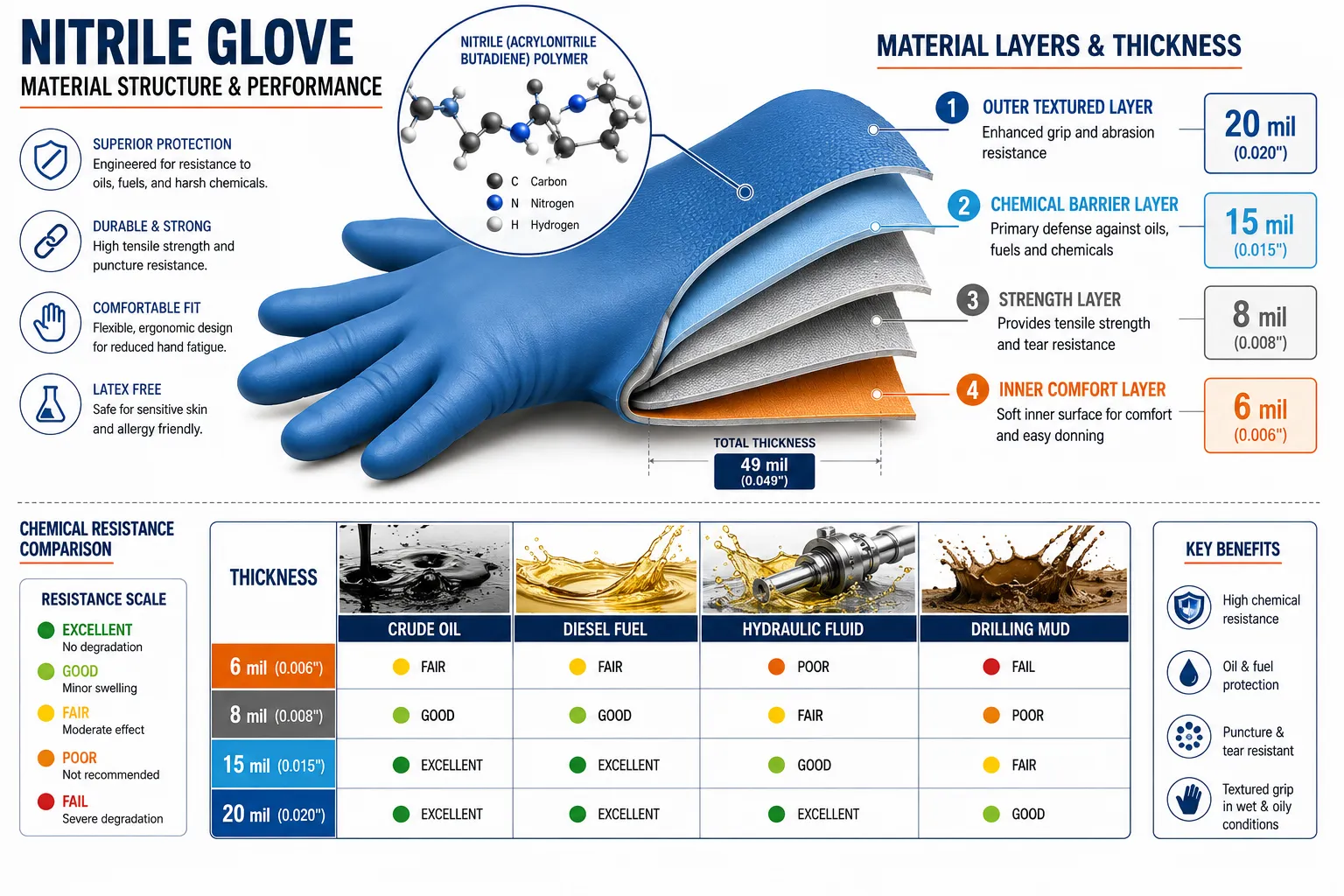
Nitrile gloves excel in oil and gas environments because the synthetic rubber polymer resists degradation from petroleum products, maintains flexibility across temperature ranges, and provides puncture resistance superior to natural rubber alternatives. The acrylonitrile-butadiene copolymer structure creates a barrier that petroleum molecules cannot easily penetrate, unlike latex proteins that break down on contact with hydrocarbon chains.
Oil and gas operations expose workers to multiple hazards simultaneously: crude oil, refined petroleum products, drilling muds containing chemical additives, hydraulic fluids, solvents, and abrasive surfaces. Nitrile gloves address these challenges through:
- Chemical barrier integrity: Nitrile maintains molecular structure when exposed to aliphatic hydrocarbons, aromatic compounds, and many acids and bases common in drilling and refining
- Mechanical strength: Thick nitrile resists tears, punctures, and abrasions from rough pipe threads, metal edges, and tool handles
- Temperature stability: Quality nitrile remains pliable from -40°F to 220°F, covering most field conditions from winter drilling to hot process equipment
- Tactile sensitivity: Even at 15-20 mil thickness, nitrile allows workers to feel valve positions, grip small fasteners, and operate touchscreen controls
- Allergen-free composition: Unlike latex, nitrile contains no natural rubber proteins, eliminating Type I allergic reactions in sensitive workers
The oil and gas industry specifically benefits from nitrile’s resistance to swelling. When latex contacts petroleum, it absorbs hydrocarbons and expands, losing protective properties within minutes. Nitrile maintains dimensional stability, keeping the barrier intact throughout extended exposure periods.
For workers handling drilling equipment, nitrile’s grip texture (diamond, raised, or textured patterns) maintains hold on wet or oily surfaces. This prevents dropped tools and equipment damage in environments where metal surfaces are constantly coated with lubricants and process fluids. Learn more about nitrile gloves’ resistance to petroleum-based oils compared to other materials.
How Thick Should Nitrile Gloves Be for Chemical Resistance
For oil and gas chemical resistance, nitrile gloves should measure 15-20 mil thickness to provide 4-8 hours of breakthrough protection against common petrochemicals, with 8-12 mil gloves suitable only for intermittent exposure under 2 hours. Thickness directly correlates with chemical breakthrough time—the period before a chemical permeates through the glove material to contact skin.
Thickness categories and appropriate uses:
- 4-6 mil (disposable): Light maintenance, inspection tasks with minimal chemical contact, single-use applications. Breakthrough time for crude oil: 15-30 minutes
- 8-10 mil (medium duty): Short-duration tasks involving diluted chemicals, equipment cleaning, sample collection. Breakthrough time: 1-2 hours for most petroleum products
- 12-15 mil (heavy duty): Extended drilling operations, valve maintenance, pipeline work with moderate chemical exposure. Breakthrough time: 2-4 hours
- 15-20 mil (industrial/reusable): Refinery operations, tank cleaning, prolonged contact with concentrated chemicals. Breakthrough time: 4-8+ hours
- 20+ mil (specialized): Extreme chemical environments, emergency spill response, handling concentrated acids or caustics
The relationship between thickness and protection is not linear. Doubling thickness from 8 mil to 16 mil can triple or quadruple breakthrough time because the chemical must travel through more material and the thicker construction reduces microscopic defects that create permeation pathways.
Common mistake: Selecting gloves based solely on thickness without checking the manufacturer’s permeation data for specific chemicals. A 15 mil glove optimized for petroleum resistance may perform poorly against ketones or chlorinated solvents. Always verify the chemical resistance chart matches your actual exposure profile.
For drilling operations specifically, 15 mil represents the minimum recommended thickness because workers encounter multiple chemical hazards simultaneously: diesel fuel, hydraulic oil, drilling mud additives (polymers, biocides, corrosion inhibitors), and formation fluids. The thicker barrier provides protection even when the specific chemical composition varies between wells or shifts.
Temperature affects chemical breakthrough time. At elevated temperatures (above 100°F), chemicals permeate faster through any glove material. In hot climates or near process equipment, increase thickness by one category or reduce expected wear time by 30-40%. For guidance on selecting appropriate thickness, see our detailed guide on the best thickness for nitrile gloves.
Can You Reuse Nitrile Gloves in Oil Field Operations
Yes, thick nitrile gloves (15+ mil) can be safely reused in oil field operations when properly cleaned, inspected, and stored between uses, typically lasting 5-15 reuse cycles depending on exposure severity and maintenance practices. This reusability delivers cost savings of 40-60% compared to single-use disposables while maintaining worker protection if protocols are followed.
Reuse protocol for oil field nitrile gloves:
Immediate post-use cleaning: Rinse gloves while still on hands under running water to remove bulk contamination. Remove gloves using proper technique (peel from wrist, turning inside-out).
Deep cleaning: Wash in mild detergent solution (dish soap or industrial hand cleaner), scrubbing both interior and exterior surfaces. Avoid harsh solvents that may degrade nitrile.
Thorough rinsing: Rinse completely in clean water until no soap residue remains. Residual detergent can cause skin irritation during next use.
Complete drying: Hang gloves in well-ventilated area away from direct sunlight and heat sources. Ensure both interior and exterior are completely dry before storage (typically 12-24 hours).
Pre-use inspection: Before each reuse, inspect under good lighting for cracks, punctures, discoloration, stiffness, or tackiness. Perform a water-fill test monthly: fill glove with water and check for leaks.
Proper storage: Store in cool, dry location away from ozone sources (electric motors, welding equipment), direct sunlight, and temperature extremes.
Factors affecting reuse lifespan:
- Chemical exposure intensity: Light petroleum contact allows 10-15 reuses; heavy crude or concentrated solvent exposure reduces this to 3-5 cycles
- Mechanical stress: Gloves used for rough handling (pipe threading, abrasive surfaces) wear faster than those used for valve operation or equipment inspection
- Cleaning consistency: Gloves cleaned immediately after use last significantly longer than those left contaminated overnight
- Storage conditions: Proper storage can double glove lifespan compared to leaving gloves in hot vehicles or direct sunlight
When to discard immediately, regardless of use count:
- Any visible puncture, tear, or hole
- Stiffness or loss of flexibility
- Discoloration or chemical staining that doesn’t wash out
- Tackiness or surface degradation
- Swelling or dimensional changes
- Any doubt about integrity
The economic case for reusable thick nitrile gloves is compelling in oil field operations. A 15 mil reusable glove costing $8-12 per pair that lasts 10 uses delivers an effective cost of $0.80-1.20 per use, compared to $2-4 for single-use disposables rated for similar chemical exposure. Across a drilling crew of 20 workers using 2-3 pairs daily, annual savings can exceed $15,000.
Edge case: In environments with unknown chemical exposures or potential contamination with highly toxic substances (hydrogen sulfide areas, radioactive scale), single-use protocols may be mandated regardless of glove thickness. Always follow site-specific safety requirements.
Nitrile Gloves vs Latex Gloves for Petroleum Industry
Nitrile gloves vastly outperform latex gloves in petroleum industry applications, with nitrile maintaining barrier integrity for hours while latex degrades within 15-30 minutes of petroleum contact due to hydrocarbon absorption and protein structure breakdown. For any task involving direct contact with crude oil, refined products, or petroleum-based chemicals, nitrile is the only appropriate choice.
Performance comparison:
| Property | Nitrile Gloves | Latex Gloves |
|---|---|---|
| Crude oil resistance | Excellent (4-8+ hours at 15 mil) | Poor (fails in 15-30 min) |
| Diesel fuel resistance | Excellent | Very poor (immediate degradation) |
| Hydraulic oil resistance | Excellent | Poor |
| Puncture resistance | Superior (3-5x stronger) | Moderate |
| Chemical resistance range | Broad (petroleum, acids, bases) | Narrow (biological, water-based) |
| Allergen concerns | None (synthetic) | High (natural rubber proteins) |
| Cost per glove | Higher ($0.15-2.00) | Lower ($0.08-0.50) |
| Shelf life | 5+ years | 3 years (degrades faster) |
| Tactile sensitivity | Good | Excellent |
| Temperature range | -40°F to 220°F | 35°F to 180°F |
The fundamental difference lies in molecular structure. Latex is natural rubber (polyisoprene) with protein chains that petroleum hydrocarbons readily penetrate and dissolve. Nitrile is synthetic rubber (acrylonitrile-butadiene copolymer) with chemical bonds that resist hydrocarbon penetration.
When latex contacts petroleum, several degradation mechanisms occur simultaneously:
- Swelling: Hydrocarbon molecules absorb into the rubber matrix, causing expansion and loss of barrier properties
- Plasticization: Petroleum acts as a solvent, softening the material and reducing mechanical strength
- Protein denaturation: Natural rubber proteins break down, creating permeation pathways
- Loss of elasticity: The glove becomes sticky, loses shape, and tears easily
In contrast, nitrile maintains dimensional stability and mechanical properties throughout petroleum exposure. The synthetic polymer resists swelling and maintains its protective barrier.
Choose latex only when: Working exclusively with water-based fluids, biological materials, or in medical settings with no petroleum exposure. Latex offers superior tactile sensitivity for precision tasks and costs less for high-volume disposable use.
Choose nitrile when: Any petroleum products are present, chemical resistance is required, workers have latex allergies, or gloves will be reused. For oil and gas operations, nitrile is the default choice for 95% of applications.
The allergy factor is significant in industrial settings. Approximately 8-12% of workers develop Type I latex allergies with repeated exposure, causing reactions ranging from skin irritation to anaphylaxis. Nitrile eliminates this risk entirely, making it the safer choice for workforce health management. For a detailed comparison, read our article on the difference between latex and nitrile gloves.
What Chemicals Do Nitrile Gloves Protect Against in Oil and Gas
Nitrile gloves provide effective protection against crude oil, diesel fuel, gasoline, hydraulic fluids, mineral oils, aliphatic hydrocarbons, weak acids, weak bases, alcohols, and many glycol-based fluids commonly encountered in oil and gas operations. However, nitrile offers limited protection against aromatic hydrocarbons (benzene, toluene), ketones (acetone, MEK), and chlorinated solvents, which require specialized glove materials.
Excellent protection (4-8+ hours breakthrough time at 15 mil):
- Crude oil and petroleum distillates
- Diesel fuel and kerosene
- Gasoline (short-term exposure)
- Hydraulic oils (petroleum-based)
- Mineral oils and lubricants
- Cutting fluids (petroleum-based)
- Weak acids (dilute sulfuric, hydrochloric up to 10%)
- Weak bases (sodium hydroxide up to 10%)
- Ethanol and isopropanol
- Ethylene glycol and propylene glycol
- Detergents and surfactants
Moderate protection (1-4 hours breakthrough time):
- Gasoline (extended exposure)
- Biodiesel and vegetable oils
- Concentrated acids (20-50%)
- Concentrated bases (20-50%)
- Phenols (dilute)
- Formaldehyde solutions
Poor protection (under 1 hour or immediate degradation):
- Aromatic hydrocarbons (benzene, toluene, xylene)
- Ketones (acetone, methyl ethyl ketone)
- Chlorinated solvents (trichloroethylene, methylene chloride)
- Strong oxidizers (concentrated hydrogen peroxide, nitric acid)
- Highly concentrated acids or bases (above 70%)
Drilling mud chemicals and additives:
Nitrile performs well against most drilling mud components including bentonite clays, polymers (xanthan gum, polyanionic cellulose), barite weighting agents, and most biocides. However, some specialty additives may reduce glove life:
- Oil-based mud systems: Excellent protection
- Water-based mud systems: Excellent protection
- Synthetic-based muds: Good to excellent (verify specific base fluid)
- Corrosion inhibitors: Generally good protection
- Surfactants and emulsifiers: Good protection
Common mistake: Assuming all nitrile gloves offer identical chemical resistance. Manufacturing processes, polymer ratios, and additives vary between brands. A budget 15 mil glove may perform significantly worse than a premium 15 mil glove against the same chemical. Always request and review the manufacturer’s permeation testing data for your specific chemicals.
Field testing recommendation: When introducing new chemicals or glove brands, conduct a simple field test. Apply a small amount of the chemical to the glove exterior and monitor for 30 minutes. Look for discoloration, swelling, stiffness, or tackiness. If any occur, the glove is unsuitable for that chemical regardless of thickness.
For workers in refinery settings where aromatic exposure is common, consider layering: a thin nitrile inner glove for comfort and a specialized outer glove (butyl rubber or laminated materials) for aromatic resistance. This combination provides broader protection than nitrile alone. Explore more about nitrile gloves’ protection against various oils.
How Long Do Heavy Duty Nitrile Gloves Last in Field Conditions
Heavy duty nitrile gloves (15-20 mil) typically last 30-90 days in oil field conditions with proper care and rotation, though actual lifespan varies significantly based on exposure intensity, mechanical stress, cleaning practices, and storage conditions. Single-shift use in light maintenance may extend life to 120+ days, while continuous exposure to harsh chemicals or abrasive work may reduce usable life to 15-30 days.
Lifespan factors ranked by impact:
Chemical exposure intensity (40% of variance): Direct contact with concentrated chemicals degrades gloves 3-5 times faster than intermittent exposure to diluted products
Mechanical stress (30% of variance): Rough handling, abrasive surfaces, and sharp edges cause physical damage that shortens life more than chemical exposure alone
Cleaning and maintenance (20% of variance): Gloves cleaned immediately after use and properly dried last 2-3 times longer than those left contaminated
Storage conditions (10% of variance): Proper storage away from heat, ozone, and UV light can extend life by 20-30%
Typical lifespan by application:
- Drilling operations (roughneck work): 15-30 days due to high mechanical stress, abrasive pipe handling, and continuous chemical exposure
- Valve maintenance and equipment operation: 45-60 days with moderate chemical contact and lower mechanical stress
- Tank inspection and sampling: 60-90 days with intermittent use and careful handling
- Refinery process operations: 30-45 days due to elevated temperatures and concentrated chemical exposure
- Pipeline maintenance: 60-90 days with primarily petroleum contact and moderate mechanical stress
Signs gloves have reached end of service life:
- Visible cracks, especially at stress points (fingertips, knuckles, between fingers)
- Permanent discoloration that doesn’t wash out
- Loss of flexibility or stiffness
- Surface tackiness or degradation
- Thinning at wear points
- Any punctures or tears
- Persistent chemical odor after cleaning
Extending glove life in the field:
Implement a rotation system where workers have 2-3 pairs in rotation. Use one pair per shift, then clean and allow 48 hours drying time before next use. This rotation extends total lifespan by 40-60% compared to daily consecutive use because the material has time to fully dry and recover between exposures.
Mark gloves with purchase or first-use date using permanent marker on the cuff. This simple tracking prevents using gloves beyond safe service life when visual inspection is ambiguous.
Edge case: In extreme cold (below 0°F), nitrile becomes less flexible and more prone to cracking. Gloves used in Arctic drilling operations may need replacement every 15-20 days even with light use due to cold-induced brittleness. Warm gloves to body temperature before donning to reduce stress during flexing.
Cost-per-day analysis: A $10 pair of 15 mil gloves lasting 60 days costs $0.17 per day. The same gloves lasting only 30 days due to poor maintenance cost $0.33 per day—double the effective cost. Proper care protocols deliver immediate ROI through extended glove life.
Best Nitrile Glove Thickness for Drilling Operations
For drilling operations, 15-18 mil nitrile gloves provide the optimal balance of chemical resistance, puncture protection, and dexterity for handling pipe, operating equipment, and managing drilling fluids. Thinner gloves (8-12 mil) lack adequate protection for the harsh mechanical and chemical environment, while thicker gloves (20+ mil) reduce tactile sensitivity needed for precision tasks and equipment operation.
Drilling operations present unique challenges that drive thickness requirements:
Mechanical hazards:
- Rough pipe threads and connections
- Metal edges on drill collars and tool joints
- Abrasive drilling mud containing sand and rock cuttings
- Sharp edges on rig equipment and catwalks
- Pinch points during pipe handling
Chemical hazards:
- Diesel fuel from pumps and generators
- Hydraulic fluid from rig systems
- Oil-based or synthetic drilling muds
- Corrosion inhibitors and additives
- Formation fluids (oil, gas, saltwater)
Operational requirements:
- Grip on wet, oily surfaces
- Tactile feedback for valve positions
- Ability to handle small fasteners and tools
- Touchscreen operation for drilling controls
- Extended wear periods (12+ hour shifts)
Thickness recommendations by drilling role:
- Roughnecks (floor hands): 18-20 mil for maximum protection during pipe handling and connection makeup
- Derrick hands: 15-18 mil balancing protection with dexterity for working at height
- Motorhands: 15 mil for equipment maintenance and fluid handling
- Drillers: 12-15 mil for equipment operation requiring tactile sensitivity
- Tool pushers/supervisors: 12-15 mil for inspection and oversight tasks
Grip texture is critical: Drilling operations involve constant contact with wet, oily surfaces. Choose gloves with aggressive grip patterns (diamond texture, raised dots, or micro-roughened surfaces) on palms and fingers. Smooth nitrile gloves, regardless of thickness, create safety hazards when handling pipe or tools in oily conditions.
Cuff length matters: Standard 12-inch cuffs are minimum for drilling operations. Extended 18-inch cuffs provide better protection when reaching into mud tanks or handling pipe with drilling fluid. The longer cuff prevents fluids from running down inside the glove during overhead work.
Common mistake: Selecting gloves based solely on chemical resistance without considering mechanical demands. A glove with excellent petroleum resistance but poor puncture resistance will fail quickly in drilling operations. Look for gloves specifically rated for both chemical and mechanical hazards.
Field feedback: Experienced drilling crews often prefer 15 mil gloves with reinforced fingertips and palms over uniform 20 mil gloves. The reinforced design provides extra protection at high-wear points while maintaining flexibility in less-stressed areas. This targeted reinforcement approach delivers better overall performance than simply increasing thickness uniformly.
For workers transitioning from leather gloves to nitrile, expect a 1-2 week adjustment period. Nitrile feels different but provides superior chemical protection. Many operations now use nitrile gloves as primary protection with leather gloves over them for heavy mechanical tasks, then remove the leather layer for chemical handling.
Are Nitrile Gloves Puncture Resistant Enough for Roughneck Work
High-quality 15-20 mil nitrile gloves provide adequate puncture resistance for most roughneck work when properly selected and used, though they cannot replace leather gloves for heavy mechanical tasks involving extreme abrasion or sharp metal edges. Nitrile gloves rated to ASTM D6978 standards with puncture resistance above 100 grams-force offer suitable protection for drilling operations when combined with proper work practices.
Puncture resistance testing standards:
The ASTM D6978 test measures the force required to puncture a glove with a standardized probe. For oil and gas work:
- Minimum acceptable: 60-80 grams-force (light duty)
- Recommended: 100-150 grams-force (medium duty)
- Preferred for roughneck work: 150-200+ grams-force (heavy duty)
Thickness alone doesn’t guarantee puncture resistance. Manufacturing quality, polymer formulation, and additives significantly affect performance. A well-formulated 15 mil glove may outperform a poorly made 20 mil glove in puncture testing.
Real-world puncture scenarios in drilling:
- Pipe threads: Moderate risk—15+ mil nitrile handles normal pipe handling but may puncture on sharp burrs or damaged threads
- Tool edges: High risk—metal tools with sharp edges can puncture any nitrile glove; use caution and inspect tools
- Wire rope: Very high risk—steel cable strands easily puncture nitrile; use leather over-gloves or specialized wire rope gloves
- Drilling mud solids: Low risk—sand and cuttings cause abrasion but rarely puncture thick nitrile
- Rig floor debris: Moderate risk—metal shavings, wire fragments, and sharp debris require vigilance
Layering strategy for maximum protection:
For tasks with high puncture risk, use a layered approach:
- Base layer: 8-10 mil nitrile glove for chemical protection and comfort
- Outer layer: Leather glove or cut-resistant glove for mechanical protection
- Remove outer layer: When handling chemicals or working with fluids
This approach provides chemical protection when needed and mechanical protection for rough handling, with the flexibility to adapt to changing tasks.
Limitations of nitrile for mechanical protection:
Nitrile gloves excel at chemical resistance but have inherent limitations for mechanical hazards:
- Cannot protect against heavy impact or crushing forces
- Limited protection against sharp metal edges under pressure
- Abrasion resistance is good but not comparable to leather
- Cut resistance is moderate—specialized cut-resistant gloves perform better
When to use leather instead of or over nitrile:
- Handling wire rope or steel cable
- Working with sharp-edged metal requiring force
- Tasks involving heavy abrasion without chemical exposure
- Situations where glove damage is expected and chemical protection isn’t needed
Inspection protocol for puncture damage:
Before each shift, inspect gloves for:
- Visible punctures or holes
- Thin spots or wear points
- Embedded debris (metal shavings, wire fragments)
- Tears at stress points
Perform a weekly water-fill test: fill glove with water, hold over dark surface, and look for leaks. Even pinhole punctures will show as water droplets.
Edge case: In offshore drilling operations with limited glove supplies, workers sometimes attempt to repair punctured gloves with tape or patches. This practice is unsafe and should be prohibited. Punctured gloves have compromised barrier protection and should be discarded immediately regardless of remaining material condition. For more on industrial glove applications, see our detailed guide.
How to Properly Clean and Reuse Industrial Nitrile Gloves
To properly clean and reuse industrial nitrile gloves, rinse immediately after use while still on hands, wash with mild detergent and water, rinse thoroughly, air dry completely for 12-24 hours away from heat and sunlight, inspect for damage before each reuse, and store in a cool, dry location. This protocol maintains barrier protection and extends glove life to 5-15 reuse cycles depending on exposure severity.
Step-by-step cleaning protocol:
Immediate rinse (while wearing): Before removing gloves, rinse hands under running water to remove bulk contamination. This prevents concentrated chemicals from sitting on the glove material during removal and cleaning.
Proper removal: Pinch glove at wrist with opposite hand, peel downward turning glove inside-out as you remove. This technique keeps contaminated exterior away from skin and work surfaces.
Pre-wash inspection: Check for obvious damage (tears, punctures, severe discoloration). Discard damaged gloves immediately—don’t waste time cleaning gloves that can’t be reused.
Wash in detergent solution: Use mild dish soap or industrial hand cleaner in warm (not hot) water. Scrub both interior and exterior surfaces, paying special attention to fingertips and palm areas where contamination concentrates. Avoid harsh solvents, bleach, or abrasive cleaners that may degrade nitrile.
Thorough rinsing: Rinse completely under running water until no soap residue remains. Squeeze gloves gently during rinsing to flush interior surfaces. Residual soap causes skin irritation during next use.
Complete drying: Hang gloves by cuffs in well-ventilated area away from direct sunlight, heat sources, and ozone-generating equipment (electric motors, welding). Ensure both interior and exterior are completely dry—typically requires 12-24 hours. Moisture trapped inside promotes bacterial growth and skin irritation.
Pre-use inspection: Before each reuse, inspect under good lighting for cracks, punctures, discoloration, stiffness, or tackiness. Flex gloves and check stress points (fingertips, knuckles, between fingers). Perform monthly water-fill test.
Proper storage: Store dried gloves in cool, dry location away from chemicals, sunlight, and temperature extremes. Avoid storing in hot vehicles or near windows.
Cleaning frequency and reuse limits:
- Clean after every use, even if exposure seems minimal
- Discard after 5-15 reuse cycles depending on exposure severity
- Track use count by marking gloves with tally marks or date codes
- When in doubt about glove integrity, discard—protection is more valuable than glove cost
What not to do:
- Never use hot water (above 120°F)—accelerates degradation
- Don’t use harsh solvents (acetone, MEK, toluene) for cleaning—they damage nitrile
- Avoid bleach or strong oxidizers—they break down polymer structure
- Don’t machine wash or dry—mechanical stress and heat damage gloves
- Never reuse gloves with any visible damage
- Don’t store wet or damp gloves—promotes bacterial growth
Cleaning agents ranked by suitability:
- Best: Mild dish soap, pH-neutral hand soap, specialized glove cleaner
- Acceptable: Industrial hand cleaner (non-solvent based), diluted all-purpose cleaner
- Avoid: Harsh detergents, abrasive cleaners, solvent-based cleaners
- Never use: Bleach, acetone, gasoline, strong acids or bases
Drying methods ranked:
- Best: Air drying on glove rack or clothesline in ventilated area
- Acceptable: Hanging in locker or storage area with good airflow
- Avoid: Drying in direct sunlight, near heaters, in closed containers
- Never: Machine dryer, heat gun, placing on hot surfaces
Cost-benefit of proper cleaning:
Proper cleaning adds 5-10 minutes per pair but extends glove life from 1 use to 5-15 uses. For a $10 pair of gloves:
- Single use: $10 per use
- 5 reuses with cleaning: $2 per use (80% savings)
- 10 reuses with cleaning: $1 per use (90% savings)
The labor cost of cleaning (approximately $2-3 at typical wage rates) is recovered after just 2-3 reuses, with all subsequent uses delivering pure savings.
Organizational implementation:
Establish a designated glove cleaning station with:
- Wash basin or utility sink
- Mild detergent dispenser
- Drying rack with good ventilation
- Inspection checklist posted on wall
- Discard container for damaged gloves
- Storage bins for clean, inspected gloves
Assign responsibility for glove maintenance or rotate the task among crew members. Consistent execution of cleaning protocols is more important than the specific person performing the task.
Do Nitrile Gloves Degrade When Exposed to Crude Oil
Nitrile gloves do not significantly degrade when exposed to crude oil for typical work periods (4-8 hours), maintaining barrier integrity and mechanical properties throughout normal shifts. However, extended exposure beyond 8-12 hours or exposure to crude oil at elevated temperatures (above 150°F) can cause gradual swelling, softening, and eventual degradation that reduces protective performance.
Crude oil interaction with nitrile:
Crude oil is a complex mixture of hydrocarbons, primarily aliphatic (straight-chain) compounds that nitrile resists well. The acrylonitrile-butadiene polymer structure prevents significant hydrocarbon penetration during normal exposure periods.
Degradation timeline for 15 mil nitrile in crude oil:
- 0-4 hours: No measurable degradation, full barrier protection maintained
- 4-8 hours: Minimal surface effects, barrier integrity intact, suitable for continued use
- 8-12 hours: Slight surface softening possible, barrier still effective but glove should be cleaned and inspected
- 12-24 hours: Moderate swelling and softening, reduced mechanical strength, glove should be discarded after use
- 24+ hours: Significant degradation, compromised barrier protection, glove unsuitable for reuse
Factors that accelerate degradation:
- Temperature: Crude oil at 150°F+ causes 2-3x faster degradation than room temperature exposure
- Aromatic content: Crude with high aromatic hydrocarbon content (benzene, toluene, xylene) degrades nitrile faster than aliphatic-rich crude
- Mechanical stress: Flexing and movement while contaminated accelerates permeation compared to static contact
- Contamination with solvents: Crude mixed with cleaning solvents or additives may degrade gloves faster than pure crude
Visual indicators of crude oil degradation:
- Surface tackiness or stickiness
- Darkening or staining that doesn’t wash out
- Loss of flexibility or stiffness
- Swelling (glove feels tighter or thicker)
- Surface cracking, especially at flex points
Comparison with other petroleum products:
Crude oil is actually less aggressive to nitrile than many refined products:
- Crude oil: Good resistance, 4-8 hour safe exposure
- Diesel fuel: Excellent resistance, 6-10 hour safe exposure
- Gasoline: Moderate resistance, 2-4 hour safe exposure (aromatics present)
- Jet fuel: Good resistance, 4-6 hour safe exposure
- Hydraulic oil: Excellent resistance, 8-12 hour safe exposure
Best practices for crude oil exposure:
- Use 15+ mil gloves for any direct crude contact
- Clean gloves immediately after exposure—don’t leave crude on gloves overnight
- Inspect gloves after each crude exposure before reuse
- Rotate gloves—don’t use same pair for consecutive crude exposure without 48-hour rest period
- Discard gloves showing any signs of degradation regardless of use count
Edge case: Heavy crude oil (high viscosity, high asphalt content) is less aggressive to nitrile than light crude because the larger molecules penetrate more slowly. Conversely, light sweet crude with higher aromatic content may degrade gloves faster despite being “cleaner” oil.
Field testing: To verify glove performance with your specific crude, conduct a simple test. Submerge a glove section in crude oil at expected working temperature for 8 hours. Remove, rinse, and inspect for swelling, softening, or discoloration. Compare thickness and flexibility to an unexposed glove. This test reveals whether your crude is more or less aggressive than typical samples.

What Mil Thickness Is Recommended for Oil and Gas Workers
For oil and gas workers, 15-18 mil thickness is recommended for general operations, with 8-12 mil suitable for light maintenance tasks and 20+ mil reserved for extreme chemical exposure or specialized applications. The 15-18 mil range provides optimal protection against petroleum products, drilling fluids, and mechanical hazards while maintaining sufficient dexterity for equipment operation and tool handling.
Mil thickness explained:
One mil equals 0.001 inches (0.0254 mm). Glove thickness is typically measured at the palm, though fingertip thickness may vary. Understanding mil ratings helps workers select appropriate protection:
- 4-6 mil: Disposable exam gloves, unsuitable for oil and gas work
- 8-10 mil: Light-duty industrial, acceptable for brief maintenance tasks
- 12-15 mil: Medium-duty industrial, suitable for moderate chemical exposure
- 15-18 mil: Heavy-duty industrial, recommended for most oil and gas operations
- 20-25 mil: Extra heavy-duty, specialized applications with extreme exposure
- 30+ mil: Specialized chemical handling, typically too thick for general field work
Thickness recommendations by job function:
Drilling and completion:
- Roughnecks: 18-20 mil (high mechanical stress)
- Derrick hands: 15-18 mil (balance of protection and dexterity)
- Motorhands: 15 mil (equipment maintenance)
- Drillers: 12-15 mil (equipment operation requiring tactile feedback)
Production operations:
- Well tenders: 15 mil (valve operation, equipment checks)
- Pumpers: 15 mil (chemical handling, equipment maintenance)
- Gaugers: 12-15 mil (sampling, measurement tasks)
Refinery and processing:
- Process operators: 15-18 mil (chemical exposure, equipment operation)
- Maintenance technicians: 15 mil (varied tasks)
- Laboratory technicians: 8-12 mil (sample handling, analysis)
Pipeline and midstream:
- Pipeline technicians: 15 mil (valve maintenance, leak repair)
- Compressor operators: 12-15 mil (equipment operation)
- Inspection personnel: 12 mil (visual inspection, testing)
Support functions:
- Supervisors: 12 mil (inspection, oversight)
- Safety personnel: 12 mil (site visits, audits)
- Warehouse workers: 8-10 mil (parts handling, inventory)
Trade-offs by thickness:
Thinner gloves (8-12 mil):
- Advantages: Better tactile sensitivity, lower cost, easier to don/doff, less hand fatigue
- Disadvantages: Shorter chemical breakthrough time, lower puncture resistance, shorter service life
Medium gloves (15-18 mil):
- Advantages: Good chemical resistance, adequate puncture protection, acceptable dexterity, reasonable cost
- Disadvantages: Some loss of fine motor control, moderate hand fatigue during extended wear
Thicker gloves (20+ mil):
- Advantages: Maximum chemical resistance, excellent puncture protection, longest service life
- Disadvantages: Reduced dexterity, difficulty with small objects, increased hand fatigue, higher cost
Common mistake: Selecting the thickest available glove assuming more protection is always better. Excessively thick gloves reduce dexterity to the point where workers remove them for precision tasks, eliminating protection entirely. The optimal thickness is the thinnest glove that provides adequate protection for the specific hazards, maintaining usability throughout the shift.
Seasonal considerations:
In hot climates or summer conditions, consider reducing thickness by one category (18 mil to 15 mil) to reduce heat stress and hand fatigue. Compensate by reducing exposure duration or increasing glove change frequency. In cold conditions, thicker gloves provide some insulation benefit, though specialized cold-weather gloves may be needed below 20°F.
Cost analysis by thickness:
- 8 mil disposable: $0.15-0.40 per pair, single use
- 12 mil reusable: $3-6 per pair, 5-8 reuses
- 15 mil reusable: $8-12 per pair, 8-12 reuses
- 18 mil reusable: $12-18 per pair, 10-15 reuses
- 20+ mil reusable: $15-25 per pair, 12-20 reuses
Effective cost per use is similar across categories when reuse is factored in, making the decision primarily about performance requirements rather than cost.
Common Mistakes When Selecting Nitrile Gloves for Hazardous Materials
The most common mistakes when selecting nitrile gloves for hazardous materials include choosing gloves based solely on thickness without verifying chemical-specific permeation data, ignoring grip texture requirements for oily conditions, selecting cuffs too short for the exposure risk, failing to match glove length to task duration, and not establishing inspection and replacement protocols. These errors compromise worker protection and increase injury risk despite using seemingly appropriate gloves.
Critical selection mistakes ranked by frequency:
1. Thickness-only selection (40% of errors)
Assuming all 15 mil nitrile gloves perform identically against all chemicals. In reality, polymer formulation, manufacturing quality, and additives significantly affect chemical resistance. Two 15 mil gloves from different manufacturers may have 2-3x different breakthrough times for the same chemical.
Solution: Always review manufacturer permeation testing data for your specific chemicals. Request test reports showing breakthrough time, permeation rate, and degradation rating for each chemical in your workplace.
2. Ignoring grip texture (25% of errors)
Selecting smooth nitrile gloves for oily environments. Smooth gloves become extremely slippery when wet or contaminated with petroleum products, creating drop hazards and loss of control.
Solution: Choose gloves with aggressive grip patterns (diamond texture, raised dots, micro-roughened surfaces) for any work involving wet or oily conditions. Test grip by handling oily tools before purchasing large quantities.
3. Inadequate cuff length (15% of errors)
Using standard 12-inch cuffs for tasks where chemicals can run down arms or splash above wrist level. Short cuffs allow contamination inside gloves, defeating barrier protection.
Solution: Match cuff length to exposure risk. Use 18-inch cuffs for overhead work, tank entry, or handling large volumes of liquids. Consider gauntlet-style gloves (24+ inches) for extreme exposure scenarios.
4. Wrong glove length for exposure duration (10% of errors)
Using disposable thin gloves for extended chemical exposure or heavy-duty reusable gloves for brief tasks. Mismatch between glove type and exposure duration wastes money or compromises protection.
Solution: Match glove durability to task duration. Brief tasks (under 30 minutes): 8-10 mil disposable. Moderate tasks (1-4 hours): 12-15 mil reusable. Extended tasks (full shift): 15-20 mil reusable.
5. No inspection or replacement protocol (10% of errors)
Continuing to use gloves until catastrophic failure without systematic inspection or replacement criteria. Degraded gloves provide false sense of security while offering minimal protection.
Solution: Establish written protocols specifying inspection frequency, replacement criteria, and maximum service life. Train workers to recognize degradation signs and empower them to discard questionable gloves.
Additional common mistakes:
Ignoring temperature effects: Not accounting for elevated temperatures that accelerate chemical permeation and reduce breakthrough time by 30-50%
Overlooking allergen concerns: Selecting gloves with accelerators or additives that cause Type IV allergic reactions in sensitive workers
Inadequate sizing: Providing limited size options, forcing workers to use ill-fitting gloves that reduce dexterity and increase fatigue
No trial period: Purchasing large quantities without field testing to verify performance, comfort, and worker acceptance
Focusing only on chemical resistance: Ignoring mechanical hazards (puncture, abrasion, cut) that may be equally or more important for specific tasks
Single glove type for all tasks: Using one glove type for all operations instead of matching glove properties to specific hazards
Decision framework to avoid mistakes:
- Identify all hazards: List chemical, mechanical, thermal, and biological hazards for each task
- Prioritize hazards: Rank hazards by severity and frequency of exposure
- Review permeation data: Verify chemical resistance for your specific chemicals, not general categories
- Consider mechanical requirements: Assess puncture, abrasion, and grip needs
- Evaluate ergonomics: Consider dexterity, comfort, and fatigue for task duration
- Test before purchasing: Conduct field trials with small quantities before large orders
- Establish protocols: Create inspection, cleaning, and replacement procedures
- Train workers: Ensure users understand proper selection, use, and limitations
Edge case: In environments with multiple chemical hazards where no single glove provides adequate protection against all substances, implement a task-based glove selection system. Workers change gloves when switching between incompatible chemicals rather than seeking a universal solution that doesn’t exist.
Are Disposable Nitrile Gloves Better Than Reusable for Refinery Work
Reusable thick nitrile gloves (15-20 mil) are generally better than disposable nitrile gloves for refinery work because they provide superior chemical resistance, longer breakthrough times, better puncture protection, and lower long-term costs despite higher initial purchase price. Disposable gloves (4-8 mil) are appropriate only for light maintenance tasks, inspection work, or situations requiring frequent glove changes to prevent cross-contamination.
Performance comparison for refinery applications:
| Factor | Disposable (4-8 mil) | Reusable (15-20 mil) |
|---|---|---|
| Chemical breakthrough time | 15-60 minutes | 4-8+ hours |
| Puncture resistance | Low to moderate | High |
| Abrasion resistance | Poor | Good to excellent |
| Service life | Single use | 5-15 reuses |
| Cost per use | $0.20-0.60 | $0.80-1.50 |
| Dexterity | Excellent | Good |
| Comfort (extended wear) | Good | Moderate |
| Environmental impact | High (waste) | Lower (reuse) |
When disposable gloves are appropriate in refineries:
- Laboratory work: Sample analysis, testing, quality control where cross-contamination prevention is critical
- Light inspection: Visual checks, gauge reading, documentation tasks with minimal chemical contact
- Brief maintenance: Quick repairs or adjustments under 30 minutes with incidental chemical exposure
- Administrative tasks: Office work, computer operation, paperwork handling in process areas
- Visitor protection: Short-duration site visits by non-operations personnel
When reusable gloves are required:
- Process operations: Valve operation, equipment adjustments, routine operations with chemical exposure
- Maintenance work: Equipment repair, gasket replacement, pump maintenance involving direct chemical contact
- Sampling operations: Process sampling, tank gauging, quality sampling with petroleum product contact
- Emergency response: Spill cleanup, leak repair, unplanned maintenance requiring extended chemical exposure
- Tank entry and cleaning: Confined space work with prolonged chemical exposure
Cost analysis for refinery operations:
Scenario 1: Process operator, 250 work days/year, 2 glove changes per day
Disposable option (8 mil, $0.40/pair):
- Annual cost: 500 pairs × $0.40 = $200 per worker
- Waste generated: 500 pairs = 2-3 pounds
Reusable option (15 mil, $10/pair, 10 reuses):
- Gloves needed: 50 pairs per year
- Annual cost: 50 × $10 = $500 per worker
- But: Better protection, fewer injuries, less downtime
- Waste generated: 50 pairs = 0.5 pounds
Scenario 2: Maintenance technician, variable exposure
Disposable approach requires constant glove changes as exposure varies, creating workflow interruptions and waste. Reusable gloves provide consistent protection regardless of exposure variation, improving efficiency.
Hybrid approach for optimal performance:
Many refineries implement a two-glove system:
- Primary protection: Reusable 15 mil nitrile for all operations involving chemical exposure
- Secondary/backup: Disposable 6-8 mil nitrile for light tasks, inspection, and situations requiring frequent changes
This approach provides appropriate protection for each task type while managing costs and waste.
Environmental and sustainability considerations:
Disposable gloves create significant waste in high-volume operations. A 100-person refinery using 2 disposable pairs per person per day generates:
- 73,000 pairs per year
- 300-400 pounds of nitrile waste
- Disposal costs and environmental impact
Reusable gloves reduce waste by 80-90% while providing better protection, aligning with corporate sustainability goals and waste reduction initiatives.
Worker preference factors:
Surveys of refinery workers show preferences vary by task:
- 75% prefer reusable gloves for process operations (better protection, don’t need frequent changes)
- 60% prefer disposable for light maintenance (convenience, no cleaning required)
- 85% prefer reusable for emergency response (confidence in protection)
Regulatory and safety considerations:
OSHA and industry standards require gloves appropriate for the hazard, not specifically disposable or reusable. However, the longer breakthrough times and better mechanical protection of reusable thick nitrile gloves better satisfy the requirement for “appropriate protection” in most refinery applications.
Common mistake: Attempting to reuse disposable gloves to save money. Thin disposable gloves are not designed for cleaning and reuse. They degrade quickly, develop microscopic defects, and provide false security. If reuse is desired, purchase gloves designed and rated for multiple uses.
How to Tell When Nitrile Gloves Need to Be Replaced in the Field
Nitrile gloves need immediate replacement when showing visible punctures or tears, permanent discoloration that doesn’t wash out, loss of flexibility or stiffness, surface tackiness or degradation, persistent chemical odor after cleaning, or when reaching manufacturer-specified maximum use count (typically 5-15 reuses for thick industrial gloves). Additionally, replace gloves that fail a water-fill leak test or show thinning at stress points even without obvious damage.
Visual inspection checklist (perform before each use):
Immediate discard indicators:
- Any visible hole, tear, or puncture
- Cracks at fingertips, knuckles, or between fingers
- Permanent dark staining or discoloration
- Surface tackiness or stickiness
- Swelling or dimensional changes
- Stiffness or loss of flexibility
- Embedded debris (metal shavings, wire fragments)
Warning signs (increased inspection frequency):
- Light discoloration that washes out
- Slight surface roughness
- Minor wear at fingertips
- Fading of original color
- Slight odor that dissipates after cleaning
Tactile inspection (perform weekly):
- Flexibility test: Flex glove completely—should bend easily without resistance or cracking sounds
- Stretch test: Gently stretch glove material—should return to original shape without permanent deformation
- Texture test: Run fingers over surface—should feel consistent without rough patches or slick areas
- Thickness test: Pinch material at fingertips and palm—should feel uniform without thin spots
Water-fill leak test (perform monthly or after suspected damage):
- Fill glove with water to wrist level
- Hold over dark surface or sink
- Gently squeeze and rotate glove
- Look for water droplets or streams
- Even pinhole leaks disqualify glove for reuse
Odor test:
After cleaning and drying, gloves should have minimal odor. Persistent chemical smell indicates absorbed contaminants that cleaning cannot remove. These gloves have compromised barrier properties and should be discarded.
Use count tracking:
Implement a tracking system to prevent exceeding safe reuse limits:
Method 1: Tally marks Mark glove cuff with permanent marker after each use. Discard at predetermined count (typically 10-15 marks).
Method 2: Date coding Write first-use date on cuff. Discard after 60-90 days regardless of use count.
Method 3: Color coding Assign different colored gloves to different weeks. Rotate colors and discard oldest batch monthly.
Method 4: Individual assignment Issue gloves to specific workers who track their own use count in logbook.
Replacement frequency by application:
- Heavy drilling operations: Replace every 15-30 days or 5-8 uses
- Moderate refinery work: Replace every 30-45 days or 8-12 uses
- Light maintenance: Replace every 60-90 days or 10-15 uses
- Inspection tasks: Replace every 90-120 days or 15-20 uses
Environmental factors affecting replacement frequency:
- High temperature (above 90°F): Reduce service life by 30-40%
- Extreme cold (below 20°F): Reduce service life by 20-30%
- High UV exposure: Reduce service life by 40-50%
- Ozone exposure (near motors, welding): Reduce service life by 30-40%
Decision tree for questionable gloves:
- Is there any visible damage? → YES: Discard immediately
- Does it pass water-fill test? → NO: Discard immediately
- Has it exceeded maximum use count? → YES: Discard
- Does it feel different (stiff, tacky, thin)? → YES: Discard
- Are you uncertain about its integrity? → YES: Discard (protection is more valuable than glove cost)
Common mistake: Continuing to use gloves with minor damage because they “still seem okay.” Microscopic defects invisible to the eye can compromise barrier protection. When in doubt, discard the glove.
Cost perspective on replacement decisions:
A $10 pair of gloves protecting a worker from chemical exposure that could cause $10,000+ in medical costs, lost time, and workers’ compensation claims is an obvious value. Err on the side of early replacement rather than extending use beyond safe limits.
Training workers to recognize replacement indicators:
Conduct monthly glove inspections as a crew:
- Each worker brings their current gloves
- Supervisor leads group inspection using checklist
- Questionable gloves are discussed and decision made
- Workers learn to recognize degradation patterns
- Reinforces importance of proactive replacement
This group approach builds collective knowledge and establishes consistent standards across the crew.
Frequently Asked Questions
Can you wash nitrile gloves and reuse them?
Yes, thick nitrile gloves (15+ mil) can be washed with mild detergent and water, thoroughly rinsed, completely air-dried, and reused 5-15 times if properly inspected before each use. Thin disposable nitrile gloves (under 8 mil) are not designed for washing and reuse.
What thickness nitrile glove is best for oil changes?
For automotive oil changes, 8-10 mil nitrile gloves provide adequate protection for the 30-60 minute task duration. For commercial or fleet maintenance with extended exposure, use 12-15 mil gloves.
Do nitrile gloves protect against gasoline?
Nitrile gloves provide moderate protection against gasoline for 2-4 hours depending on thickness, but gasoline’s aromatic hydrocarbon content degrades nitrile faster than pure petroleum products. Use 15+ mil gloves and limit exposure duration.
How long do nitrile gloves last in storage?
Properly stored nitrile gloves (cool, dry, away from sunlight and ozone) maintain protective properties for 5+ years. Check manufacturer shelf life recommendations, typically 3-5 years from production date.
Are orange nitrile gloves better than blue for oil work?
Color doesn’t affect chemical resistance—orange and blue nitrile gloves perform identically if thickness and formulation are the same. Orange is often chosen for visibility in industrial settings. For specific product reviews, see our glove works orange nitrile gloves review.
Can nitrile gloves be used for hot work?
Nitrile gloves resist temperatures up to 220°F but are not designed for direct contact with hot surfaces or flames. For hot work, use specialized heat-resistant gloves over nitrile gloves for chemical protection.
What’s the difference between industrial and medical nitrile gloves?
Industrial nitrile gloves are typically thicker (8-20 mil), prioritize chemical and puncture resistance, and may be reusable. Medical nitrile gloves are thinner (3-6 mil), prioritize tactile sensitivity and sterility, and are single-use.
Do nitrile gloves protect against all petroleum products?
Nitrile provides excellent protection against most petroleum products including crude oil, diesel, and hydraulic fluids, but offers limited protection against aromatic hydrocarbons (benzene, toluene) and petroleum-based solvents. Verify specific chemical compatibility.
How do you dispose of contaminated nitrile gloves?
Dispose of nitrile gloves contaminated with hazardous materials according to local regulations and site-specific waste management procedures. Many petroleum-contaminated gloves require disposal as hazardous waste, not regular trash.
Can you wear nitrile gloves all day?
Yes, properly fitted nitrile gloves can be worn for full shifts (8-12 hours), though periodic removal for hand washing and drying is recommended every 2-4 hours to prevent moisture buildup and skin irritation.
Are powder-free nitrile gloves better for oil and gas work?
Yes, powder-free nitrile gloves are strongly preferred for oil and gas work because powder can contaminate equipment, interfere with adhesives and coatings, and cause respiratory irritation in confined spaces.
What’s the minimum thickness for chemical-resistant nitrile gloves?
For true chemical resistance in industrial applications, 12 mil is the practical minimum, with 15 mil recommended for reliable protection against petroleum products and common industrial chemicals during full-shift exposure.
Conclusion
Thick durable nitrile gloves rated 15 mil or higher represent the optimal choice for oil and gas operations in 2026, delivering superior chemical resistance to petroleum products, adequate puncture protection for field conditions, and significant cost savings through reusability when proper maintenance protocols are followed. The key to maximizing both protection and value lies in matching glove thickness to specific hazards, implementing systematic cleaning and inspection procedures, and training workers to recognize when gloves have reached end of service life.
For drilling operations, 15-18 mil gloves provide the best balance of protection and dexterity. Refinery and process operations benefit from the extended chemical breakthrough times of 15-20 mil gloves. Light maintenance and inspection tasks can utilize 8-12 mil gloves for adequate protection at lower cost. The critical factor is not simply choosing the thickest available glove, but selecting thickness appropriate to exposure duration, chemical concentration, and mechanical demands.
Reusability transforms the economics of hand protection in oil and gas operations. A properly maintained 15 mil glove costing $10 that delivers 10 reuses provides protection at $1 per use—comparable to or better than disposables while offering superior chemical resistance and puncture protection. This requires commitment to cleaning protocols, inspection discipline, and worker training, but the investment pays immediate dividends in both safety and cost reduction.
Action steps for implementing effective nitrile glove programs:
- Conduct hazard assessment: Document chemical exposures, mechanical hazards, and task durations for each job function
- Select appropriate gloves: Match thickness and properties to specific hazards using manufacturer permeation data
- Establish protocols: Create written procedures for cleaning, inspection, and replacement
- Provide training: Ensure workers understand proper selection, use, care, and replacement criteria
- Implement tracking: Use date coding, tally marks, or logbooks to prevent exceeding safe reuse limits
- Monitor performance: Review injury data, worker feedback, and glove consumption to optimize selections
- Adjust as needed: Refine glove choices and protocols based on field experience and changing conditions
The oil and gas industry’s demanding environment requires hand protection that balances chemical resistance, mechanical durability, and practical usability. Thick nitrile gloves meeting these requirements are available, proven, and cost-effective when properly selected and maintained. The difference between adequate and inadequate hand protection often comes down to informed selection, consistent protocols, and organizational commitment to worker safety.
SEO Meta Title: Thick Nitrile Gloves for Oil & Gas: Reuse & Durability