Last updated: June 27, 2026
Global nitrile glove production now exceeds 450 billion units annually, yet defect rates in traditional manufacturing still hover between 5-8%, costing manufacturers millions in waste and recalls. AI and Automation in Nitrile Glove Manufacturing: Boosting Quality, Reducing Defects, and Scaling Production represents the most significant shift in glove production since the introduction of automated dipping lines in the 1990s. Modern AI-driven systems can detect microscopic defects invisible to human inspectors, reduce rejection rates by up to 70%, and increase production throughput by 30-40% while maintaining consistent quality standards across millions of units.
Key Takeaways
- AI-powered vision systems detect defects as small as 50 microns in real-time, catching pinholes, tears, and thickness variations that manual inspection misses
- Automated quality control reduces defect rates from industry average of 5-8% down to 1-2% in facilities with full AI integration
- Machine learning algorithms analyze production data to predict equipment failures 48-72 hours before they occur, minimizing costly downtime
- Initial investment for mid-sized manufacturers ranges from $500,000 to $2 million, with typical ROI achieved within 18-24 months through reduced waste and increased output
- Small manufacturers can start with modular AI systems for $150,000-$300,000, focusing on critical inspection points rather than full-line automation
- Worker retraining typically requires 2-4 weeks for operators and 6-8 weeks for maintenance technicians to manage AI-enhanced production lines
- AI systems require backup protocols and manual override capabilities to prevent production halts during system failures or maintenance
- Defect detection accuracy improves over time as machine learning models train on facility-specific production patterns and material variations
How Does AI Improve Quality Control in Nitrile Glove Production
AI improves quality control in nitrile glove production by using computer vision systems that inspect every glove at speeds exceeding 600 units per minute, identifying defects with 99.2% accuracy compared to 85-90% accuracy in manual inspection. These systems analyze multiple parameters simultaneously including wall thickness uniformity, surface integrity, dimensional accuracy, and color consistency.
Modern AI quality control systems employ several key technologies:
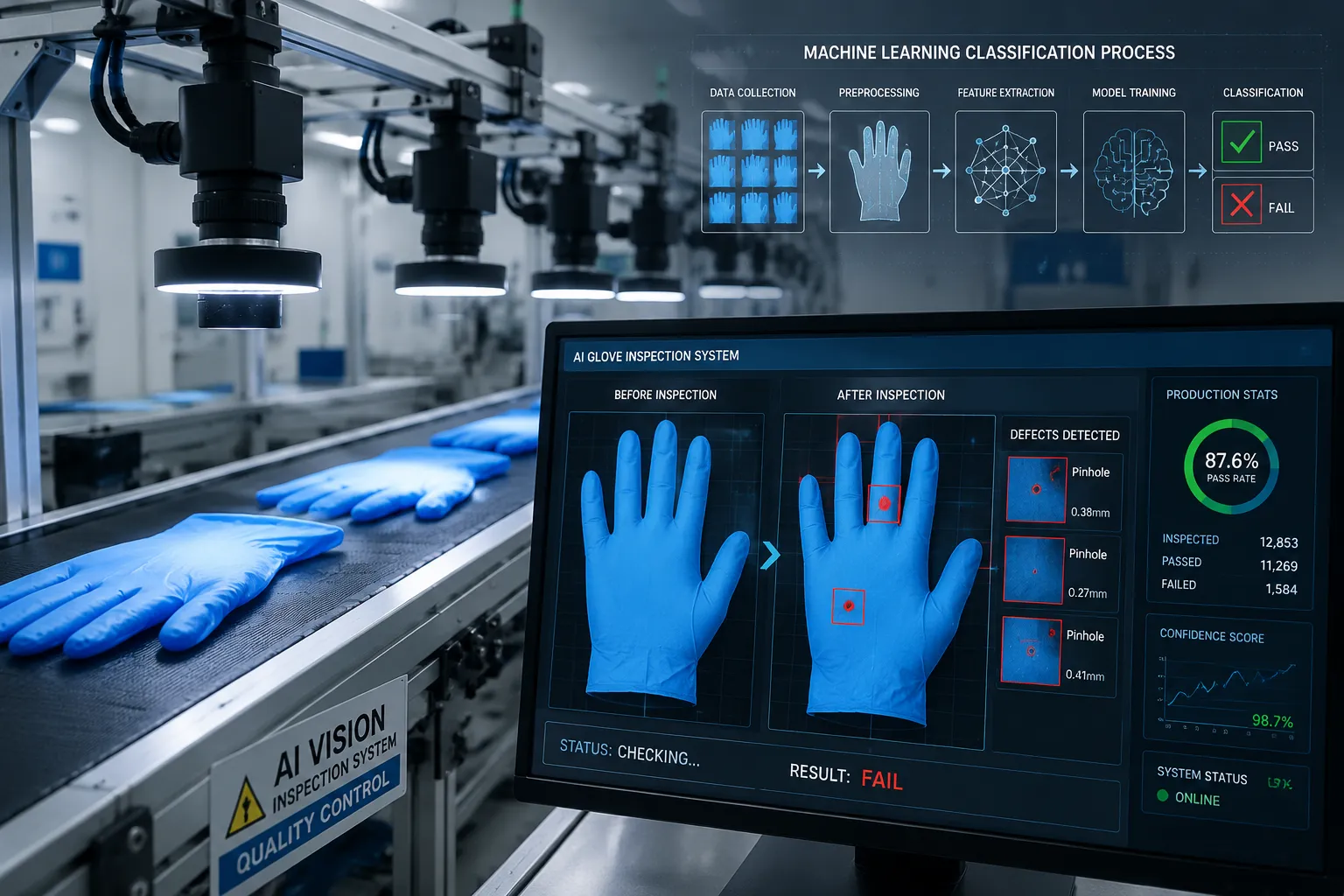
High-resolution imaging systems capture multiple angles of each glove as it moves through the production line. Cameras equipped with specialized lighting detect surface irregularities, contamination, and structural weaknesses. The imaging occurs at production speed without slowing the line.
Neural network algorithms process visual data in milliseconds, comparing each glove against learned patterns of acceptable and defective products. The system identifies subtle variations in texture, color gradients that indicate thin spots, and microscopic pinholes that would pass undetected in manual inspection.
Real-time data integration connects quality control findings with upstream production parameters. When the AI detects a pattern of defects, it correlates this with dipping temperature, curing time, or material batch numbers to identify root causes. This feedback loop enables immediate process adjustments before significant waste accumulates.
Adaptive learning capabilities allow the system to improve over time. As the AI encounters new defect types or production conditions, it updates its classification models. Manufacturers can also train the system on facility-specific quality standards that may exceed industry minimums.
One common mistake manufacturers make is expecting AI systems to work perfectly from day one. The initial calibration period typically requires 2-3 weeks of supervised operation where quality control staff verify AI decisions and flag any misclassifications. This training phase is essential for achieving optimal performance.
Choose AI quality control if your facility produces more than 50 million gloves annually, experiences defect rates above 3%, or supplies medical-grade nitrile gloves where quality standards are non-negotiable.
What Defects Can Automation Detect in Nitrile Glove Manufacturing
Automation detects seven primary defect categories in nitrile glove manufacturing: pinholes and micro-tears, thickness variations, dimensional inconsistencies, surface contamination, color defects, cuff irregularities, and structural weaknesses. Advanced systems identify defects as small as 50 microns, well below the threshold of human visual detection.
Pinholes and micro-tears represent the most critical defect type, compromising barrier protection. AI-powered leak detection uses high-voltage electrical testing combined with optical inspection. The glove passes over a charged mandrel while sensors detect any electrical conductivity indicating a breach. This method catches defects that water leak testing might miss.
Thickness variations affect both durability and tactile sensitivity. Laser measurement systems scan the entire glove surface, creating a thickness map with resolution down to 0.01mm. The AI flags areas that fall outside specification ranges, whether too thin (weak points) or too thick (reduced dexterity).
Dimensional inconsistencies include incorrect length, width, or finger proportions. Vision systems measure dozens of reference points on each glove, comparing them against CAD specifications. This catches issues like stretched fingers, misshapen palms, or cuffs that won’t seal properly.
Surface contamination from dust, oil, or chemical residue appears as discoloration or texture changes. Multispectral imaging detects contaminants invisible to standard cameras by analyzing how different wavelengths reflect off the glove surface.
Color defects indicate formulation problems or curing issues. Colorimetric sensors measure precise color values, flagging gloves that deviate from target specifications. This matters for color-coded glove systems used in food service and healthcare.
Cuff irregularities such as rolled edges, tears, or incomplete beading affect donning ease and seal integrity. Edge detection algorithms analyze cuff geometry and flag any deviations from the standard profile.
Structural weaknesses including thin spots, stress marks, or incomplete polymerization show up under specialized lighting. UV fluorescence inspection reveals areas where the nitrile hasn’t fully cured, predicting future failure points.
The system categorizes defects by severity. Critical defects trigger immediate rejection and line stoppage if multiple units show the same issue. Minor cosmetic defects may downgrade gloves to non-critical applications rather than complete rejection, reducing waste.
AI vs Traditional Inspection Methods for Glove Manufacturing
AI inspection systems achieve 99.2% defect detection accuracy compared to 85-90% for manual inspection, while processing 600+ gloves per minute versus 60-80 gloves per minute for human inspectors. Traditional methods rely on visual examination, water leak testing, and statistical sampling, whereas AI inspects 100% of production with consistent standards.
Speed and throughput differences are substantial. A single AI vision system replaces 8-10 human inspectors on a high-speed production line. Human inspectors fatigue after 2-3 hours of continuous inspection, leading to declining accuracy. AI maintains consistent performance across 24-hour production runs.
Detection capabilities vary significantly. Human inspectors excel at identifying obvious defects like large tears or severe discoloration but struggle with subtle issues. They miss pinholes smaller than 200 microns and have difficulty detecting slight thickness variations. AI systems detect defects down to 50 microns and measure thickness variations of 0.01mm.
Consistency represents AI’s biggest advantage. Human inspection quality varies by individual skill, experience, fatigue level, and even time of day. Studies show manual inspection accuracy drops 15-20% during the last hour of a shift. AI applies identical criteria to every glove, eliminating subjective judgment.
Cost structure differs fundamentally. Traditional inspection requires ongoing labor costs that scale with production volume. A facility producing 200 million gloves annually might employ 40-50 quality control inspectors at a total annual cost of $1.2-1.5 million. AI systems require higher upfront investment ($500,000-$2 million) but lower ongoing costs limited to maintenance and occasional recalibration.
Flexibility favors traditional methods in some scenarios. Human inspectors adapt quickly to new glove styles or specification changes with minimal retraining. AI systems require reprogramming and retraining periods of 1-2 weeks when introducing new products. For manufacturers producing many small batches of varied products, this can slow production.
Data generation gives AI a decisive edge. Traditional inspection produces minimal data beyond pass/fail counts. AI systems generate detailed analytics on defect types, frequencies, locations, and correlations with production parameters. This data drives continuous improvement initiatives.
Hybrid approaches combine both methods effectively. Many manufacturers use AI for primary inspection with human supervisors monitoring AI performance and handling edge cases. This captures AI’s speed and consistency while maintaining human oversight for quality assurance.
Choose traditional inspection if you produce fewer than 20 million gloves annually, manufacture highly varied custom products, or operate in regions where skilled labor costs are very low. Choose AI if you produce high volumes of standardized products, supply regulated industries like healthcare, or face high rejection rates with current methods.
Cost of Implementing AI Automation in Nitrile Glove Factory
Implementing AI automation in a nitrile glove factory costs between $500,000 and $2 million for mid-sized manufacturers producing 100-300 million gloves annually, with the investment covering vision systems, machine learning software, integration with existing equipment, and initial training. Small manufacturers can start with modular systems for $150,000-$300,000 focusing on critical inspection points.
Equipment costs break down into several categories:
- High-resolution camera systems with specialized lighting: $80,000-$150,000 per production line
- AI processing hardware and servers: $100,000-$200,000 for facilities with 4-8 production lines
- Automated rejection mechanisms: $50,000-$80,000 per line
- Sensors for thickness, electrical testing, and dimensional measurement: $60,000-$100,000 per line
- Integration hardware and control systems: $40,000-$70,000 per line
Software and licensing represents ongoing investment:
- Machine learning platform licenses: $30,000-$60,000 annually
- Custom algorithm development: $80,000-$150,000 one-time cost
- Data analytics and reporting software: $20,000-$40,000 annually
- System updates and maintenance contracts: $25,000-$50,000 annually
Installation and integration costs include:
- Production line modifications: $40,000-$80,000 per line
- Electrical and networking infrastructure: $30,000-$60,000 facility-wide
- System integration and testing: $50,000-$100,000
- Commissioning and calibration: $20,000-$40,000
Training expenses cover:
- Operator training programs: $15,000-$30,000
- Maintenance technician certification: $25,000-$40,000
- Quality control staff retraining: $10,000-$20,000
- Ongoing skill development: $8,000-$15,000 annually
Hidden costs that manufacturers often overlook:
- Production downtime during installation: $50,000-$100,000 in lost output
- Parallel operation period running both old and new systems: $30,000-$60,000
- Backup and redundancy systems: $40,000-$80,000
- Facility modifications for clean room standards: $20,000-$50,000
The total investment scales with facility size. Large manufacturers producing over 500 million gloves annually may invest $3-5 million for comprehensive automation across multiple production lines. Very small operations producing under 50 million gloves annually can implement basic AI inspection for $100,000-$150,000 by focusing on end-of-line quality control only.
Financing options reduce upfront burden. Equipment leasing spreads costs over 3-5 years at interest rates of 4-7%. Some AI system vendors offer performance-based contracts where payment ties to achieved defect reduction or throughput improvements.
How Much Does AI Reduce Defect Rates in Glove Production
AI reduces defect rates in glove production from industry averages of 5-8% down to 1-2% in facilities with fully integrated systems, representing a 60-75% reduction in rejected units. The improvement varies by facility baseline quality, with poorly performing plants seeing reductions of up to 80% while already well-managed facilities achieve 40-50% improvement.
Quantifiable improvements documented across multiple implementations:
Facilities starting with 6-8% defect rates typically achieve 1.5-2.5% rates within six months of AI deployment. This translates to 5-6.5 percentage points of improvement, saving 50-65 million gloves annually for a plant producing 1 billion units.
Plants with 3-5% baseline defect rates see reductions to 0.8-1.5%, improving yield by 2-3.5 percentage points. While the absolute improvement is smaller, these facilities often produce medical-grade gloves where even marginal quality gains command premium pricing.
Defect category improvements vary:
- Pinhole detection improves most dramatically, with AI catching 99%+ of pinholes versus 70-80% in manual inspection
- Thickness variation detection improves from 60-70% to 95%+ with laser measurement systems
- Dimensional defects drop by 50-60% as AI provides consistent measurement standards
- Contamination detection improves by 70-80% using multispectral imaging
Time-based improvements show AI systems get better with use:
Months 1-3: Defect rates drop 30-40% as the system applies consistent standards and catches obvious defects missed by fatigued inspectors.
Months 4-6: Additional 15-20% improvement as machine learning models train on facility-specific patterns and operators learn to respond quickly to AI alerts.
Months 7-12: Final 10-15% improvement as predictive maintenance prevents equipment issues that cause defects and process optimization based on AI data takes effect.
Secondary quality benefits beyond defect reduction:
Consistency improves across production batches. Standard deviation in glove thickness drops by 40-50%, meaning products cluster more tightly around target specifications.
Customer complaint rates decrease by 60-70% as fewer borderline-quality gloves reach end users. This particularly matters for food safety applications where glove failure creates contamination risk.
Recall risk drops substantially. Facilities with AI inspection report 80-90% fewer quality-related recalls because the system catches systematic defects before large quantities ship.
One edge case to consider: AI systems can initially increase apparent defect rates by 10-20% as they catch defects that previously went undetected. This temporary spike in rejections actually indicates the system is working, not that quality has declined. After process adjustments address the newly visible issues, defect rates drop below previous levels.
What Size Glove Manufacturer Needs AI Automation
Glove manufacturers producing more than 100 million units annually see clear ROI from AI automation, while facilities producing 50-100 million units benefit from modular implementations targeting specific quality bottlenecks. Very small manufacturers under 50 million units typically cannot justify full AI systems but may benefit from standalone inspection modules for critical applications.
Large manufacturers (300+ million units annually) represent ideal candidates:
- Multiple production lines running 24/7 create scale advantages where AI systems pay back within 12-18 months
- High labor costs in quality control departments make automation economically compelling
- Supply contracts with major healthcare or industrial buyers require documented quality systems that AI provides
- Export markets demand compliance with international standards that AI inspection helps verify
These facilities should implement comprehensive automation including inline inspection, automated rejection, predictive maintenance, and data analytics across all production lines.
Mid-sized manufacturers (100-300 million units annually) benefit from phased implementation:
- Start with AI inspection on highest-volume production lines where defect rates are highest
- Add automated rejection systems once inspection proves reliable
- Expand to additional lines as ROI demonstrates value
- Implement predictive maintenance after inspection systems are stable
This approach spreads investment over 18-24 months, reducing financial strain while building internal expertise gradually.
Small manufacturers (50-100 million units annually) should focus on modular solutions:
- End-of-line inspection systems that check finished gloves before packaging
- Standalone pinhole detection for critical applications like surgical gloves
- Thickness measurement systems if producing gloves for chemical resistance applications
- Basic data analytics to identify quality trends
Investment of $150,000-$300,000 targets specific pain points rather than comprehensive automation. ROI extends to 24-36 months but remains positive.
Very small manufacturers (under 50 million units annually) face challenges justifying AI:
- Limited production volume means longer payback periods of 36-48 months
- Smaller facilities often produce varied products requiring frequent system retraining
- Manual inspection labor costs may be low enough that automation savings are minimal
These manufacturers should consider AI only if they produce high-value specialized gloves, face regulatory pressure requiring enhanced quality documentation, or experience defect rates above 10% that threaten business viability.
Product mix considerations matter as much as volume:
Manufacturers producing standardized commodity gloves in high volumes benefit most from AI. The system trains once and runs continuously on identical products.
Manufacturers producing many custom formulations, colors, or sizes face higher AI implementation costs. Each product variant requires separate training data and calibration, multiplying setup time and complexity.
Facilities producing specialized gloves for chemical resistance or extreme conditions benefit from AI’s precise thickness and integrity testing even at lower volumes, as defects carry higher liability risk.
Common Mistakes When Implementing Automation in Glove Factories
The most common mistake when implementing automation in glove factories is insufficient planning for the integration period, leading to extended production disruptions and failure to achieve projected ROI. Manufacturers often underestimate the time required for system calibration, worker training, and process optimization, expecting immediate results when reality requires 3-6 months of adjustment.
Critical implementation mistakes to avoid:
Inadequate baseline documentation before installation prevents measuring true improvement. Manufacturers must document current defect rates by category, production speeds, labor costs, and downtime patterns for at least 60 days before automation begins. Without this data, proving ROI becomes impossible and identifying whether the system performs as promised is difficult.
Skipping the parallel operation phase where old and new systems run simultaneously for 2-4 weeks creates risk. Manufacturers who immediately shut down manual inspection and rely entirely on untested AI systems face potential quality disasters if the system misses defect types or produces false positives that halt production.
Insufficient electrical infrastructure causes system instability. AI inspection requires clean, stable power with backup systems. Facilities that connect AI equipment to existing electrical systems without upgrades experience shutdowns, data corruption, and equipment damage. Budget $30,000-$60,000 for electrical infrastructure improvements.
Neglecting environmental controls undermines AI performance. Vision systems require consistent lighting, temperature, and humidity. Facilities that install AI in areas with variable conditions see accuracy drop by 10-15%. Clean room standards aren’t always necessary, but stable conditions are essential.
Inadequate training investment leaves workers unable to operate or maintain systems effectively. Manufacturers who provide only 2-3 days of basic training face ongoing problems. Operators need 2-4 weeks to understand system responses, maintenance staff need 6-8 weeks to troubleshoot issues, and quality managers need 4-6 weeks to interpret analytics data.
Unrealistic expectations about defect elimination lead to disappointment. AI reduces defects dramatically but doesn’t eliminate them entirely. Manufacturers expecting zero defects become frustrated when systems achieve 1-2% rejection rates. Setting realistic targets of 60-75% improvement prevents this disillusionment.
Failure to plan for system failures creates production crises. AI systems require maintenance, experience occasional malfunctions, and need periodic recalibration. Manufacturers without backup inspection protocols face complete production halts during downtime. Maintain manual inspection capability for at least the first 12 months.
Ignoring data security exposes proprietary information. AI systems generate detailed production data that competitors would value. Facilities that connect AI systems to internet-accessible networks without proper cybersecurity face data theft risks. Implement network segmentation and access controls from day one.
Underestimating change management creates worker resistance. Employees fear job loss, distrust new technology, and resist changing established routines. Manufacturers who announce AI implementation without addressing these concerns face sabotage, high turnover, and poor adoption. Communicate early, involve workers in planning, and clarify how roles will evolve rather than disappear.
Choosing systems based solely on price rather than fit leads to poor outcomes. The cheapest AI system may lack features your facility needs or require extensive customization. Evaluate systems based on total cost of ownership over 5 years, including training, maintenance, and upgrade costs.
Can Small Nitrile Glove Manufacturers Afford AI Systems
Small nitrile glove manufacturers can afford AI systems through modular implementations starting at $150,000-$300,000, focusing on critical inspection points rather than comprehensive automation. These scaled-down systems target specific quality issues like pinhole detection or thickness measurement, delivering ROI within 24-36 months even at production volumes of 50-100 million gloves annually.
Affordable entry points for small manufacturers:
End-of-line inspection modules cost $120,000-$200,000 and check finished gloves before packaging. These systems catch defects that escaped earlier inspection stages, preventing customer complaints and returns. They’re easier to install than inline systems because they don’t require production line modifications.
Standalone pinhole detection using electrical testing costs $80,000-$150,000. This addresses the most critical defect type for medical and food service applications. Small manufacturers producing high-value gloves for these markets see fastest payback.
Thickness measurement systems cost $60,000-$120,000 and ensure gloves meet specifications for chemical resistance or durability. Manufacturers producing specialized industrial gloves benefit most from this targeted investment.
Basic vision inspection for obvious defects costs $100,000-$180,000. While less sophisticated than full AI systems, these catch tears, contamination, and color defects at speeds exceeding manual inspection.
Financing strategies that make AI accessible:
Equipment leasing spreads costs over 3-5 years at monthly payments of $3,000-$6,000 for a $150,000 system. This preserves working capital while delivering immediate quality benefits.
Vendor financing programs offered by some AI system manufacturers provide 0-2% interest rates for qualified buyers. These programs aim to expand market adoption and may include deferred payment options.
Government grants and incentives for manufacturing modernization exist in many regions. Small manufacturers may qualify for programs covering 20-40% of automation costs. Research regional economic development programs before purchasing.
Cooperative purchasing where multiple small manufacturers share an AI system works in some scenarios. Contract manufacturers or industry cooperatives can invest jointly in inspection equipment used across multiple facilities.
Cost-benefit analysis for small manufacturers:
A facility producing 75 million gloves annually with a 6% defect rate wastes 4.5 million gloves worth approximately $90,000-$135,000 in materials and production costs. An AI system reducing defects to 2% saves 3 million gloves worth $60,000-$90,000 annually.
Add savings from reduced customer complaints, fewer returns, and lower quality control labor costs, and total annual benefit reaches $80,000-$120,000. A $200,000 system investment pays back in 20-30 months.
When small manufacturers should wait on AI investment:
Facilities with defect rates below 3% may not save enough to justify investment. Focus on maintaining current quality levels through process control.
Manufacturers producing highly varied custom products face higher implementation costs because each product requires separate system training. Wait until production standardizes or volume increases.
Operations with unstable production processes should fix fundamental issues before adding AI. If defect rates vary widely week-to-week due to inconsistent materials or equipment problems, address those root causes first.
How Does Machine Learning Detect Pinholes in Nitrile Gloves
Machine learning detects pinholes in nitrile gloves by combining electrical conductivity testing with optical analysis, achieving detection rates above 99% for holes as small as 50 microns. The system passes each glove over a charged electrode while cameras capture high-resolution images, then neural networks analyze both electrical signals and visual data to identify breaches in the barrier.
The detection process works in multiple stages:
Electrical testing forms the primary detection method. The glove moves over a metal mandrel charged with 100-300 volts. Intact nitrile provides excellent electrical insulation, but any pinhole allows current to flow through moisture or conductive contamination. Sensors detect current spikes indicating barrier breaches.
This method catches pinholes too small for visual detection but can produce false positives from surface moisture or contamination. Machine learning algorithms distinguish between true pinholes and false signals by analyzing signal patterns.
High-resolution imaging captures the glove surface under specialized lighting. LED arrays with specific wavelengths highlight surface irregularities. Cameras with resolution of 5-10 megapixels capture multiple angles as the glove moves through the inspection zone at speeds up to 600 units per minute.
Neural network analysis processes the visual data. The system trains on thousands of images of gloves with known defects, learning to recognize patterns associated with pinholes. These include:
- Tiny bright spots where light passes through holes
- Texture changes around pinhole edges
- Stress patterns radiating from weak points
- Color variations indicating thin areas prone to failure
Multi-sensor fusion combines electrical and optical data. The machine learning algorithm weighs evidence from both sources, achieving higher accuracy than either method alone. If electrical testing flags a potential pinhole but imaging shows no visual defect, the system may classify it as a false positive from contamination. If imaging suggests a thin spot but electrical testing shows no current flow, the system flags it for secondary inspection.
Adaptive learning improves detection over time. When quality control staff verify or reject AI decisions during the training period, the system updates its classification models. It learns facility-specific patterns like how pinholes appear in particular glove formulations or how production line conditions affect defect characteristics.
Edge case handling addresses challenging scenarios:
Very small pinholes under 50 microns may not conduct enough current for reliable electrical detection. The system flags gloves with suspicious visual patterns for secondary testing using more sensitive methods.
Pinholes in thick areas like cuffs or reinforced sections are harder to detect visually. The system increases sensitivity in these regions based on learned patterns of where defects commonly occur.
Multiple small pinholes clustered together can appear as a single larger defect. The algorithm distinguishes between these scenarios because they indicate different production problems requiring different corrective actions.
System calibration requires careful setup. Manufacturers must provide training sets of 500-1,000 gloves with verified defects and 2,000-3,000 defect-free gloves. The system learns what normal variation looks like versus true defects. Recalibration every 3-6 months maintains accuracy as production conditions evolve.
ROI Timeline for AI Automation in Glove Manufacturing
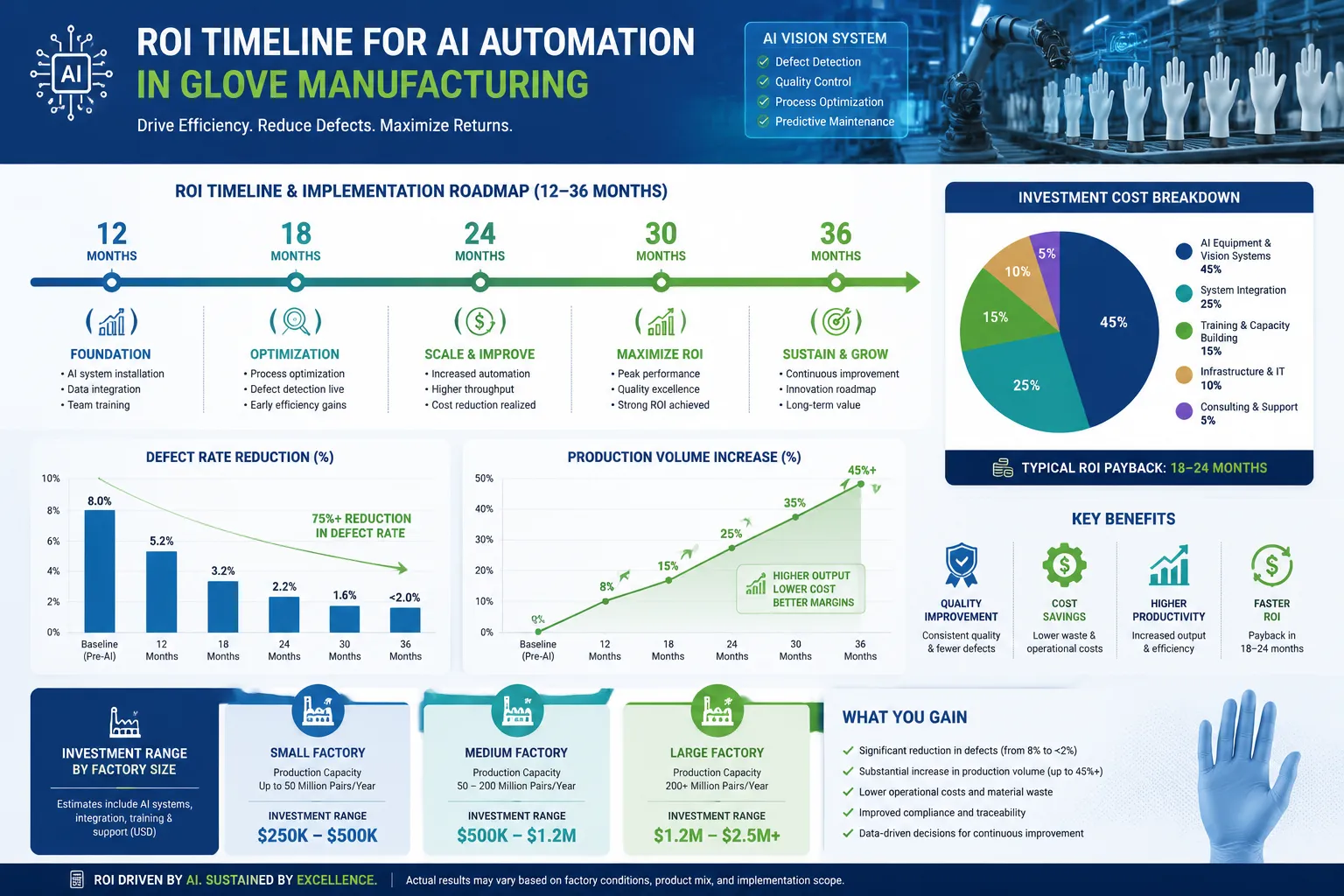
ROI timeline for AI automation in glove manufacturing typically ranges from 18-24 months for mid-sized facilities producing 100-300 million gloves annually, with large manufacturers achieving payback in 12-18 months and small operations requiring 24-36 months. The timeline depends on baseline defect rates, labor costs, production volume, and whether implementation proceeds smoothly without extended disruptions.
Payback calculation components:
Direct savings from reduced waste provide the largest benefit. A facility producing 200 million gloves annually with a 6% defect rate wastes 12 million gloves. At material and production costs of $0.02-0.03 per glove, annual waste totals $240,000-$360,000. Reducing defects to 2% saves 8 million gloves worth $160,000-$240,000 annually.
Labor cost reduction contributes significantly. Replacing 8-10 quality control inspectors at $30,000-$35,000 annual cost each saves $240,000-$350,000 per year. Some facilities redeploy these workers to other roles rather than eliminating positions, reducing but not eliminating this benefit.
Increased throughput adds revenue. AI inspection processes 600+ gloves per minute versus 60-80 for manual inspection, removing quality control as a production bottleneck. Facilities can increase output by 15-25% on existing lines, generating additional revenue of $300,000-$800,000 annually depending on facility size and market conditions.
Reduced customer complaints and returns save $40,000-$80,000 annually in direct costs plus unmeasurable brand protection value. Facilities supplying medical markets particularly value this benefit.
Premium pricing opportunities emerge for manufacturers who can document superior quality through AI inspection data. Some buyers pay 5-10% premiums for gloves from AI-certified facilities, adding $100,000-$400,000 in annual revenue for mid-sized manufacturers.
Total annual benefit for a typical mid-sized facility sums to $540,000-$1,270,000. Against an implementation cost of $800,000-$1,200,000, payback occurs in 15-27 months.
Timeline by facility size:
Large facilities (300+ million units annually):
- Months 1-6: Installation, training, parallel operation
- Months 7-12: Full operation, initial savings realization
- Months 13-18: ROI achieved, system optimization ongoing
- Total payback: 12-18 months
Mid-sized facilities (100-300 million units annually):
- Months 1-6: Installation and training
- Months 7-12: Ramp-up to full operation
- Months 13-24: Savings accumulation
- Total payback: 18-24 months
Small facilities (50-100 million units annually):
- Months 1-6: Modular system installation
- Months 7-18: Operation and optimization
- Months 19-36: ROI achievement
- Total payback: 24-36 months
Factors that accelerate payback:
High baseline defect rates above 7% create larger savings opportunities, reducing payback to 12-15 months even for mid-sized facilities.
High labor costs in developed markets make automation more attractive. Facilities in regions where quality control inspectors earn $40,000-$50,000 annually see faster payback.
Premium market positioning allows manufacturers to capture value through higher pricing rather than just cost reduction.
Factors that extend payback:
Implementation problems that cause extended downtime can add 3-6 months to payback periods. Budget contingency time and maintain backup systems.
Low baseline defect rates below 3% mean smaller savings from quality improvement. These facilities must rely more on throughput increases and labor savings.
Small production volumes spread fixed costs over fewer units, extending payback periods.
Long-term value beyond initial payback:
After achieving ROI, AI systems continue delivering benefits for 7-10 years with proper maintenance. Annual savings of $500,000-$1,200,000 accumulate to $3.5-$12 million in total value over system lifetime.
Continuous improvement from machine learning means quality and efficiency gains increase over time rather than plateauing.
Alternatives to Full AI Automation for Glove Quality Control
Alternatives to full AI automation for glove quality control include semi-automated inspection systems, enhanced manual inspection with digital aids, statistical process control, and hybrid approaches that combine human judgment with technology assistance. These options cost $50,000-$300,000 compared to $500,000-$2 million for comprehensive AI systems while still delivering meaningful quality improvements.
Semi-automated inspection systems use basic machine vision without AI:
These systems employ cameras and simple algorithms to detect obvious defects like large tears, severe discoloration, or missing fingers. They cost $80,000-$200,000 per line and catch 70-80% of defects that manual inspection would find, missing only subtle issues.
Choose this option if your facility has defect rates of 3-5% and produces standardized products. The system pays back in 18-24 months through labor savings and improved consistency.
Enhanced manual inspection with digital tools costs $30,000-$80,000:
Provide inspectors with magnification devices, specialized lighting, and digital checklists that ensure consistent evaluation criteria. Add simple electrical pinhole testers that flag potential breaches for human verification.
This approach works for small manufacturers producing under 50 million gloves annually where full automation cannot be justified. Quality improves by 20-30% through better tools and standardized procedures.
Statistical process control (SPC) focuses on prevention rather than detection:
Monitor production parameters like dipping temperature, curing time, and material viscosity. Use control charts to identify when processes drift out of specification before defects occur. Implementation costs $40,000-$100,000 for sensors, software, and training.
SPC complements any inspection method by reducing defect occurrence rather than just catching defects after they happen. Facilities implementing robust SPC see defect rates drop by 30-40% even without changing inspection methods.
Automated electrical testing without vision systems costs $60,000-$120,000:
Focus solely on pinhole detection using high-voltage testing. This catches the most critical defect type while leaving other inspection to manual methods. Particularly valuable for medical glove manufacturers where barrier integrity is paramount.
Hybrid human-AI systems cost $200,000-$400,000:
AI handles high-speed initial screening, flagging suspicious gloves for human verification. This reduces the number of gloves requiring detailed manual inspection by 80-90% while maintaining human judgment for edge cases.
This approach delivers 70-80% of full AI benefits at 40-50% of the cost. It works well for manufacturers producing varied products where AI alone struggles with frequent product changes.
Third-party inspection services avoid capital investment entirely:
Some manufacturers outsource quality control to specialized firms that bring portable inspection equipment to your facility. Costs run $0.002-0.005 per glove inspected, making this viable for small batches or new product launches.
Use this option when introducing new products before committing to permanent inspection infrastructure, or for small manufacturers who cannot justify any capital investment.
Comparison of alternatives:
| Approach | Cost | Defect Detection | Best For |
|---|---|---|---|
| Full AI automation | $500,000-$2M | 99%+ | Large facilities, high volumes |
| Semi-automated vision | $80,000-$200,000 | 70-80% | Mid-sized, standardized products |
| Enhanced manual | $30,000-$80,000 | 60-70% | Small facilities, varied products |
| SPC focus | $40,000-$100,000 | Prevents 30-40% of defects | All facilities as complement |
| Electrical testing only | $60,000-$120,000 | 95%+ for pinholes | Medical glove focus |
| Hybrid human-AI | $200,000-$400,000 | 85-90% | Varied products, quality-critical |
Choose alternatives to full AI when production volume is under 100 million units annually, product mix changes frequently, or capital availability is limited. Many manufacturers start with alternatives and upgrade to full AI as volume grows and ROI becomes clearer.
What Happens When AI System Fails During Glove Production
When AI systems fail during glove production, manufacturers must immediately switch to backup inspection protocols to prevent shipping defective products, typically reverting to manual inspection or activating redundant AI systems. Production speed usually drops by 60-80% during manual backup operation, and facilities without adequate contingency plans face complete production halts lasting 2-24 hours depending on failure severity.
Common failure modes and their impacts:
Software crashes occur when AI algorithms encounter unexpected data or system resources become exhausted. These failures typically resolve within 15-30 minutes through automatic restarts or manual intervention. Production continues at reduced speed using the most recent system state.
Hardware failures including camera malfunctions, lighting failures, or server problems require physical repairs. Resolution time ranges from 1-4 hours for simple component replacement to 8-24 hours for major hardware issues. Facilities with spare components minimize downtime.
Network connectivity loss between inspection systems and central servers disrupts data logging and remote monitoring but may not stop inspection if systems have local processing capability. Impact ranges from minor (lost analytics data) to severe (complete inspection failure) depending on system architecture.
Calibration drift occurs gradually as production conditions change or equipment ages. The system continues operating but accuracy declines, potentially missing defects or generating excessive false positives. Regular recalibration every 3-6 months prevents this issue.
Power failures shut down AI systems immediately. Facilities with uninterruptible power supplies (UPS) maintain operation for 15-30 minutes, allowing graceful shutdown. Without UPS, sudden power loss can corrupt data and require 1-2 hours for system recovery after power restoration.
Backup protocols every facility must maintain:
Redundant inspection capability means installing duplicate AI systems on critical production lines. If the primary system fails, production switches to the backup within minutes. This doubles inspection equipment costs but eliminates downtime risk for high-value production.
Manual inspection procedures that workers practice monthly ensure they can step in during AI failures. Maintain inspection stations with proper lighting and tools even after AI implementation. Train all production staff in basic inspection techniques, not just dedicated quality control personnel.
Inventory buffers of inspected gloves allow production to continue during inspection system downtime. Maintain 2-4 hours of finished goods inventory that can be packaged while inspection systems are repaired.
Rapid response maintenance contracts with AI system vendors provide 4-8 hour response times for critical failures. These contracts cost $25,000-$50,000 annually but prevent extended downtime.
Preventive maintenance schedules reduce failure frequency:
- Daily: Visual inspection of cameras, lighting, and mechanical components
- Weekly: Cleaning of optical systems, verification of calibration
- Monthly: Software updates, backup system testing
- Quarterly: Comprehensive system calibration, component replacement
- Annually: Major system overhaul, upgrade evaluation
Risk mitigation strategies:
Design production schedules with planned downtime for maintenance rather than running systems continuously until failure occurs. Schedule maintenance during low-demand periods or shift changes.
Maintain relationships with multiple AI system vendors or service providers so you’re not dependent on a single supplier for repairs and support.
Document all system failures, response times, and resolution methods. This data helps identify recurring issues and justify investments in redundancy or upgrades.
Financial impact of system failures:
A 4-hour production halt on a line producing 100,000 gloves per hour costs $8,000-$12,000 in lost production plus $2,000-$4,000 in labor costs for idle workers. Annual downtime of 20-40 hours totals $50,000-$160,000 in lost value.
Shipping defective products during undetected system failures costs far more. A single batch of 500,000 defective gloves reaching customers can trigger recalls costing $100,000-$300,000 plus brand damage.
These risks justify investing $50,000-$100,000 in backup systems and maintenance contracts that minimize failure frequency and duration.
Do I Need to Retrain Workers After Installing AI in Glove Factory
Yes, you need to retrain workers after installing AI in glove factories, with operators requiring 2-4 weeks of training, maintenance technicians needing 6-8 weeks, and quality managers requiring 4-6 weeks to effectively work with AI-enhanced production systems. The training covers system operation, troubleshooting, data interpretation, and integration of AI insights into production decisions.
Operator training requirements:
Basic system operation takes 3-5 days. Workers learn to start and stop the AI system, monitor status displays, and respond to alerts. This training covers normal operation procedures and when to call for technical support.
Alert response protocols require 1-2 weeks of practice. Operators must understand what different alerts mean and take appropriate action. Some alerts require immediate production stops, others need process adjustments, and some are informational only. Distinguishing between these categories prevents both unnecessary shutdowns and failure to respond to critical issues.
Quality verification procedures take 1-2 weeks to master. Even with AI inspection, operators must periodically verify system accuracy by manually inspecting samples. Training covers proper sampling techniques, inspection criteria, and documentation requirements.
System interaction during production requires ongoing practice. Operators learn to interpret real-time quality dashboards, adjust production parameters based on AI feedback, and coordinate with maintenance staff when issues arise.
Maintenance technician training:
Hardware maintenance requires 2-3 weeks covering camera systems, lighting, sensors, and mechanical components. Technicians learn cleaning procedures, component replacement, and basic troubleshooting.
Software troubleshooting takes 2-3 weeks. Technicians must diagnose whether problems stem from hardware issues, software glitches, or calibration drift. They learn to restart systems, restore from backups, and when to escalate to vendor support.
Calibration procedures require 1-2 weeks of training. Technicians learn to recalibrate vision systems, adjust sensitivity settings, and verify system accuracy using test samples.
Preventive maintenance protocols take 1 week to learn. Technicians follow detailed schedules for cleaning, inspection, and component replacement that prevent failures.
Quality manager training:
Data analytics interpretation requires 2-3 weeks. Managers learn to read quality dashboards, identify trends, and correlate defect patterns with production parameters. This skill enables proactive problem-solving rather than reactive firefighting.
System performance monitoring takes 1-2 weeks. Managers must verify AI systems maintain accuracy over time, catch calibration drift before it impacts quality, and ensure operators follow proper procedures.
Continuous improvement using AI data requires 1-2 weeks of training. Managers learn to use quality data to identify root causes of defects, justify process improvements, and measure the impact of changes.
Training delivery methods:
Vendor-provided training during system installation covers basic operation and maintenance. Most AI system vendors include 40-80 hours of on-site training in their implementation packages.
Hands-on practice during parallel operation allows workers to learn while manual inspection provides backup. This 2-4 week period builds confidence and competence before full reliance on AI systems.
Ongoing skill development through monthly refresher sessions maintains proficiency and introduces new features as systems are upgraded.
Job role evolution rather than elimination:
Quality control inspectors transition from manual inspection to AI system supervision. Instead of staring at gloves for hours, they monitor dashboards, verify AI decisions, and investigate root causes of defects.
Maintenance staff add AI system maintenance to their existing responsibilities. Facilities typically need 1-2 dedicated AI technicians for every 4-6 production lines.
Production managers gain new tools for quality improvement but retain responsibility for overall production outcomes. AI provides better data for decision-making but doesn’t make decisions autonomously.
Cost of training:
Vendor training included in system purchase covers basic operation. Additional specialized training costs $5,000-$15,000 per person for advanced skills.
Lost productivity during training totals $30,000-$60,000 as workers spend time in training rather than production. Schedule training during slow periods to minimize impact.
Ongoing training costs $8,000-$15,000 annually for refreshers and updates as systems evolve.
Best AI Automation Systems for Nitrile Glove Manufacturers
The best AI automation systems for nitrile glove manufacturers include Cognex vision systems with deep learning capabilities, Keyence AI-powered inspection platforms, and specialized glove industry solutions from companies like Mirtec and Nirtan that integrate vision inspection with electrical testing and data analytics. System selection depends on production volume, product variety, quality requirements, and integration needs with existing equipment.
Evaluation criteria for selecting systems:
Detection accuracy represents the most critical factor. Systems should demonstrate 99%+ accuracy in detecting pinholes, 95%+ for thickness variations, and 98%+ for dimensional defects. Request validation data from installations at facilities similar to yours.
Processing speed must match or exceed your production line rates. Systems should inspect 600-800 gloves per minute for high-speed lines or 300-400 per minute for standard lines without creating bottlenecks.
Integration capability with existing production equipment determines implementation complexity. Systems with standard industrial protocols (OPC-UA, Modbus, Ethernet/IP) integrate more easily than proprietary systems requiring custom interfaces.
Adaptability to product changes matters for manufacturers producing multiple glove types. Systems should allow rapid retraining for new products without extensive downtime.
Data analytics capabilities vary widely. Better systems provide real-time dashboards, trend analysis, root cause investigation tools, and integration with enterprise systems for comprehensive quality management.
Vendor support including training, maintenance, and upgrade paths affects long-term value. Evaluate vendor responsiveness, local service availability, and user community strength.
System architecture options:
Centralized systems use powerful servers to process data from multiple inspection stations. This approach provides sophisticated analytics and easier software updates but creates single points of failure.
Distributed systems with local processing at each inspection station offer better reliability and faster response times but may have less sophisticated analytics capabilities.
Hybrid architectures combine local processing for real-time inspection with centralized analytics for trend analysis and reporting. This approach balances performance, reliability, and analytical capability.
Modular vs. integrated solutions:
Modular systems allow manufacturers to start with basic inspection and add capabilities over time. This approach reduces initial investment and allows learning before full commitment. However, integration between modules from different vendors can be challenging.
Integrated solutions provide complete inspection, rejection, and analytics in a single package. These systems work together seamlessly but require larger upfront investment and may include features you don’t need.
Customization requirements:
Off-the-shelf systems work well for manufacturers producing standard examination or food service gloves in high volumes. Implementation takes 8-12 weeks with minimal customization.
Specialized applications like chemical-resistant gloves or gloves with textured surfaces require custom algorithm development. Budget an additional $50,000-$150,000 and 12-16 weeks for customization.
Selection process:
Start by documenting your requirements including production volumes, defect types most critical to your applications, product variety, and integration needs. This specification guides vendor discussions.
Request demonstrations using your actual gloves under your production conditions. Lab demonstrations don’t always translate to factory floor performance.
Visit reference installations at facilities similar to yours. Talk to operators, maintenance staff, and quality managers about real-world performance, not just vendor claims.
Conduct pilot testing with 2-3 finalist systems before final selection. A 30-60 day trial on one production line reveals performance issues and integration challenges before full commitment.
Evaluate total cost of ownership over 5 years including purchase price, installation, training, maintenance, and upgrade costs. The cheapest initial price often isn’t the best long-term value.
Emerging technologies to consider:
Edge AI systems that process data locally using specialized processors offer faster response times and better reliability than cloud-dependent systems. These are becoming standard in new installations.
Hyperspectral imaging detects material composition variations and contamination invisible to standard cameras. This technology is moving from research to commercial availability in 2026.
Predictive quality systems that use AI to forecast defect rates based on production parameters allow proactive adjustments before defects occur. These systems are available from leading vendors as add-on modules.
Frequently Asked Questions
How long does it take to install AI inspection systems in a glove factory?
Installation takes 8-16 weeks depending on system complexity and facility readiness. This includes 2-3 weeks for equipment installation, 1-2 weeks for electrical and network infrastructure, 2-3 weeks for system calibration, and 2-4 weeks for parallel operation and training. Facilities with good infrastructure and experienced staff complete installation faster.
Can AI systems inspect colored or textured nitrile gloves effectively?
Yes, AI systems inspect colored and textured gloves effectively after training on those specific products. The system learns what normal variation looks like for each color and texture pattern, then identifies deviations. Initial training requires 500-1,000 sample gloves per product variant and takes 1-2 weeks per variant.
What maintenance do AI inspection systems require?
AI systems require daily cleaning of optical components, weekly calibration verification, monthly software updates, and quarterly comprehensive calibration. Annual maintenance costs run $25,000-$50,000 including parts, labor, and vendor support contracts. Facilities with dedicated maintenance staff reduce these costs by handling routine tasks internally.
How do AI systems handle new defect types they haven’t seen before?
AI systems flag unusual patterns that don’t match known defect or acceptable categories for human review. Quality managers then classify these samples and add them to the training dataset. The system updates its models within 24-48 hours to recognize similar defects in the future. This adaptive learning improves performance over time.
Can AI inspection systems work with existing production lines?
Yes, modern AI systems integrate with existing production lines through standard industrial protocols. Installation requires mounting cameras and sensors at appropriate inspection points and connecting to line control systems. Older lines may need electrical and control system upgrades costing $30,000-$60,000 per line.
What happens to quality control workers after AI implementation?
Quality control workers typically transition to AI system supervision, verification sampling, root cause analysis, and continuous improvement roles. Most facilities redeploy rather than eliminate these positions. Some workers require 4-8 weeks of retraining for new responsibilities.
How accurate are AI systems compared to manual inspection?
AI systems achieve 99%+ accuracy for critical defects like pinholes compared to 85-90% for manual inspection. AI maintains consistent performance across 24-hour operation while human accuracy declines with fatigue. However, humans still excel at identifying unusual defects the AI hasn’t encountered before.
Do AI systems work in high-humidity or high-temperature environments?
AI systems work in controlled environments with temperature of 18-25°C and humidity below 70%. Production areas exceeding these ranges require environmental controls or protective enclosures for inspection equipment. Budget $20,000-$40,000 for environmental control improvements if needed.
Can small manufacturers share AI systems between multiple facilities?
Sharing AI systems between facilities is impractical because systems must be permanently installed on production lines. However, small manufacturers can share implementation costs through cooperative purchasing, joint training programs, and shared maintenance contracts, reducing individual investment by 20-30%.
How often do AI systems need recalibration?
AI systems need recalibration every 3-6 months to maintain optimal accuracy as production conditions evolve. Recalibration takes 4-8 hours and involves running test samples with known defects through the system and adjusting sensitivity settings. Facilities experiencing frequent product changes may need monthly recalibration.
What cybersecurity risks do AI inspection systems create?
AI systems connected to networks face risks of data theft, ransomware, and unauthorized access. Implement network segmentation isolating production systems from office networks, require strong authentication, and maintain offline backups of system configurations. Annual cybersecurity costs run $5,000-$15,000 for small to mid-sized facilities.
Can AI systems detect defects in gloves still on forming molds?
Yes, inline AI systems inspect gloves while still on forming molds, catching defects earlier in the process. This allows immediate process adjustments and reduces waste from continuing to process defective gloves. Inline systems cost 20-30% more than end-of-line inspection but deliver faster feedback.
Conclusion
AI and Automation in Nitrile Glove Manufacturing: Boosting Quality, Reducing Defects, and Scaling Production represents a fundamental transformation in how manufacturers ensure product quality, reduce waste, and meet growing global demand. The technology delivers measurable benefits including 60-75% reductions in defect rates, 30-40% increases in production throughput, and ROI within 18-24 months for most facilities.
Success requires careful planning, realistic expectations, and commitment to worker training and change management. Manufacturers should start by documenting baseline quality metrics, evaluating system options based on their specific needs rather than price alone, and implementing backup protocols to manage system failures. Small manufacturers can access these benefits through modular systems targeting critical quality issues, while large facilities benefit from comprehensive automation across all production lines.
The competitive landscape in 2026 increasingly favors manufacturers who can document consistent quality through AI-powered inspection systems. Buyers in healthcare, food service, and industrial markets demand the reliability and traceability that AI systems provide. Manufacturers who delay implementation risk losing market share to competitors who deliver superior quality at lower costs.
Take action by conducting a quality audit to identify your highest-impact opportunities, requesting demonstrations from 2-3 AI system vendors using your actual products, and visiting reference installations to see real-world performance. Start with a pilot implementation on one production line to build internal expertise before expanding to full facility automation. The investment in AI and automation positions your facility for long-term competitiveness in an industry where quality, efficiency, and scalability determine success.
SEO Meta Title: AI in Nitrile Glove Manufacturing: Quality & Production