Last updated: June 26, 2026
Quick Answer
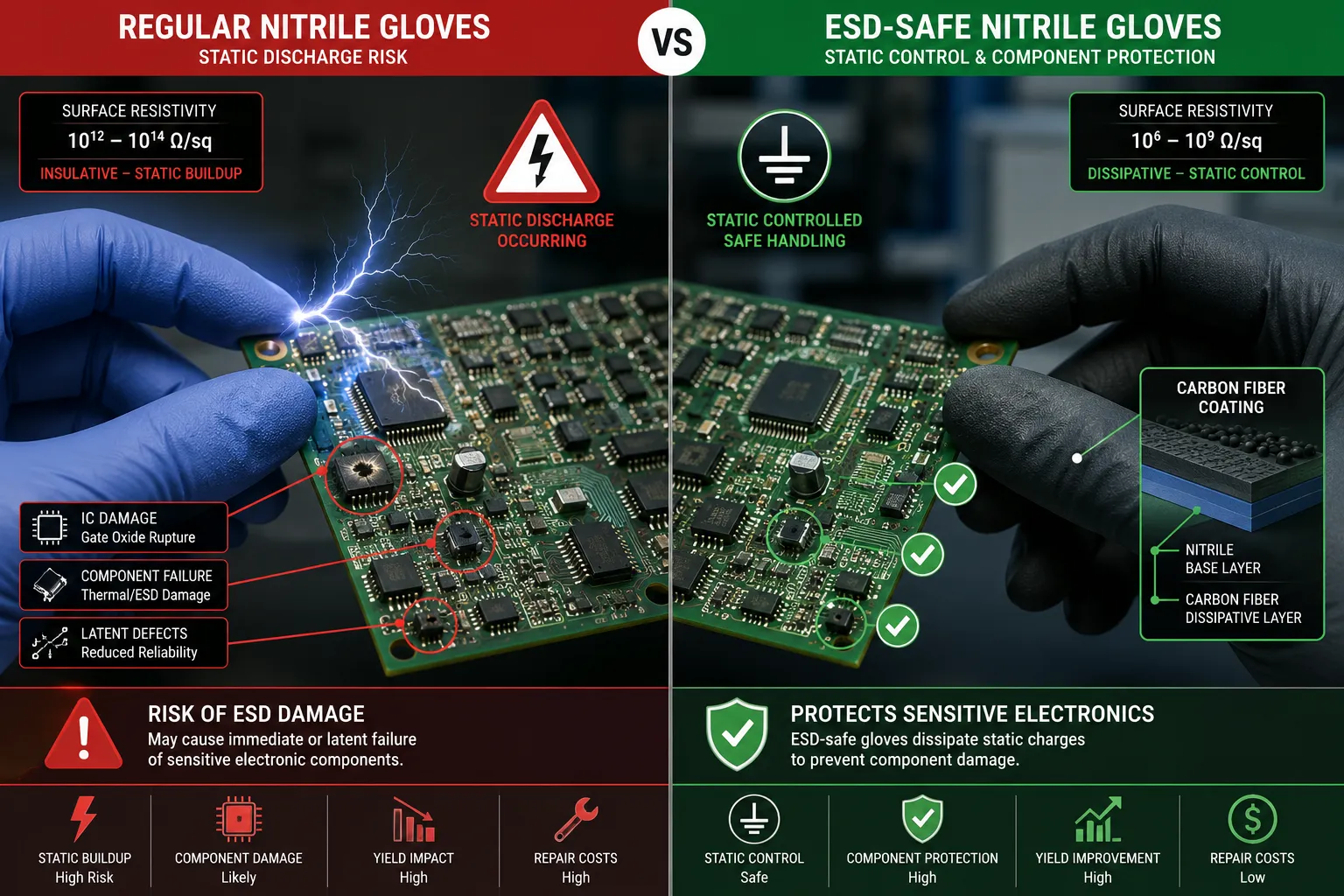
Nitrile Gloves for Semiconductor and Precision Tech with ESD-safe features incorporate conductive or static-dissipative materials (typically carbon or metal fibers) that prevent electrostatic discharge, which can destroy sensitive electronic components. These specialized gloves maintain surface resistivity between 10^6 and 10^11 ohms per square, are lint-free to meet cleanroom standards, and provide chemical resistance while safely grounding static charges. Standard nitrile gloves do not offer ESD protection and can actually generate damaging static when used in electronics manufacturing.
Key Takeaways
- ESD-safe nitrile gloves contain conductive materials that dissipate static charges, preventing damage to sensitive electronic components worth thousands of dollars
- Surface resistivity ratings between 10^6 and 10^9 ohms per square indicate proper static-dissipative properties for semiconductor work
- Regular nitrile gloves can generate up to 35,000 volts of static electricity and should never be used on circuit boards or microchips
- Powder-free formulations are mandatory for cleanroom environments to prevent particle contamination on silicon wafers and precision optics
- ESD gloves typically cost 3-5 times more than standard nitrile gloves but prevent costly component failures and production losses
- Proper testing with surface resistivity meters confirms gloves maintain ESD protection throughout their shelf life
- Most ESD nitrile gloves work with capacitive touchscreens while maintaining static control properties

What Are ESD-Safe Nitrile Gloves and Why Do Semiconductors Need Them
ESD-safe nitrile gloves are specialized hand protection designed with conductive or static-dissipative materials that prevent electrostatic discharge from damaging sensitive electronic components. Semiconductor manufacturing requires these gloves because even a 10-volt static discharge can permanently destroy microchips, while human bodies routinely generate 3,000 to 35,000 volts through normal movement.
Standard nitrile gloves act as insulators, trapping static charges on the surface and creating dangerous voltage differentials. When a technician wearing regular gloves touches a circuit board, the accumulated charge transfers instantly, creating a spark that can:
- Vaporize microscopic circuit traces on integrated circuits
- Corrupt data stored in memory chips
- Create latent defects that cause premature component failure
- Damage sensitive sensors and MEMS devices
ESD-safe variants solve this problem by incorporating carbon fibers, metal particles, or conductive polymers throughout the nitrile material. These additives create pathways for static charges to dissipate gradually rather than discharge suddenly. The gloves connect to grounding systems through wrist straps or conductive flooring, safely channeling charges away from sensitive work.
Semiconductor facilities lose millions annually to ESD damage. A single contaminated wafer can represent $500,000 in lost production. Choose ESD-safe gloves whenever handling bare circuit boards, unpackaged chips, or any component rated below 100 volts sensitivity. Standard nitrile gloves remain appropriate for general lab work, chemical handling, or tasks not involving exposed electronics.
For workers concerned about latex allergies, ESD-safe nitrile options provide protection without the allergic risks associated with natural rubber.
How Do Anti-Static Gloves Work in Cleanroom Environments
Anti-static gloves function by creating a controlled electrical path that allows static charges to dissipate slowly rather than discharge suddenly. The conductive materials embedded in the glove matrix (typically carbon black, copper, or silver particles) form a network that maintains consistent electrical resistance across the entire surface.
In cleanroom environments, these gloves serve dual purposes:
Static Control Mechanism:
- Conductive fibers create a resistive path measuring 10^6 to 10^11 ohms per square
- Charges flow from high-potential areas (your body) to ground through the glove material
- Dissipation occurs gradually over milliseconds rather than nanoseconds, preventing damaging sparks
- When properly grounded via wrist straps or ESD flooring, charges never accumulate to dangerous levels
Cleanroom Compatibility Features:
- Lint-free construction prevents fiber shedding that contaminates silicon wafers
- Low particulate generation meets ISO Class 4-7 cleanroom standards
- Chemical resistance protects against solvents, photoresists, and etchants used in fabrication
- Smooth surfaces minimize particle entrapment and facilitate cleaning protocols
The gloves must maintain contact with grounded surfaces or personnel grounding systems. A common mistake is wearing ESD gloves without proper grounding, which renders the static protection ineffective. The gloves themselves don’t eliminate static; they provide a safe pathway for controlled dissipation.
Testing protocols verify performance through surface resistivity measurements at multiple points. Gloves showing readings outside the 10^6 to 10^11 ohm range fail qualification. Too low (below 10^6) creates shock hazards; too high (above 10^11) provides insufficient static protection.
Nitrile vs Latex Gloves for Electronics Manufacturing: Which Is Better
Nitrile gloves outperform latex for electronics manufacturing in nearly every critical metric. Nitrile offers superior chemical resistance, generates fewer particles, eliminates latex allergy concerns, and accepts ESD treatments more effectively than natural rubber latex.
Nitrile Advantages:
- Chemical resistance to isopropyl alcohol, acetone, flux removers, and most solvents used in electronics assembly
- Lower protein content reduces contamination risk on sensitive surfaces
- Accepts carbon and metal fiber additives without compromising material integrity
- Maintains consistent ESD properties across temperature ranges from 15°C to 30°C
- Longer shelf life (3-5 years vs 2-3 years for latex)
- No natural rubber proteins that trigger allergic reactions in 8-12% of healthcare workers
Latex Limitations:
- Degrades rapidly when exposed to petroleum-based flux and cleaning solvents
- Proteins can contaminate optical surfaces and bonding areas
- Powder residue (in powdered variants) leaves ionic contaminants on circuit boards
- Less stable ESD properties due to natural material variability
- Allergic reactions create safety and compliance issues
Performance Comparison Table:
| Property | ESD Nitrile | ESD Latex |
|---|---|---|
| Chemical resistance | Excellent | Poor to moderate |
| Particle generation | Very low | Moderate |
| ESD consistency | Stable | Variable |
| Allergy risk | Minimal | 8-12% population |
| Cost per glove | $0.30-$0.80 | $0.25-$0.60 |
| Cleanroom rating | ISO 4-7 | ISO 5-8 |
Choose nitrile for semiconductor fabrication, PCB assembly, disk drive manufacturing, and precision optics. Latex may suffice for basic electronics repair or testing environments where chemical exposure is minimal and workers have confirmed no allergies. However, most facilities standardize on nitrile to eliminate allergy concerns and ensure consistent performance.
Similar to considerations for working with metals, material compatibility matters significantly in electronics applications.
Do All Nitrile Gloves Provide ESD Protection or Only Specific Types
Only specifically engineered nitrile gloves provide ESD protection. Standard nitrile gloves are electrical insulators with surface resistivity exceeding 10^14 ohms per square, making them dangerous for electronics work because they trap and accumulate static charges.
Standard Nitrile Gloves:
- Surface resistivity: >10^14 ohms per square
- Act as insulators, preventing charge dissipation
- Generate static through triboelectric effect during movement
- Suitable for medical, food service, automotive, and general industrial use
- Cost: $0.08-$0.15 per glove
ESD-Safe Nitrile Gloves:
- Surface resistivity: 10^6 to 10^11 ohms per square
- Contain conductive additives (carbon black, metal fibers, or conductive polymers)
- Dissipate charges safely when grounded
- Meet ANSI/ESD S20.20 and IEC 61340-5-1 standards
- Cost: $0.30-$0.80 per glove
The distinction is critical. Using standard nitrile gloves in electronics manufacturing creates a false sense of security while actually increasing ESD risk. The insulating properties trap charges that discharge violently when the glove contacts a grounded component.
Identification Methods:
- Check packaging for “ESD-safe,” “static-dissipative,” or “conductive” labeling
- Look for surface resistivity specifications in the 10^6-10^11 range
- Verify compliance with ANSI/ESD S20.20 or IEC 61340-5-1
- Confirm carbon or metal fiber content in material specifications
- Test with surface resistivity meter before use
Some manufacturers color-code ESD gloves (commonly blue, pink, or gray with visible carbon speckling) to distinguish them from standard variants. However, color alone doesn’t guarantee ESD properties. Always verify specifications through documentation or testing.
A common mistake is assuming all cleanroom gloves provide ESD protection. Many cleanroom-rated gloves focus solely on low particle generation without addressing static control. Read specifications carefully and confirm both cleanroom rating and ESD performance meet your requirements.
Where to Buy ESD-Safe Nitrile Gloves for Semiconductor Work
ESD-safe nitrile gloves are available through specialized industrial distributors, cleanroom supply companies, and electronics manufacturing suppliers. Major sources include Digi-Key, Mouser Electronics, Grainger, Uline, and dedicated ESD product specialists like Desco Industries and SCS (Static Control Solutions).
Primary Distribution Channels:
Industrial Distributors:
- Grainger and MSC Industrial Supply stock multiple brands
- Minimum orders typically 10 boxes (1,000 gloves)
- Pricing: $30-$80 per 100-glove box
- Same-day or next-day delivery in most regions
Electronics Suppliers:
- Digi-Key and Mouser carry gloves alongside electronic components
- Convenient for facilities already ordering parts through these channels
- Smaller quantity options available (single boxes)
- Technical specifications clearly documented
Cleanroom Specialists:
- Berkshire, Valutek, and Nitritex focus on contamination control
- Offer certified lot testing and traceability
- Higher prices ($50-$120 per box) but guaranteed cleanroom performance
- Provide certificates of conformance and particle count data
Direct from Manufacturers:
- Superior Glove, Showa, and Ansell sell through authorized distributors
- Bulk pricing available for high-volume users (10,000+ gloves)
- Custom specifications possible for large contracts
Selection Criteria:
- Verify surface resistivity rating matches your requirements (typically 10^6-10^9 ohms)
- Confirm cleanroom classification if working in controlled environments
- Check thickness (4-6 mil typical for semiconductor work)
- Ensure powder-free formulation
- Review chemical compatibility for your specific processes
Request samples before committing to large orders. Test gloves with your actual workflow, verify touchscreen compatibility if needed, and confirm comfort during extended wear. Different brands vary in fit, tactile sensitivity, and durability.
For facilities requiring documentation, choose suppliers offering certificates of conformance, lot traceability, and test reports. Semiconductor manufacturers often require this documentation for quality system compliance.
How Much Do Static Control Nitrile Gloves Cost Compared to Regular Ones
Static control nitrile gloves cost 3-5 times more than standard nitrile gloves, with ESD-safe variants ranging from $30-$80 per 100-glove box compared to $8-$20 for regular nitrile gloves. The price premium reflects specialized materials, additional testing, and lower production volumes.
Price Breakdown by Category:
Standard Nitrile Gloves:
- General purpose: $8-$12 per 100 gloves ($0.08-$0.12 each)
- Exam grade: $12-$20 per 100 gloves ($0.12-$0.20 each)
- Heavy-duty: $15-$25 per 100 gloves ($0.15-$0.25 each)
ESD-Safe Nitrile Gloves:
- Basic static-dissipative: $30-$45 per 100 gloves ($0.30-$0.45 each)
- Cleanroom-rated ESD: $45-$65 per 100 gloves ($0.45-$0.65 each)
- High-performance cleanroom: $65-$120 per 100 gloves ($0.65-$1.20 each)
Cost Drivers:
- Conductive additives (carbon fibers, metal particles) increase raw material costs by 40-60%
- Specialized manufacturing processes require dedicated production lines
- Batch testing for surface resistivity adds quality control expenses
- Lower production volumes prevent economies of scale
- Cleanroom packaging and handling increase logistics costs
Cost-Benefit Analysis:
The higher upfront cost becomes negligible when compared to ESD damage prevention. Consider these scenarios:
- Single damaged microprocessor: $50-$500 loss
- Contaminated silicon wafer: $500,000+ loss
- Product field failure from latent ESD damage: $10,000-$100,000 in warranty costs
- Production line shutdown for contamination investigation: $50,000-$500,000 per day
A facility using 10,000 gloves monthly spends approximately $4,000 on ESD-safe variants versus $1,200 on standard gloves. The $2,800 monthly premium ($33,600 annually) provides insurance against losses that can exceed this amount from a single incident.
Volume Pricing:
- Orders of 10+ boxes typically receive 10-15% discounts
- Annual contracts (100,000+ gloves) can reduce costs by 20-30%
- Private label options available for very high volumes
Choose the appropriate grade for your application. Basic assembly work may not require the most expensive cleanroom-certified gloves, while semiconductor fabrication demands the highest specifications. Match glove cost to component sensitivity and contamination requirements.
What Happens If You Use Regular Gloves Instead of ESD Gloves on Circuit Boards
Using regular gloves on circuit boards creates static discharges that can instantly destroy components, cause latent failures that manifest weeks later, or corrupt data in memory devices. Standard nitrile gloves generate 5,000-35,000 volts through normal movement, while many electronic components fail at voltages below 100 volts.
Immediate Damage:
- Gate oxide rupture in MOSFETs and microprocessors (failure threshold: 10-100 volts)
- Junction damage in diodes and transistors (failure threshold: 50-200 volts)
- Metallization vaporization in integrated circuits (failure threshold: 100-500 volts)
- Sensor calibration shifts in MEMS devices (failure threshold: 25-100 volts)
Latent Failures: More insidious than immediate failures, latent ESD damage creates weakened components that pass initial testing but fail prematurely in the field. A static discharge insufficient to cause immediate failure can:
- Create micro-cracks in semiconductor junctions
- Partially degrade gate oxide insulation
- Weaken bond wires and interconnects
- Reduce component lifespan by 50-90%
These latent failures appear as infant mortality in the field, generating warranty claims, product recalls, and reputation damage far exceeding the cost of proper ESD protection.
Real-World Consequences:
- Automotive electronics: Safety-critical failures in airbag controllers or brake systems
- Medical devices: Malfunction of implantable devices or diagnostic equipment
- Aerospace: Avionics failures with catastrophic potential
- Consumer electronics: High return rates and negative reviews
Financial Impact:
- Component replacement: $10-$500 per damaged part
- Rework labor: $50-$200 per board
- Yield loss: 2-15% reduction in manufacturing efficiency
- Field failures: $10,000-$100,000 per incident including logistics, labor, and reputation damage
Detection Challenges:
ESD damage often leaves no visible evidence. Components may show:
- Normal electrical parameters during basic testing
- Intermittent failures under stress conditions
- Degraded performance at temperature extremes
- Sudden failure after thermal cycling
Advanced failure analysis using scanning electron microscopy can reveal ESD damage, but this destructive testing costs $500-$5,000 per component and only occurs after field failures prompt investigation.
Risk Mitigation:
If ESD gloves are unavailable, better alternatives include:
- Bare hands (properly grounded with wrist strap) for short-duration tasks
- Finger cots on thumb and index finger only
- Cotton gloves (though these offer no contamination protection)
Never use vinyl, latex, or standard nitrile gloves as substitutes. The insulating properties make them worse than bare hands for ESD control.
Similar to considerations for handling sensitive equipment, proper glove selection prevents costly damage.
How to Test If Nitrile Gloves Are Actually ESD-Safe
Testing nitrile gloves for ESD safety requires a surface resistivity meter that measures electrical resistance across the glove material in ohms per square. Proper ESD-safe gloves should measure between 10^6 and 10^11 ohms per square, with most semiconductor applications requiring the 10^6 to 10^9 range for optimal static dissipation.
Required Testing Equipment:
- Surface resistivity meter (ANSI/ESD STM11.11 compliant)
- Parallel plate electrodes (2.5 kg weight, 6.35 cm diameter)
- Calibration standards for verification
- Cost: $800-$3,000 for professional meters
Testing Procedure:
- Condition the gloves: Store at 23°C ± 3°C and 50% ± 5% relative humidity for 24 hours before testing
- Place glove sample: Lay glove flat between parallel plate electrodes
- Apply voltage: Meter applies 10 or 100 volts across electrodes
- Wait for stabilization: Allow 15-60 seconds for reading to stabilize
- Record measurement: Document resistance in ohms per square
- Test multiple locations: Measure palm, fingers, and back of hand (minimum 5 points)
- Verify consistency: All measurements should fall within specified range
Acceptance Criteria:
Static-Dissipative (Preferred for Semiconductors):
- Surface resistivity: 10^6 to 10^9 ohms per square
- Provides rapid charge dissipation
- Safe for most sensitive components
Conductive (Specialized Applications):
- Surface resistivity: <10^6 ohms per square
- Very rapid dissipation
- May require additional safety considerations for electrical shock
Insulative (Fails ESD Requirements):
- Surface resistivity: >10^11 ohms per square
- Traps static charges
- Unsuitable for electronics work
Field Testing Methods:
For quick verification without expensive equipment:
Visual Inspection:
- Look for carbon speckling or metallic fibers visible in glove material
- Check for “ESD-safe” markings printed on gloves
- Verify packaging includes surface resistivity specifications
Wrist Strap Continuity Test:
- Wear glove and connect wrist strap tester
- Touch tester probe with gloved hand
- Proper ESD gloves should show continuity (though this tests the system, not glove resistance specifically)
Common Testing Mistakes:
- Testing gloves immediately after removing from packaging (insufficient conditioning)
- Single-point measurement (doesn’t reveal inconsistencies)
- Testing at incorrect humidity (resistance varies significantly with moisture)
- Using uncalibrated meters (produces unreliable results)
- Failing to test after extended storage (properties can degrade)
Periodic Verification:
Establish testing schedules based on usage:
- Incoming inspection: Test random samples from each lot
- Quarterly verification: Test gloves from active inventory
- Annual audit: Comprehensive testing of all glove types in use
Document all test results for quality system compliance and traceability. Many semiconductor facilities require this documentation for ISO 9001 or IATF 16949 certification.
Degradation Indicators:
Retest gloves if you observe:
- Visible damage or excessive wear
- Storage beyond manufacturer’s shelf life
- Exposure to extreme temperatures or chemicals
- Changes in tactile feel or flexibility
ESD properties can degrade while gloves remain physically intact. Regular testing ensures continued protection.
Are Powdered or Powder-Free Nitrile Gloves Better for Cleanrooms
Powder-free nitrile gloves are mandatory for cleanroom environments and semiconductor manufacturing. Powdered gloves shed cornstarch particles that contaminate silicon wafers, optical surfaces, and precision assemblies, causing defects that can destroy entire production batches worth hundreds of thousands of dollars.
Why Powder-Free Is Required:
Cornstarch powder used in gloves (typically 2-10 mg per glove) creates multiple contamination pathways:
- Particles settle on silicon wafers, creating defects during photolithography
- Powder absorbs moisture and chemicals, creating ionic contamination
- Airborne particles exceed cleanroom particle count limits
- Residue interferes with adhesive bonding and coating processes
- Powder can react with process chemicals, creating unexpected byproducts
A single powdered glove can release 10,000-100,000 particles larger than 0.5 microns when donned. ISO Class 5 cleanrooms (typical for semiconductor work) allow only 3,520 particles ≥0.5 microns per cubic meter. One glove change can exceed the entire room’s particle budget.
Powder-Free Advantages:
- Zero particle generation from powder
- No ionic contamination from cornstarch
- Better tactile sensitivity (no powder coating)
- Reduced skin irritation and allergic reactions
- Meets ISO 14644 cleanroom standards
- Compatible with all semiconductor processes
Powder-Free Manufacturing:
Modern powder-free gloves use chlorination or polymer coating to prevent glove surfaces from sticking together during manufacturing. These treatments:
- Create smooth, low-friction surfaces
- Maintain low particle generation
- Don’t compromise ESD properties
- Add minimal cost ($0.01-$0.02 per glove)
Cleanroom Classification:
When selecting powder-free ESD gloves, verify cleanroom rating:
- ISO Class 4: <352 particles ≥0.5 μm per cubic meter (advanced semiconductor)
- ISO Class 5: <3,520 particles ≥0.5 μm per cubic meter (standard semiconductor)
- ISO Class 6: <35,200 particles ≥0.5 μm per cubic meter (assembly operations)
- ISO Class 7: <352,000 particles ≥0.5 μm per cubic meter (general electronics)
Glove manufacturers test particle generation using IEST-RP-CC005 protocols, measuring particles released during simulated use. Request particle count data when qualifying gloves for cleanroom use.
Donning Considerations:
Even powder-free gloves generate particles during donning. Best practices include:
- Don gloves in gowning area before entering cleanroom
- Use slow, controlled movements to minimize particle generation
- Avoid touching glove exteriors during donning
- Change gloves if they contact non-cleanroom surfaces
Never use powdered gloves in any electronics manufacturing environment, even for non-cleanroom areas. Powder transfers to surfaces, tools, and equipment, creating contamination that migrates into controlled areas.
What Surface Resistivity Rating Should Semiconductor Gloves Have
Semiconductor gloves should have surface resistivity between 10^6 and 10^9 ohms per square for optimal static dissipation without creating electrical shock hazards. This static-dissipative range provides fast enough charge dissipation to protect sensitive components while maintaining sufficient resistance to prevent sudden current flow.
Resistivity Categories and Applications:
Conductive (<10^6 ohms per square):
- Very rapid charge dissipation
- Risk of electrical shock if contacting live circuits
- Used in explosive environments or specialized applications
- Not recommended for general semiconductor work
Static-Dissipative (10^6 to 10^9 ohms per square):
- Optimal for semiconductor manufacturing
- Dissipates charges in milliseconds
- Safe for handling all ESD-sensitive components
- Meets ANSI/ESD S20.20 requirements
- Industry standard for chip fabrication and assembly
Dissipative (10^9 to 10^11 ohms per square):
- Slower charge dissipation
- Acceptable for less sensitive components
- Used in PCB assembly and testing
- Lower cost than static-dissipative variants
Insulative (>10^11 ohms per square):
- Traps static charges
- Unsuitable for electronics work
- Standard nitrile gloves fall in this category
Component Sensitivity Levels:
Match glove resistivity to component sensitivity:
Class 0 (<100 volts):
- MOSFETs, microprocessors, memory chips
- Requires 10^6-10^8 ohms per square gloves
- Most semiconductor devices fall in this category
Class 1 (100-1,000 volts):
- Operational amplifiers, some transistors
- Acceptable with 10^7-10^9 ohms per square gloves
Class 2 (1,000-4,000 volts):
- Resistors, capacitors, some ICs
- Can use 10^8-10^10 ohms per square gloves
Class 3 (>4,000 volts):
- Robust components, connectors
- Standard ESD precautions sufficient
Testing Standards:
Verify gloves meet these specifications:
- ANSI/ESD S20.20: Primary standard for ESD control programs
- IEC 61340-5-1: International equivalent
- ANSI/ESD STM11.11: Test method for surface resistivity
- EN 16350: European standard for protective gloves
Environmental Factors:
Surface resistivity varies with environmental conditions:
Humidity Effects:
- 10% RH: Resistance increases 10-100x
- 50% RH: Nominal resistance (testing standard)
- 90% RH: Resistance decreases 2-10x
Maintain cleanroom humidity at 40-60% RH for consistent ESD protection. Lower humidity increases static generation and reduces glove effectiveness.
Temperature Effects:
- Resistance typically decreases 2-5% per degree Celsius
- Significant variation occurs outside 15-30°C range
- Verify glove specifications match your operating temperature
Practical Recommendations:
For semiconductor fabrication facilities:
- Specify 10^6-10^8 ohms per square for wafer handling
- Use 10^7-10^9 ohms per square for assembly operations
- Verify specifications with surface resistivity testing
- Retest gloves quarterly to confirm properties remain stable
The tighter the resistivity range, the more consistent the ESD protection. High-quality gloves maintain ±20% variation across the glove surface and between production lots.
Can ESD Gloves Lose Their Static Protection Over Time
ESD gloves can lose static protection over time through degradation of conductive additives, exposure to chemicals, UV light, heat, and humidity extremes. Shelf life typically ranges from 3-5 years when stored properly, but improper storage or use can reduce effectiveness within months.
Degradation Mechanisms:
Oxidation of Conductive Materials:
- Carbon fibers and metal particles oxidize when exposed to air and moisture
- Oxidation increases electrical resistance
- Process accelerates at temperatures above 30°C
- Antioxidants in glove formulation slow but don’t prevent degradation
Chemical Exposure:
- Strong solvents can leach conductive additives
- Acids and bases alter polymer structure
- Repeated exposure to isopropyl alcohol gradually degrades properties
- Each chemical interaction reduces conductive pathway integrity
Mechanical Wear:
- Flexing and stretching breaks conductive fiber networks
- Surface abrasion removes conductive coatings
- Micro-cracks disrupt electrical pathways
- Visible wear indicates likely ESD property degradation
UV Degradation:
- Ultraviolet light breaks polymer chains
- Conductive additives separate from matrix
- Storage in direct sunlight accelerates aging
- Fluorescent lighting has minimal effect
Humidity Cycling:
- Repeated wet-dry cycles stress polymer structure
- Moisture absorption and desorption creates micro-voids
- Conductive pathways become discontinuous
- Effect compounds with temperature cycling
Storage Best Practices:
Maximize glove lifespan through proper storage:
- Temperature: 15-25°C (avoid temperature swings)
- Humidity: 40-60% RH (prevents excessive drying or moisture absorption)
- Light: Store in original packaging away from UV sources
- Contamination: Keep sealed until use
- Shelf life: Use within 3 years of manufacture date
Signs of Degradation:
Replace gloves showing these indicators:
- Discoloration (yellowing, darkening)
- Brittleness or reduced flexibility
- Surface cracking or crazing
- Sticky or tacky feel
- Visible damage or holes
- Storage beyond expiration date
Testing Frequency:
Establish verification schedules:
New Lot Qualification:
- Test samples from each incoming shipment
- Verify surface resistivity meets specifications
- Document lot numbers and test results
In-Service Monitoring:
- Monthly spot checks of active inventory
- Quarterly comprehensive testing
- Annual audit of all glove types
Post-Exposure Testing:
- Test after chemical spills or contamination
- Verify properties after environmental excursions
- Retest if storage conditions were compromised
Requalification Criteria:
Reject gloves if testing reveals:
- Surface resistivity outside specified range (typically 10^6-10^9 ohms)
- Variation >50% between measurement points
- Inconsistent readings across multiple gloves from same lot
- Any measurement >10^11 ohms (insulative)
Extending Glove Life:
Maximize useful life without compromising protection:
- Rotate stock using first-in-first-out (FIFO) system
- Store unopened boxes in climate-controlled areas
- Minimize exposure to process chemicals
- Use appropriate glove thickness for task duration
- Change gloves at scheduled intervals rather than wearing until failure
Cost Considerations:
While extending glove life reduces costs, the savings pale compared to ESD damage prevention. A $0.50 glove that has degraded to insulative properties can cause thousands of dollars in component damage. When in doubt, replace gloves rather than risk compromised protection.
Document all testing, storage conditions, and glove usage to maintain quality system compliance and enable root cause analysis if ESD events occur.
Who Needs to Wear ESD-Safe Gloves in a Tech Facility
Anyone handling unpackaged electronic components, bare circuit boards, or working within 12 inches of ESD-sensitive items needs to wear ESD-safe gloves. This includes assembly technicians, quality inspectors, test engineers, maintenance personnel, and even visitors entering production areas where sensitive electronics are exposed.
Mandatory ESD Glove Users:
Manufacturing Personnel:
- Semiconductor wafer fabrication operators
- Chip packaging and assembly technicians
- PCB assembly workers (SMT and through-hole)
- Wire bonding and die attach operators
- Final assembly and integration technicians
Quality and Test:
- Incoming inspection personnel handling components
- In-process quality inspectors
- Functional test technicians
- Failure analysis engineers
- Reliability test operators
Engineering and Development:
- Hardware design engineers during prototyping
- Test fixture builders and maintainers
- Calibration technicians servicing sensitive equipment
- Research and development personnel
Support Functions:
- Maintenance technicians repairing production equipment
- Facilities personnel working near sensitive areas
- Material handlers moving component inventory
- Cleaning staff in cleanroom environments
Situations Requiring ESD Gloves:
Component Handling:
- Removing integrated circuits from tubes or trays
- Installing components on circuit boards
- Transferring devices between manufacturing steps
- Sorting or counting loose components
Assembly Operations:
- Soldering components to boards
- Installing connectors and cables
- Attaching heat sinks and thermal interfaces
- Mechanical assembly of electronic products
Testing and Inspection:
- Probing circuit boards with test equipment
- Visual inspection under microscopes
- Electrical testing of bare boards
- Functional testing of assemblies
Maintenance and Repair:
- Replacing components on failed assemblies
- Cleaning circuit boards and contacts
- Adjusting or calibrating electronic equipment
- Troubleshooting electronic systems
When ESD Gloves Aren’t Required:
Packaged Components:
- Handling components in anti-static bags or tubes
- Moving sealed component reels
- Transporting packaged finished products
Non-Sensitive Work:
- Mechanical assembly not involving electronics
- Packaging operations after final test
- Administrative tasks in office areas
- General facility maintenance away from production
Bare Hands with Grounding:
- Some precision tasks requiring maximum tactile sensitivity
- When proper wrist strap grounding is verified
- For very short-duration component handling
- Only when facility procedures explicitly allow
Training Requirements:
All personnel wearing ESD gloves need training on:
- Proper donning and doffing procedures
- Verification of grounding system continuity
- Recognition of glove damage or degradation
- Appropriate glove selection for specific tasks
- Contamination prevention protocols
Visitor Protocols:
Facilities must establish procedures for visitors:
- Provide disposable ESD gloves for plant tours
- Restrict visitor access to areas with exposed sensitive components
- Require ESD training before entering production areas
- Supervise visitors to ensure compliance
Compliance Verification:
Implement systems to ensure proper glove use:
- Visual audits of production areas
- Compliance metrics in performance reviews
- Automated monitoring systems (where feasible)
- Corrective action for non-compliance
The cost of providing ESD gloves to all required personnel is minimal compared to the cost of a single ESD damage incident. When in doubt, err on the side of caution and require ESD gloves.
Common Mistakes When Selecting Nitrile Gloves for Precision Electronics
The most common mistake is assuming all nitrile gloves provide ESD protection, when in fact standard nitrile gloves are insulators that increase static discharge risk. Other critical errors include ignoring cleanroom particle generation ratings, selecting powdered variants, and failing to verify surface resistivity specifications through testing.
Critical Selection Errors:
Assuming ESD Protection:
- Believing “nitrile” automatically means ESD-safe
- Trusting color coding without verifying specifications
- Using medical-grade gloves for electronics work
- Failing to check surface resistivity ratings
Reality: Only gloves specifically formulated with conductive additives provide ESD protection. Standard nitrile gloves have surface resistivity >10^14 ohms per square, making them dangerous for electronics work.
Ignoring Cleanroom Requirements:
- Selecting gloves based only on ESD properties
- Using non-cleanroom gloves in controlled environments
- Overlooking particle generation specifications
- Choosing powdered gloves for any semiconductor application
Impact: Particle contamination causes defects in semiconductor fabrication, optical assembly, and disk drive manufacturing. A single contaminated wafer can cost $500,000.
Incorrect Thickness Selection:
- Choosing gloves too thin for durability requirements
- Selecting unnecessarily thick gloves that reduce tactile sensitivity
- Ignoring thickness impact on dexterity
- Failing to match thickness to task duration
Guidance:
- 4-5 mil: Short-duration tasks, maximum dexterity
- 5-6 mil: General semiconductor work, balanced performance
- 6-8 mil: Extended wear, chemical exposure, mechanical stress
Chemical Compatibility Oversights:
- Assuming all nitrile gloves resist all chemicals
- Failing to verify compatibility with specific solvents
- Ignoring degradation from repeated chemical exposure
- Not considering chemical mixtures and synergistic effects
Solution: Request chemical resistance data for your specific chemicals. Nitrile resists many solvents but degrades rapidly with ketones, strong acids, and some aromatic hydrocarbons.
Cost-Driven Decisions:
- Selecting cheapest gloves without verifying specifications
- Ignoring total cost of ownership (including failure costs)
- Failing to calculate cost per use versus cost per glove
- Not considering productivity impact of poor glove performance
Analysis: A $0.30 ESD glove that prevents one $500 component failure pays for 1,666 gloves. The incremental cost is negligible compared to risk.
Size and Fit Problems:
- Ordering single size for all users
- Ignoring fit impact on dexterity and fatigue
- Failing to stock multiple sizes
- Not considering hand size distribution in workforce
Best Practice: Stock at least three sizes (small, medium, large) and allow workers to select proper fit. Poor-fitting gloves reduce productivity and increase error rates.
Testing and Verification Gaps:
- Accepting supplier specifications without verification
- Failing to test incoming lots
- Not establishing periodic requalification
- Ignoring environmental factors affecting performance
Requirement: Test surface resistivity on incoming gloves and quarterly for stored inventory. Document results for quality system compliance.
Shelf Life Management:
- Storing gloves beyond expiration dates
- Failing to implement FIFO inventory rotation
- Ignoring storage condition requirements
- Not tracking lot numbers for traceability
Impact: Degraded gloves lose ESD protection while appearing normal, creating false security and increasing damage risk.
Touchscreen Compatibility Assumptions:
- Assuming all ESD gloves work with touchscreens
- Not testing with actual equipment before purchase
- Ignoring capacitive versus resistive screen differences
- Failing to verify compatibility with specific devices
Verification: Test gloves with your actual touchscreens, tablets, and control panels before large-scale purchase.
Decision Framework:
Avoid these mistakes by following a structured selection process:
- Define requirements (ESD rating, cleanroom class, chemical exposure, thickness)
- Identify qualified suppliers and request specifications
- Verify claims through independent testing
- Conduct user trials with actual tasks
- Evaluate total cost including productivity and failure prevention
- Establish incoming inspection and periodic requalification
- Document selection rationale for quality system compliance
Similar considerations apply when selecting gloves for other specialized applications, where matching glove properties to task requirements is critical.
Do ESD Nitrile Gloves Work with Touchscreens and Sensitive Equipment
Most ESD nitrile gloves work with capacitive touchscreens because the conductive materials that provide static protection also enable capacitive coupling between your finger and the screen. However, performance varies significantly between glove brands and touchscreen technologies, requiring verification with your specific equipment before large-scale adoption.
Touchscreen Technology Compatibility:
Capacitive Touchscreens (Most Common):
- Detect changes in electrical field caused by conductive objects
- ESD gloves with surface resistivity 10^6-10^9 ohms per square typically work well
- Conductive carbon or metal fibers enable electrical coupling
- Response may be slightly less sensitive than bare fingers
- Multi-touch gestures usually function normally
Resistive Touchscreens:
- Respond to pressure rather than electrical properties
- Work with any glove type including non-ESD variants
- Less common in modern equipment
- Found in some industrial control panels and older devices
Infrared and Optical Touchscreens:
- Detect interruption of light beams
- Work with any glove type
- Uncommon in semiconductor manufacturing environments
Performance Factors:
Glove Resistivity:
- Lower resistivity (10^6-10^7 ohms) provides better touchscreen response
- Higher resistivity (10^9-10^11 ohms) may require firmer touch
- Gloves >10^11 ohms typically don’t work with capacitive screens
Glove Thickness:
- Thinner gloves (4-5 mil) provide better sensitivity
- Thicker gloves (6-8 mil) may require increased touch pressure
- Thickness affects both tactile feedback and electrical coupling
Moisture Content:
- Humidity improves conductivity and touchscreen response
- Dry environments (low humidity) reduce sensitivity
- Sweaty hands inside gloves can improve or degrade performance depending on moisture distribution
Screen Sensitivity Settings:
- Many modern touchscreens offer “glove mode” with increased sensitivity
- Adjusting sensitivity settings can improve gloved operation
- Some equipment allows calibration for gloved use
Equipment-Specific Considerations:
Manufacturing Equipment:
- HMI (Human-Machine Interface) panels in production equipment
- Test equipment with touchscreen controls
- Inspection microscopes with touch controls
- Automated handling systems with operator interfaces
Verification Process:
- Test gloves with actual equipment before purchase
- Verify all required gestures (tap, swipe, pinch, zoom)
- Test with multiple users to account for individual variation
- Evaluate performance throughout work shift (as hands perspire)
Mobile Devices:
- Smartphones and tablets used for work instructions
- Barcode scanners with touchscreen interfaces
- Portable test equipment
- Inventory management devices
Glove Selection for Touchscreen Use:
Prioritize These Features:
- Surface resistivity 10^6-10^8 ohms per square (optimal range)
- Thin fingertips (4-5 mil) for maximum sensitivity
- Smooth surface finish (textured surfaces may reduce response)
- Verified touchscreen compatibility from manufacturer
Alternatives for Poor Compatibility:
If ESD gloves don’t work well with critical touchscreens:
Stylus Solutions:
- Conductive stylus designed for capacitive screens
- Maintains ESD protection while enabling screen interaction
- Requires one hand free to hold stylus
- May slow workflow compared to direct touch
Hybrid Approaches:
- Use ESD finger cots on thumb and index finger only
- Full ESD gloves on non-dominant hand
- Bare fingers (properly grounded) for touchscreen operation
- Requires careful procedure development and training
Equipment Modifications:
- Replace touchscreens with physical buttons where feasible
- Add external keyboards or input devices
- Upgrade to higher-sensitivity touchscreen models
- Enable “glove mode” in device settings
Testing Protocol:
Before committing to glove purchase:
- Obtain samples from multiple manufacturers
- Test with all critical touchscreen equipment
- Evaluate with multiple operators
- Test throughout full shift duration
- Verify performance at different humidity levels
- Document results and select best-performing option
Common Issues and Solutions:
Intermittent Response:
- Cause: Inconsistent pressure or contact area
- Solution: Train users on proper touch technique with gloves
Reduced Sensitivity:
- Cause: Glove resistivity too high or thickness excessive
- Solution: Select thinner gloves with lower resistivity
Multi-Touch Failure:
- Cause: Insufficient conductivity for simultaneous contacts
- Solution: Verify glove specifications support multi-touch, or modify procedures to use single-touch gestures
Degraded Performance Over Time:
- Cause: Glove contamination or degradation
- Solution: Establish regular glove change intervals, clean touchscreens regularly
Most modern ESD nitrile gloves work adequately with capacitive touchscreens, but verification with your specific equipment is essential before large-scale implementation.
Frequently Asked Questions
Can you wash and reuse ESD nitrile gloves?
No, ESD nitrile gloves are designed for single use and should not be washed or reused. Washing degrades the conductive additives, compromises ESD protection, and introduces contamination that defeats cleanroom requirements. Replace gloves when contaminated, damaged, or at the end of each work shift.
How long can you wear ESD gloves before changing them?
Change ESD gloves every 2-4 hours during continuous use, or immediately if they become contaminated, damaged, or visibly soiled. Extended wear causes perspiration buildup that can compromise both ESD properties and cleanroom particle requirements. Establish change intervals based on your specific process requirements.
Do ESD gloves protect against electrical shock?
No, ESD gloves are not rated for electrical shock protection. They prevent static discharge damage to components but provide no protection against AC or DC electrical current. Use properly rated electrical safety gloves when working with energized circuits or high-voltage equipment.
Can you use ESD gloves for food handling?
ESD gloves are not certified for food contact unless specifically labeled as food-safe. The conductive additives and manufacturing processes differ from food-grade gloves. If you need both ESD protection and food safety, select gloves certified to both standards, though this is an uncommon requirement.
What’s the difference between ESD gloves and cleanroom gloves?
ESD gloves provide static control through conductive materials, while cleanroom gloves focus on low particle generation. Many gloves combine both properties, offering ESD protection and cleanroom certification. Verify gloves meet both requirements if working in semiconductor fabrication or other controlled environments.
Do black nitrile gloves provide ESD protection?
Color doesn’t determine ESD properties. Some black nitrile gloves contain carbon black for ESD protection, but others use pigment only for color. Always verify surface resistivity specifications rather than relying on color. Many ESD gloves are blue, pink, or gray with visible carbon speckling.
How do you dispose of used ESD gloves?
Dispose of ESD gloves according to your facility’s waste management procedures. If contaminated with hazardous chemicals, treat as chemical waste. Otherwise, dispose as general industrial waste. ESD gloves are not recyclable due to the conductive additives and contamination from use.
Can ESD gloves cause allergic reactions?
ESD nitrile gloves rarely cause allergic reactions compared to latex gloves. However, some individuals develop contact dermatitis from accelerators used in nitrile manufacturing. If irritation occurs, try gloves from different manufacturers or consider alternative materials with different chemical formulations.
Do you need to ground ESD gloves to work properly?
Yes, ESD gloves must be part of a complete grounding system including wrist straps, ESD flooring, or grounded work surfaces. The gloves provide a conductive path, but charges must have somewhere to dissipate. Wearing ESD gloves without proper grounding provides minimal protection.
Are powder-free gloves more expensive than powdered gloves?
Powder-free gloves typically cost $0.01-$0.03 more per glove than powdered variants, a negligible difference for the contamination prevention benefits. For semiconductor and precision electronics work, powder-free is mandatory regardless of cost, as powdered gloves cause unacceptable contamination.
Can you use hand lotion before wearing ESD gloves?
Avoid lotions, creams, or moisturizers before wearing ESD gloves. These products can contaminate components, interfere with ESD properties, and degrade glove material. If hand care is necessary, use products specifically approved for cleanroom use and allow complete absorption before gloving.
What happens if ESD gloves get wet?
Moisture generally improves conductivity and ESD protection but may compromise cleanroom particle requirements and introduce contamination. Change gloves immediately if they become wet from chemicals, water, or excessive perspiration. Wet gloves also lose tactile sensitivity and may tear more easily.
Conclusion
Nitrile Gloves for Semiconductor and Precision Tech with ESD-Safe Features and Static Control Innovations represent a critical investment in protecting sensitive electronic components from electrostatic discharge damage. The specialized conductive materials, surface resistivity ratings between 10^6 and 10^9 ohms per square, and lint-free construction make these gloves essential for anyone handling bare circuit boards, unpackaged chips, or working in cleanroom environments.
Success requires understanding that standard nitrile gloves provide no ESD protection and actually increase static discharge risk. Only gloves specifically engineered with carbon fibers, metal particles, or conductive polymers offer the static control properties necessary for semiconductor manufacturing, precision electronics assembly, and sensitive equipment handling.
Actionable Next Steps:
Audit your current glove inventory: Test surface resistivity to verify ESD protection. Replace any standard nitrile gloves used in electronics work with properly rated ESD-safe variants.
Establish specifications: Define requirements including surface resistivity range (typically 10^6-10^9 ohms), cleanroom classification (ISO Class 4-7), thickness (4-6 mil for most applications), and chemical compatibility for your specific processes.
Source qualified suppliers: Request samples from multiple manufacturers, verify specifications through independent testing, and evaluate with actual production tasks before large-scale purchase.
Implement testing protocols: Establish incoming inspection procedures using surface resistivity meters, quarterly verification of stored inventory, and documentation systems for quality compliance.
Train personnel: Ensure all users understand proper donning procedures, grounding system requirements, glove change intervals, and recognition of degradation indicators.
Verify touchscreen compatibility: Test gloves with all critical equipment before deployment, particularly HMI panels, test equipment, and mobile devices used in production.
Establish inventory management: Implement FIFO rotation, monitor shelf life, maintain proper storage conditions (15-25°C, 40-60% RH), and stock multiple sizes for proper fit.
The incremental cost of ESD-safe nitrile gloves ($0.30-$0.80 per glove versus $0.08-$0.15 for standard variants) becomes negligible when compared to the cost of a single damaged component, contaminated wafer, or field failure from latent ESD damage. Proper glove selection and use represents one of the most cost-effective risk mitigation strategies in electronics manufacturing.
For facilities transitioning to ESD-safe gloves, start with high-risk areas handling the most sensitive components, then expand to all electronics work areas as procedures and training mature. Document your selection rationale, testing results, and usage protocols to maintain quality system compliance and enable continuous improvement.
The technology continues advancing, with manufacturers developing thinner materials for improved tactile sensitivity, enhanced touchscreen compatibility, and longer shelf life. Stay informed about innovations while maintaining focus on the fundamental requirements: verified surface resistivity, cleanroom compatibility, and proper integration into comprehensive ESD control programs.
SEO Meta Title: ESD-Safe Nitrile Gloves for Semiconductors: Static Control