Last updated: June 26, 2026
Quick Answer
Standard nitrile gloves are not suitable for direct welding contact but can serve specific roles in metal fabrication shops. Most nitrile gloves withstand temperatures only up to 200-250°F before degrading, while welding sparks reach 2,500°F or higher. However, specialized heat-resistant nitrile gloves rated for 400°F+ work well for pre-weld prep, grinding, metal handling, and post-weld tasks where leather gloves prove too bulky. For actual welding operations, leather remains the industry standard, but nitrile gloves fill critical gaps in fabrication workflows.
Key Takeaways
- Standard nitrile gloves melt at temperatures above 200-250°F and should never be used during active welding operations
- Heat-resistant nitrile gloves rated for 400°F+ provide adequate protection for grinding, cutting, and metal handling tasks
- Leather welding gloves remain superior for direct welding contact, withstanding temperatures above 600°F
- Thickness matters: 8-15 mil nitrile gloves offer better spark protection than standard 4-6 mil disposable versions
- Nitrile gloves excel at pre-weld surface prep and post-weld finishing where dexterity matters more than extreme heat protection
- ANSI/ISEA 105 cut resistance ratings help identify gloves suitable for sharp metal edges and fabrication work
- Cost ranges from $15-40 per box for standard nitrile to $50-120 for specialized heat-resistant versions
- Common mistakes include using thin disposable nitrile gloves near open flames and assuming all nitrile gloves offer equal protection
- TIG welding requires leather gloves due to sustained heat exposure, while nitrile works for adjacent prep tasks
- Combining nitrile gloves for precision work with leather gloves for welding creates the most efficient fabrication workflow
Are Nitrile Gloves Heat Resistant Enough for Welding?
Standard nitrile gloves are not heat resistant enough for welding operations. Most conventional nitrile gloves begin to degrade at temperatures between 200-250°F, while welding arcs generate temperatures exceeding 10,000°F and sparks reach 2,500°F or higher. Direct contact with welding heat will cause standard nitrile gloves to melt, shrink, or ignite within seconds.
However, the welding and metal fabrication environment involves more than just the welding arc itself. Many tasks in a fabrication shop require hand protection that balances heat resistance with dexterity:
- Pre-weld surface preparation: Cleaning metal surfaces, applying anti-spatter spray, and positioning workpieces
- Grinding and finishing: Removing slag, smoothing welds, and preparing surfaces between welding passes
- Material handling: Moving metal stock that’s warm but not hot enough to require leather gloves
- Quality inspection: Checking weld quality and measuring dimensions where tactile sensitivity matters
For these adjacent tasks, specialized heat-resistant nitrile gloves rated for 400°F or higher can provide adequate protection. These gloves typically feature thicker construction (8-15 mil), reinforced palms, and chemical treatments that improve thermal resistance.
Choose standard leather welding gloves if you’re performing MIG, TIG, or stick welding where direct heat exposure is constant. Choose heat-resistant nitrile gloves if you need chemical resistance, better grip on oily surfaces, or enhanced dexterity for precision tasks between welding operations.
What Temperature Can Nitrile Gloves Withstand?
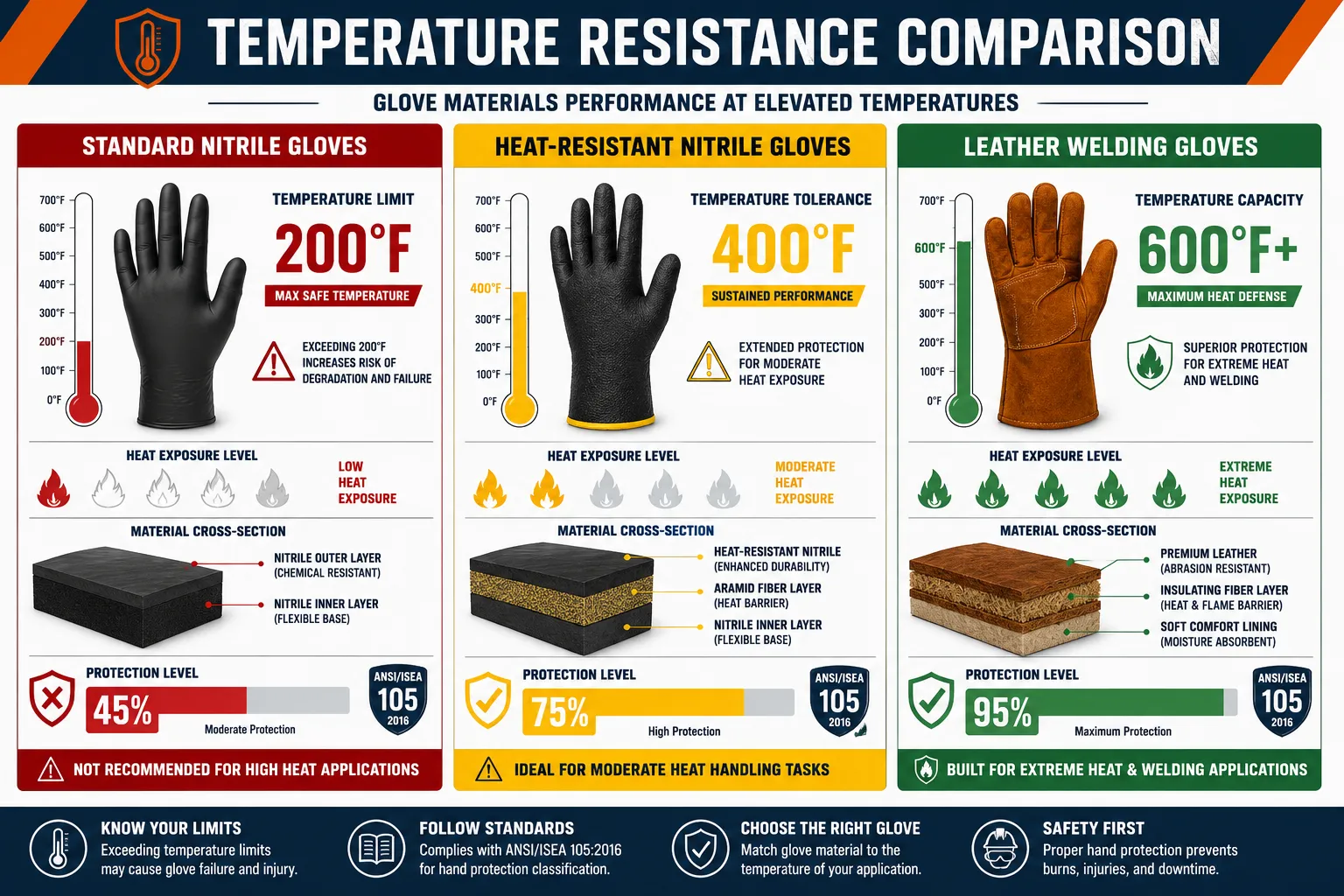
Standard disposable nitrile gloves withstand continuous temperatures up to 200-212°F before material degradation begins. At temperatures above 250°F, conventional nitrile rubber loses structural integrity, becomes brittle, and can melt or ignite. This limitation makes them unsuitable for direct welding contact but acceptable for handling metal that has cooled below these thresholds.
Heat-resistant nitrile gloves use modified formulations and thicker construction to extend temperature tolerance:
- Standard nitrile (4-6 mil): 200-212°F continuous, 250°F brief contact
- Industrial nitrile (8-10 mil): 250-300°F continuous, 350°F brief contact
- Heat-resistant nitrile (12-15 mil): 350-400°F continuous, 450°F brief contact
- Specialty high-temp nitrile: Up to 500°F for brief contact (rare and expensive)
Temperature ratings depend on exposure duration. Brief contact (under 15 seconds) allows higher temperatures than sustained contact. Manufacturers test gloves using ASTM F1060 standards for thermal resistance, though not all nitrile glove makers publish these specifications.
Common mistake: Assuming mil thickness alone determines heat resistance. While thicker gloves generally offer better protection, the nitrile formulation and any thermal coatings matter more. A 15-mil glove without heat-resistant treatment may perform worse than an 8-mil glove specifically engineered for thermal protection.
For context, freshly welded steel cools from welding temperature (2,500°F+) to 400°F in approximately 2-5 minutes depending on material thickness. This means heat-resistant nitrile gloves become safe for handling metal roughly 5-10 minutes after welding stops, while standard nitrile requires 10-15 minutes of cooling time.
When working with metals, understanding temperature thresholds prevents glove failure and potential burns.
Nitrile Gloves vs Leather Welding Gloves: Which Is Better?
Leather welding gloves are better for actual welding operations, while nitrile gloves excel at precision tasks in metal fabrication. Leather gloves withstand temperatures above 600°F, resist spark penetration, and provide the heavy-duty protection required for MIG, TIG, and stick welding. Nitrile gloves offer superior dexterity, chemical resistance, and grip on oily surfaces but cannot handle direct welding heat.
Leather Welding Gloves: Strengths and Limitations
Strengths:
- Temperature resistance: 600-1,000°F depending on leather type and thickness
- Spark and spatter protection: Thick leather prevents burn-through
- Durability: Withstands abrasion from rough metal edges
- Industry standard: Meets ANSI/ISEA 105 requirements for welding PPE
Limitations:
- Reduced dexterity: Thick leather makes precise movements difficult
- Poor chemical resistance: Absorbs oils, solvents, and coolants
- Maintenance required: Leather dries out and cracks without conditioning
- Cost: Quality welding gloves range from $20-60 per pair
Nitrile Gloves: Strengths and Limitations
Strengths:
- Excellent dexterity: Thin construction allows precise finger movements
- Chemical resistance: Protects against oils, solvents, and cutting fluids
- Grip performance: Textured surfaces grip oily metal better than leather
- Disposable convenience: No cleaning or maintenance required
- Cost-effective: $15-40 per box (50-100 gloves)
Limitations:
- Low heat resistance: Standard versions melt above 250°F
- Limited spark protection: Thin material can burn through
- Lower abrasion resistance: Tears more easily on sharp metal edges
- Not suitable for direct welding: Cannot withstand arc temperatures
The Hybrid Approach
Most efficient fabrication shops use both glove types strategically. Welders keep leather gloves for active welding and switch to nitrile gloves for:
- Measuring and marking workpieces
- Applying cutting fluids or anti-spatter compounds
- Operating grinders and sanders (with appropriate heat-resistant nitrile)
- Cleaning and degreasing metal surfaces
- Quality inspection and dimensional checking
This approach maximizes both safety and productivity. Leather protects during high-heat operations, while nitrile enables precision work that would be clumsy in thick welding gloves.
Do Nitrile Gloves Protect Against Sparks and Metal Splatter?
Standard thin nitrile gloves do not provide adequate protection against welding sparks and metal splatter. Sparks from grinding and welding reach temperatures of 2,500°F or higher, easily burning through 4-6 mil nitrile material. Metal splatter from welding operations can penetrate thin nitrile and cause severe burns to the skin underneath.
However, thicker industrial-grade nitrile gloves (8-15 mil) with reinforced construction offer limited spark protection for specific tasks:
Tasks where thick nitrile provides adequate spark protection:
- Grinding operations where sparks are smaller and cooler than welding sparks
- Light metal cutting with angle grinders (brief, intermittent spark exposure)
- Handling recently welded metal after initial cooling (5-10 minutes post-weld)
- Using plasma cutters at safe distances where only occasional sparks contact gloves
Tasks where nitrile gloves fail to protect:
- Active MIG, TIG, or stick welding (direct arc exposure)
- Overhead welding where molten metal drips onto hands
- Heavy grinding that generates continuous spark streams
- Cutting operations that produce large, hot metal chips
The key factor is spark size and temperature. Small grinding sparks that have traveled several feet cool to 400-600°F and may not immediately penetrate 12-15 mil nitrile. Large welding sparks and molten metal droplets remain above 1,500°F and will burn through any nitrile glove instantly.
Edge case: Some fabricators wear thin nitrile gloves under leather welding gloves for added chemical protection and easier cleanup. This layering approach works only if the outer leather glove provides complete coverage and the nitrile glove never contacts heat directly.
For comprehensive information on glove thickness options, understanding mil ratings helps match protection to task requirements.
Best Nitrile Gloves for MIG Welding and Metal Work
The best nitrile gloves for MIG welding support tasks are heat-resistant, 8-15 mil thickness models with textured grips and cut-resistance ratings of ANSI A3 or higher. These gloves work for pre-weld prep, post-weld handling, and grinding operations but should never replace leather gloves during active welding.
Top-rated categories for metal fabrication:
Heavy-Duty Industrial Nitrile (8-12 mil)
- Best for: General metal handling, grinding, parts cleaning
- Temperature rating: 250-350°F brief contact
- Cut resistance: ANSI A2-A3
- Typical cost: $25-45 per box of 50
- Key features: Textured palms, extended cuffs, chemical resistance
Heat-Resistant Specialty Nitrile (12-15 mil)
- Best for: Handling warm metal, post-weld finishing, hot parts inspection
- Temperature rating: 350-450°F brief contact
- Cut resistance: ANSI A3-A4
- Typical cost: $50-90 per box of 50
- Key features: Thermal coatings, reinforced fingertips, high tensile strength
Chemical-Resistant Nitrile with Grip (6-8 mil)
- Best for: Applying cutting fluids, degreasing, precision assembly
- Temperature rating: 200-250°F brief contact
- Cut resistance: ANSI A1-A2
- Typical cost: $20-35 per box of 100
- Key features: Diamond grip patterns, solvent resistance, good dexterity
Selection criteria for MIG welding environments:
- Thickness: Minimum 8 mil for spark protection during grinding; 12+ mil for handling metal within 10 minutes of welding
- Cuff length: Extended cuffs (12+ inches) prevent sparks from entering glove opening
- Grip texture: Diamond or raised dot patterns maintain grip on oily metal stock
- Cut resistance: ANSI A3 rating minimum for handling sharp metal edges and burrs
- Chemical compatibility: Resistance to cutting oils, anti-spatter sprays, and degreasers
Real-world testing considerations: Fabrication shops should test gloves with actual workflow tasks. A glove that performs well in grinding operations may lack the dexterity needed for fitting tack welds. Many shops maintain two or three nitrile glove types for different tasks rather than seeking one universal solution.
Can Nitrile Gloves Melt from Welding Heat?
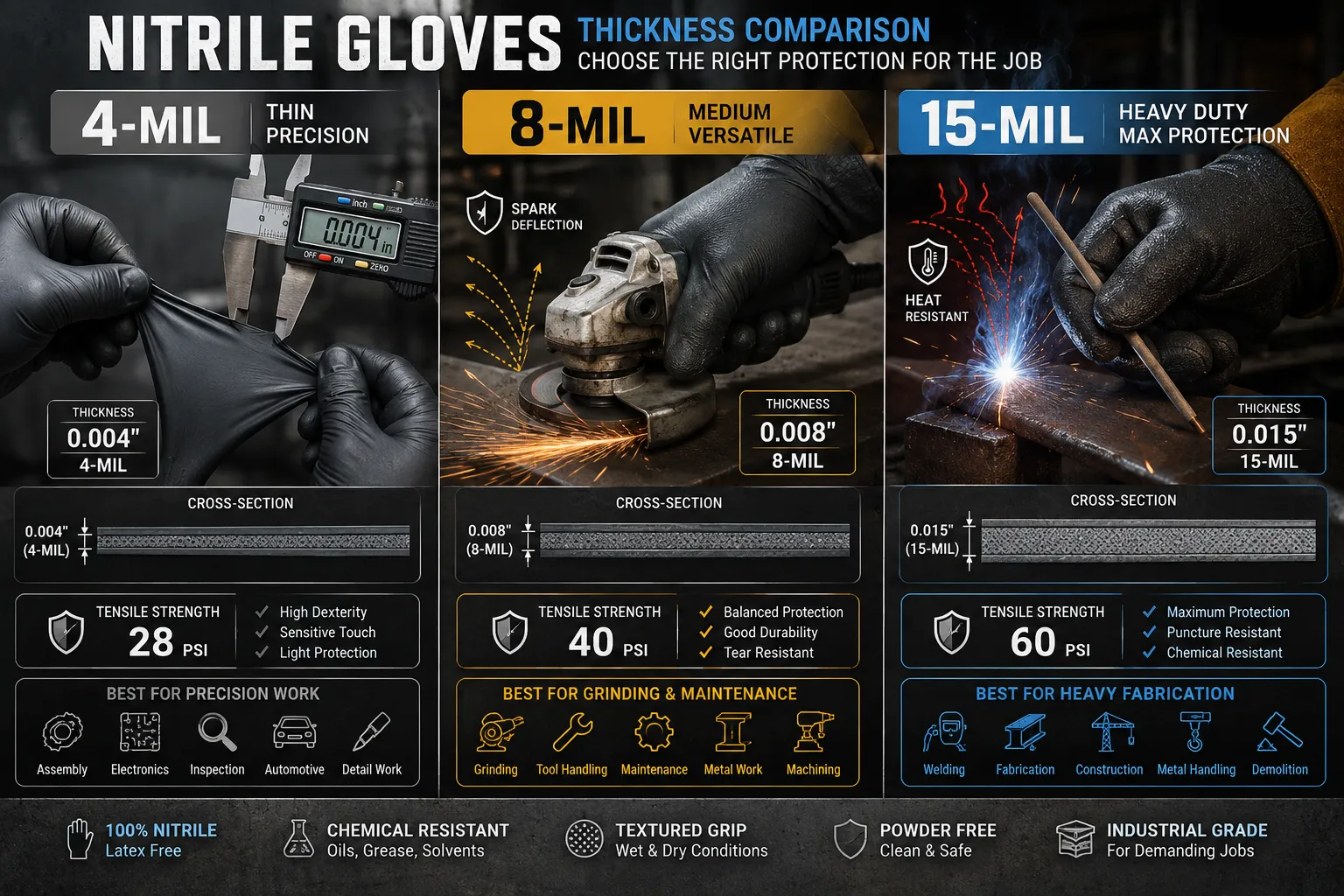
Yes, nitrile gloves will melt from welding heat. Standard nitrile gloves begin melting at temperatures around 250-300°F, while welding arcs generate temperatures exceeding 10,000°F and sparks reach 2,500°F. Direct contact with welding heat causes nitrile material to melt within 1-2 seconds, potentially causing the melted material to adhere to skin and worsen burn injuries.
The melting process creates additional hazards beyond simple heat exposure:
Hazards of melted nitrile:
- Melted rubber adheres to skin, making burns more severe
- Toxic fumes release when nitrile burns (nitrogen oxides, carbon monoxide)
- Melted material can drip onto other body parts, spreading injury
- Glove failure happens suddenly without warning, leaving hands unprotected
Temperature progression and glove failure:
- 200-250°F: Nitrile softens, loses elasticity, becomes sticky
- 250-300°F: Material begins melting, structural failure starts
- 300-400°F: Rapid melting, glove disintegrates
- 400°F+: Ignition possible, toxic smoke production
Even heat-resistant nitrile gloves rated for 400-500°F will eventually melt if exposed to sustained welding heat. The “heat-resistant” designation means the gloves can handle brief contact with hot surfaces, not continuous exposure to welding temperatures.
Critical safety rule: Never use any nitrile glove as primary protection during active welding. The only acceptable use of nitrile gloves in welding environments is for tasks where hands remain at least 12 inches from the welding arc and no direct spark contact occurs.
When glove melting becomes an emergency: If a nitrile glove begins melting on your hand, immediately remove it and cool the affected area with room-temperature water for 10-15 minutes. Do not use ice, which can cause additional tissue damage. Seek medical attention for any burn that penetrates beyond the surface skin layer.
How Much Do Heat-Resistant Nitrile Gloves Cost?
Heat-resistant nitrile gloves for metal fabrication cost between $50-120 per box of 50 gloves, averaging $1.00-2.40 per pair. Standard industrial nitrile gloves without specialized heat resistance cost $25-45 per box of 50 ($0.50-0.90 per pair), while basic disposable nitrile gloves cost $15-30 per box of 100 ($0.15-0.30 per pair).
Price breakdown by category:
| Glove Type | Price per Box | Gloves per Box | Cost per Pair | Best Use Case |
|---|---|---|---|---|
| Standard disposable nitrile | $15-30 | 100 | $0.15-0.30 | Light assembly, inspection |
| Industrial nitrile (8-10 mil) | $25-45 | 50 | $0.50-0.90 | General metal handling, grinding |
| Heat-resistant nitrile (12-15 mil) | $50-90 | 50 | $1.00-1.80 | Post-weld handling, hot parts |
| Premium heat-resistant nitrile | $90-120 | 50 | $1.80-2.40 | Sustained heat exposure, specialty tasks |
| Leather welding gloves (comparison) | $20-60 | 1 pair | $20-60 | Active welding operations |
Cost factors that affect pricing:
- Thickness: Each additional mil of thickness adds approximately $5-10 per box
- Cut resistance rating: ANSI A4-A5 ratings cost 20-30% more than A2-A3
- Chemical resistance: Specialized formulations for solvents add $10-20 per box
- Brand reputation: Established safety brands charge 15-25% premium over generic options
- Certification: ANSI/ISEA certified gloves cost more than uncertified alternatives
Cost-effectiveness analysis for fabrication shops:
A typical metal fabrication shop using 10 pairs of gloves per day across all tasks might spend:
- All leather gloves: $200-600 per month (reduced dexterity, slower precision work)
- All standard nitrile: $45-90 per month (frequent burns, safety incidents, inadequate protection)
- Hybrid approach: $100-180 per month (leather for welding, heat-resistant nitrile for other tasks, optimal balance)
The hybrid approach costs more than standard nitrile alone but reduces injury rates and improves productivity on precision tasks. Most shops find the investment pays for itself through fewer worker compensation claims and faster completion of detailed work.
Bulk purchasing considerations: Boxes of 500-1,000 gloves typically offer 15-25% discounts compared to individual box pricing. However, nitrile gloves have a shelf life of 3-5 years when stored properly, so shops should balance bulk savings against storage capacity and usage rates.
What Are the Top-Rated Nitrile Gloves for Fabrication Shops?
Top-rated nitrile gloves for fabrication shops combine 8-15 mil thickness, ANSI A3 or higher cut resistance, textured grips, and temperature ratings of 350°F or above. Based on real-world testing in metalworking environments, gloves meeting these specifications consistently receive high marks for durability, protection, and usability.
Key performance criteria for fabrication environments:
Tensile strength: Minimum 1,500 PSI (pounds per square inch) prevents tearing when pulling on sharp metal edges. Premium gloves exceed 2,000 PSI.
Puncture resistance: ASTM F2878 testing measures resistance to sharp metal points. Fabrication gloves should withstand at least 20 Newtons of force.
Abrasion resistance: ANSI/ISEA 105 Level 3 or higher ensures gloves survive repeated contact with rough metal surfaces.
Grip performance: Coefficient of friction above 0.5 on oily surfaces maintains control of metal stock and tools.
Chemical compatibility: Resistance to common shop chemicals including cutting oils, degreasers, anti-spatter compounds, and solvents.
Features that distinguish top-rated models:
- Extended cuffs: 12-14 inch cuffs prevent sparks and debris from entering glove
- Reinforced fingertips: Double-layer construction in high-wear areas extends glove life
- Anatomical design: Pre-curved fingers reduce hand fatigue during extended use
- Textured palms: Diamond or micro-dot patterns maintain grip without excess bulk
- Color coding: Different colors for different thickness levels prevent mix-ups
Selection based on specific fabrication tasks:
For precision fitting and tack welding prep: 6-8 mil gloves with excellent dexterity, ANSI A2 cut resistance, textured fingertips for small part handling.
For grinding and deburring: 10-12 mil gloves with ANSI A3-A4 cut resistance, full-palm texturing, reinforced thumb and index finger.
For handling recently welded parts: 12-15 mil heat-resistant gloves rated for 400°F+, extended cuffs, high tensile strength (2,000+ PSI).
For general metal stock handling: 8-10 mil industrial gloves with balanced protection and dexterity, ANSI A3 cut resistance, chemical resistance for oils.
Testing protocol for new gloves: Before committing to bulk purchases, fabrication shops should test candidate gloves across all typical tasks. Evaluate comfort after 2-4 hours of continuous wear, check for tears or degradation after one full shift, and gather feedback from multiple workers with different hand sizes.
Understanding the best thickness for different applications helps match glove specifications to actual shop requirements.
Are Nitrile Gloves Safe for TIG Welding or Too Dangerous?
Nitrile gloves are too dangerous for TIG welding operations and should never be worn during active TIG welding. TIG welding requires sustained hand proximity to the arc (often 2-4 inches), generates continuous heat above 10,000°F, and produces ultraviolet radiation that degrades nitrile material. The combination of extreme heat, UV exposure, and close hand positioning makes nitrile gloves completely unsuitable for TIG welding.
Why TIG welding is especially hazardous for nitrile gloves:
- Sustained heat exposure: Unlike MIG welding with intermittent trigger control, TIG welding maintains continuous arc heat
- Close hand proximity: TIG technique requires the filler hand to work within inches of the arc
- UV radiation: TIG arcs produce intense UV that breaks down nitrile molecular structure even without direct heat contact
- Precision requirements: TIG welding demands steady hand control; glove failure mid-weld creates serious safety and quality issues
- Tungsten contamination risk: Melted nitrile can contaminate the tungsten electrode, ruining weld quality
Acceptable nitrile glove use in TIG welding environments:
Nitrile gloves can safely be used for TIG-adjacent tasks when hands remain at least 18 inches from active arcs:
- Cleaning base metal with solvents before welding
- Applying backing gas or purge setups
- Handling filler rods and consumables
- Post-weld inspection after complete cooling (15+ minutes)
- Equipment setup and adjustment when torch is off
The only safe approach: Wear proper TIG welding gloves (thin, flexible leather or specialized TIG gloves) during all welding operations. Keep nitrile gloves in the work area for pre-weld and post-weld tasks, but establish a clear protocol that requires glove changes before striking an arc.
Common dangerous practice: Some welders wear thin nitrile gloves under TIG gloves for sweat absorption or added cleanliness. This practice is hazardous because if the outer leather glove develops any gap or wear point, the inner nitrile glove can melt against skin. If sweat management is needed, cotton glove liners designed for welding provide safer absorption without melt risk.
Common Mistakes When Using Nitrile Gloves for Metal Work
The most common mistake when using nitrile gloves for metal work is wearing standard thin disposable gloves for tasks requiring heat or cut resistance. This error leads to frequent glove failures, minor burns, and cuts that reduce productivity and increase injury risk. Other critical mistakes include using damaged gloves, selecting wrong thickness for the task, and failing to change gloves when switching between chemical and heat exposure tasks.
Top mistakes and how to avoid them:
Mistake 1: Using 4-6 mil disposable gloves for grinding or hot metal handling
These thin gloves tear easily on sharp edges and provide no meaningful heat protection. Solution: Use minimum 8 mil industrial nitrile for any task involving sharp metal or temperatures above 150°F.
Mistake 2: Continuing to use gloves with small tears or punctures
Even minor damage compromises protection and allows chemicals or heat to reach skin. Solution: Inspect gloves before each use and discard any with visible damage immediately.
Mistake 3: Wearing the same gloves for chemical application and heat exposure
Chemicals can degrade nitrile’s heat resistance, and heat exposure can reduce chemical resistance. Solution: Use separate glove types for chemical tasks and heat tasks, or change gloves between task types.
Mistake 4: Assuming all nitrile gloves offer equal cut protection
Cut resistance varies dramatically based on thickness and construction. Solution: Check ANSI/ISEA 105 cut resistance ratings and match to task requirements (A3+ for metal fabrication).
Mistake 5: Storing gloves in direct sunlight or near heat sources
UV exposure and heat degrade nitrile material even before use. Solution: Store gloves in cool, dark locations away from windows and heat-generating equipment.
Mistake 6: Wearing gloves that are too large or too small
Loose gloves reduce dexterity and can catch on machinery; tight gloves tear easily and cause hand fatigue. Solution: Stock multiple sizes and ensure proper fit for each worker.
Mistake 7: Using nitrile gloves for tasks requiring electrical insulation
Nitrile provides no electrical protection and can create false sense of safety. Solution: Use properly rated electrical gloves for any work on or near energized circuits.
Mistake 8: Failing to remove gloves when operating rotating machinery
Gloves can catch in drills, grinders, or lathes and pull hands into machinery. Solution: Remove gloves or use specialized machine-safe gloves when operating rotating equipment.
Mistake 9: Wearing gloves during welding because “they’re thick enough”
No nitrile glove is thick enough for welding heat. Solution: Always use leather welding gloves for active welding, reserve nitrile for pre- and post-weld tasks.
Mistake 10: Not training workers on proper glove selection
Workers often grab whatever gloves are available without considering task requirements. Solution: Implement color-coded glove systems and provide clear training on which glove types match which tasks.
For workers concerned about potential allergic reactions, understanding symptoms helps identify issues early.
When Should You Not Use Nitrile Gloves for Welding?
Never use nitrile gloves during active welding operations, when handling molten metal, during overhead welding, or within 12 inches of an active welding arc. Nitrile gloves also should not be used for electrical work, when operating rotating machinery, or for tasks requiring flame-resistant PPE as specified by OSHA or NFPA 70E standards.
Specific situations requiring alternative protection:
Active welding (MIG, TIG, stick, flux-core): Use leather welding gloves rated for the specific welding process. Nitrile cannot withstand arc temperatures or protect against molten metal spatter.
Overhead welding: Use leather welding gloves with extended cuffs and flame-resistant sleeves. Overhead positions create high risk of molten metal dripping onto hands and arms.
Plasma cutting: Use leather gloves rated for cutting operations. Plasma cutters generate extreme heat and large volumes of sparks that penetrate nitrile instantly.
Oxy-fuel cutting and welding: Use leather welding gloves. Oxy-fuel processes produce sustained high heat and large molten metal pools.
Electrical work on energized circuits: Use properly rated electrical gloves with leather protectors. Nitrile provides zero electrical insulation.
Operating lathes, drill presses, or mills: Remove gloves entirely or use specialized machine-safe gloves. Standard gloves can catch in rotating parts.
Tasks requiring NFPA 70E compliance: Use arc-rated PPE including leather gloves. Nitrile does not meet arc flash protection requirements.
Handling cryogenic materials: Use cryogenic gloves rated for extreme cold. Nitrile becomes brittle and cracks at cryogenic temperatures.
Working with strong oxidizers: Use chemical-resistant gloves specifically rated for oxidizers. Some chemicals can cause nitrile to ignite.
Decision framework for glove selection:
Ask these questions before choosing nitrile gloves for any metal work task:
- Will hands be within 12 inches of an active welding arc? (If yes, use leather)
- Will the task involve temperatures above 400°F? (If yes, use leather or specialty high-temp gloves)
- Does the task require electrical insulation? (If yes, use rated electrical gloves)
- Will gloves contact rotating machinery? (If yes, remove gloves or use machine-safe alternatives)
- Do workplace safety standards specify other glove types? (If yes, follow specifications)
If the answer to all questions is no, nitrile gloves may be appropriate based on specific heat, cut, and chemical resistance requirements.
Do Nitrile Gloves Work for Grinding and Cutting Metal?
Nitrile gloves work for grinding and cutting metal only when they meet minimum thickness (8 mil+) and cut resistance (ANSI A3+) requirements. Standard thin disposable nitrile gloves fail quickly when grinding or cutting due to inadequate abrasion resistance and spark protection. Industrial-grade nitrile gloves with reinforced construction provide adequate protection for most grinding tasks but still require caution around heavy spark generation.
Grinding operations where nitrile gloves provide adequate protection:
- Light surface grinding: Removing rust, paint, or light scale with angle grinders
- Deburring: Smoothing sharp edges on cut metal parts
- Sanding and finishing: Using flap discs or sanding attachments for surface prep
- Wire wheel brushing: Cleaning weld areas or removing light corrosion
- Cut-off wheel operations: Making cuts in thin sheet metal (under 1/4 inch)
Requirements for grinding with nitrile gloves:
- Minimum 8 mil thickness (10-12 mil preferred)
- ANSI A3 or higher cut resistance rating
- Textured grip for tool control
- Reinforced palm and fingertips
- Extended cuffs to prevent spark entry
Grinding operations requiring leather gloves instead:
- Heavy grinding generating continuous spark streams
- Grinding immediately after welding (metal still above 400°F)
- Overhead grinding where sparks fall directly onto hands
- Grinding operations lasting more than 30 minutes continuously
- Working with large angle grinders (7+ inch wheels)
Cutting operations and nitrile glove suitability:
Plasma cutting: Requires leather gloves due to extreme heat and large spark volume.
Oxy-fuel cutting: Requires leather gloves due to sustained high temperatures.
Band saw cutting: Nitrile gloves acceptable for handling material, but remove gloves when near moving blade.
Shear cutting: Nitrile gloves acceptable for material handling and finished part removal.
Abrasive saw cutting: Requires leather gloves due to high spark generation.
Safety protocol for grinding with nitrile gloves:
- Inspect gloves before use for any tears or thin spots
- Position body and hands to minimize direct spark contact
- Take breaks every 15-20 minutes to check gloves for damage
- Replace gloves immediately if any burn marks or holes appear
- Keep leather gloves nearby for tasks that prove too hot for nitrile
- Never grind with damaged nitrile gloves
Performance tip: Many fabricators find that using 10-12 mil nitrile gloves for grinding provides the best balance of protection and dexterity. Thicker 15 mil gloves offer more protection but reduce tool control, while thinner 6-8 mil gloves tear too quickly.
What Thickness Nitrile Gloves Do I Need for Welding Protection?
For welding-adjacent tasks in metal fabrication, you need minimum 8 mil nitrile gloves for basic protection, 10-12 mil for grinding and moderate heat exposure, and 12-15 mil for handling metal shortly after welding. Standard 4-6 mil disposable nitrile gloves provide insufficient protection for any welding environment task and should be reserved for inspection and light assembly work only.
Thickness guide for specific welding shop tasks:
4-6 mil (Standard Disposable)
- Suitable for: Final inspection, measuring, marking, light assembly
- Not suitable for: Any heat exposure, grinding, sharp metal handling
- Temperature limit: 200°F brief contact
- Cut resistance: ANSI A1-A2
- Cost: $0.15-0.30 per pair
6-8 mil (Light Industrial)
- Suitable for: Parts cleaning, applying chemicals, handling room-temperature metal
- Not suitable for: Grinding, hot metal, sustained sharp edge contact
- Temperature limit: 250°F brief contact
- Cut resistance: ANSI A2
- Cost: $0.40-0.60 per pair
8-10 mil (Medium Industrial)
- Suitable for: Light grinding, deburring, handling metal cooled 15+ minutes
- Not suitable for: Heavy grinding, metal above 300°F, direct spark exposure
- Temperature limit: 300°F brief contact
- Cut resistance: ANSI A2-A3
- Cost: $0.50-0.90 per pair
10-12 mil (Heavy Industrial)
- Suitable for: Grinding, cutting, handling metal cooled 10-15 minutes
- Not suitable for: Active welding, metal above 350°F, sustained heavy spark exposure
- Temperature limit: 350°F brief contact
- Cut resistance: ANSI A3-A4
- Cost: $0.80-1.40 per pair
12-15 mil (Heat-Resistant Specialty)
- Suitable for: Post-weld handling (5-10 minutes cooling), heavy grinding, hot parts inspection
- Not suitable for: Active welding, metal above 450°F
- Temperature limit: 400-450°F brief contact
- Cut resistance: ANSI A3-A5
- Cost: $1.00-2.40 per pair
How to determine required thickness for your shop:
- Identify hottest task: Measure or estimate the highest temperature your hands will contact
- Assess cut hazards: Evaluate sharpness and frequency of sharp edge contact
- Consider dexterity needs: Thicker gloves reduce precision for detailed work
- Test multiple thicknesses: Have workers try different options for each task type
- Monitor glove failure rates: Track how quickly gloves tear or burn through
Common thickness selection mistakes:
- Choosing thickest gloves for all tasks (reduces dexterity unnecessarily)
- Using same thickness for all workers (hand strength and technique vary)
- Selecting based on price alone (cheap thin gloves cost more through frequent replacement)
- Ignoring manufacturer specifications (mil rating alone doesn’t indicate heat or cut resistance)
Optimal shop inventory: Most fabrication shops stock three thickness levels: 6-8 mil for precision work, 10-12 mil for general grinding and handling, and 12-15 mil for hot metal tasks. This approach balances protection, dexterity, and cost across the full range of shop activities.
For detailed guidance on selecting appropriate glove thickness, understanding how mil ratings translate to real-world protection helps optimize safety and performance.
Alternatives to Nitrile Gloves for Welding and Fabrication
The primary alternatives to nitrile gloves for welding and fabrication are leather welding gloves, Kevlar-blend gloves, heat-resistant cotton gloves, and specialized high-temperature synthetic gloves. Each alternative offers distinct advantages for specific tasks, with leather remaining the industry standard for actual welding operations and other options filling specialized roles.
Leather Welding Gloves
Best for: All active welding operations (MIG, TIG, stick, flux-core)
Advantages:
- Temperature resistance: 600-1,000°F depending on leather type
- Excellent spark and spatter protection
- Durable against abrasion and punctures
- Industry standard with proven track record
- Available in various styles for different welding processes
Disadvantages:
- Poor dexterity for precision tasks
- Absorbs oils and chemicals
- Requires maintenance (conditioning to prevent cracking)
- Higher cost per pair ($20-60)
- Not disposable (requires cleaning)
Kevlar-Blend Gloves
Best for: Cut protection during metal handling, grinding with moderate heat
Advantages:
- Superior cut resistance (ANSI A4-A9 ratings possible)
- Better dexterity than leather
- Heat resistance: 400-500°F
- Excellent abrasion resistance
- Washable and reusable
Disadvantages:
- More expensive than nitrile ($30-80 per pair)
- Can be bulky depending on construction
- Not suitable for direct welding contact
- May absorb chemicals depending on coating
Heat-Resistant Cotton Gloves
Best for: Handling warm parts, light assembly, general shop work
Advantages:
- Comfortable for extended wear
- Good breathability reduces hand fatigue
- Inexpensive ($5-15 per pair)
- Washable and reusable
- No allergy concerns
Disadvantages:
- Limited heat resistance (250-300°F)
- Poor chemical resistance
- Lower cut protection than synthetic options
- Absorbs oils and liquids
- Not suitable for grinding or welding
High-Temperature Synthetic Gloves (Nomex, PBI, etc.)
Best for: Extreme heat applications, foundry work, specialized fabrication
Advantages:
- Exceptional heat resistance (500-1,000°F+)
- Flame resistant (won’t melt or ignite)
- Chemical resistant depending on formulation
- Durable and long-lasting
Disadvantages:
- Very expensive ($50-150+ per pair)
- Often bulky with reduced dexterity
- Overkill for most fabrication tasks
- Specialized sizing and fit requirements
Hybrid and Combination Approaches
Many fabrication shops use multiple glove types strategically:
- Leather for welding: Primary protection during all arc operations
- Nitrile for precision: Chemical resistance and dexterity for prep and finishing
- Kevlar for cutting: Superior cut protection when handling sharp stock
- Cotton for assembly: Comfort during extended non-hazardous tasks
Selection decision tree:
Choose leather welding gloves if: Task involves active welding, temperatures above 500°F, or sustained spark exposure.
Choose nitrile gloves if: Task requires chemical resistance, fine dexterity, or involves temperatures under 400°F with minimal spark exposure.
Choose Kevlar-blend gloves if: Primary hazard is cuts from sharp metal edges and moderate heat (under 500°F).
Choose cotton gloves if: Task involves warm but not hot parts (under 250°F) and no chemical exposure.
Choose high-temp synthetic gloves if: Task involves extreme heat (over 600°F) but requires more dexterity than leather provides.
Cost-effectiveness comparison for 100 hours of fabrication work:
- All leather: $40-120 (2-4 pairs, reduced productivity on precision tasks)
- All nitrile: $30-80 (30-80 pairs, safety incidents from inadequate protection)
- Hybrid approach: $60-140 (leather + nitrile + specialty, optimal safety and productivity)
The hybrid approach costs more in glove purchases but typically reduces total cost through fewer injuries, less rework from poor dexterity, and improved worker satisfaction.
For workers exploring alternatives to disposable gloves, understanding reusable options helps balance cost and environmental considerations.
Frequently Asked Questions
Can I wear nitrile gloves under leather welding gloves?
Wearing thin nitrile gloves under leather welding gloves is not recommended. If the leather glove develops any gap or wear point, the nitrile can melt against your skin and worsen burns. If you need sweat absorption, use cotton glove liners specifically designed for welding instead.
How long do heat-resistant nitrile gloves last in a fabrication shop?
Heat-resistant nitrile gloves typically last 2-4 hours of active use in fabrication environments before accumulating enough damage to require replacement. Lifespan depends on task intensity, with grinding and sharp metal handling causing faster wear than parts handling or inspection work.
Do nitrile gloves protect against UV radiation from welding?
No, nitrile gloves do not provide meaningful UV protection from welding arcs. UV radiation from welding can degrade nitrile material even without direct heat contact. Keep hands at least 18 inches from active arcs and use proper welding gloves for any work near the arc.
What ANSI standards apply to nitrile gloves for metal work?
ANSI/ISEA 105 covers cut and puncture resistance ratings (A1-A9 scale). ASTM F1060 covers thermal resistance testing. ASTM D6978 covers nitrile glove material specifications. Look for gloves meeting ANSI A3 or higher for metal fabrication work.
Can nitrile gloves catch fire from welding sparks?
Yes, nitrile gloves can ignite if exposed to sustained spark contact or temperatures above 400-450°F. While brief spark contact may only cause small burn marks, continuous exposure or large molten metal droplets can cause nitrile to catch fire and produce toxic fumes.
Are powder-free nitrile gloves better for welding shops?
Yes, powder-free nitrile gloves are better for welding and fabrication. Powder can contaminate weld surfaces, interfere with coatings, and create respiratory irritation when combined with welding fumes. Most modern nitrile gloves are powder-free by default.
How do I know if my nitrile gloves are heat-resistant?
Check the manufacturer specifications for temperature ratings. Heat-resistant nitrile gloves will explicitly state maximum temperature tolerance (typically 350-500°F). If no temperature rating is listed, assume the gloves are standard nitrile with 200-250°F limits.
Can I reuse nitrile gloves in a fabrication shop?
Nitrile gloves are designed as single-use disposable PPE. Reusing gloves compromises protection because damage may not be visible, and washing can degrade material properties. For cost savings, consider thicker reusable gloves like leather or Kevlar for appropriate tasks.
What color nitrile gloves are best for metal work?
Color doesn’t affect performance, but darker colors (black, blue, dark gray) hide oil and metal dust stains better than light colors. Some shops use color coding to differentiate glove thicknesses or designate gloves for specific tasks.
Do nitrile gloves work for aluminum welding?
Nitrile gloves work for aluminum welding prep tasks (cleaning, degreasing, fitting) but not for actual aluminum welding. Aluminum welding requires TIG process with sustained heat exposure, making leather gloves necessary. Use nitrile for pre-weld cleaning where chemical resistance matters.
How should I store nitrile gloves in a welding shop?
Store nitrile gloves in a cool, dry location away from direct sunlight, heat sources, and ozone-generating equipment. Keep boxes sealed until use to prevent contamination. Ideal storage temperature is 50-80°F with humidity below 80%.
Are there biodegradable nitrile gloves for fabrication work?
Some manufacturers offer biodegradable nitrile gloves, but they typically have lower heat and chemical resistance than standard nitrile. For fabrication work requiring 8+ mil thickness and heat resistance, biodegradable options are currently limited and more expensive.
Conclusion
Nitrile gloves serve important but limited roles in welding and metal fabrication environments. While they cannot replace leather gloves for active welding operations, heat-resistant nitrile gloves rated for 350-450°F provide valuable protection for grinding, metal handling, and precision tasks where leather gloves prove too bulky. The key to safe and effective use lies in understanding temperature limits, selecting appropriate thickness (8-15 mil for most fabrication tasks), and maintaining clear protocols about when to switch between glove types.
Successful fabrication shops implement a strategic approach: leather welding gloves for all active welding and high-heat operations, heat-resistant nitrile gloves for grinding and post-weld handling, and standard nitrile gloves for chemical application and precision work. This hybrid system maximizes both safety and productivity while controlling costs.
Action steps for implementing nitrile gloves in your fabrication workflow:
- Audit current tasks to identify which require heat resistance, cut protection, chemical resistance, or dexterity
- Stock three glove types: leather for welding, 10-12 mil nitrile for grinding and handling, 6-8 mil nitrile for precision work
- Train workers on proper glove selection using clear decision criteria (temperature, spark exposure, dexterity needs)
- Establish inspection protocols requiring workers to check gloves before each use and discard damaged gloves immediately
- Monitor glove failure rates and worker feedback to refine glove selection over time
- Review ANSI/ISEA 105 standards and ensure selected gloves meet minimum A3 cut resistance for metal work
By matching glove specifications to actual task requirements and maintaining strict safety protocols, fabrication shops can leverage the benefits of nitrile gloves while avoiding the serious hazards of misuse. The investment in proper glove selection and worker training pays dividends through reduced injuries, improved productivity, and better overall safety culture.
SEO Meta Title: Nitrile Gloves for Welding: Heat Resistance & Top Picks