Research and development teams across the glove manufacturing industry have achieved what once seemed contradictory: nitrile gloves that are simultaneously thinner and stronger than their predecessors. In 2026, powder-free nitrile gloves account for 56.6% of the global market, driven largely by innovations in thin-wall formulations that deliver 3 to 5 times better puncture resistance than latex while maintaining the tactile sensitivity demanded by laboratory technicians, pharmaceutical workers, and surgical teams. This breakthrough in Thinner Yet Stronger Nitrile Gloves: Advanced Manufacturing for Tactile Sensitivity and Protection represents a fundamental shift in how protective equipment balances safety with precision.
Key Takeaways
- Advanced thin-wall nitrile formulations now provide superior puncture resistance (3-5x better than latex) while reducing thickness from 6 mil to 3 mil
- Accelerator-free chemistry eliminates common skin sensitization risks without compromising protective properties
- Powder-free designs dominate the market at 56.6-72% share, offering contamination control essential for precision work
- Biodegradable nitrile options have reached 81% biodegradation in 491 days, addressing environmental concerns
- Medical and laboratory applications drive over 61% of market demand, with thin-yet-strong designs expanding surgical and diagnostic use
The Science Behind Thinner Yet Stronger Nitrile Gloves
Molecular Engineering for Enhanced Performance
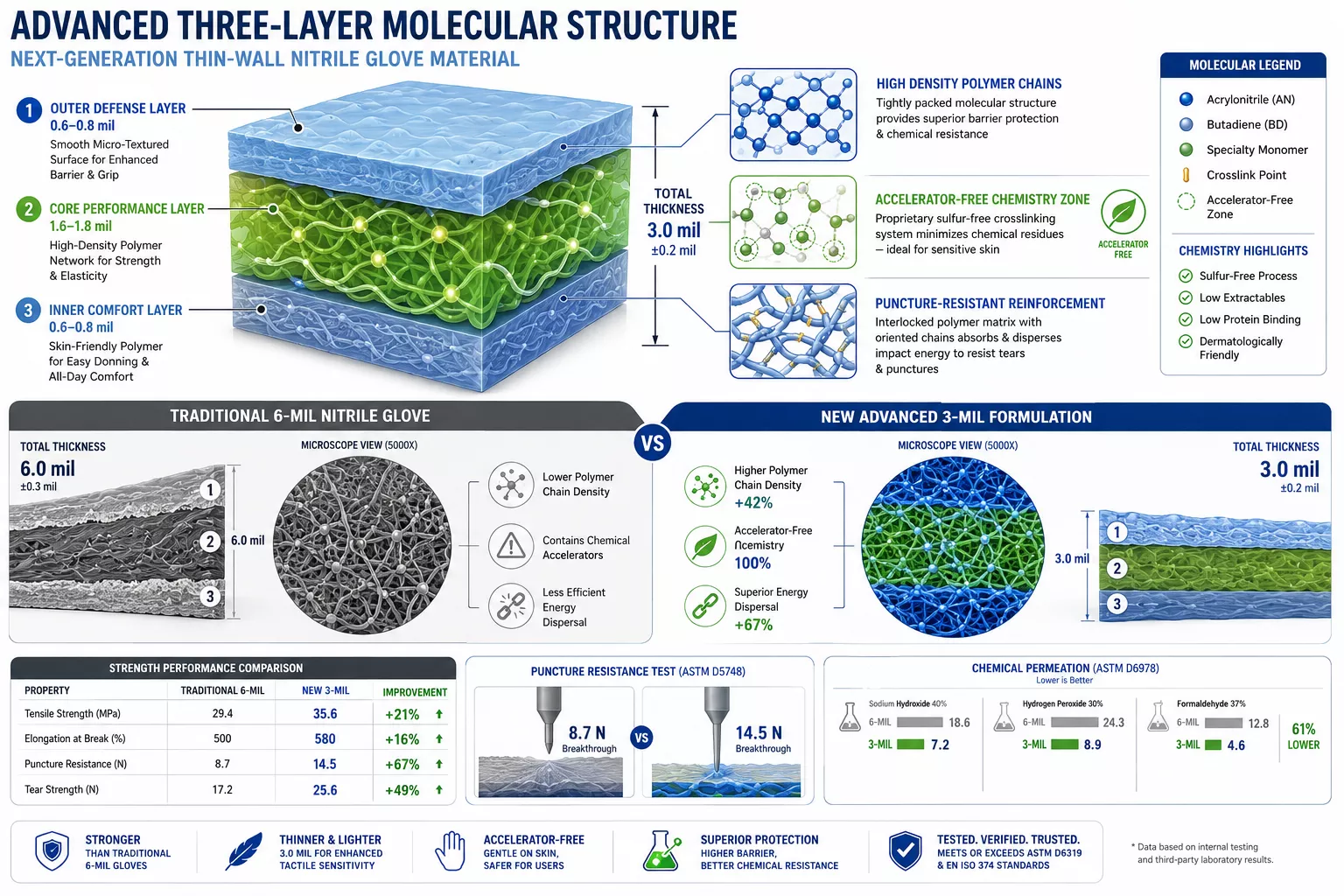
The breakthrough in Thinner Yet Stronger Nitrile Gloves: Advanced Manufacturing for Tactile Sensitivity and Protection stems from advances in polymer chemistry. Manufacturers have redesigned the molecular structure of nitrile butadiene rubber (NBR) to create denser cross-linking patterns that distribute stress more evenly across the glove material. This molecular architecture allows gloves as thin as 3 mil to withstand puncture forces that would tear traditional 6-mil designs.
Key manufacturing innovations include:
- Polymer chain optimization 🔬 – Enhanced cross-linking density without increasing thickness
- Multi-layer lamination – Strategic layering of different NBR formulations for targeted protection
- Controlled curing processes – Precision temperature and time management during vulcanization
- Nano-particle reinforcement – Microscopic additives that strengthen weak points in the polymer matrix
These technical improvements directly address the needs of professionals who require both protection and tactile sensitivity in their daily work.
Accelerator-Free Chemistry: Safety Without Compromise
One of the most significant recent developments in Thinner Yet Stronger Nitrile Gloves: Advanced Manufacturing for Tactile Sensitivity and Protection is the elimination of chemical accelerators. Traditional nitrile manufacturing relied on accelerators to speed the vulcanization process, but these compounds caused allergic reactions and skin sensitization in some users.
In March 2025, Top Glove launched ElastiCore accelerator-free nitrile examination gloves, followed by Wadi Surgicals’ Enliva accelerator-free line in May 2025. These products maintain the same protective characteristics as conventional nitrile while reducing dermatological risks—a critical advancement for healthcare workers who wear gloves for extended periods.
For professionals concerned about prolonged glove use, accelerator-free formulations represent a major step forward in occupational safety.
Manufacturing Advances Enabling Thin-Wall Technology
Precision Dipping and Forming Processes
Modern nitrile glove production employs computer-controlled dipping systems that achieve unprecedented uniformity in wall thickness. Traditional manufacturing created variations of ±0.5 mil across a single glove; current systems maintain tolerances within ±0.1 mil. This consistency ensures that thin-wall gloves don’t develop weak spots that could compromise protection.
Advanced manufacturing features:
| Technology | Benefit | Impact on Performance |
|---|---|---|
| Automated dipping robots | Uniform coating thickness | Eliminates thin spots and weak points |
| Real-time thickness monitoring | Quality control during production | Consistent tactile sensitivity across batches |
| Multi-stage curing chambers | Optimized polymer cross-linking | Enhanced puncture and tear resistance |
| Chlorination surface treatment | Reduced friction for easy donning | Maintains powder-free design benefits |
These manufacturing refinements allow producers to create gloves that meet the demanding requirements of laboratory work and pharmaceutical compounding, where both contamination control and manual dexterity are non-negotiable.
Quality Assurance and Testing Standards
Thinner gloves require more rigorous testing protocols to verify their protective capabilities. Manufacturers now conduct multiple quality checks:
- Pinhole testing – Every glove undergoes electrical or water leak detection
- Tensile strength measurement – Samples tested for elongation and break points
- Chemical permeation testing – Verification of resistance to specific substances
- Puncture resistance validation – Force-to-failure testing with standardized probes
These quality measures ensure that reduced thickness doesn’t translate to reduced protection—a concern particularly relevant for workers handling oils and chemicals.
Applications Driving Demand for Advanced Thin Nitrile Gloves
Laboratory and Research Settings

Laboratory technicians represent one of the largest user groups for Thinner Yet Stronger Nitrile Gloves: Advanced Manufacturing for Tactile Sensitivity and Protection. These professionals require the ability to manipulate micropipettes, handle delicate glassware, and feel subtle differences in texture—all while maintaining barrier protection against chemical exposure.
In May 2024, Kimberly-Clark Professional’s Kimtech Polaris Nitrile Exam Glove received the ACT Environmental Impact Factor Label from My Green Lab, highlighting how premium thin-wall gloves are now evaluated not just on performance but also on environmental transparency. This eco-labeling trend reflects the growing sophistication of laboratory procurement decisions.
The thin-wall formulations have proven particularly valuable in:
- Pharmaceutical compounding 💊 – Precise measurement and mixing of medications
- Diagnostic testing – Handling of specimens and reagents
- Research and development – Manipulation of sensitive materials
- Quality control inspection – Tactile examination of products
Medical and Surgical Applications
Medical-grade nitrile gloves account for over 61% of the market in 2026, with surgical and examination procedures driving substantial demand for thinner designs. Surgeons and interventional specialists benefit from the enhanced tactile feedback that allows them to feel anatomical structures and suture materials more precisely.
The durability advantages of nitrile over vinyl make thin-wall formulations particularly suitable for procedures requiring extended wear time without glove changes. This reliability reduces the risk of contamination from mid-procedure glove failures.
Industrial and Manufacturing Uses
Beyond healthcare and laboratory settings, thin-yet-strong nitrile gloves have found applications in precision manufacturing, electronics assembly, and quality inspection roles. Workers in these fields need protection from oils, solvents, and contaminants while maintaining the dexterity to handle small components and perform detailed assembly work.
For professionals working in industrial settings, the combination of chemical resistance and tactile sensitivity makes advanced nitrile formulations an increasingly attractive alternative to heavier-duty gloves that sacrifice dexterity for protection.
Environmental Considerations and Sustainability
Biodegradable Nitrile Technology
One of the most promising developments in Thinner Yet Stronger Nitrile Gloves: Advanced Manufacturing for Tactile Sensitivity and Protection is the emergence of biodegradable formulations. In December 2024, Sybron launched biodegradable nitrile single-use gloves that achieved 81% biodegradation in 491 days—a significant improvement over conventional nitrile, which can persist in landfills for decades.
While biodegradable nitrile remains a niche segment in 2026, the technology demonstrates that environmental responsibility and protective performance need not be mutually exclusive. For organizations seeking to reduce their environmental footprint, these innovations offer a path forward without compromising worker safety.
Those interested in broader sustainability questions can explore whether nitrile gloves can be recycled through specialized programs.
Reduced Material Consumption
The shift toward thinner glove designs inherently reduces material consumption per glove. A 3-mil glove uses approximately 50% less raw material than a 6-mil equivalent, translating to lower resource extraction, reduced manufacturing energy, and decreased shipping weight. When multiplied across billions of gloves produced annually, these savings become substantial.
Environmental benefits of thin-wall technology:
- ✅ Lower raw material requirements – Reduced petroleum-based polymer consumption
- ✅ Decreased manufacturing energy – Less material to heat and cure
- ✅ Reduced transportation emissions – Lighter products require less fuel to ship
- ✅ Smaller packaging footprint – More gloves per box reduces packaging waste
Market Growth and Industry Investment
The global nitrile gloves market demonstrates strong confidence in advanced formulations. Market projections estimate the sector will reach USD 10.29 billion in 2026 and grow to USD 32.22 billion by 2034, representing a compound annual growth rate of 15.34%. This growth reflects both expanding applications and the premium pricing that advanced thin-wall products command.
Manufacturing capacity investments underscore this optimism. In September 2024, American Nitrile purchased a 530,000-square-foot facility in Grove City for $21.5 million specifically to manufacture medical and research laboratory gloves—a clear signal that producers anticipate sustained demand for high-performance products.
Selecting the Right Thin Nitrile Gloves for Your Application
Thickness Considerations
While “thinner” has become a selling point, the optimal thickness depends on your specific application. Understanding what is the best thickness for nitrile gloves requires evaluating:
- Task duration – Longer procedures may benefit from slightly thicker designs
- Chemical exposure – Certain substances require minimum thickness for adequate protection
- Tactile requirements – More precise work demands thinner materials
- Puncture risk – High-risk environments may need reinforced formulations
Powder-Free vs. Powdered Options
Powder-free designs dominate the market at 56.6-72% share for good reason. The powder used in traditional gloves (typically cornstarch) can contaminate sensitive environments, cause respiratory issues, and interfere with wound healing. For precision applications where Thinner Yet Stronger Nitrile Gloves: Advanced Manufacturing for Tactile Sensitivity and Protection matter most, powder-free is the clear choice.
Certification and Compliance
Ensure your gloves meet relevant standards:
- ASTM D6319 – Standard specification for nitrile examination gloves
- FDA 21 CFR 177.2600 – Food contact approval for food service applications
- EN 374 – European standard for chemical protective gloves
- ISO 13485 – Medical device quality management certification
For specialized applications like food safety, verify that gloves carry appropriate food-contact certifications.
Conclusion
The evolution of Thinner Yet Stronger Nitrile Gloves: Advanced Manufacturing for Tactile Sensitivity and Protection represents a genuine technological achievement in personal protective equipment. Through advances in polymer chemistry, accelerator-free formulations, and precision manufacturing processes, today’s thin-wall nitrile gloves deliver superior puncture resistance, enhanced tactile sensitivity, and reduced allergenic potential compared to previous generations.
For professionals in healthcare, laboratory research, pharmaceutical compounding, and precision manufacturing, these innovations translate directly to improved job performance and worker safety. The ability to feel subtle textures and manipulate delicate instruments while maintaining robust barrier protection against chemicals and pathogens addresses a fundamental tension in protective equipment design.
Next Steps
To implement advanced thin nitrile gloves in your workplace:
- Assess your specific requirements – Document the chemicals, pathogens, and physical hazards your team encounters
- Request samples from multiple manufacturers – Test tactile sensitivity and comfort with your actual work tasks
- Verify certifications – Ensure gloves meet industry-specific standards for your application
- Calculate total cost of ownership – Factor in reduced material waste and potential productivity gains from improved dexterity
- Monitor performance metrics – Track puncture rates, user satisfaction, and task completion times after implementation
The market trajectory suggests that thin-yet-strong formulations will continue to improve, with accelerator-free chemistry, biodegradable options, and enhanced eco-labeling becoming standard features rather than premium add-ons. Organizations that adopt these advanced gloves now position themselves at the forefront of both worker protection and operational efficiency.
For those seeking to understand the broader landscape of nitrile glove applications, the thin-wall revolution demonstrates how material science innovations can fundamentally reshape an entire product category—delivering better performance through less material, and proving that in protective equipment, thinner truly can mean stronger.